service MITSUBISHI 3000GT 1991 Workshop Manual
[x] Cancel search | Manufacturer: MITSUBISHI, Model Year: 1991, Model line: 3000GT, Model: MITSUBISHI 3000GT 1991Pages: 1146, PDF Size: 76.68 MB
Page 113 of 1146

FUEL SYSTEM - SDecifications
L
Items
Actuators
Control relay type
Injector type and number
Injector identification mark
Variable induction control servo
Purge control solenoid valve
EGR control solenoid valve
Fuel pressure control solenoid valve
Waste gate solenoid valve
Fuel pressure regulator
Regulated pressure
kPa (psi)
Specifications
Contact switch type
Electromagnetic, 6
BDH210
BDL360
Electric motor
ON/OFF type solenoid valve
Duty cycle solenoid valve
ON/OFF type solenoid valve
Duty cycle type solenoid valve
335 (47.6)
300 (43.5)
SERVICE SPECIFICATIONS
i
ternsSpecifications
3asic ignition timing5” -t 2”BTDC at curb idle
3urb idle speedrpm700 * 100
dle speed when air conditioner is on
rpm
3asic idle speedrpm700 + 50
Throttle position sensor adjusting voltageV0.4- 1 .o
Throttle position sensor resistancek03.5 - 6.5
dle speed control servo (stepper motor) coil resistance028 - 33 [at 20°C (68”F)I
ntake air temperature sensor resistancekfi2.7 [at 20°C (68”F)I
Engine coolant temperature sensor resistancekQ
20°C (68°F)
2.4
80°C (176°F)0.3
%el pressurekPa (psi)
Vacuum hose disconnection
295 - 315 (43 - 45) at curb idle
Vacuum hose connection
Sz
2 - 3 [at 20°C (68”F)I
SEALANTMlXE-A
IItems1 Specified sealantI
/
L
Engine coolant temperature sensor threaded portion3M NUT Locking Part No. 4171 or equivalent
Fuel tank hole cover3M ATD Part No. 8509 or equivalent
1 TSB Revision
Page 137 of 1146
SERVICE ADJUSTMENT PROCEDURES
MlBFHSU
BASIC IDLE SPEED ADJUSTMENT
NOTE(1) The basic idle speed has been factory-adjusted with the
speed adjusting screw (SAS) and does not normally require
adjustment.(2) If the adjustment is required, first check that the ignition
plug, injector,
ISC servo, and compression pressure are
normal.
(1) Before starting the inspection and adjustment procedures,set the vehicle in the following conditions:
l
Engine coolant temperature: 80 to 95°C (176 to 205°F)l Lights, electric cooling fan, accessories: OFF
lTransaxle: Neutral (P range on vehicles with automatic
transaxle)l Steering wheel: Straightforward position
(2) When using the multi-use tester, connect it to the diagnosis
connector.
NOTEThe connection of the multi-use tester grounds the
self-
diagnosis/data transmission selector terminal.
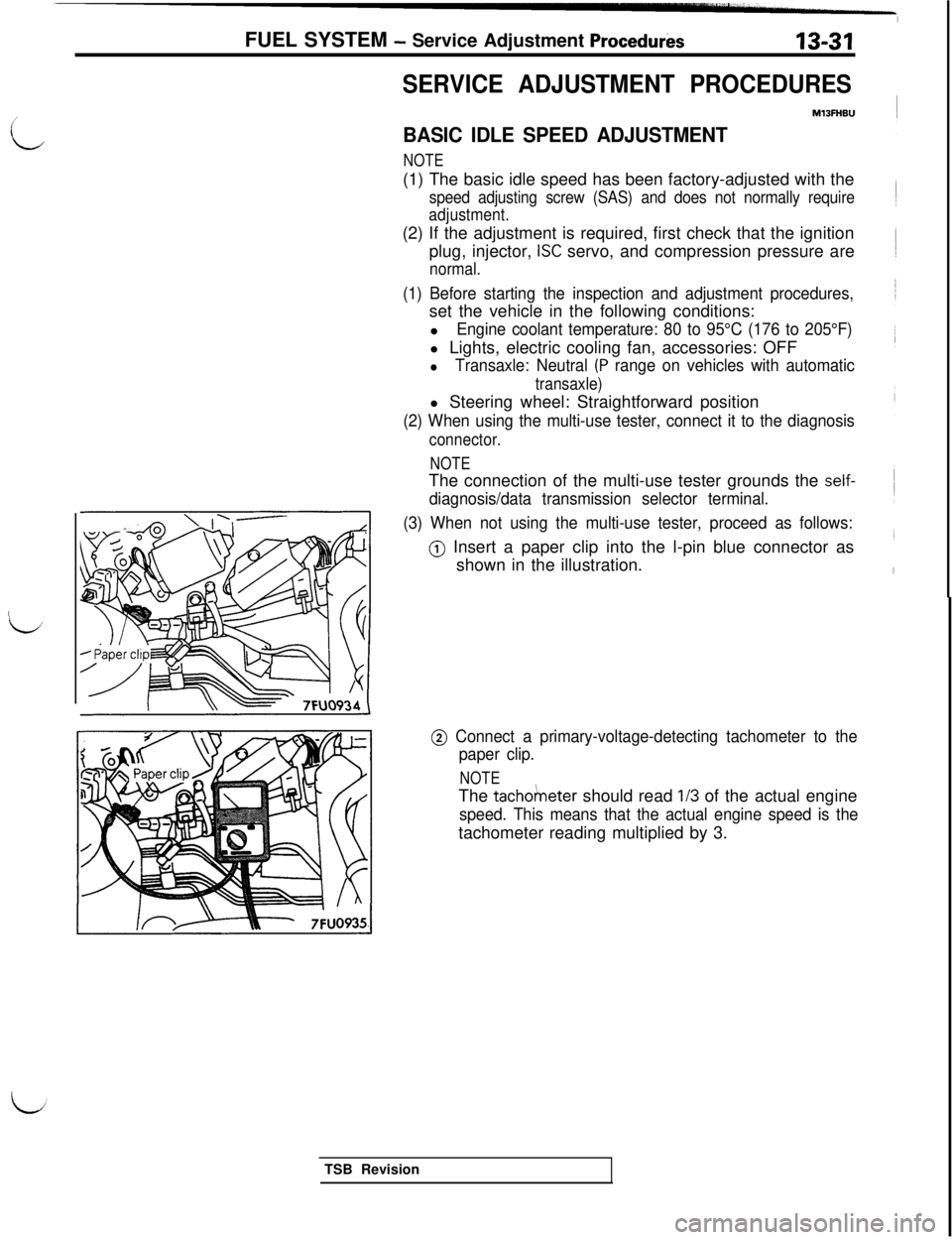
(3) When not using the multi-use tester, proceed as follows:
@) Insert a paper clip into the l-pin blue connector as
shown in the illustration. FUEL SYSTEM
- Service Adjustment Procedurks13-31
i
@ Connect a primary-voltage-detecting tachometer to the
paper clip.
NOTEThe
tacho/neter should read l/3 of the actual engine
speed. This means that the actual engine speed is thetachometer reading multiplied by 3.
TSB Revision
Page 138 of 1146
13-32FUEL SYSTEM - Service Adjustment Procedures
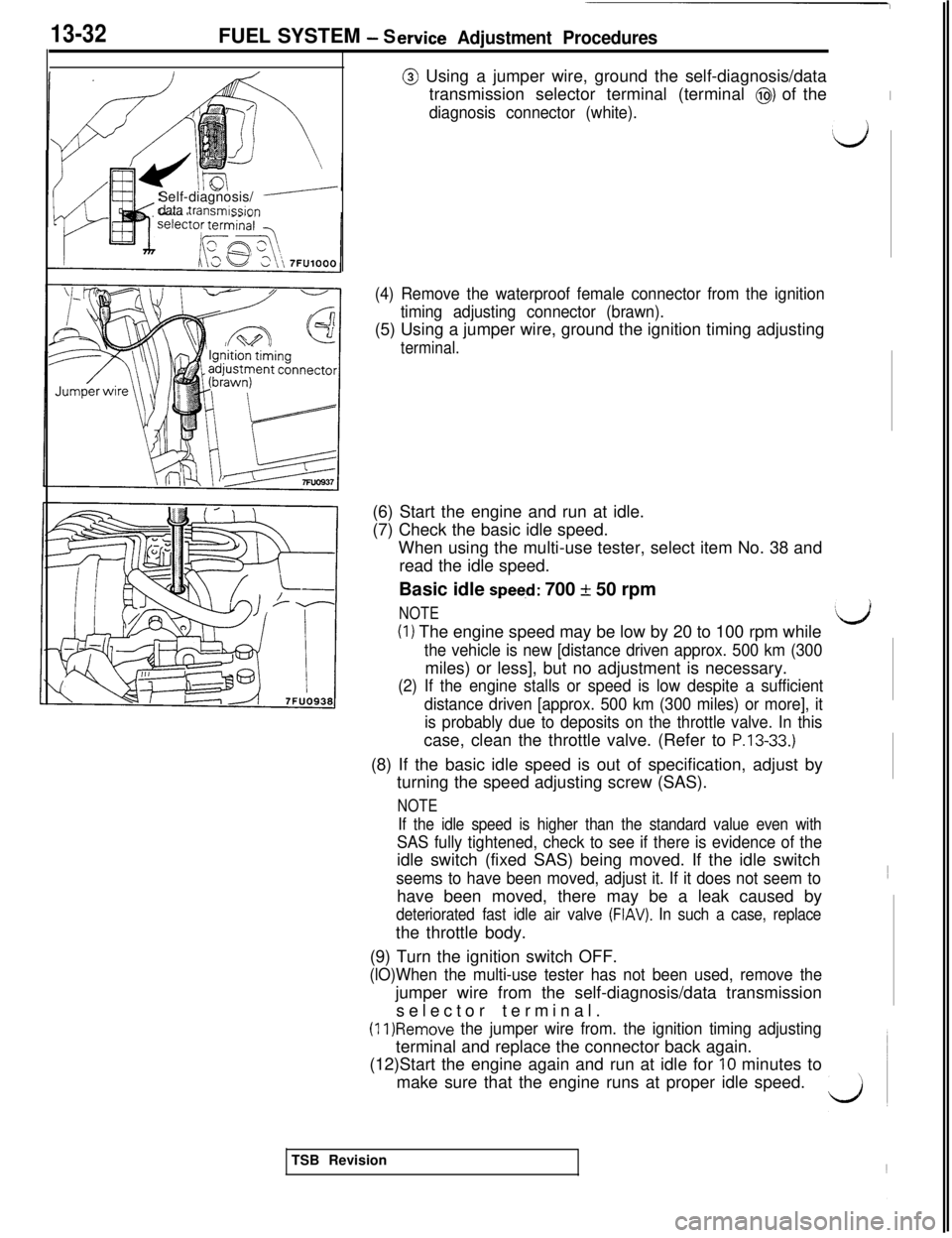
@ Using a jumper wire, ground the self-diagnosis/data
transmission selector terminal (terminal
@) of theI
diagnosis connector (white).
dSelf-diagnosis/
ydata transmission
(4) Remove the waterproof female connector from the ignition
timing adjusting connector (brawn).(5) Using a jumper wire, ground the ignition timing adjusting
terminal.(6) Start the engine and run at idle.
(7) Check the basic idle speed.
When using the multi-use tester, select item No. 38 and
read the idle speed.
Basic idle
speeci: 700 + 50 rpm
NOTE(I) The engine speed may be low by 20 to 100 rpm while
the vehicle is new [distance driven approx. 500 km (300miles) or less], but no adjustment is necessary.
(2) If the engine stalls or speed is low despite a sufficient
distance driven [approx. 500 km (300 miles) or more], it
is probably due to deposits on the throttle valve. In thiscase, clean the throttle valve. (Refer to
P.13-33.)(8) If the basic idle speed is out of specification, adjust by
turning the speed adjusting screw (SAS).
NOTE
If the idle speed is higher than the standard value even with
SAS fully tightened, check to see if there is evidence of theidle switch (fixed SAS) being moved. If the idle switch
seems to have been moved, adjust it. If it does not seem tohave been moved, there may be a leak caused by
deteriorated fast idle air valve (FIAV). In such a case, replacethe throttle body.
(9) Turn the ignition switch OFF.
(lO)When the multi-use tester has not been used, remove thejumper wire from the self-diagnosis/data transmission
selector terminal.
(11)Remove the jumper wire from. the ignition timing adjustingterminal and replace the connector back again.
(12)Start the engine again and run at idle for
10 minutes to
make sure that the engine runs at proper idle speed.
‘dTSB Revision
Page 139 of 1146
FUEL SYSTEM - Service Adjustment Procedures13-33THROTTLE BODY
(THROTrLE VALVE AREA)
CLEANINGM13FICS
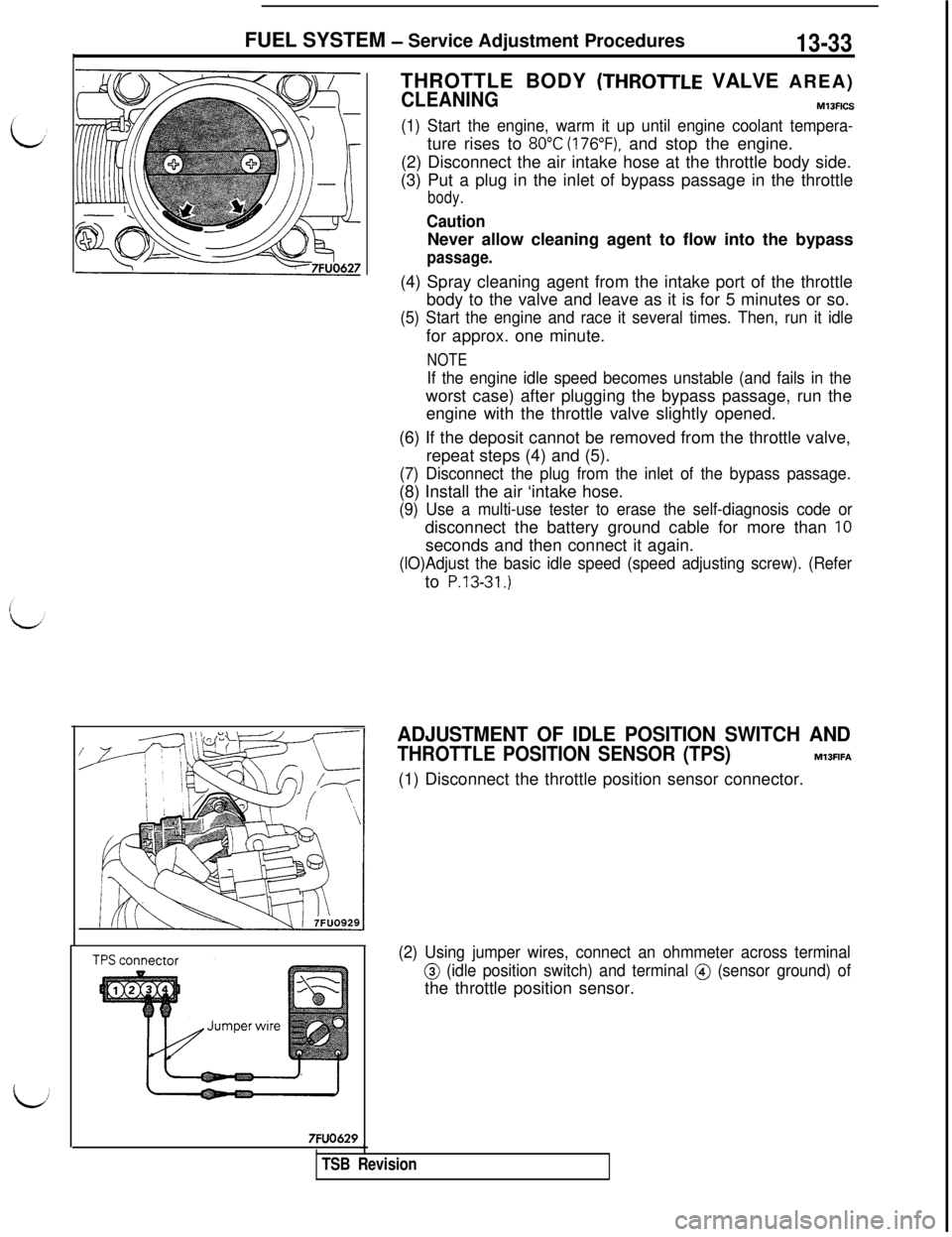
(1) Start the engine, warm it up until engine coolant tempera-ture rises to
80°C (176”F), and stop the engine.
(2) Disconnect the air intake hose at the throttle body side.
(3) Put a plug in the inlet of bypass passage in the throttle
body.
CautionNever allow cleaning agent to flow into the bypass
passage.(4) Spray cleaning agent from the intake port of the throttle
body to the valve and leave as it is for 5 minutes or so.
(5) Start the engine and race it several times. Then, run it idlefor approx. one minute.
NOTE
If the engine idle speed becomes unstable (and fails in theworst case) after plugging the bypass passage, run the
engine with the throttle valve slightly opened.
(6) If the deposit cannot be removed from the throttle valve,
repeat steps (4) and (5).
(7) Disconnect the plug from the inlet of the bypass passage.(8) Install the air ‘intake hose.
(9) Use a multi-use tester to erase the self-diagnosis code ordisconnect the battery ground cable for more than
IOseconds and then connect it again.
(lO)Adjust the basic idle speed (speed adjusting screw). (Referto
P.13-31.)
7FUO629
ADJUSTMENT OF IDLE POSITION SWITCH AND
THROTTLE POSITION SENSOR (TPS)M13FIFA(1) Disconnect the throttle position sensor connector.
(2) Using jumper wires, connect an ohmmeter across terminal
@ (idle position switch) and terminal @ (sensor ground) ofthe throttle position sensor.
TSB Revision
Page 140 of 1146
FUEL SYSTEM - Service Adjustment Procedures
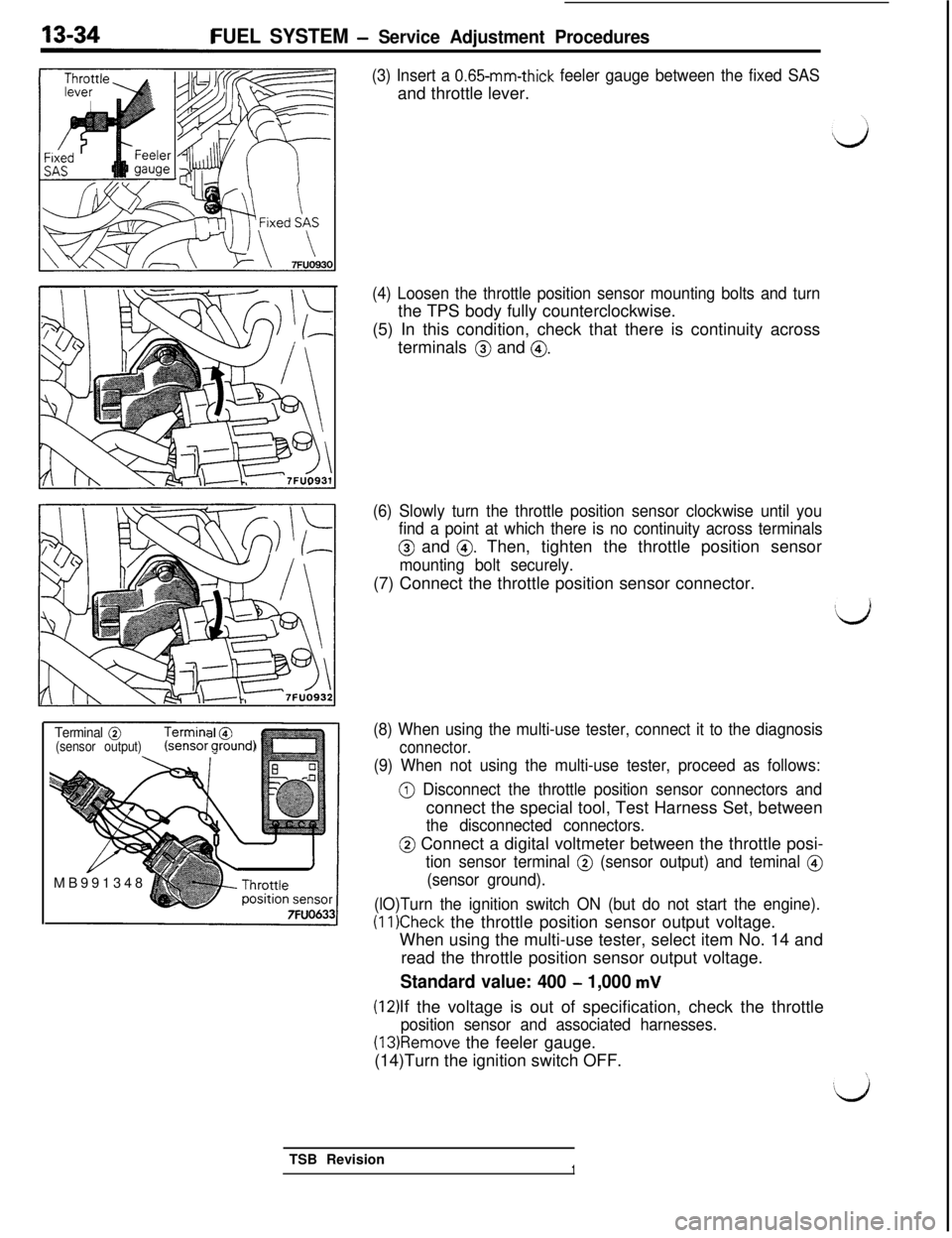
(3) Insert a 0.65-mm-thick feeler gauge between the fixed SASand throttle lever.
Terminal @
(sensor output)zensor g&nd)MB991348
1
(4) Loosen the throttle position sensor mounting bolts and turnthe TPS body fully counterclockwise.
(5) In this condition, check that there is continuity across
terminals
@ and @.
(6) Slowly turn the throttle position sensor clockwise until you
find a point at which there is no continuity across terminals
@ and 0. Then, tighten the throttle position sensor
mounting bolt securely.(7) Connect the throttle position sensor connector.
(8) When using the multi-use tester, connect it to the diagnosis
connector.
(9) When not using the multi-use tester, proceed as follows:
@ Disconnect the throttle position sensor connectors andconnect the special tool, Test Harness Set, between
the disconnected connectors.
@ Connect a digital voltmeter between the throttle posi-
tion sensor terminal @ (sensor output) and teminal @
(sensor ground).
(lO)Turn the ignition switch ON (but do not start the engine).
(IlKheck the throttle position sensor output voltage.
When using the multi-use tester, select item No. 14 and
read the throttle position sensor output voltage.
Standard value: 400 - 1,000 mV
(12)lf the voltage is out of specification, check the throttle
position sensor and associated harnesses.
(13)Remove the feeler gauge.
(14)Turn the ignition switch OFF.
TSB Revision
1
Page 141 of 1146
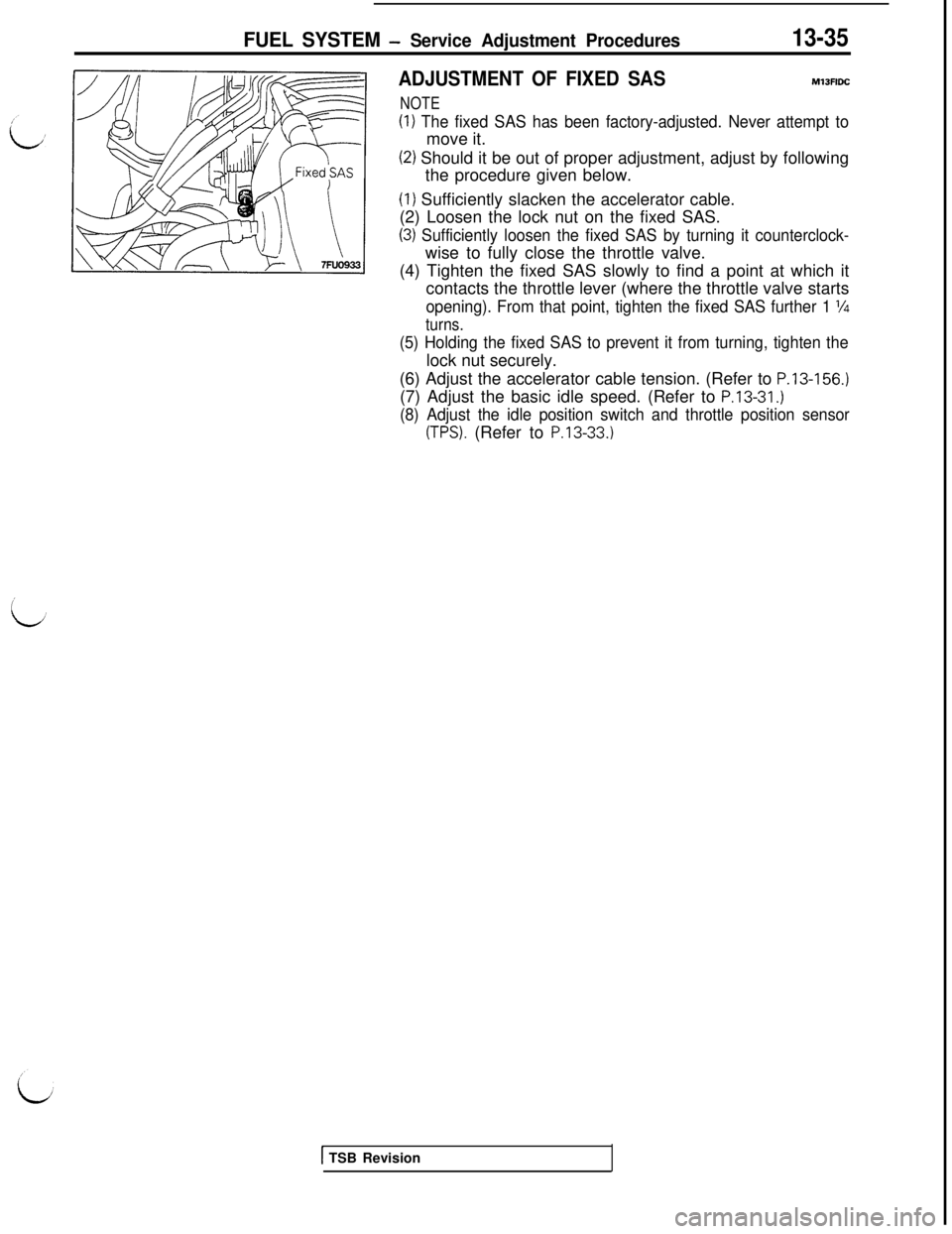
FUEL SYSTEM - Service Adjustment Procedures13-35
ADJUSTMENT OF FIXED SASMlJFlDC
NOTE
(1) The fixed SAS has been factory-adjusted. Never attempt tomove it.
(2) Should it be out of proper adjustment, adjust by following
the procedure given below.(I) Sufficiently slacken the accelerator cable.
(2) Loosen the lock nut on the fixed SAS.
(3) Sufficiently loosen the fixed SAS by turning it counterclock-wise to fully close the throttle valve.
(4) Tighten the fixed SAS slowly to find a point at which it
contacts the throttle lever (where the throttle valve starts
opening). From that point, tighten the fixed SAS further 1 l/4
turns.
(5) Holding the fixed SAS to prevent it from turning, tighten thelock nut securely.
(6) Adjust the accelerator cable tension. (Refer to
P.13-156.)(7) Adjust the basic idle speed. (Refer to
P.13-31.)
(8) Adjust the idle position switch and throttle position sensor
(TPS). (Refer to P.13-33.)
1 TSB Revision
Page 146 of 1146
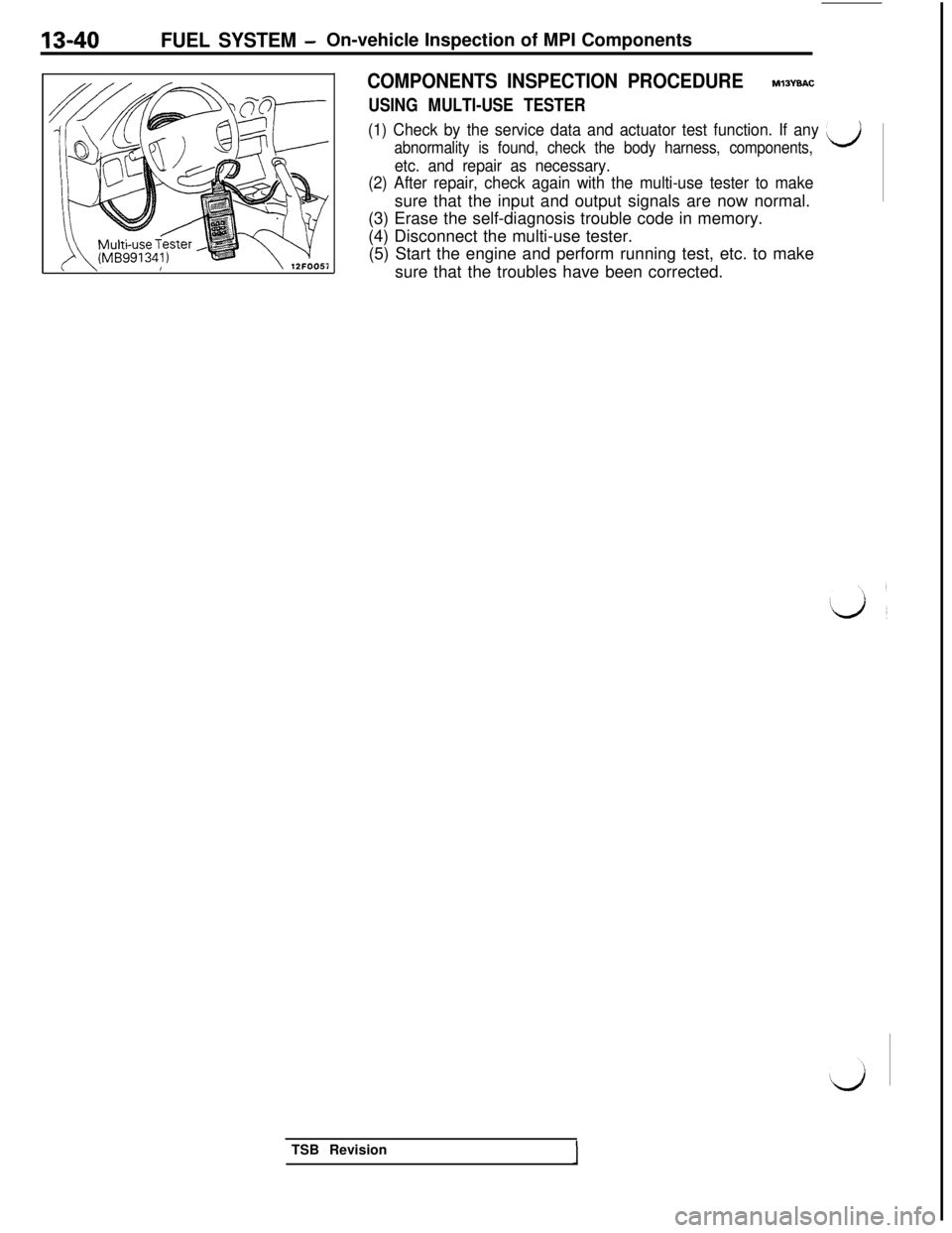
13-40FUEL SYSTEM -On-vehicle Inspection of MPI Components
COMPONENTS INSPECTION PROCEDUREM13YBAC
USING MULTI-USE TESTER
(1) Check by the service data and actuator test function. If any ij
abnormality is found, check the body harness, components,
etc. and repair as necessary.
(2) After repair, check again with the multi-use tester to makesure that the input and output signals are now normal.
(3) Erase the self-diagnosis trouble code in memory.
(4) Disconnect the multi-use tester.
(5) Start the engine and perform running test, etc. to make
sure that the troubles have been corrected.
TSB Revision
Page 187 of 1146
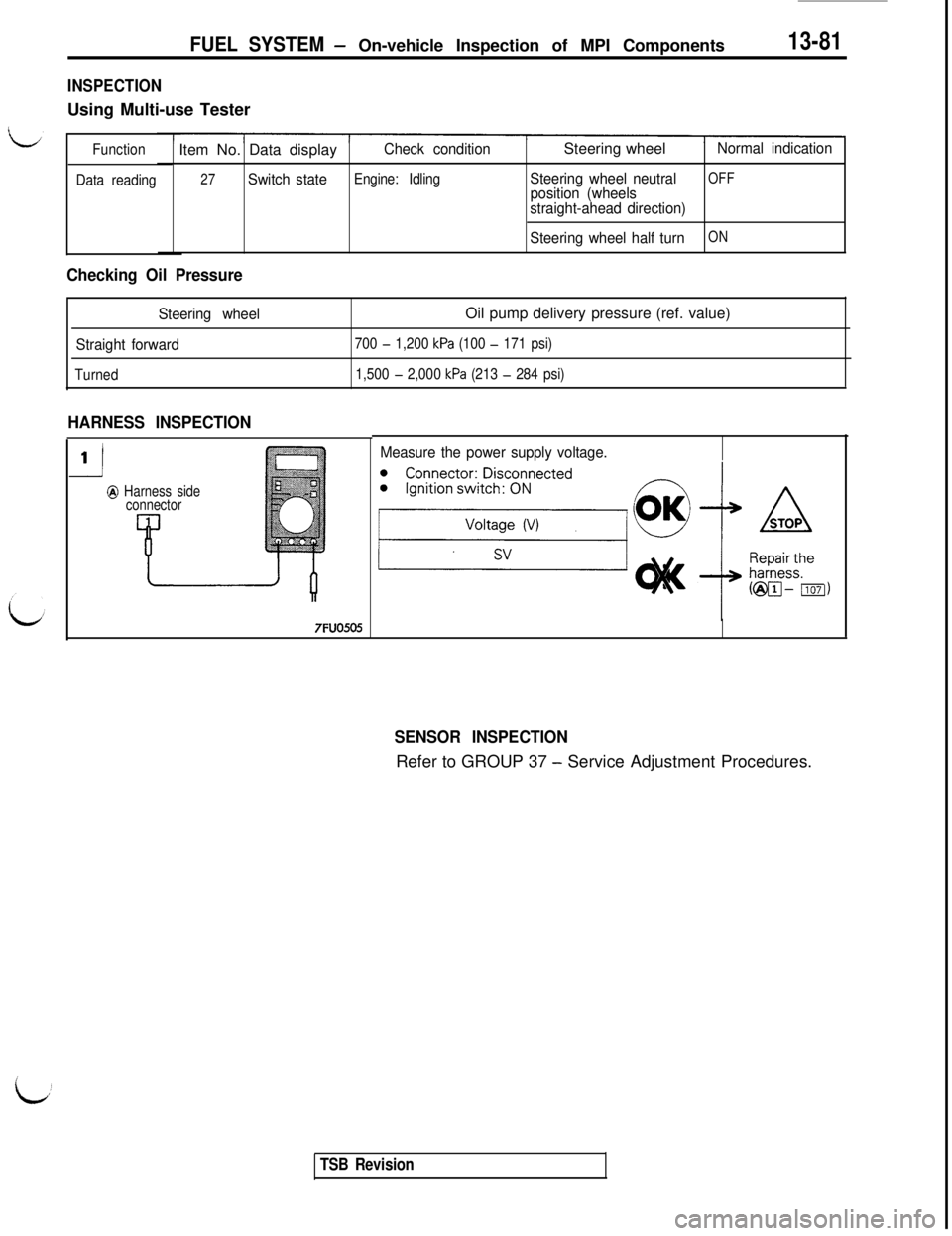
FUEL SYSTEM- On-vehicle Inspection of MPI Components13-81
INSPECTIONUsing Multi-use Tester
Function
Data readingItem No. Data displayCheck conditionSteering wheelNormal indication
27Switch stateEngine: IdlingSteering wheel neutralOFFposition (wheels
straight-ahead direction)
Steering wheel half turn
ON
Checking Oil Pressure
Steering wheelOil pump delivery pressure (ref. value)
Straight forward700 - 1,200 kPa (100 - 171 psi)
Turned1,500
- 2,000 kPa (213 - 284 psi)
HARNESS INSPECTION
i1
@ Harness side
connector
Measure the power supply voltage.
SENSOR INSPECTIONRefer to GROUP 37
- Service Adjustment Procedures.
TSB Revision
Page 189 of 1146
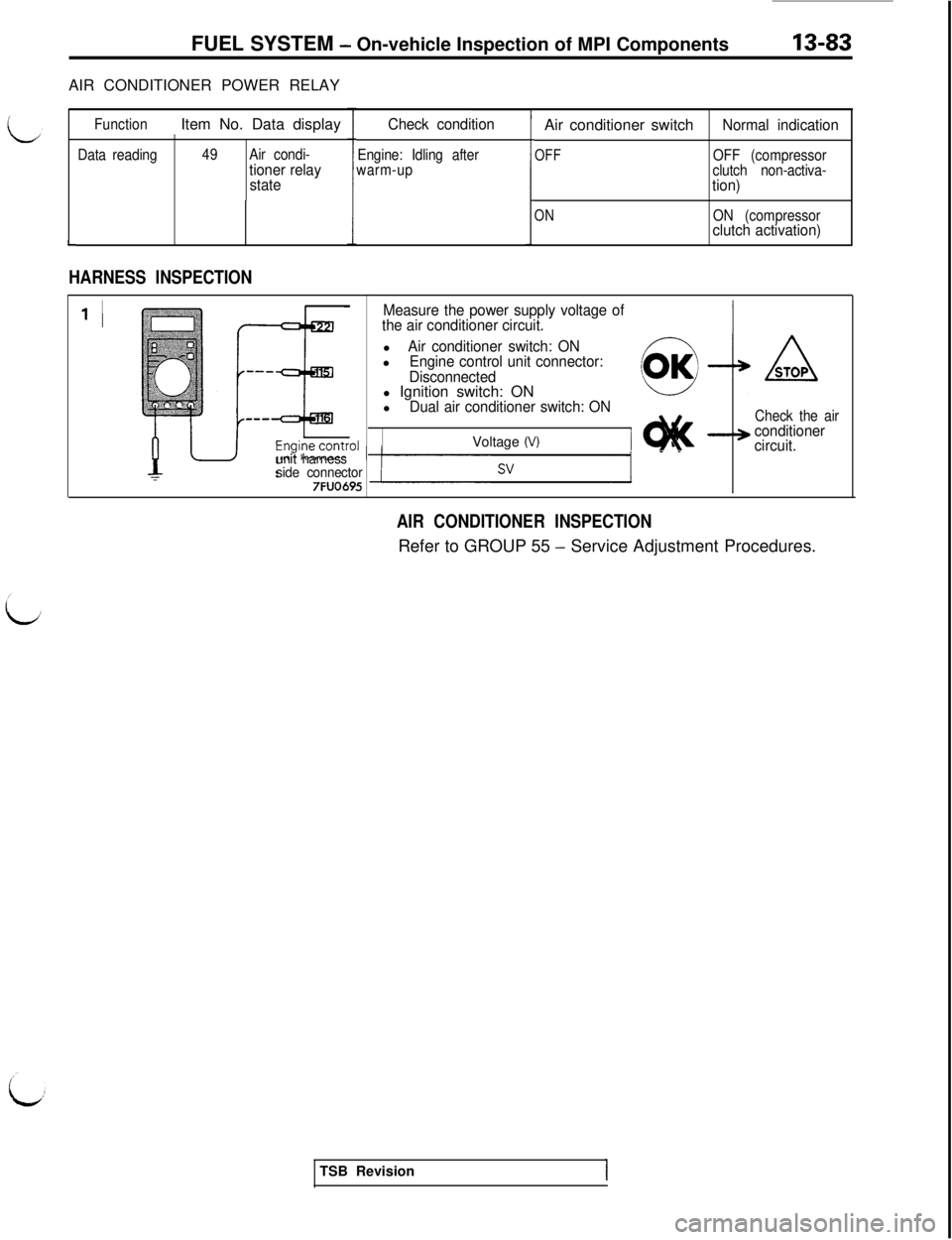
FUEL SYSTEM - On-vehicle Inspection of MPI Components
AIR CONDITIONER POWER RELAY
L
FunctionItem No. Data display
Data reading49Air condi-tioner relay
stateCheck conditionEngine: Idling after
warm-up
HARNESS INSPECTIONAir conditioner switch
Normal indication
OFFOFF (compressor
clutch non-activa-
tion)
ONON (compressorclutch activation)
’ I
unit harness
side connector
7FUO695
Measure the power supply voltage of
the air conditioner circuit.l
Air conditioner switch: ONlEngine control unit connector:
Disconnectedl Ignition switch: ON
l
Dual air conditioner switch: ONVoltage
(V)IM
ASTOP
Check the airconditioner
circuit.
AIR CONDITIONER INSPECTIONRefer to GROUP 55
- Service Adjustment Procedures.
TSB Revision
Page 247 of 1146
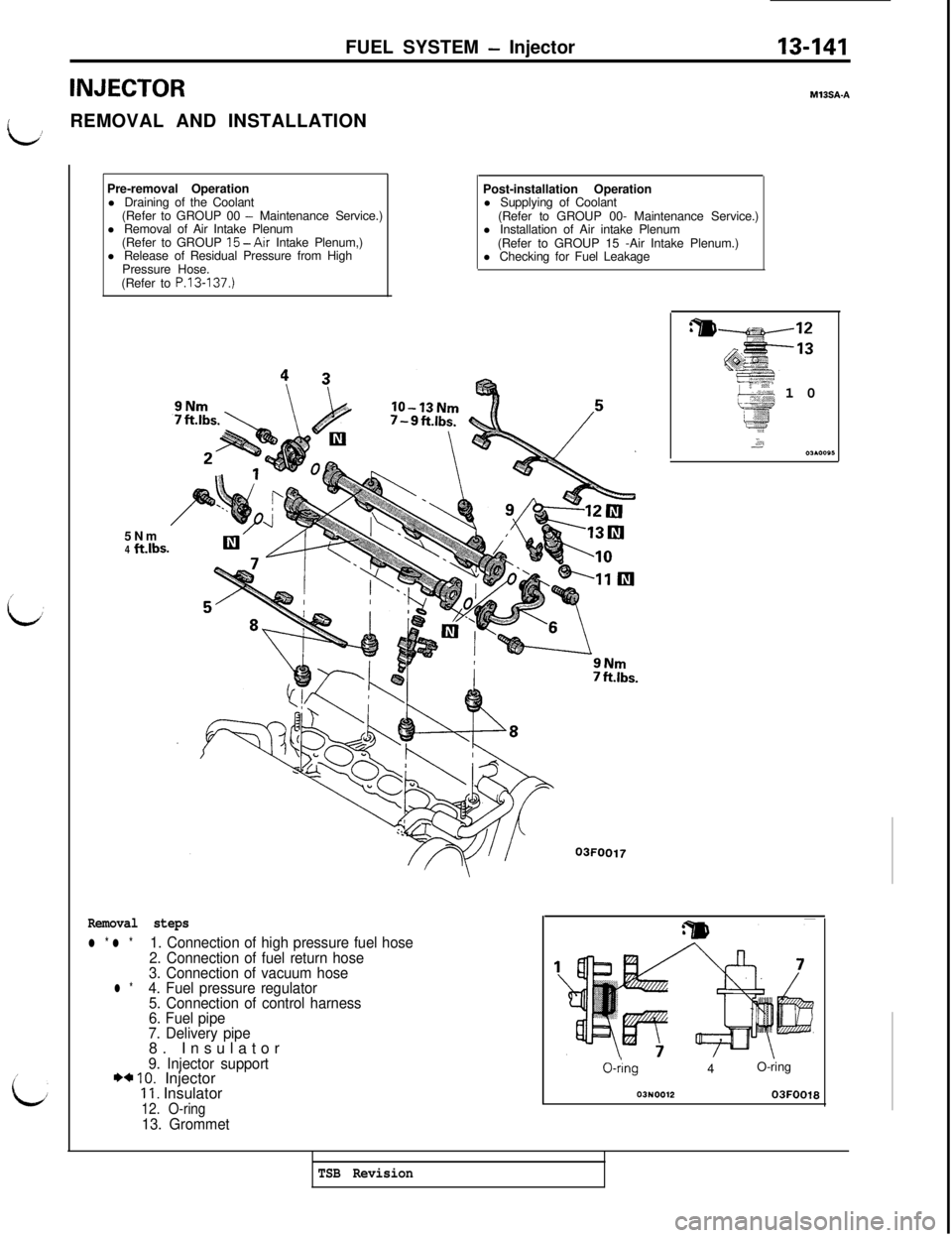
FUEL SYSTEM - Injector13-141
INJECTOR
LREMOVAL AND INSTALLATION
!
MlBSA-A
/
LPre-removal Operation
l Draining of the Coolant
(Refer to GROUP 00
- Maintenance Service.)
l Removal of Air Intake Plenum
(Refer to GROUP
15-Air Intake Plenum,)
l Release of Residual Pressure from High
Pressure Hose.
(Refer to P.13-137.)
5Nm
4
WbsPost-installation Operation
l Supplying of Coolant
(Refer to GROUP 00- Maintenance Service.)
l Installation of Air intake Plenum
(Refer to GROUP 15 -Air Intake Plenum.)
l Checking for Fuel Leakage
03FOO17
Removal steps
l * l *1. Connection of high pressure fuel hose
2. Connection of fuel return hose
3. Connection of vacuum hose
l *4. Fuel pressure regulator
5. Connection of control harness
6. Fuel pipe
7. Delivery pipe8. Insulator
9. Injector support*+ IO. Injector11. Insulator12. O-ring13. Grommet
:m
*:”
-aI : %~’.1X.-10p$
y&,*,,A200A0005
0-hng4O-ring
03N001203FOO18
TSB Revision