wiring MITSUBISHI 3000GT 1991 Workshop Manual
[x] Cancel search | Manufacturer: MITSUBISHI, Model Year: 1991, Model line: 3000GT, Model: MITSUBISHI 3000GT 1991Pages: 1146, PDF Size: 76.68 MB
Page 979 of 1146
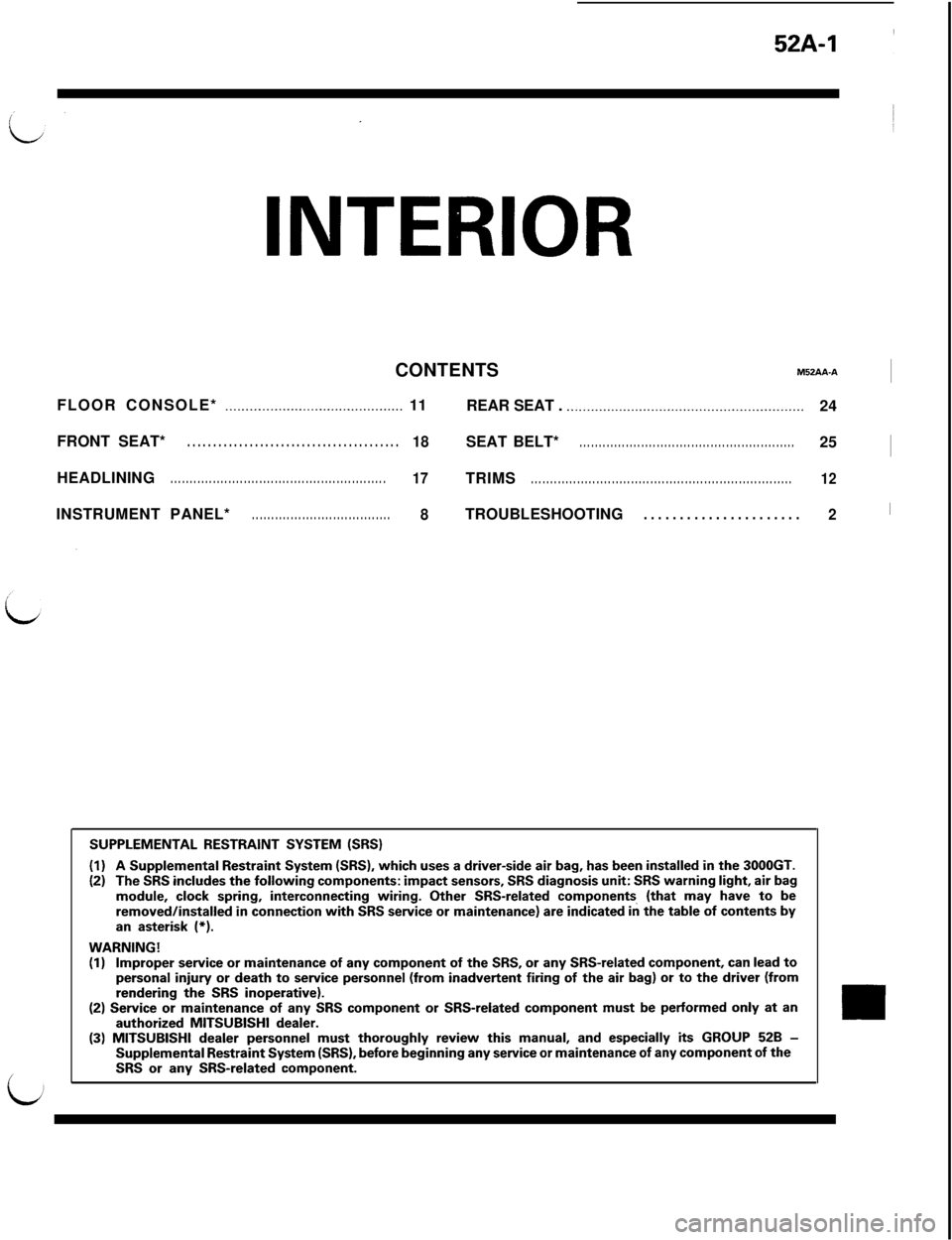
INTERIORCONTENTSNWAA-A~
FLOOR CONSOLE*
____....._.........__._..._......_..._...... 11
REAR SEAT . .._._____..______....____.._.._._..___.._._____.....___....24
FRONT SEAT*
. . . . . . . . . . . . . . . . . . . . . . . . . . . . . . . . . . . . . . . . .18SEAT BELT*. . . . . . . . . . . . . . . . . . . . . . . . . . . . . . . . . . . . . . . . . . . . . . . . . . . . . . . .25IHEADLINING
. . . . . . . . . . . . . . . . . . . . . . . . . . . . . . . . . . . . . . . . . . . . . . . . . . . . . . . .17TRIMS. . . . . . . . . . . . . . . . . . . . . . . . . . . . . . . . . . . . . . . . . . . . . . . . . . . . . . . . . . . . . . . . . . . .12INSTRUMENT PANEL*
. . . . . . . . . . . . . . . . . . . . . . . . . . . . . . . . . . . .8TROUBLESHOOTING. . . . . . . . . . . . . . . . . . . . . .
i
SUPPLEMENTAL RESTRAINT SYSTEM (SRS)
(1)A Supplemental Restraint System (SRS), which uses a driver-side air bag, has been installed in the 3000GT.(2)The SRS includes the following components: impact sensors, SRS diagnosis unit: SRS warning light, air bagmodule, clock spring, interconnecting wiring. Other SRS-related components, (that may have to beremoved/installed in connection with SRS service or maintenance) are indicated in the table of contents byan asterisk (*).
WARNING!(I)Improper service or maintenance of any component of the SRS, or any SRS-related component, can lead topersonal injury or death to service personnel (from inadvertent firing of the air bag) or to the driver (fromrendering the SRS inoperative).(2) Service or maintenance of any SRS component or SRS-related component must be performed only at anauthorized MITSUBISHI dealer.(3) MITSUBISHI dealer personnel must thoroughly review this manual, and especially its GROUP 52B -Supplemental Restraint System (SRS), before beginning any service or maintenance of any component of theSRS or any SRS-related component.
2I
Page 988 of 1146
52A-10
INTERIOR - Instrument Panel
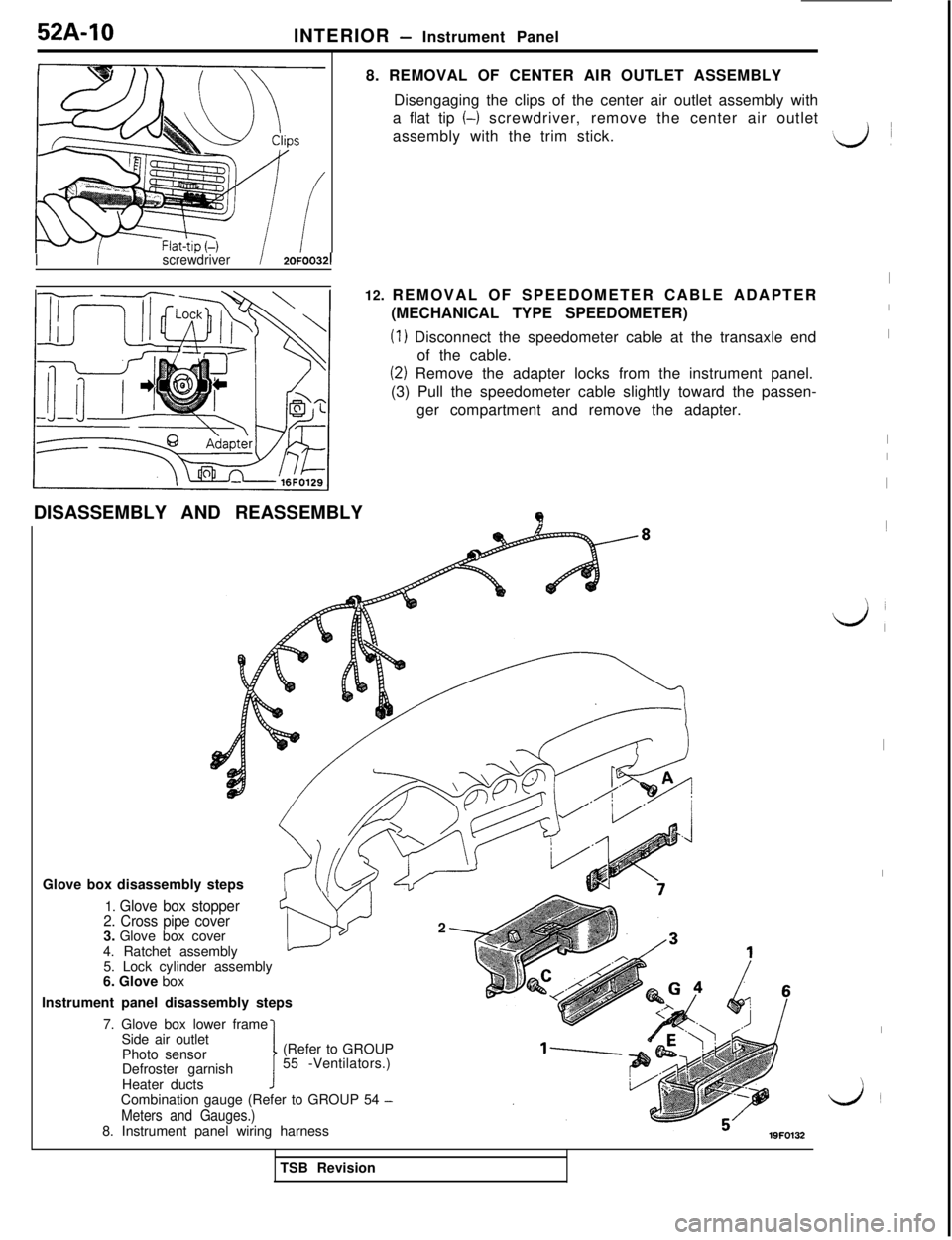
8. REMOVAL OF CENTER AIR OUTLET ASSEMBLY
Disengaging the clips of the center air outlet assembly with
a flat tip
(-1 screwdriver, remove the center air outlet
assembly with the trim stick.
IIscrewdriver/ 2OFOO321
12. REMOVAL OF SPEEDOMETER CABLE ADAPTER
(MECHANICAL TYPE SPEEDOMETER)
(1) Disconnect the speedometer cable at the transaxle end
of the cable.
(2) Remove the adapter locks from the instrument panel.
(3) Pull the speedometer cable slightly toward the passen-
ger compartment and remove the adapter.
DISASSEMBLY AND REASSEMBLY
QGlove box disassembly steps
1. Glove box stopper
2. Cross pipe cover3. Glove box cover
- w2
4. Ratchet assembly
5. Lock cylinder assembly
6. Glove box
Instrument panel disassembly steps
7. Glove box lower frame
Side air outlet
Photo sensor
Defroster garnish
Heater ducts1(Refer to GROUP
55 -Ventilators.)
Combination gauge (Refer to GROUP 54
-
Meters and Gauges.)8. Instrument panel wiring harness
19FO132
I
I
I
I
I
I1
d’
I
I
I
L&iTSB Revision
Page 1003 of 1146
INTERIOR - Seat Belt52A-25
Diagnosis connector”LJ’2OFOOl
GW161,338
With voltmeter___.-- -- ~~--~_. ___-- ..-.. .-.-
With multi-use tester
SEAT BELTM52UGEH
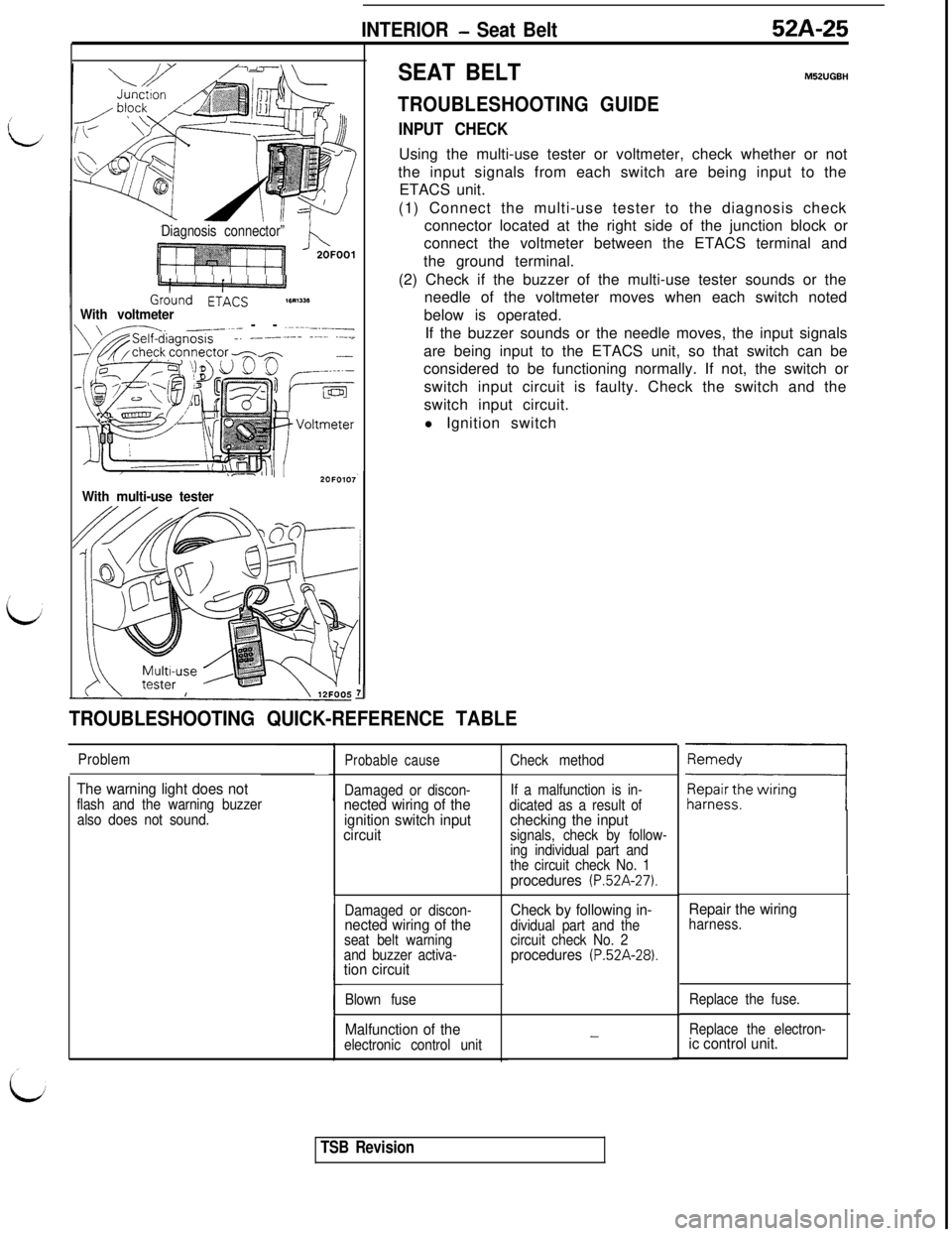
TROUBLESHOOTING GUIDE
INPUT CHECKUsing the multi-use tester or voltmeter, check whether or not
the input signals from each switch are being input to the
ETACS unit.
(1) Connect the multi-use tester to the diagnosis check
connector located at the right side of the junction block or
connect the voltmeter between the ETACS terminal and
the ground terminal.
(2) Check if the buzzer of the multi-use tester sounds or the
needle of the voltmeter moves when each switch noted
below is operated.
If the buzzer sounds or the needle moves, the input signals
are being input to the ETACS unit, so that switch can be
considered to be functioning normally. If not, the switch or
switch input circuit is faulty. Check the switch and the
switch input circuit.
l Ignition switch
II
TROUBLESHOOTING QUICK-REFERENCE TABLE
Problem
The warning light does notflash and the warning buzzer
also does not sound.
Probable cause
Damaged or discon-nected wiring of the
ignition switch input
circuit
Damaged or discon-nected wiring of theseat belt warning
and buzzer activa-
tion circuit
Blown fuse
Malfunction of theelectronic control unitCheck method
If a malfunction is in-
dicated as a result of
checking the inputsignals, check by follow-
ing individual part and
the circuit check No. 1
procedures (P.52A-27).
Check by following in-dividual part and the
circuit check No. 2
procedures (P.52A-28).
-
Repair the wiringharness.
Replace the fuse.
Replace the electron-
ic control unit.
TSB Revision
Page 1004 of 1146
52A-26
INTERIOR - Seat Belt
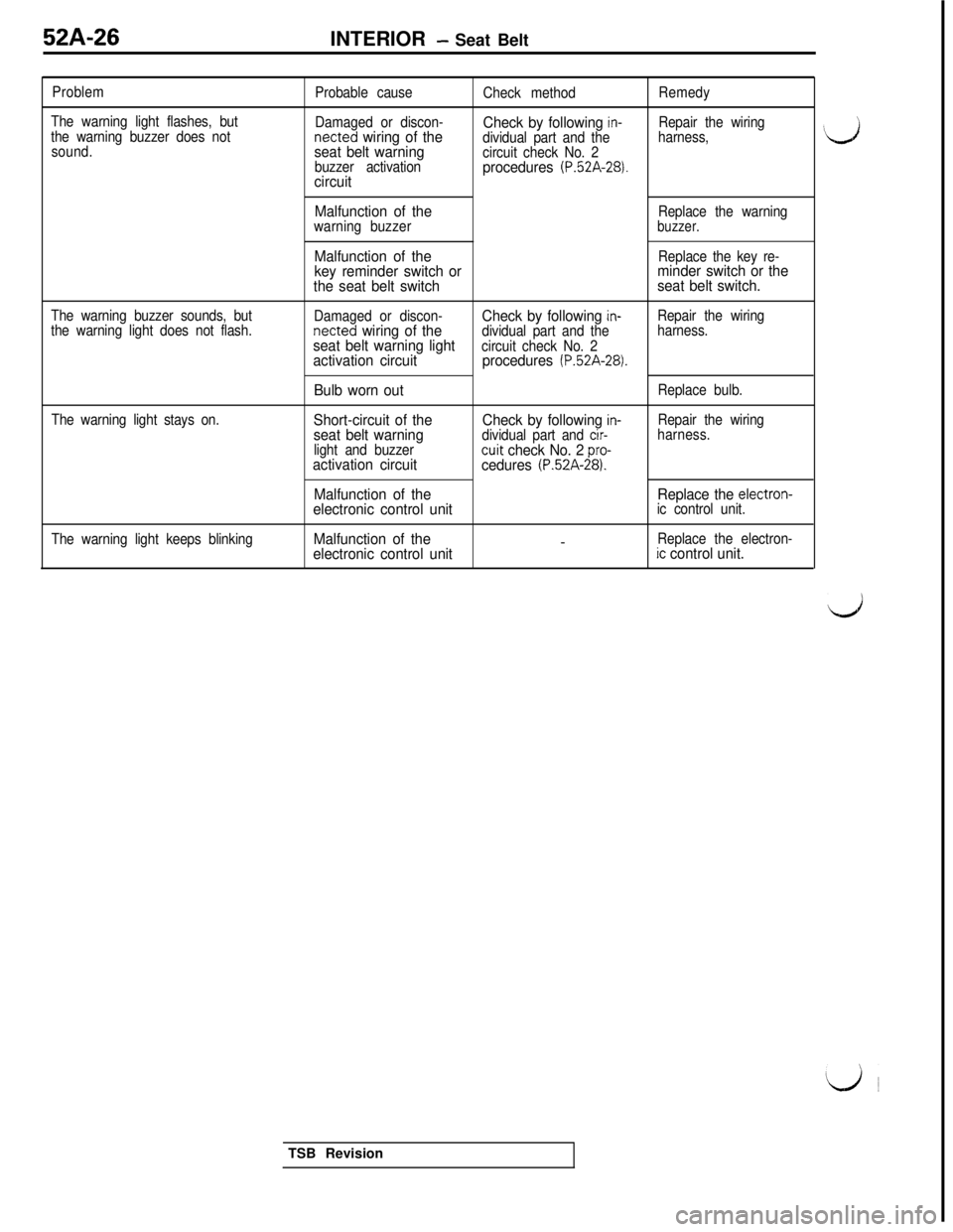
Problem
The warning light flashes, but
the warning buzzer does not
sound.Probable cause
Damaged or discon-netted
wiring of the
seat belt warning
buzzer activationcircuit
Check method
Check by following in-dividual part and the
circuit check No. 2
procedures (P.52A-28).
Remedy
Repair the wiring
harness,
The warning buzzer sounds, but
the warning light does not flash.
The warning light stays on.
The warning light keeps blinking
Malfunction of theReplace the warning
warning buzzerbuzzer.
Malfunction of theReplace the key re-key reminder switch orminder switch or the
the seat belt switchseat belt switch.
Damaged or discon-Check by following in-Repair the wiringnetted wiring of thedividual part and theharness.seat belt warning lightcircuit check No. 2activation circuitprocedures (P.52A-28).
Bulb worn outReplace bulb.
Short-circuit of theCheck by following in-Repair the wiringseat belt warningdividual part and cir-harness.
light and buzzer
cuit check No. 2 pro-activation circuit
cedures (P.52A-28).
Malfunction of theReplace the electron-electronic control unitic control unit.
Malfunction of the-Replace the electron-electronic control unitic control unit.
‘dTSB Revision
Page 1005 of 1146
INTERIOR - Seat Belt52A-27
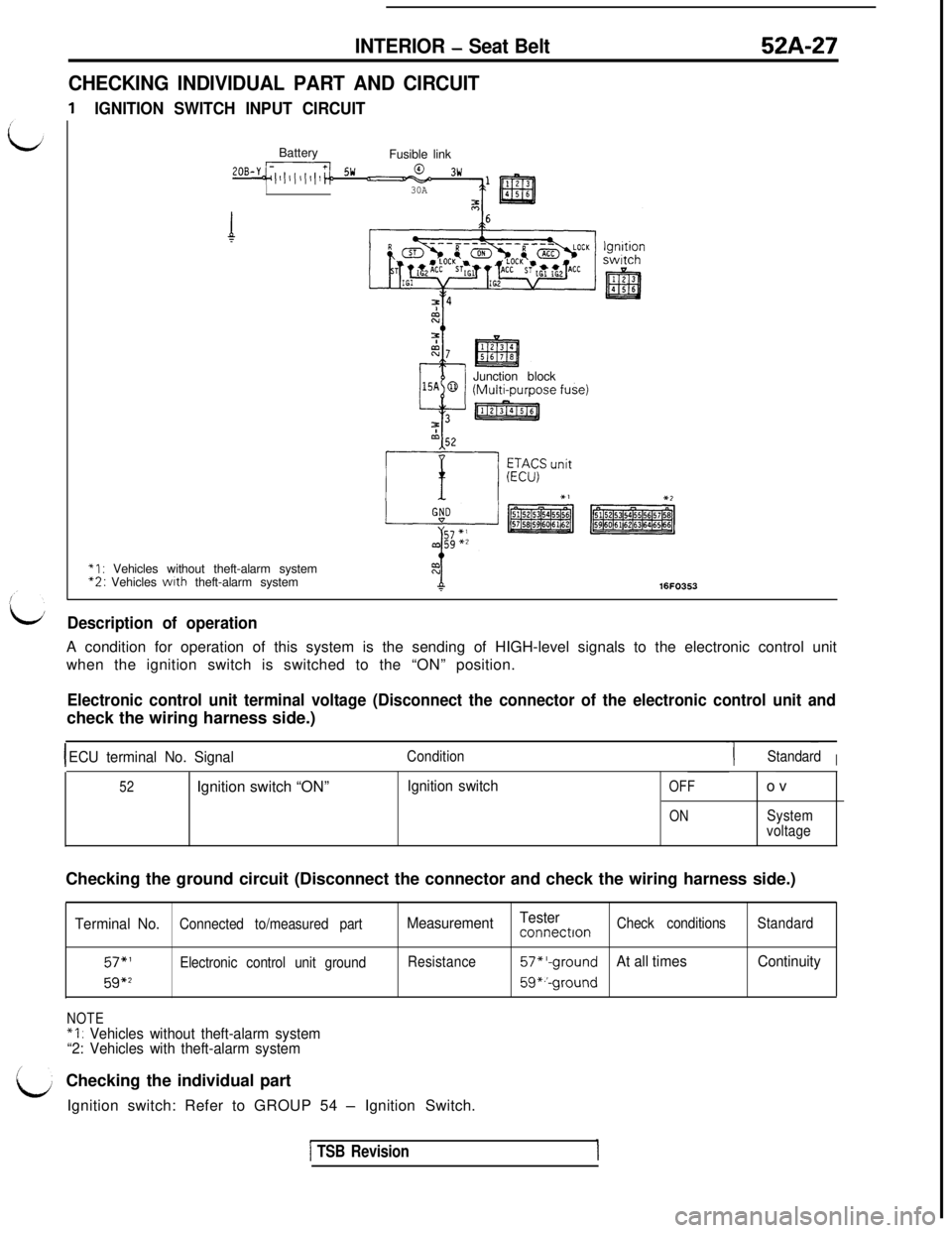
CHECKING INDIVIDUAL PART AND CIRCUIT
IGNITION SWITCH INPUT CIRCUITBattery
Fusible link
2oB-y~~/l,l(l,l,,~~ !jw u03w
30AJunction block
*I : Vehicles without theft-alarm system“2: Vehicles wtth theft-alarm system16FO35.3
It/Description of operationA condition for operation of this system is the sending of HIGH-level signals to the electronic control unit
when the ignition switch is switched to the “ON” position.
Electronic control unit terminal voltage (Disconnect the connector of the electronic control unit andcheck the wiring harness side.)
IECU terminal No. SignalCondition-1 ~StandardI
52Ignition switch “ON”Ignition switchOFF
ONov
System
voltageChecking the ground circuit (Disconnect the connector and check the wiring harness side.)
Terminal No.Connected to/measured part
57,’Electronic control unit ground
59*2
NOTE
*I : Vehicles without theft-alarm system
“2: Vehicles with theft-alarm systemMeasurementTester
connectronCheck conditionsStandard
Resistance
57*‘-groundAt all timesContinuity
59*.‘-groundChecking the individual part
Ignition switch: Refer to GROUP 54
- Ignition Switch.
1 TSB Revision
Page 1006 of 1146
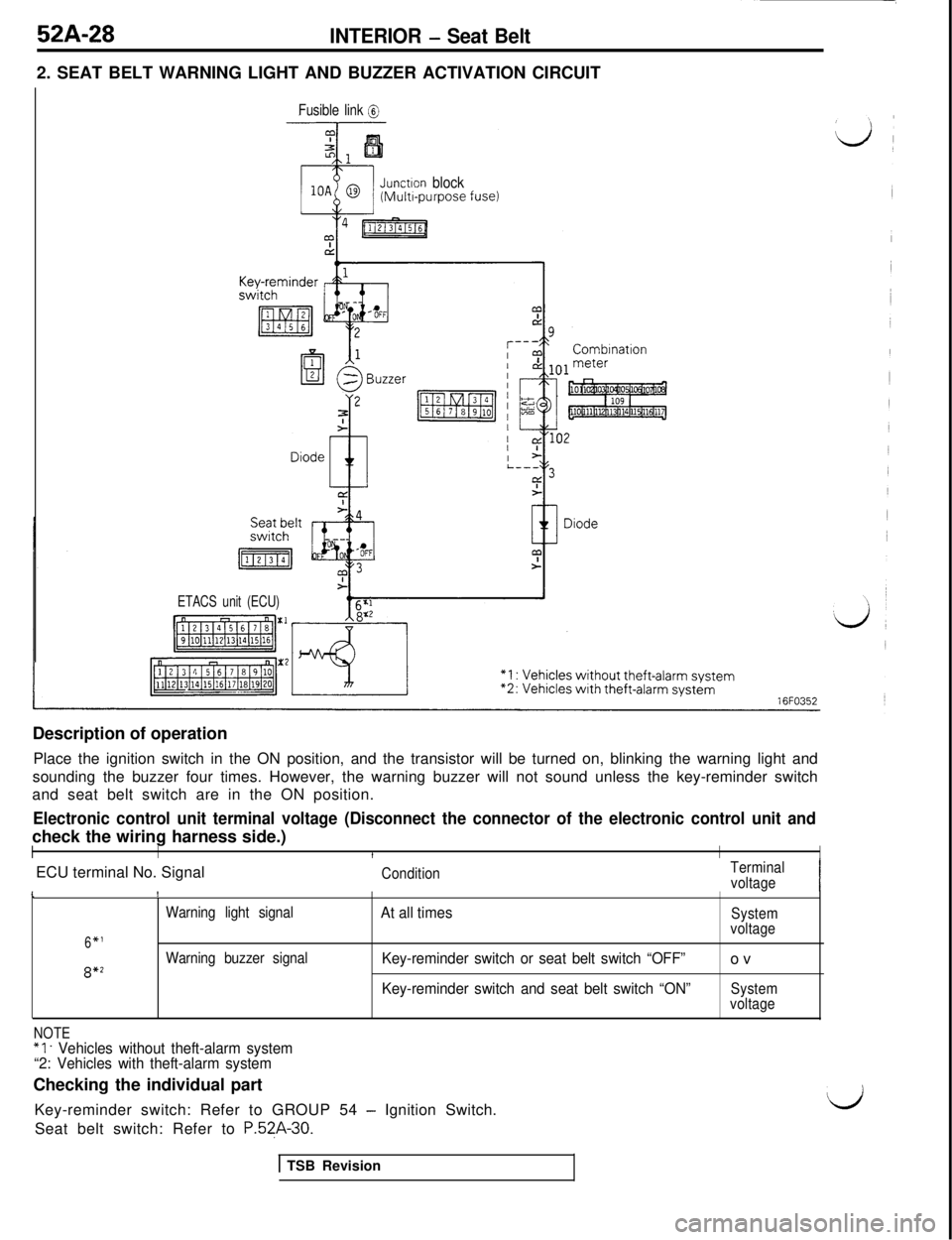
52A-28INTERIOR - Seat Belt2. SEAT BELT WARNING LIGHT AND BUZZER ACTIVATION CIRCUIT
Fusible link @
Junctron block(Multr-purpose fuse)
ETACS unit (ECU)Description of operation
Place the ignition switch in the ON position, and the transistor will be turned on, blinking the warning light and
sounding the buzzer four times. However, the warning buzzer will not sound unless the key-reminder switch
and seat belt switch are in the ON position.
Electronic control unit terminal voltage (Disconnect the connector of the electronic control unit andcheck the wiring harness side.)
IIIIIECU terminal No. Signal
ConditionTerminal
voltageI\!
Warning light signalAt all timesSystem
6*1voltage
Warning buzzer signal
Key-reminder switch or seat belt switch “OFF”ov8*2
Key-reminder switch and seat belt switch “ON”System
voltage
NOTE“1. Vehicles without theft-alarm system
“2: Vehicles with theft-alarm systemChecking the individual part
Key-reminder switch: Refer to GROUP 54
- Ignition Switch.dSeat belt switch: Refer to
P.5?A-30.
1 TSB Revision
Page 1012 of 1146
52B-2SUPPLEMENTAL RESTRAINT SYSTEM (SRS) - General informationGENERAL INFORMATION
INTRODUCTIONThe Supplemental Restraint System (SRS) is de-
signed to supplement the driver’s seat belt to help
reduce the risk or severity of injury to the driver by
activating and deploying a driver’s-side air bag in
certain frontal collisions.
The SRS consists of: left front and right front impact
sensors located, one each, on the right and left front
upper frame lowers; an air bag module located in
the center of the steering wheel, which contains the
folded air bag and an inflator unit; the SRS diagnosis
unit located under the rear console assembly, which
monitors the system, and which contains a safing
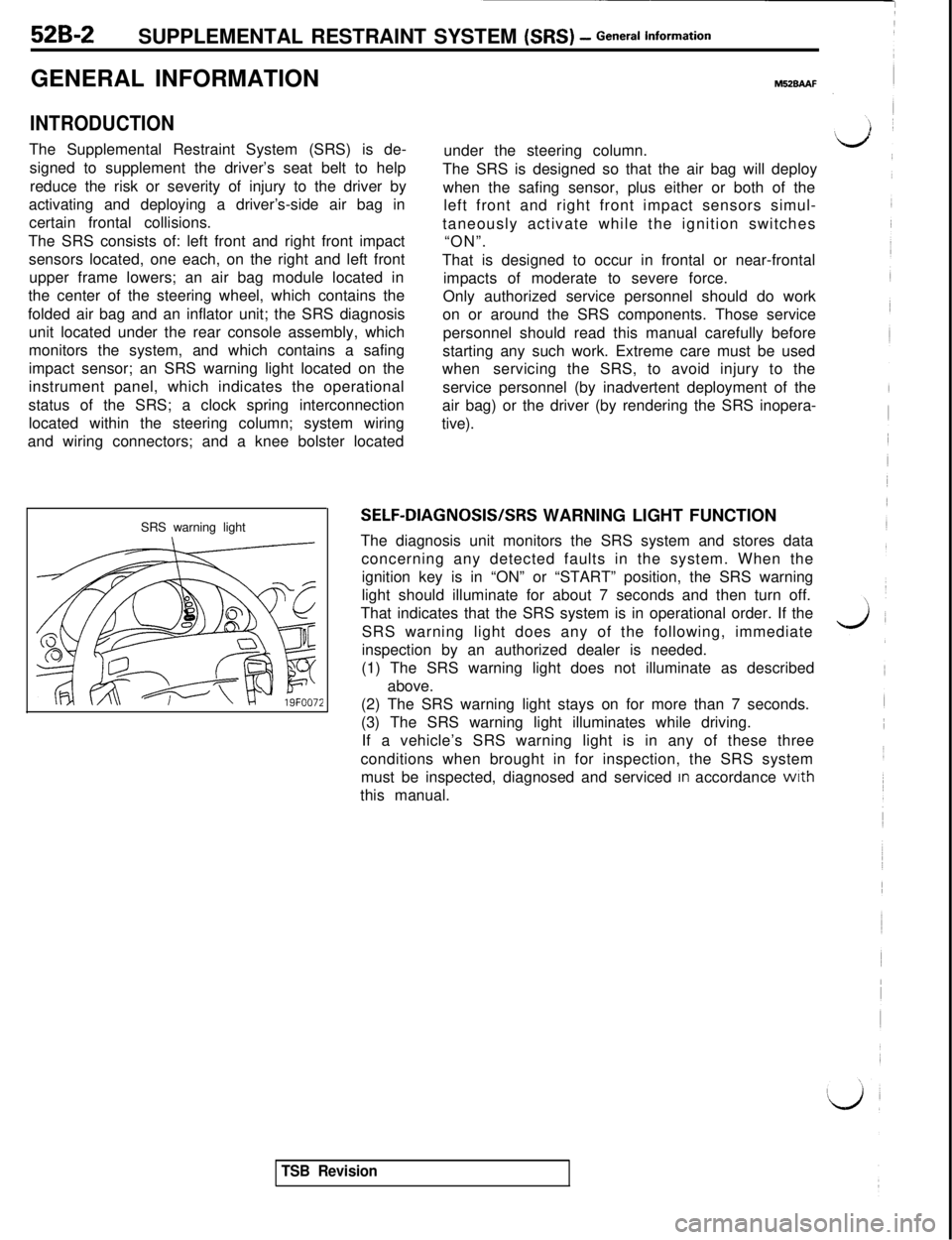
impact sensor; an SRS warning light located on the
instrument panel, which indicates the operational
status of the SRS; a clock spring interconnection
located within the steering column; system wiring
and wiring connectors; and a knee bolster located
SRS warning light
M52BAAFunder the steering column.
The SRS is designed so that the air bag will deploy
when the safing sensor, plus either or both of the
left front and right front impact sensors simul-
taneously activate while the ignition switches
“ON”.
That is designed to occur in frontal or near-frontal
impacts of moderate to severe force.
Only authorized service personnel should do work
on or around the SRS components. Those service
personnel should read this manual carefully before
starting any such work. Extreme care must be used
whenservicing the SRS, to avoid injury to the
service personnel (by inadvertent deployment of the
air bag) or the driver (by rendering the SRS inopera-
tive).
SELF-DIAGNOSIS/SRS WARNING LIGHT FUNCTION
The diagnosis unit monitors the SRS system and stores data
concerning any detected faults in the system. When the
ignition key is in “ON” or “START” position, the SRS warning
light should illuminate for about 7 seconds and then turn off.
That indicates that the SRS system is in operational order. If the
SRS warning light does any of the following, immediate
inspection by an authorized dealer is needed.
(1) The SRS warning light does not illuminate as described
above.
(2) The SRS warning light stays on for more than 7 seconds.
(3) The SRS warning light illuminates while driving.
If a vehicle’s SRS warning light is in any of these three
conditions when brought in for inspection, the SRS system
must be inspected, diagnosed and serviced
In accordance wrth
this manual.
TSB Revision
Page 1018 of 1146
52B-8SUPPLEMENTAL RESTRAINT SYSTEM (SRS) - General Information
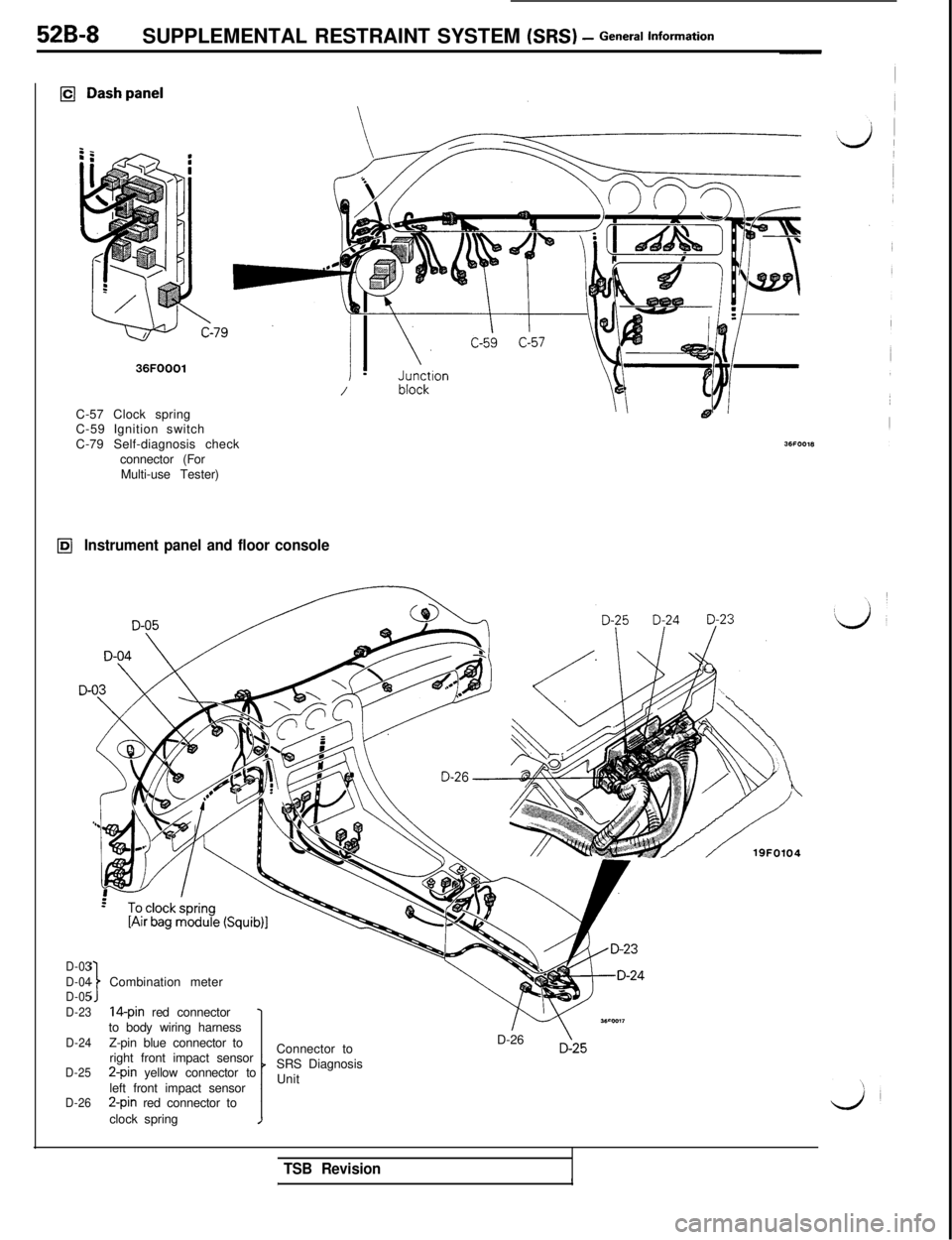
36FOOOlJ/C-57 Clock spring
C-59 Ignition switch
C-79 Self-diagnosis check
connector (For
Multi-use Tester)
IbJInstrument panel and floor console
D-
D-03
D-04Combination meter
D-05
D-2314-pin red connector
to body wiring harness
D-24Z-pin blue connector to
right front impact sensor
D-252-pin yellow connector to
left front impact sensor
D-262-pin red connector to
clock springConnector to
SRS Diagnosis
UnitD-26225
TSB Revision,1
Page 1022 of 1146
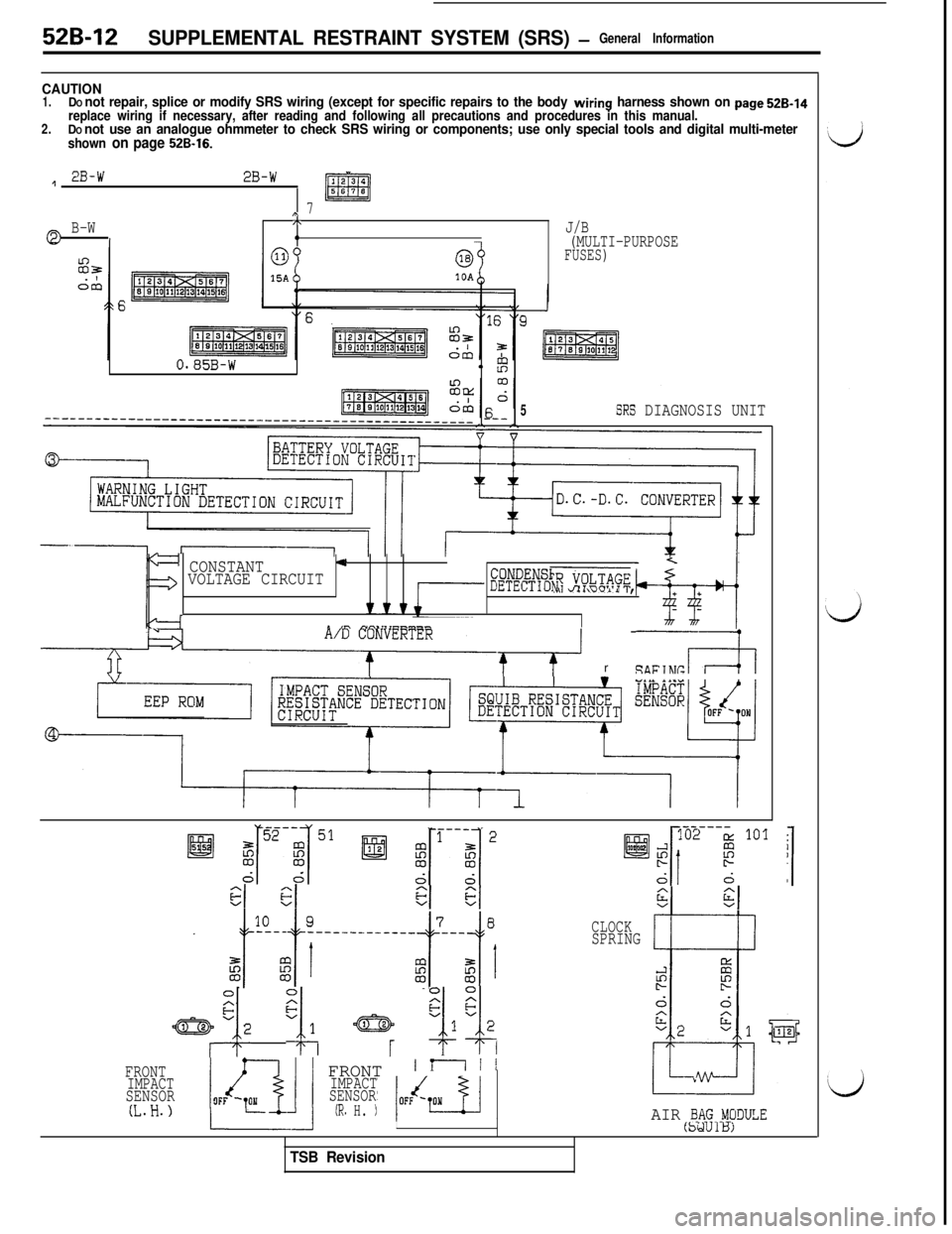
52B-12SUPPLEMENTAL RESTRAINT SYSTEM (SRS) -General Information
CAUTION1.DO not repair, splice or modify SRS wiring (except for specific repairs to the body wiring harness shown on page QB-14
2.replace wiring if necessary, after reading and following all precautions and procedures in this manual.DO not use an analogue ohmmeter to check SRS wiring or components; use only special tools and digital multi-metershown on page 52B-16.
12B-W2B-W
,, 7
B-WI\.J/B0(MULTI-PURPOSEFUSES)
10A
0.85B-WI' 2
---_-__--_----_--------~---~~~--~~--~~-~-~----~---- --_5SRS DIAGNOSIS UNIT
= CONSTANT4I- -xI
> VOLTAGE CIRCUITCONDENSIDETECTIL,. vAI\vvII ,
vvvn ,n N~,11rrnm,vn
Ttttlr .,,,,,,a
l@i fTii51 l@!l %piJ’
/
-i----
EBI
102!x 101
‘o’ @ii?r
i 1I
z
dd
3) clEl $1BVIi2VI
Qy y2 qli y jl y2/
FRONTIMPACTFRONT ' - ' '
SENSOR
I!?--
IMPACT
SENSOR
(L.H.)OFF -If-(R. H. )II
CLOCKSPRING
(5QUIBjAIR QA$e_MODULE
TSB Revision
Page 1024 of 1146
.52B-14 SUPPLEMENTAL RESTRAINT SYSTEM (SRS) - SRS Service Precautions
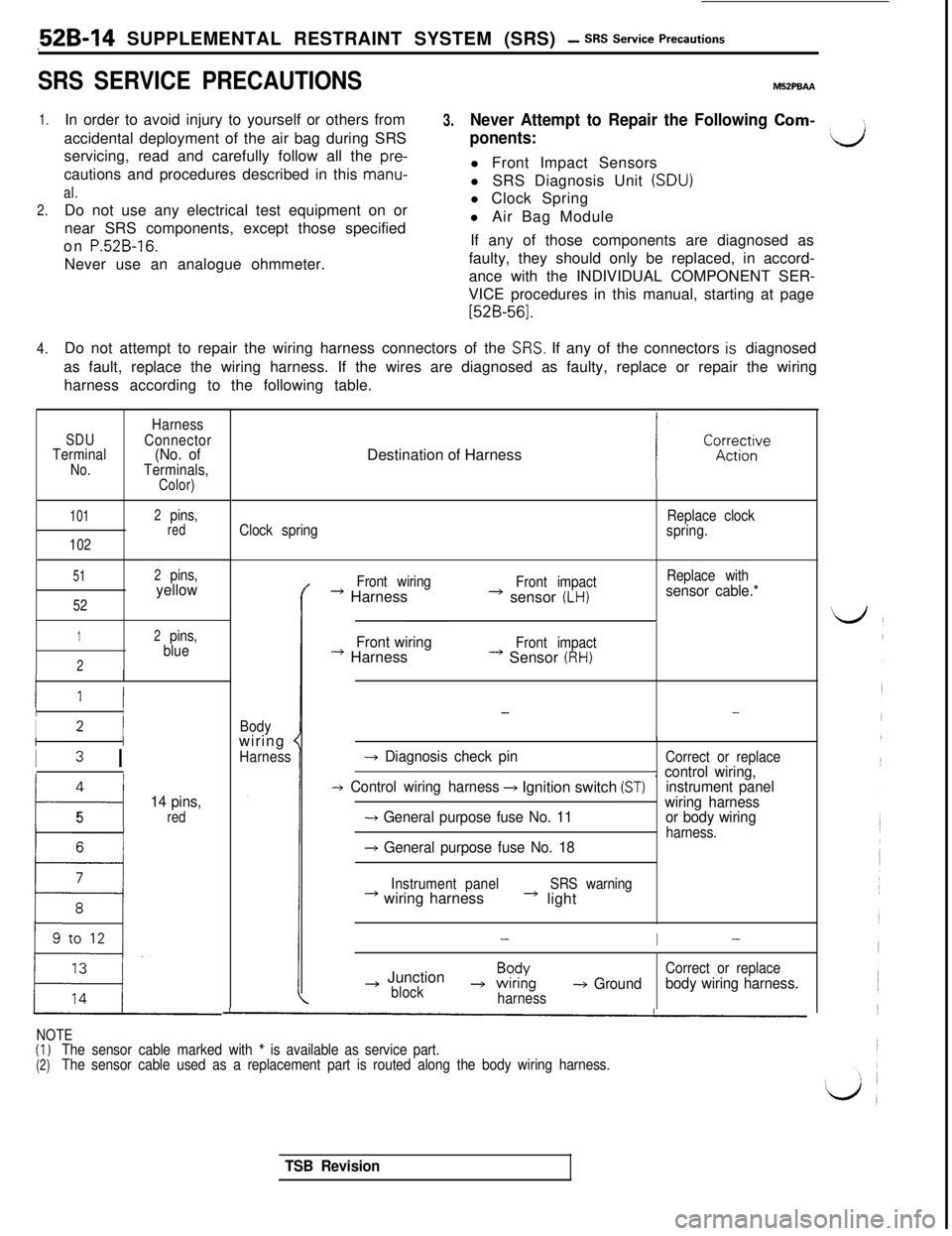
SRS SERVICE PRECAUTIONSMBZPBAA
1.In order to avoid injury to yourself or others from3.accidental deployment of the air bag during SRSNever Attempt to Repair the Following Com-servicing, read and carefully follow all the
pre-
ponents:dcautions and procedures described in this
manu-l Front Impact Sensors
al.l SRS Diagnosis Unit (SDU)
2.Do not use any electrical test equipment on orl Clock Spring
near SRS components, except those specifiedl Air Bag Module
on
P.52B-16.If any of those components are diagnosed as
Never use an analogue ohmmeter.faulty, they should only be replaced, in accord-
ance with the INDIVIDUAL COMPONENT SER-
VICE procedures in this manual, starting at page
[52B-561.
4.Do not attempt to repair the wiring harness connectors of the
SRS. If any of the connectors is diagnosed
as fault, replace the wiring harness. If the wires are diagnosed as faulty, replace or repair the wiring
harness according to the following table.
SDUTerminalNo.
Harness
Connector
(No. ofTerminals,Color)
101
102
2pins,red
51
52
2pins,yellow
12pins,
blue
2
II
II
I2 IIi
I3 I
4
t---i
14 pins,
5red
16 t
LDestination of Harness
Clock springReplace clock
spring.
Bodywiring
*
HarnessFront wiring
* HarnessFront impact+ sensor (LH)
Replace withsensor cable.*
Front wiring
--) HarnessFront impact* Sensor (RH)
--
-+ Diagnosis check pinCorrect or replace
-+ Control wiring harness+ Ignition switch (ST). control wiring,
instrument panel
-+ General purpose fuse No. 11wiring harness
or body wiringharness.+ General purpose fuse No. 18
Instrument panel+ wiring harnessSRS warning* light
-I-
~ JunctionBpdYCorrect or replace
block-+ wrnng-+ Groundharnessbody wiring harness.
NOTE(I)
(2)The sensor cable marked with * is available as service part.
The sensor cable used as a replacement part is routed along the body wiring harness.
TSB Revision