wiring MITSUBISHI 3000GT 1991 Manual PDF
[x] Cancel search | Manufacturer: MITSUBISHI, Model Year: 1991, Model line: 3000GT, Model: MITSUBISHI 3000GT 1991Pages: 1146, PDF Size: 76.68 MB
Page 1064 of 1146
52B-54 SUPPLEMENTAL RESTRAINT SYSTEM (SRS) - ZZ%K%~g~~~s
POST-COLLISION DIAGNOSISTEST EQUIPMENT TO BE USED FOR POST-COLLISION DIAGNOSIS
ToolNumberName
Use
MB991 341Multi-use tester subassemblyl Reading diagnosis codesl Reading trouble periodl Erasing diagnosis codel Reading erase times
MB991 359
ROM pack (for Multi-
use Tester
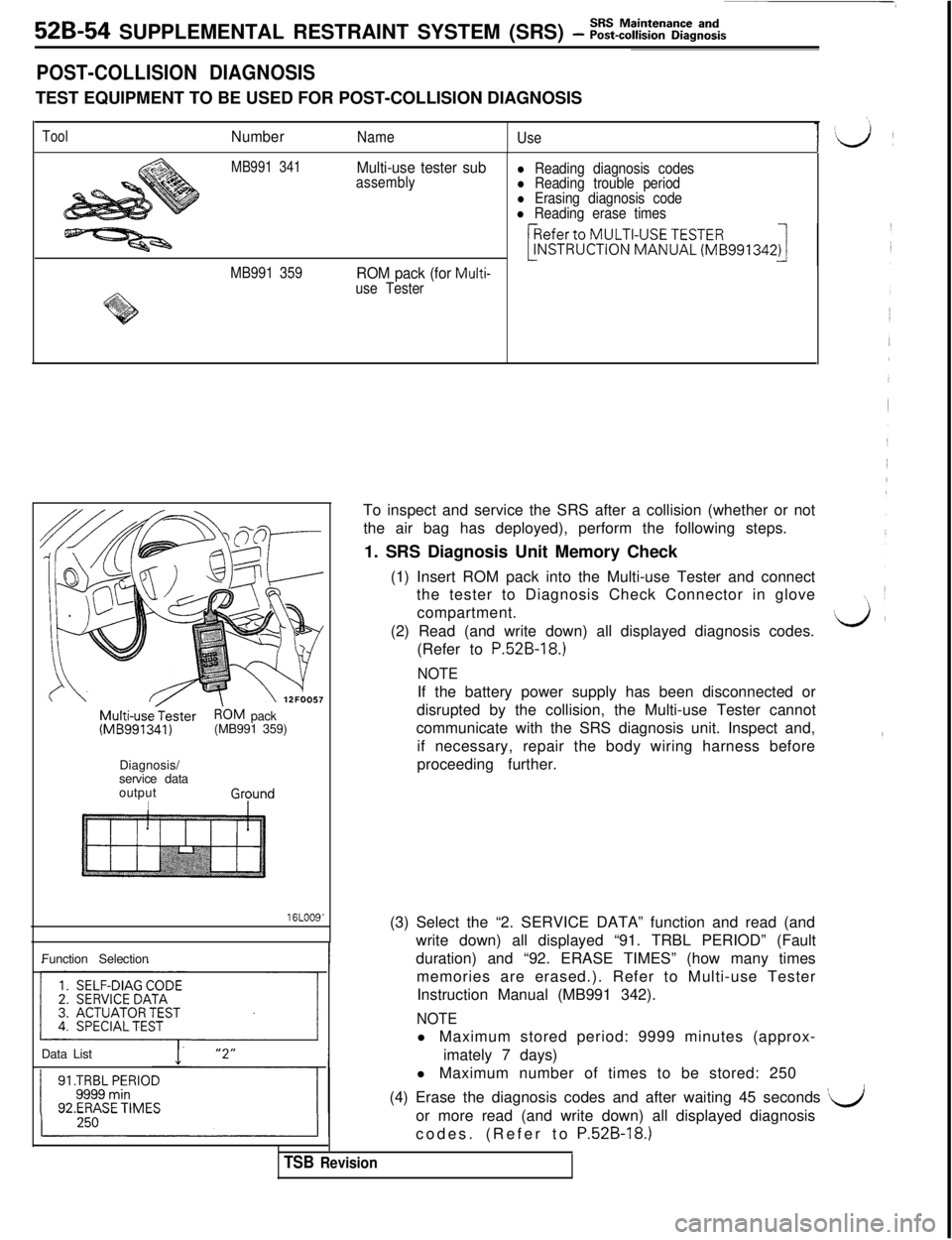
Multi-usejesterR'OM pack(MB991341)(MB991 359)
Diagnosis/
service data
output
I
16LOO9'Function Selection
Data ListTo inspect and service the SRS after a collision (whether or not
the air bag has deployed), perform the following steps.
1. SRS Diagnosis Unit Memory Check
(1) Insert ROM pack into the Multi-use Tester and connect
the tester to Diagnosis Check Connector in glove
compartment.
‘I i(2) Read (and write down) all displayed diagnosis codes.J’(Refer to
P.52B-18.)
NOTEIf the battery power supply has been disconnected or
disrupted by the collision, the Multi-use Tester cannot
communicate with the SRS diagnosis unit. Inspect and,
if necessary, repair the body wiring harness before
proceeding further.
(3) Select the “2. SERVICE DATA” function and read (and
write down) all displayed “91. TRBL PERIOD” (Fault
duration) and “92. ERASE TIMES” (how many times
memories are erased.). Refer to Multi-use Tester
Instruction Manual (MB991 342).
NOTEl Maximum stored period: 9999 minutes (approx-
imately 7 days)
l Maximum number of times to be stored: 250
(4) Erase the diagnosis codes and after waiting 45 seconds
‘dor more read (and write down) all displayed diagnosis
codes. (Refer to P.528-18.)
TSB Revision
Page 1065 of 1146
SUPPLEMENTAL RESTRAINT SYSTEM (SRS) - ~~~-~~~~~a~~g~~~s 52B-552. Repair Procedure
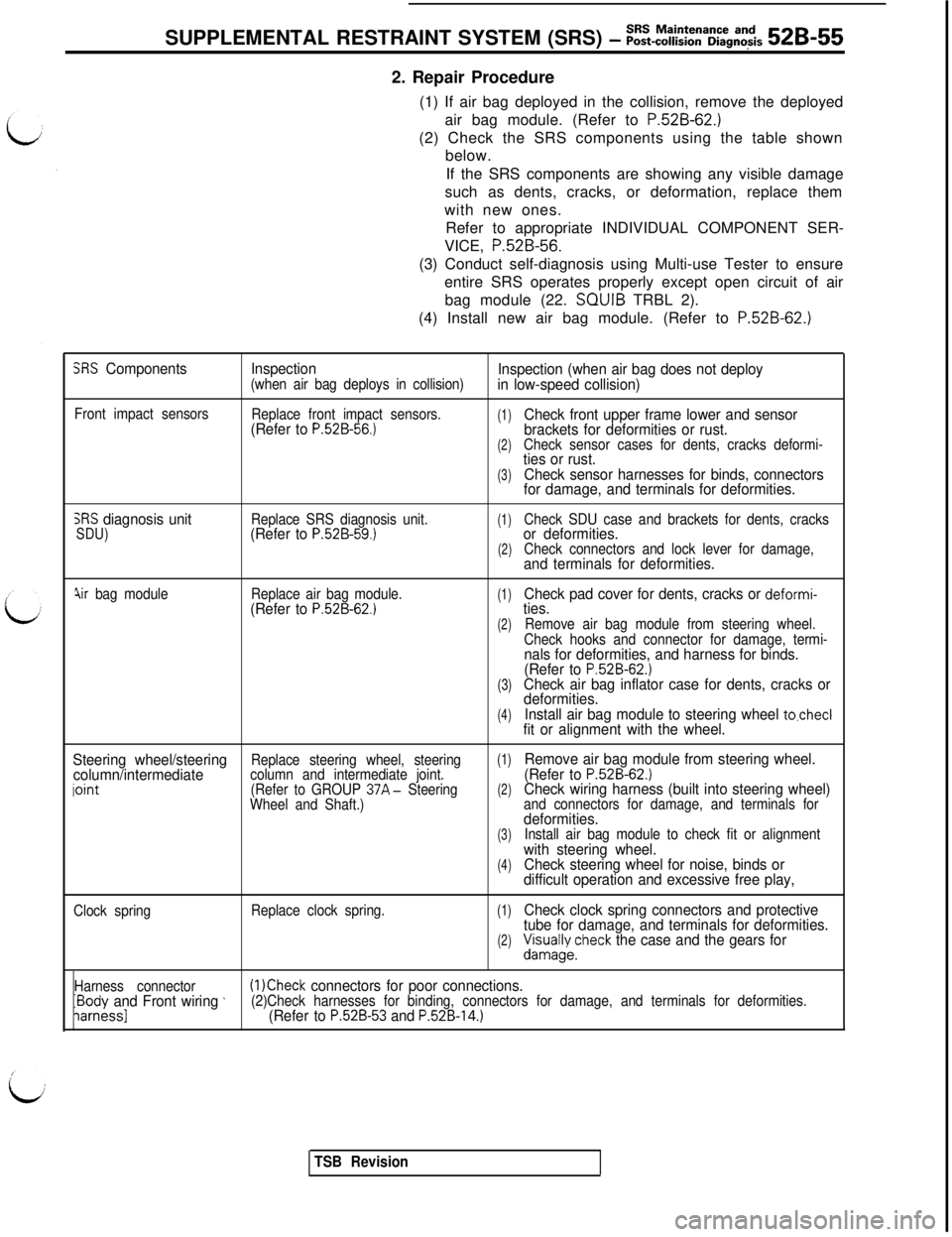
(1) If air bag deployed in the collision, remove the deployed
air bag module. (Refer to
P.52B-62.)(2) Check the SRS components using the table shown
below.
If the SRS components are showing any visible damage
such as dents, cracks, or deformation, replace them
with new ones.
Refer to appropriate INDIVIDUAL COMPONENT SER-
VICE, P.52B-56.
(3) Conduct self-diagnosis using Multi-use Tester to ensure
entire SRS operates properly except open circuit of air
bag module (22. SQUIB TRBL 2).
(4) Install new air bag module. (Refer to
P.52B-62.)
SRS ComponentsInspection(when air bag deploys in collision)Inspection (when air bag does not deploy
in low-speed collision)
Front impact sensors
Replace front impact sensors.(Refer to P.52B-56.)(1)Check front upper frame lower and sensor
brackets for deformities or rust.
(2)Check sensor cases for dents, cracks deformi-ties or rust.
(3)Check sensor harnesses for binds, connectors
for damage, and terminals for deformities.
SRS diagnosis unitSDU)Replace SRS diagnosis unit.(Refer to P.52B-59.)(1)Check SDU case and brackets for dents, cracksor deformities.(2)Check connectors and lock lever for damage,and terminals for deformities.
jir bag moduleReplace air bag module.(Refer to P.52B-62.)(1)Check pad cover for dents, cracks or deformi-ties.
(2)Remove air bag module from steering wheel.
Check hooks and connector for damage, termi-
nals for deformities, and harness for binds.
(Refer to P.52B-62.)(3)Check air bag inflator case for dents, cracks or
deformities.
(4)Install air bag module to steering wheel to.checlfit or alignment with the wheel.
Steering wheel/steering
(1)column/intermediateReplace steering wheel, steering
iointcolumn and intermediate joint.Remove air bag module from steering wheel.
(Refer to P.52B-62.)(Refer to GROUP 37A- Steering(2)Wheel and Shaft.)Check wiring harness (built into steering wheel)and connectors for damage, and terminals fordeformities.(3)Install air bag module to check fit or alignmentwith steering wheel.(4)Check steering wheel for noise, binds or
difficult operation and excessive free play,
Clock springReplace clock spring.(1)Check clock spring connectors and protective
tube for damage, and terminals for deformities.
(2)&/;yecheck the case and the gears for
Harness connectorIBody and Front wiring ’(1 )Check connectors for poor connections.
iarnessl(2)Check harnesses for binding, connectors for damage, and terminals for deformities.(Refer to P.52B-53 and P.52B-14.)
TSB Revision
Page 1068 of 1146
52B-58SUPPLEMENTAL RESTRAINT SYSTEM (SRS) - Front Impact Sensors
SERVICE POINT OF INSTALLATION
PRE-INSTALLATION INSPECTION
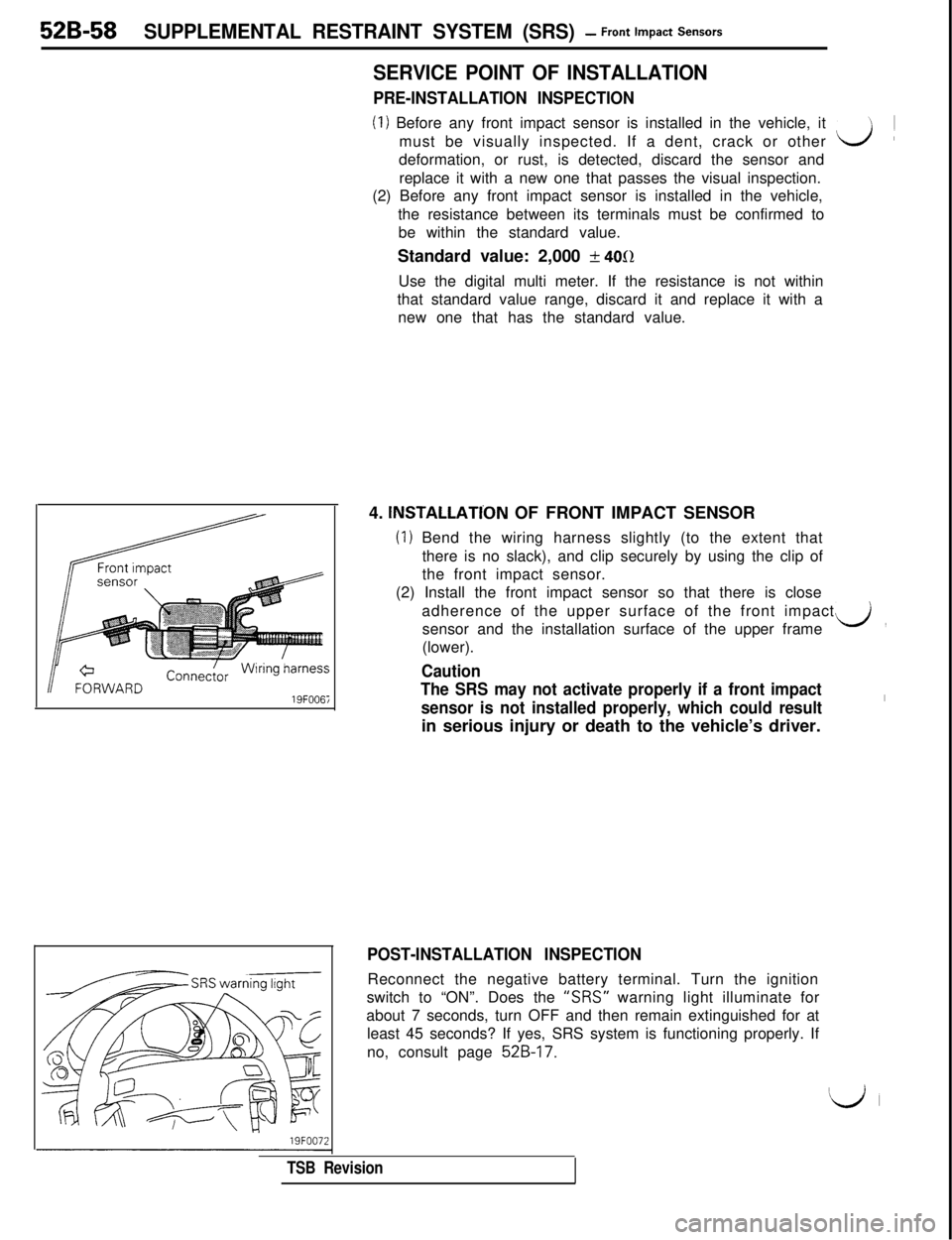
(1) Before any front impact sensor is installed in the vehicle, it
must be visually inspected. If a dent, crack or other
LAdeformation, or rust, is detected, discard the sensor and
replace it with a new one that passes the visual inspection.
(2) Before any front impact sensor is installed in the vehicle,
the resistance between its terminals must be confirmed to
be within the standard value.
Standard value: 2,000
-t 400
Use the digital multi meter. If the resistance is not within
that standard value range, discard it and replace it with a
new one that has the standard value.
19FOO6i4.
INSTALLATI’ON OF FRONT IMPACT SENSOR
(1) Bend the wiring harness slightly (to the extent that
there is no slack), and clip securely by using the clip of
the front impact sensor.
(2) Install the front impact sensor so that there is close
adherence of the upper surface of the front impact
sensor and the installation surface of the upper frame
d’(lower).
Caution
The SRS may not activate properly if a front impact
sensor is not installed properly, which could result
Iin serious injury or death to the vehicle’s driver.
POST-INSTALLATION INSPECTIONReconnect the negative battery terminal. Turn the ignition
switch to “ON”. Does the
“SW” warning light illuminate for
about 7 seconds, turn OFF and then remain extinguished for at
least 45 seconds? If yes, SRS system is functioning properly. If
no, consult page 52B-17.
19FOO72
TSB Revision
Page 1070 of 1146
52B-60 SUPPLEMENTAL RESTRAINT SYSTEM (SRS) - SRS Diagnosis Unit (SW
0I/-Battery e
13R0721lSF1072:
SRS diagnosis unitView A13R0704
To front impact sensor
(L.H.)
\To front impact sensor (R.H.1\I
I- - -,I1
\To clock springTo body wiring harness (14-pin)19FOllt
r-TSB I
SERVICE POINTS OF REMOVAL1. DISCONNECTION OF THE NEGATIVE
(-) BATTERY
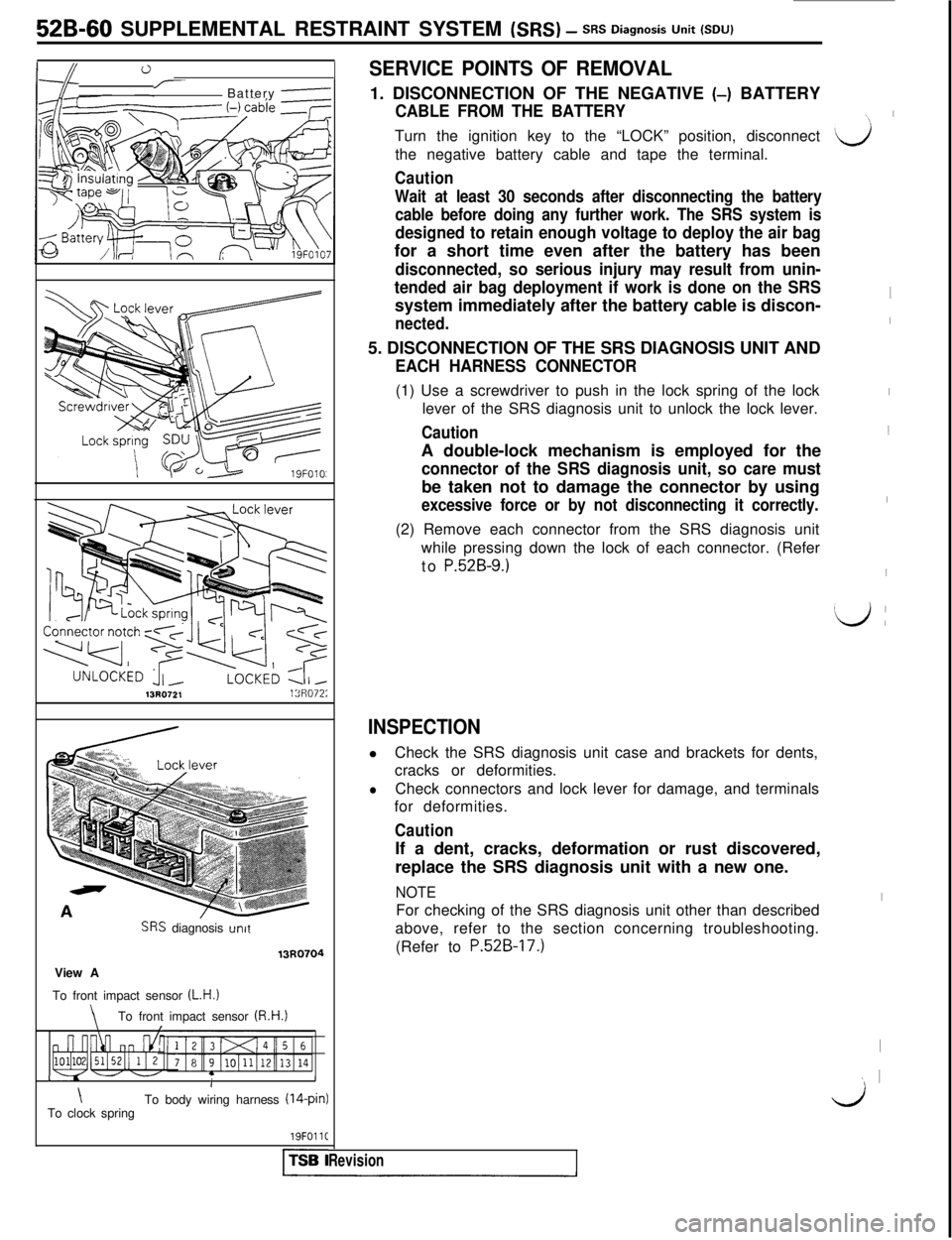
CABLE FROM THE BATTERYTurn the ignition key to the “LOCK” position, disconnect
the negative battery cable and tape the terminal.
Caution
Wait at least 30 seconds after disconnecting the battery
cable before doing any further work. The SRS system is
designed to retain enough voltage to deploy the air bagfor a short time even after the battery has been
disconnected, so serious injury may result from unin-
tended air bag deployment if work is done on the SRSsystem immediately after the battery cable is discon-
nected.5. DISCONNECTION OF THE SRS DIAGNOSIS UNIT AND
EACH HARNESS CONNECTOR(1) Use a screwdriver to push in the lock spring of the lock
lever of the SRS diagnosis unit to unlock the lock lever.
CautionA double-lock mechanism is employed for the
connector of the SRS diagnosis unit, so care mustbe taken not to damage the connector by using
excessive force or by not disconnecting it correctly.(2) Remove each connector from the SRS diagnosis unit
while pressing down the lock of each connector. (Refer
to
P.52B-9.)
INSPECTIONlCheck the SRS diagnosis unit case and brackets for dents,
cracks or deformities.
lCheck connectors and lock lever for damage, and terminals
for deformities.
CautionIf a dent, cracks, deformation or rust discovered,
replace the SRS diagnosis unit with a new one.
NOTEFor checking of the SRS diagnosis unit other than described
above, refer to the section concerning troubleshooting.
(Refer to
P.52B-17.)
Revision
\\I
‘d
I
I
I1
I~
\Lj (
I
I
~ I
kJ
Page 1072 of 1146
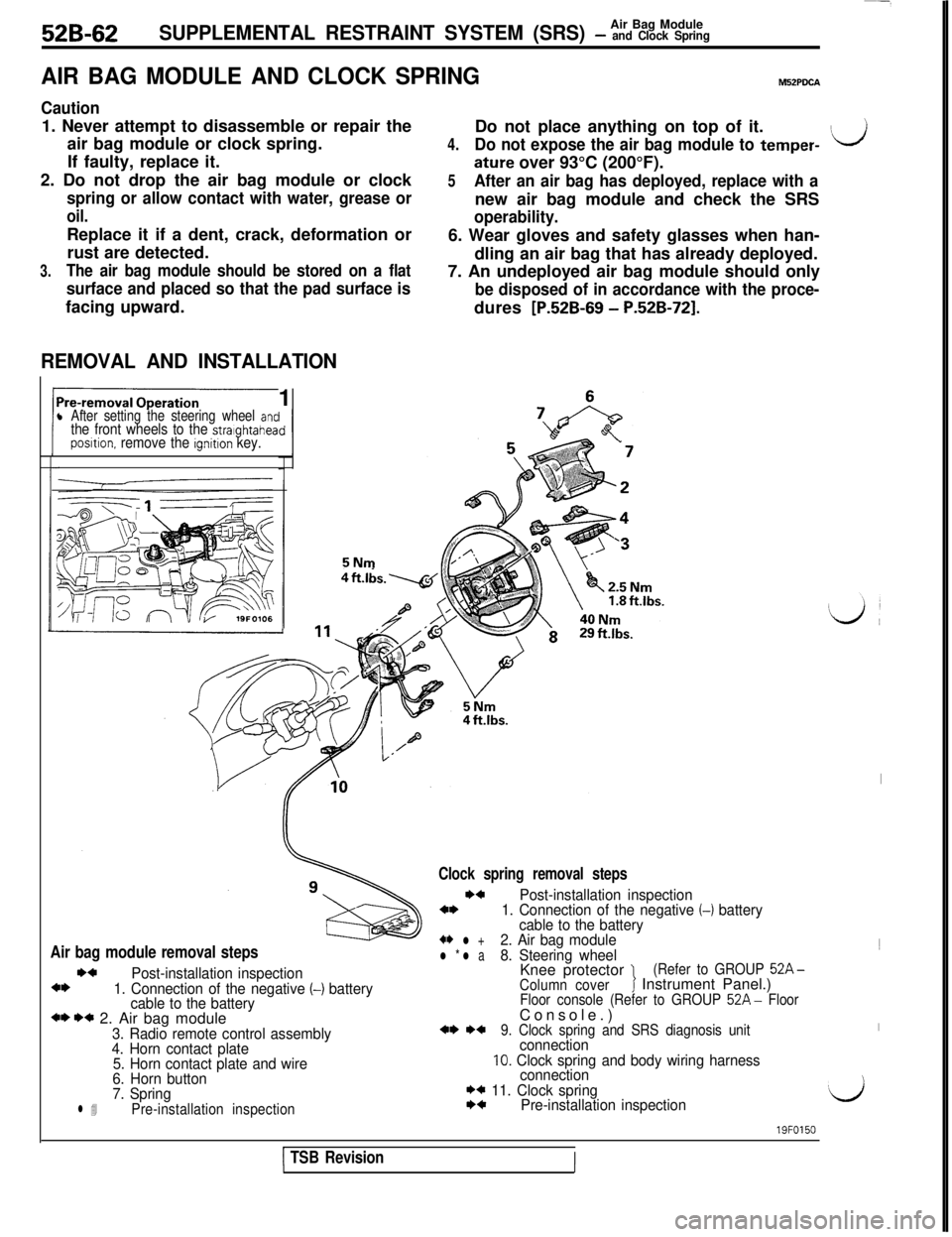
52B-62Air Bag ModuleSUPPLEMENTAL RESTRAINT SYSTEM (SRS) - and Clock Spring
AIR BAG MODULE AND CLOCK SPRINGM52PDCA
Caution1. Never attempt to disassemble or repair the
air bag module or clock spring.
If faulty, replace it.
2. Do not drop the air bag module or clock
spring or allow contact with water, grease or
oil.Replace it if a dent, crack, deformation or
rust are detected.
3.The air bag module should be stored on a flat
surface and placed so that the pad surface isfacing upward.
REMOVAL AND INSTALLATION1
l After setting the steering wheel antthe front wheels to the stralghtaheaposltion. remove the ignition key.5NmDo not place anything on top of it.
4.Do not expose the air bag module to temper-ILJ
ature over 93°C (200°F).
5After an air bag has deployed, replace with anew air bag module and check the SRS
operability.6. Wear gloves and safety glasses when han-
dling an air bag that has already deployed.
7. An undeployed air bag module should only
be disposed of in accordance with the proce-dures
[P.52B-69 - P.52B-721.
Air bag module removal stepsI)4
Post-installation inspection4*1. Connection of the negative (-1 battery
cable to the battery
*I) I)* 2. Air bag module3. Radio remote control assembly
4. Horn contact plate
5. Horn contact plate and wire
6. Horn button
7. Spring
l 4Pre-installation inspection
Clock spring removal steps
I)4Post-installation inspection4*1. Connection of the negative (-1 battery
cable to the battery
+* l +2. Air bag modulel * l a8. Steering wheelKnee protector 1(Refer to GROUP 52A-
Column coverJ Instrument Panel.)Floor console (Refer to GROUP 52A- FloorConsole.)
*I) *+9. Clock spring and SRS diagnosis unitconnection10. Clock spring and body wiring harness
connection
I)* 11. Clock springI)4Pre-installation inspection
I1
I
‘d
1 TSB Revision
19FO150
III
Page 1078 of 1146
52B-68SUPPLEMENTAL RESTRAINT SYSTEM (SRS) - %%%$kgSRS warning
light
/------ r--l
I
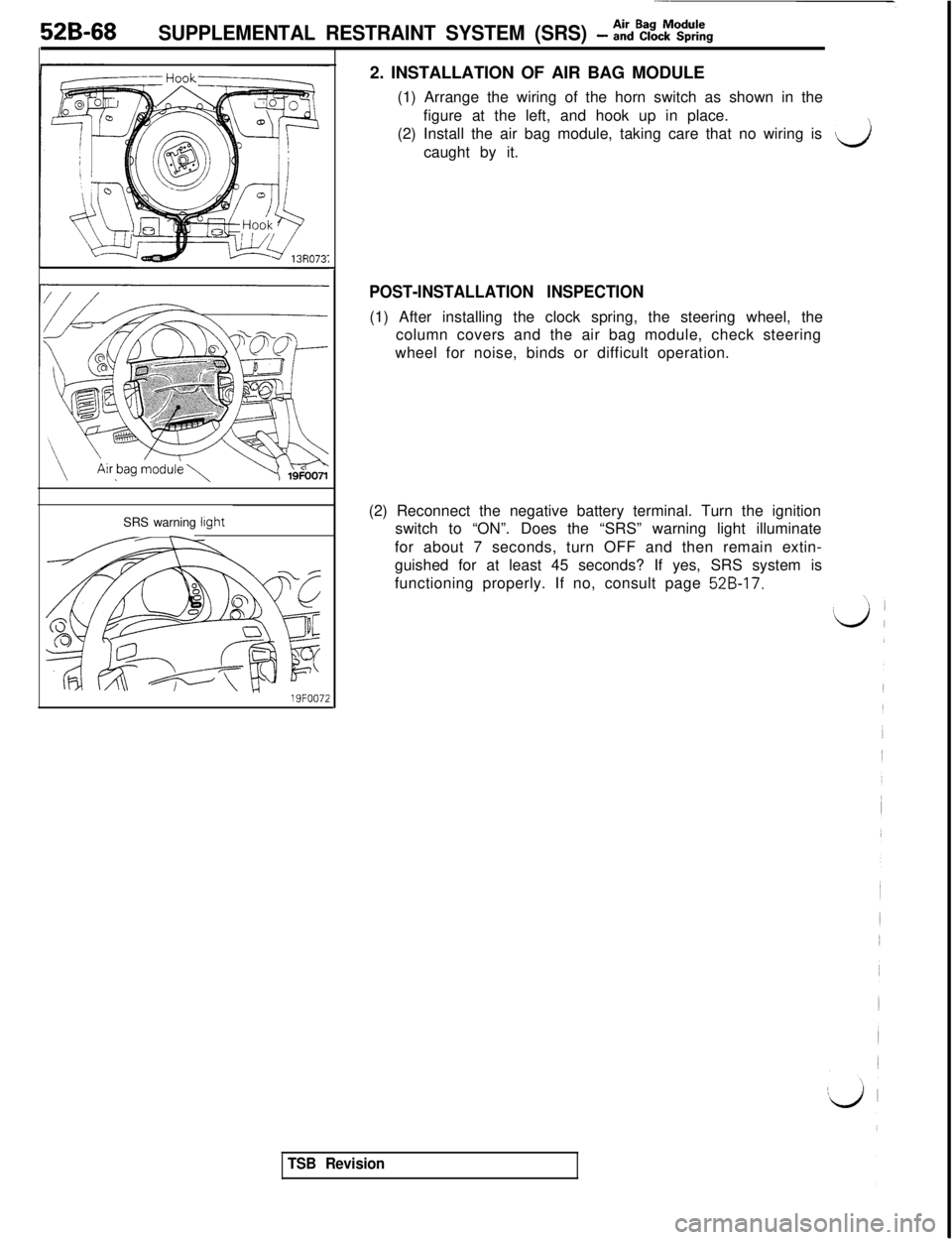
19FOO722. INSTALLATION OF AIR BAG MODULE
(1) Arrange the wiring of the horn switch as shown in the
figure at the left, and hook up in place.
(2) Install the air bag module, taking care that no wiring is
vicaught by it.
POST-INSTALLATION INSPECTION(1) After installing the clock spring, the steering wheel, the
column covers and the air bag module, check steering
wheel for noise, binds or difficult operation.
(2) Reconnect the negative battery terminal. Turn the ignition
switch to “ON”. Does the “SRS” warning light illuminate
for about 7 seconds, turn OFF and then remain extin-
guished for at least 45 seconds? If yes, SRS system is
functioning properly. If no, consult page
52B-17.
TSB Revision
Page 1083 of 1146
55-1
HEATER, AIR
CONDITIONER
AND VENTILATION
CONTENTSM55AA- -
HEATERS AND AIR CONDITIONING................3HEATER UNIT*........................................................................22
SPECIFICATIONS
....................................................................3REFRIGERANT LINE................................................................35General Specifications
........................................................3RESISTOR................................................................................20Lubricants
............................................................................4SAFETY PRECAUTIONS........................................................9Sealant and Adhesive............................................................4
Service Specifications3SERVICE ADJUSTMENT PROCEDURES............................10........................................................
SPECIAL TOOLS4Charging Procedures............................................................11
i
........................................................................Charging the Refrigerant....................................................12Compressor Drive Belt Adjustment....................................11
HEATERS AND MANUAL AIR CONDITIONER5Compressor Noise................................................................16
................................................16
AIR CONDITIONER SWITCH................................................21Handling Tubing andFittings
Idle-up Operation Check....................................................17
BELT LOCK CONTROLLER20Performance Test................................................................15....................................................
BLOWER ASSEMBLYPower Relay Check............................................................17............................................................23Refrigerant Leak Repair Procedure....................................15COMPRESSOR........................................................................
27TestProcedures....................................................................10
CONDENSER AND CONDENSER FAN MOTOR................33TROUBLESHOOTING............................................................5
ENGINE COOLANT TEMPERATURE SWITCH....................
39VENTILATORS (AIR INLET AND AIR OUTLET)................38
EVAPORATOR
........................................................................
25VENTILATORS (INSTRUMENT PANEL)*............................36
HEATER CONTROL ASSEMBLY*
........................................18CONTINUED ON NEXT PAGE
SUPPLEMENTAL RESTRAINT SYSTEM (SRS)
(1)A Supplemental Restraint System (SRS), which uses a driver-side air bag, has been installed in the 3000GT.(2)The SRS includes the following components: impact sensors, SRS diagnosis unit: SRS warning light, air bagmodule, clock spring, interconnecting wiring. Other SRS-related components (that may have to be
removed/installed in connection with SRS service or maintenance) are indicated in the table of contents byan asterisk (*).
WARNING!(1)Improper service or maintenance of any component of the SRS, or any SRS-related component, can lead to
personal injury or death to service personnel (from inadvertent firing of the air bag) or to the driver (fromrendering the
SRS inoperative).(2) Service or maintenance of any SRS component or SRS-related component must be performed only at anauthorized MITSUBISHI dealer.
(3) MITSUBISHI dealer personnel must thoroughly review this manual, and especially its GROUP 52B
-Supplemental Restraint System (SRS), before beginning any service or maintenance of any component of theSRS or any SRS-related component.
Page 1092 of 1146
55-10 HEATERS AND MANUAL AIR CONDITIONER -Service Adjustment Procedures
OFF-----__-__1210235 2,1002,700
(30) (33)(299) (384)
Pressure Fil
2OPOOlL
SERVICE ADJUSTMENT PROCEDURES
M55FEAU
TEST PROCEDURESSIGHT GLASS REFRIGERANT LEVEL TEST
The sight glass is a refrigerant level indicator. To check the
refrigerant level, clean the sight glass and start the vehicle
engine. Push the air conditioner button to operate the com-
pressor, place the blower switch to high and move the
temperature control lever to MAX. COOL. After operating for a
few minutes in this manner, check the sight glass.
(I) If the sight glass is clear, the magnetic clutch is engaged,
the compressor discharge line is warm and the compressor
inlet line is cool; the system has a full charge.
(2) If the sight glass is clear, the magnetic clutch is engaged
and there is no significant temperature difference between
compressor inlet and discharge lines; the system has lost
some refrigerant.
(3) If the sight glass shows foam or bubbles, the system could
be low on charge. The system has to be charged with some
refrigerant.
MAGNETIC CLUTCH(1) Disconnect the wiring to the magnetic clutch.
(2) Connect battery (+) voltage directly to the wiring for the
magnetic clutch.
(3) If the magnetic clutch is normal, there will be a “click”. If
the pulley and armature do not make contact (“click”), there
is a malfunction.
v):
I
I
I
I
\,
3’
RECEIVER DRIERTo Test the Receiver Drier
(1) Operate the unit and check the piping temperature by
touching the receiver drier outlet and inlet.
(2) If there is a difference in the temperatures, the receiver
drier is restricted.
Replace the receiver drier.
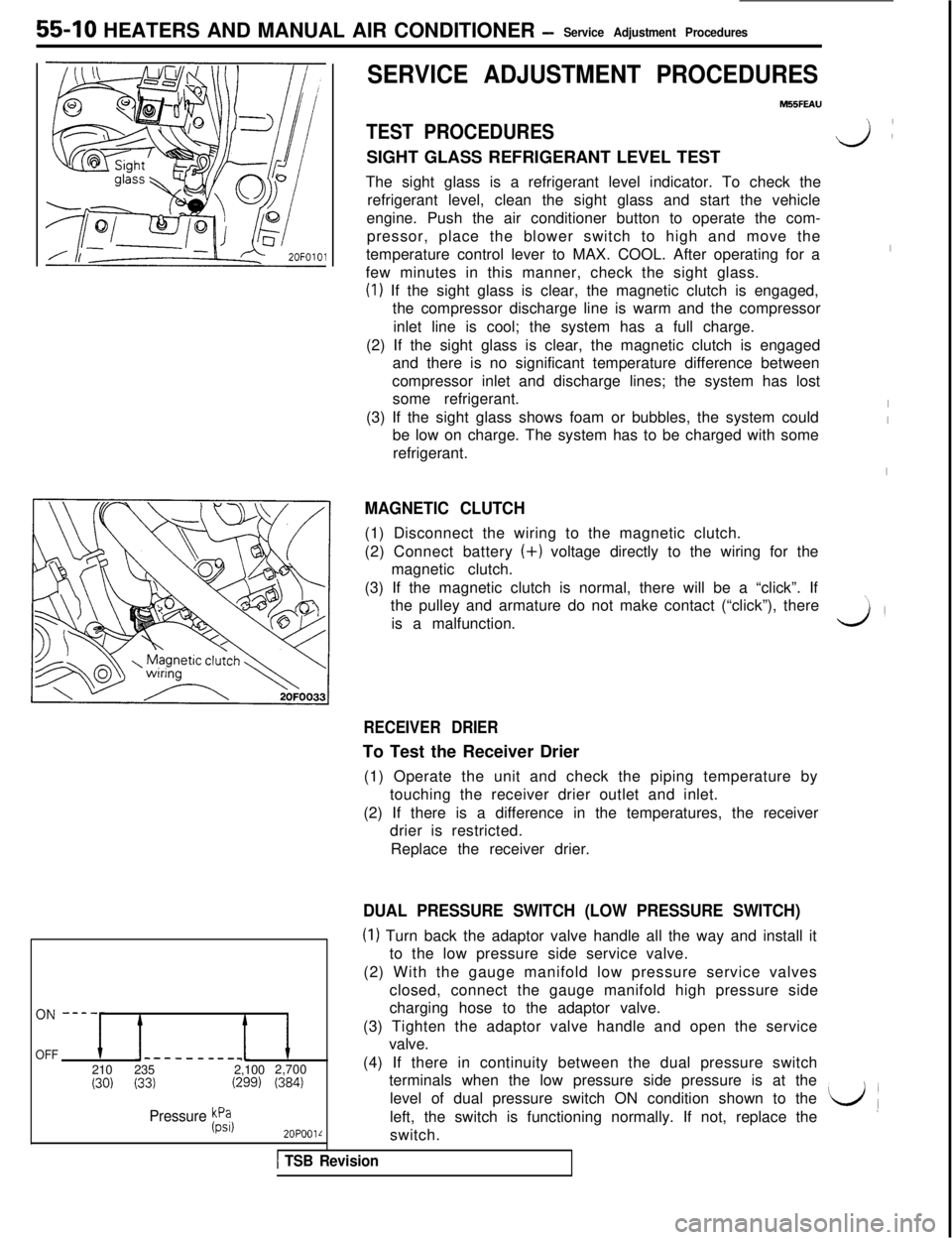
DUAL PRESSURE SWITCH (LOW PRESSURE SWITCH)
(I) Turn back the adaptor valve handle all the way and install it
to the low pressure side service valve.
(2) With the gauge manifold low pressure service valves
closed, connect the gauge manifold high pressure side
charging hose to the adaptor valve.
(3) Tighten the adaptor valve handle and open the service
valve.
(4) If there in continuity between the dual pressure switch
terminals when the low pressure side pressure is at the
level of dual pressure switch ON condition shown to the
left, the switch is functioning normally. If not, replace the
L/(switch.
1 TSB Revision