ignition switch wiring dia MITSUBISHI 380 2005 Workshop Manual
[x] Cancel search | Manufacturer: MITSUBISHI, Model Year: 2005, Model line: 380, Model: MITSUBISHI 380 2005Pages: 1500, PDF Size: 47.87 MB
Page 781 of 1500
AUTO A/C DIAGNOSIS
HEATER, AIR CONDITIONING AND VENTILATION55-80
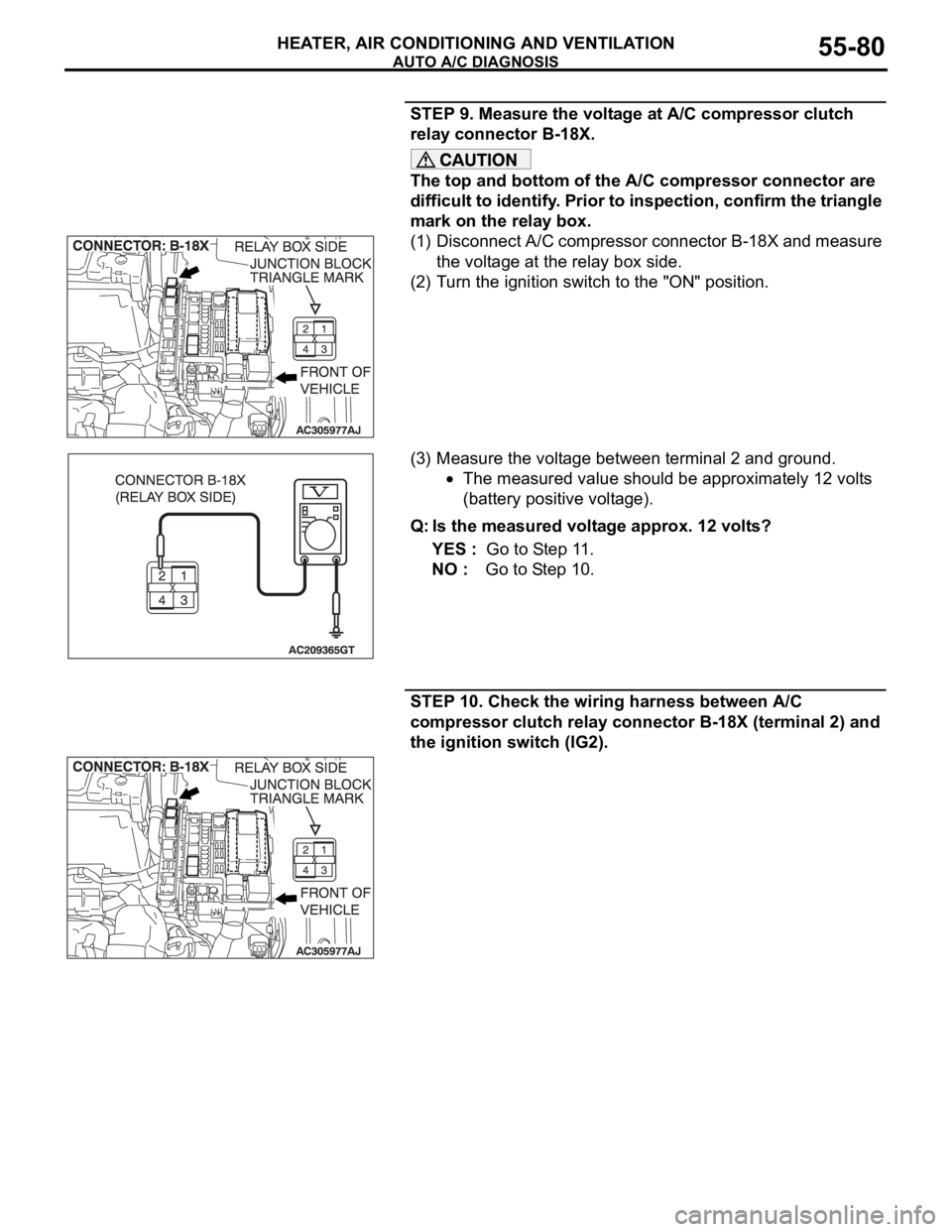
STEP 9. Measure the voltage at A/C compressor clutch
relay connector B-18X.
The top and bottom of the A/C compressor connector are
difficult to identify. Prior to inspection, confirm the triangle
mark on the relay box.
(1) Disconnect A/C compressor connector B-18X and measure
the voltage at the relay box side.
(2) Turn the ignition switch to the "ON" position.
(3) Measure the voltage between terminal 2 and ground.
The measured value should be approximately 12 volts
(battery positive voltage).
Q: Is the measured voltage approx. 12 volts?
YES : Go to Step 11.
NO : Go to Step 10.
STEP 10. Check the wiring harness between A/C
compressor clutch relay connector B-18X (terminal 2) and
the ignition switch (IG2).
Page 782 of 1500
AUTO A/C DIAGNOSIS
HEATER, AIR CONDITIONING AND VENTILATION55-81
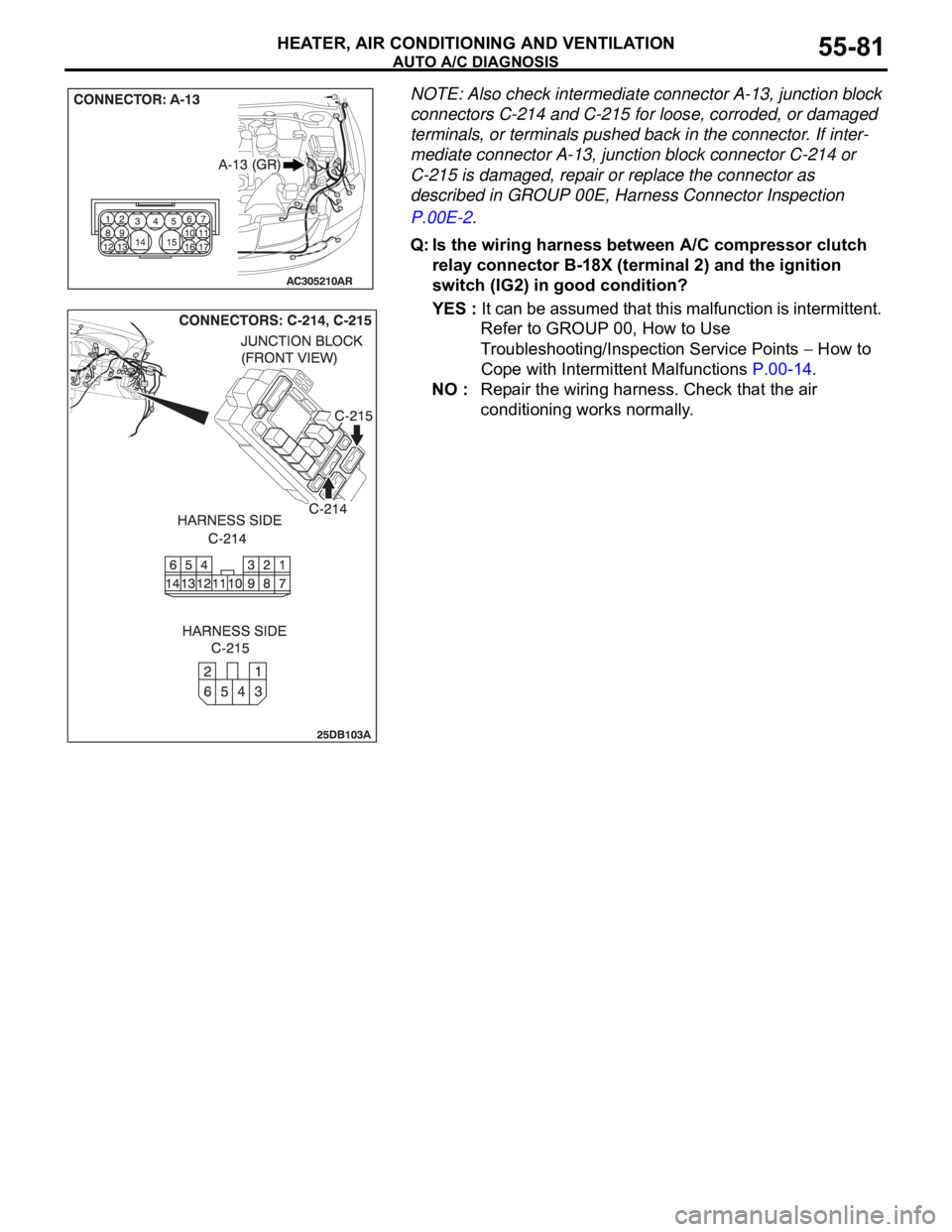
NOTE: Also check intermediate connector A-13, junction block
connectors C-214 and C-215 for loose, corroded, or damaged
terminals, or terminals pushed back in the connector. If inter-
mediate connector A-13, junction block connector C-214 or
C-215 is damaged, repair or replace the connector as
described in GROUP 00E, Harness Connector Inspection
P.00E-2.
Q: Is the wiring harness between A/C compressor clutch
relay connector B-18X (terminal 2) and the ignition
switch (IG2) in good condition?
YES : It can be assumed that this malfunction is intermittent.
Refer to GROUP 00, How to Use
Troubleshooting/Inspection Service Points
How to
Cope with Intermittent Malfunctions P.00-14.
NO : Repair the wiring harness. Check that the air
conditioning works normally.
Page 792 of 1500
AUTO A/C DIAGNOSIS
HEATER, AIR CONDITIONING AND VENTILATION55-91
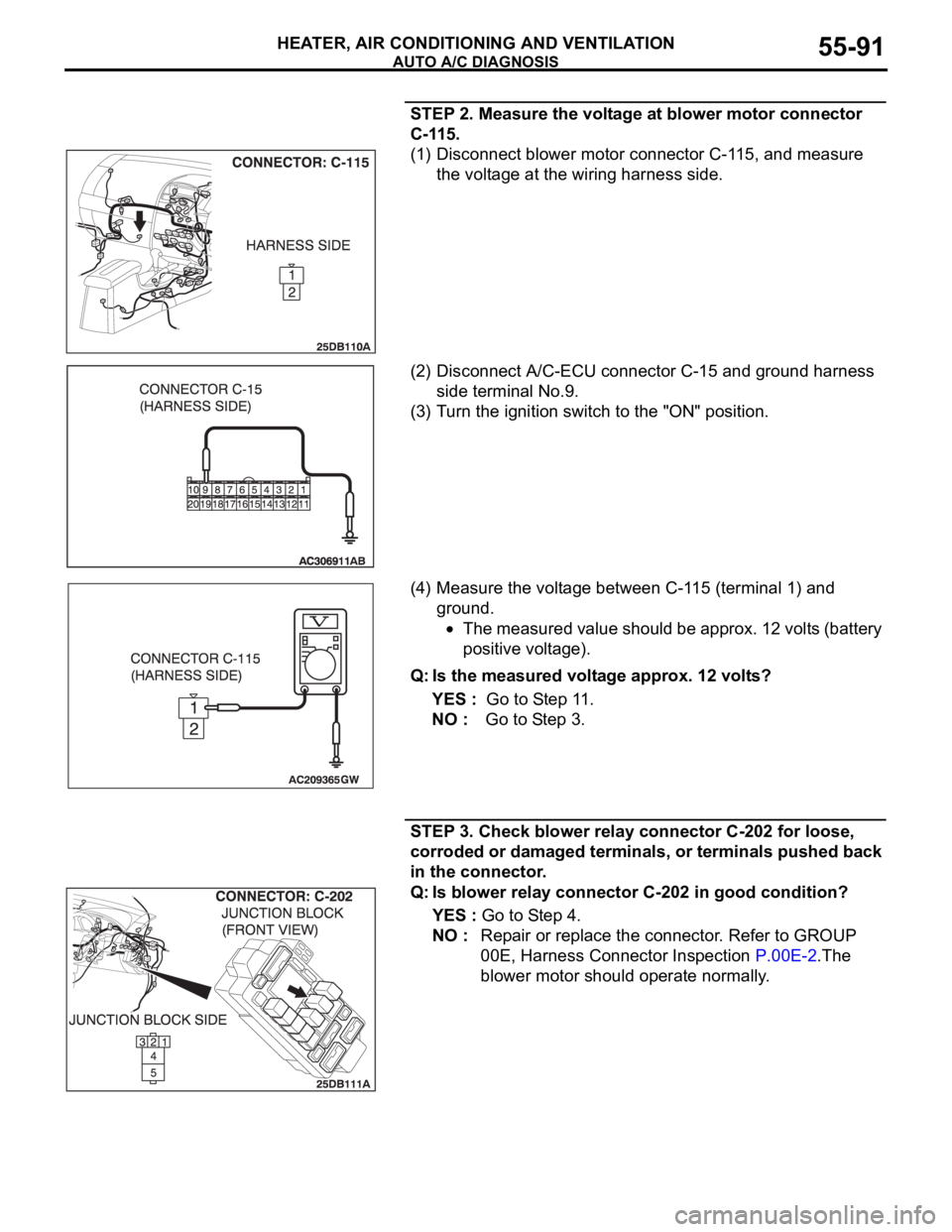
STEP 2. Measure the voltage at blower motor connector
C-115.
(1) Disconnect blower motor connector C-115, and measure
the voltage at the wiring harness side.
(2) Disconnect A/C-ECU connector C-15 and ground harness
side terminal No.9.
(3) Turn the ignition switch to the "ON" position.
(4) Measure the voltage between C-115 (terminal 1) and
ground.
The measured value should be approx. 12 volts (battery
positive voltage).
Q: Is the measured voltage approx. 12 volts?
YES : Go to Step 11.
NO : Go to Step 3.
STEP 3. Check blower relay connector C-202 for loose,
corroded or damaged terminals, or terminals pushed back
in the connector.
Q: Is blower relay connector C-202 in good condition?
YES : Go to Step 4.
NO : Repair or replace the connector. Refer to GROUP
00E, Harness Connector Inspection P.00E-2.The
blower motor should operate normally.
Page 794 of 1500
AUTO A/C DIAGNOSIS
HEATER, AIR CONDITIONING AND VENTILATION55-93
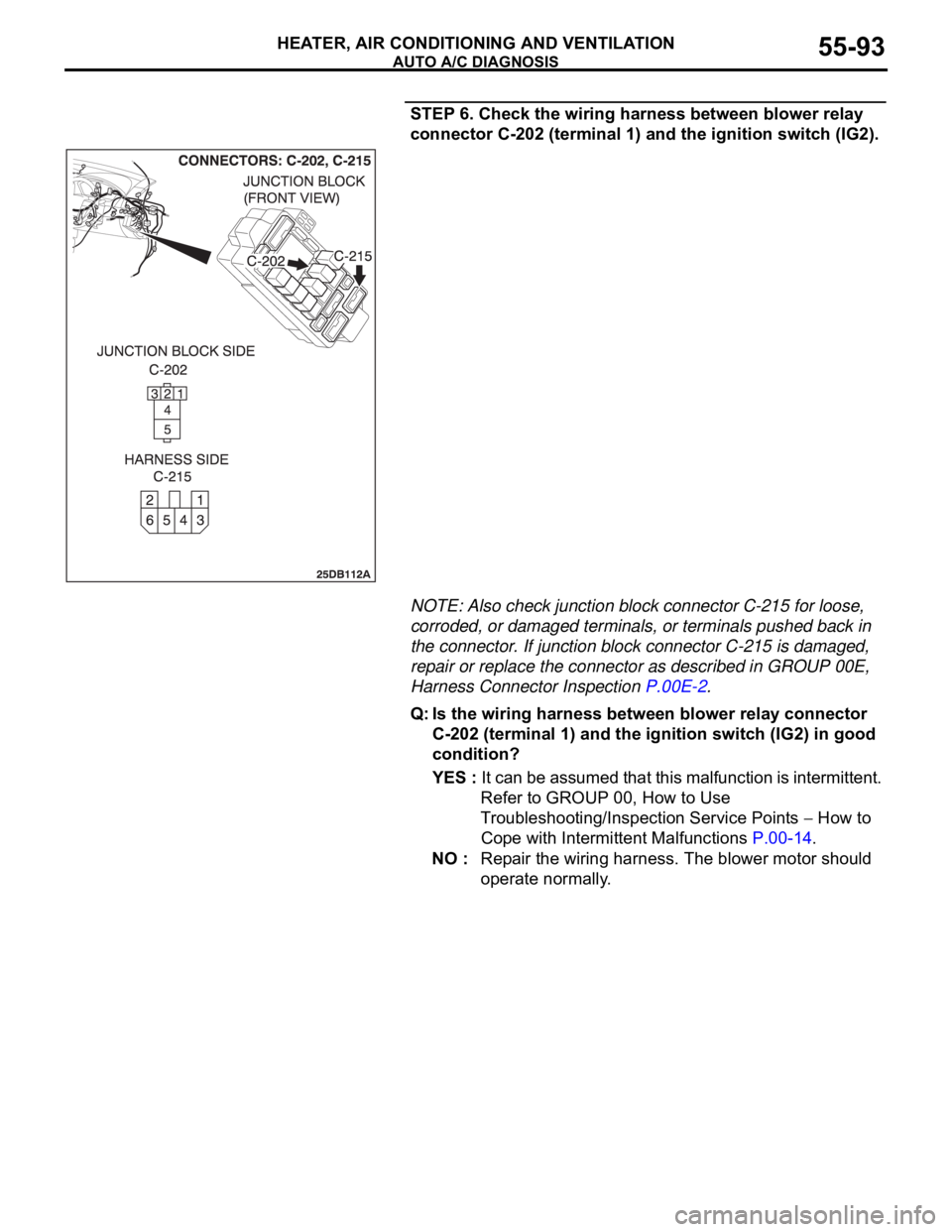
STEP 6. Check the wiring harness between blower relay
connector C-202 (terminal 1) and the ignition switch (IG2).
NOTE: Also check junction block connector C-215 for loose,
corroded, or damaged terminals, or terminals pushed back in
the connector. If junction block connector C-215 is damaged,
repair or replace the connector as described in GROUP 00E,
Harness Connector Inspection P.00E-2.
Q: Is the wiring harness between blower relay connector
C-202 (terminal 1) and the ignition switch (IG2) in good
condition?
YES : It can be assumed that this malfunction is intermittent.
Refer to GROUP 00, How to Use
Troubleshooting/Inspection Service Points
How to
Cope with Intermittent Malfunctions P.00-14.
NO : Repair the wiring harness. The blower motor should
operate normally.
Page 817 of 1500
AUTO A/C DIAGNOSIS
HEATER, AIR CONDITIONING AND VENTILATION55-116
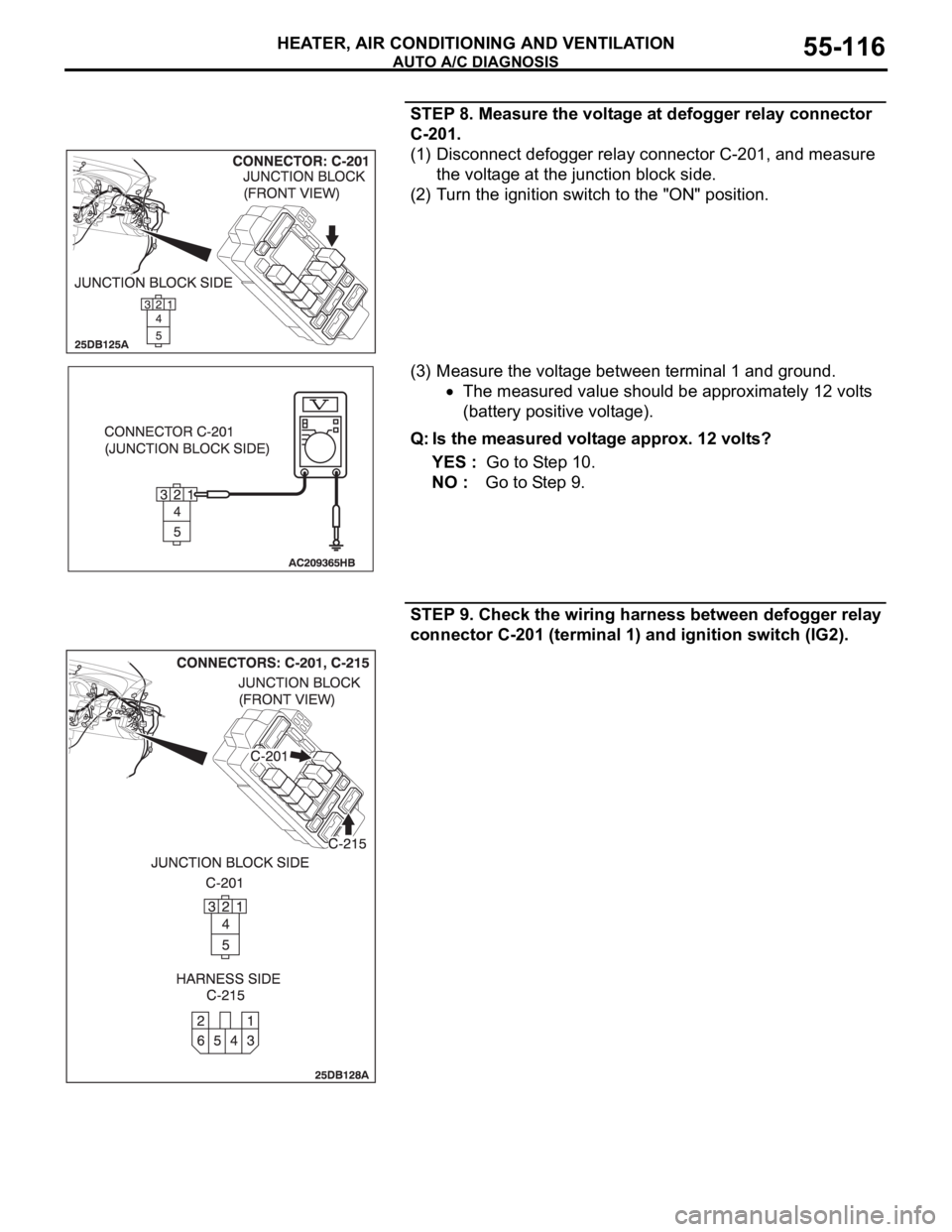
STEP 8. Measure the voltage at defogger relay connector
C-201.
(1) Disconnect defogger relay connector C-201, and measure
the voltage at the junction block side.
(2) Turn the ignition switch to the "ON" position.
(3) Measure the voltage between terminal 1 and ground.
The measured value should be approximately 12 volts
(battery positive voltage).
Q: Is the measured voltage approx. 12 volts?
YES : Go to Step 10.
NO : Go to Step 9.
STEP 9. Check the wiring harness between defogger relay
connector C-201 (terminal 1) and ignition switch (IG2).
Page 818 of 1500
AUTO A/C DIAGNOSIS
HEATER, AIR CONDITIONING AND VENTILATION55-117
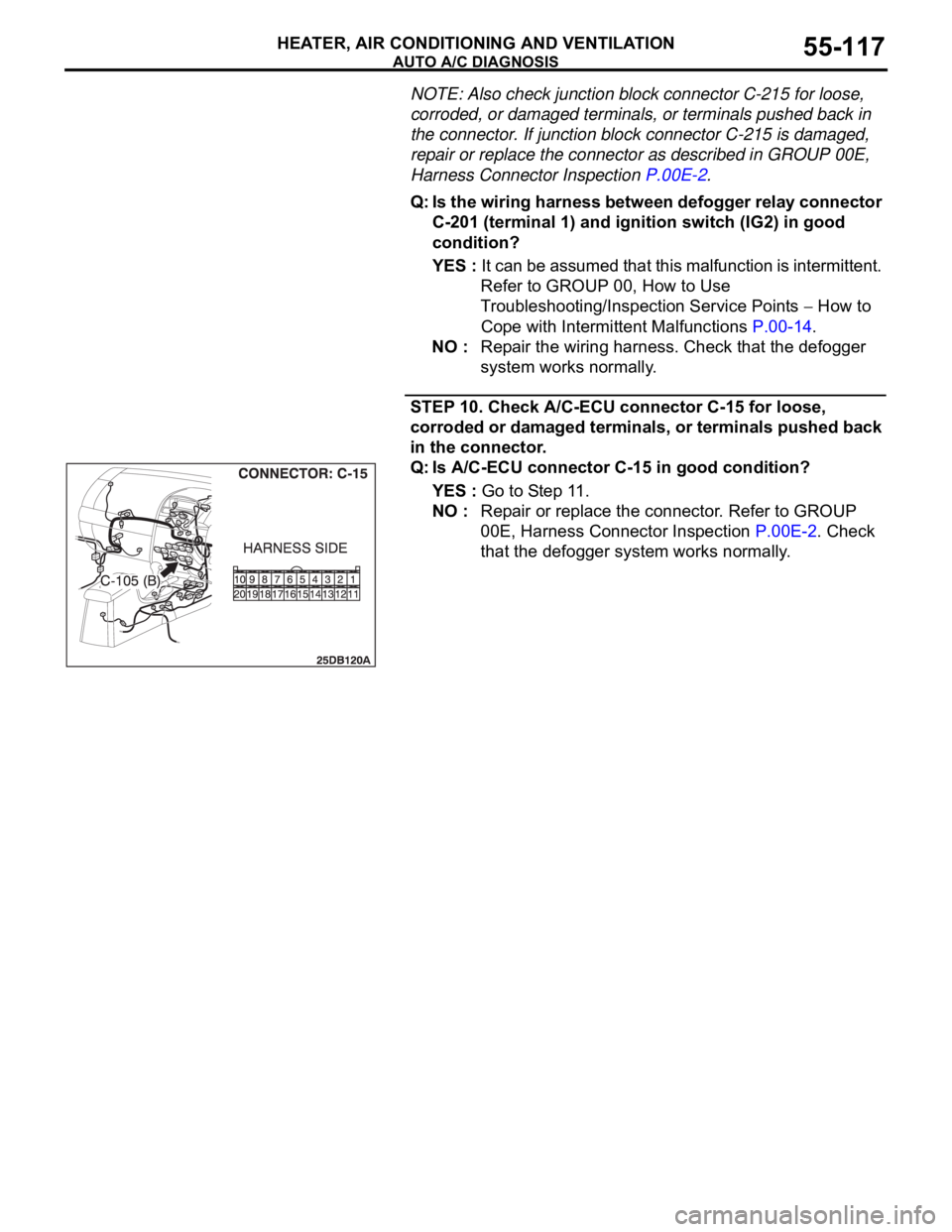
NOTE: Also check junction block connector C-215 for loose,
corroded, or damaged terminals, or terminals pushed back in
the connector. If junction block connector C-215 is damaged,
repair or replace the connector as described in GROUP 00E,
Harness Connector Inspection P.00E-2.
Q: Is the wiring harness between defogger relay connector
C-201 (terminal 1) and ignition switch (IG2) in good
condition?
YES : It can be assumed that this malfunction is intermittent.
Refer to GROUP 00, How to Use
Troubleshooting/Inspection Service Points
How to
Cope with Intermittent Malfunctions P.00-14.
NO : Repair the wiring harness. Check that the defogger
system works normally.
STEP 10. Check A/C-ECU connector C-15 for loose,
corroded or damaged terminals, or terminals pushed back
in the connector.
Q: Is A/C-ECU connector C-15 in good condition?
YES : Go to Step 11.
NO : Repair or replace the connector. Refer to GROUP
00E, Harness Connector Inspection P.00E-2. Check
that the defogger system works normally.
Page 824 of 1500
AUTO A/C DIAGNOSIS
HEATER, AIR CONDITIONING AND VENTILATION55-123
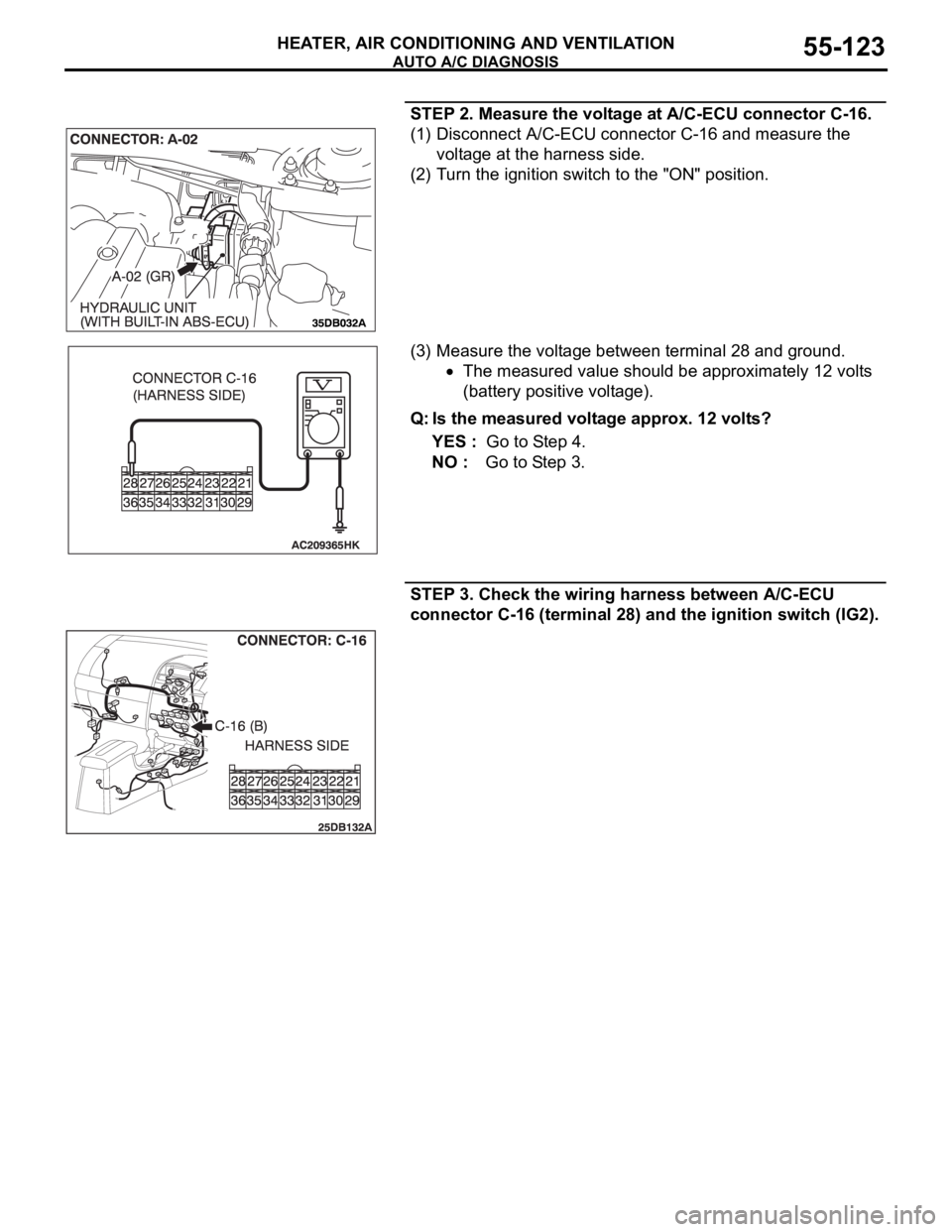
STEP 2. Measure the voltage at A/C-ECU connector C-16.
(1) Disconnect A/C-ECU connector C-16 and measure the
voltage at the harness side.
(2) Turn the ignition switch to the "ON" position.
(3) Measure the voltage between terminal 28 and ground.
The measured value should be approximately 12 volts
(battery positive voltage).
Q: Is the measured voltage approx. 12 volts?
YES : Go to Step 4.
NO : Go to Step 3.
STEP 3. Check the wiring harness between A/C-ECU
connector C-16 (terminal 28) and the ignition switch (IG2).
Page 825 of 1500
AUTO A/C DIAGNOSIS
HEATER, AIR CONDITIONING AND VENTILATION55-124
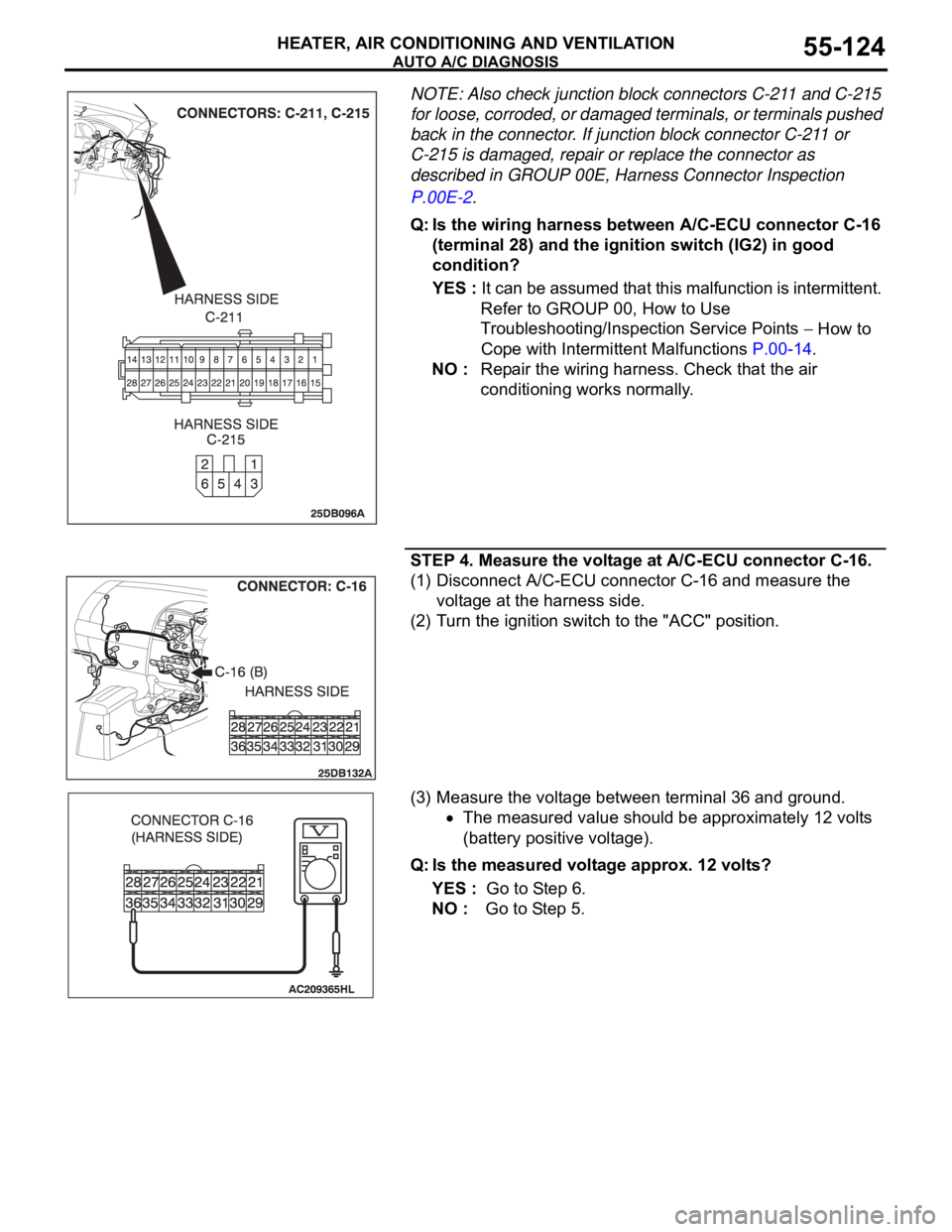
NOTE: Also check junction block connectors C-211 and C-215
for loose, corroded, or damaged terminals, or terminals pushed
back in the connector. If junction block connector C-211 or
C-215 is damaged, repair or replace the connector as
described in GROUP 00E, Harness Connector Inspection
P.00E-2.
Q: Is the wiring harness between A/C-ECU connector C-16
(terminal 28) and the ignition switch (IG2) in good
condition?
YES : It can be assumed that this malfunction is intermittent.
Refer to GROUP 00, How to Use
Troubleshooting/Inspection Service Points
How to
Cope with Intermittent Malfunctions P.00-14.
NO : Repair the wiring harness. Check that the air
conditioning works normally.
STEP 4. Measure the voltage at A/C-ECU connector C-16.
(1) Disconnect A/C-ECU connector C-16 and measure the
voltage at the harness side.
(2) Turn the ignition switch to the "ACC" position.
(3) Measure the voltage between terminal 36 and ground.
The measured value should be approximately 12 volts
(battery positive voltage).
Q: Is the measured voltage approx. 12 volts?
YES : Go to Step 6.
NO : Go to Step 5.
Page 826 of 1500
AUTO A/C DIAGNOSIS
HEATER, AIR CONDITIONING AND VENTILATION55-125
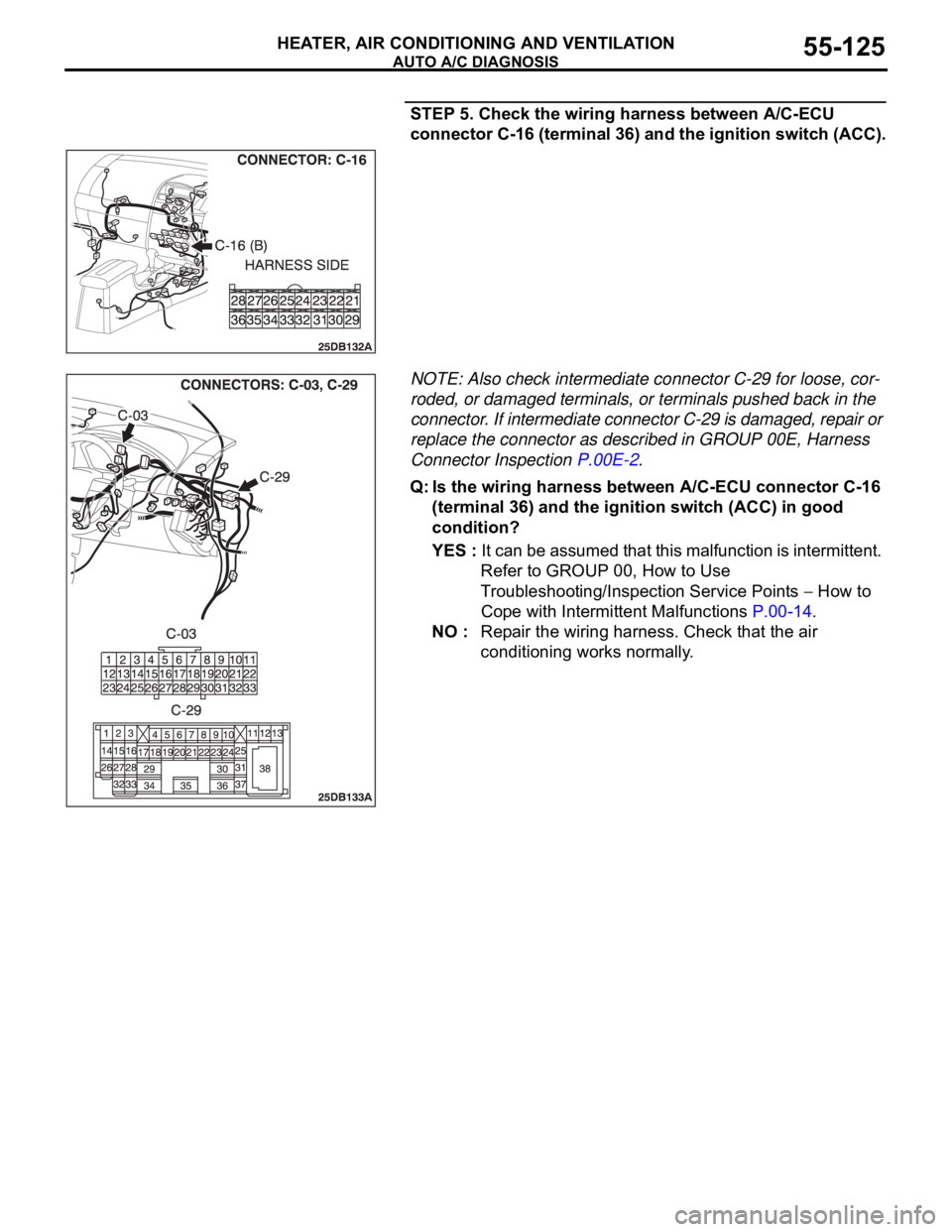
STEP 5. Check the wiring harness between A/C-ECU
connector C-16 (terminal 36) and the ignition switch (ACC).
NOTE: Also check intermediate connector C-29 for loose, cor-
roded, or damaged terminals, or terminals pushed back in the
connector. If intermediate connector C-29 is damaged, repair or
replace the connector as described in GROUP 00E, Harness
Connector Inspection P.00E-2.
Q: Is the wiring harness between A/C-ECU connector C-16
(terminal 36) and the ignition switch (ACC) in good
condition?
YES : It can be assumed that this malfunction is intermittent.
Refer to GROUP 00, How to Use
Troubleshooting/Inspection Service Points
How to
Cope with Intermittent Malfunctions P.00-14.
NO : Repair the wiring harness. Check that the air
conditioning works normally.
Page 907 of 1500
HOW TO DIAGNOSE
GENERAL
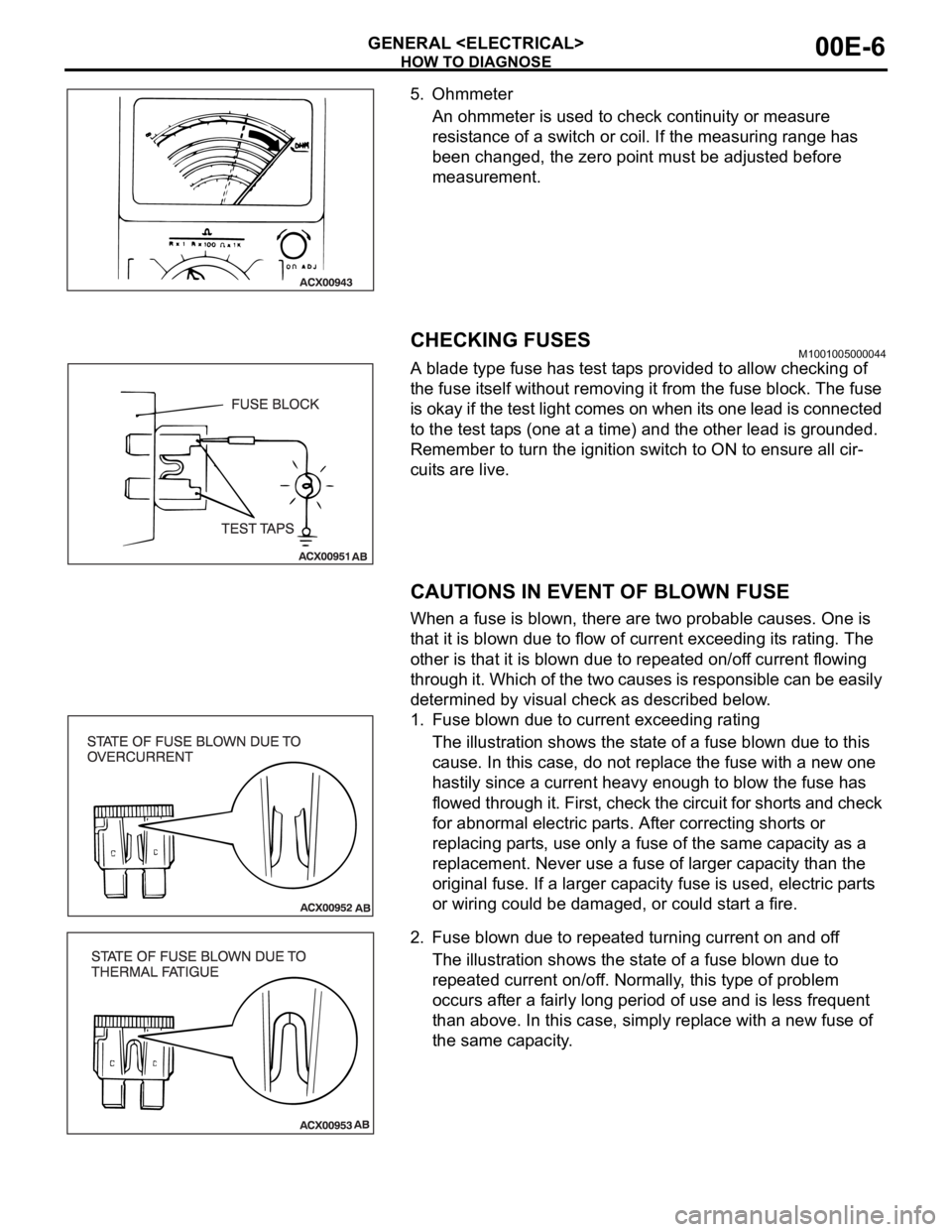
5. Ohmmeter
An ohmmeter is used to check continuity or measure
resistance of a switch or coil. If the measuring range has
been changed, the zero point must be adjusted before
measurement.
CHECKING FUSESM1001005000044
A blade type fuse has test taps provided to allow checking of
the fuse itself without removing it from the fuse block. The fuse
is okay if the test light comes on when its one lead is connected
to the test taps (one at a time) and the other lead is grounded.
Remember to turn the ignition switch to ON to ensure all cir-
cuits are live.
CAUTIONS IN EVENT OF BLOWN FUSE
When a fuse is blown, there are two probable causes. One is
that it is blown due to flow of current exceeding its rating. The
other is that it is blown due to repeated on/off current flowing
through it. Which of the two causes is responsible can be easily
determined by visual check as described below.
1. Fuse blown due to current exceeding rating
The illustration shows the state of a fuse blown due to this
cause. In this case, do not replace the fuse with a new one
hastily since a current heavy enough to blow the fuse has
flowed through it. First, check the circuit for shorts and check
for abnormal electric parts. After correcting shorts or
replacing parts, use only a fuse of the same capacity as a
replacement. Never use a fuse of larger capacity than the
original fuse. If a larger capacity fuse is used, electric parts
or wiring could be damaged, or could start a fire.
2. Fuse blown due to repeated turning current on and off
The illustration shows the state of a fuse blown due to
repeated current on/off. Normally, this type of problem
occurs after a fairly long period of use and is less frequent
than above. In this case, simply replace with a new fuse of
the same capacity.