brakes MITSUBISHI 380 2005 User Guide
[x] Cancel search | Manufacturer: MITSUBISHI, Model Year: 2005, Model line: 380, Model: MITSUBISHI 380 2005Pages: 1500, PDF Size: 47.87 MB
Page 1199 of 1500
DISC BRAKE ASSEMBLY
BASIC BRAKE SYSTEM35A-34
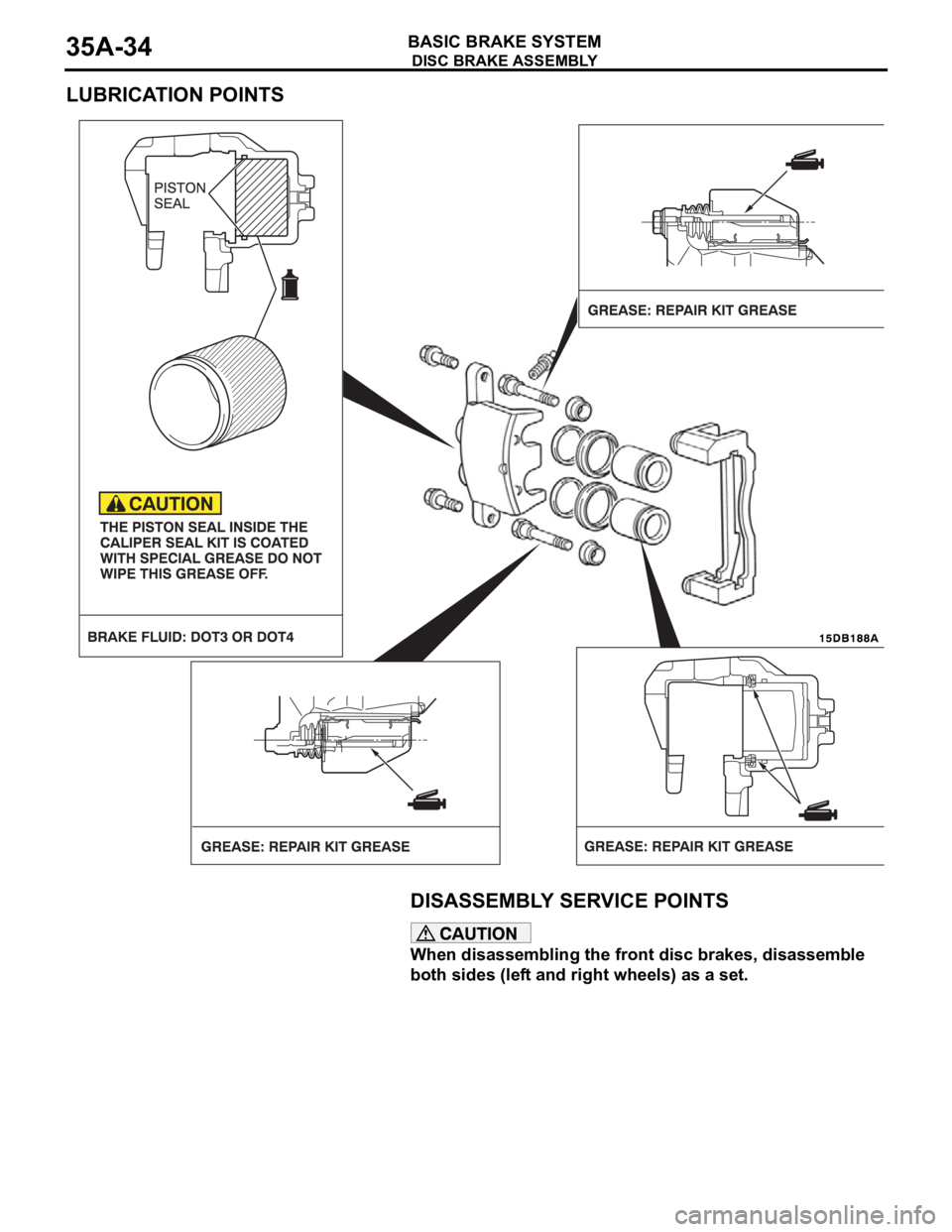
LUBRICATION POINTS
DISASSEMBLY SERVICE POINTS
When disassembling the front disc brakes, disassemble
both sides (left and right wheels) as a set.
.
Page 1202 of 1500
DISC BRAKE ASSEMBLY
BASIC BRAKE SYSTEM35A-37
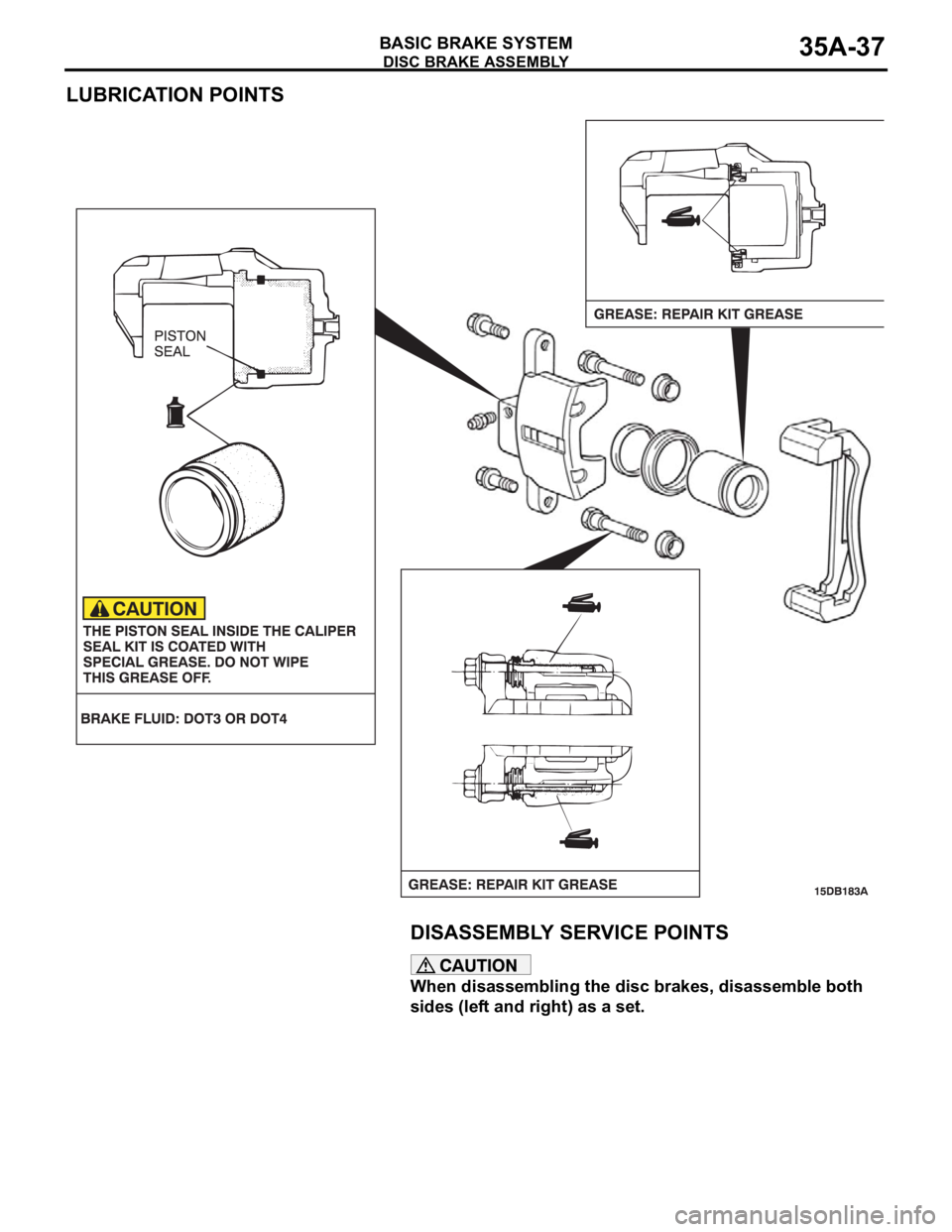
LUBRICATION POINTS
DISASSEMBLY SERVICE POINTS
When disassembling the disc brakes, disassemble both
sides (left and right) as a set.
.
Page 1205 of 1500

SPECIFICATIONS
BASIC BRAKE SYSTEM35A-40
SPECIFICATIONS
FASTENER TIGHTENING SPECIFICATIONSM1351009600390
GENERAL SPECIFICATIONSM1351000200362
ITEM SPECIFICATION
Brake line
Brake tube flare nut 15
2 Nm
Brake pedal
Brake booster nut 14
2 Nm
Brake pedal bolt 13
2 Nm
Front disc brake
Brake hose connector bolt 30
4 Nm
Caliper bleeder 12.5
1.5 Nm
Front brake assembly mounting bolt 100
10 Nm
Front brake bolt (guide pin bolt) 36.5
1.5 Nm
Master cylinder assembly and brake booster
Brake booster nut 14
2 Nm
Brake master cylinder mounting nut 25
2 Nm
Rear disc brake
Brake hose connector bolt 30
4 Nm
Caliper bleeder 12.5
1.5 Nm
Rear brake assembly mounting bolt 60
5 Nm
Rear brake bolt (guide pin bolt) 36.5
1.5 Nm
ITEM SPECIFICATION
Master
cylinderType Tandem type
I.D. mm 25.4
Brake
boosterType Vacuum type, tandem
Effective dia. of power
cylinder mm 205 + 230
Boosting ratio 6.5
Rear wheel hydraulic control method Electronic brake-force distribution (EBD)
Front brakes Type Floating caliper, Aluminium housing, 2 piston, ventilated disc
Disc effective dia
thickness
mm 296 28.0
Wheel cylinder I.D. mm 42.0 x 2
Pad thickness mm 10.0
Clearance adjustment Automatic
Page 1206 of 1500

SPECIFICATIONS
BASIC BRAKE SYSTEM35A-41
SERVICE SPECIFICATIONSM1351000300477
LUBRICANTSM1351000400429
Rear brakes Type Floating caliper, Aluminium housing, 1 piston, ventilated disc
Disc effective dia
thickness
mm 303 18
Wheel cylinder I.D. mm 40.5
Pad thickness mm 10.0
Clearance adjustment Automatic ITEM SPECIFICATION
ITEM STANDARD VALUE LIMIT
Brake pedal height mm A/T 168.5
171.5
M/T 169.4 172.4
Brake pedal free play mm 3
8
Brake pedal to floor board clearance mm 110 or more
Disc brake pad thickness mm 10.0 Minimum 2.0
Disc brake disc thickness
mm Front 28.0 Minimum 26.4
Rear 18.0 Minimum 16.4
Disc brake disc run-out
mm Front
0.1
Rear
0.04
Disc brake drag force N Front 64 or less
Rear 54 or less
Hub end play mm 0.05
Brake booster push rod protruding length mm.
[When applying negative pressure of 66.7 kPa to the
brake booster]5.0
0.1
ITEM SPECIFIED LUBRICANT
Brake fluid DOT3 or DOT4
Piston boot, piston seal Repair kit grease
Front brake pin, rear brake pin (guide pin)
Page 1208 of 1500
36-1
GROUP 36
PARKING BRAKES
CONTENTS
GENERAL DESCRIPTION. . . . . . . . .36-2
PARKING BRAKE DIAGNOSIS . . . .36-2
INTRODUCTION. . . . . . . . . . . . . . . . . . . . . 36-2
TROUBLESHOOTING STRATEGY . . . . . . 36-2
SYMPTOM CHART. . . . . . . . . . . . . . . . . . . 36-2
SYMPTOM PROCEDURES . . . . . . . . . . . . 36-3
ON-VEHICLE SERVICE . . . . . . . . . . .36-3
PARKING BRAKE LEVER STROKE CHECK
AND ADJUSTMENT . . . . . . . . . . . . . . . . . . 36-3
PARKING BRAKE SWITCH CHECK . . . . . 36-5
PARKING BRAKE LINING SEATING
PROCEDURE . . . . . . . . . . . . . . . . . . . . . . . 36-5
PARKING BRAKE LEVER . . . . . . . . .36-6
REMOVAL AND INSTALLATION . . . . . . . . 36-6
PARKING BRAKE CABLE . . . . . . . . .36-7
REMOVAL AND INSTALLATION . . . . . . . . 36-7
PARKING BRAKE LINING AND
DRUM . . . . . . . . . . . . . . . . . . . . . . . . .36-8
REMOVAL AND INSTALLATION . . . . . . . . 36-8
INSPECTION. . . . . . . . . . . . . . . . . . . . . . . . 36-11
SPECIFICATIONS . . . . . . . . . . . . . . .36-12
FASTENER TIGHTENING SPECIFICATIONS36-12
SERVICE SPECIFICATIONS . . . . . . . . . . . 36-12
LUBRICANT . . . . . . . . . . . . . . . . . . . . . . . . 36-12
Page 1209 of 1500
GENERAL DESCRIPTION
PARKING BRAKES36-2
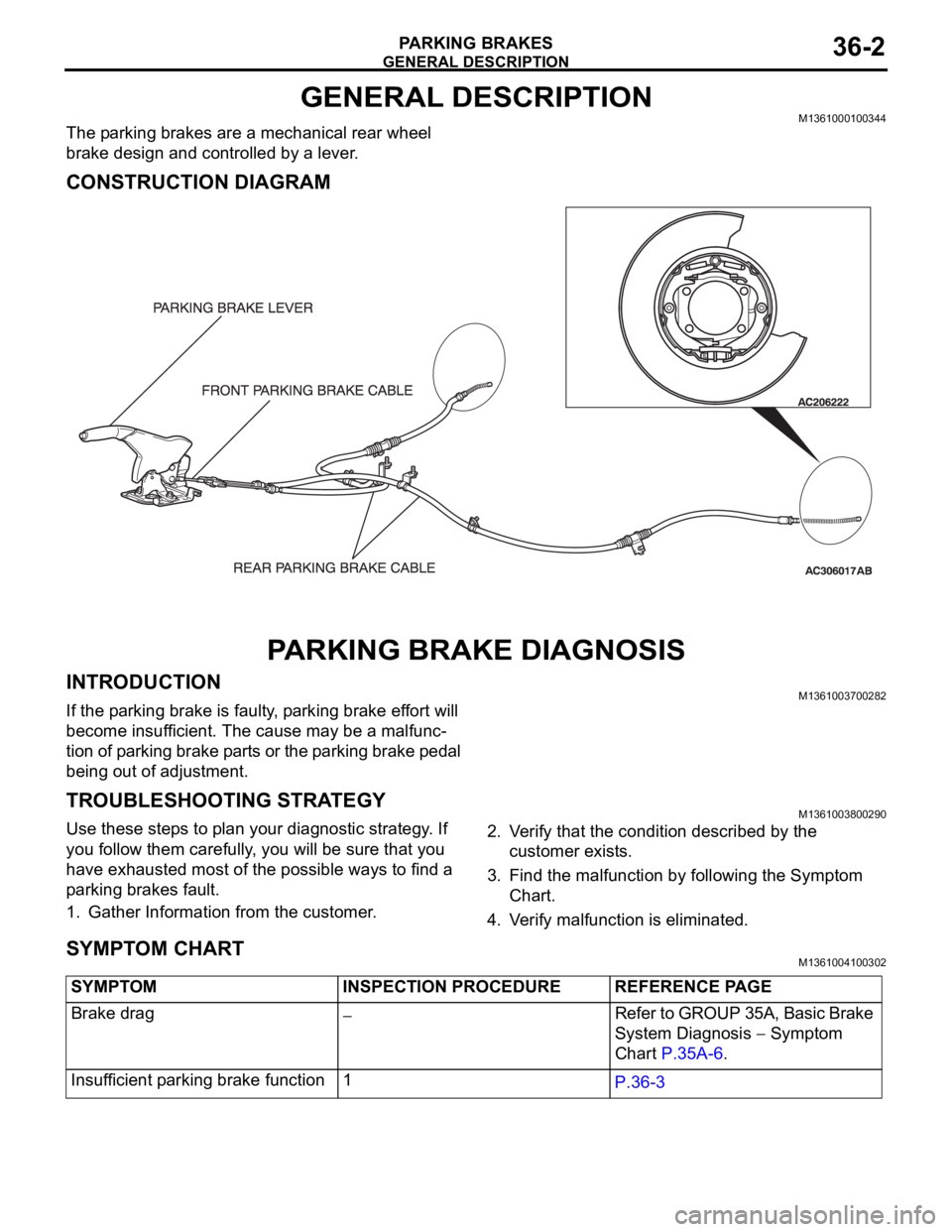
GENERAL DESCRIPTIONM1361000100344
The parking brakes are a mechanical rear wheel
brake design and controlled by a lever.
CONSTRUCTION DIAGRAM
PARKING BRAKE DIAGNOSIS
INTRODUCTIONM1361003700282
If the parking brake is faulty, parking brake effort will
become insufficient. The cause may be a malfunc-
tion of parking brake parts or the parking brake pedal
being out of adjustment.
TROUBLESHOOTING STRATEGYM1361003800290
Use these steps to plan your diagnostic strategy. If
you follow them carefully, you will be sure that you
have exhausted most of the possible ways to find a
parking brakes fault.
1. Gather Information from the customer.2. Verify that the condition described by the
customer exists.
3. Find the malfunction by following the Symptom
Chart.
4. Verify malfunction is eliminated.
SYMPTOM CHARTM1361004100302
SYMPTOM INSPECTION PROCEDURE REFERENCE PAGE
Brake drag
Refer to GROUP 35A, Basic Brake
System Diagnosis
Symptom
Chart P.35A-6.
Insufficient parking brake function 1
P.36-3
Page 1210 of 1500
ON-VEHICLE SERVICE
PARKING BRAKES36-3
SYMPTOM PROCEDURES
INSPECTION PROCEDURE 1: Insufficient Parking Brake Function
DIAGNOSIS
STEP 1. Check the excessive parking brake lever
stroke.
Refer to P.36-3.
Q: Is the parking brake lever stroke adjusted
properly?
YES :
Go to Step 2.
NO : Adjust the parking brake lever stroke or
check the parking brake cable routing. Then
go to Step 5.
STEP 2. Check the parking brake cable for
sticking.
Q: Is the parking brake cable stuck?
YES :
Replace the cable. Then go to Step 5.
NO : Go to Step 3.
STEP 3. Check the brake lining and brake drum
for wear.
Refer to P.36-11.
Q: Is the brake lining thickness or brake drum inside
diameter outside of specification?
YES :
Replace the rear brake shoe assembly or
rear brake disc (Refer to P.36-8). Then go to
Step 5.
NO : Go to Step 4.
STEP 4. Check for oil, water, etc., on the lining
contact surfaces.
Q: Is oil, water, etc., on the lining contact surface?
YES :
Replace the part and determine and repair
source/cause of foreign material. Then go to
St e p 5.
NO : Carry out the parking brake lining seating
(Refer to P.36-5) and then go to Step 5.
STEP 5. Retest the system.
Q: Is the malfunction eliminated?
YES :
The procedure is complete.
NO : Recheck from Step 1.
ON-VEHICLE SERVICE
PARKING BRAKE LEVER STROKE CHECK AND
ADJUSTMENT
M1361000900362
1. Pull the parking brake lever with a force of approximately
200 N (45 pounds) and count the number of notches.
Standard value: 5
7 notches
2. If the parking brake lever stroke is not within the standard
value, adjust as described below.
(1) Release the parking brake.
Page 1211 of 1500
ON-VEHICLE SERVICE
PARKING BRAKES36-4
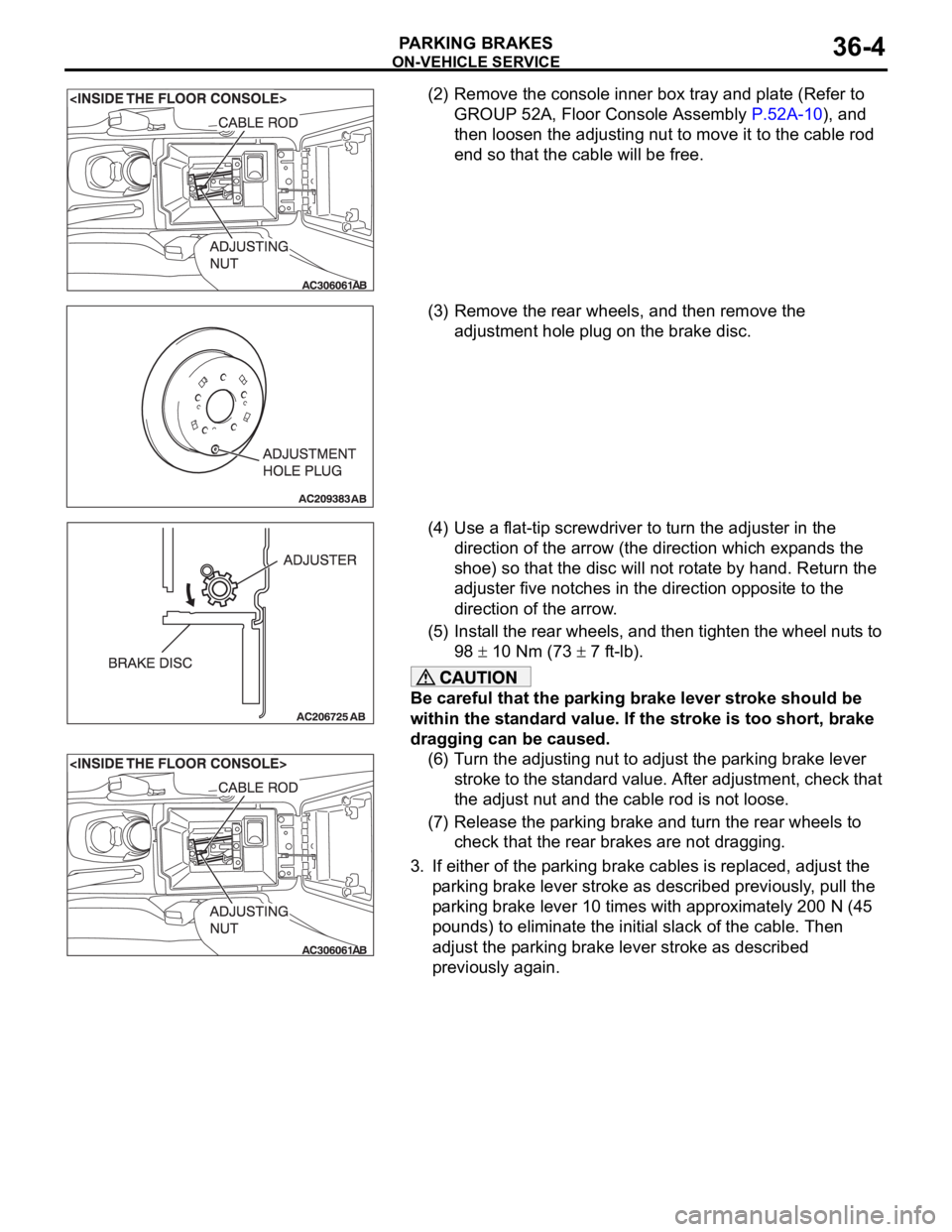
(2) Remove the console inner box tray and plate (Refer to
GROUP 52A, Floor Console Assembly P.52A-10), and
then loosen the adjusting nut to move it to the cable rod
end so that the cable will be free.
(3) Remove the rear wheels, and then remove the
adjustment hole plug on the brake disc.
(4) Use a flat-tip screwdriver to turn the adjuster in the
direction of the arrow (the direction which expands the
shoe) so that the disc will not rotate by hand. Return the
adjuster five notches in the direction opposite to the
direction of the arrow.
(5) Install the rear wheels, and then tighten the wheel nuts to
98
10 Nm (73 7 ft-lb).
Be careful that the parking brake lever stroke should be
within the standard value. If the stroke is too short, brake
dragging can be caused.
(6) Turn the adjusting nut to adjust the parking brake lever
stroke to the standard value. After adjustment, check that
the adjust nut and the cable rod is not loose.
(7) Release the parking brake and turn the rear wheels to
check that the rear brakes are not dragging.
3. If either of the parking brake cables is replaced, adjust the
parking brake lever stroke as described previously, pull the
parking brake lever 10 times with approximately 200 N (45
pounds) to eliminate the initial slack of the cable. Then
adjust the parking brake lever stroke as described
previously again.
Page 1212 of 1500
ON-VEHICLE SERVICE
PARKING BRAKES36-5
PARKING BRAKE SWITCH CHECKM1361003300411
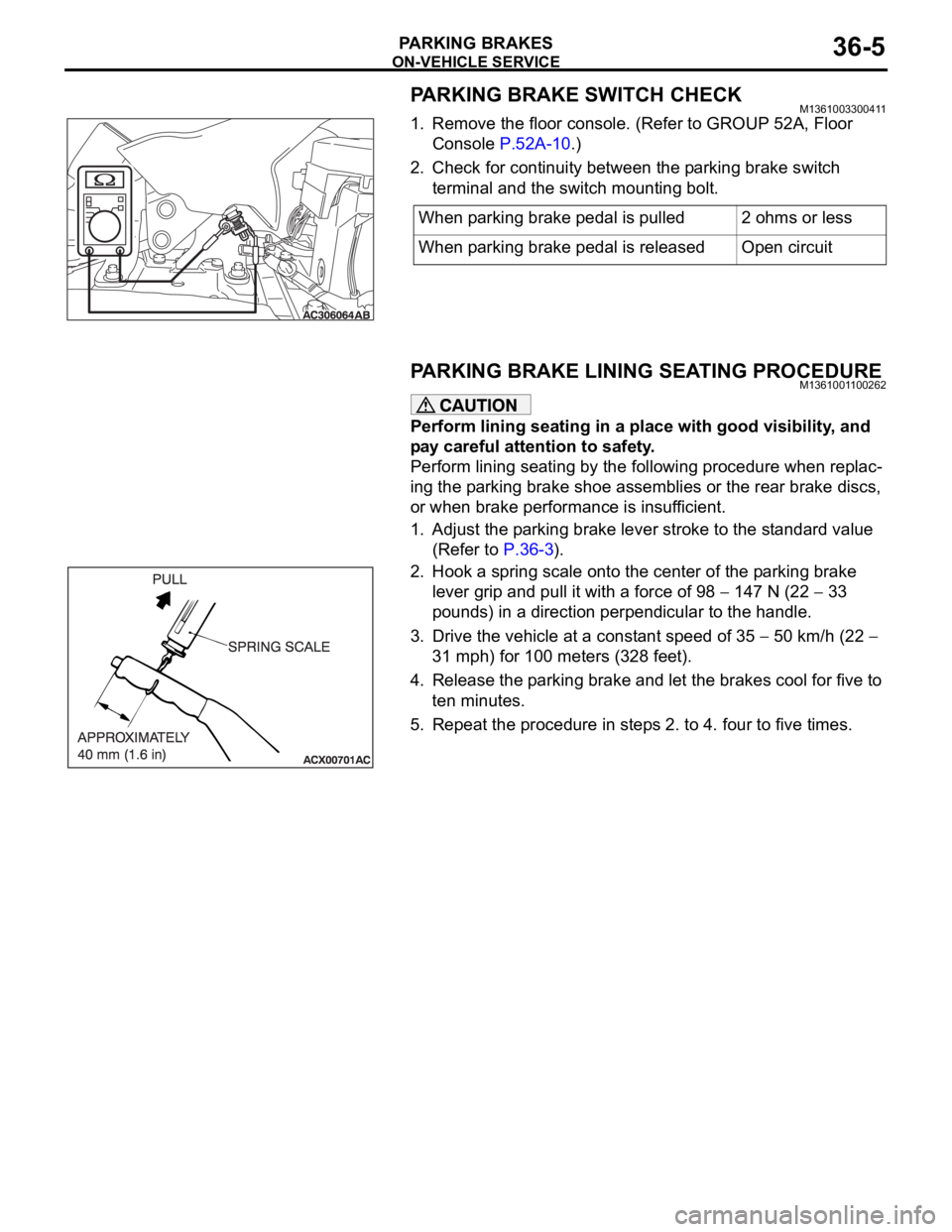
1. Remove the floor console. (Refer to GROUP 52A, Floor
Console P.52A-10.)
2. Check for continuity between the parking brake switch
terminal and the switch mounting bolt.
PARKING BRAKE LINING SEATING PROCEDUREM1361001100262
Perform lining seating in a place with good visibility, and
pay careful attention to safety.
Perform lining seating by the following procedure when replac-
ing the parking brake shoe assemblies or the rear brake discs,
or when brake performance is insufficient.
1. Adjust the parking brake lever stroke to the standard value
(Refer to P.36-3).
2. Hook a spring scale onto the center of the parking brake
lever grip and pull it with a force of 98
147 N (22 33
pounds) in a direction perpendicular to the handle.
3. Drive the vehicle at a constant speed of 35
50 km/h (22
31 mph) for 100 meters (328 feet).
4. Release the parking brake and let the brakes cool for five to
ten minutes.
5. Repeat the procedure in steps 2. to 4. four to five times.When parking brake pedal is pulled 2 ohms or less
When parking brake pedal is released Open circuit
Page 1213 of 1500
PARKING BRAKE LEVER
PARKING BRAKES36-6
PARKING BRAKE LEVER
REMOVAL AND INSTALLATIONM1361001300363
Pre-removal Operation
Rear Floor Console Assembly and Rear Console Bracket
Removal (Refer to GROUP 52A, Floor Console P.52A-10.)Post-installation Operation
Parking Brake Lever Stroke Adjustment (Refer to P.36-3.)
Rear Console Bracket and Rear Floor Console Assembly
Installation (Refer to GROUP 52A, Floor Console
P.52A-10.)
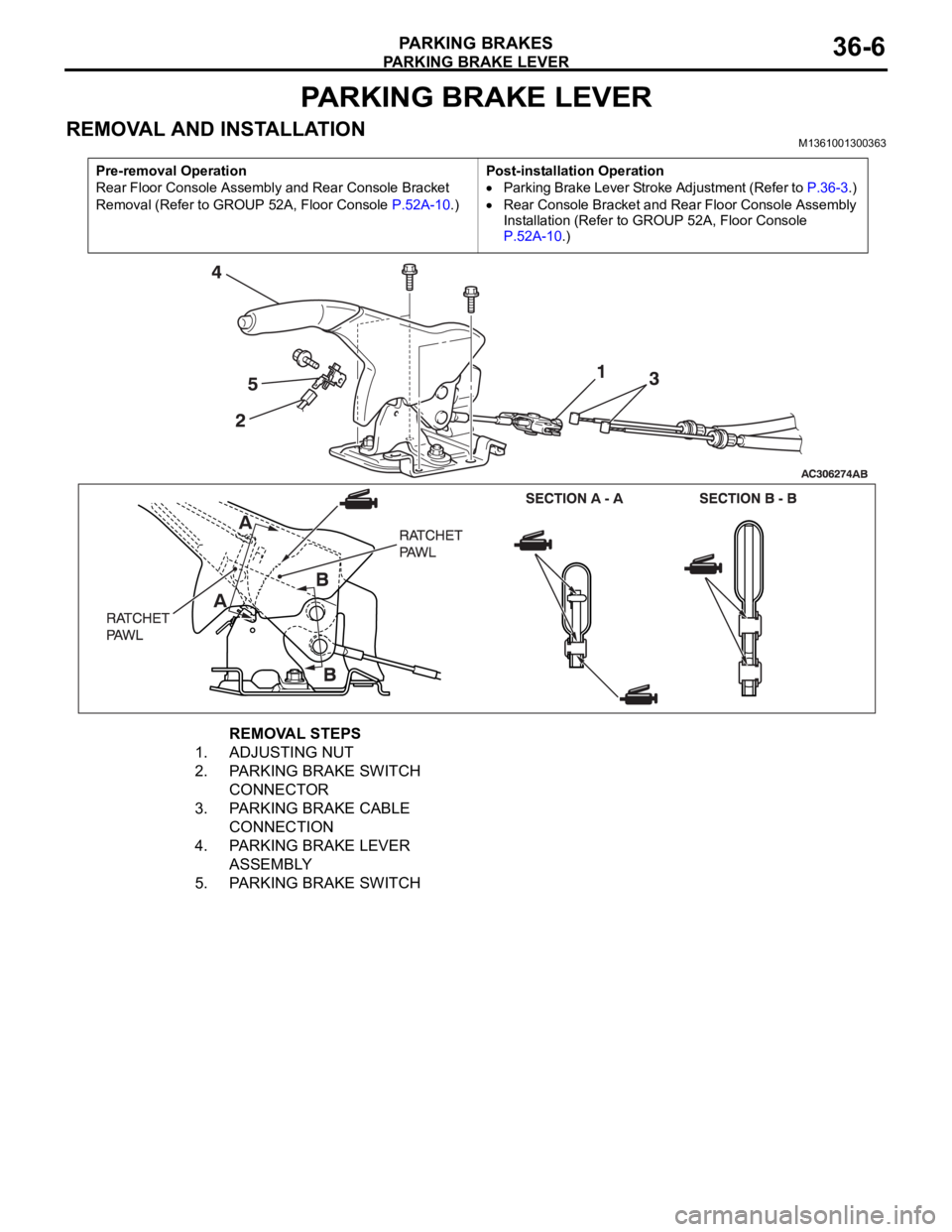
REMOVAL STEPS
1. ADJUSTING NUT
2. PARKING BRAKE SWITCH
CONNECTOR
3. PARKING BRAKE CABLE
CONNECTION
4. PARKING BRAKE LEVER
ASSEMBLY
5. PARKING BRAKE SWITCH