service MITSUBISHI 380 2005 Manual Online
[x] Cancel search | Manufacturer: MITSUBISHI, Model Year: 2005, Model line: 380, Model: MITSUBISHI 380 2005Pages: 1500, PDF Size: 47.87 MB
Page 865 of 1500
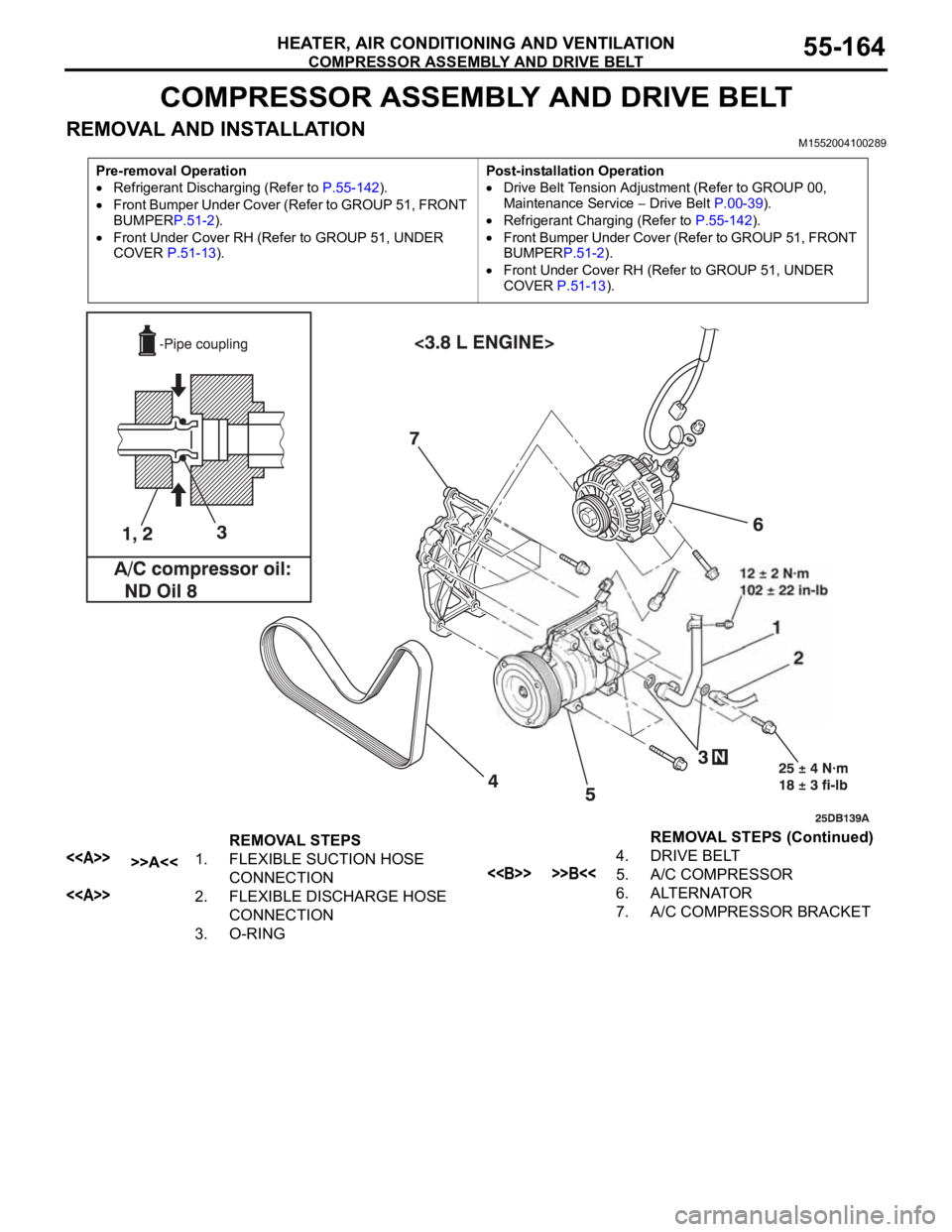
COMPRESSOR ASSEMBLY AND DRIVE BELT
HEATER, AIR CONDITIONING AND VENTILATION55-164
COMPRESSOR ASSEMBLY AND DRIVE BELT
REMOVAL AND INSTALLATIONM1552004100289
Pre-removal Operation
Refrigerant Discharging (Refer to P.55-142).
Front Bumper Under Cover (Refer to GROUP 51, FRONT
BUMPERP.51-2).
Front Under Cover RH (Refer to GROUP 51, UNDER
COVER P.51-13).Post-installation Operation
Drive Belt Tension Adjustment (Refer to GROUP 00,
Maintenance Service
Drive Belt P.00-39).
Refrigerant Charging (Refer to P.55-142).
Front Bumper Under Cover (Refer to GROUP 51, FRONT
BUMPERP.51-2).
Front Under Cover RH (Refer to GROUP 51, UNDER
COVER P.51-13).
REMOVAL STEPS
<>>>A<<1. FLEXIBLE SUCTION HOSE
CONNECTION
<>2. FLEXIBLE DISCHARGE HOSE
CONNECTION
3. O-RING4. DRIVE BELT
<> >>B<<5. A/C COMPRESSOR
6. ALTERNATOR
7. A/C COMPRESSOR BRACKETREMOVAL STEPS (Continued)
Page 866 of 1500
Page 869 of 1500
Page 872 of 1500
Page 873 of 1500
REFRIGERANT LINE
HEATER, AIR CONDITIONING AND VENTILATION55-172
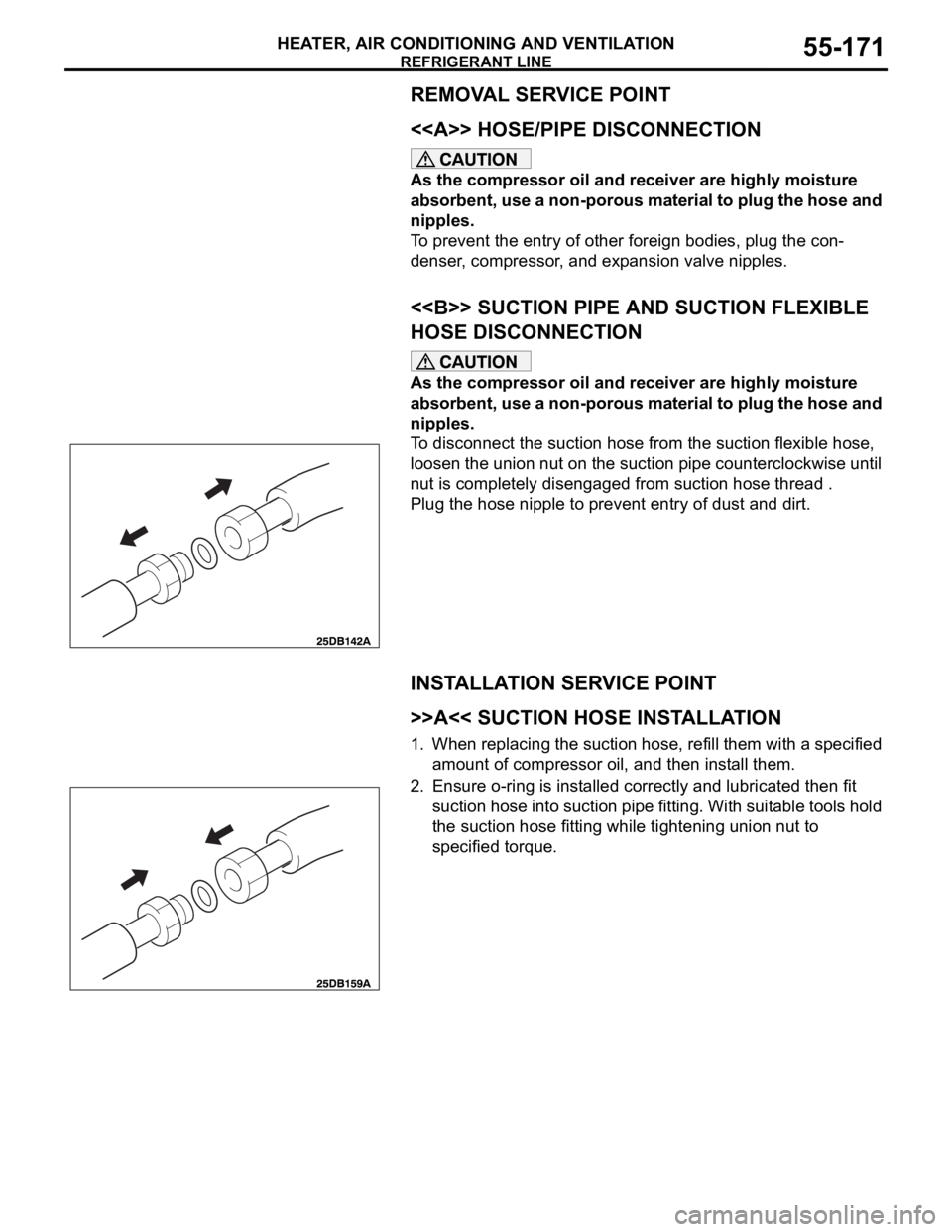
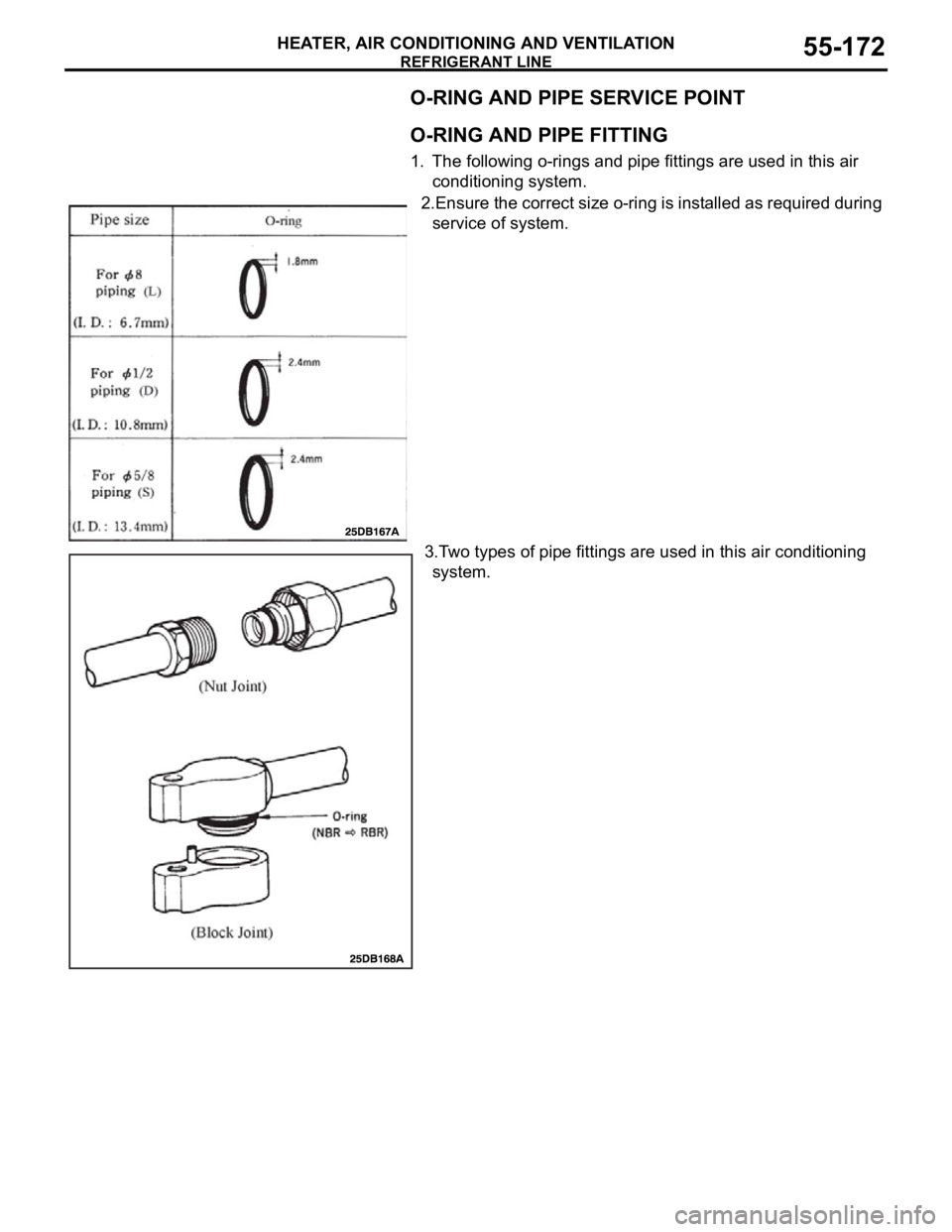
O-RING AND PIPE SERVICE POINT
.
O-RING AND PIPE FITTING
1. The following o-rings and pipe fittings are used in this air
conditioning system.
2.Ensure the correct size o-ring is installed as required during
service of system.
3.Two types of pipe fittings are used in this air conditioning
system.
.
Page 879 of 1500

SPECIFICATIONS
HEATER, AIR CONDITIONING AND VENTILATION55-178
SPECIFICATIONS
FASTENER TIGHTENING SPECIFICATIONSM1552012100273
GENERAL SPECIFICATIONSM1552000200262
SERVICE SPECIFICATIONSM1552000300333
LUBRICANTSM1552000400329
ITEM SPECIFICATION
Liquid pipe mounting nut (heater unit side) 4.9
0.9 Nm (43 8 in-lb)
Liquid pipe mounting bolt (condenser side) 4.9
0.9 Nm (44 8 in-lb)
Suction flexible hose mounting nut (compressor side) 25
4 Nm (18 3 ft-lb)
Suction pipe mounting nut (heater unit side) 12
2 Nm (107 17 in-lb)
Suction pipe to suction hose union nut 32
2 Nm
Discharge flexible hose mounting bolt (compressor side) 25
4 Nm (18 3 ft-lb)
Discharge flexible hose mounting nut (condenser side) 12
2 Nm (107 17 in-lb)
ITEM MANUAL AIR CONDITIONING
Heater control Dial type
Air conditioning switch Push-button type
Compressor Type 10S17 (Swashplate type)
Displacement (cm
3)188
Refrigerant Type R134a (HFC-134a)
Amount (grams) 435
475
ITEM STANDARD VALUE
Idle speed r/min 680
50
Idle-up speed r/min 680
50
Air mix damper potentiometer resistance k
1.7 5.0
Air outlet changeover damper potentiometer resistance k
0.8 4.8
Air gap (air conditioning compressor clutch) mm (in) 0.3
0.5 (0.012 0.020)
ITEM SPECIFIED LUBRICANT QUANTITY(ml)
Each connection of refrigerant line ND Oil 8 As required
Compressor refrigerant unit lubricant (ml) ND Oil 8 140
Page 916 of 1500
14-1
GROUP 14
ENGINE COOLING
CONTENTS
GENERAL DESCRIPTION. . . . . . . . .14-2
SPECIAL TOOL . . . . . . . . . . . . . . . . .14-2
ENGINE COOLING DIAGNOSIS . . . .14-2
INTRODUCTION. . . . . . . . . . . . . . . . . . . . . 14-2
TROUBLESHOOTING STRATEGY . . . . . . 14-2
SYMPTOM CHART. . . . . . . . . . . . . . . . . . . 14-3
SYMPTOM PROCEDURES . . . . . . . . . . . . 14-3
ON-VEHICLE SERVICE . . . . . . . . . . .14-26
ENGINE COOLANT LEAK CHECK . . . . . . 14-26
RADIATOR CAP PRESSURE CHECK . . . . 14-27
ENGINE COOLANT REPLACEMENT . . . . 14-27
ENGINE COOLANT CONCENTRATION TEST14-29
FAN CONTROLLER CHECK . . . . . . . . . . . 14-29
FAN CONTROL RELAY CONTINUITY CHECK14-31
RADIATOR . . . . . . . . . . . . . . . . . . . . .14-32
REMOVAL AND INSTALLATION . . . . . . . . 14-32
THERMOSTAT . . . . . . . . . . . . . . . . . .14-35
REMOVAL AND INSTALLATION . . . . . . . . 14-35
INSPECTION. . . . . . . . . . . . . . . . . . . . . . . . 14-38
WATER PUMP . . . . . . . . . . . . . . . . . .14-39
REMOVAL AND INSTALLATION . . . . . . . . 14-39
WATER HOSE AND WATER PIPE . .14-40
REMOVAL AND INSTALLATION . . . . . . . . 14-40
INSPECTION. . . . . . . . . . . . . . . . . . . . . . . . 14-41
SPECIFICATIONS . . . . . . . . . . . . . . .14-42
FASTENER TIGHTENING
SPECIFICATIONS. . . . . . . . . . . . . . . . . . . . 14-42
SERVICE SPECIFICATION . . . . . . . . . . . . 14-43
CAPACITIES . . . . . . . . . . . . . . . . . . . . . . . . 14-43
SEALANTS . . . . . . . . . . . . . . . . . . . . . . . . . 14-43
Page 917 of 1500
GENERAL DESCRIPTION
ENGINE COOLING14-2
GENERAL DESCRIPTIONM1141000100401
The cooling system is designed to keep every
part of the engine at appropriate temperature in
whatever condition the engine may be operated.
The cooling method is of the water-cooled, pres-
sure forced circulation type in which the water
pump pressurizes coolant and circulates it
throughout the engine. If the coolant temperature exceeds the prescribed temperature, the thermo-
stat opens to circulate the coolant through the
radiator as well so that the heat absorbed by the
coolant may be radiated into the air. The water
pump is of the centrifugal type and is driven by
the drive belt from the crankshaft. The radiator is
the corrugated fin, down flow type.
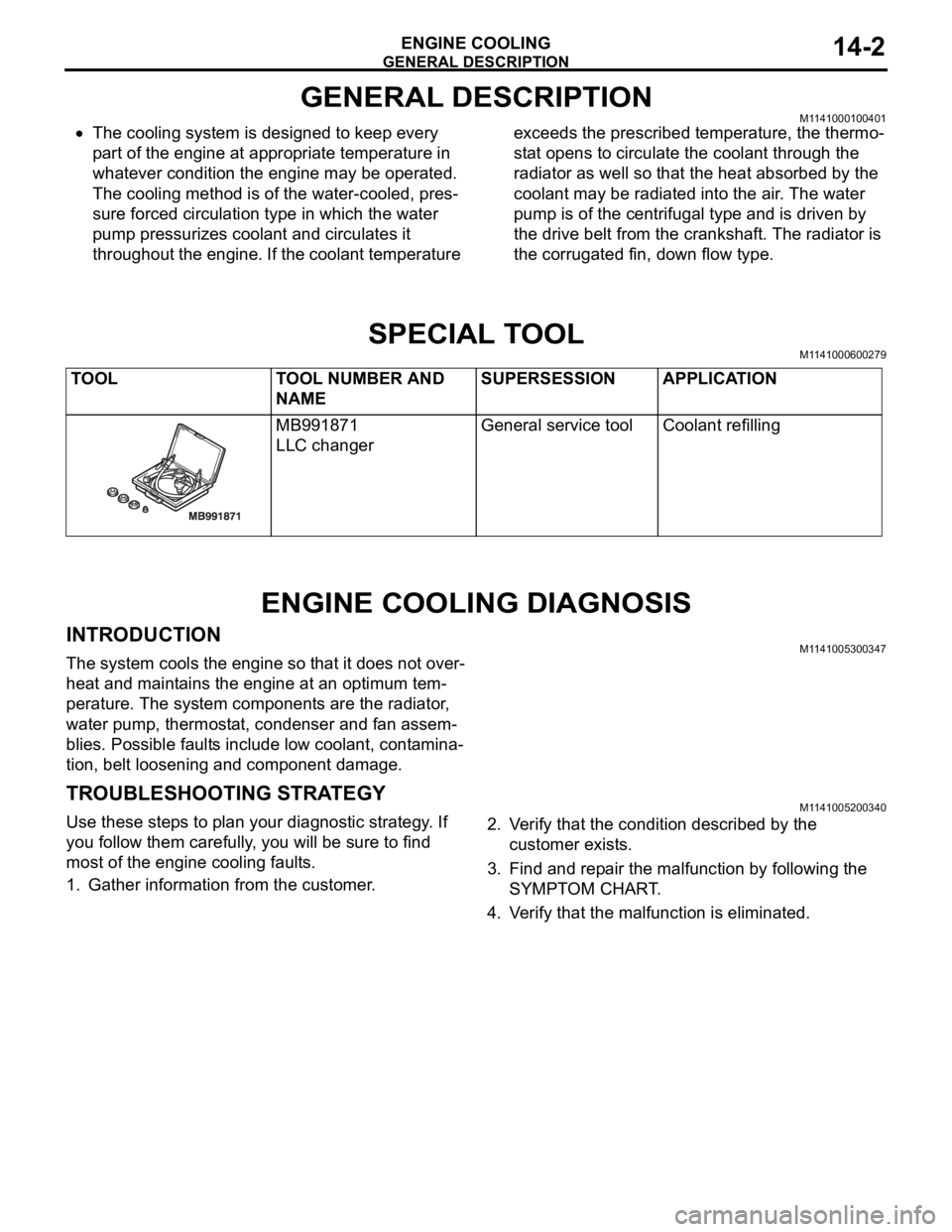
SPECIAL TOOLM1141000600279
ENGINE COOLING DIAGNOSIS
INTRODUCTIONM1141005300347
The system cools the engine so that it does not over-
heat and maintains the engine at an optimum tem-
perature. The system components are the radiator,
water pump, thermostat, condenser and fan assem-
blies. Possible faults include low coolant, contamina-
tion, belt loosening and component damage.
TROUBLESHOOTING STRATEGYM1141005200340
Use these steps to plan your diagnostic strategy. If
you follow them carefully, you will be sure to find
most of the engine cooling faults.
1. Gather information from the customer.2. Verify that the condition described by the
customer exists.
3. Find and repair the malfunction by following the
SYMPTOM CHART.
4. Verify that the malfunction is eliminated. TOOL TOOL NUMBER AND
NAMESUPERSESSION APPLICATION
MB991871
LLC changerGeneral service tool Coolant refilling
Page 919 of 1500
ENGINE COOLING DIAGNOSIS
ENGINE COOLING14-4
INSPECTION PROCEDURE 2: Engine Overheating
DIAGNOSIS
STEP 1. Remove the radiator cap and check for coolant
contamination.
Q: Is the coolant contaminated with rust and oil?
YES : Replace it. Refer to P.14-27.
NO : There is no action to be taken. Go to Step 2.
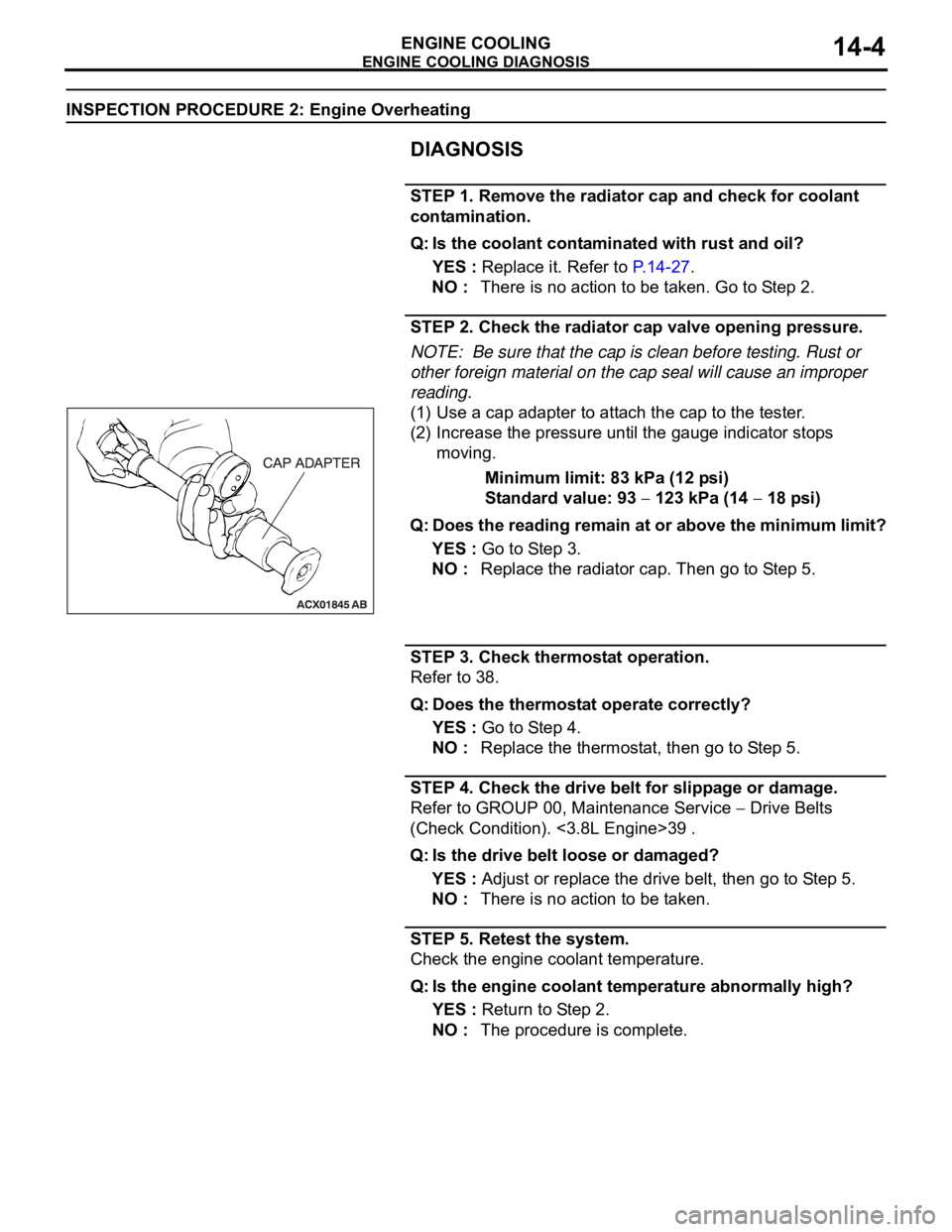
STEP 2. Check the radiator cap valve opening pressure.
NOTE: Be sure that the cap is clean before testing. Rust or
other foreign material on the cap seal will cause an improper
reading.
(1) Use a cap adapter to attach the cap to the tester.
(2) Increase the pressure until the gauge indicator stops
moving.
Minimum limit: 83 kPa (12 psi)
Standard value: 93
123 kPa (14 18 psi)
Q: Does the reading remain at or above the minimum limit?
YES : Go to Step 3.
NO : Replace the radiator cap. Then go to Step 5.
STEP 3. Check thermostat operation.
Refer to 38.
Q: Does the thermostat operate correctly?
YES : Go to Step 4.
NO : Replace the thermostat, then go to Step 5.
STEP 4. Check the drive belt for slippage or damage.
Refer to GROUP 00, Maintenance Service
Drive Belts
(Check Condition). <3.8L Engine>39 .
Q: Is the drive belt loose or damaged?
YES : Adjust or replace the drive belt, then go to Step 5.
NO : There is no action to be taken.
STEP 5. Retest the system.
Check the engine coolant temperature.
Q: Is the engine coolant temperature abnormally high?
YES : Return to Step 2.
NO : The procedure is complete.
Page 941 of 1500
ON-VEHICLE SERVICE
ENGINE COOLING14-26
DIAGNOSIS
STEP 1. Check the condenser fan motor.
Condenser fan motor check. (Refer to GROUP 55, Condenser
and Condenser Fan Motor.
Q: Is the condenser fan motor in good condition?
YES : Go to Step 2.
NO : Replace the condenser fan motor, then go to Step 3.
STEP 2. Check the fan controller.
Refer to 29.
Q: Is the fan controller in good condition?
YES : Go to Step 3.
NO : Replace the fan motor and fan controller (Refer to
14-25). Then go to Step 3.
STEP 3. Check the symptoms.
Q: Do the condenser fan operate?
YES : This symptom is complete.
NO : Return to Step 1.
ON-VEHICLE SERVICE
ENGINE COOLANT LEAK CHECKM1141001000333
When pressure testing the cooling system, slowly
release cooling system pressure to avoid getting
burned by hot coolant.
Be sure to completely clean away any moisture from
the places checked.
When the tester is taken out, be careful not to spill any
coolant.
Be careful when installing and removing the tester and
when testing not to deform the filler neck of the radia-
tor.
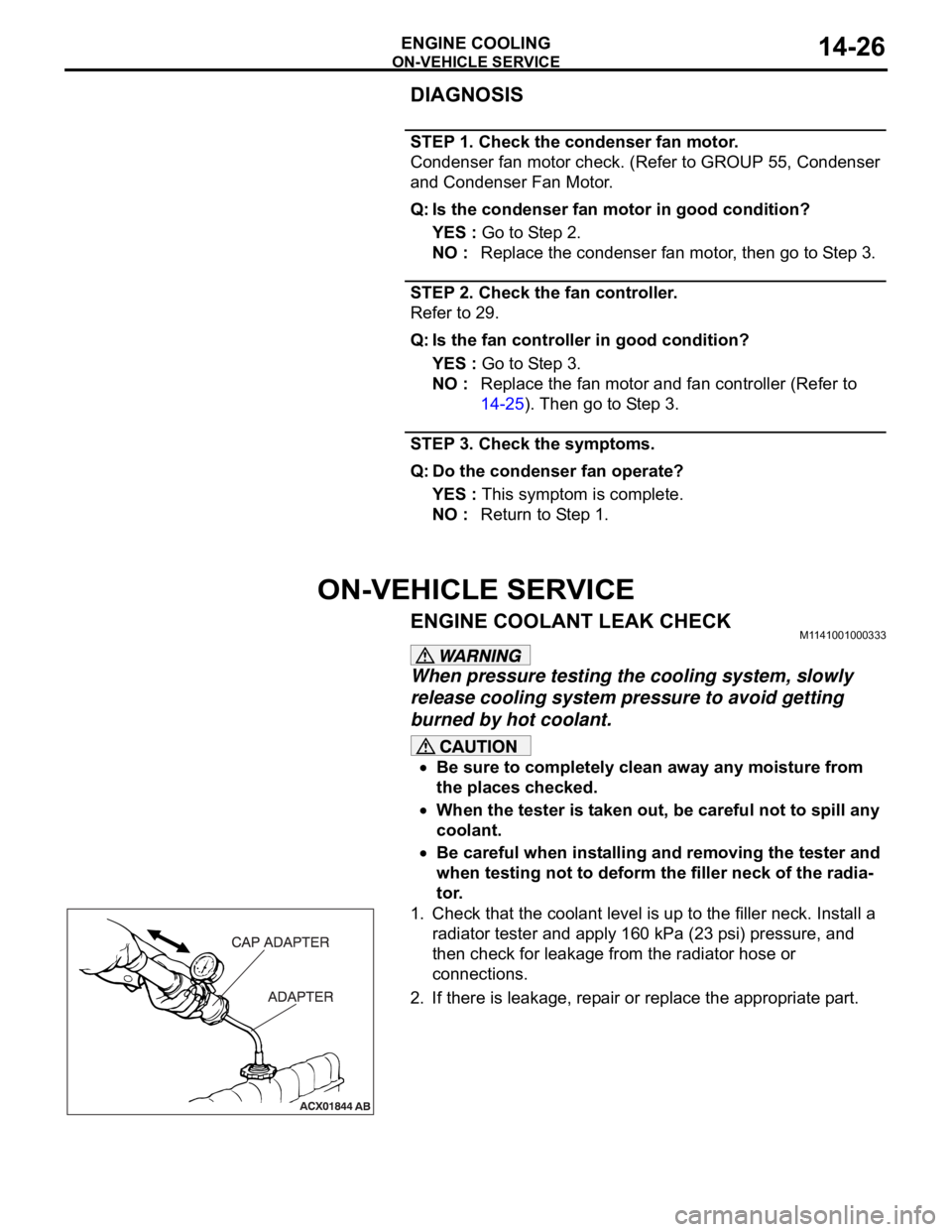
1. Check that the coolant level is up to the filler neck. Install a
radiator tester and apply 160 kPa (23 psi) pressure, and
then check for leakage from the radiator hose or
connections.
2. If there is leakage, repair or replace the appropriate part.