service MITSUBISHI COLT 2009 10.G Service Manual
[x] Cancel search | Manufacturer: MITSUBISHI, Model Year: 2009, Model line: COLT, Model: MITSUBISHI COLT 2009 10.GPages: 273, PDF Size: 17.28 MB
Page 196 of 273
Downloaded from www.Manualslib.com manuals search engine CAUTIONlBe sure to check the tyre pressure for con-
firmation that the emergency repair pro-
cedure is complete.
NOTE
l Please give the empty sealant bottle to your
MITSUBISHI MOTORS Authorized Service
Point when you purchase new sealant or dis-
pose of the sealant bottle according to nation-
al regulations for the disposal of chemical
waste.
l A tyre in which puncture sealant has been
used should ideally be replaced with a new
one. If you wish to have such a tyre properly
repaired for reuse, please contact a
MITSUBISHI MOTORS Authorized Service
Point or another specialist. Note that a proper
repair is impossible following an emergency
repair if the puncture hole cannot be located.
l Wipe away any sealant that gets on the
wheel. Provided the valve is replaced with a
new one, the wheel can be reused.
l The manufacturer is unable to guarantee that
all tyre punctures can be repaired with the
tyre repair kit, in particular cuts or perfora-
tions with a diameter of more than 4 mm or
away from the tyre’s tread. The manufacturer
is not liable for damage sustained through im-
proper use of the tyre repair kit.
l The manufacturer is not liable for damage sus-
tained through re-use of any tyre in which
tyre sealant has been used.
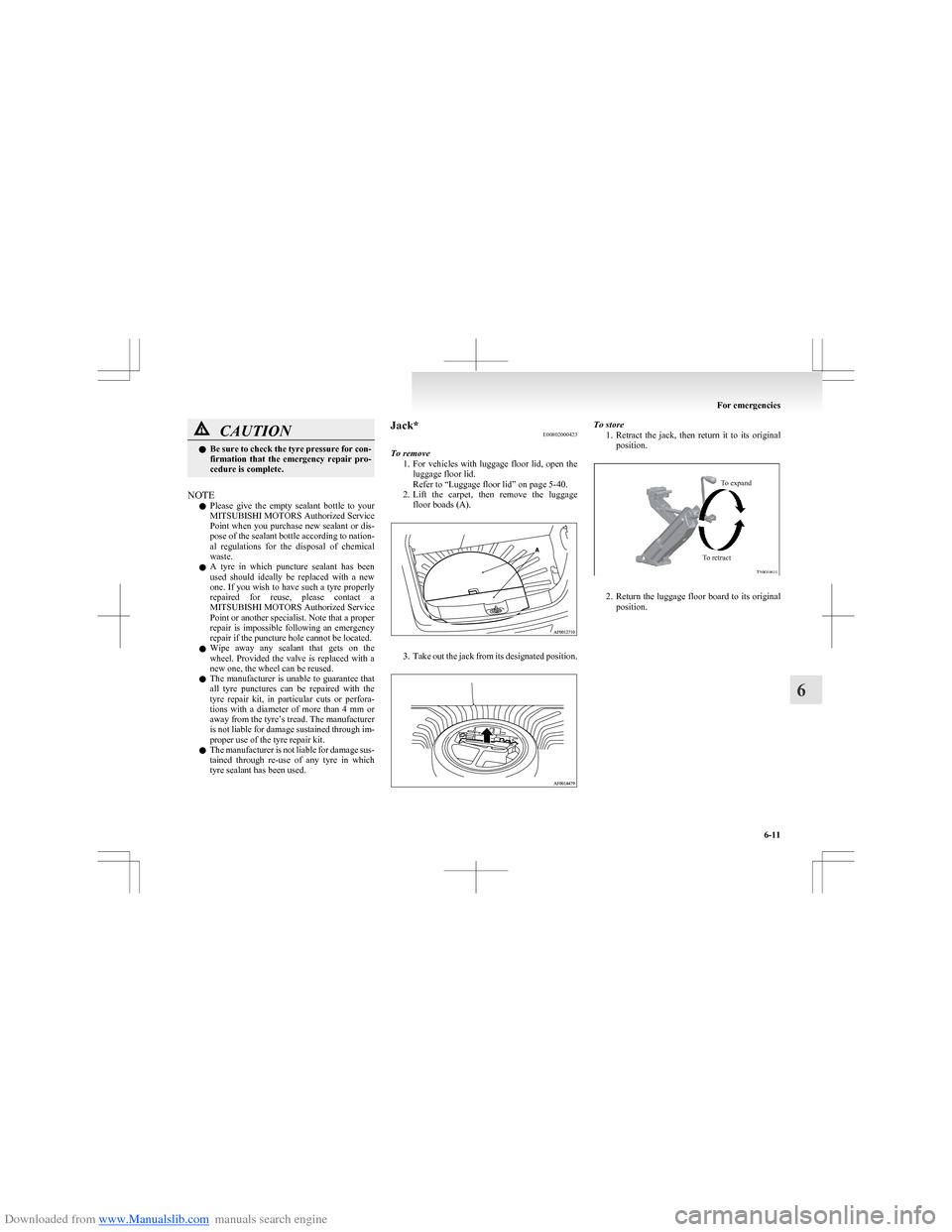
Jack* E00802000423
To remove 1.For vehicles with luggage floor lid, open the
luggage floor lid.
Refer to “Luggage floor lid” on page 5-40.
2. Lift the carpet, then remove the luggage
floor boads (A).
3. Take out the jack from its designated position.
To store
1.Retract the jack, then return it to its original
position.To expandTo retract
2. Return the luggage floor board to its original
position.
For emergencies
6-11
6
Page 203 of 273
Downloaded from www.Manualslib.com manuals search engine CAUTIONlUse the wheel nut wrench until the wheel
cover comes completely off. If you try to
use your hands, they may be hurt by the
edge of the wheel cover.
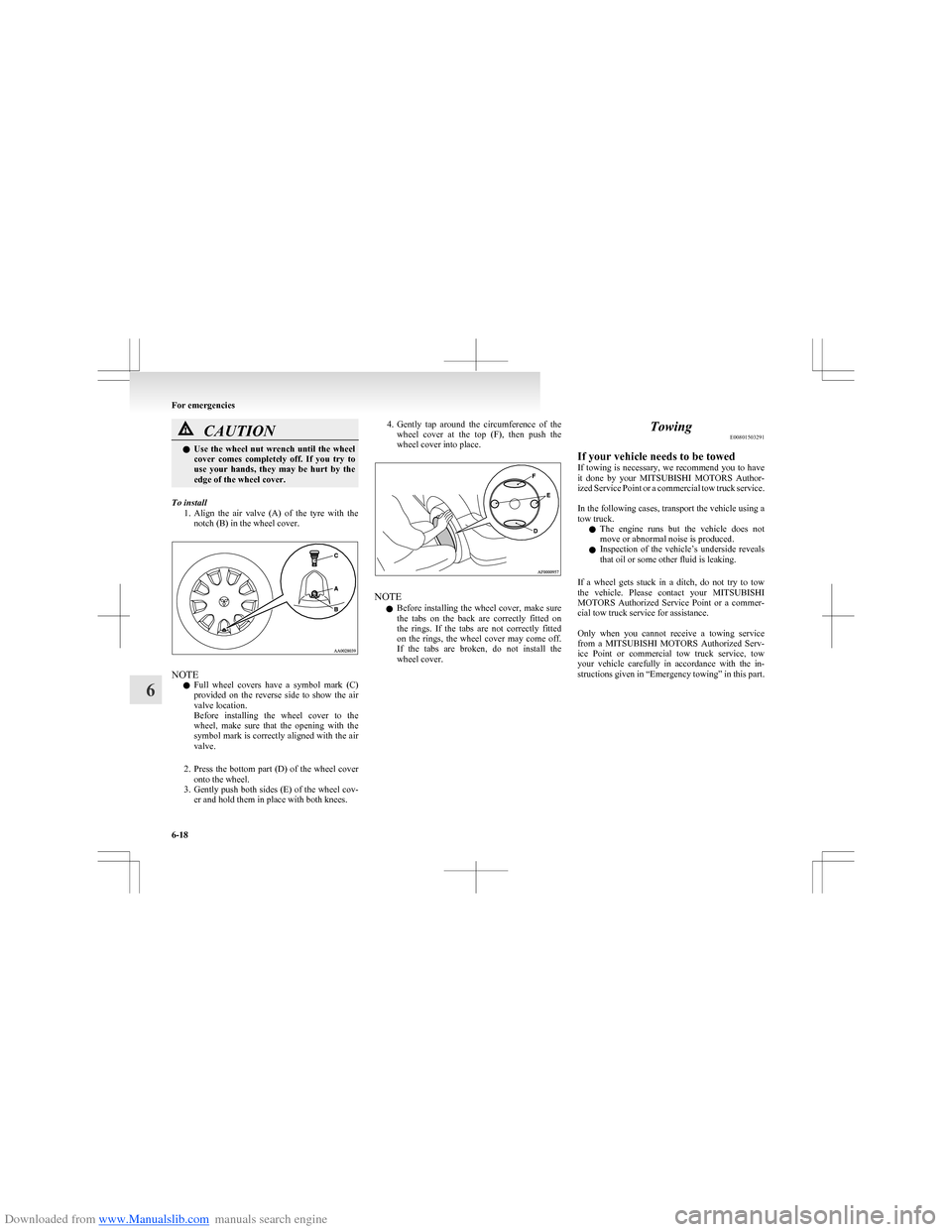
To install
1.Align the air valve (A) of the tyre with the
notch (B) in the wheel cover.
NOTE
l Full wheel covers have a symbol mark (C)
provided on the reverse side to show the air
valve location.
Before installing the wheel cover to the
wheel, make sure that the opening with the
symbol mark is correctly aligned with the air
valve.
2. Press the bottom part (D) of the wheel cover
onto the wheel.
3. Gently push both sides (E) of the wheel cov-
er and hold them in place with both knees.
4. Gently tap around the circumference of the
wheel cover at the top (F), then push the
wheel cover into place.
NOTE
l Before installing the wheel cover, make sure
the tabs on the back are correctly fitted on
the rings. If the tabs are not correctly fitted
on the rings, the wheel cover may come off.
If the tabs are broken, do not install the
wheel cover.
Towing E00801503291
If your vehicle needs to be towed
If towing is necessary, we recommend you to have
it done by your MITSUBISHI MOTORS Author-
ized Service Point or a commercial tow truck service.
In the following cases, transport the vehicle using a
tow truck.
l The engine runs but the vehicle does not
move or abnormal noise is produced.
l Inspection of the vehicle’s underside reveals
that oil or some other fluid is leaking.
If a wheel gets stuck in a ditch, do not try to tow
the vehicle. Please contact your MITSUBISHI
MOTORS Authorized Service Point or a commer-
cial tow truck service for assistance.
Only when you cannot receive a towing service
from a MITSUBISHI MOTORS Authorized Serv-
ice Point or commercial tow truck service, tow
your vehicle carefully in accordance with the in-
structions given in “Emergency towing” in this part.
For emergencies
6-18
6
Page 204 of 273
Downloaded from www.Manualslib.com manuals search engine The regulations concerning towing may differ from
country to country. It is recommended that you
obey the regulations of the area where you are driv-
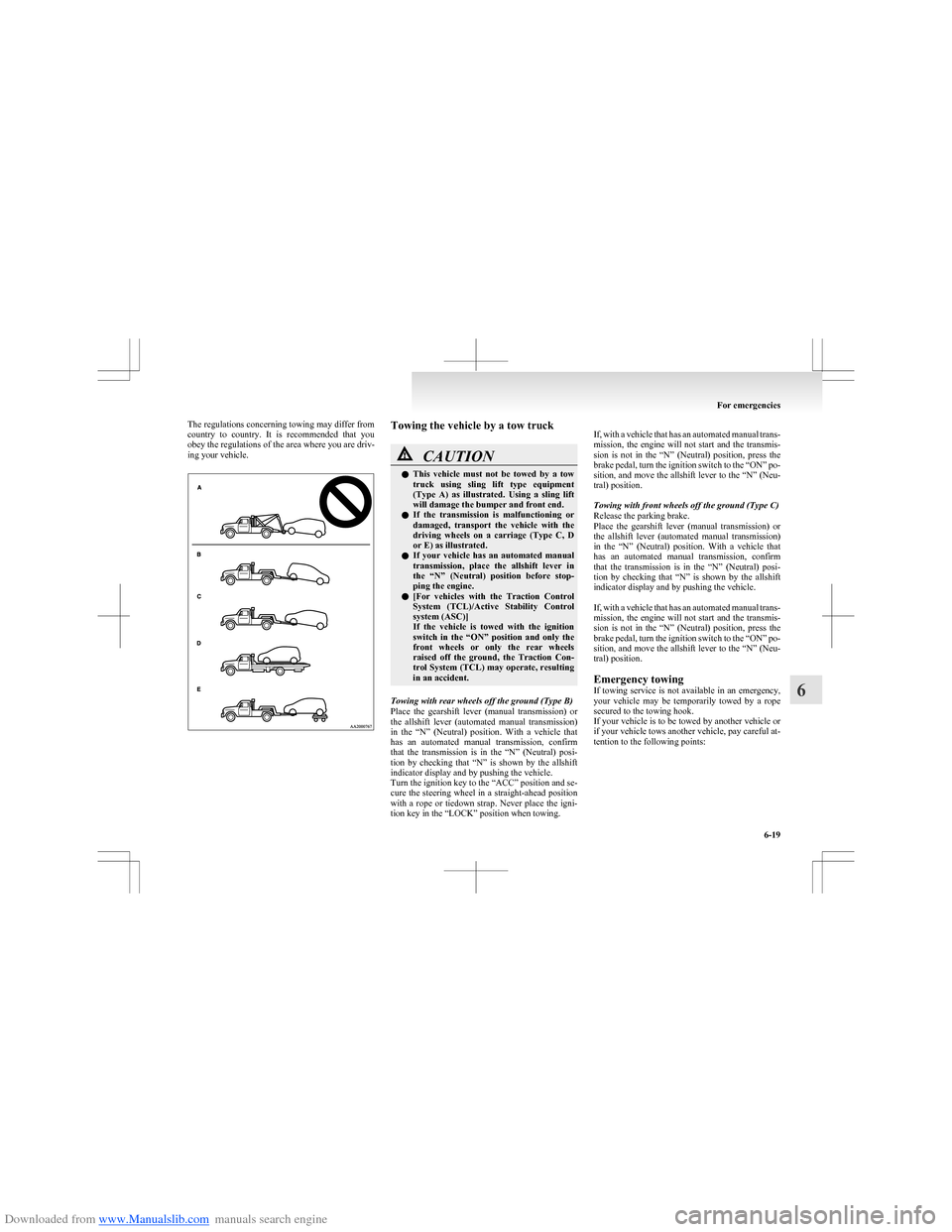
ing your vehicle.Towing the vehicle by a tow truckCAUTIONl This vehicle must not be towed by a tow
truck using sling lift type equipment
(Type A) as illustrated. Using a sling lift
will damage the bumper and front end.
l If the transmission is malfunctioning or
damaged, transport the vehicle with the
driving wheels on a carriage (Type C, D
or E) as illustrated.
l If your vehicle has an automated manual
transmission, place the allshift lever in
the “N” (Neutral) position before stop-
ping the engine.
l [
For vehicles with the Traction Control
System (TCL)/Active Stability Control
system (ASC)]
If the vehicle is towed with the ignition
switch in the “ON” position and only the
front wheels or only the rear wheels
raised off the ground, the Traction Con-
trol System (TCL) may operate, resulting
in an accident.
Towing with rear wheels off the ground (Type B)
Place the gearshift lever (manual transmission) or
the allshift lever (automated manual transmission)
in the “N” (Neutral) position. With a vehicle that
has an automated manual transmission, confirm
that the transmission is in the “N” (Neutral) posi-
tion by checking that “N” is shown by the allshift
indicator display and by pushing the vehicle.
Turn the ignition key to the “ACC” position and se-
cure the steering wheel in a straight-ahead position
with a rope or tiedown strap. Never place the igni-
tion key in the “LOCK” position when towing.
If, with a vehicle that has an automated manual trans-
mission, the engine will not start and the transmis-
sion is not in the “N” (Neutral) position, press the
brake pedal, turn the ignition switch to the “ON” po-
sition, and move the allshift lever to the “N” (Neu-
tral) position.
Towing with front wheels off the ground (Type C)
Release the parking brake.
Place the gearshift lever (manual transmission) or
the allshift lever (automated manual transmission)
in the “N” (Neutral) position. With a vehicle that
has an automated manual transmission, confirm
that the transmission is in the “N” (Neutral) posi-
tion by checking that “N” is shown by the allshift
indicator display and by pushing the vehicle.
If, with a vehicle that has an automated manual trans-
mission, the engine will not start and the transmis-
sion is not in the “N” (Neutral) position, press the
brake pedal, turn the ignition switch to the “ON” po-
sition, and move the allshift lever to the “N” (Neu-
tral) position.
Emergency towing
If towing service is not available in an emergency,
your vehicle may be temporarily towed by a rope
secured to the towing hook.
If your vehicle is to be towed by another vehicle or
if your vehicle tows another vehicle, pay careful at-
tention to the following points:
For emergencies
6-19
6
Page 214 of 273
Downloaded from www.Manualslib.com manuals search engine Service precautions....................................................................... 8-02
Catalytic converter ........................................................................ 8-02
Bonnet ........................................................................................... 8-03
Engine oil ...................................................................................... 8-05
Engine coolant .............................................................................. 8-07
Washer fluid ................................................................................. 8-09
Brake fluid/Clutch fluid* .............................................................. 8-09
Battery .......................................................................................... 8-10
Tyres ............................................................................................. 8-11
Clutch pedal free play* ................................................................. 8-15
Brake pedal free play .................................................................... 8-16
Parking brake lever stroke ............................................................ 8-16
Wiper blades ................................................................................. 8-16
General maintenance .................................................................... 8-18
For cold and snowy weather ......................................................... 8-18
Fusible links .................................................................................. 8-19
Fuses ............................................................................................. 8-19
Replacement of lamp bulbs .......................................................... 8-23Maintenance8
Page 215 of 273
Downloaded from www.Manualslib.com manuals search engine Service precautionsE01000100458
Adequate care of your vehicle at regular intervals
serves to preserve the value and appearance as long
as possible.
Maintenance items as described in this owner’s man-
ual can be performed by the owner.
We recommend you to have the periodic inspection
and maintenance performed by a MITSUBISHI
MOTORS Authorized Service Point or another spe-
cialist. In the event a malfunction or other problem
is discovered, we recommend you to have it
checked and repaired. This section contains infor-
mation on inspection maintenance procedures that
you can do yourself. Follow the instructions and
cautions for each of the various procedures.WARNINGl When checking or servicing the inside of
the engine compartment, make sure the
engine is switched off and has had a
chance to cool down.
l If it is necessary to do work in the engine
compartment with the engine running, be
especially careful that your clothing, hair,
etc., does not become caught by the fans,
drive belts, or other moving parts.
l The fan may turn on automatically even
if the engine is not running; turn the igni-
tion key to “LOCK” position and remove
the key to ensure safety while you work
in the engine compartment.
l Do not smoke, cause sparks or allow open
flames around fuel or battery. The fumes
are flammable.WARNINGl Be extremely cautious when working
around the battery. It contains poisonous
and corrosive sulphuric acid.
l Do not get under your vehicle with just
the body jack supporting it. Always use
automotive jack stands.
l Improper handling of components and
materials used in the vehicle can endan-
ger your personal safety. We recommend
you to consult a specialist for necessary in-
formation.Catalytic converter E01000201140
For ordinary use, there are no particular precau-
tions except that of using unleaded petrol.
The exhaust gas scavenging devices used with the
catalytic converter are extremely efficient for the re-
duction of noxious gases. The catalytic converter is
installed in the exhaust system.
It is important to keep the engine properly tuned to
ensure proper catalyst operation and prevent possi-
ble catalyst damage.CAUTIONl Damage to the catalytic converter can re-
sult if your vehicle is not kept in proper
operating condition. In the event of an en-
gine malfunction particularly involving
engine misfire or other apparent loss of
performance, have your vehicle serviced
promptly. Continued operation of your ve-
hicle with a severe overheated condition
may result in possible damage to the con-
verter and vehicle.WARNINGl As with any vehicle, do not park or oper-
ate this vehicle in areas where combusti-
ble materials such as dry grass or leaves
can come in contact with a hot exhaust
since a fire could occur.
l Paint should not be applied to the catalyt-
ic converter.
Maintenance
8-02
8
Page 216 of 273
Downloaded from www.Manualslib.com manuals search engine The catalytic converter itself gets hot quickly, and
may be damaged if overheated. The following
points should be noted in order to prevent the igni-
tion of unburned petrol within the catalytic convert-
er.
l Use UNLEADED PETROL ONLY of the
type recommended in “Fuel selection” on
page 02.
l Do not drive with an extremely low fuel lev-
el; running out of fuel could cause damage to
the catalytic converter.
l Do not attempt to start the engine by pushing
the vehicle. If the battery is weak or dis-
charged, use another battery to start the en-
gine.
l Do not idle the engine with any spark plug
wires disconnected or removed such as per-
forming diagnostic tests.
l Do not idle the engine for prolonged periods
during very rough idle or malfunctioning op-
erating conditions.
l Do not race the engine when turning off the
ignition switch. This will cause the catalytic
converter to be damaged due to contact with
unburnt fuel.
l Stop driving the vehicle if you think the per-
formance is noticeably low, or if the engine
has a malfunction such as with the ignition,
etc.
If it is impractical to stop driving immediate-
ly, reduce the speed and drive for only a
short time. We recommend you to have your
vehicle inspected as soon as possible.l In unusual situations involving grossly mal-
functioning engine operation, a burnt smell
may indicate severe and abnormal catalyst
overheating.
If this occurs, the vehicle should be stopped
in a safe place, the engine switched off and
the vehicle allowed to cool. Once the engine
is cool, a service, including a tune-up to man-
ufacturer’s specifications, should be obtained
immediately.Bonnet E01000302470
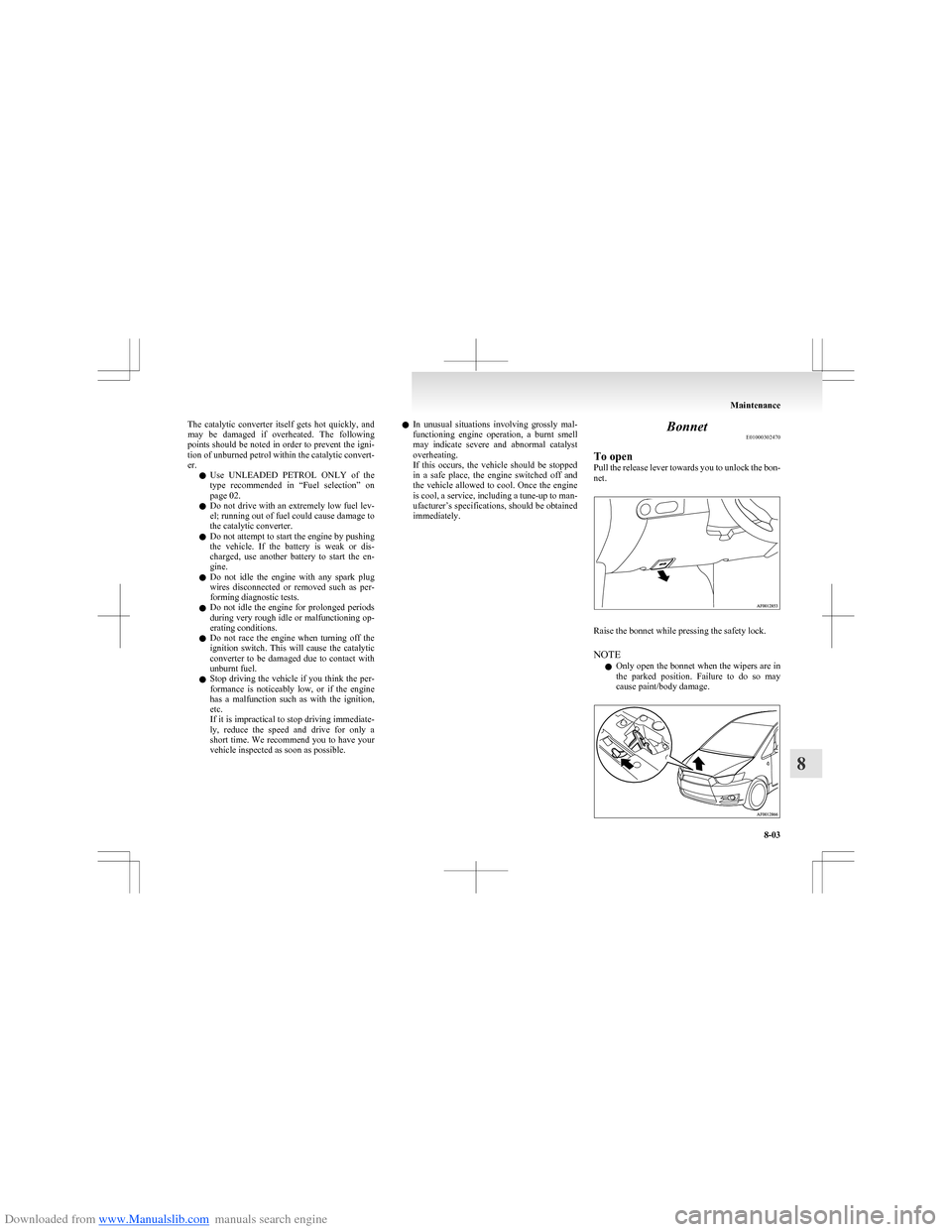
To open
Pull the release lever towards you to unlock the bon-
net.
Raise the bonnet while pressing the safety lock.
NOTE l Only open the bonnet when the wipers are in
the parked position. Failure to do so may
cause paint/body damage.
Maintenance
8-03
8
Page 218 of 273
Downloaded from www.Manualslib.com manuals search engine Engine oilE01000402530
To check and refill engine oil
The engine oil used has a significant effect on the
engine’s performance, service life and startability.
Be sure to use oil of the recommended quality and
appropriate viscosity.
All engines consume a certain amount of oil during
normal operation, and engine oil consumption is
greatly influenced by payload, engine speed, etc.
Therefore, it is important to check the oil level at
regular intervals or before starting a long trip.
This check must be made with the engine warm but
not running. Park the vehicle on a level surface,
stop the engine, and then wait a few moments to al-
low the engine oil in circulation to return to the oil
pan to ensure accurate measurement.
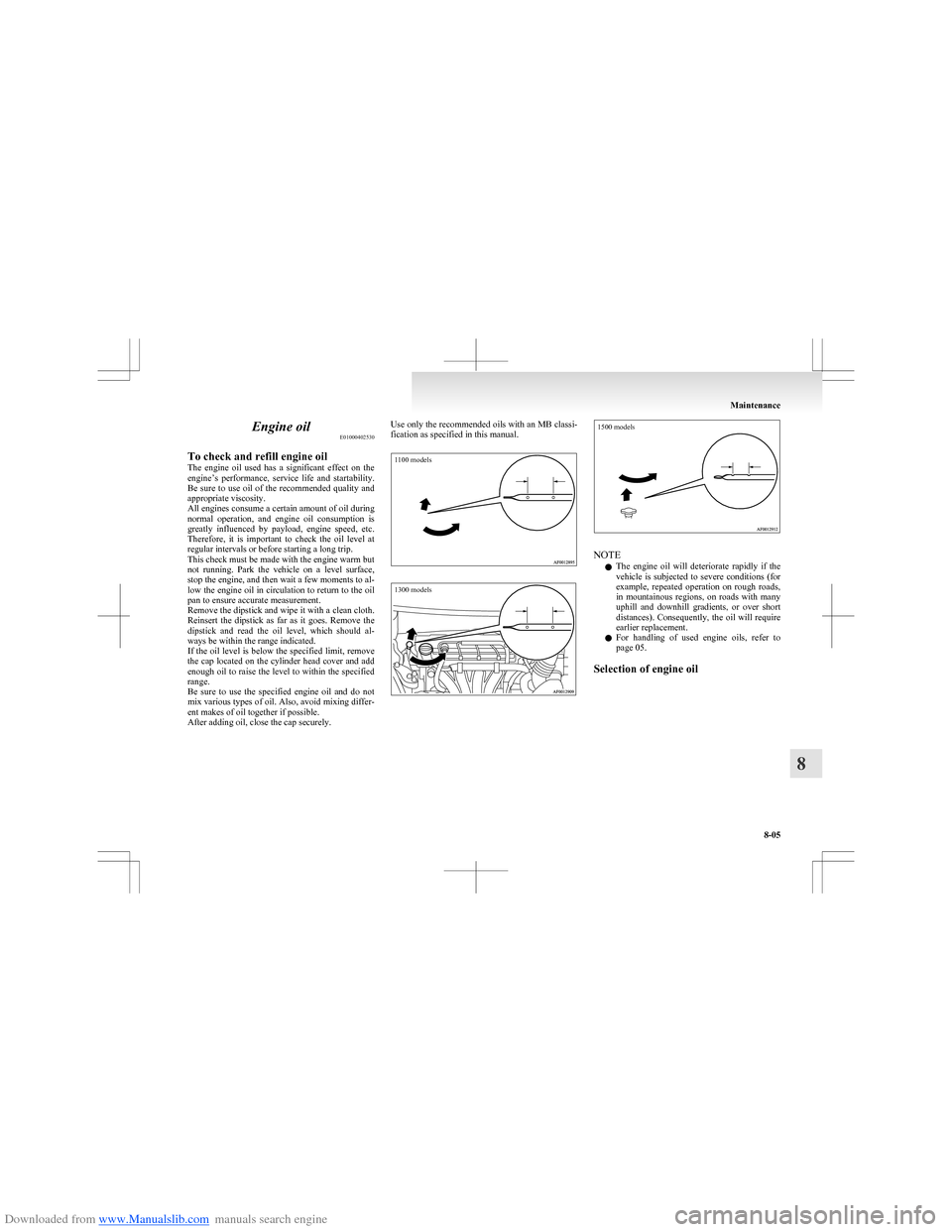
Remove the dipstick and wipe it with a clean cloth.
Reinsert the dipstick as far as it goes. Remove the
dipstick and read the oil level, which should al-
ways be within the range indicated.
If the oil level is below the specified limit, remove
the cap located on the cylinder head cover and add
enough oil to raise the level to within the specified
range.
Be sure to use the specified engine oil and do not
mix various types of oil. Also, avoid mixing differ-
ent makes of oil together if possible.
After adding oil, close the cap securely.
Use only the recommended oils with an MB classi-
fication as specified in this manual.1100 models1300 models1500 models
NOTE
l The engine oil will deteriorate rapidly if the
vehicle is subjected to severe conditions (for
example, repeated operation on rough roads,
in mountainous regions, on roads with many
uphill and downhill gradients, or over short
distances). Consequently, the oil will require
earlier replacement.
l For handling of used engine oils, refer to
page 05.
Selection of engine oil
Maintenance
8-05
8
Page 219 of 273
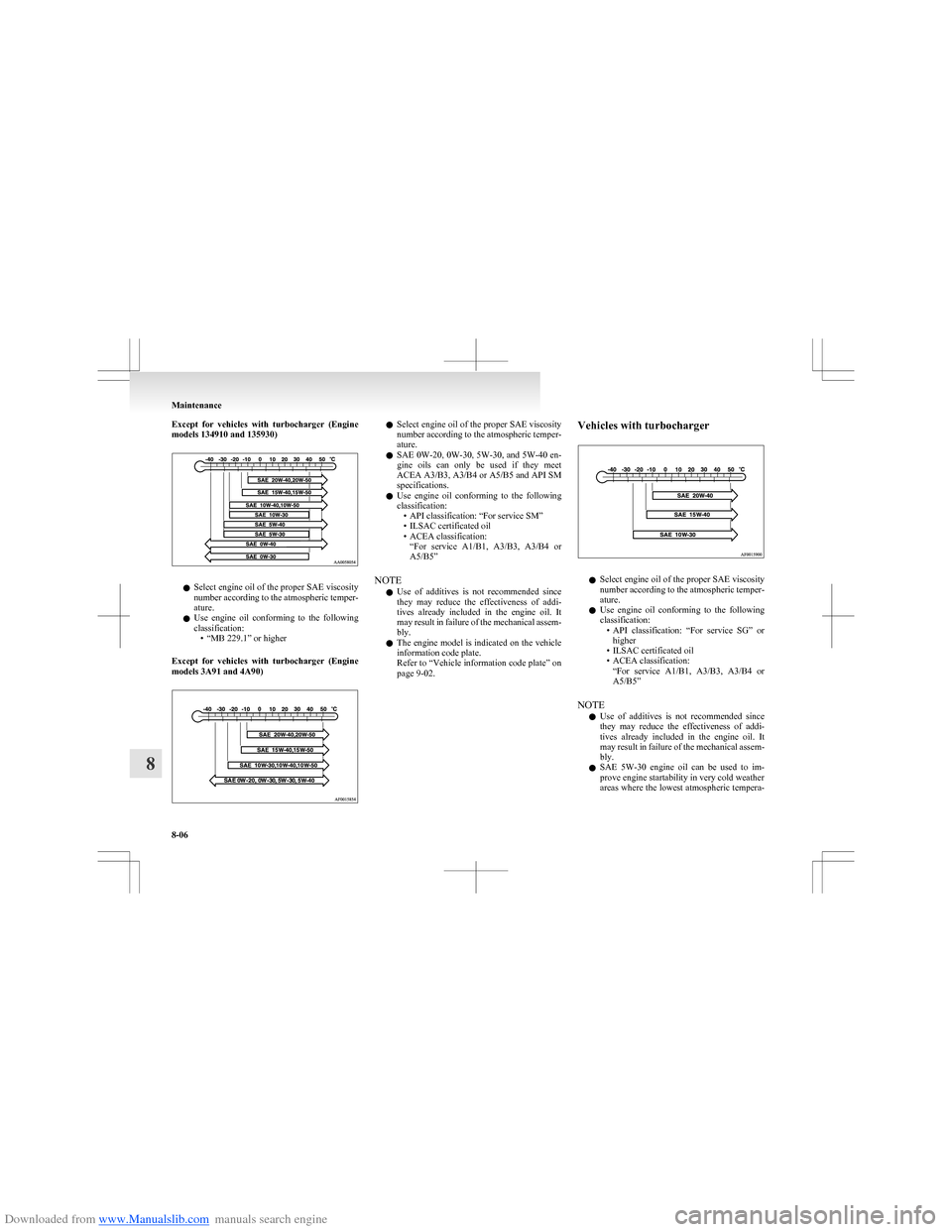
Downloaded from www.Manualslib.com manuals search engine Except for vehicles with turbocharger (Engine
models 134910 and 135930)
l Select engine oil of the proper SAE viscosity
number according to the atmospheric temper-
ature.
l Use engine oil conforming to the following
classification: • “MB 229.1” or higher
Except for vehicles with turbocharger (Engine
models 3A91 and 4A90)
l Select engine oil of the proper SAE viscosity
number according to the atmospheric temper-
ature.
l SAE
0W-20 , 0W-30 , 5W-30 , and 5W-40 en-
gine oils can only be used if they meet
ACEA A3/B3, A3/B4 or A5/B5 and API SM
specifications.
l Use engine oil conforming to the following
classification: • API classification: “For service SM”
• ILSAC certificated oil
• ACEA classification: “For service A1/B1, A3/B3 , A3/B4 or
A5/B5”
NOTE l Use of additives is not recommended since
they may reduce the effectiveness of addi-
tives already included in the engine oil. It
may result in failure of the mechanical assem-
bly.
l The engine model is indicated on the vehicle
information code plate.
Refer to “Vehicle information code plate” on
page 9-02.Vehicles with turbocharger
l Select engine oil of the proper SAE viscosity
number according to the atmospheric temper-
ature.
l Use engine oil conforming to the following
classification: •API classification: “For service SG” or
higher
• ILSAC certificated oil
• ACEA classification: “For service A1/B1, A3/B3 , A3/B4 or
A5/B5”
NOTE l Use of additives is not recommended since
they may reduce the effectiveness of addi-
tives already included in the engine oil. It
may result in failure of the mechanical assem-
bly.
l SAE
5W-30 engine oil can be used to im-
prove engine startability in very cold weather
areas where the lowest atmospheric tempera-
Maintenance
8-06
8
Page 220 of 273
Downloaded from www.Manualslib.com manuals search engine ture is below the range shown in the illustra-
tion.
In this case, use engine oil conforming to the
following classification: • ACEA classification:“For service A3/ B3, A3/B4 or A5/B5”
• API classification: “For service SG” or higherEngine coolant E01000501390
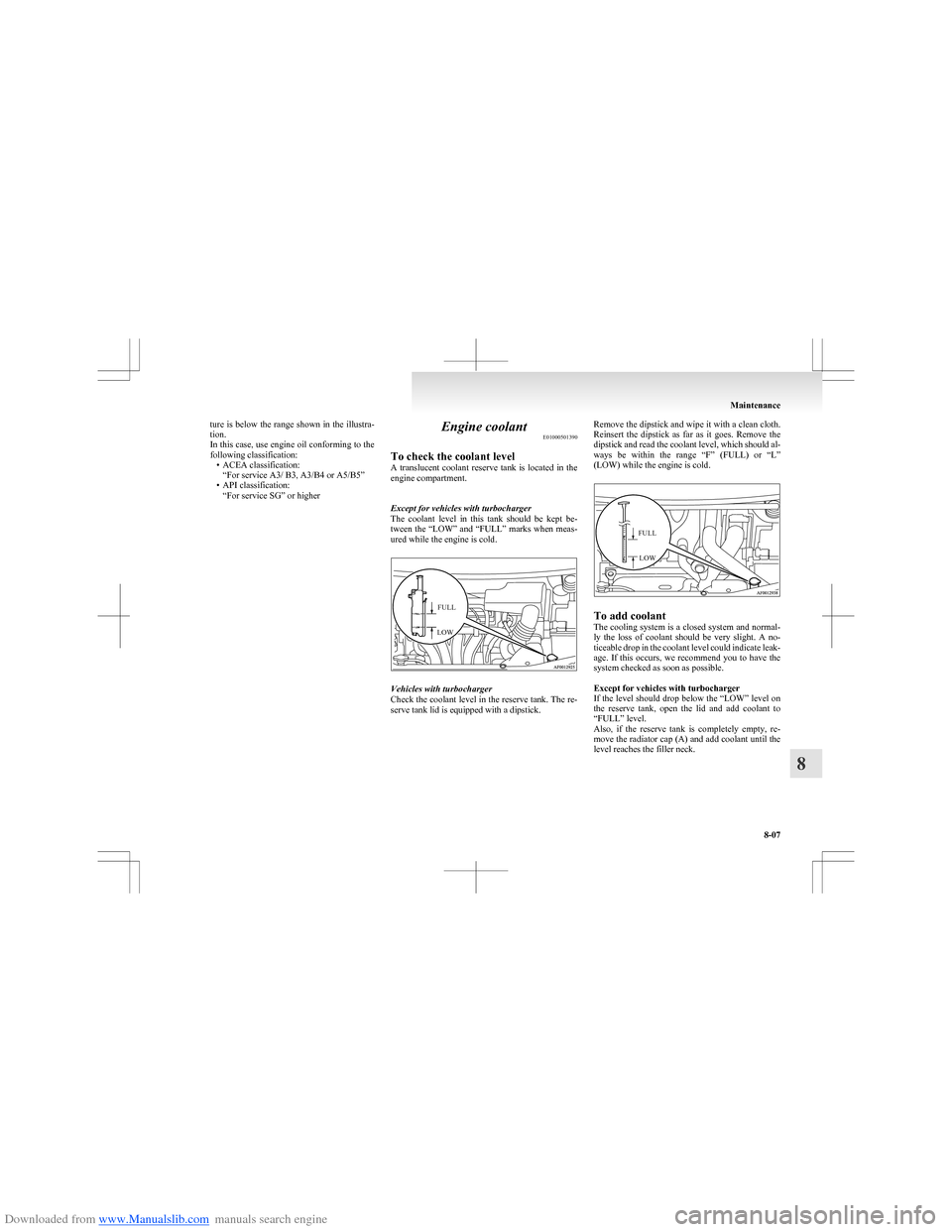
To check the coolant level
A translucent coolant reserve tank is located in the
engine compartment.
Except for vehicles with turbocharger
The coolant level in this tank should be kept be-
tween the “LOW” and “FULL” marks when meas-
ured while the engine is cold.
FULLLOW
Vehicles with turbocharger
Check the coolant level in the reserve tank. The re-
serve tank lid is equipped with a dipstick.
Remove the dipstick and wipe it with a clean cloth.
Reinsert the dipstick as far as it goes. Remove the
dipstick and read the coolant level, which should al-
ways be within the range “F” (FULL) or “L”
(LOW) while the engine is cold.FULLLOW
To add coolant
The cooling system is a closed system and normal-
ly the loss of coolant should be very slight. A no-
ticeable drop in the coolant level could indicate leak-
age. If this occurs, we recommend you to have the
system checked as soon as possible.
Except for vehicles with turbocharger
If the level should drop below the “LOW” level on
the reserve tank, open the lid and add coolant to
“FULL” level.
Also, if the reserve tank is completely empty, re-
move the radiator cap (A) and add coolant until the
level reaches the filler neck.
Maintenance
8-07
8
Page 230 of 273
Downloaded from www.Manualslib.com manuals search engine NOTEl Do not allow the wiper arm to fall onto the
windscreen; it could damage the glass.
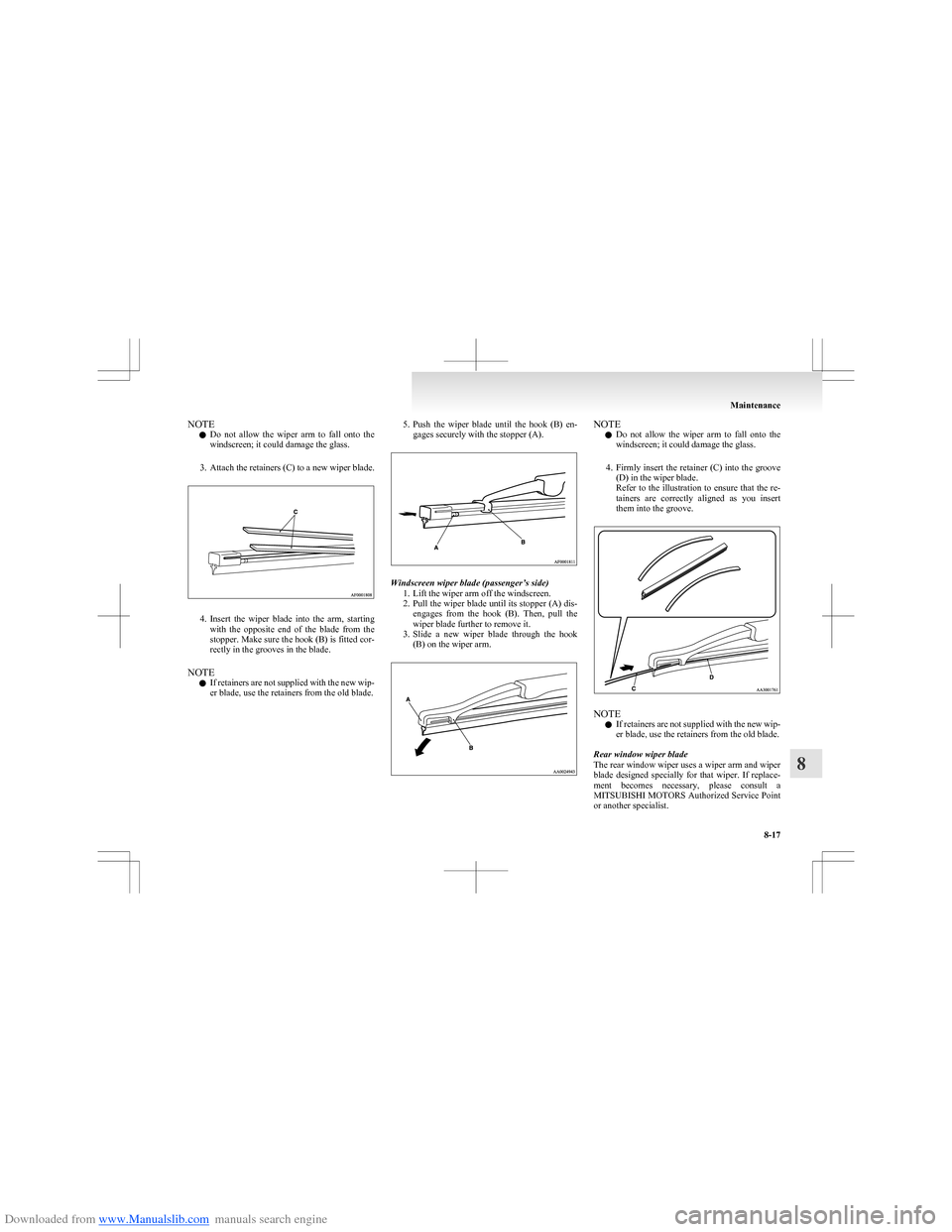
3. Attach the retainers (C) to a new wiper blade.
4.Insert the wiper blade into the arm, starting
with the opposite end of the blade from the
stopper. Make sure the hook (B) is fitted cor-
rectly in the grooves in the blade.
NOTE l If retainers are not supplied with the new wip-
er blade, use the retainers from the old blade.
5. Push the wiper blade until the hook (B) en-
gages securely with the stopper (A).
Windscreen wiper blade (passenger’s side)
1. Lift the wiper arm off the windscreen.
2. Pull the wiper blade until its stopper (A) dis-
engages from the hook (B). Then, pull the
wiper blade further to remove it.
3. Slide a new wiper blade through the hook
(B) on the wiper arm.
NOTE
l Do not allow the wiper arm to fall onto the
windscreen; it could damage the glass.
4. Firmly insert the retainer (C) into the groove
(D) in the wiper blade.
Refer to the illustration to ensure that the re-
tainers are correctly aligned as you insert
them into the groove.
NOTE
l If retainers are not supplied with the new wip-
er blade, use the retainers from the old blade.
Rear window wiper blade
The rear window wiper uses a wiper arm and wiper
blade designed specially for that wiper. If replace-
ment becomes necessary, please consult a
MITSUBISHI MOTORS Authorized Service Point
or another specialist.
Maintenance
8-17
8