time MITSUBISHI COLT 2009 10.G Repair Manual
[x] Cancel search | Manufacturer: MITSUBISHI, Model Year: 2009, Model line: COLT, Model: MITSUBISHI COLT 2009 10.GPages: 273, PDF Size: 17.28 MB
Page 222 of 273
Downloaded from www.Manualslib.com manuals search engine Washer fluidE01000700702
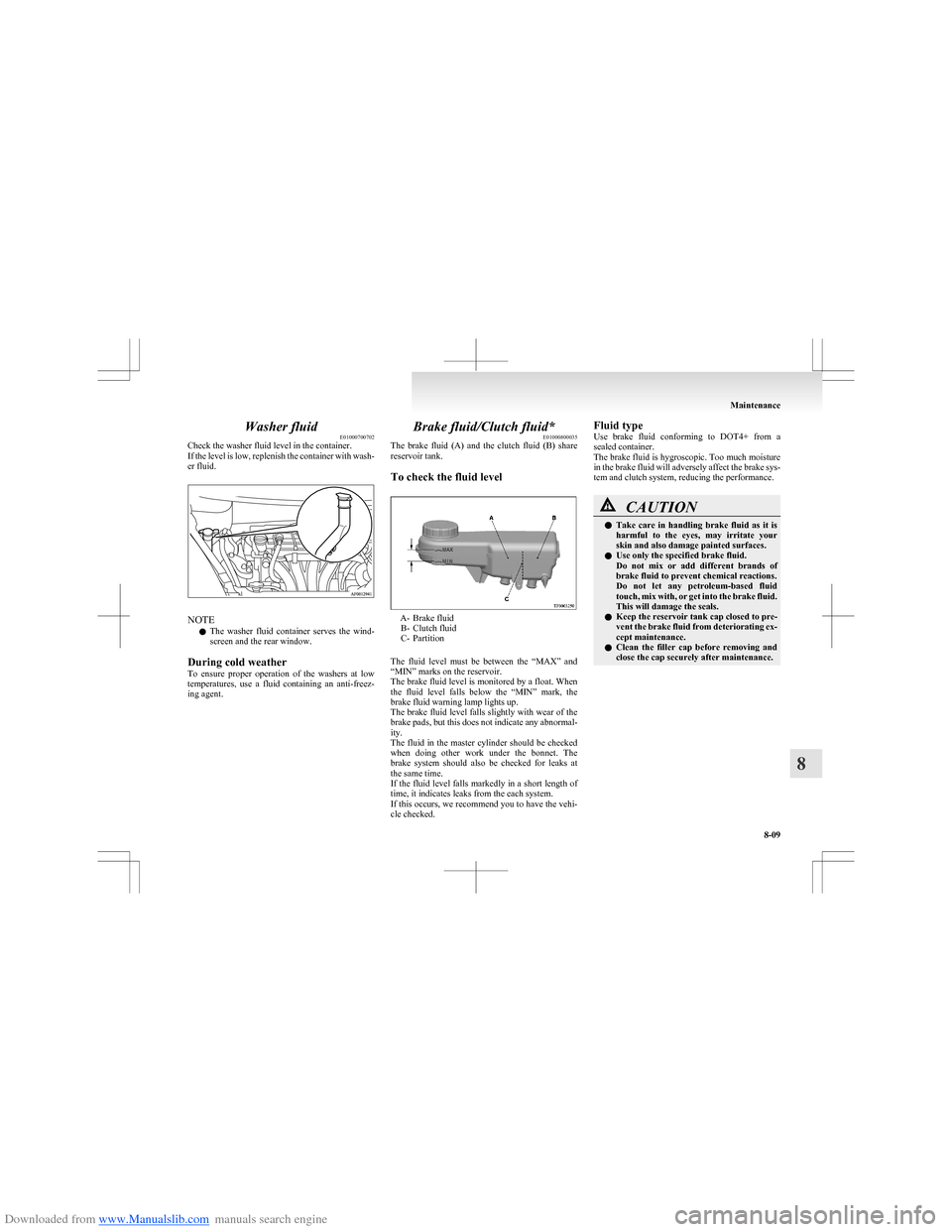
Check the washer fluid level in the container.
If the level is low, replenish the container with wash-
er fluid.
NOTE
l The washer fluid container serves the wind-
screen and the rear window.
During cold weather
To ensure proper operation of the washers at low
temperatures, use a fluid containing an anti-freez-
ing agent.
Brake fluid/Clutch fluid* E01000800035
The brake fluid (A) and the clutch fluid (B) share
reservoir tank.
To check the fluid level
A- Brake fluid B- Clutch fluid
C- Partition
The fluid level must be between the “MAX” and
“MIN” marks on the reservoir.
The brake fluid level is monitored by a float. When
the fluid level falls below the “MIN” mark, the
brake fluid warning lamp lights up.
The brake fluid level falls slightly with wear of the
brake pads, but this does not indicate any abnormal-
ity.
The fluid in the master cylinder should be checked
when doing other work under the bonnet. The
brake system should also be checked for leaks at
the same time.
If the fluid level falls markedly in a short length of
time, it indicates leaks from the each system.
If this occurs, we recommend you to have the vehi-
cle checked.
Fluid type
Use brake fluid conforming to DOT4+ from a
sealed container.
The brake fluid is hygroscopic. Too much moisture
in the brake fluid will adversely affect the brake sys-
tem and clutch system, reducing the performance.CAUTIONl Take care in handling brake fluid as it is
harmful to the eyes, may irritate your
skin and also damage painted surfaces.
l Use only the specified brake fluid.
Do not mix or add different brands of
brake fluid to prevent chemical reactions.
Do not let any petroleum-based fluid
touch, mix with, or get into the brake fluid.
This will damage the seals.
l Keep the reservoir tank cap closed to pre-
vent the brake fluid from deteriorating ex-
cept maintenance.
l Clean the filler cap before removing and
close the cap securely after maintenance.
Maintenance
8-09
8
Page 223 of 273
Downloaded from www.Manualslib.com manuals search engine BatteryE01001202160
The condition of the battery is very important for
quick starting of the engine and proper functioning
of the vehicle’s electrical system. Regular inspec-
tion and care are especially important in cold weath-
er.
Checking battery electrolyte level
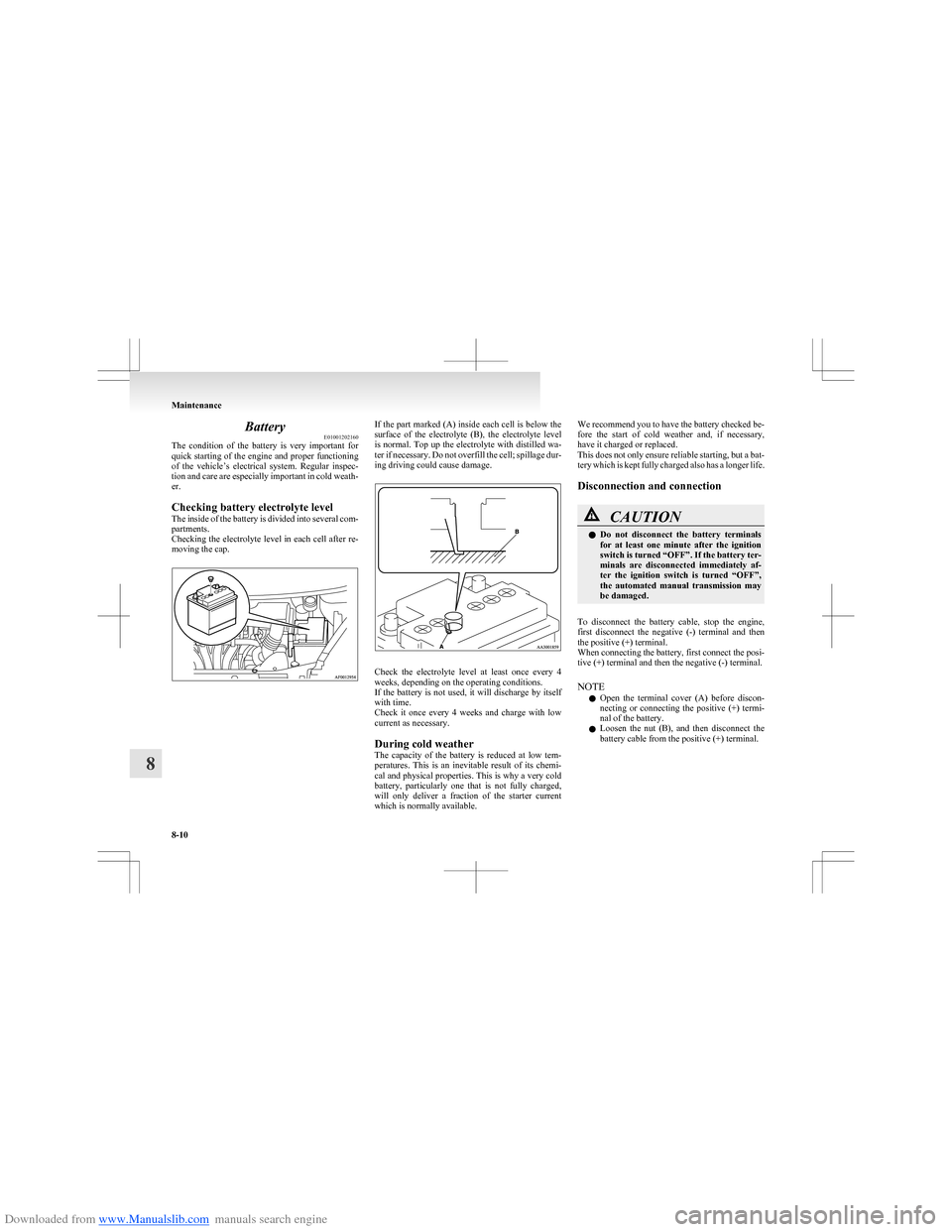
The inside of the battery is divided into several com-
partments.
Checking the electrolyte level in each cell after re-
moving the cap.If the part marked (A) inside each cell is below the
surface of the electrolyte (B), the electrolyte level
is normal. Top up the electrolyte with distilled wa-
ter if necessary. Do not overfill the cell; spillage dur-
ing driving could cause damage.
Check the electrolyte level at least once every 4
weeks, depending on the operating conditions.
If the battery is not used, it will discharge by itself
with time.
Check it once every 4 weeks and charge with low
current as necessary.
During cold weather
The capacity of the battery is reduced at low tem-
peratures. This is an inevitable result of its chemi-
cal and physical properties. This is why a very cold
battery, particularly one that is not fully charged,
will only deliver a fraction of the starter current
which is normally available.
We recommend you to have the battery checked be-
fore the start of cold weather and, if necessary,
have it charged or replaced.
This does not only ensure reliable starting, but a bat-
tery which is kept fully charged also has a longer life.
Disconnection and connectionCAUTIONl Do not disconnect the battery terminals
for at least one minute after the ignition
switch is turned “OFF”. If the battery ter-
minals are disconnected immediately af-
ter the ignition switch is turned “OFF”,
the automated manual transmission may
be damaged.
To disconnect the battery cable, stop the engine,
first disconnect the negative (-) terminal and then
the positive (+) terminal.
When connecting the battery, first connect the posi-
tive (+) terminal and then the negative (-) terminal.
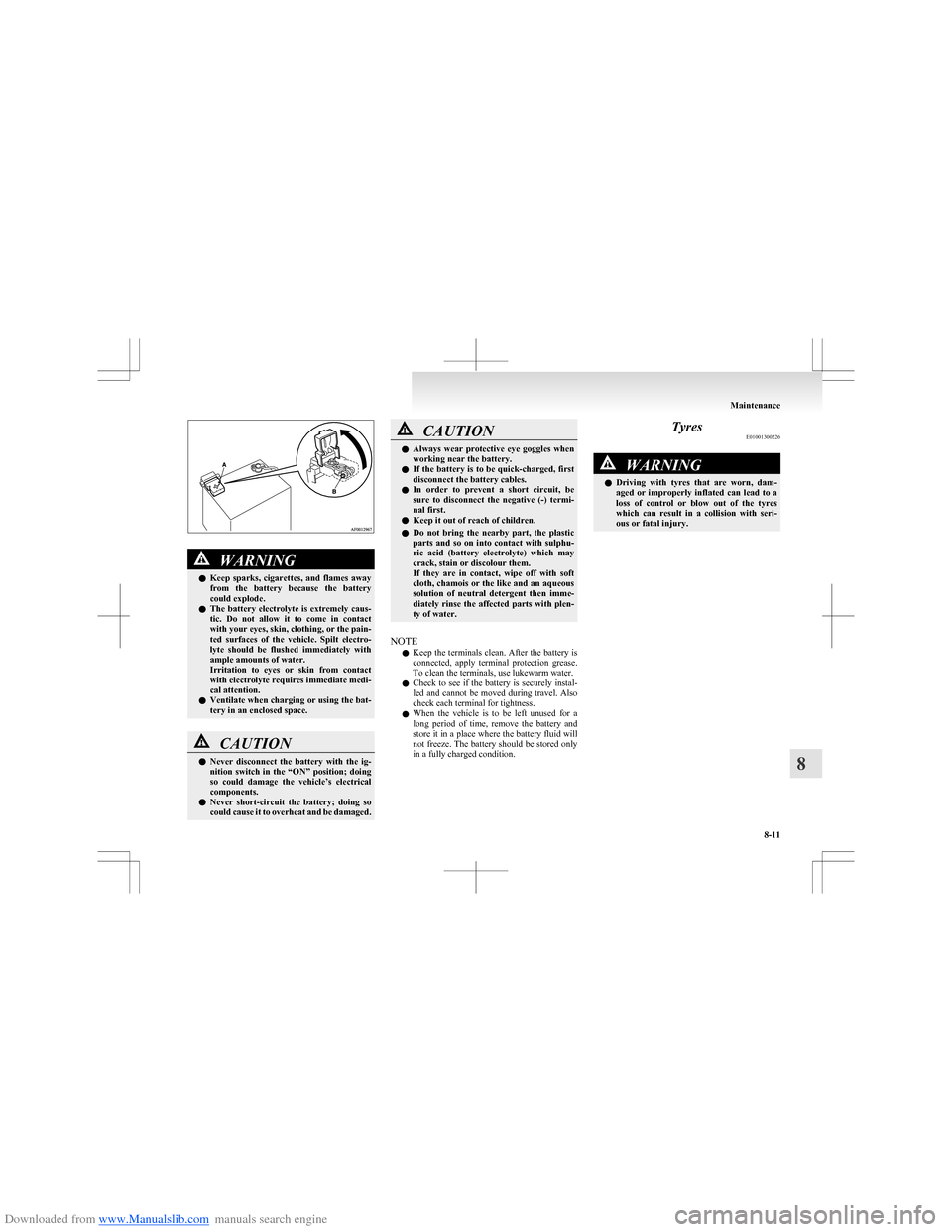
NOTE l Open the terminal cover (A) before discon-
necting or connecting the positive (+) termi-
nal of the battery.
l Loosen the nut (B), and then disconnect the
battery cable from the positive (+) terminal.
Maintenance
8-10
8
Page 224 of 273
Downloaded from www.Manualslib.com manuals search engine WARNINGlKeep sparks, cigarettes, and flames away
from the battery because the battery
could explode.
l The battery electrolyte is extremely caus-
tic. Do not allow it to come in contact
with your eyes, skin, clothing, or the pain-
ted surfaces of the vehicle. Spilt electro-
lyte should be flushed immediately with
ample amounts of water.
Irritation to eyes or skin from contact
with electrolyte requires immediate medi-
cal attention.
l Ventilate when charging or using the bat-
tery in an enclosed space.CAUTIONl Never disconnect the battery with the ig-
nition switch in the “ON” position; doing
so could damage the vehicle’s electrical
components.
l Never short-circuit the battery; doing so
could cause it to overheat and be damaged.CAUTIONl Always wear protective eye goggles when
working near the battery.
l If the battery is to be quick-charged, first
disconnect the battery cables.
l In order to prevent a short circuit, be
sure to disconnect the negative (-) termi-
nal first.
l Keep it out of reach of children.
l Do not bring the nearby part, the plastic
parts and so on into contact with sulphu-
ric acid (battery electrolyte) which may
crack, stain or discolour them.
If they are in contact, wipe off with soft
cloth, chamois or the like and an aqueous
solution of neutral detergent then imme-
diately rinse the affected parts with plen-
ty of water.
NOTE
l Keep the terminals clean. After the battery is
connected, apply terminal protection grease.
To clean the terminals, use lukewarm water.
l Check to see if the battery is securely instal-
led and cannot be moved during travel. Also
check each terminal for tightness.
l When the vehicle is to be left unused for a
long period of time, remove the battery and
store it in a place where the battery fluid will
not freeze. The battery should be stored only
in a fully charged condition.
Tyres E01001300226WARNINGlDriving with tyres that are worn, dam-
aged or improperly inflated can lead to a
loss of control or blow out of the tyres
which can result in a collision with seri-
ous or fatal injury.
Maintenance
8-11
8
Page 229 of 273
Downloaded from www.Manualslib.com manuals search engine Brake pedal free playE01002300281
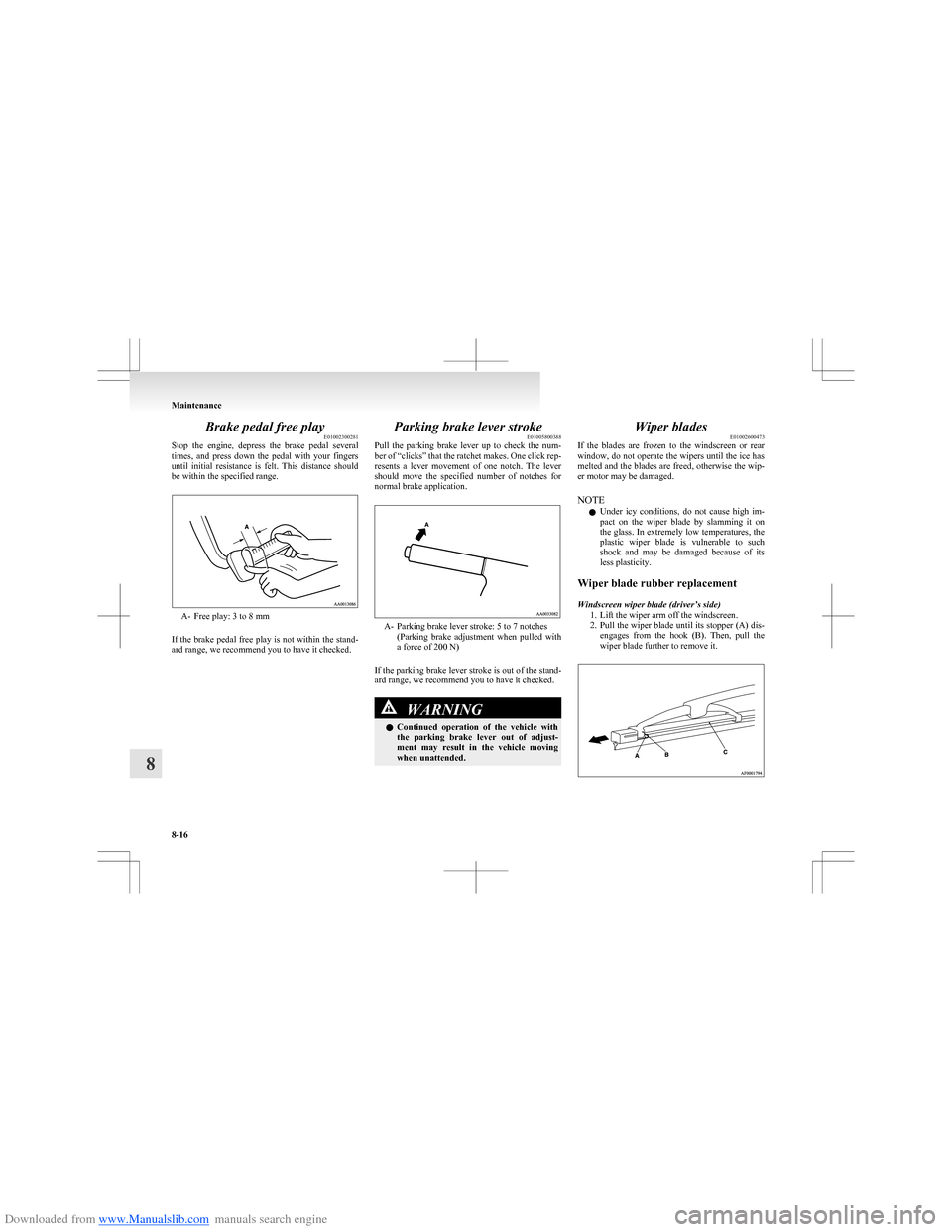
Stop the engine, depress the brake pedal several
times, and press down the pedal with your fingers
until initial resistance is felt. This distance should
be within the specified range.
A- Free play: 3 to 8 mm
If the brake pedal free play is not within the stand-
ard range, we recommend you to have it checked.
Parking brake lever stroke E01005800388
Pull the parking brake lever up to check the num-
ber of “clicks” that the ratchet makes. One click rep-
resents a lever movement of one notch. The lever
should move the specified number of notches for
normal brake application.
A- Parking brake lever stroke: 5 to 7 notches (Parking brake adjustment when pulled with
a force of 200 N)
If the parking brake lever stroke is out of the stand-
ard range, we recommend you to have it checked.
WARNINGl Continued operation of the vehicle with
the parking brake lever out of adjust-
ment may result in the vehicle moving
when unattended.Wiper blades E01002600473
If the blades are frozen to the windscreen or rear
window, do not operate the wipers until the ice has
melted and the blades are freed, otherwise the wip-
er motor may be damaged.
NOTE l Under icy conditions, do not cause high im-
pact on the wiper blade by slamming it on
the glass. In extremely low temperatures, the
plastic wiper blade is vulnerable to such
shock and may be damaged because of its
less plasticity.
Wiper blade rubber replacement
Windscreen wiper blade (driver’s side) 1. Lift the wiper arm off the windscreen.
2. Pull the wiper blade until its stopper (A) dis-
engages from the hook (B). Then, pull the
wiper blade further to remove it.
Maintenance
8-16
8
Page 235 of 273
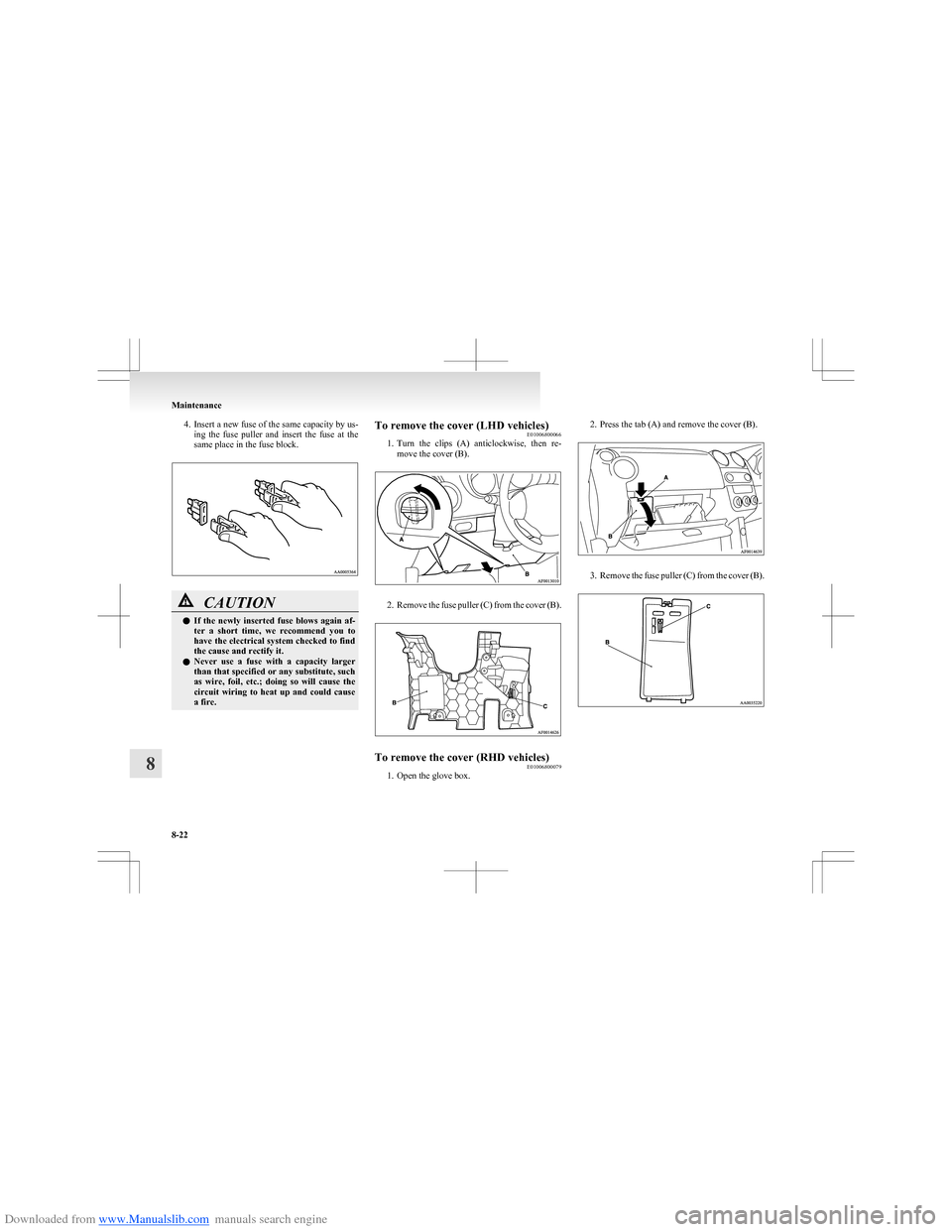
Downloaded from www.Manualslib.com manuals search engine 4.Insert a new fuse of the same capacity by us-
ing the fuse puller and insert the fuse at the
same place in the fuse block.CAUTIONl If the newly inserted fuse blows again af-
ter a short time, we recommend you to
have the electrical system checked to find
the cause and rectify it.
l Never use a fuse with a capacity larger
than that specified or any substitute, such
as wire, foil, etc.; doing so will cause the
circuit wiring to heat up and could cause
a fire.To remove the cover (LHD vehicles) E01006800066
1. Turn the clips (A) anticlockwise, then re-
move the cover (B).
2. Remove the fuse puller (C) from the cover (B).
To remove the cover (RHD vehicles)
E01006800079
1. Open the glove box.
2. Press the tab (A) and remove the cover (B).
3.Remove the fuse puller (C) from the cover (B).
Maintenance
8-22
8
Page 236 of 273
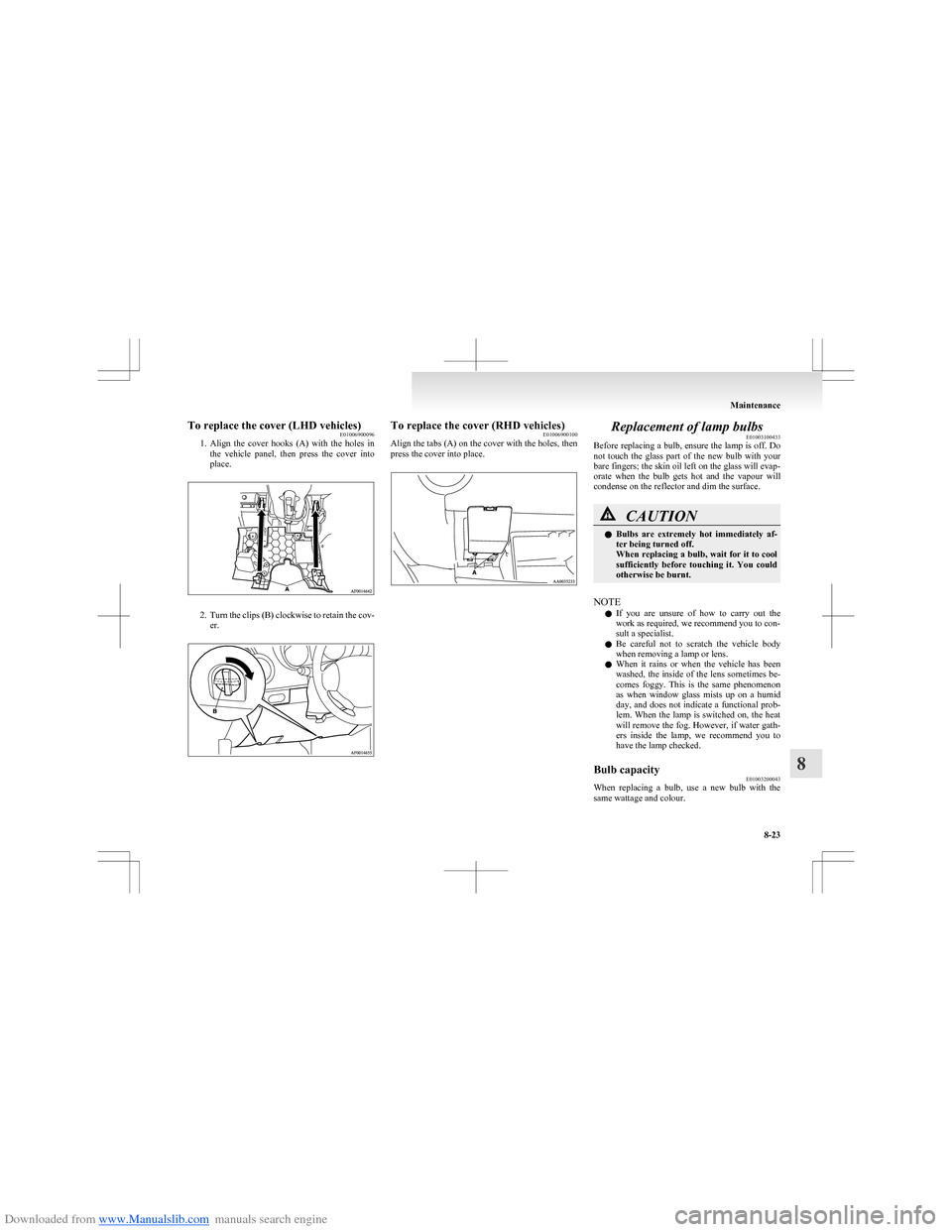
Downloaded from www.Manualslib.com manuals search engine To replace the cover (LHD vehicles)E01006900096
1. Align the cover hooks (A) with the holes in
the vehicle panel, then press the cover into
place.
2. Turn the clips (B) clockwise to retain the cov-
er.
To replace the cover (RHD vehicles) E01006900100
Align the tabs (A) on the cover with the holes, then
press the cover into place.Replacement of lamp bulbs E01003100433
Before replacing a bulb, ensure the lamp is off. Do
not touch the glass part of the new bulb with your
bare fingers; the skin oil left on the glass will evap-
orate when the bulb gets hot and the vapour will
condense on the reflector and dim the surface.CAUTIONl Bulbs are extremely hot immediately af-
ter being turned off.
When replacing a bulb, wait for it to cool
sufficiently before touching it. You could
otherwise be burnt.
NOTE
l If you are unsure of how to carry out the
work as required, we recommend you to con-
sult a specialist.
l Be careful not to scratch the vehicle body
when removing a lamp or lens.
l When it rains or when the vehicle has been
washed, the inside of the lens sometimes be-
comes foggy. This is the same phenomenon
as when window glass mists up on a humid
day, and does not indicate a functional prob-
lem. When the lamp is switched on, the heat
will remove the fog. However, if water gath-
ers inside the lamp, we recommend you to
have the lamp checked.
Bulb capacity E01003200043
When replacing a bulb, use a new bulb with the
same wattage and colour.
Maintenance
8-23
8
Page 238 of 273
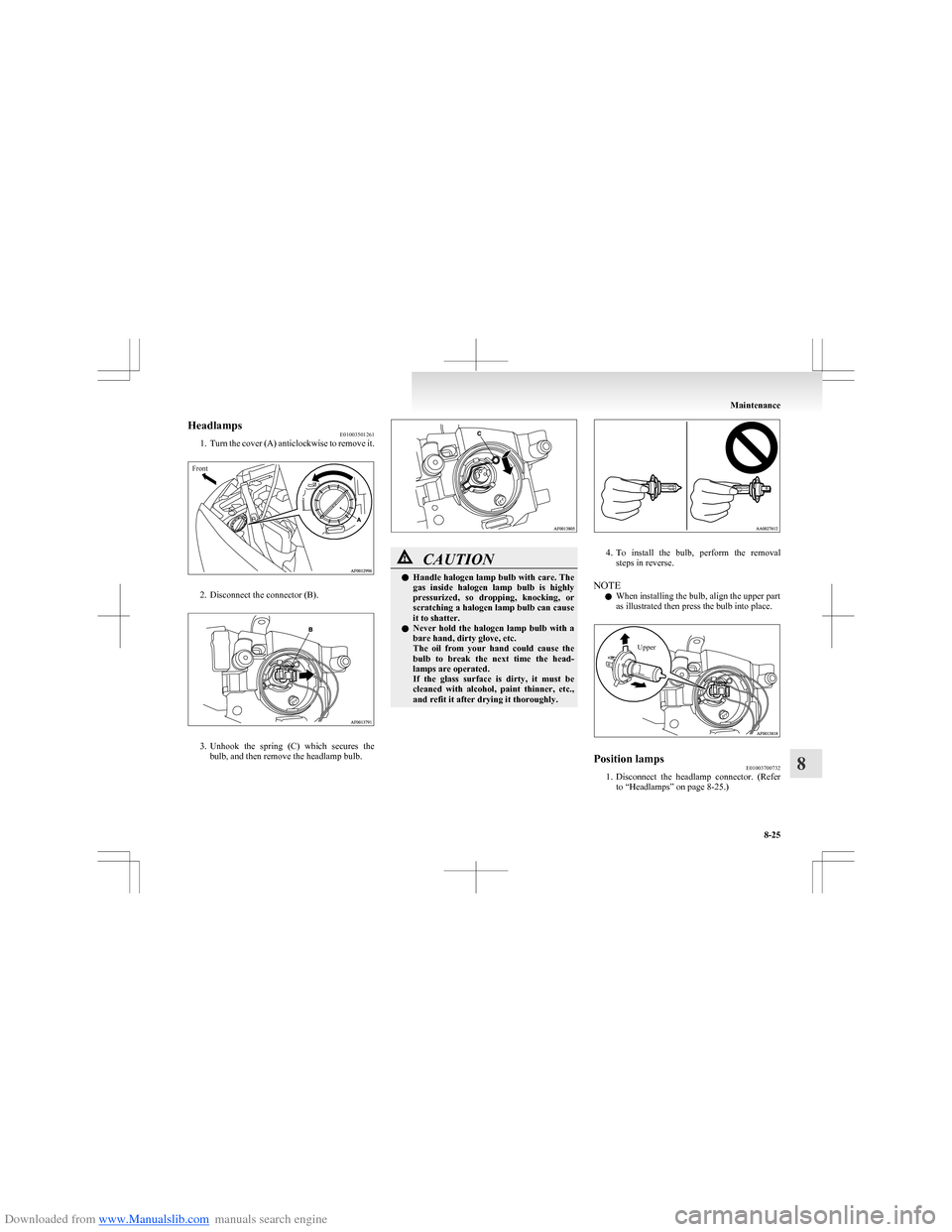
Downloaded from www.Manualslib.com manuals search engine HeadlampsE01003501261
1. Turn the cover (A) anticlockwise to remove it.Front
2. Disconnect the connector (B).
3.Unhook the spring (C) which secures the
bulb, and then remove the headlamp bulb.
CAUTIONl Handle halogen lamp bulb with care. The
gas inside halogen lamp bulb is highly
pressurized, so dropping, knocking, or
scratching a halogen lamp bulb can cause
it to shatter.
l Never hold the halogen lamp bulb with a
bare hand, dirty glove, etc.
The oil from your hand could cause the
bulb to break the next time the head-
lamps are operated.
If the glass surface is dirty, it must be
cleaned with alcohol, paint thinner, etc.,
and refit it after drying it thoroughly.
4. To install the bulb, perform the removal
steps in reverse.
NOTE l When installing the bulb, align the upper part
as illustrated then press the bulb into place.
UpperPosition lamps E01003700732
1.Disconnect the headlamp connector. (Refer
to “Headlamps” on page 8-25.)
Maintenance
8-25
8
Page 240 of 273
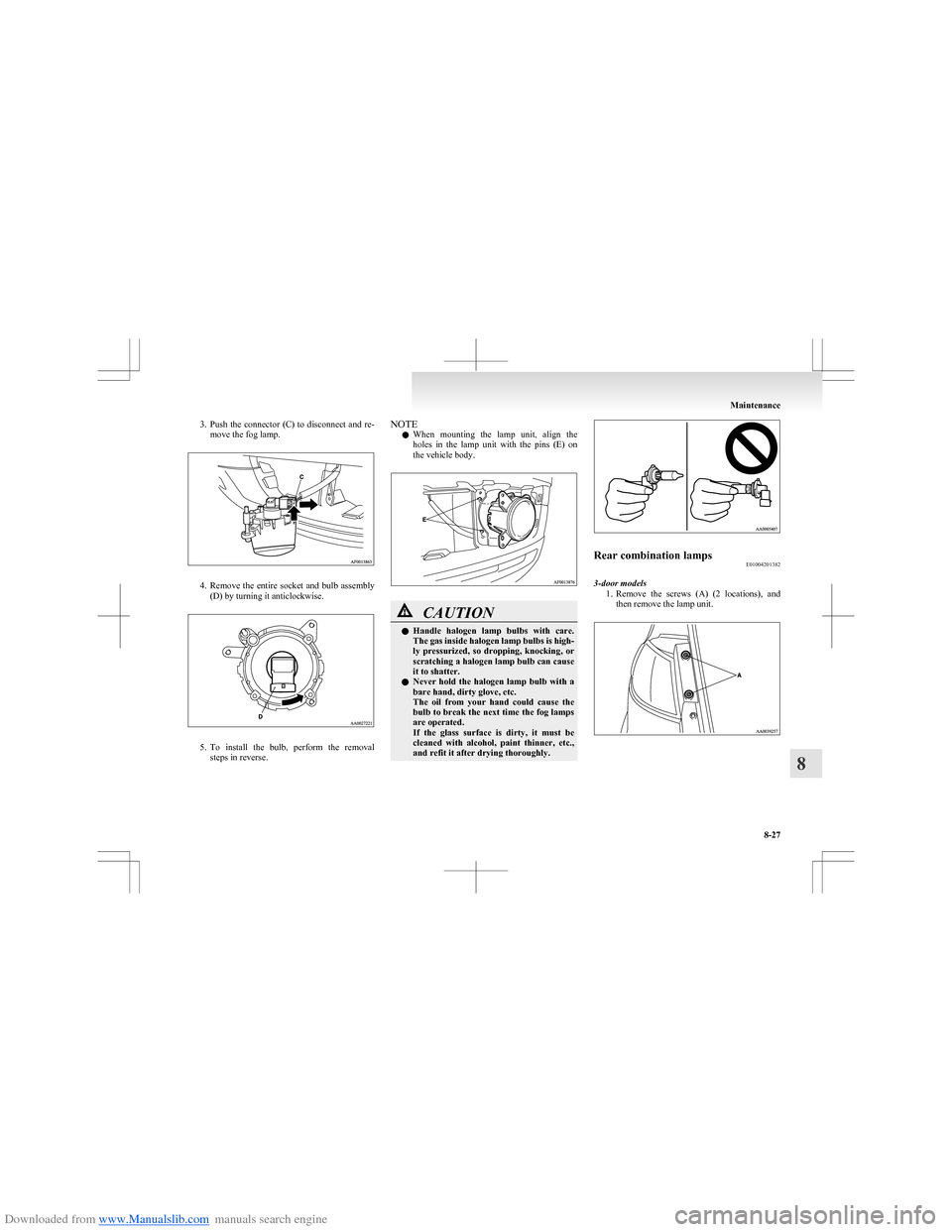
Downloaded from www.Manualslib.com manuals search engine 3.Push the connector (C) to disconnect and re-
move the fog lamp.
4. Remove the entire socket and bulb assembly
(D) by turning it anticlockwise.
5. To install the bulb, perform the removal
steps in reverse.
NOTE
l When mounting the lamp unit, align the
holes in the lamp unit with the pins (E) on
the vehicle body.CAUTIONl Handle halogen lamp bulbs with care.
The gas inside halogen lamp bulbs is high-
ly pressurized, so dropping, knocking, or
scratching a halogen lamp bulb can cause
it to shatter.
l Never hold the halogen lamp bulb with a
bare hand, dirty glove, etc.
The oil from your hand could cause the
bulb to break the next time the fog lamps
are operated.
If the glass surface is dirty, it must be
cleaned with alcohol, paint thinner, etc.,
and refit it after drying thoroughly.Rear combination lamps E01004201382
3-door models
1.Remove the screws (A) (2 locations), and
then remove the lamp unit.
Maintenance
8-27
8