time MITSUBISHI COLT 2009 10.G Workshop Manual
[x] Cancel search | Manufacturer: MITSUBISHI, Model Year: 2009, Model line: COLT, Model: MITSUBISHI COLT 2009 10.GPages: 273, PDF Size: 17.28 MB
Page 173 of 273
Downloaded from www.Manualslib.com manuals search engine Handling of compact discsE00723000207
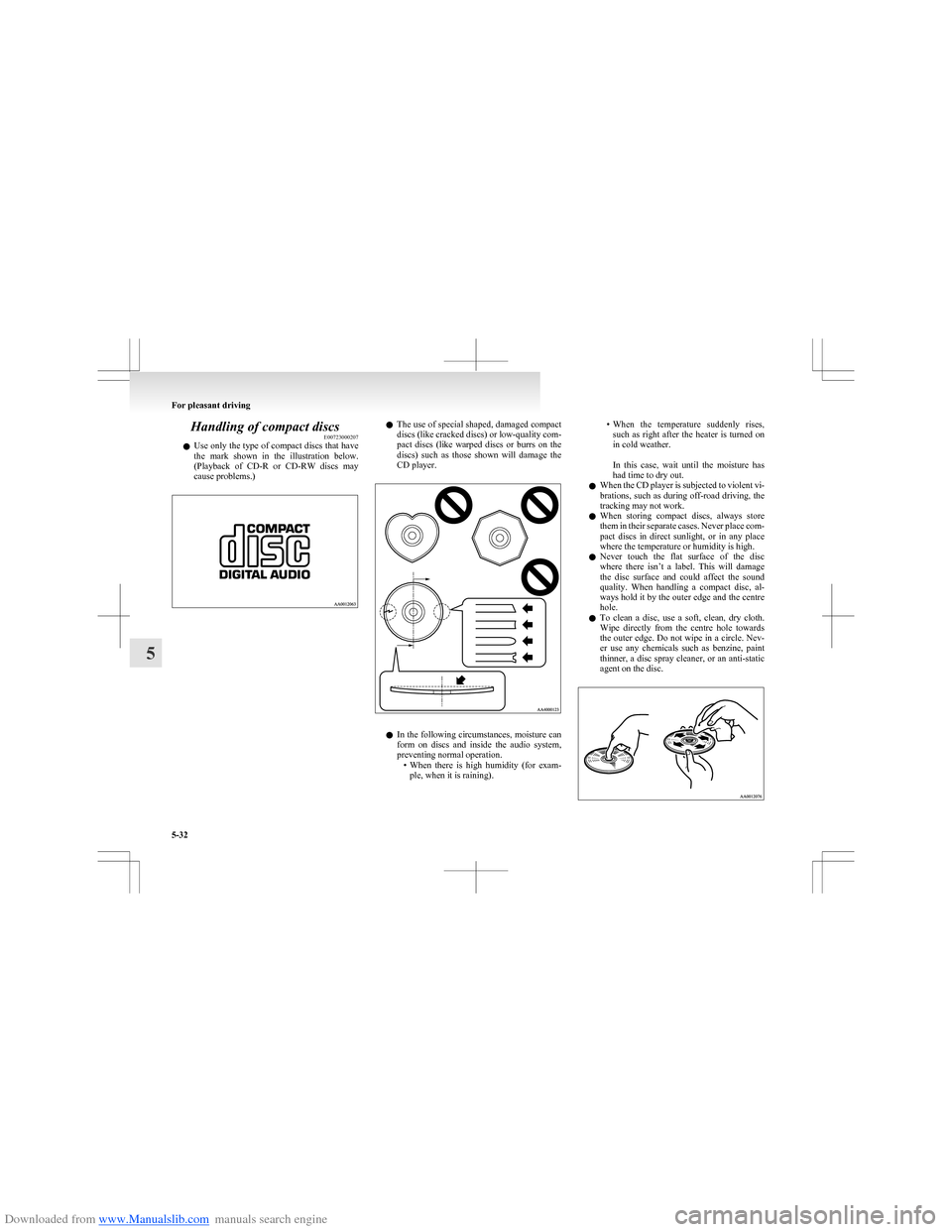
l Use only the type of compact discs that have
the mark shown in the illustration below.
(Playback of CD-R or CD-RW discs may
cause problems.)l The use of special shaped, damaged compact
discs (like cracked discs) or low-quality com-
pact discs (like warped discs or burrs on the
discs) such as those shown will damage the
CD player.
l In the following circumstances, moisture can
form on discs and inside the audio system,
preventing normal operation. •When there is high humidity (for exam-
ple, when it is raining).
• When the temperature suddenly rises,
such as right after the heater is turned on
in cold weather.
In this case, wait until the moisture has
had time to dry out.
l When the CD player is subjected to violent vi-
brations, such as during off-road driving, the
tracking may not work.
l When storing compact discs, always store
them in their separate cases. Never place com-
pact discs in direct sunlight, or in any place
where the temperature or humidity is high.
l Never touch the flat surface of the disc
where there isn’t a label. This will damage
the disc surface and could affect the sound
quality. When handling a compact disc, al-
ways hold it by the outer edge and the centre
hole.
l To clean a disc, use a soft, clean, dry cloth.
Wipe directly from the centre hole towards
the outer edge. Do not wipe in a circle. Nev-
er use any chemicals such as benzine, paint
thinner, a disc spray cleaner, or an anti-static
agent on the disc.
For pleasant driving
5-32
5
Page 176 of 273
Downloaded from www.Manualslib.com manuals search engine 3.Press the Menu button (B) repeatedly to se-
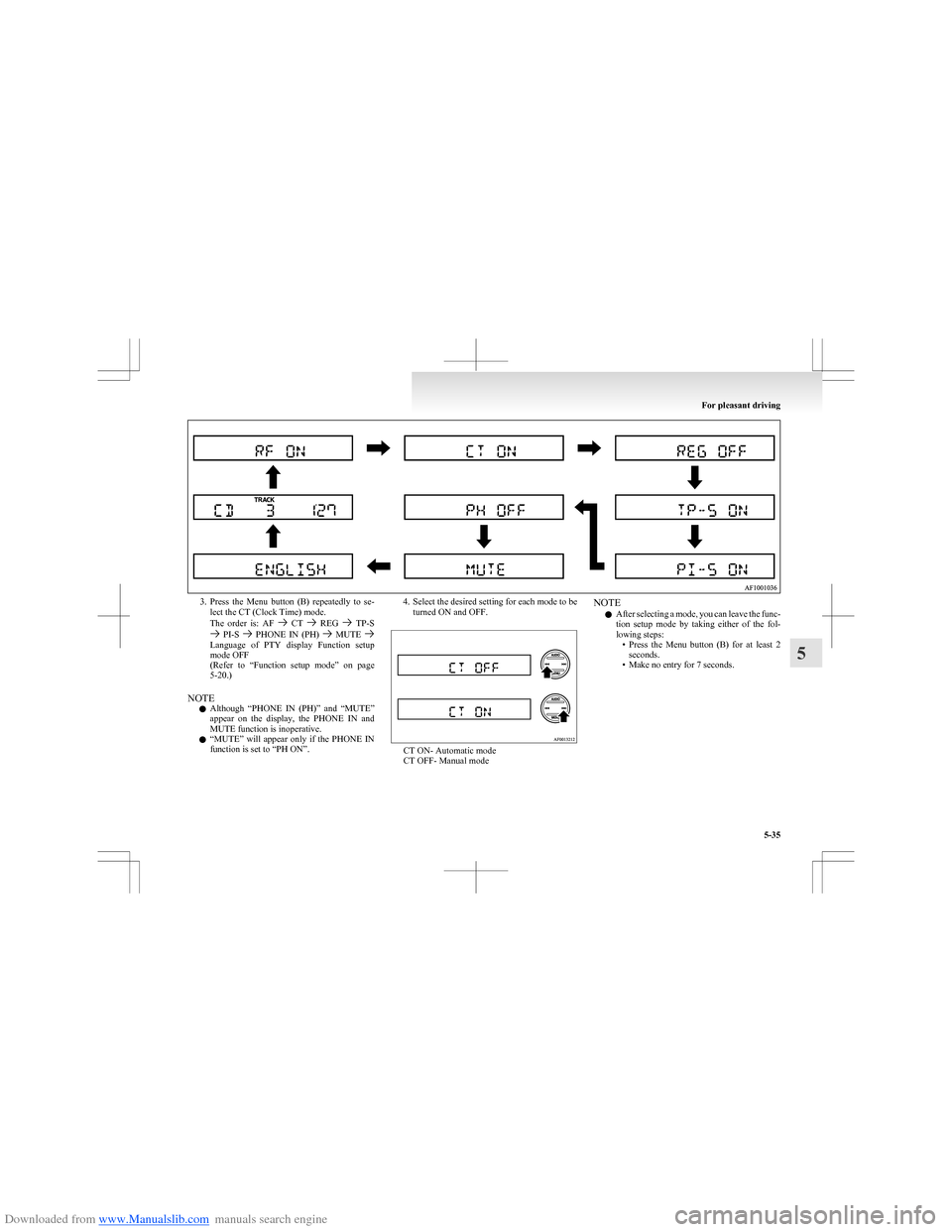
lect the CT (Clock Time) mode.
The order is: AF
CT REG TP-S PI-S PHONE IN (PH) MUTE Language of PTY display Function setup
mode OFF
( Refer to “Function setup mode” on page
5-20.)
NOTE l Although “PHONE IN (PH)” and “MUTE”
appear on the display, the PHONE IN and
MUTE function is inoperative.
l “
MUTE” will appear only if the PHONE IN
function is set to “PH ON”.
4. Select the desired setting for each mode to be turned ON and OFF.
CT ON- Automatic mode
CT OFF- Manual mode
NOTE
l After selecting a mode, you can leave the func-
tion setup mode by taking either of the fol-
lowing steps: •Press the Menu button (B) for at least 2
seconds.
• Make no entry for 7 seconds.
For pleasant driving
5-35
5
Page 177 of 273
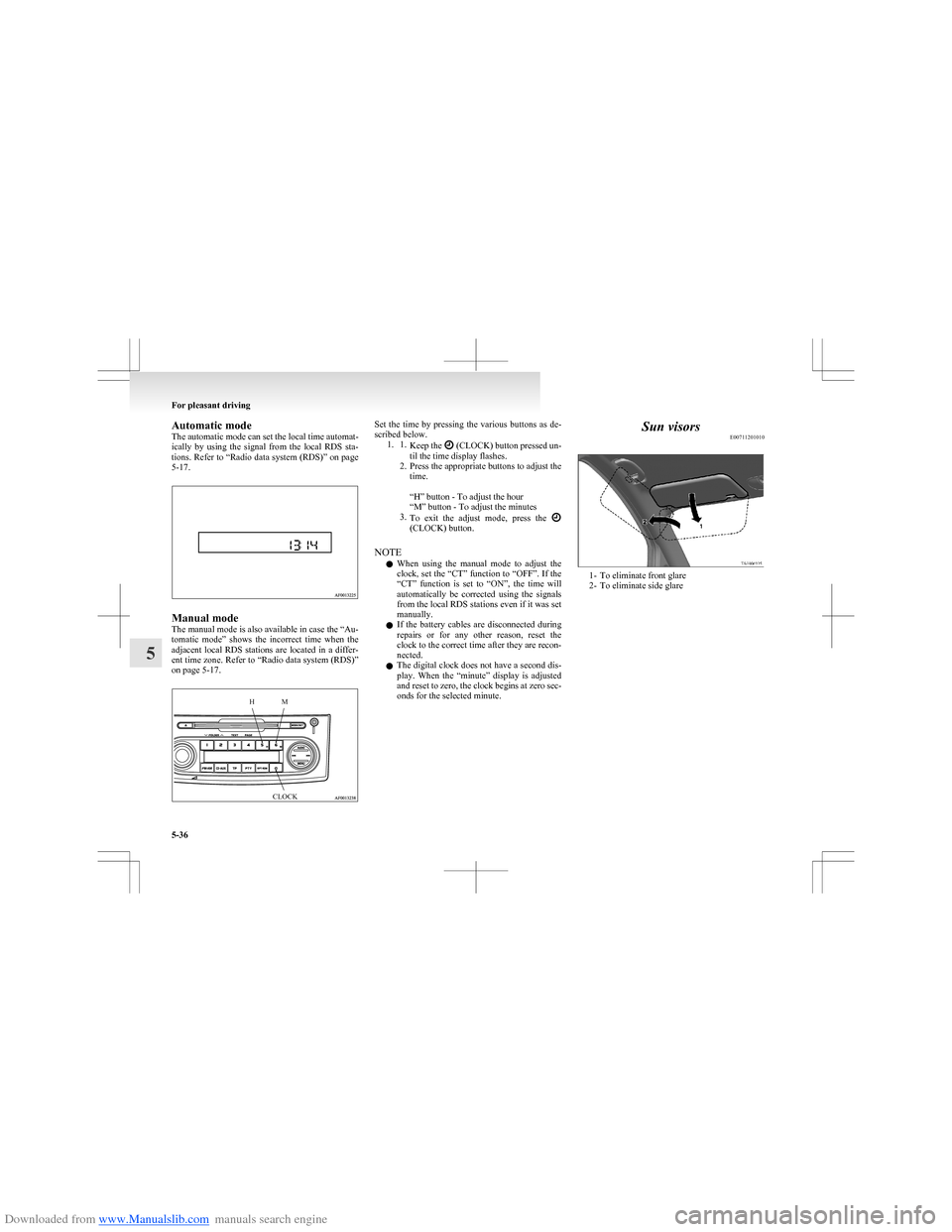
Downloaded from www.Manualslib.com manuals search engine Automatic mode
The automatic mode can set the local time automat-
ically by using the signal from the local RDS sta-
tions. Refer to “Radio data system (RDS)” on page
5-17.
Manual mode
The manual mode is also available in case the “Au-
tomatic mode” shows the incorrect time when the
adjacent local RDS stations are located in a differ-
ent time zone. Refer to “Radio data system (RDS)”
on page 5-17.
HMCLOCKSet the time by pressing the various buttons as de-
scribed below. 1. 1. Keep the
(CLOCK) button pressed un-
til the time display flashes.
2. Press the appropriate buttons to adjust the
time.
“H” button - To adjust the hour
“M” button - To adjust the minutes
3. To exit the adjust mode, press the
(CLOCK) button.
NOTE l When using the manual mode to adjust the
clock, set the “CT” function to “OFF”. If the
“CT” function is set to “ON”, the time will
automatically be corrected using the signals
from the local RDS stations even if it was set
manually.
l If the battery cables are disconnected during
repairs or for any other reason, reset the
clock to the correct time after they are recon-
nected.
l The digital clock does not have a second dis-
play. When the “minute” display is adjusted
and reset to zero, the clock begins at zero sec-
onds for the selected minute.
Sun visors E00711201010
1- To eliminate front glare
2- To eliminate side glare
For pleasant driving
5-36
5
Page 190 of 273
Downloaded from www.Manualslib.com manuals search engine 4.After the engine coolant temperature has drop-
ped to the normal temperature, stop the engine.
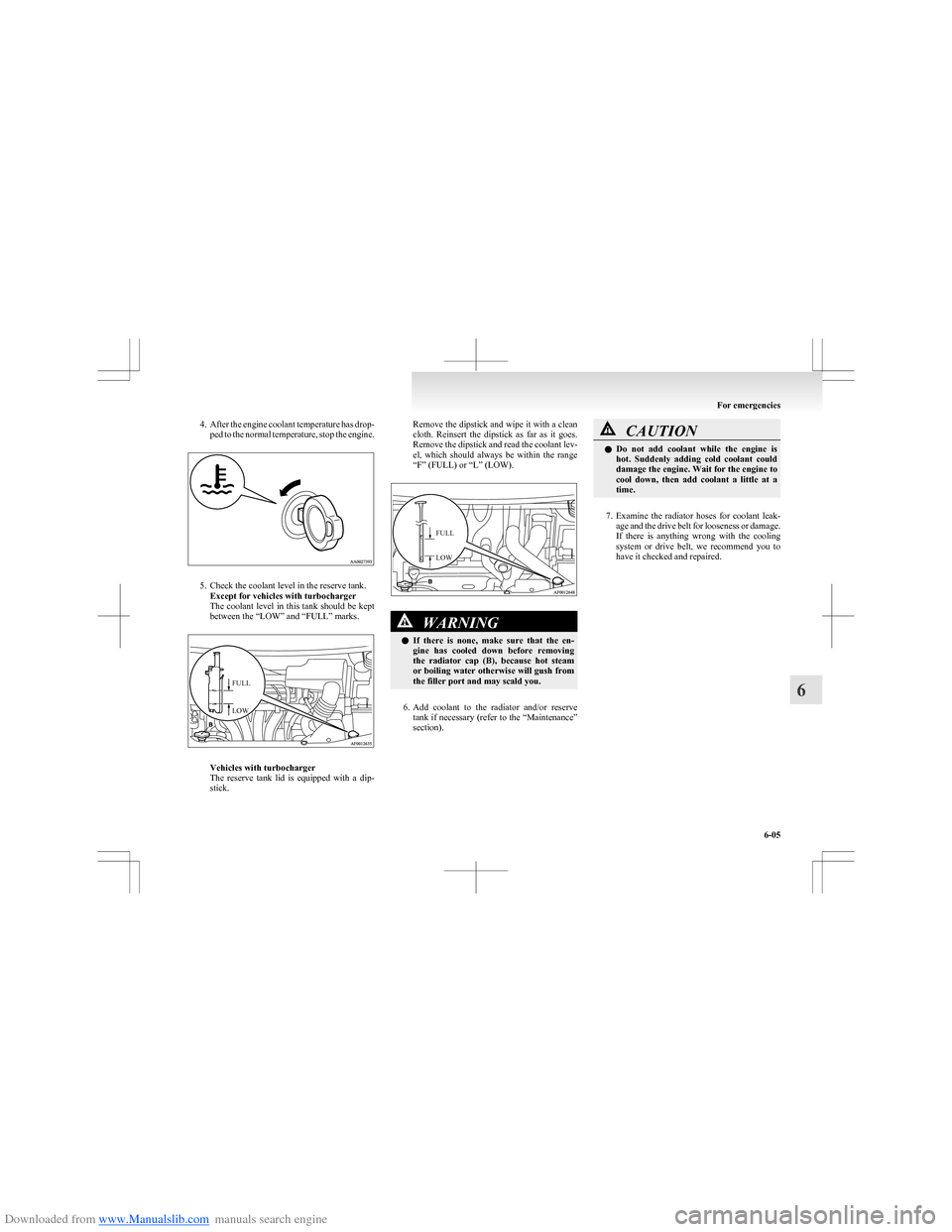
5. Check the coolant level in the reserve tank. Except for vehicles with turbocharger
The coolant level in this tank should be kept
between the “LOW” and “FULL” marks.
FULLLOW
Vehicles with turbocharger
The reserve tank lid is equipped with a dip-
stick.
Remove the dipstick and wipe it with a clean
cloth. Reinsert the dipstick as far as it goes.
Remove the dipstick and read the coolant lev-
el, which should always be within the range
“F” (FULL) or “L” (LOW).FULLLOW
WARNINGl If there is none, make sure that the en-
gine has cooled down before removing
the radiator cap (B), because hot steam
or boiling water otherwise will gush from
the filler port and may scald you.
6. Add coolant to the radiator and/or reserve
tank if necessary (refer to the “Maintenance”
section).
CAUTIONl Do not add coolant while the engine is
hot. Suddenly adding cold coolant could
damage the engine. Wait for the engine to
cool down, then add coolant a little at a
time.
7. Examine the radiator hoses for coolant leak-
age and the drive belt for looseness or damage.
If there is anything wrong with the cooling
system or drive belt, we recommend you to
have it checked and repaired.
For emergencies
6-05
6
Page 195 of 273
Downloaded from www.Manualslib.com manuals search engine lThe surface of the compressor will get hot
while the compressor is running. Do not
keep the compressor running continuously
for more than 6 minutes. After using the com-
pressor, wait for the compressor to cool be-
fore using it again.
l If the tyre pressure does not rise to the neces-
sary of at least 1.8 bar level within 5 mi-
nutes, the tyre may be so severely damaged
that the tyre sealant cannot be used to effect
an emergency repair. Please contact a
MITSUBISHI MOTORS Authorized Service
Point or another specialist in this event.
l Simply putting sealant and air into the tyre us-
ing the tyre repair kit does not seal the punc-
ture hole. Air will leak through the puncture
hole until the emergency repair procedure is
completed (through step 17 of these instruc-
tions).
15. When you have inflated the tyre to the speci-
fied pressure, stow the compressor and bottle
in the vehicle and promptly start driving the
vehicle so that the tire sealant can spread even-
ly in the tyre. Drive with great care. Do not
exceed a speed of 80 km/h (50 mph). Ob-
serve local speed limits.
Remove the “max. 80 km/h ” or “max.
50 mph ” label from the bottle, that must be
displayed on the instrument panel within the
driver’s field of view.CAUTIONl If you sense any abnormality while driv-
ing, stop the vehicle and contact a
MITSUBISHI MOTORS Authorized
Service Point or another specialist. Other-
wise the tyre pressure may drop before
the emergency repair procedure is com-
pleted, rendering the vehicle unsafe.
NOTE
l Driving faster than 80 km/h
(50 mph) can
make the vehicle vibrate.
16. After driving for 10 minutes, check the tyre
pressure using the air pressure gauge on the
compressor.
If the tyre pressure is not sufficient, inflate
the tyre to the specified pressure again and
drive the vehicle carefully without exceeding
a speed of 80 km/h (50 mph).
CAUTIONl If the tyre pressure is lower than the min-
imum permitted pressure (1.3 bar
{ 130 kPa}), the tyre cannot successfully
be repaired with the tyre sealant. Do not
drive the vehicle any further. Contact a
MITSUBISHI MOTORS Authorized
Service Point or another specialist.
17. After driving for 10 minutes, check the tyre
pressure using the air pressure gauge on the
compressor. (Refer to “Tyre inflation pres-
sures” on page 8-12.) If the tyre pressure
has apparently not dropped, the emergency re-
pair procedure is complete. You must still
not exceed a speed of 80 km/h (50 mph).
Observe local speed limits.
NOTE l If the tyre pressure has dropped below the
specified level when you check it at the end
of the repair procedure, do not drive the vehi-
cle any further. Contact a MITSUBISHI
MOTORS Authorized Service Point or anoth-
er specialist.
l In cold conditions (when the ambient temper-
ature is 0 °C or lower), the time and driving
distance necessary until completion of the re-
pair can be longer than in warmer conditions,
meaning that the tyre pressure can drop be-
low the specified level even when you have
inflated the tyre a second time and subsequent-
ly driven the vehicle. If this happens, inflate
the tyre to the specified pressure once more,
drive for about 10 minutes or 5 km (3 miles),
then check the tyre pressure again. If the tyre
pressure has again dropped below the speci-
fied level, stop driving the vehicle and con-
tact a MITSUBISHI MOTORS Authorized
Service Point or another specialist.
18. Then immediately drive with great care to a
MITSUBISHI MOTORS Authorized Service
Point or another specialist and have tyre re-
pair/replacement performed.
For emergencies
6-10
6
Page 198 of 273
Downloaded from www.Manualslib.com manuals search engine WARNINGlStop jacking up the vehicle as soon as the
tyre is raised off the ground. It is danger-
ous to raise the vehicle any higher.
l Do not get under your vehicle while using
the jack.
l Do not bump the raised vehicle or leave it
sitting on the jack for a long time. Both
are very dangerous.
l Do not use a jack except the one that
came with your vehicle.
l The jack should not be used for any pur-
pose other than to change a tyre.
l No one should be in your vehicle when us-
ing the jack.
l Do not start or run the engine while your
vehicle is on the jack.
l Do not turn the raised wheel. The tyres
still on the ground could turn and make
your vehicle fall off the jack.Spare wheel* E00801101394
Check the air pressure of the spare tyre frequently
and make sure it is ready for emergency use at any
time.
Maintaining the spare wheel at the highest speci-
fied air pressure will ensure that it can always be
used under any conditions (city/high-speed driving,
varying load weight, etc.).
The spare wheel is stored beneath the luggage floor
board of the luggage compartment.
Compact spare wheel
The compact spare tyre is designed to save space in
the luggage compartment and its lighter weight
makes it easier to use if a flat tyre occurs.CAUTIONl The pressure should be periodically
checked and maintained at the specified
pressure while the tyre is stowed.
Driving with an insufficient tyre pressure
can lead to an accident. If you have no
choice but to drive with an insufficient
tyre pressure, keep your speed down and
inflate the tyre to the correct pressure as
soon as possible. (Refer to “Tyre inflation
pressures” on page 8-12.)
l The compact spare wheel is for tempora-
ry use only and should be removed as
soon as the original wheel can be re-
paired or replaced.
l The vehicle must not be driven at speeds
in excess of 80 km/h (50 mph) while using
the compact spare wheel.CAUTIONl The compact spare tyre is not as good as
a standard tyre in controllability and sta-
bility. When the compact spare tyre is
used, avoid quick starts, sudden braking
and sharp steering.
l Avoid driving through automatic vehicle
washers and over obstacles that could pos-
sibly damage the vehicle’s undercarriage.
Because the compact spare wheel is small-
er than the original wheel, the ground
clearance is slightly reduced.
l The compact spare wheel is specifically de-
signed for your vehicle and it should not
be used on any other vehicle.
l Do not use tyre chains with your compact
spare wheel. Because of the smaller tyre
size, a tyre chain will not fit properly.
This could cause damage to the wheel
and result in loss of the chain.
If a front tyre becomes flat when using
tyre chains, first replace a rear wheel
with the compact spare wheel and then
use the removed rear wheel to replace the
flat front wheel so that you can continue
to use the chains.
For emergencies
6-13
6
Page 199 of 273
Downloaded from www.Manualslib.com manuals search engine CAUTIONlThe compact spare tyre should not be
used on any other wheels, nor should
standard tyres, snow tyres, wheel covers
or trim rings be used with the compact
spare wheel. If such use is attempted, dam-
age to these items or other vehicle compo-
nents may occur.
l Upon installation of the compact spare
tyre, the overall vehicle height is lowered
slightly as the tyre is smaller in diameter
than the standard tyre. When passing
over the projections on the road, take
care not to drive the vehicle with the
same feeling as used in driving with the
standard tyre on.
l Do not install more than one compact
spare wheel at the same time.
l When the tread wear indicators appear,
the tyre must be replaced.
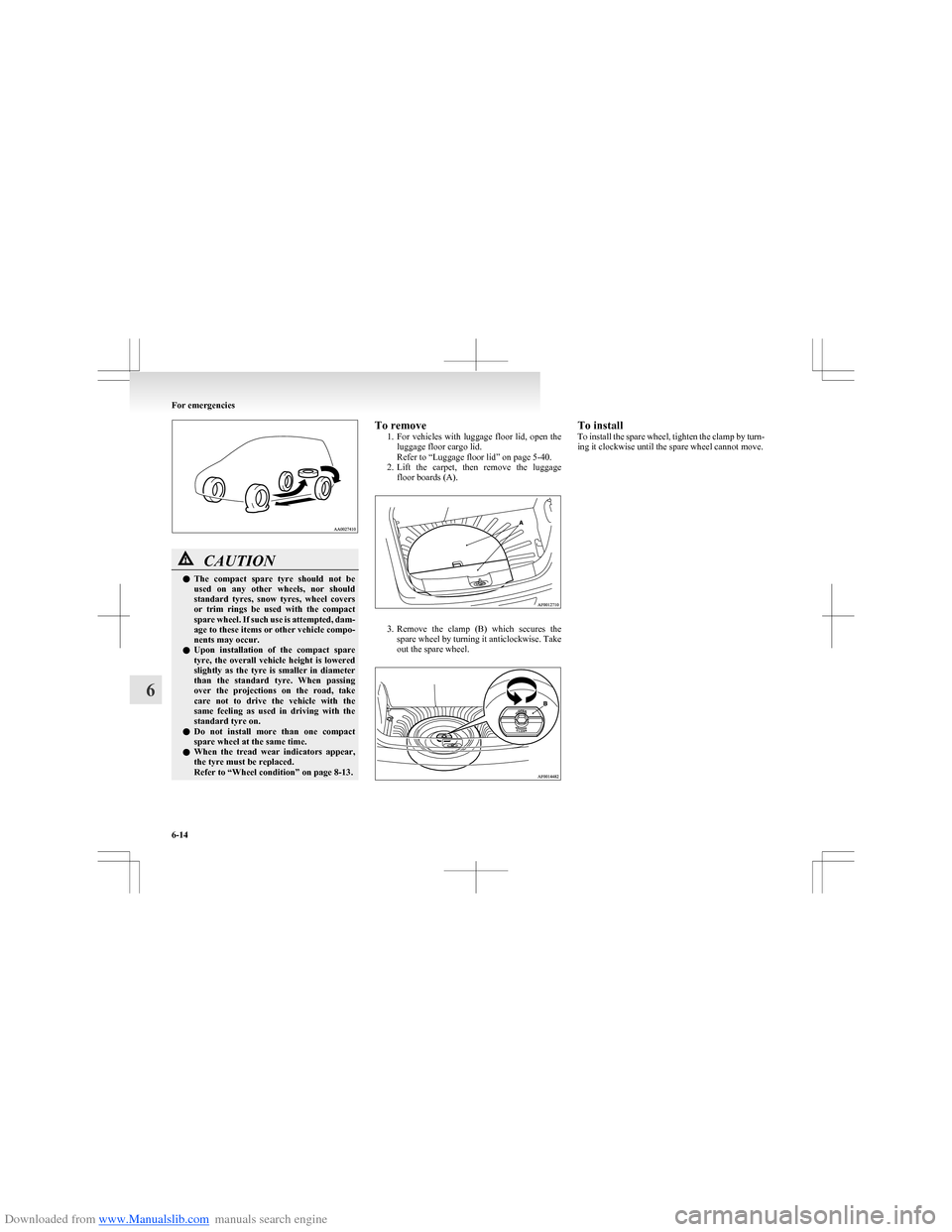
Refer to “Wheel condition” on page 8-13.To remove
1.For vehicles with luggage floor lid, open the
luggage floor cargo lid.
Refer to “Luggage floor lid” on page 5-40.
2. Lift the carpet, then remove the luggage
floor boards (A).
3. Remove the clamp (B) which secures the
spare wheel by turning it anticlockwise. Take
out the spare wheel.
To install
To install the spare wheel, tighten the clamp by turn-
ing it clockwise until the spare wheel cannot move.
For emergencies
6-14
6
Page 207 of 273
Downloaded from www.Manualslib.com manuals search engine Operation under adverse drivingconditions E00801701840
If your vehicle becomes stuck in sand,
mud or snow
If the vehicle becomes stuck in snow, sand, or
mud, it can often be moved by a rocking motion.
For vehicle with manual transmission, move the
gearshift lever alternately between 1 st
and Reverse,
while applying slight pressure to the accelerator ped-
al.
With an automated manual transmission vehicle,
place the allshift lever in the “A” (automatic mode)
position to select automatic mode or select 1 st
or
2 nd
gear in the manual mode or place the allshift lev-
er in the “R” (Reverse) position for reverse. Con-
firm that there is an “A”, “1”, “2” or “R” in the all-
shift indicator display, then gently press the acceler-
ator pedal. Do not press the accelerator pedal while
moving the allshift lever.
Avoid racing the engine or spinning the wheels. Pro-
longed efforts to free a stuck vehicle may result in
overheating and transmission failure. Allow the en-
gine to idle for a few minutes to let the transmis-
sion cool between rocking attempts.
If the vehicle remains stuck after several rocking at-
tempts, seek other assistance.WARNINGl When attempting to rock your vehicle out
of a stuck position, be sure that the area
around the vehicle is clear of people and
physical objects. The rocking motion may
cause the vehicle to suddenly launch for-
ward or backward, causing injury or dam-
age to nearby people or objects.
On a flooded road
l Avoid flooded roads. Water could enter the
brake discs, resulting in temporarily ineffec-
tive brakes. In such cases, lightly depress the
brake pedal to see if the brakes operate prop-
erly. If they do not, lightly depress the pedal
several times while driving in order to dry
the brake pads.
l When driving in rain or on a road with many
puddles a layer of water may form between
the tyres and the road surface.
This reduces a tyre’s frictional resistance on
the road, resulting in loss of steering stability
and braking capability.
To cope with this, observe the following items:
(a)Drive your vehicle at slow speed. (b)Do not drive on worn tyres. Always
maintain the specified tyre inflation
pressures.
On a snow-covered or frozen road
l When driving on a snow-covered or frozen
road, it is recommended that you use snow
tyres or tyre chains.
Refer to the “Snow tyres” and “Tyre chains”
sections.
l Avoid high-speed operation, sudden acceler-
ation, abrupt brake application and sharp cor-
nering.
l Depressing the brake pedal during travel on
snowy or icy roads may cause tyre slippage
and skidding. When traction between the
tyres and the road is reduced the wheels may
skid and the vehicle cannot readily be
brought to a stop by conventional braking
techniques. Braking will differ, depending
upon whether you have anti-lock brake sys-
tem (ABS). As your vehicle is equipped with
anti-lock brake system (ABS), brake by press-
ing the brake pedal hard, and keeping it press-
ed.
l Allow extra distance between your vehicle
and the vehicle in front of you, and avoid sud-
den braking.
On a bumpy or rutted road l Drive as slow as possible when driving on
bumpy or rutted roads.CAUTIONl The impact on tyres and/or wheels when
driving on a bumpy or rutted road can
damage the tyre and/or wheel.
For emergencies
6-22
6
Page 211 of 273
Downloaded from www.Manualslib.com manuals search engine CAUTIONlAfter washing the vehicle, drive the vehi-
cle slowly while lightly depressing the
brake pedal several times in order to dry
out the brakes.
Leaving the brakes wet could result in re-
duced braking performance. Also, there
is a possibility that they could freeze up
or become inoperative due to rust, render-
ing the vehicle unable to move.
l When using an automatic car wash, pay
attention to the following items, referring
to the operation manual or consulting a
car wash operator. If the following proce-
dure is not followed, it could result in dam-
age to your vehicle. • The outside mirrors are retracted.
• The antenna is removed.
• The rear wiper arm assembly is taped
or removed.
• If your vehicle is equipped with a rear
spoiler, consult a car wash operator be-
fore using the car wash.
• If your vehicle has rain sensor wipers,
place the wiper switch lever in the
“
” (OFF) position to deactivate the
rain sensor.
During cold weather
Salt and other chemicals spread on the roads in
some areas in winter can have a harmful effect on
the vehicle body. You should therefore wash the ve-
hicle as often as possible in accordance with our
care-instructions. It is recommended to have a pres-
ervative applied and the underfloor protection
checked before and after the cold weather season.
After washing your vehicle, wipe off all water-
drops from the rubber parts around the doors to pre-
vent the doors from freezing.
NOTE l To prevent freezing of the weatherstripping
on the doors, bonnet, etc., they should be trea-
ted with silicone spray.Waxing E00901000717
Waxing the vehicle will help prevent the adherence
of dust and road chemicals to the paintwork. Apply
a wax solution after washing the vehicle, or at least
once every three months to assist displacing of water.
Do not wax your vehicle in direct sunlight. You
should wax after the surfaces have cooled.
CAUTIONl Waxes containing high abrasive com-
pounds should not be used. Such waxes re-
move rust and stains effectively from the
paintwork but they are harmful to the lus-
tre on the painted surface and the plated
surface.
Further, they are harmful to glossy surfa-
ces such as grille, garnish, mouldings, etc.
l Do not use petrol or paint thinners to re-
move road tar or other contamination to
the vehicle surface.
l Do not apply wax on the areas having
black mat coating as it can cause uneven
discolouration, patches, blurs, etc. If
stained with wax, immediately wipe off
with a piece of soft cloth and warm water.Polishing E00901100011
The vehicle should only be polished if the paint-
work has become stained or lost its lustre. Matt-fin-
ish parts and plastic bumpers must not be polished,
polishing these parts will stain them or damage
their finish.Damaged paint E00901200168
Small cracks and scratches in the paint coat should
be touched up as soon as possible with
MITSUBISHI touch-up paint to prevent corrosion.
Check body areas facing the road or the tyres care-
fully for damage to the paint coat caused by flying
stones, etc. The paint code number for your vehicle
can be found on the vehicle information code plate
on the door sill.
Cleaning plastic parts E00901300550
Use a sponge or chamois leather.
If a car wax adheres on a grey or black rough sur-
face of the bumper, moulding or lamps, the surface
becomes white. In such a case, wipe it off using
lukewarm water and soft cloth or chamois leather.
CAUTIONl Do not use a scrubbing brush or other
hard tools as they may damage the plastic
part surface.
l Do not use wax containing compound (pol-
ishing powder) which may damage the
plastic part surface.
Vehicle care
7-04
7
Page 216 of 273
Downloaded from www.Manualslib.com manuals search engine The catalytic converter itself gets hot quickly, and
may be damaged if overheated. The following
points should be noted in order to prevent the igni-
tion of unburned petrol within the catalytic convert-
er.
l Use UNLEADED PETROL ONLY of the
type recommended in “Fuel selection” on
page 02.
l Do not drive with an extremely low fuel lev-
el; running out of fuel could cause damage to
the catalytic converter.
l Do not attempt to start the engine by pushing
the vehicle. If the battery is weak or dis-
charged, use another battery to start the en-
gine.
l Do not idle the engine with any spark plug
wires disconnected or removed such as per-
forming diagnostic tests.
l Do not idle the engine for prolonged periods
during very rough idle or malfunctioning op-
erating conditions.
l Do not race the engine when turning off the
ignition switch. This will cause the catalytic
converter to be damaged due to contact with
unburnt fuel.
l Stop driving the vehicle if you think the per-
formance is noticeably low, or if the engine
has a malfunction such as with the ignition,
etc.
If it is impractical to stop driving immediate-
ly, reduce the speed and drive for only a
short time. We recommend you to have your
vehicle inspected as soon as possible.l In unusual situations involving grossly mal-
functioning engine operation, a burnt smell
may indicate severe and abnormal catalyst
overheating.
If this occurs, the vehicle should be stopped
in a safe place, the engine switched off and
the vehicle allowed to cool. Once the engine
is cool, a service, including a tune-up to man-
ufacturer’s specifications, should be obtained
immediately.Bonnet E01000302470
To open
Pull the release lever towards you to unlock the bon-
net.
Raise the bonnet while pressing the safety lock.
NOTE l Only open the bonnet when the wipers are in
the parked position. Failure to do so may
cause paint/body damage.
Maintenance
8-03
8