ABS MITSUBISHI ECLIPSE 1990 User Guide
[x] Cancel search | Manufacturer: MITSUBISHI, Model Year: 1990, Model line: ECLIPSE, Model: MITSUBISHI ECLIPSE 1990Pages: 391, PDF Size: 15.27 MB
Page 107 of 391
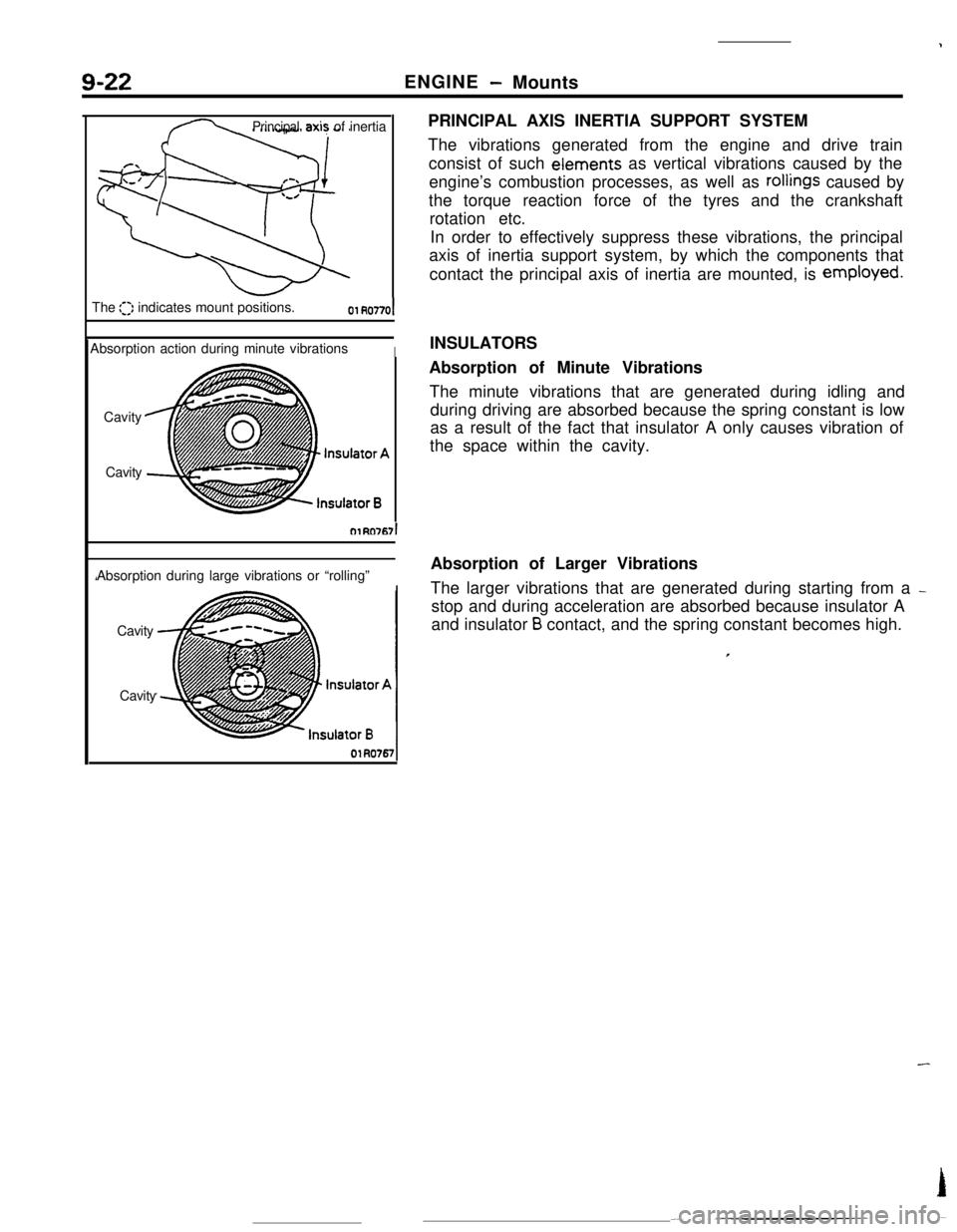
9-22ENGINE- Mounts
Principalaxi? of inertia
The
::I: indicates mount positions.01 RO77OlAbsorption action during minute vibrations
ICavity
CavityOlRcl767l
Absorption during large vibrations or “rolling”
Cavity
CavityPRINCIPAL AXIS INERTIA SUPPORT SYSTEM
The vibrations generated from the engine and drive train
consist of such eiements as vertical vibrations caused by the
engine’s combustion processes, as well as
rollings caused by
the torque reaction force of the tyres and the crankshaft
rotation etc.
In order to effectively suppress these vibrations, the principal
axis of inertia support system, by which the components that
contact the principal axis of inertia are mounted, is employed.
INSULATORS
Absorption of Minute Vibrations
The minute vibrations that are generated during idling and
during driving are absorbed because the spring constant is low
as a result of the fact that insulator A only causes vibration of
the space within the cavity.
Absorption of Larger Vibrations
The larger vibrations that are generated during starting from a
_stop and during acceleration are absorbed because insulator A
and insulator
B contact, and the spring constant becomes high.
Page 128 of 391
14-16FUEL SYSTEM - Sensors
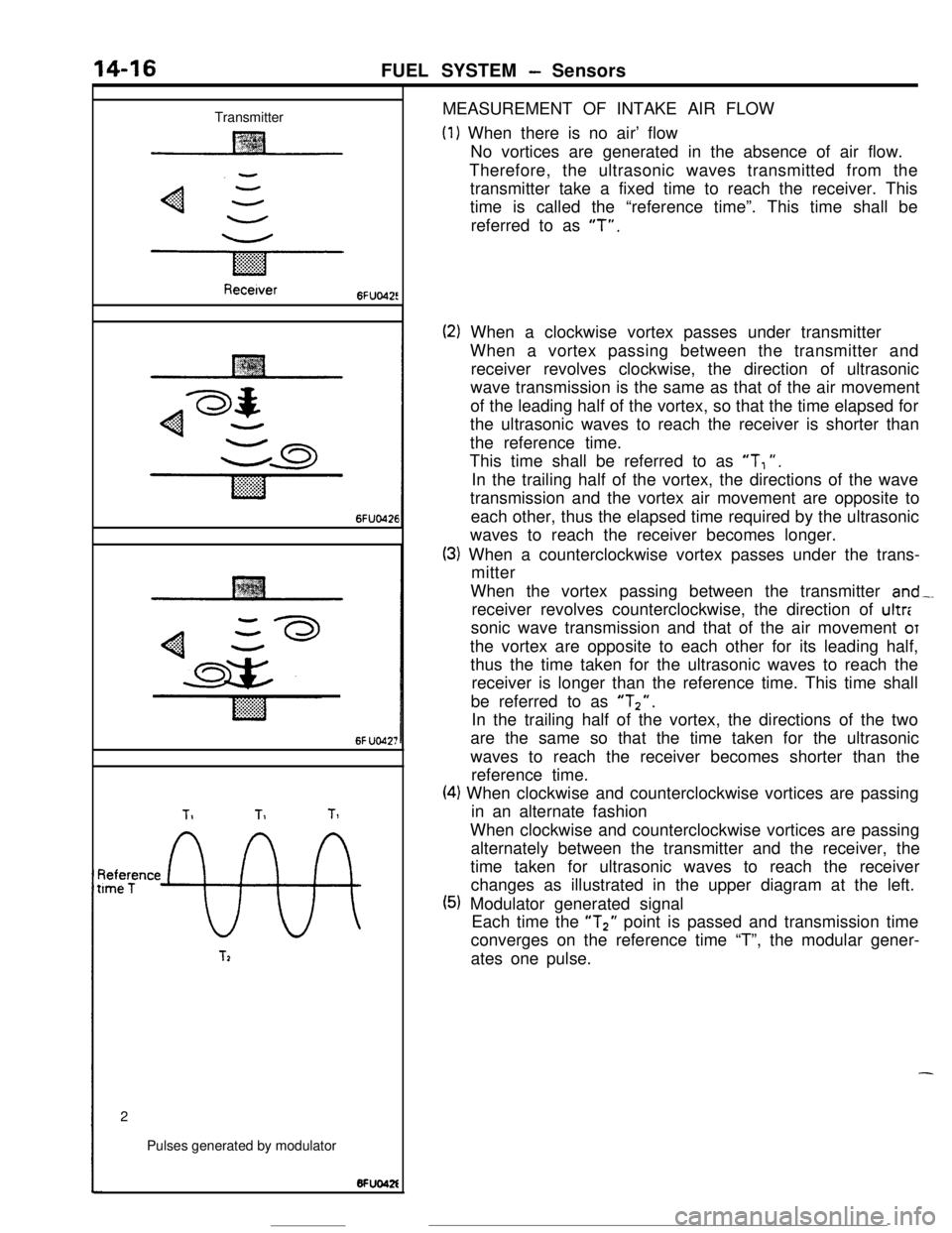
TransmitterMEASUREMENT OF INTAKE AIR FLOW
(1) When there is no air’ flow
No vortices are generated in the absence of air flow.
Therefore, the ultrasonic waves transmitted from the
transmitter take a fixed time to reach the receiver. This
time is called the “reference time”. This time shall be
referred to as
“T”.
Recetver6FUo42!
6FUO426
6f UO42;
TIT1Tl
~tee;ence
9%
T22
Pulses generated by modulator
(2) When a clockwise vortex passes under transmitter
When a vortex passing between the transmitter and
receiver revolves clockwise, the direction of ultrasonic
wave transmission is the same as that of the air movement
of the leading half of the vortex, so that the time elapsed for
the ultrasonic waves to reach the receiver is shorter than
the reference time.
This time shall be referred to as
“T, “.
In the trailing half of the vortex, the directions of the wave
transmission and the vortex air movement are opposite to
each other, thus the elapsed time required by the ultrasonic
waves to reach the receiver becomes longer.
(3) When a counterclockwise vortex passes under the trans-
mitter
When the vortex passing between the transmitter
and-.receiver revolves counterclockwise, the direction of ultr:
sonic wave transmission and that of the air movement
OTthe vortex are opposite to each other for its leading half,
thus the time taken for the ultrasonic waves to reach the
receiver is longer than the reference time. This time shall
be referred to as
“Tz”.In the trailing half of the vortex, the directions of the two
are the same so that the time taken for the ultrasonic
waves to reach the receiver becomes shorter than the
reference time.
(4) When clockwise and counterclockwise vortices are passing
in an alternate fashion
When clockwise and counterclockwise vortices are passing
alternately between the transmitter and the receiver, the
time taken for ultrasonic waves to reach the receiver
changes as illustrated in the upper diagram at the left.
(5) Modulator generated signal
Each time the “T2” point is passed and transmission time
converges on the reference time “T”, the modular gener-
ates one pulse.
-
Page 152 of 391
14-40FUEL SYSTEM - Fuel Injection Control
BASIC INJECTOR ACTIVATION DURATION
In sequential injection under normal operating conditions, fuel
is injected into each cylinder once every cycle (i.e., two
crankshaft revolutions).
The injector activation duration required to inject the amount of
fuel that achieves the stoichiometric air-fuel ratio
(15 times as
much air, by weight, as gasoline, by weight) with regard to the
amount of air admitted during one cycle in each cylinder is
called the “basic injector activation duration”.
The amount of air admitted to each cylinder during one cycle is
calculated by the engine control unit based on the signals
provided by the air flow sensor and crank angle sensor.
FOR YOUR INFORMATION:
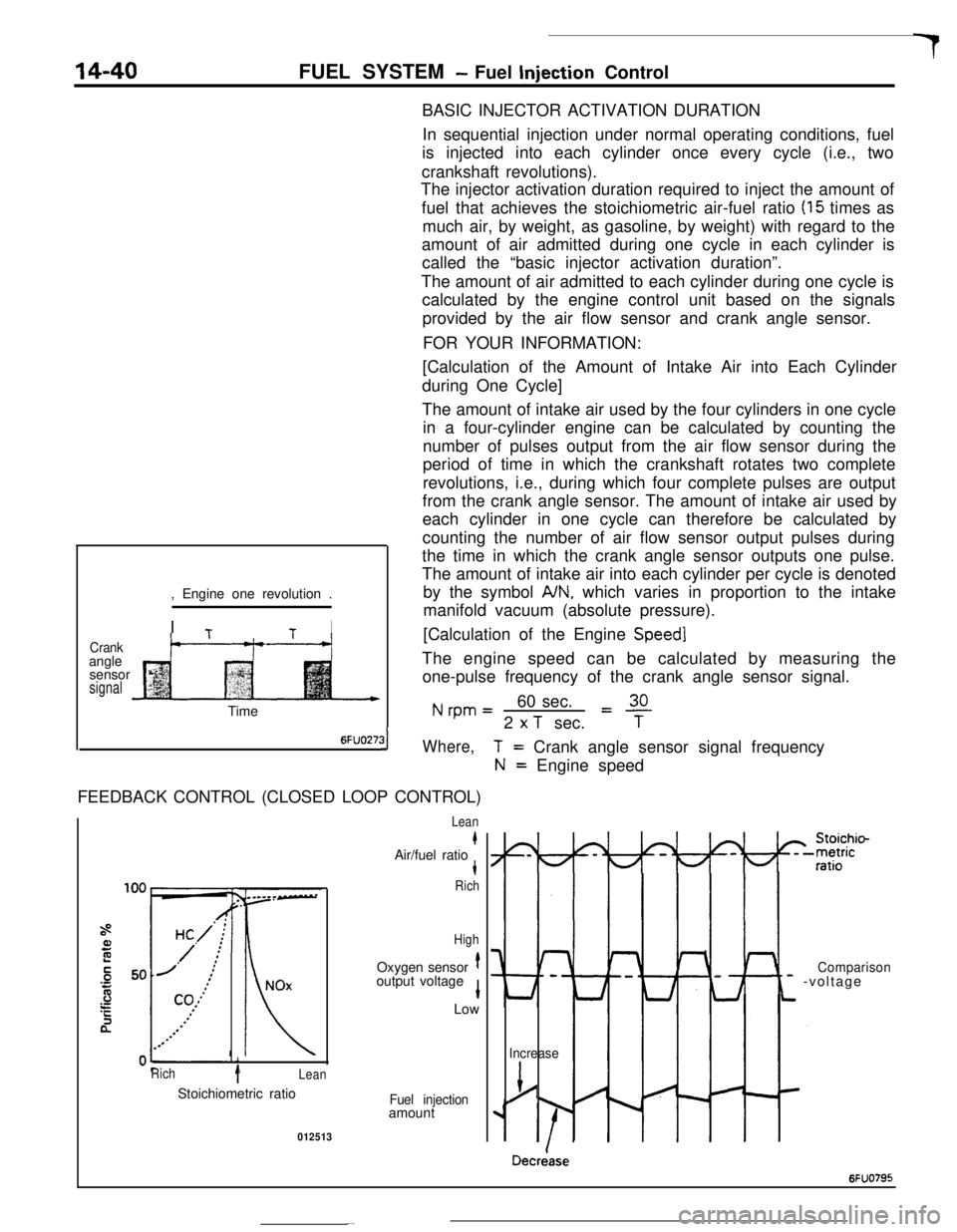
Crankangle
sensor
signal, Engine one revolution .
I
TtI
t--“---t-+[Calculation of the Amount of Intake Air into Each Cylinder
during One Cycle]
The amount of intake air used by the four cylinders in one cycle
in a four-cylinder engine can be calculated by counting the
number of pulses output from the air flow sensor during the
period of time in which the crankshaft rotates two complete
revolutions, i.e., during which four complete pulses are output
from the crank angle sensor. The amount of intake air used by
each cylinder in one cycle can therefore be calculated by
counting the number of air flow sensor output pulses during
the time in which the crank angle sensor outputs one pulse.
The amount of intake air into each cylinder per cycle is denoted
by the symbol
A/N, which varies in proportion to the intake
manifold vacuum (absolute pressure).
[Calculation of the Engine
Speed]The engine speed can be calculated by measuring the
one-pulse frequency of the crank angle sensor signal.
Nrpm=60 sec.L!!L2
x T sec.TTime
6FUO27:31Where,FEEDBACK CONTROL (CLOSED LOOP CONTROL)
i
Rich1Lean
T= Crank angle sensor signal frequency
N= Engine speed
Lean
kAir/fuel ratiot
Rich
HighOxygen sensor
toutput voltage
1Low
Stoichiometric ratio
Fuel injectionamount
012513
I-
Lt
Comparison- -voltage
Increase
j/
Decriase
6FUO795
Page 164 of 391
--
14-52FUEL SYSTEM - Idle Speed Control
4
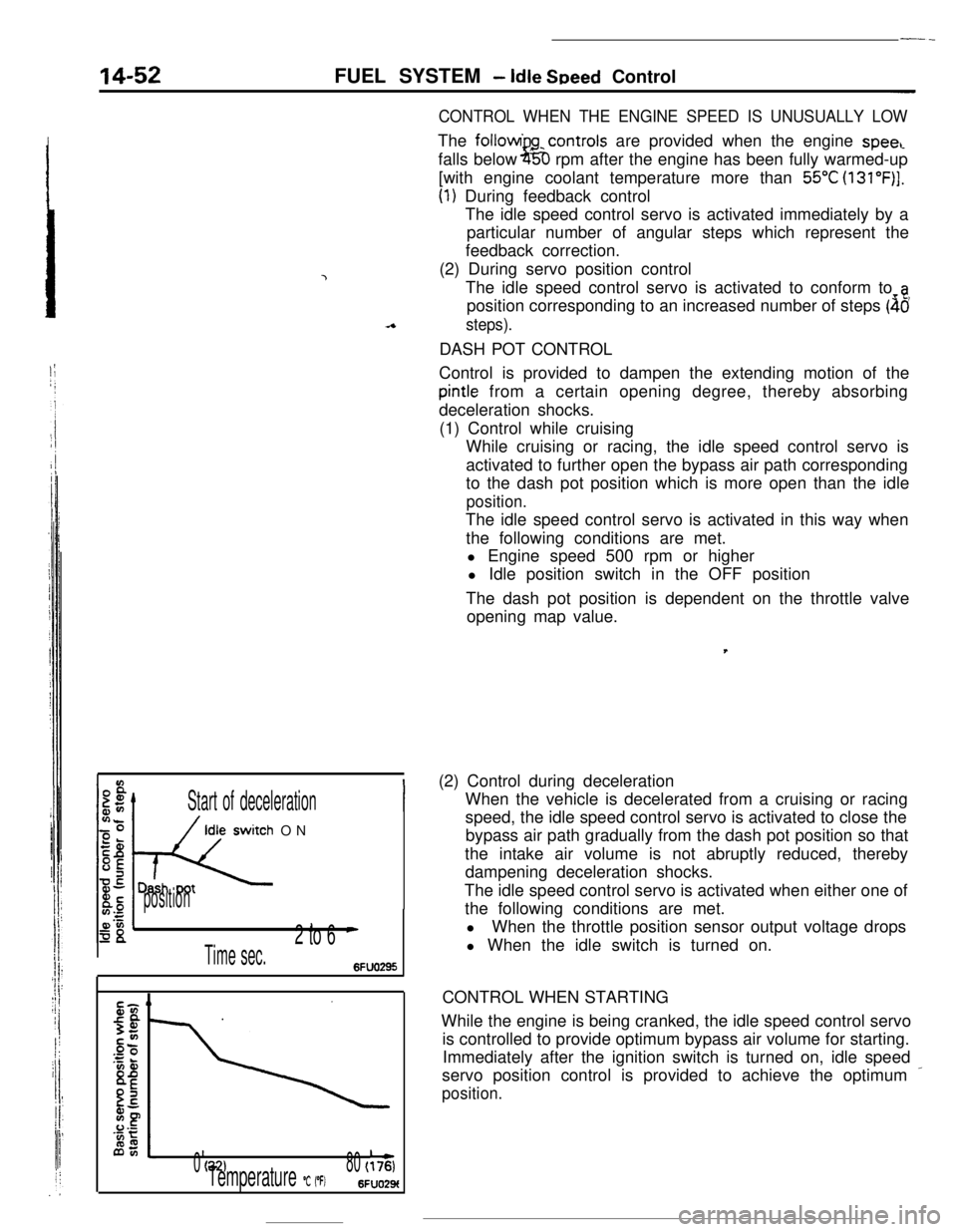
Start of deceleration
DLhq ON
position
I*2 to 6
Time sec.6FUO295
II)
0(32180(176)Temperature “C 1°F)6FUO29t
CONTROL WHEN THE ENGINE SPEED IS UNUSUALLY LOWThe followi
gcontrols are provided when the engine speecfalls below
i5;D rpm after the engine has been fully warmed-up
[with engine coolant temperature more than
55°C (131”F)].
(1) During feedback control
The idle speed control servo is activated immediately by a
particular number of angular steps which represent the
feedback correction.
(2) During servo position control
The idle speed control servo is activated to conform to
aposition corresponding to an increased number of steps
(46
steps).DASH POT CONTROL
Control is provided to dampen the extending motion of the
pintle from a certain opening degree, thereby absorbing
deceleration shocks.
(1) Control while cruising
While cruising or racing, the idle speed control servo is
activated to further open the bypass air path corresponding
to the dash pot position which is more open than the idle
position.The idle speed control servo is activated in this way when
the following conditions are met.
l Engine speed 500 rpm or higher
l Idle position switch in the OFF position
The dash pot position is dependent on the throttle valve
opening map value.,
(2) Control during deceleration
When the vehicle is decelerated from a cruising or racing
speed, the idle speed control servo is activated to close the
bypass air path gradually from the dash pot position so that
the intake air volume is not abruptly reduced, thereby
dampening deceleration shocks.
The idle speed control servo is activated when either one of
the following conditions are met.
lWhen the throttle position sensor output voltage drops
l When the idle switch is turned on.
CONTROL WHEN STARTING
While the engine is being cranked, the idle speed control servo
is controlled to provide optimum bypass air volume for starting.
Immediately after the ignition switch is turned on, idle speed
servo position control is provided to achieve the optimum
_
position.
Page 192 of 391
PROPELLER SHAFT -General Information / Liibro Joint16-3
SPEClFlCATlONSterns
‘repeller shaft
Type
Length
x O.D.mm (in.)
Front
Center
RearUniversal joint
Type
No. 1 (front)
No. 2 (center front)
No. 3 (center rear) [Ldbro joint]
No. 4 (rear)Cross type universal joint bearing
Cross type universal joint journal O.D.mm (in.)Constant velocity joint type
Constant velocity joint size O.D.mm (in.)
NOTE
Specifications
4 joint propeller shaft707
x 50.8 (27.8 x 2.00)647.5 x 50.8 (25.5 x
2.00)530.5 x 50.8 (20.9 x
2.00)
Cross type
Cross type
CV type
Cross type
Needle roller bearing (oilless type)
14.689 i.5783)
LGbro joint (oilless type)94
(3.7)The propeller shaft length is the length between the centers of the joints.
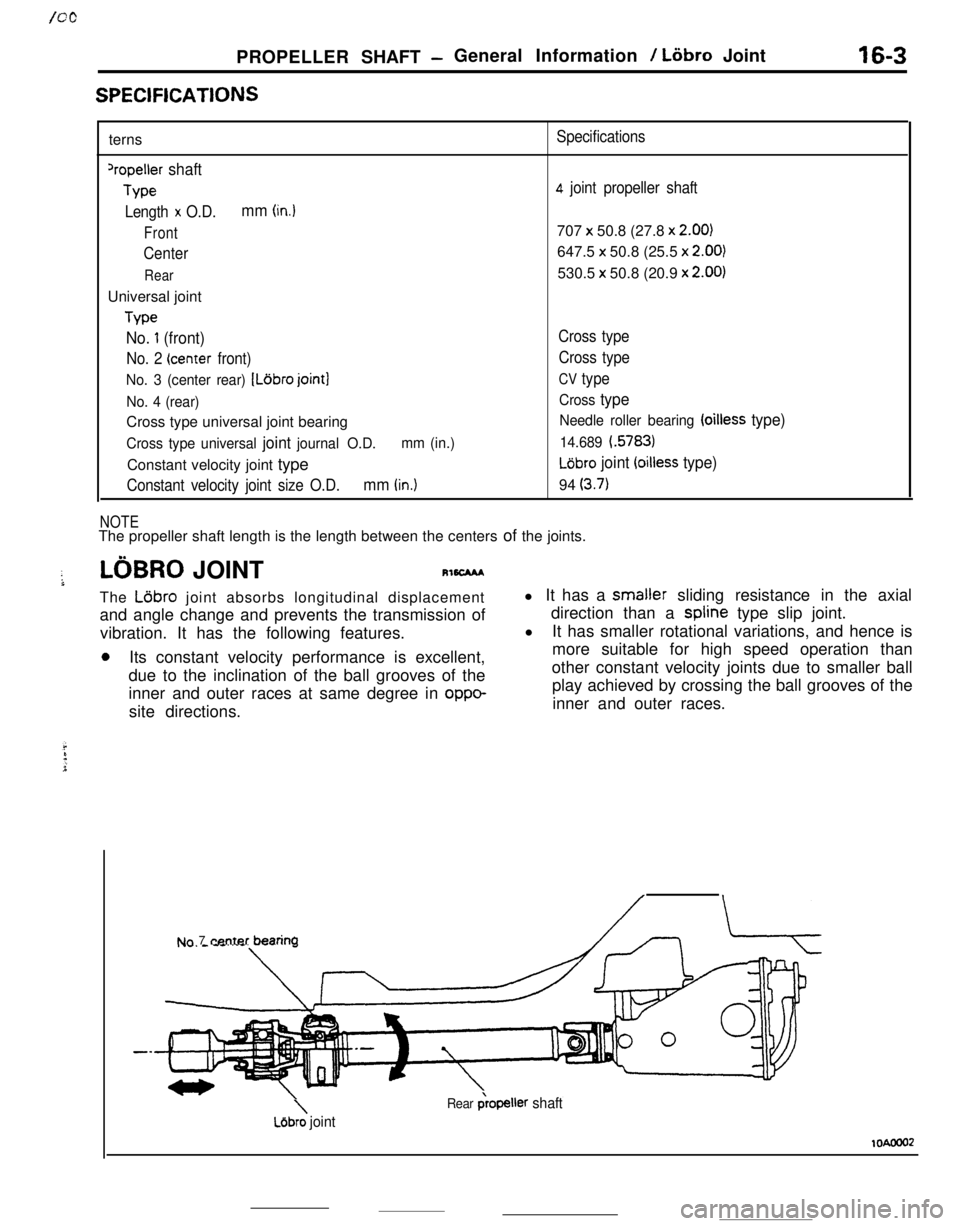
LOBRO JOINTRl6CMAThe
L6bro joint absorbs longitudinal displacement
and angle change and prevents the transmission of
vibration. It has the following features.
0Its constant velocity performance is excellent,
due to the inclination of the ball grooves of the
inner and outer races at same degree in
oppo-site directions.l It has a smaller sliding resistance in the axial
direction than a spline type slip joint.
l
It has smaller rotational variations, and hence is
more suitable for high speed operation than
other constant velocity joints due to smaller ball
play achieved by crossing the ball grooves of the
inner and outer races.
Nn 7 center bearina
\Lejbro joint
Rear &opeller shaft
lOAooo2
Page 193 of 391
- --- -._ -...PROPELLER SHAFT
- LBbro Joint / Center Bearing
groove
Inner race
ball groove
Outer race
ball grooveLGBRO
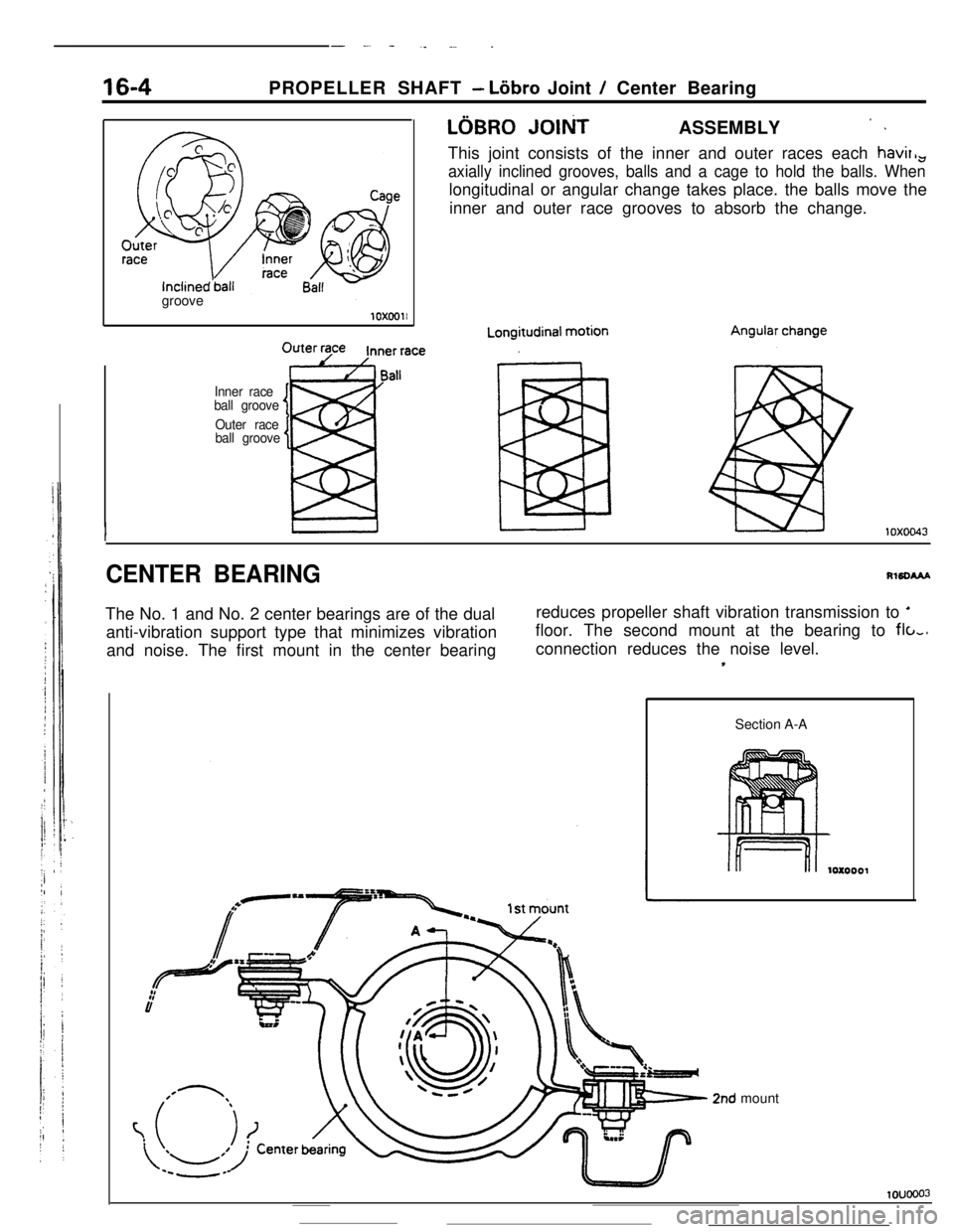
JOltiT ASSEMBLY ’ IThis joint consists of the inner and outer races each havir,,
axially inclined grooves, balls and a cage to hold the balls. Whenlongitudinal or angular change takes place. the balls move the
inner and outer race grooves to absorb the change.
CENTER BEARINGRlSDWThe No. 1 and No. 2 center bearings are of the dualreduces propeller shaft vibration transmission to ’
anti-vibration support type that minimizes vibrationfloor. The second mount at the bearing to
flo,,and noise. The first mount in the center bearingconnection reduces the noise level.
*Section A-A
2nd mount
1ouooo3
Page 199 of 391
17-6REAR SUSPENSION <2WD> - Three-link Suspension
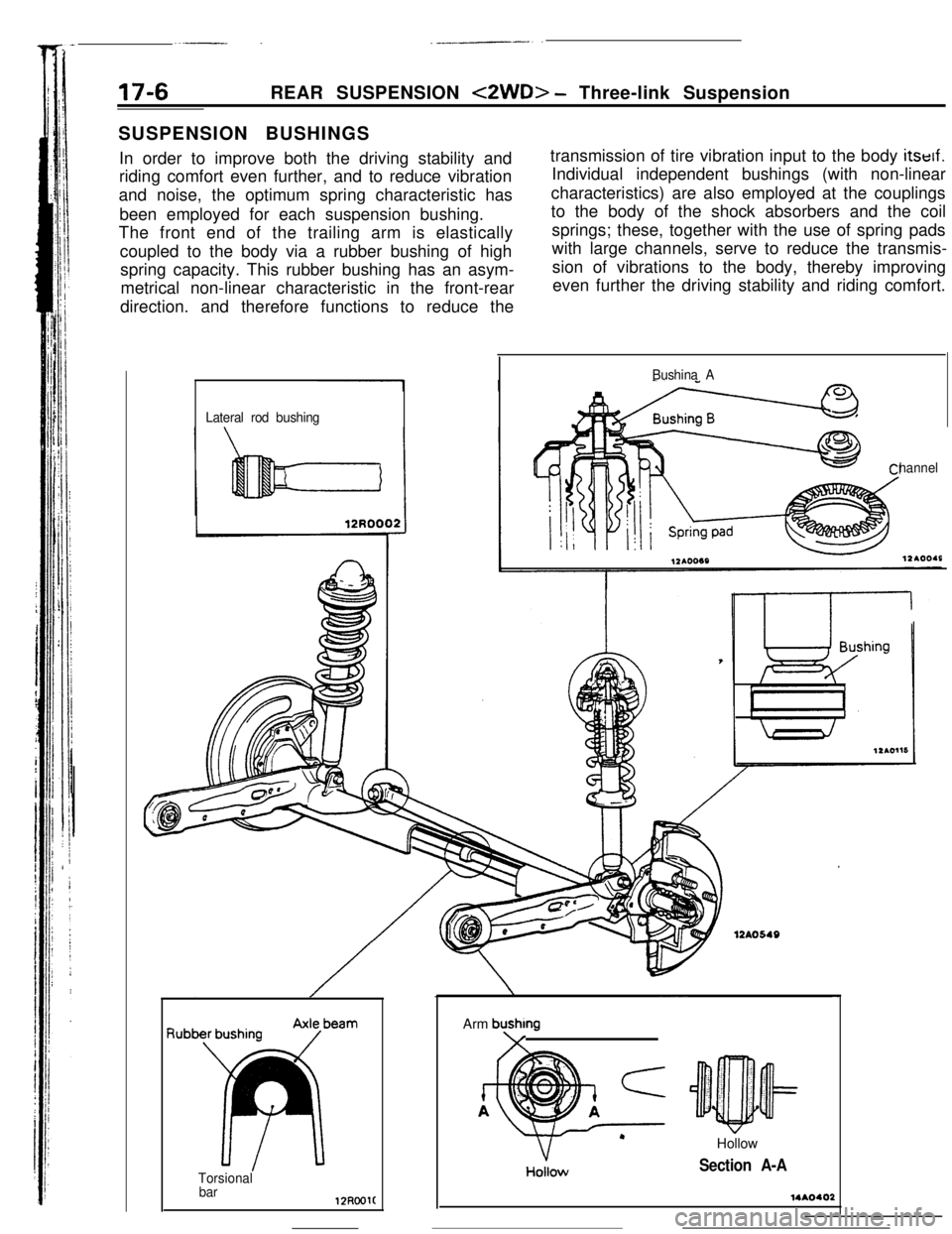
SUSPENSION BUSHINGS
In order to improve both the driving stability and
riding comfort even further, and to reduce vibration
and noise, the optimum spring characteristic has
been employed for each suspension bushing.
The front end of the trailing arm is elastically
coupled to the body via a rubber bushing of high
spring capacity. This rubber bushing has an asym-
metrical non-linear characteristic in the front-rear
direction. and therefore functions to reduce thetransmission of tire vibration input to the body itself.
Individual independent bushings (with non-linear
characteristics) are also employed at the couplings
to the body of the shock absorbers and the coil
springs; these, together with the use of spring pads
with large channels, serve to reduce the transmis-
sion of vibrations to the body, thereby improving
even further the driving stability and riding comfort.
Lateral rod bushingBushina A
hannel
f3ub
Torsional
barArm
bushmg\/HollowHoilow
Section A-A
Page 201 of 391
.-_. -
17-8REAR SUSPENSION <4WD> - Geneal information
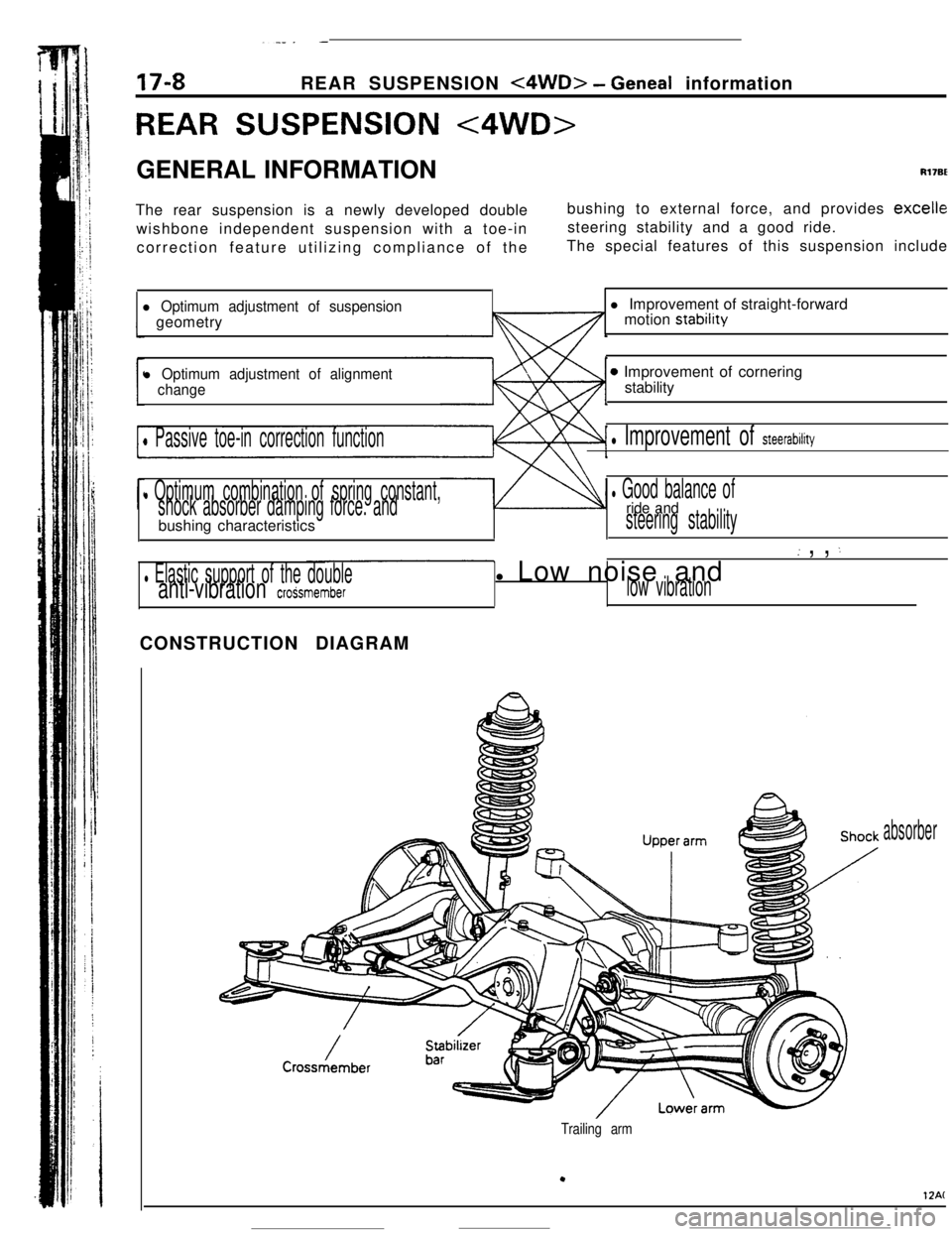
REAR SUSPENSION <4WD>GENERAL INFORMATION
Rl7BEThe rear suspension is a newly developed double
wishbone independent suspension with a toe-in
correction feature utilizing compliance of thebushing to external force, and provides
excellesteering stability and a good ride.
The special features of this suspension include
l Optimum adjustment of suspensiongeometry
l Optimum adjustment of alignment
change
0 Passive toe-in correction function
l Optimum combination of spring constant,
shock absorber damping force. andbushing characteristics
l Elastic support of the doubleanti-vibration croSsmemberl Improvement of straight-forward
motion stability
0 Improvement of cornering
stability
l Improvement of steerability
l Good balance ofride andsteering stability
( , , :l Low noise and
low vibrationCONSTRUCTION DIAGRAM
absorber
Trailing arm
.
12AC
Page 202 of 391
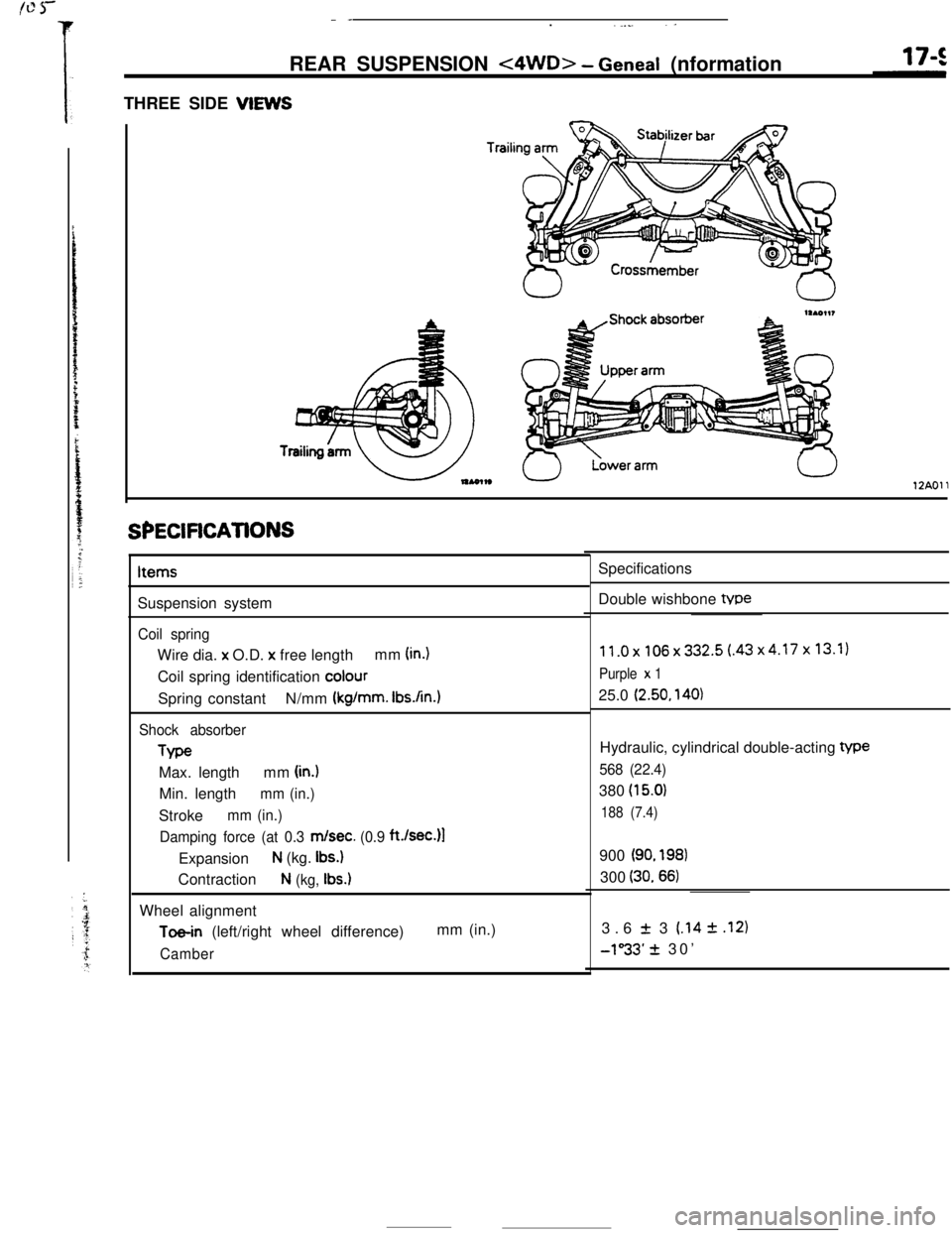
_ -. ..__ .-
REAR SUSPENSION
<4WD> - Geneal (nformation
THREE SIDE VIEWS
Trailil
12AOll
SPECiFiCATiONSItems
Suspension system
Coil springWire dia. x O.D.
x free lengthmm (in.)Coil spring identification
colourSpring constantN/mm
(kg/mm. Ibs.An.1
Shock absorberType
Max. lengthmm
(in.)Min. length
mm (in.)Stroke
mm (in.)
Damping force (at 0.3
m/set. (0.9 ft./sec.)l
Expansion
N (kg. Ibs.)Contraction
N (kg, Ibs.)Wheel alignment
Toe-in (left/right wheel difference)mm (in.)
CamberSpecifications
Double wishbone tvpe
11.0x106x332.5(.43x4.17x13.1)
Purple x 125.0
(2.50, 140)Hydraulic, cylindrical double-acting
We
568 (22.4)380
(15.0)
188 (7.4)900
(90. 198)300
(30.66)3.6
f 3 (.14 2 .I21
-1”33’ + 30’
Page 207 of 391
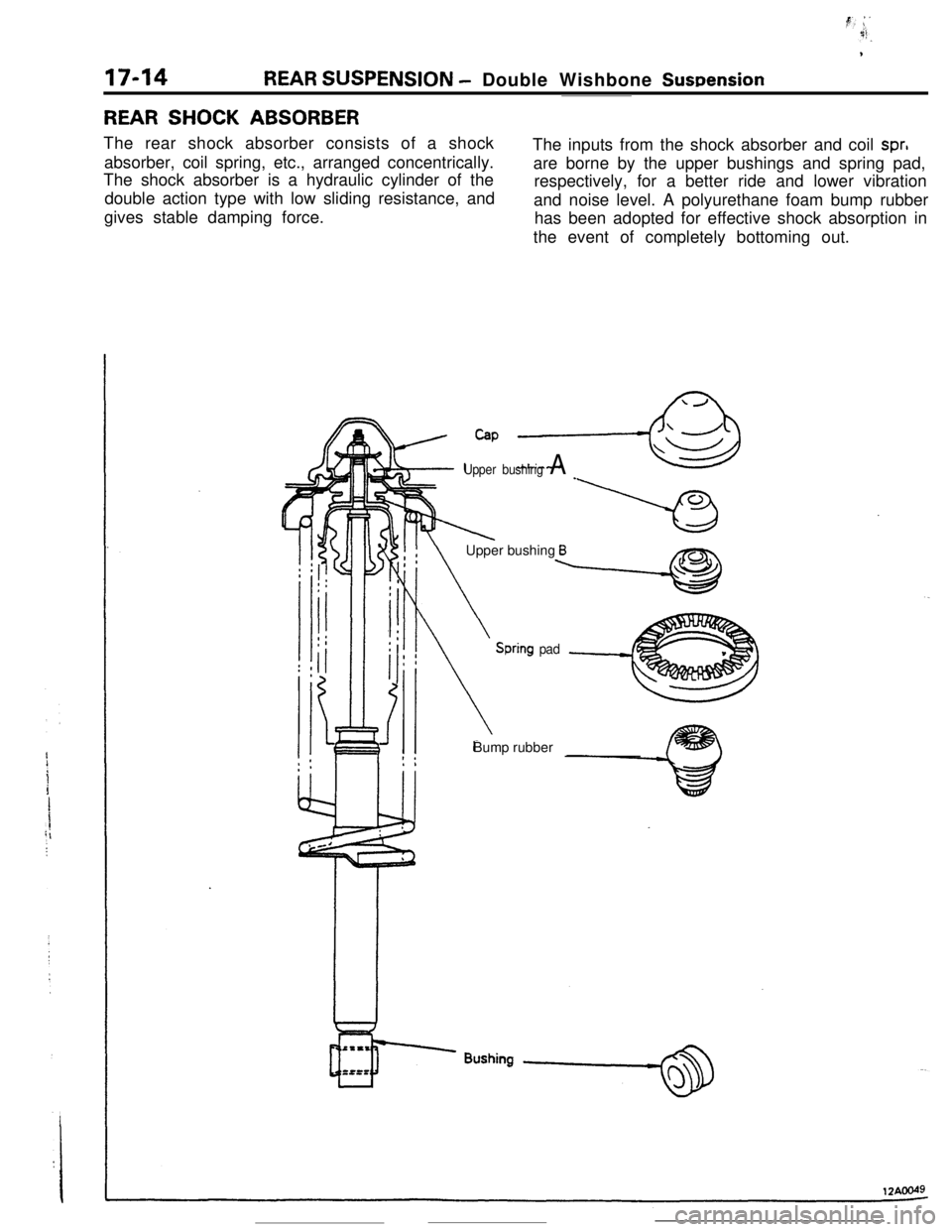
17-14REAR SUSPENSION - Double Wishbone Suwension
REAR SHOCK ABSORBERThe rear shock absorber consists of a shock
absorber, coil spring, etc., arranged concentrically.
The shock absorber is a hydraulic cylinder of the
double action type with low sliding resistance, and
gives stable damping force.The inputs from the shock absorber and coil
spr,are borne by the upper bushings and spring pad,
respectively, for a better ride and lower vibration
and noise level. A polyurethane foam bump rubber
has been adopted for effective shock absorption in
the event of completely bottoming out.
Cap ,-&
Upper bushing A _
IlXk!! \Upper bushing Bx?nb
Spring padBump rubber