ABS MITSUBISHI ECLIPSE 1990 Owner's Manual
[x] Cancel search | Manufacturer: MITSUBISHI, Model Year: 1990, Model line: ECLIPSE, Model: MITSUBISHI ECLIPSE 1990Pages: 391, PDF Size: 15.27 MB
Page 208 of 391
REAR SUSPENSION- Double Wishbone Suspension17-15TRAILING ARM
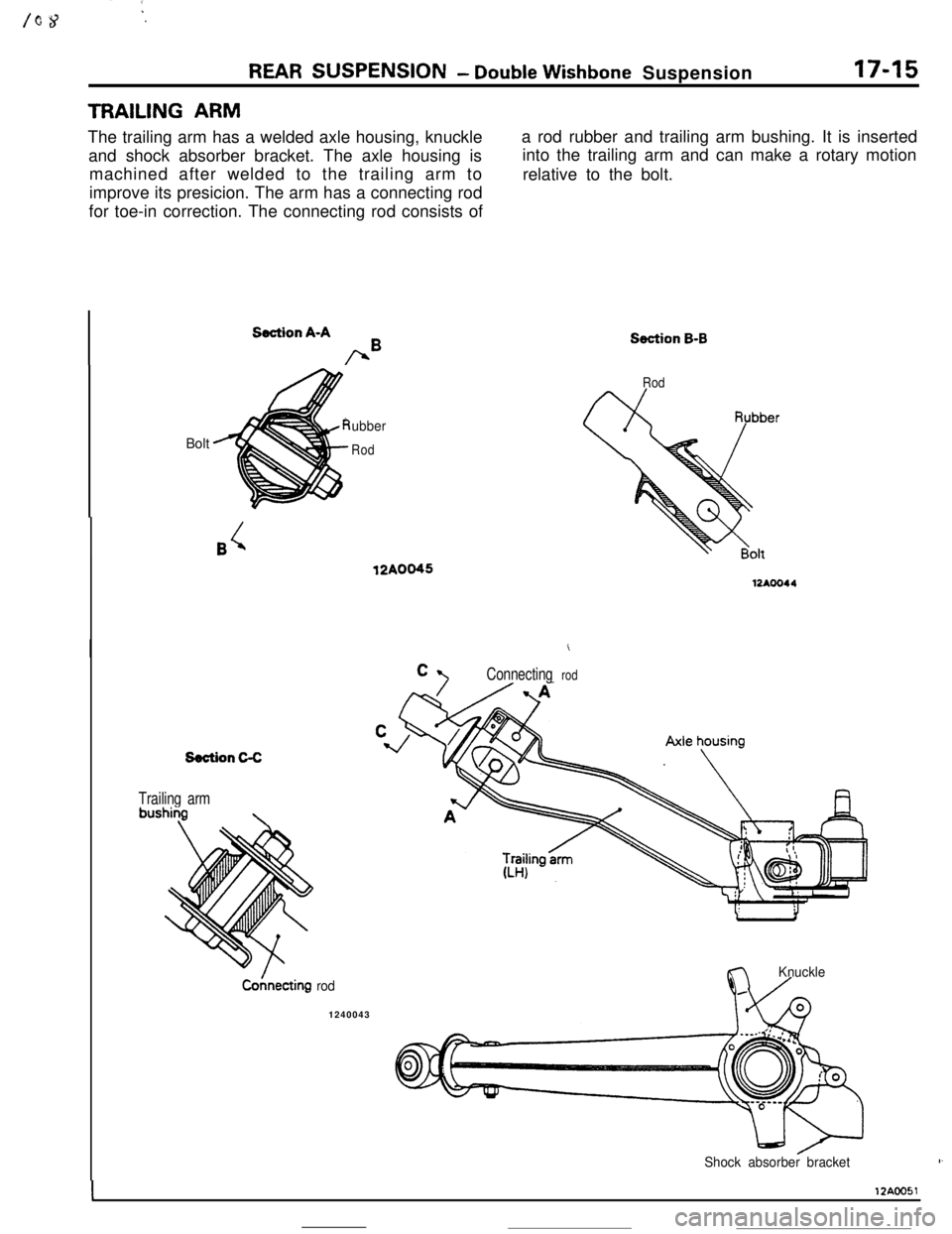
The trailing arm has a welded axle housing, knuckle
and shock absorber bracket. The axle housing is
machined after welded to the trailing arm to
improve its presicion. The arm has a connecting rod
for toe-in correction. The connecting rod consists ofa rod rubber and trailing arm bushing. It is inserted
into the trailing arm and can make a rotary motion
relative to the bolt.
Section A-A
bBBolt
ubber
RodRod12A0045
Ii
Connecting rod
Section C-C
Trailing armbushiyg
\Co;lnecting
rod1240043
Section B-B
Knuckleii-l /
Shock absorber bracket,,
I12ACO51
Page 229 of 391
MANUAL TRANSAXLE <2WD> - Transaxle Control
21-5
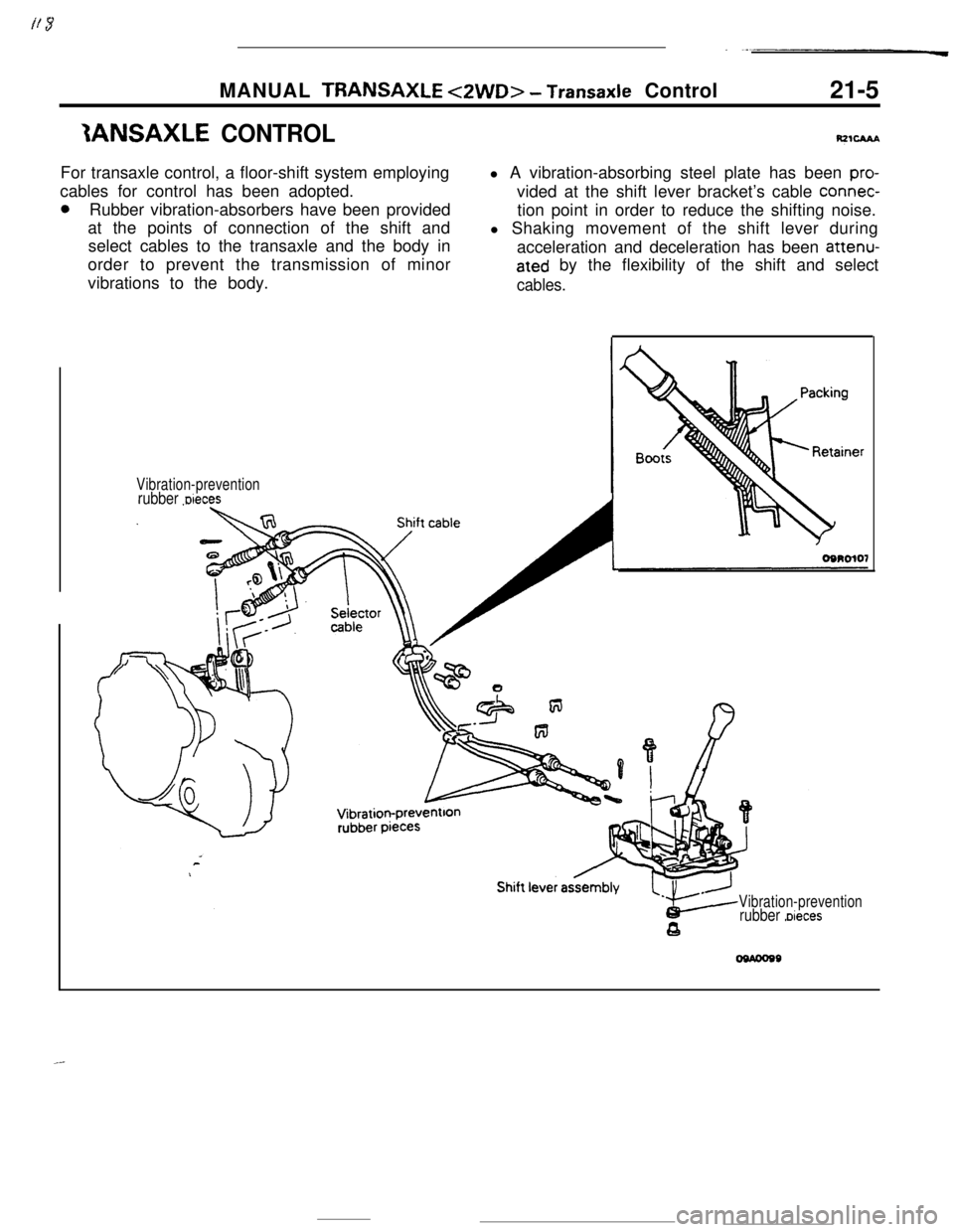
IANSAXLE CONTROLFor transaxle control, a floor-shift system employing
cables for control has been adopted.
0Rubber vibration-absorbers have been provided
at the points of connection of the shift and
select cables to the transaxle and the body in
order to prevent the transmission of minor
vibrations to the body.l A vibration-absorbing steel plate has been
pro-vided at the shift lever bracket’s cable connec-
tion point in order to reduce the shifting noise.
l Shaking movement of the shift lever during
acceleration and deceleration has been attenu-
ated by the flexibility of the shift and select
cables.
Vibration-preventionrubber Dieces
Vibration-preventionrubber Dieces
Page 234 of 391
21-10MANUAL TRANSAXLE <4WD> - General Information4WD SYSTEM OPERATION
Conventional 4WD systems (direct-coupled
4WD,or center differential type 4WDl have their own
merits and demerits; they rely on manual operation
(switching between 4WD and 2WD modes, center
differential locking) to cope with their demerits.
With this new 4WD system, the viscous coupling
built in the center differential automatically performssuch operations used to be made manually. The
driver can participate with the merits of 4WD at alltimes.The operation of the differential and the
viscous
coupling under representative conditions
are described in the following section.
I
Reardifferential
Center
differential
U differential
Viscous AuDk?TFNOO5’difference
ce271010i
TFMMYTFMMY
0
Turningdirection
ITFMOO!X
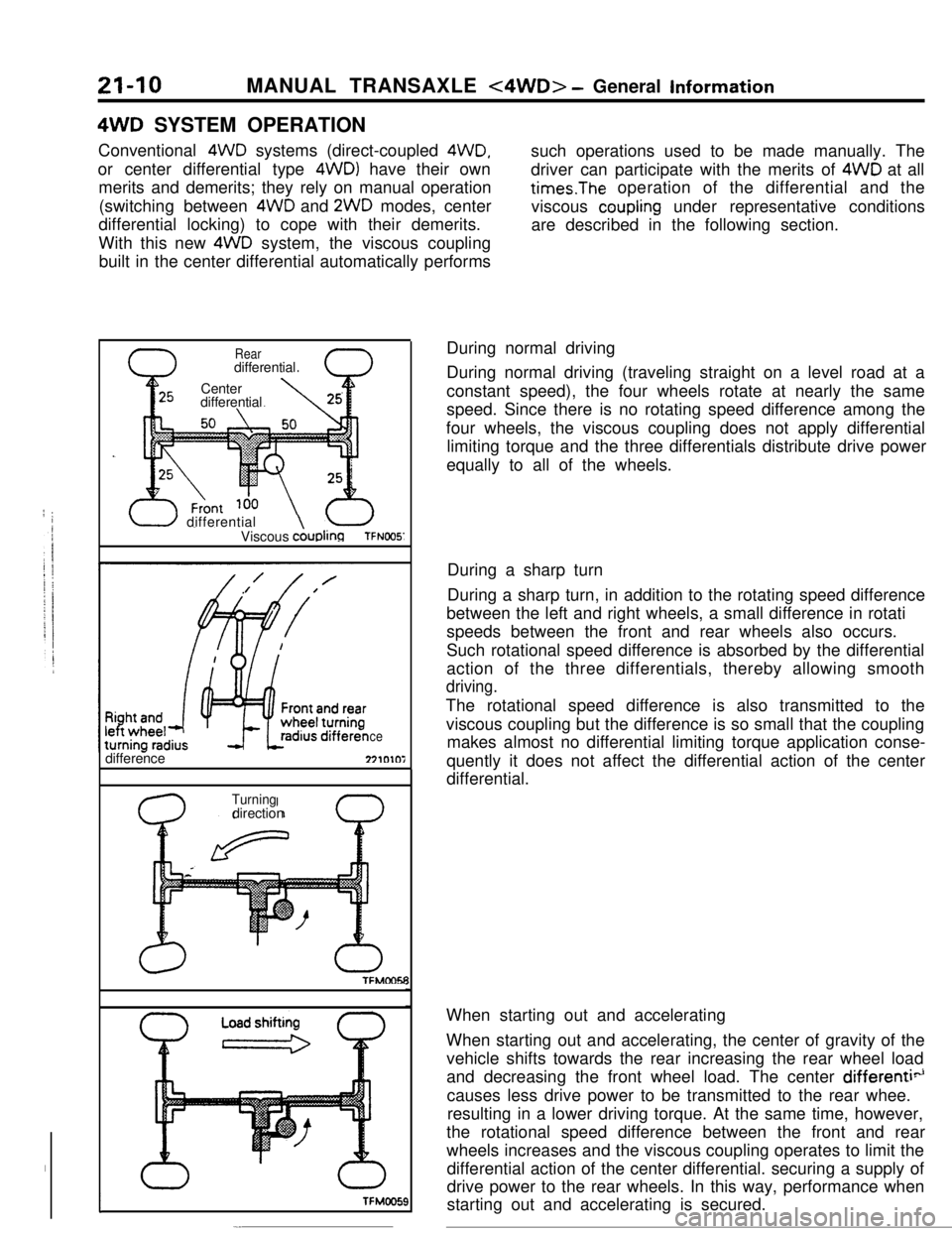
-.During normal driving
During normal driving (traveling straight on a level road at a
constant speed), the four wheels rotate at nearly the same
speed. Since there is no rotating speed difference among the
four wheels, the viscous coupling does not apply differential
limiting torque and the three differentials distribute drive power
equally to all of the wheels.
During a sharp turn
During a sharp turn, in addition to the rotating speed difference
between the left and right wheels, a small difference in rotati
speeds between the front and rear wheels also occurs.
Such rotational speed difference is absorbed by the differential
action of the three differentials, thereby allowing smooth
driving.The rotational speed difference is also transmitted to the
viscous coupling but the difference is so small that the coupling
makes almost no differential limiting torque application conse-
quently it does not affect the differential action of the center
differential.
When starting out and accelerating
When starting out and accelerating, the center of gravity of the
vehicle shifts towards the rear increasing the rear wheel load
and decreasing the front wheel load. The center
differenti”causes less drive power to be transmitted to the rear whee.
resulting in a lower driving torque. At the same time, however,
the rotational speed difference between the front and rear
wheels increases and the viscous coupling operates to limit the
differential action of the center differential. securing a supply of
drive power to the rear wheels. In this way, performance when
starting out and accelerating is secured.
Page 238 of 391
21-14MANUAL TRANSAXLE t4WD> - Viscous Coupling (VCU)
Rotating speed difference
Transmitted
torque
TemperatureII I
t
/
IIc
P&e surface‘II I
preTYl-LLL
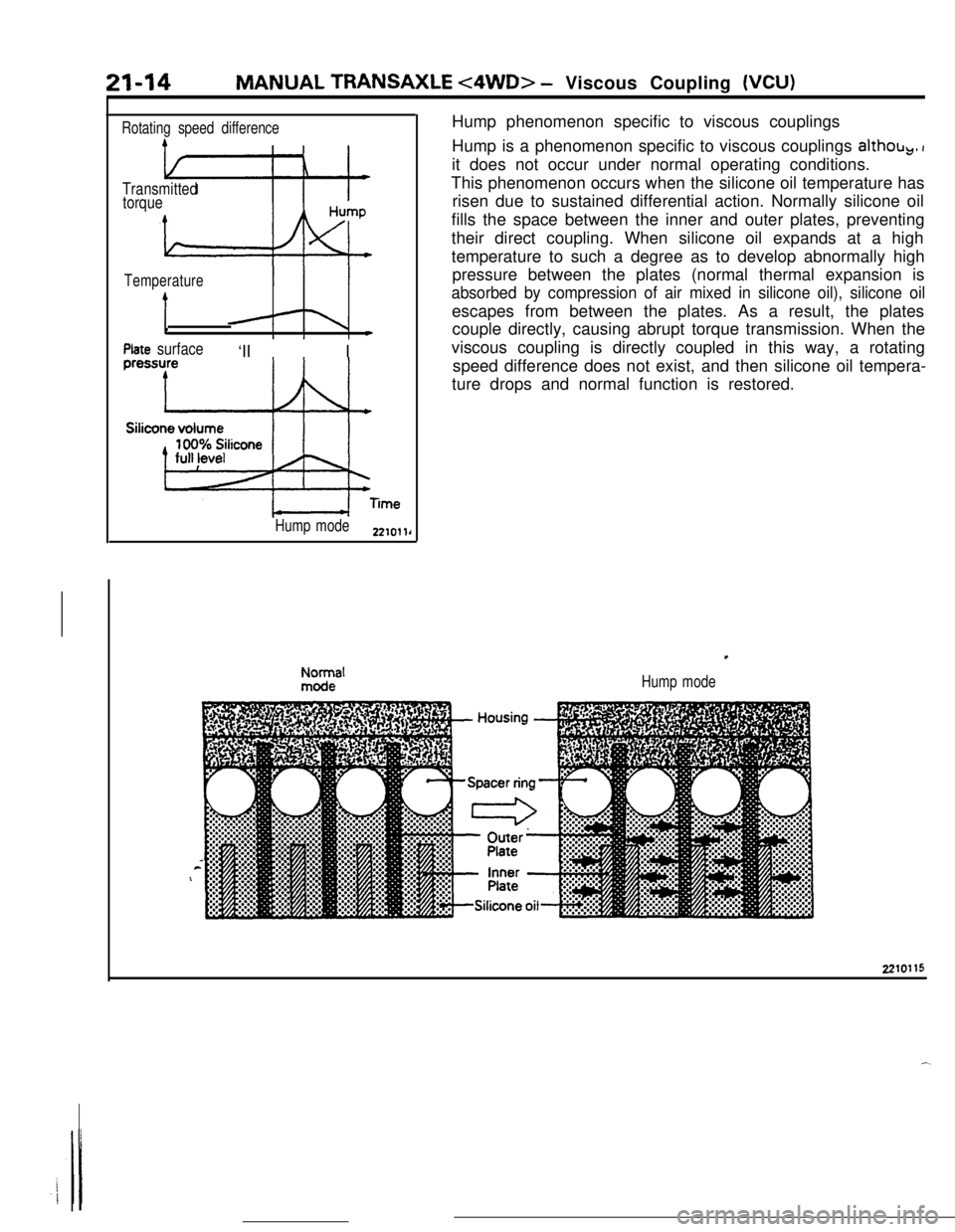
Hump mode2210llrHump phenomenon specific to viscous couplings
Hump is a phenomenon specific to viscous couplings
althob,, Iit does not occur under normal operating conditions.
This phenomenon occurs when the silicone oil temperature has
risen due to sustained differential action. Normally silicone oil
fills the space between the inner and outer plates, preventing
their direct coupling. When silicone oil expands at a high
temperature to such a degree as to develop abnormally high
pressure between the plates (normal thermal expansion is
absorbed by compression of air mixed in silicone oil), silicone oilescapes from between the plates. As a result, the plates
couple directly, causing abrupt torque transmission. When the
viscous coupling is directly coupled in this way, a rotating
speed difference does not exist, and then silicone oil tempera-
ture drops and normal function is restored.
Hump mode2210115
Page 246 of 391
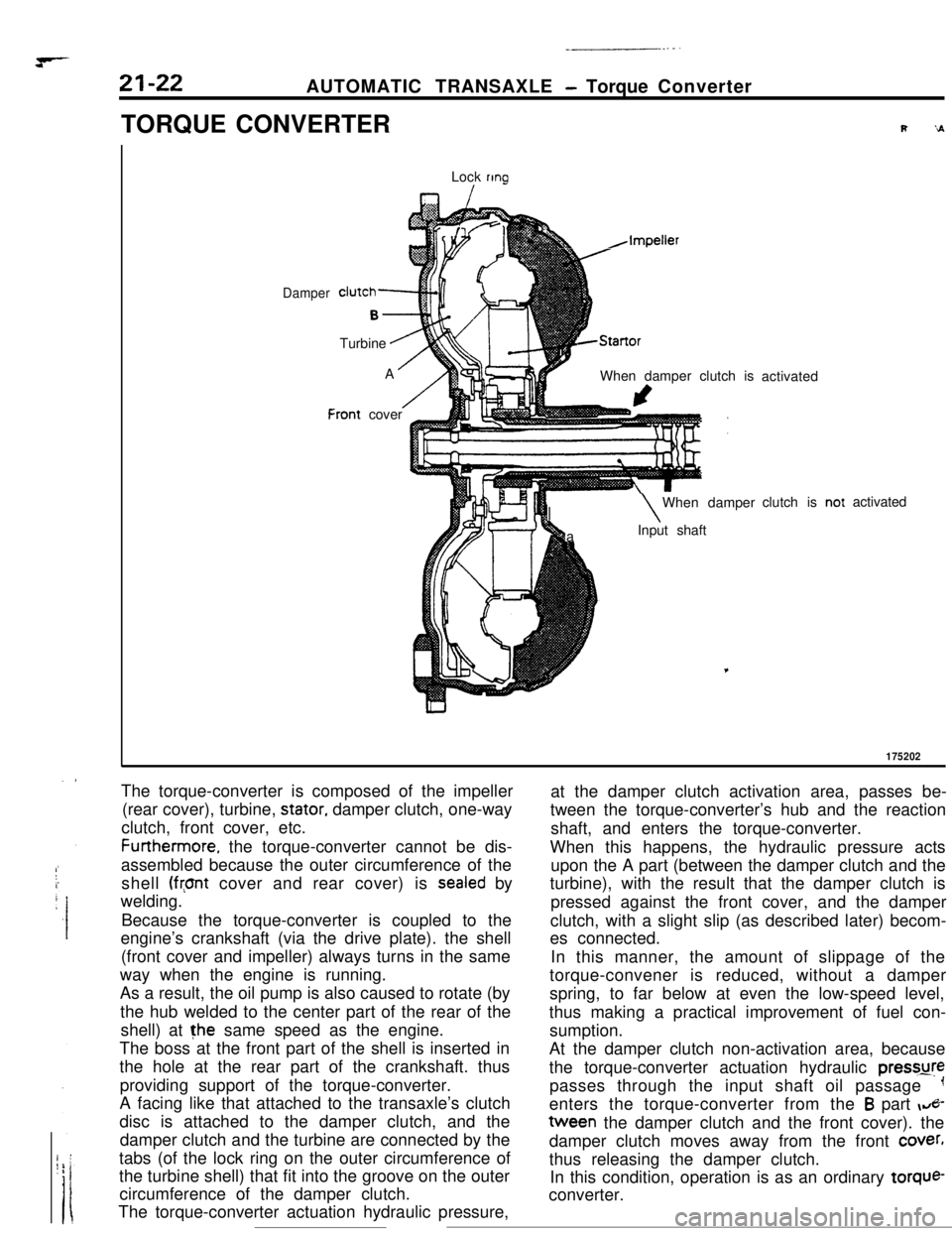
AUTOMATIC TRANSAXLE - Torque Converter
TORQUE CONVERTER
Lock
ring
I
Damper
F
clutch-
B-.Turbine
.AA
/:ront cover
h,Impeller
AStartorWhen damper clutch is
I\When damper
aInput shaftactivated
clutch isactivated
175202The torque-converter is composed of the impeller
(rear cover), turbine,
stator, damper clutch, one-way
clutch, front cover, etc.Furthermore. the torque-converter cannot be dis-
assembled because the outer circumference of the
shell
(front cover and rear cover) is sealed by
welding.
Because the torque-converter is coupled to the
engine’s crankshaft (via the drive plate). the shell
(front cover and impeller) always turns in the same
way when the engine is running.
As a result, the oil pump is also caused to rotate (by
the hub welded to the center part of the rear of the
shell) at the same speed as the engine.
The boss at the front part of the shell is inserted in
the hole at the rear part of the crankshaft. thus
providing support of the torque-converter.
A facing like that attached to the transaxle’s clutch
disc is attached to the damper clutch, and the
damper clutch and the turbine are connected by the
tabs (of the lock ring on the outer circumference of
the turbine shell) that fit into the groove on the outer
circumference of the damper clutch.
The torque-converter actuation hydraulic pressure,at the damper clutch activation area, passes be-
tween the torque-converter’s hub and the reaction
shaft, and enters the torque-converter.
When this happens, the hydraulic pressure acts
upon the A part (between the damper clutch and the
turbine), with the result that the damper clutch is
pressed against the front cover, and the damper
clutch, with a slight slip (as described later) becom-
es connected.
In this manner, the amount of slippage of the
torque-convener is reduced, without a damper
spring, to far below at even the low-speed level,
thus making a practical improvement of fuel con-
sumption.
At the damper clutch non-activation area, because
the torque-converter actuation hydraulic pressure
passes through the input shaft oil passage
-1enters the torque-converter from the
B part &-tween the damper clutch and the front cover). the
damper clutch moves away from the front
cover,thus releasing the damper clutch.
In this condition, operation is as an ordinary torque-
converter.
Page 331 of 391
BODY - Main Body23-13
Crash bead31AO19
IDash panelreinforcement,
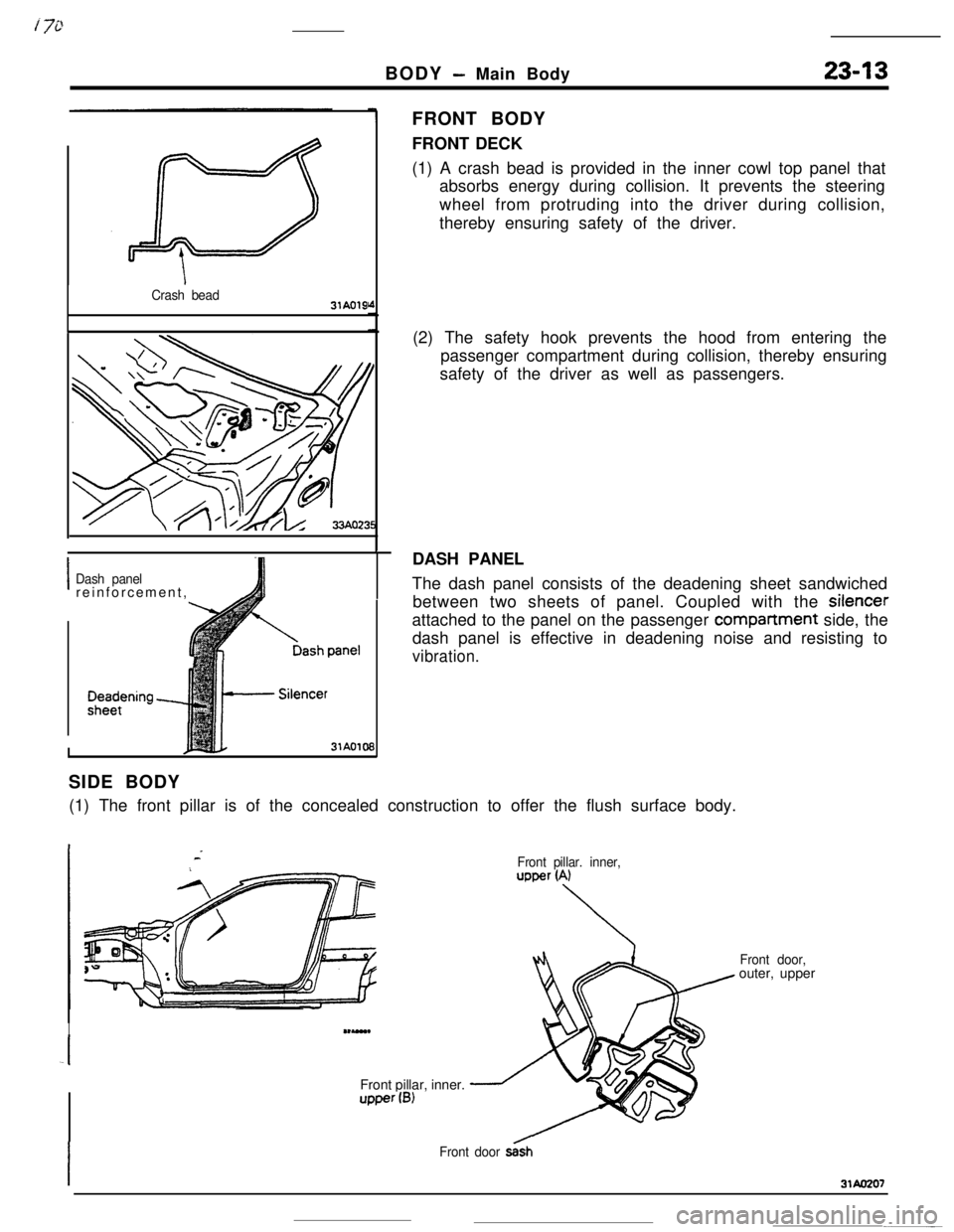
I31AO109FRONT BODY
FRONT DECK
(1) A crash bead is provided in the inner cowl top panel that
absorbs energy during collision. It prevents the steering
wheel from protruding into the driver during collision,
thereby ensuring safety of the driver.
(2) The safety hook prevents the hood from entering the
passenger compartment during collision, thereby ensuring
safety of the driver as well as passengers.
DASH PANEL
The dash panel consists of the deadening sheet sandwiched
between two sheets of panel. Coupled with the silencer
attached to the panel on the passenger
companment side, the
dash panel is effective in deadening noise and resisting to
vibration.SIDE BODY
(1) The front pillar is of the concealed construction to offer the flush surface body.
IU-Front pillar, inner.upper(B)
Front pillar. inner,upper (A)
Front door,outer, upper
Front door s&h
Page 341 of 391
23-24BODY - Power Windows / Bumpers
Batterv
r--+----
02’
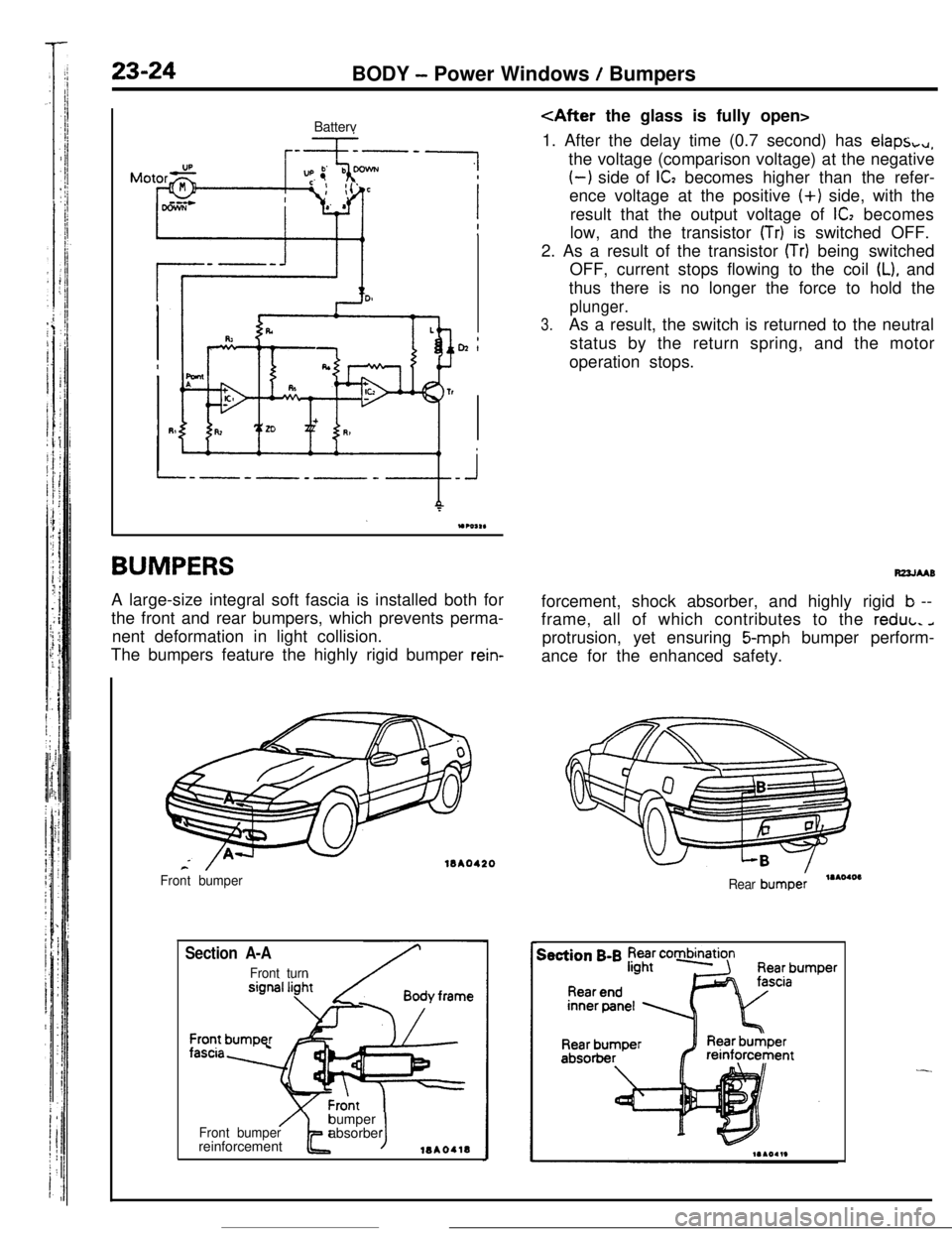
BUMPERSA large-size integral soft fascia is installed both for
the front and rear bumpers, which prevents perma-
nent deformation in light collision.
The bumpers feature the highly rigid bumper
rein-
18A0420
Section A-A
Front turn Front bumper
/Front bumperbumper
t Jabsorber
reinforcement18AOllB
1. After the delay time (0.7 second) has
claps,+,,,the voltage (comparison voltage) at the negative
(-1 side of IC2 becomes higher than the refer-
ence voltage at the positive
(+) side, with the
result that the output voltage of
ICI becomes
low, and the transistor
(Tr) is switched OFF.
2. As a result of the transistor
(Tr) being switched
OFF, current stops flowing to the coil
(L), and
thus there is no longer the force to hold the
plunger.
3.As a result, the switch is returned to the neutral
status by the return spring, and the motor
operation stops.
R22JMBforcement, shock absorber, and highly rigid
b --
frame, all of which contributes to the reduL.
aprotrusion, yet ensuring
5-mph bumper perform-
ance for the enhanced safety.
Rear bumpe:,.AOIOI
-
Page 348 of 391

BODY - Seat Belts
._-- -
23-31
Shoulder beltI
Lapbelt
IGlove box pad toasty
Knee protector
Guide rail\Fasten switch
\
SEAT BELTSRZ3SBAS
On Federal and California vehicles automatic seat belts (Manualseat belts on vehicles for Canada) are installed on the front
seats and the
3-point seat belts with ELR on the rear seat, both
contributing to the enhanced safety and ease of use.
AUTOMATIC SEAT BELTS
GENERAL INFORMATION
The Automatic Seat Belts are designed to automatically fasten
themselves around the driver and front passenger as they get
into the vehicle and close the front door, thereby,
by a
combination of the lap belt, the knee protector, the corner pad
and the glove box pad (at the lower part of the instrument
panel), protecting them from second collisions during a
front-end crash or similar accident.
The lap belt for the driver’s seat is provided with the ELR
(ELR:Emergency Locking Retractor), and that for the front passen-
ger’s seat with the
ELR-ALR” to support the Child Restraint
System incorporated into the seat. (“ALR: Automatic Locking
Retractor) The buckle tilts toward front and inside helping the
belts be tight around the body.
The
tongue plate on the driver’s seat is provided with
energy-absorbing structure.
The automatic seat belts consist of a driving-device assembly,
shoulder belt, manual lap belt, knee protector, and other
components.
The driving-device assembly is composed of the slide anchor,
the release switch, the guide rail, the “fasten” switch, the
automatic seat belt motor relay, and the driving device.
There is an emergency-release button on the slide anchor; this
button can be used to release the shoulder belt in the event of
an emergency resulting from an accident, etc.
Release switchmergency
release button
Automatic seat
belt control unit
PI, Lap belt
Tongue plateDriving device
Automatic seat belt
motor relay
Page 350 of 391
BODY - Seat Belts23-33
Gear eGear B
Energy-absorbingbelt
Before absorbing
shock
19AO332Inward
Forward
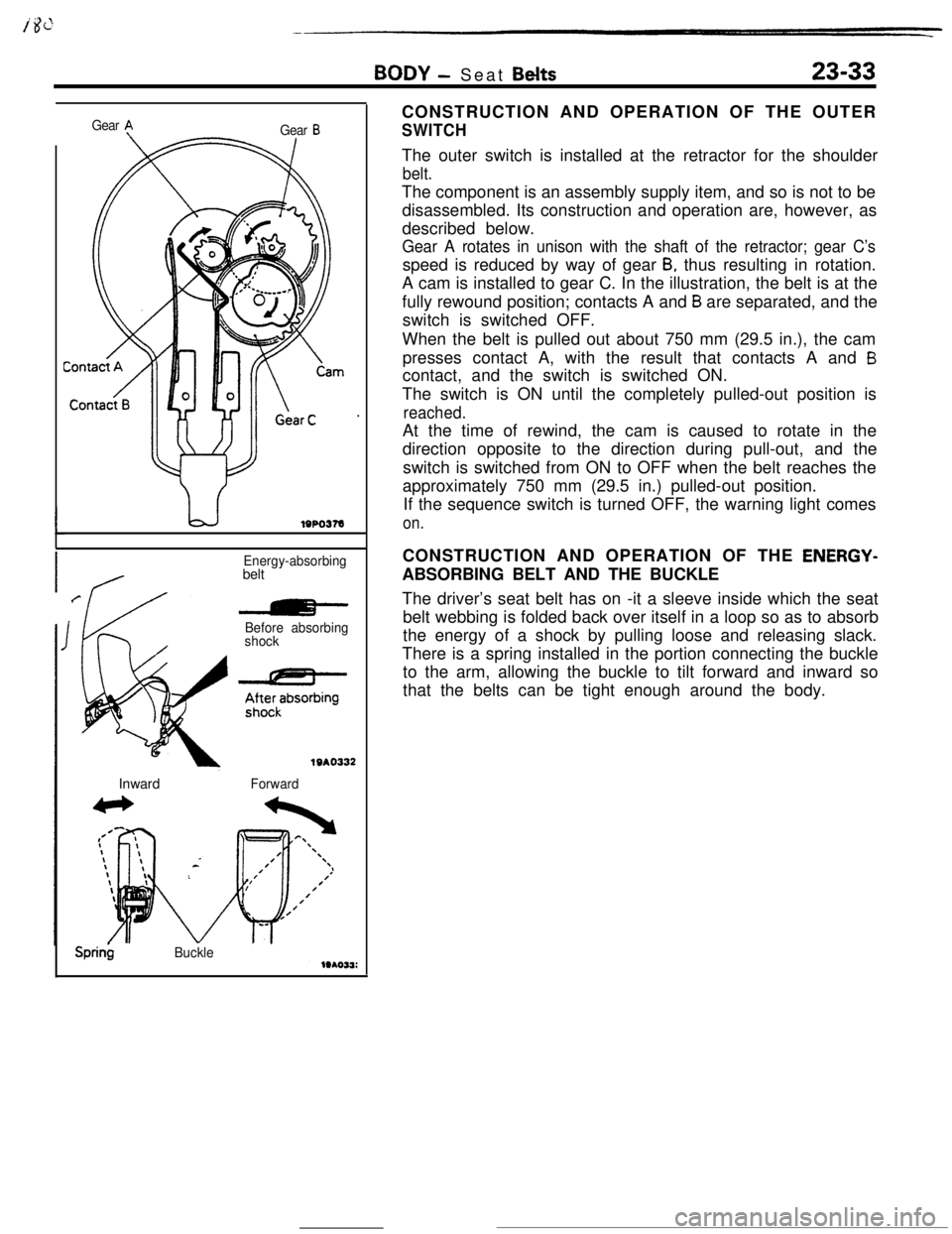
Sprin$BuckleCONSTRUCTION AND OPERATION OF THE OUTER
SWITCHThe outer switch is installed at the retractor for the shoulder
belt.The component is an assembly supply item, and so is not to be
disassembled. Its construction and operation are, however, as
described below.
Gear A rotates in unison with the shaft of the retractor; gear C’sspeed is reduced by way of gear
B, thus resulting in rotation.
A cam is installed to gear C. In the illustration, the belt is at the
fully rewound position; contacts A and
B are separated, and the
switch is switched OFF.
When the belt is pulled out about 750 mm (29.5 in.), the cam
presses contact A, with the result that contacts A and
Bcontact, and the switch is switched ON.
The switch is ON until the completely pulled-out position is
reached.At the time of rewind, the cam is caused to rotate in the
direction opposite to the direction during pull-out, and the
switch is switched from ON to OFF when the belt reaches the
approximately 750 mm (29.5 in.) pulled-out position.
If the sequence switch is turned OFF, the warning light comes
on.CONSTRUCTION AND OPERATION OF THE
ENERGY-ABSORBING BELT AND THE BUCKLE
The driver’s seat belt has on -it a sleeve inside which the seat
belt webbing is folded back over itself in a loop so as to absorb
the energy of a shock by pulling loose and releasing slack.
There is a spring installed in the portion connecting the buckle
to the arm, allowing the buckle to tilt forward and inward so
that the belts can be tight enough around the body.
Page 352 of 391
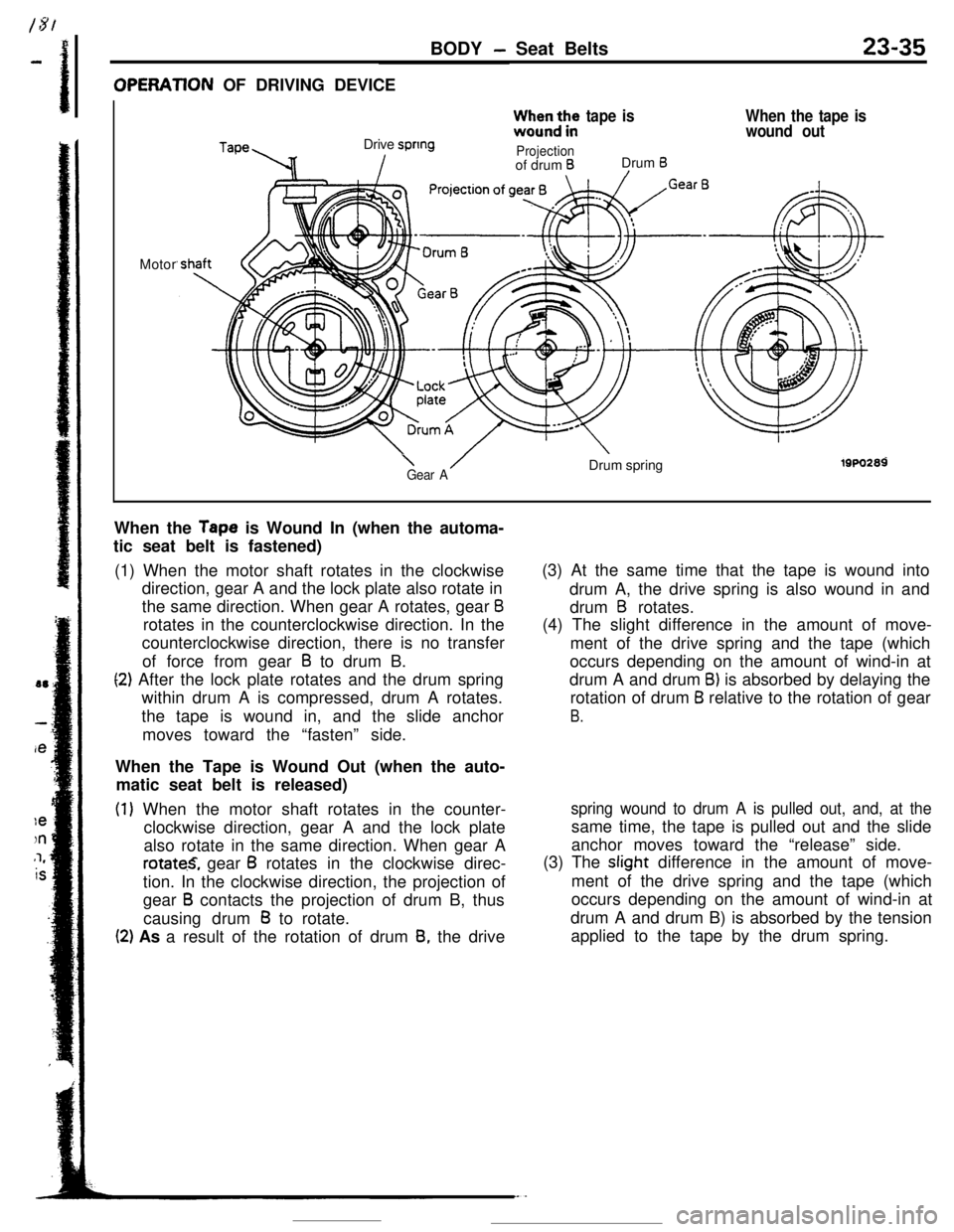
BODY - Seat Belts23-35OPERATlON OF DRIVING DEVICE
TapeDrive spring
Izz;b3;:,e
tape is
Projectionof drum BDrum B/
When the tape is
wound outMotor
\ /Gear ADrum springi9w2a9When the
Tape is Wound In (when the automa-
tic seat belt is fastened)
(1) When the motor shaft rotates in the clockwise
direction, gear A and the lock plate also rotate in
the same direction. When gear A rotates, gear
Brotates in the counterclockwise direction. In the
counterclockwise direction, there is no transfer
of force from gear
B to drum B.
(2) After the lock plate rotates and the drum spring
within drum A is compressed, drum A rotates.
the tape is wound in, and the slide anchor
moves toward the “fasten” side.
When the Tape is Wound Out (when the auto-
matic seat belt is released)
(1) When the motor shaft rotates in the counter-
clockwise direction, gear A and the lock plate
also rotate in the same direction. When gear A
rotate.S, gear B rotates in the clockwise direc-
tion. In the clockwise direction, the projection of
gear
B contacts the projection of drum B, thus
causing drum
B to rotate.
(2) As a result of the rotation of drum 8, the drive(3) At the same time that the tape is wound into
drum A, the drive spring is also wound in and
drum
B rotates.
(4) The slight difference in the amount of move-
ment of the drive spring and the tape (which
occurs depending on the amount of wind-in at
drum A and drum
B) is absorbed by delaying the
rotation of drum
B relative to the rotation of gear
B.
spring wound to drum A is pulled out, and, at thesame time, the tape is pulled out and the slide
anchor moves toward the “release” side.
(3) The slight difference in the amount of move-
ment of the drive spring and the tape (which
occurs depending on the amount of wind-in at
drum A and drum B) is absorbed by the tension
applied to the tape by the drum spring.