tcl MITSUBISHI ENDEAVOR 2004 Service Owner's Manual
[x] Cancel search | Manufacturer: MITSUBISHI, Model Year: 2004, Model line: ENDEAVOR, Model: MITSUBISHI ENDEAVOR 2004Pages: 3870, PDF Size: 98.47 MB
Page 3117 of 3870
The ECU incorporates the ABS-ECU, active skid control-ECU, and traction
control-ECU. The integral design allows joint operation of the TCL/ASC-ECU with
the ABS and coordinated control of the driving force and braking force. SYSTEM CONFIGURATION The Traction Control and Active Skid Control (TCL/ASC) System is a system that
adds a yaw rate sensor, a steering wheel sensor and master cylinder pressure sensor
(incorporated in hydraulic unit) to the ABS system. OVERVIEW OF CONTROL The TCL/ASC-ECU detects vehicle movement based on information from various
sensors and calculates a model of ideal vehicle movement. After comparing actual
and ideal movements, it acts to bring the actual vehicle movement closer to the
ideal model by controlling specific wheel brake force and governing engine output.
It restrains under-steering and over-steering through a corrective yaw moment, as
explained on the following pages. EXAMPLE OF ACTIVE SKID CONTROL OPERATION The Active Skid Control manages the vehicle attitude by creating a yaw moment
from altering the balance between the cornering force and each wheel's braking
mechanism.
For example, on a slippery surface, if the vehicle tends to be under-steered contrary
to the driver's intention, a yaw moment (a rotational moment) is created to restrain
the under-steering by increasing the rear-inside braking force. On the other hand,
when the vehicle tends to be over-steered, a yaw moment (a restorative moment) is
created to restrain the over-steering by increasing the front-outside braking force.
Furthermore, when it is determined that the vehicle is over-speeding, safe and stable
cornerin
g is enabled b
y deceleration from restrictin
g en
gine out
put.
2004 Mitsubishi Endeavor LS
2004 BRAKES Traction Control, Active Skid Control System - Endeavor
Page 3120 of 3870
Fig. 10: Identifying Joint Control Specification
s
Courtesy of MITSUBISHI MOTOR SALES OF AMERICA.
EXAMPLE OF OPERATION OF TRACTION CONTROL The Traction Control prevents drive force loss during slipping of the drive wheels
by automatically applying the brakes and sending engine torque reduction signal to
the PCM when the drive wheels slip or when driving on partly low-friction
surfaces. FAIL-SAFE AND DIAGNOSTIC FUNCTIONS The TCL/ASC-ECU regularly monitors input and out put signals. If an error is
detected in the system, the ECU sends a fail signal and the TCL/ASC indicator light
is illuminated or blinks. Various controls are processed depending on the cause of
malfunction as shown below. When the ABS system fails, the TCL/ASC system is
also suspended. However, when the TCL/ASC system fails, no other systems are
suspended. The appropriate indicator lights are illuminated/flashed.
The TCL/ASC-ECU includes the following functions to make system inspection
easier.
Diagnostic trouble code Display Data list Actuator test
All of the above operations can be carried out using scan tool MB991958.
ACTIVE SKID CONTROL SYSTEM OPERATION The TCL/ASC-ECU receives information from the PCM, the steering sensor, the G
and yaw-rate sensor and the wheel speed sensor. If the ECU determines that the
vehicle is tending to oversteer or understeer, it sends signals to the active skid
control system valves and the ABS solenoid valves to increase the fluid pressure to
the wheels.
The system closes the cut valve to shut the fluid channel to the suction valve, and
activates the
pum
p motor. The brake fluid, which is
pum
ped throu
gh the h
ydraulic
2004 Mitsubishi Endeavor LS
2004 BRAKES Traction Control, Active Skid Control System - Endeavor
Page 3134 of 3870
Fig. 30: Status Of Operation Valve Specificatio
n
Courtesy of MITSUBISHI MOTOR SALES OF AMERICA.
TRACTION CONTROL SYSTEM OPERATION The TCL/ASC-ECU receives information from the PCM, the G and yaw-rate
sensor, and the wheel speed sensor. If the ECU determines that a road wheel is
spinning, it will control the fluid pressure to the spinning wheel to apply torque to
the other road wheels. The operations of the ABS solenoid valves and the active
skid control system valves are the same as for the active skid control system.
Furthermore, the system also controls the engine if the accelerator pedal is
depressed excessively. TCL/ASC DIAGNOSIS INTRODUCTION TO TRACTION CONTROL/ACTIVE SKID CONTROL SYSTEM DIAGNOSIS The traction control/active skid control system (TCL/ASC) is a system that has
added the cut valve and suction valve to the conventional ABS system. These
valves are used to control each of the road wheels independently. These differences
include sounds, sensations, and vehicle performance that owners and service
technicians who are not familiar with TCL/ASC may not be used to.
Some operational characteristics may seem to be malfunctions, but they are simply
signs of normal TCL/ASC operation. When diagnosing the TCL/ASC system, keep
these operational characteristics in mind. Inform the owner of the kind of
performance characteristics to expect from an TCL/ASC-equipped vehicle. TCL/ASC Diagnostic Trouble Code Detection Conditions TCL/ASC diagnostic trouble codes (TCL/ASC DTCs) are set under different
conditions, depending on the malfunction detected. Most TCL/ASC DTCs will only
be set during vehicle operation. Some TCL/ASC DTCs will also be set during the
TCL/ASC self-check immediatel
y after the en
gine is started.
NOTE: *: When the ASC is operating while the brake pedal is
depressed, the suction valve turns on and off according to
the brake fluid amount supplied to the buffer chamber.
2004 Mitsubishi Endeavor LS
2004 BRAKES Traction Control, Active Skid Control System - Endeavor
Page 3135 of 3870
When you check if an TCL/ASC DTC will be displayed again after the DTC has
been erased, you should duplicate the TCL/ASC DTC set conditions. Depending on
the detection timing and set conditions for the specific TCL/ASC DTC, you must
either drive the vehicle or turn the engine off and restart it. To set the proper
conditions for that DTC again, refer to "TCL/ASC DTC SET CONDITIONS
" for
each TCL/ASC DTC that you are trying to reset.
TCL/ASC DIAGNOSTIC TROUBLESHOOTING STRATEGY Use these steps to plan your diagnostic strategy. If you follow them carefully, you
will be sure that you have exhausted most of the possible ways to find an TCL/ASC
fault.
1. Gather information about the problem from the customer.
2. Verify that the condition described by the customer exists.
3. Check the vehicle for any TCL/ASC DTC.
4. If you cannot verify the condition and there are no TCL/ASC DTCs, the
malfunction is intermittent. Refer to HOW TO COPE WITH
INTERMITTENT MALFUNCTIONS
.
5. If you can verify the condition but there are no TCL/ASC DTCs, or the system
cannot communicate with the scan tool, check that the basic brake system is
operating properly.
If the basic brake system is not operating properly, refer to the BASIC BRAKE SYSTEM DIAGNOSIS
, .
If the basic brake system is operating properly, refer to SYMPTOM CHART
.
6. If there is an TCL/ASC DTC, record the number of the DTC, then erase the
DTC from the memory using the scan tool.
7. Duplicate the TCL/ASC DTC set conditions to see if the same TCL/ASC DTC
will set again.
If the same TCL/ASC DTC sets again or the TCL/ASC DTC cannot be
erased, perform the diagnostic procedures for the DTC. Refer to
DIAGNOSTIC TROUBLE CODE CHART
.
If you cannot
get the same TCL/ASC DTC to set a
gain, the malfunction is
2004 Mitsubishi Endeavor LS
2004 BRAKES Traction Control, Active Skid Control System - Endeavor
Page 3136 of 3870
intermittent. Refer to HOW TO COPE WITH INTERMITTENT MALFUNCTIONS
.
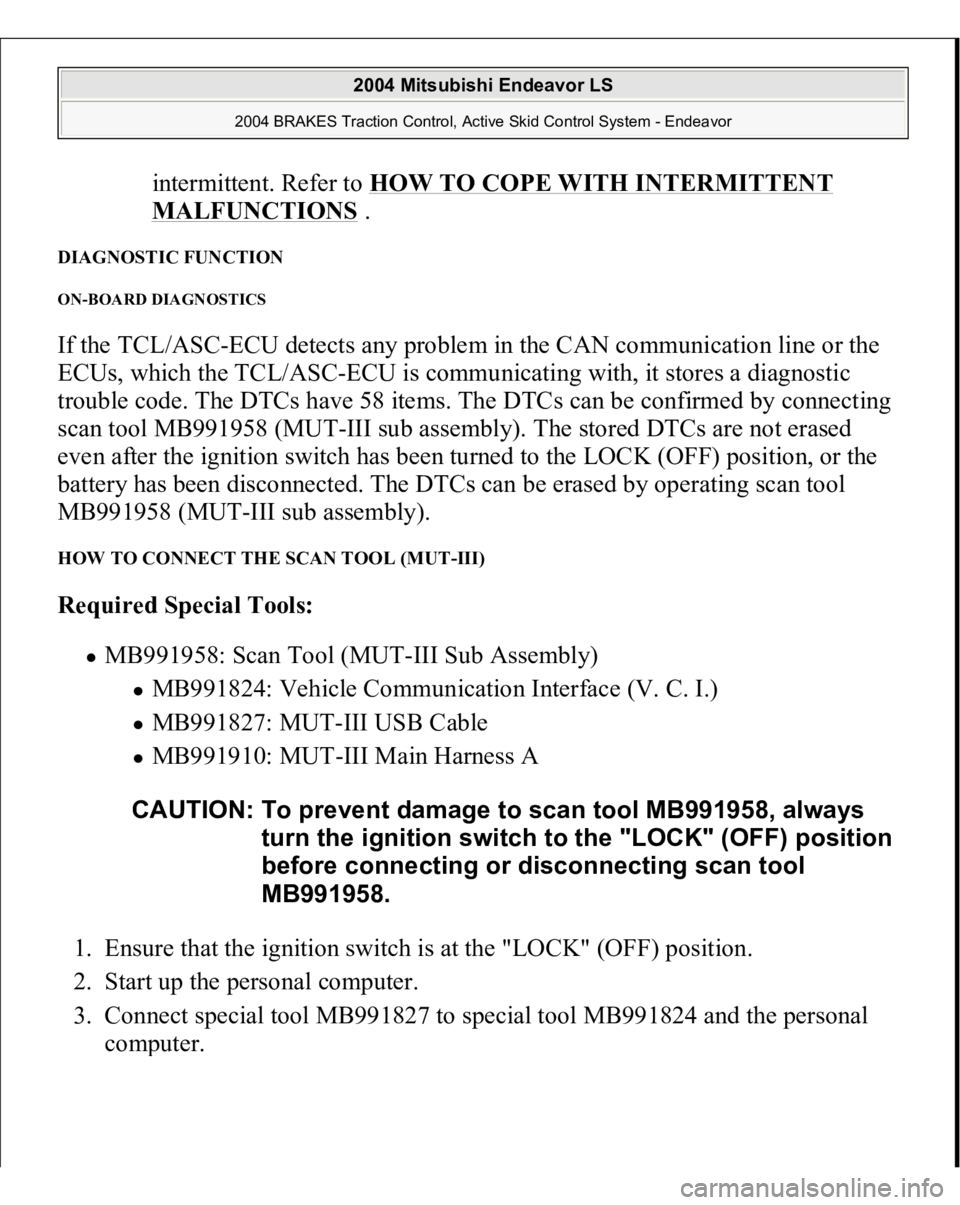
DIAGNOSTIC FUNCTION ON-BOARD DIAGNOSTICS If the TCL/ASC-ECU detects any problem in the CAN communication line or the
ECUs, which the TCL/ASC-ECU is communicating with, it stores a diagnostic
trouble code. The DTCs have 58 items. The DTCs can be confirmed by connecting
scan tool MB991958 (MUT-III sub assembly). The stored DTCs are not erased
even after the ignition switch has been turned to the LOCK (OFF) position, or the
battery has been disconnected. The DTCs can be erased by operating scan tool
MB991958 (MUT-III sub assembly). HOW TO CONNECT THE SCAN TOOL (MUT-III) Required Special Tools:
MB991958: Scan Tool (MUT-III Sub Assembly)
MB991824: Vehicle Communication Interface (V. C. I.) MB991827: MUT-III USB Cable MB991910: MUT-III Main Harness A
1. Ensure that the ignition switch is at the "LOCK" (OFF) position.
2. Start up the personal computer.
3. Connect special tool MB991827 to special tool MB991824 and the personal
computer.
CAUTION: To prevent damage to scan tool MB991958, always
turn the ignition switch to the "LOCK" (OFF) position
before connecting or disconnecting scan tool
MB991958.
2004 Mitsubishi Endeavor LS
2004 BRAKES Traction Control, Active Skid Control System - Endeavor
Page 3146 of 3870
Courtesy of MITSUBISHI MOTOR SALES OF AMERICA
.
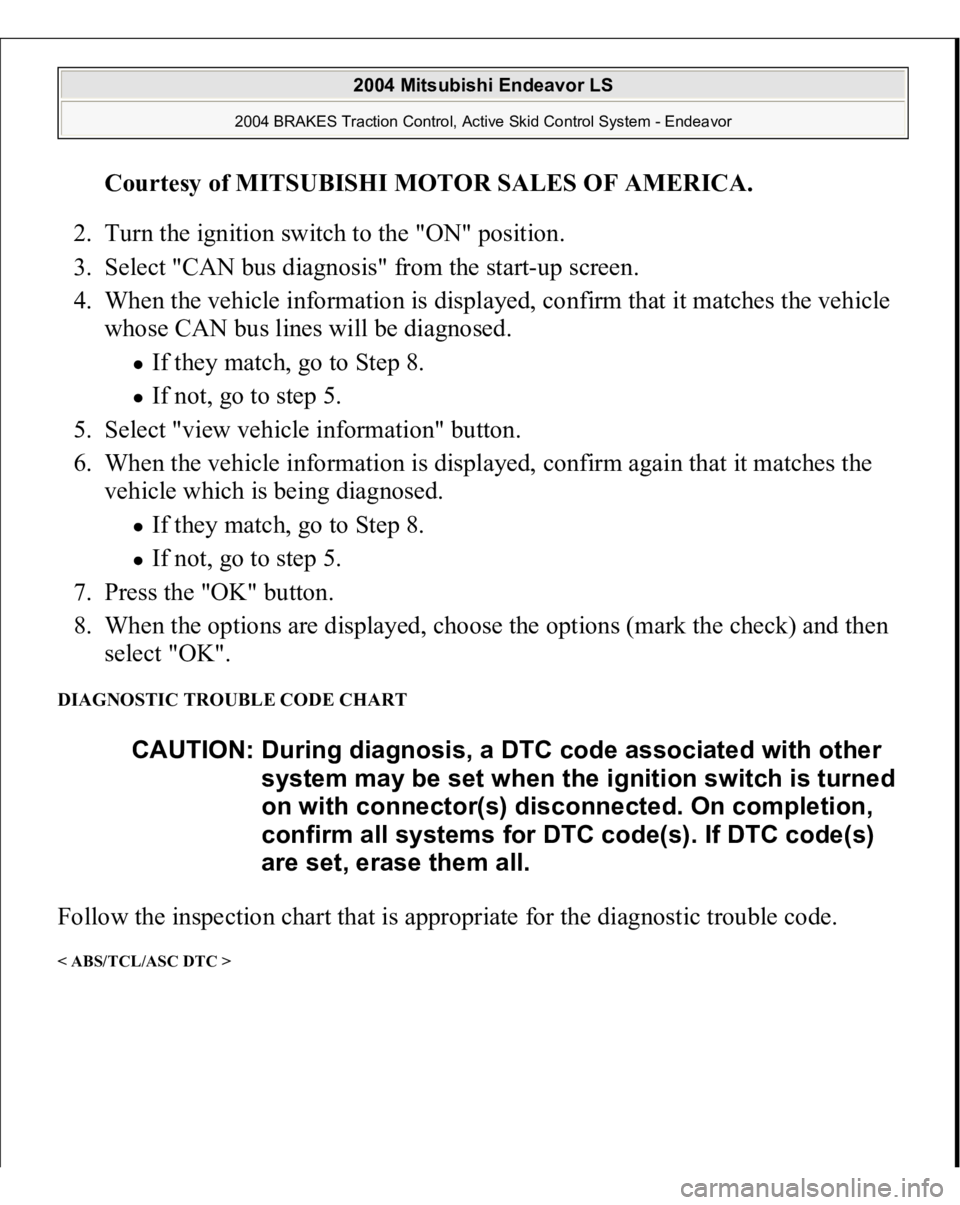
2. Turn the ignition switch to the "ON" position.
3. Select "CAN bus diagnosis" from the start-up screen.
4. When the vehicle information is displayed, confirm that it matches the vehicle
whose CAN bus lines will be diagnosed.
If they match, go to Step 8. If not, go to step 5.
5. Select "view vehicle information" button.
6. When the vehicle information is displayed, confirm again that it matches the
vehicle which is being diagnosed. If they match, go to Step 8. If not, go to step 5.
7. Press the "OK" button.
8. When the options are displayed, choose the options (mark the check) and then
select "OK".
DIAGNOSTIC TROUBLE CODE CHART Follow the inspection chart that is appropriate for the diagnostic trouble code. < ABS/TCL/ASC DTC >
CAUTION: During diagnosis, a DTC code associated with other
system may be set when the ignition switch is turned
on with connector(s) disconnected. On completion,
confirm all systems for DTC code(s). If DTC code(s)
are set, erase them all.
2004 Mitsubishi Endeavor LS
2004 BRAKES Traction Control, Active Skid Control System - Endeavor
Page 3153 of 3870
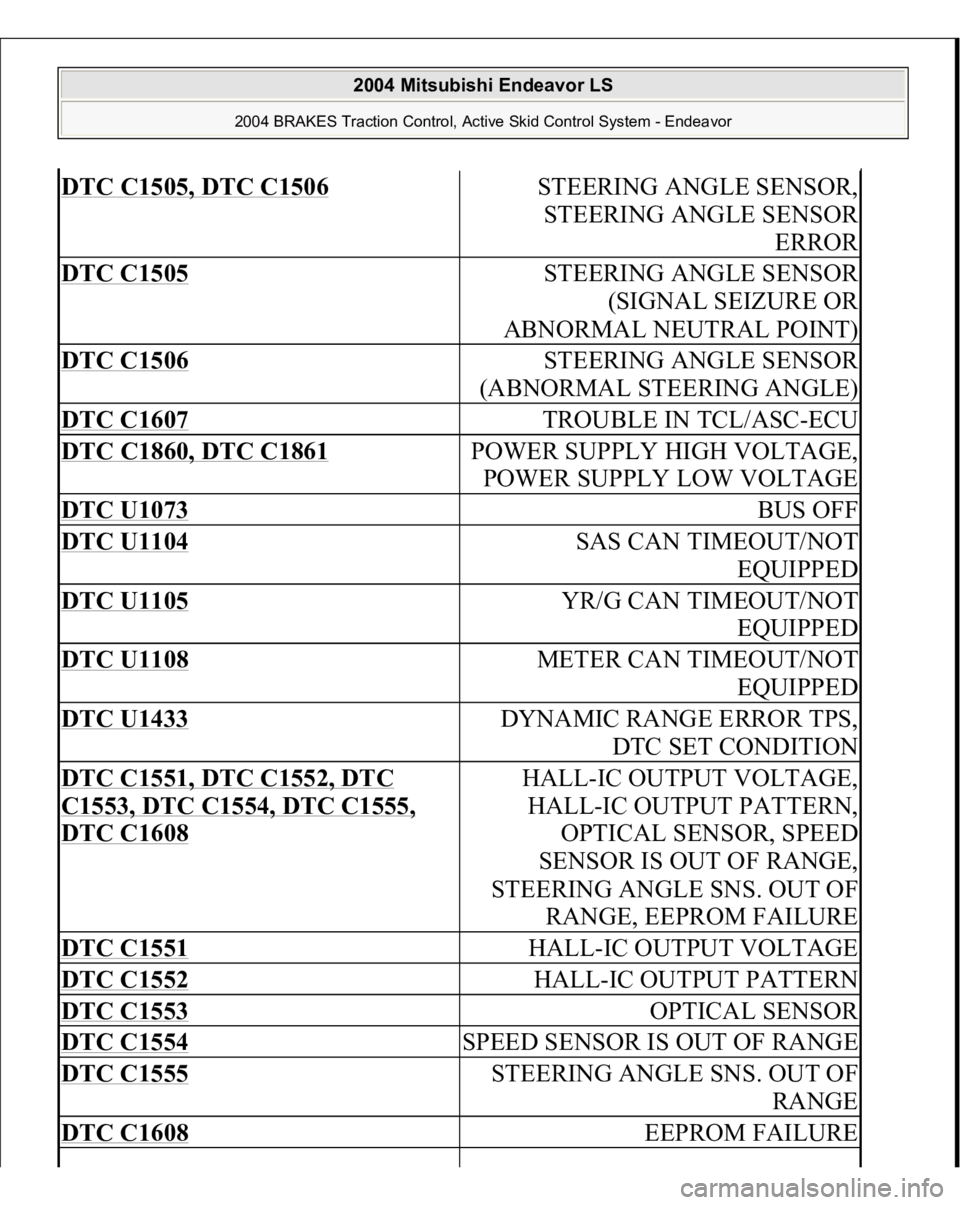
DTC C1505, DTC C1506
STEERING ANGLE SENSOR,
STEERING ANGLE SENSOR
ERROR
DTC C1505
STEERING ANGLE SENSOR
(SIGNAL SEIZURE OR
ABNORMAL NEUTRAL POINT)
DTC C1506
STEERING ANGLE SENSOR
(ABNORMAL STEERING ANGLE)
DTC C1607
TROUBLE IN TCL/ASC-ECU
DTC C1860, DTC C1861
POWER SUPPLY HIGH VOLTAGE,
POWER SUPPLY LOW VOLTAGE
DTC U1073
BUS OFF
DTC U1104
SAS CAN TIMEOUT/NOT
EQUIPPED
DTC U1105
YR/G CAN TIMEOUT/NOT
EQUIPPED
DTC U1108
METER CAN TIMEOUT/NOT
EQUIPPED
DTC U1433
DYNAMIC RANGE ERROR TPS,
DTC SET CONDITION
DTC C1551, DTC C1552, DTC C1553, DTC C1554, DTC C1555, DTC C1608
HALL-IC OUTPUT VOLTAGE,
HALL-IC OUTPUT PATTERN,
OPTICAL SENSOR, SPEED
SENSOR IS OUT OF RANGE,
STEERING ANGLE SNS. OUT OF
RANGE, EEPROM FAILURE
DTC C1551
HALL-IC OUTPUT VOLTAGE
DTC C1552
HALL-IC OUTPUT PATTERN
DTC C1553
OPTICAL SENSOR
DTC C1554
SPEED SENSOR IS OUT OF RANGE
DTC C1555
STEERING ANGLE SNS. OUT OF
RANGE
DTC C1608
EEPROM FAILURE
2004 Mitsubishi Endeavor LS
2004 BRAKES Traction Control, Active Skid Control System - Endeavor
Page 3154 of 3870
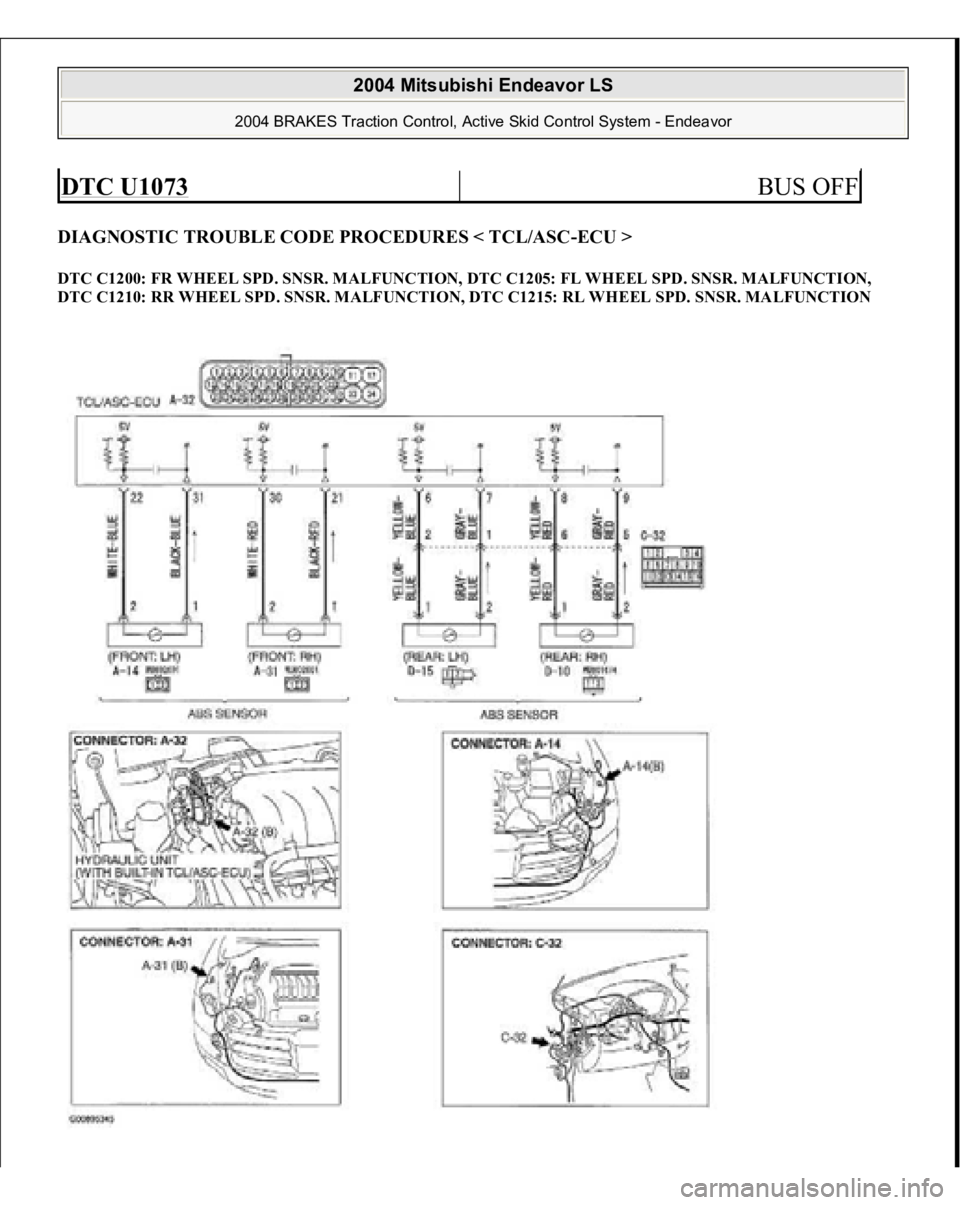
DIAGNOSTIC TROUBLE CODE PROCEDURES < TCL/ASC-ECU > DTC C1200: FR WHEEL SPD. SNSR. MALFUNCTION, DTC C1205: FL WHEEL SPD. SNSR. MALFUNCTION,
DTC C1210: RR WHEEL SPD. SNSR. MALFUNCTION, DTC C1215: RL WHEEL SPD. SNSR. MALFUNCTION DTC U1073
BUS OFF
2004 Mitsubishi Endeavor LS
2004 BRAKES Traction Control, Active Skid Control System - Endeavor
Page 3155 of 3870
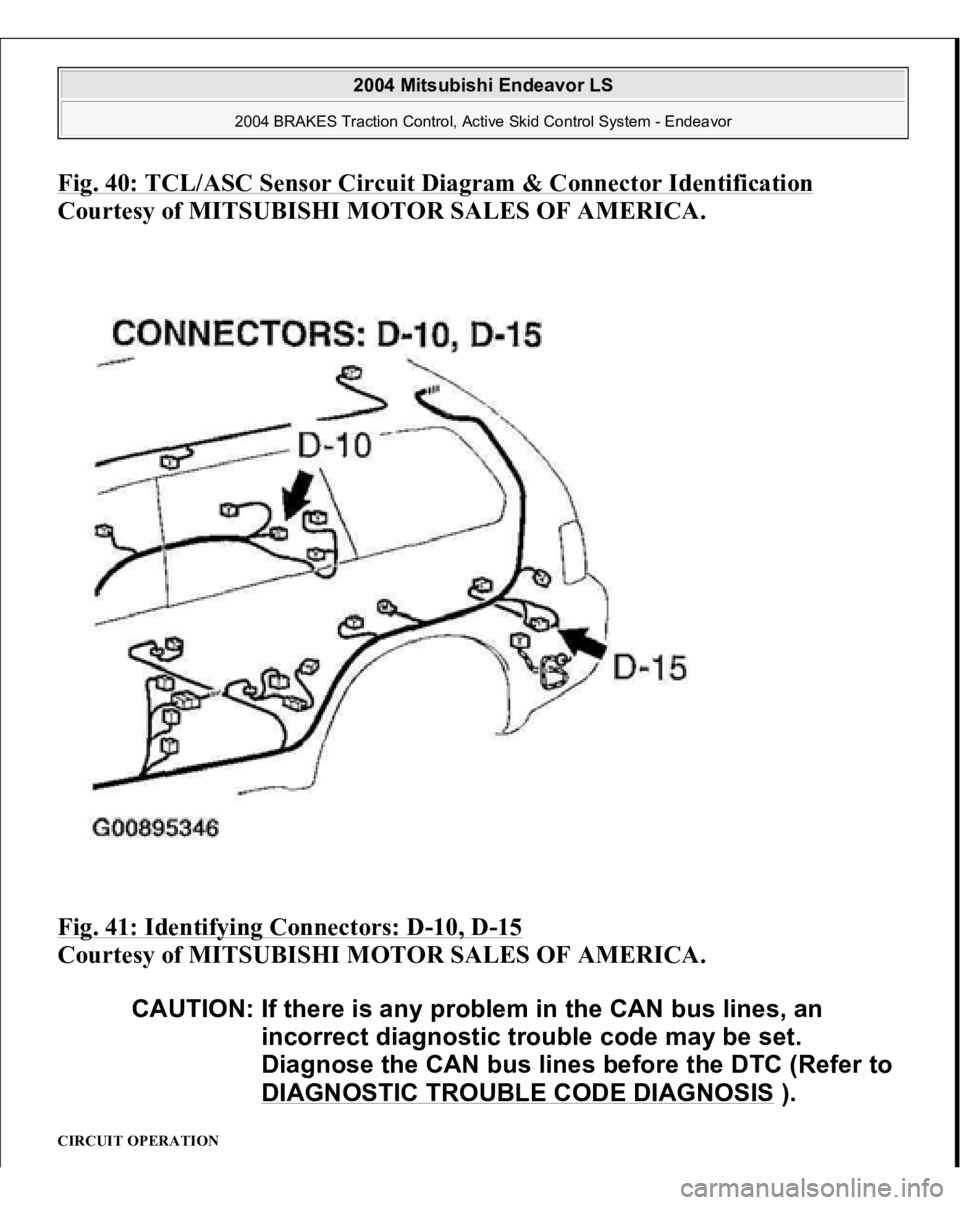
Fig. 40: TCL/ASC Sensor Circuit Diagram & Connector Identificatio
n
Courtesy of MITSUBISHI MOTOR SALES OF AMERICA.
Fig. 41: Identifying Connectors: D
-10, D
-15
Courtesy of MITSUBISHI MOTOR SALES OF AMERICA.
CIRCUIT OPERATION
CAUTION: If there is any problem in the CAN bus lines, an
incorrect diagnostic trouble code may be set.
Diagnose the CAN bus lines before the DTC (Refer to
DIAGNOSTIC TROUBLE CODE DIAGNOSIS
).
2004 Mitsubishi Endeavor LS
2004 BRAKES Traction Control, Active Skid Control System - Endeavor
Page 3156 of 3870
A toothed ABS rotor generates a voltage pulse as it moves across the pickup
field of each ABS sensor. The amount of voltage generated at each wheel is determined by the clearance
between the ABS rotor teeth and the ABS sensor, and by the speed of rotation. Sends alternating current signals at frequencies which are proportional to the
rotation speeds of each wheel to the TCL/ASC electronic control unit
(TCL/ASC-ECU). The ABS hydraulic unit modulates the amount of braking force individually
applied to each wheel cylinder.
TCL/ASC DTC SET CONDITIONS The TCL/ASC-ECU monitors voltage fluctuation in each ABS sensor circuit. If the
ECU detects short or open circuit in the circuit, it will set a diagnostic trouble code. TROUBLESHOOTING HINTS (The most likely causes for these DTCs are to set are:)
Current trouble
Malfunction of the ABS sensor Damaged wiring harness or connector Malfunction of the hydraulic unit (integrated with TCL/ASC-ECU)
Past trouble
Carry out diagnosis with particular emphasis on connector(s) or wiring harness
in ABS sensor circuit. For diagnosis procedures, refer to HOW TO USE TROUBLESHOOTING/INSPECTION SERVICE POINTS
.
DIAGNOSIS Required Special Tools:
MB991958: Scan Tool (MUT-III Sub Assembly)
MB991824: Vehicle Communication Interface (V.C.I.) MB991827: MUT-III USB Cable MB991910: MUT-III Main Harness A
2004 Mitsubishi Endeavor LS
2004 BRAKES Traction Control, Active Skid Control System - Endeavor