jack points MITSUBISHI GALANT 1989 Service User Guide
[x] Cancel search | Manufacturer: MITSUBISHI, Model Year: 1989, Model line: GALANT, Model: MITSUBISHI GALANT 1989Pages: 1273, PDF Size: 37.62 MB
Page 1059 of 1273
33B-120 ACTIVE-ELECTRONIC CONTROL SUSPENSION - Z%iZky8”d
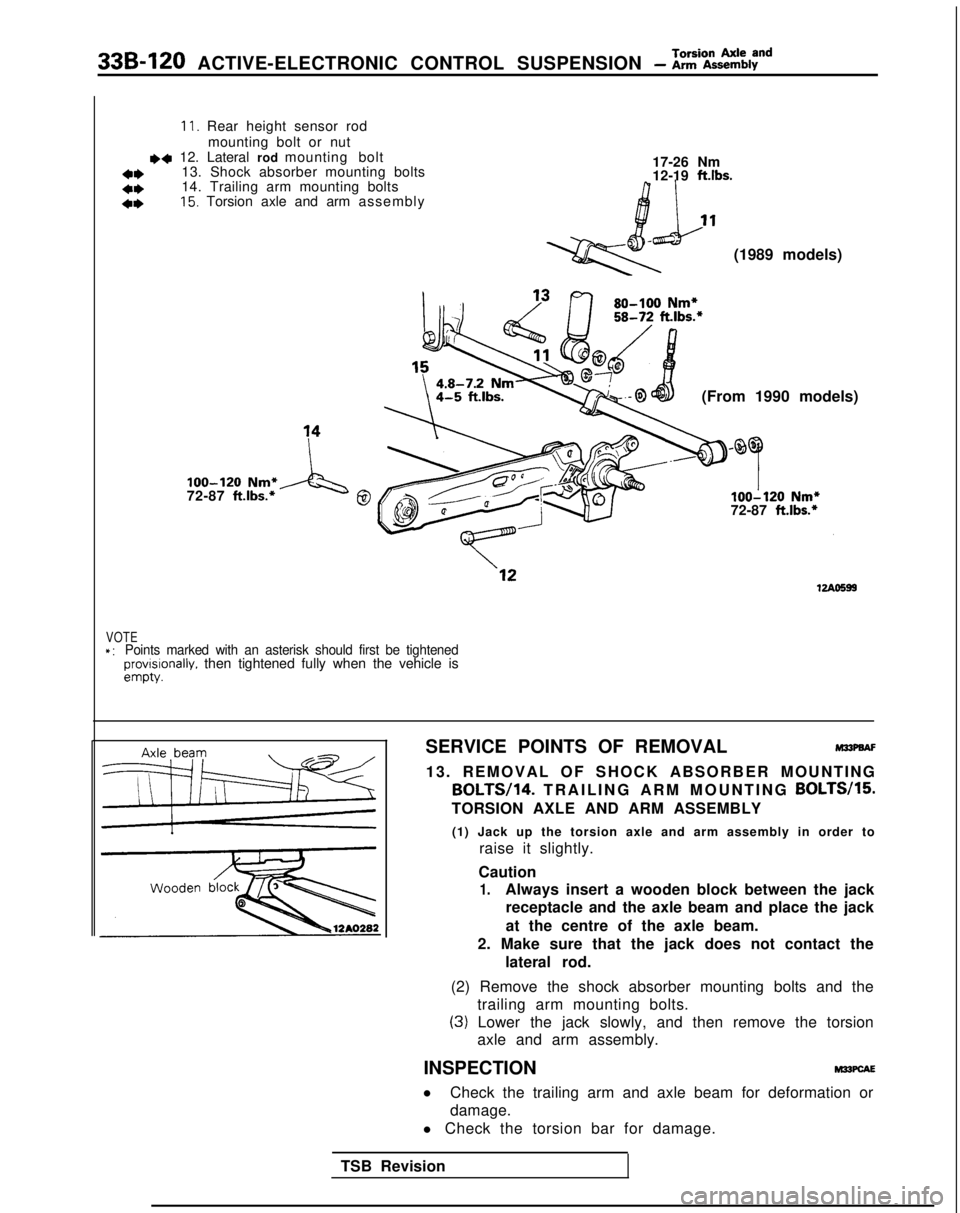
11. Rear height sensor rodmounting bolt or nut
~~ 12. Lateral rod mounting bolt
13. Shock absorber mounting bolts 17-26 Nm
a*12-19 ftlbs.*I)14. Trailing arm mounting bolts
4*15. Torsion axle and arm assembl
y
(1989 models)
(From 1990 models)
loo-120 Nm*
72-87 ft.lbs.*A‘g0loo-120 Nm*
72-87 ft.lbs.*
VOTE*:Points marked with an asterisk should first be tightenedprovrslonally. then tightened fully when the vehicle isempty.
SERVICE POINTS OF REMOVALM33PaAF
13. REMOVAL OF SHOCK ABSORBER MOUNTING BOLTW14.
TRAILING ARM MOUNTING BOLTW15.
TORSION AXLE AND ARM ASSEMBLY
(1) Jack up the torsion axle and arm assembly in order to raise it slightly.
Caution
1.Always insert a wooden block between the jack receptacle and the axle beam and place the jack
at the centre of the axle beam.
2. Make sure that the jack does not contact the lateral rod.
(2) Remove the shock absorber mounting bolts and the trailing arm mounting bolts.
(3) Lower the jack slowly, and then remove the torsionaxle and arm assembly.
INSPECTION
M22PcAE
l Check the trailing arm and axle beam for deformation or
damage.
l Check the torsion bar for damage.
TSB Revision
Page 1088 of 1273
REAR SUSPENSION
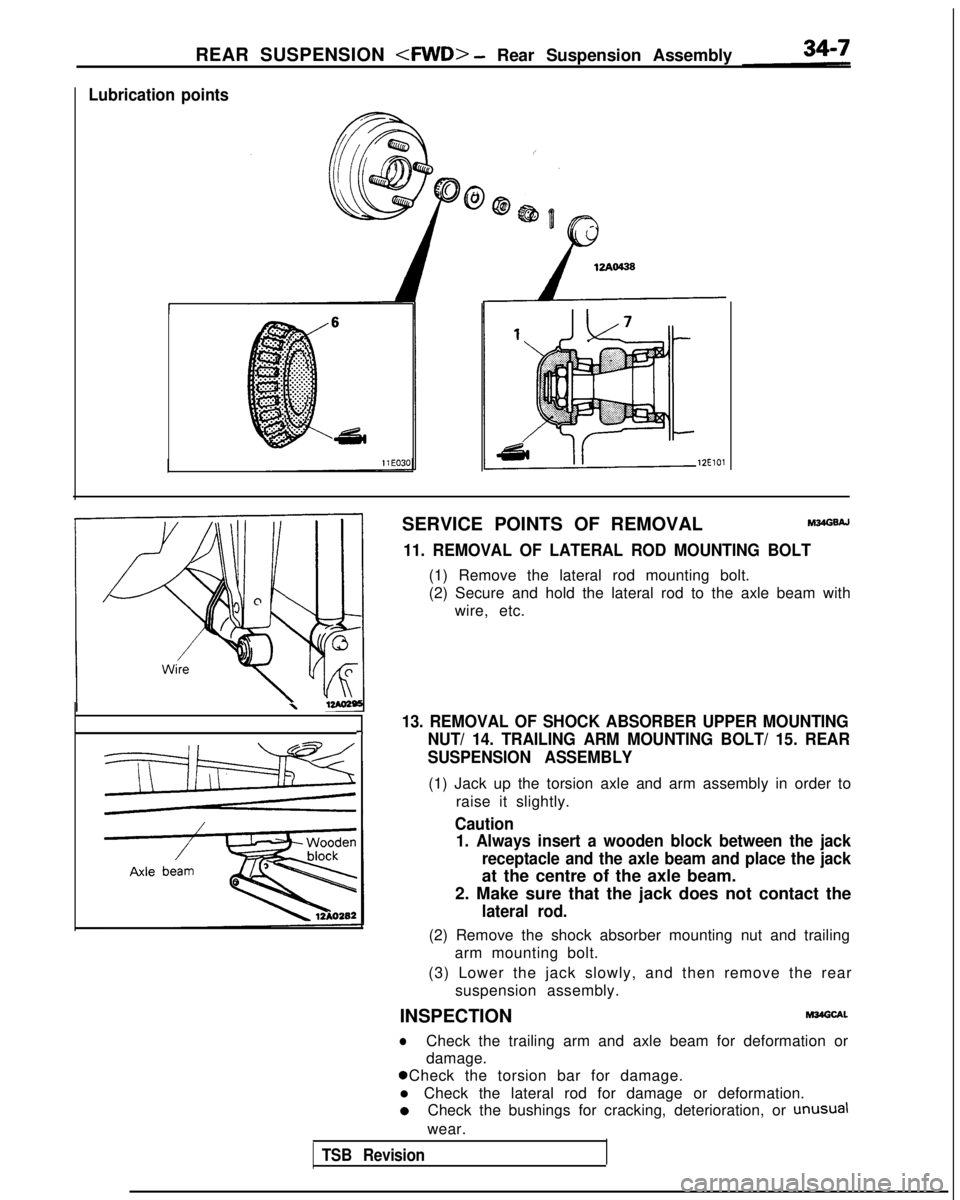
Lubrication points
12ElOl
SERVICE POINTS OF REMOVALM34GsAJ
11. REMOVAL OF LATERAL ROD MOUNTING BOLT
(1) Remove the lateral rod mounting bolt.
(2) Secure and hold the lateral rod to the axle beam with
wire, etc.
\
13. REMOVAL OF SHOCK ABSORBER UPPER MOUNTING-INUT/ 14. TRAILING ARM MOUNTING BOLT/ 15. REAR
SUSPENSION ASSEMBLY
(1) Jack up the torsion axle and arm assembly in order to
raise it slightly.
Caution1. Always insert a wooden block between the jack
receptacle and the axle beam and place the jack
at the centre of the axle beam.
2. Make sure that the jack does not contact the
lateral rod.
(2) Remove the shock absorber mounting nut and trailing arm mounting bolt.
(3) Lower the jack slowly, and then remove the rear suspension assembly.
INSPECTION
M34Glxl.
lCheck the trailing arm and axle beam for deformation or
damage. 0 Check the torsion bar for damage.
l Check the lateral rod for damage or deformation. 0
Check the bushings for cracking, deterioration, or
unusual
wear.
TSB Revision
Page 1092 of 1273
REAR SUSPENSION
SHOCK ABSORBER ASSEMBLY
REMOVAL AND INSTALLATION
hl34NA-A
Pre-removal
and Post-installation Op-
r
*Removal and lnstallatlon of the TrunkSide Trim (Refer to GROUP
52-Trims.)
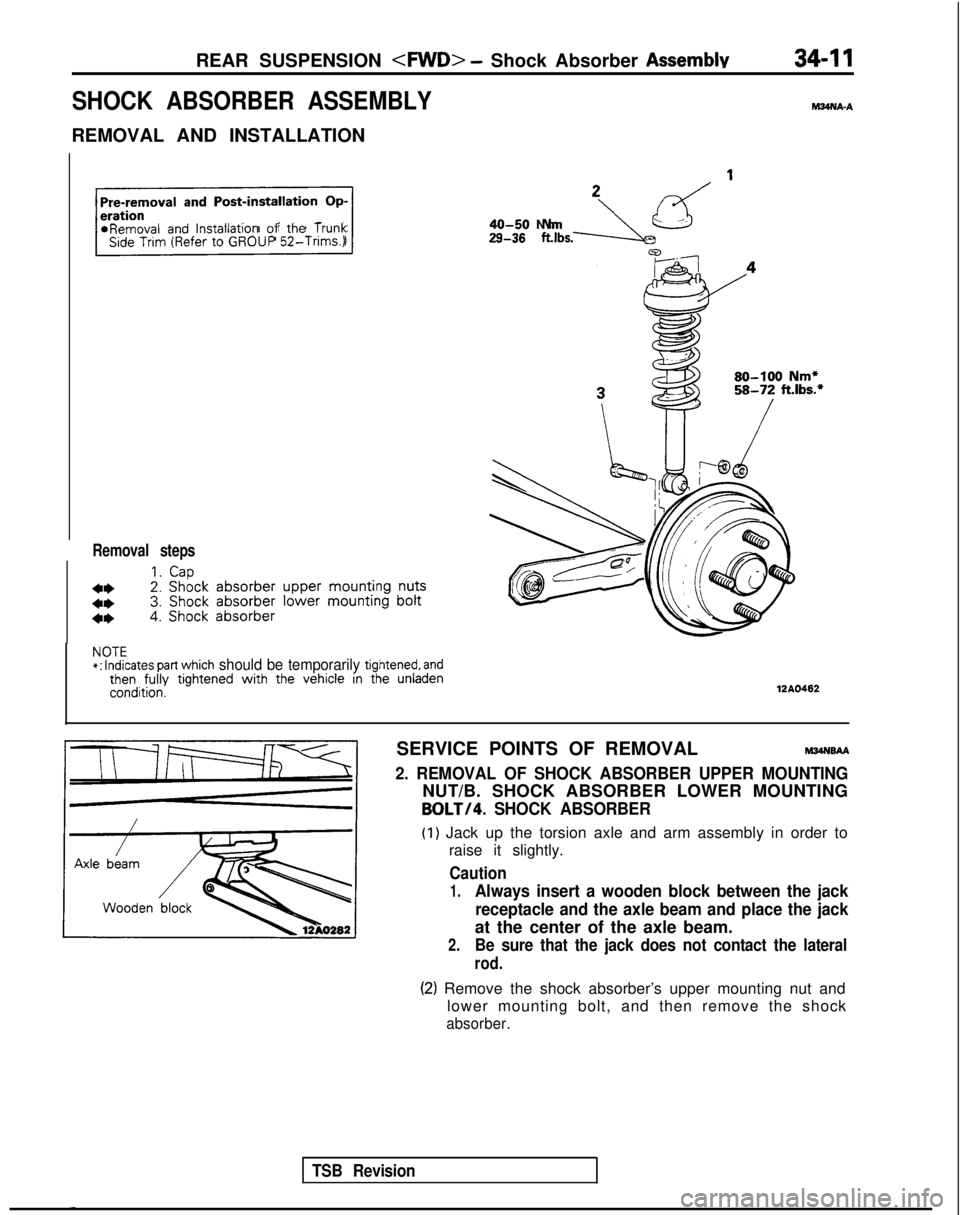
Removal steps
1.Cap
4*2. Shock
absorber
upper
mounting
nuts
4*3. Shock
absorber
lower mounting
bolt
4*4. Shock absorber
29-38 .,bs.-JLzd ’40-50 N
m
80-100 Nm*58-72 ft.lbs.*
NOTE*:
Indicates part which should be temporarily tightened, andthen fully
tightened with
the vehicle in the unladencondition.12AO462
TSB Revision
SERVICE POINTS OF REMOVALM34NsAA
2. REMOVAL OF SHOCK ABSORBER UPPER MOUNTING
NUT/B. SHOCK ABSORBER LOWER MOUNTING
BOLT/4. SHOCK ABSORBER
(1) Jack up the torsion axle and arm assembly in order to
raise it slightly.
Caution
1.Always insert a wooden block between the jack
receptacle and the axle beam and place the jack
at the center of the axle beam.
2.Be sure that the jack does not contact the lateral
rod.
(2) Remove the shock absorber’s upper mounting nut and lower mounting bolt, and then remove the shock
absorber.
Page 1097 of 1273
34-16 REAR SUSPENSION
L
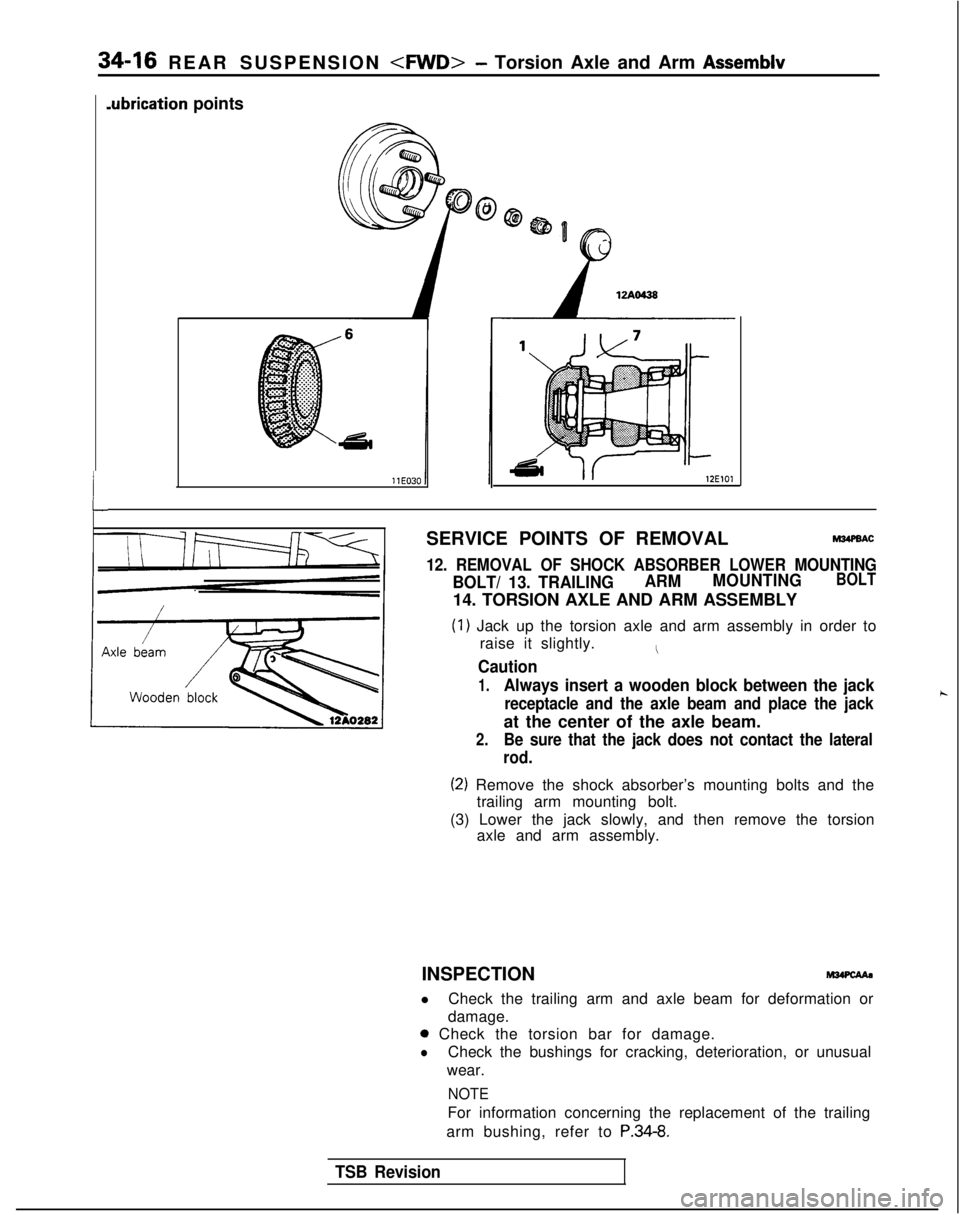
.ubrication points
12ElOl
SERVICE POINTS OF REMOVALM34PBAC
12. REMOVAL OF SHOCK ABSORBER LOWER MOUNTING
BOLT/ 13. TRAILINGARM
MOUNTINGBOLT
14. TORSION AXLE AND ARM ASSEMBLY
(1) Jack up the torsion axle and arm assembly in order to
raise it slightly.
I
Caution
1.Always insert a wooden block between the jack
receptacle and the axle beam and place the jackh
at the center of the axle beam.
2.Be sure that the jack does not contact the lateral
rod.
(2) Remove the shock absorber’s mounting bolts and the trailing arm mounting bolt.
(3) Lower the jack slowly, and then remove the torsion axle and arm assembly.
INSPECTION
l Check the trailing arm and axle beam for deformation or
damage.
0 Check the torsion bar for damage.
lCheck the bushings for cracking, deterioration, or unusual
wear.
NOTE
For information concerning the replacement of the trailing
arm bushing, refer to
P.34-8.
TSB Revision
Page 1107 of 1273
34-26REAR SUSPENSION
I 412AOlOS
J
TSB Revision
SERVICE POINTS OF REMOVAL
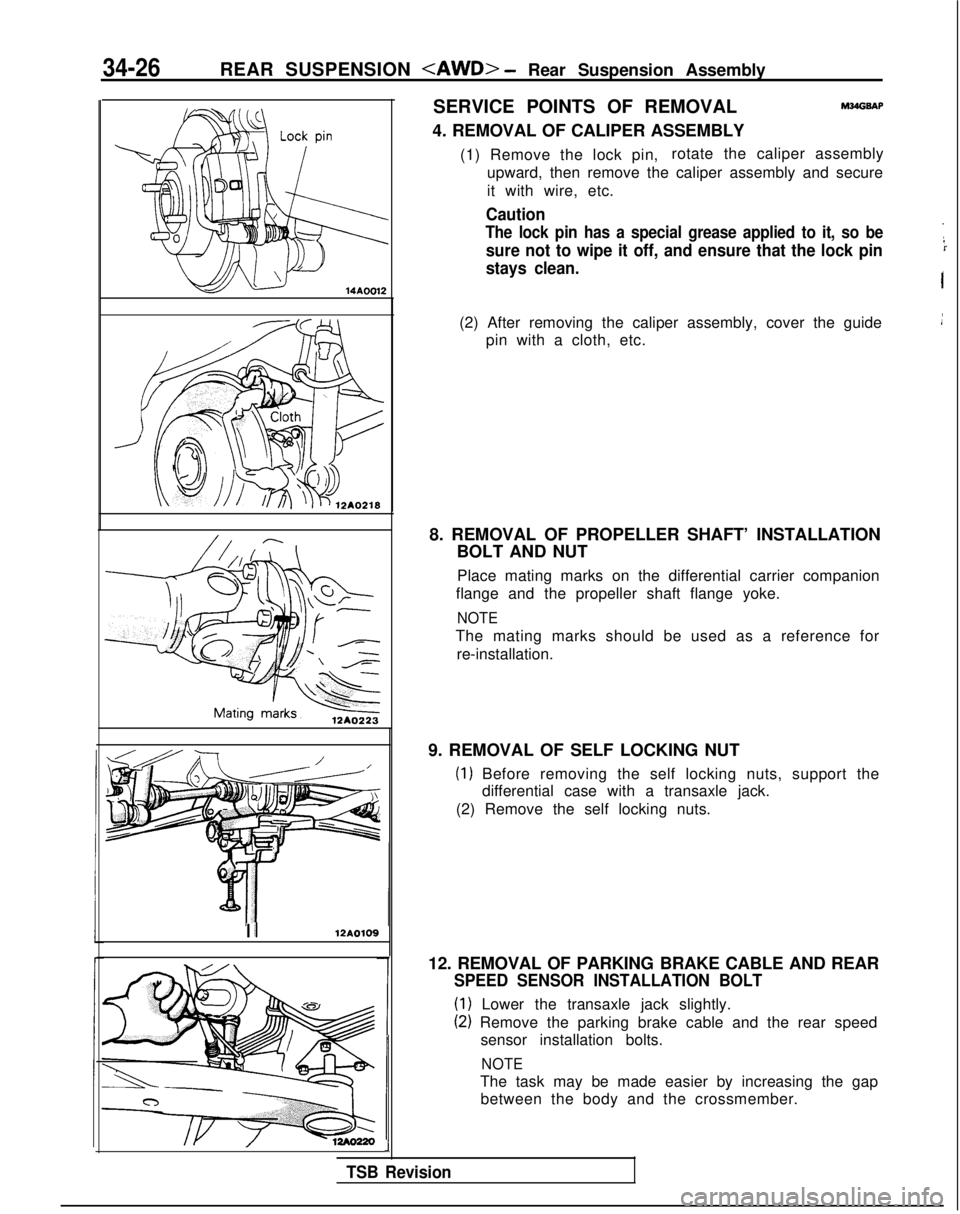
4. REMOVAL OF CALIPER ASSEMBLYM?dGSAP
(1) Remove the lock pin, rotate the caliper assembly
upward, then remove the caliper assembly and secure
it with wire, etc.
Caution
The lock pin has a special grease applied to it, so be
sure not to wipe it off, and ensure that the lock pin
stays clean.
I
(2) After removing the caliper assembly, cover the guide pin with a cloth, etc.
8. REMOVAL OF PROPELLER SHAFT’ INSTALLATION BOLT AND NUT
Place mating marks on the differential carrier companion
flange and the propeller shaft flange yoke.
NOTE
The mating marks should be used as a reference for
re-installation.
9. REMOVAL OF SELF LOCKING NUT
(1) Before removing the self locking nuts, support the differential case with a transaxle jack.
(2) Remove the self locking nuts.
12. REMOVAL OF PARKING BRAKE CABLE AND REAR
SPEED SENSOR INSTALLATION BOLT
(1) Lower the transaxle jack slightly.
(2) Remove the parking brake cable and the rear speed sensor installation bolts.
NOTE
The task may be made easier by increasing the gapbetween the body and the crossmember.
Page 1108 of 1273
REAR SUSPENSION
12A0222
12A.0221
,
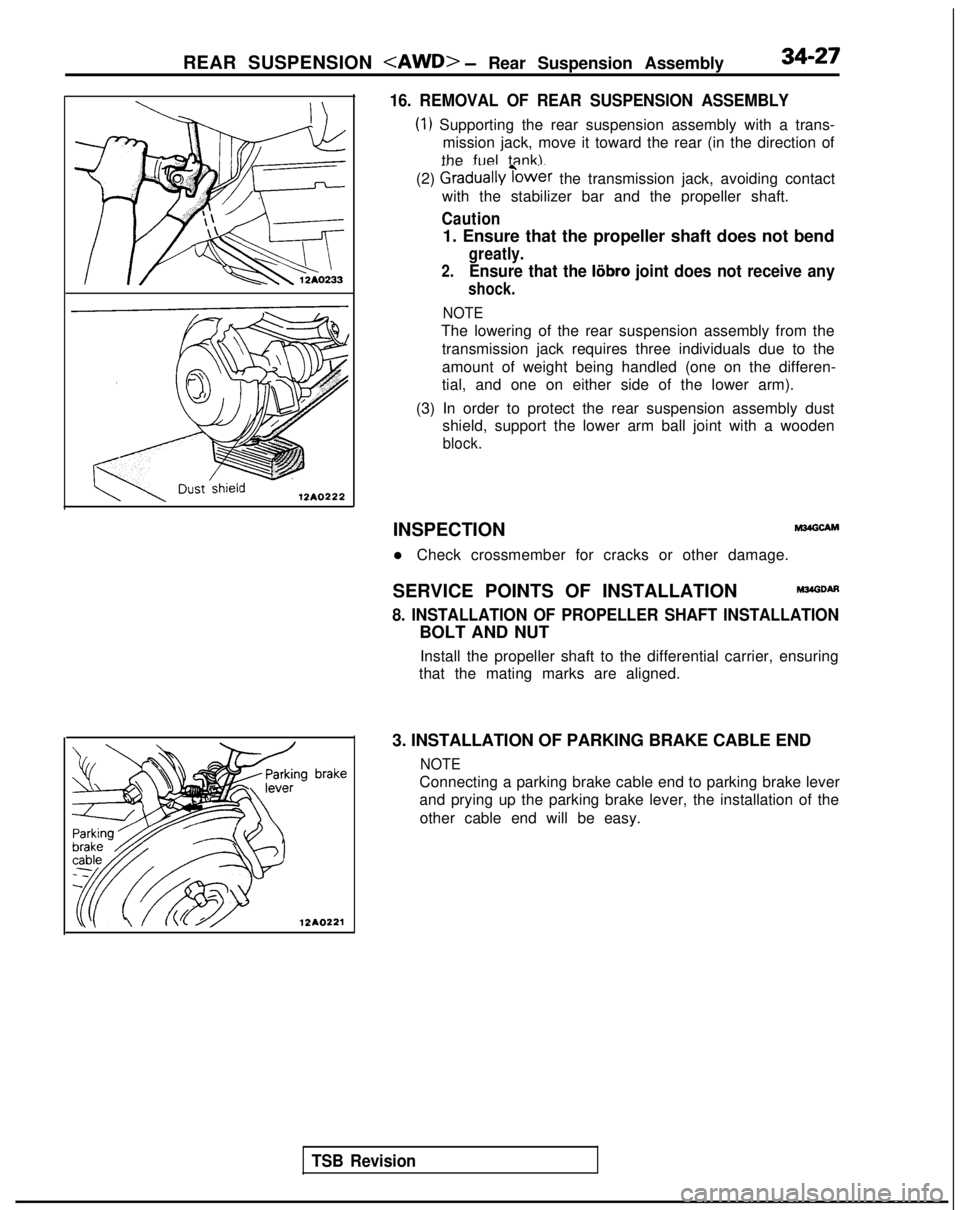
16. REMOVAL OF REAR SUSPENSION ASSEMBLY
(1) Supporting the rear suspension assembly with a trans-
mission jack, move it toward the rear (in the direction of
the fuel tank).
(2)
Graduallyibwer the transmission jack, avoiding contact
with the stabilizer bar and the propeller shaft.
Caution
1. Ensure that the propeller shaft does not bend
greatly.
2.Ensure that the liibro joint does not receive any
shock.
NOTE
The lowering of the rear suspension assembly from the
transmission jack requires three individuals due to the
amount of weight being handled (one on the differen-
tial, and one on either side of the lower arm).
(3) In order to protect the rear suspension assembly dust shield, support the lower arm ball joint with a wooden
block.
TSB Revision
INSPECTIONM24GCAM
l Check crossmember for cracks or other damage.
SERVICE POINTS OF INSTALLATION
M34GDAfl
8. INSTALLATION OF PROPELLER SHAFT INSTALLATION
BOLT AND NUT Install the propeller shaft to the differential carrier, ensuring
that the mating marks are aligned.
3. INSTALLATION OF PARKING BRAKE CABLE END
NOTE
Connecting a parking brake cable end to parking brake lever
and prying up the parking brake lever, the installation of the other cable end will be easy.
Page 1119 of 1273
34-38
REAR SUSPENSION
II12AO109
/ 12AOllOSERVICE POINTS OF REMOVAL
M34lDAB
1. REMOVAL O
F
SELFLOCKINGNUT/
2. CROSSMEMBER BRACKET
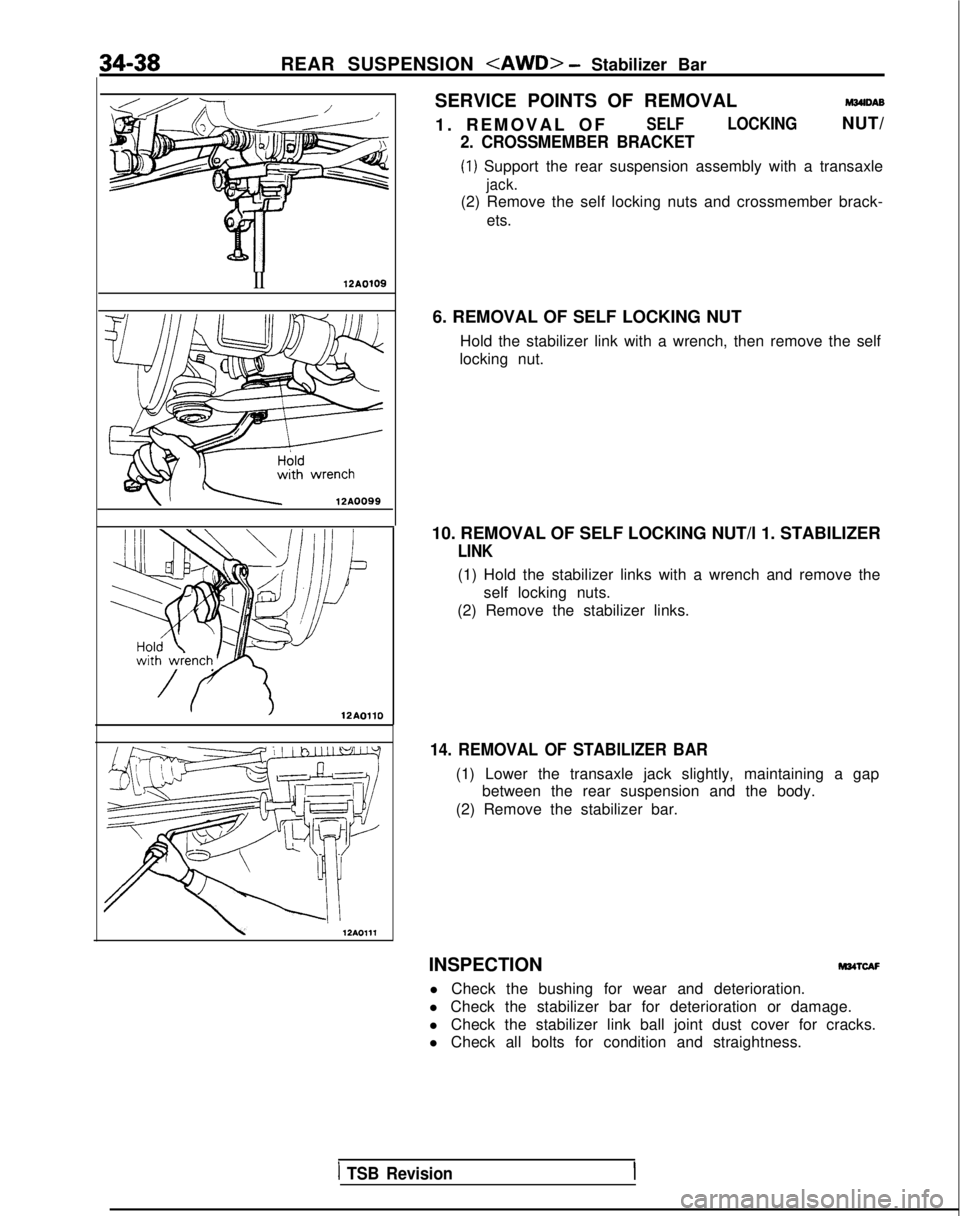
(1) Support the rear suspension assembly with a transaxle
jack.
(2) Remove the self locking nuts and crossmember brack-
ets.
6. REMOVAL OF SELF LOCKING NUT Hold the stabilizer link with a wrench, then remove the self
locking nut.
10. REMOVAL OF SELF LOCKING NUT/l 1. STABILIZER
LINK
(1) Hold the stabilizer links with a wrench and remove the self locking nuts.
(2) Remove the stabilizer links.
14. REMOVAL OF STABILIZER BAR
(1) Lower the transaxle jack slightly, maintaining a gap between the rear suspension and the body.
(2) Remove the stabilizer bar.
INSPECTION
M34TcAF
l Check the bushing for wear and deterioration.
l Check the stabilizer bar for deterioration or damage.
l Check the stabilizer link ball joint dust cover for cracks.
l Check all bolts for condition and straightness.
1 TSB Revision
Page 1191 of 1273
35-70SERVICE BRAKES- Service Adjustment Procedures
I, ! I ! I4 IO II IIWhen turned manually :---;---i-.-l---L--.I 8 ! IaI 1 11 1 II ’I 1’ I I I;-;--1---:--‘---+---t---i ’I IL---)-.-i---+--.II ’ I I 1 , 1 ,I
--:--~---;---:---~--~--
POINTS IN WAVEFORM MEASUREMENT
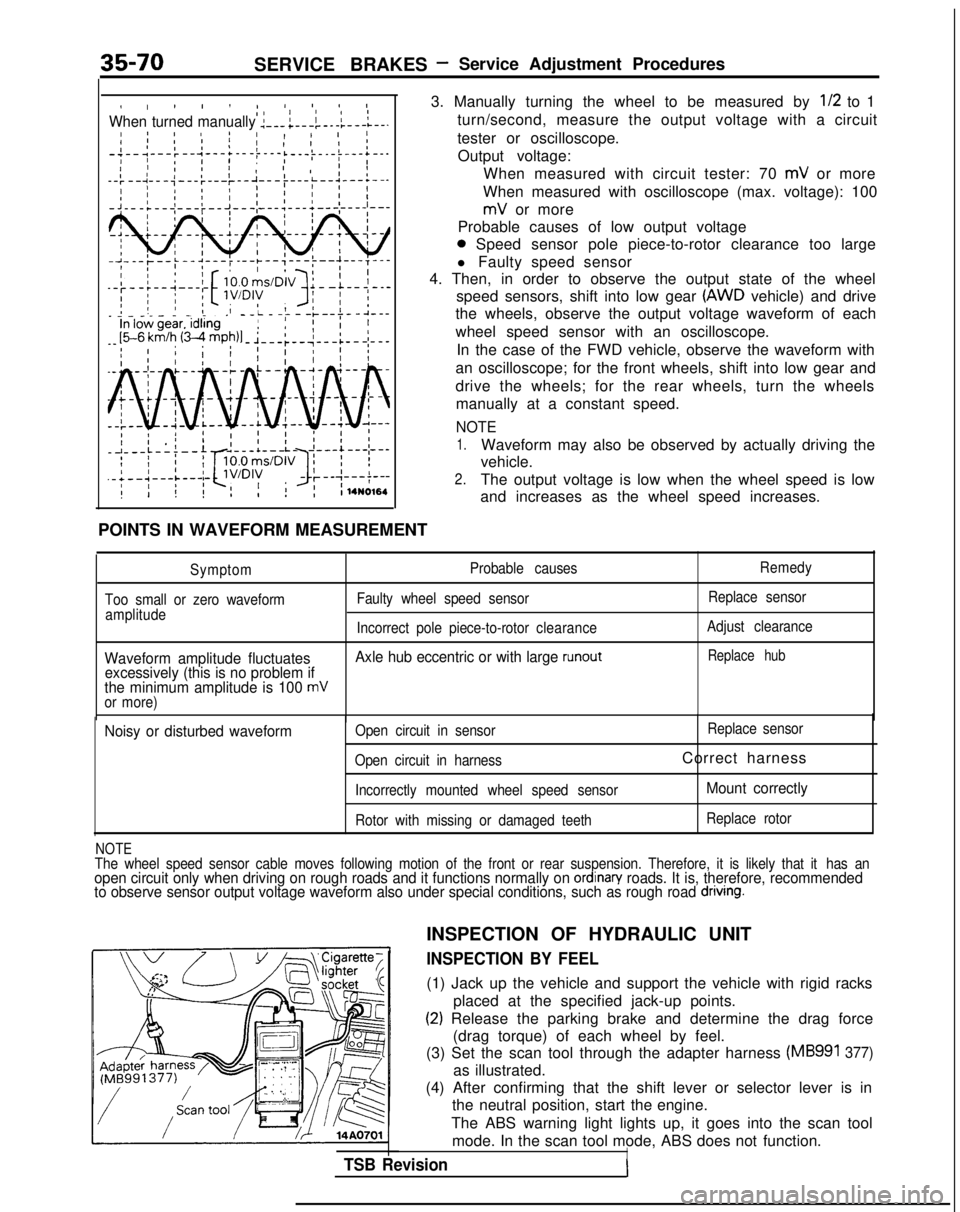
3. Manually turning the wheel to be measured by
l/2 to 1
turn/second, measure the output voltage with a circuit
tester or oscilloscope. Output voltage: When measured with circuit tester: 70
mV or more
When measured with oscilloscope (max. voltage): 100
mV or more
Probable causes of low output voltage
0 Speed sensor pole piece-to-rotor clearance too large
l Faulty speed sensor
4. Then, in order to observe the output state of the wheel
speed sensors, shift into low gear
(AWD vehicle) and drive
the wheels, observe the output voltage waveform of each
wheel speed sensor with an oscilloscope.
In the case of the FWD vehicle, observe the waveform with
an oscilloscope; for the front wheels, shift into low gear and
drive the wheels; for the rear wheels, turn the wheels manually at a constant speed.
NOTE
1.Waveform may also be observed by actually driving the
vehicle.
2.The output voltage is low when the wheel speed is low
and increases as the wheel speed increases.
Symptom
Too small or zero waveform amplitude Probable causes
Faulty wheel speed sensor Remedy
Replace sensor
Incorrect pole piece-to-rotor clearanceAdjust clearance
Waveform amplitude fluctuates Axle hub eccentric or with large runoutReplace hub
excessively (this is no problem if
the minimum amplitude is 100 mVor more)
Noisy or disturbed waveformOpen circuit in sensor Replace
sensor
Open circuit in harness
Correct harness
Incorrectly mounted wheel speed sensorMount correctly
Rotor with missing or damaged teeth Replace rotor
NOTEThe wheel speed sensor cable moves following motion of the front or rear\
suspension. Therefore, it is likely that it
has anopen circuit only when driving on rough roads and it functions normally \
on ordinan/ roads. It is, therefore, recommended
to observe sensor output voltage waveform also under special conditions,\
such as rough road dnvlng.
TSB Revision
INSPECTION OF HYDRAULIC UNIT
INSPECTION BY FEEL
(1) Jack up the vehicle and support the vehicle with rigid racks
placed at the specified jack-up points.
(2) Release the parking brake and determine the drag force(drag torque) of each wheel by feel.
(3) Set the scan tool through the adapter harness
(MB991 377)
as illustrated.
(4) After confirming that the shift lever or selector lever is in the neutral position, start the engine.
The ABS warning light lights up, it goes into the scan tool mode. In the scan tool mode, ABS does not function.
I