sensor MITSUBISHI GALANT 1989 Service Owner's Guide
[x] Cancel search | Manufacturer: MITSUBISHI, Model Year: 1989, Model line: GALANT, Model: MITSUBISHI GALANT 1989Pages: 1273, PDF Size: 37.62 MB
Page 157 of 1273
FUEL SYSTEM
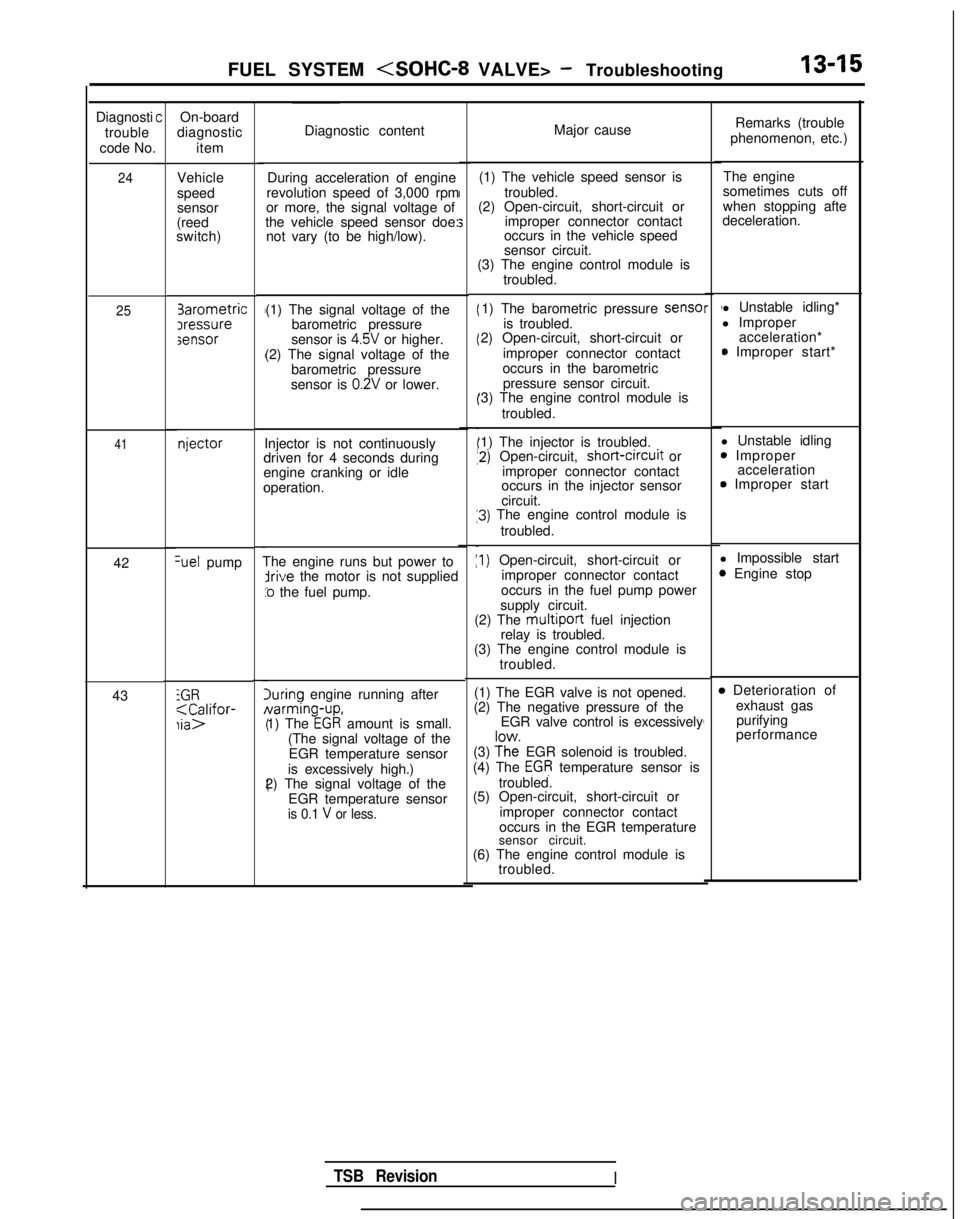
Diagnosti
trouble
code No.
24
25
41
42Set pump
43
iGR;aC;lifor-
COn-board
diagnostic
item
Vehicle
speed
sensor
(reed
switch) 3arometric
Iressuresensor
njector
Diagnostic content
Major cause
During acceleration of engine
revolution speed of 3,000 rpm
or more, the signal voltage of
the vehicle speed sensor doe: not vary (to be high/low). (1) The vehicle speed sensor is
troubled.
(2) Open-circuit, short-circuit or
improper connector contact
occurs in the vehicle speed
sensor circuit.
(1) The signal voltage of the barometric pressure
sensor is 4.5V or higher.
(2) The signal voltage of the barometric pressure
sensor is
0.2V or lower.
Injector is not continuously
driven for 4 seconds during
engine cranking or idle
operation.
The engine runs but power to
irive the motor is not supplied
:o the fuel pump.
luring engine running after Narming-up,
1) The
EGR amount is small.
(The signal voltage of the EGR temperature sensor
is excessively high.)
2) The signal voltage of the
EGR temperature sensor
is 0.1 V or less.
(3) The engine control module is troubled.
1) The barometric pressure sense
is troubled.
2) Open-circuit, short-circuit or
improper connector contact
occurs in the barometric pressure sensor circuit.
‘3) The engine control module is
troubled.
‘1) The injector is troubled.
12) Open-circuit, short-crrcuit
or
improper connector contact
occurs in the injector sensor
circuit.
13) The engine control module is
troubled.
:I) Open-circuit, short-circuit or improper connector contact
occurs in the fuel pump power
supply circuit.
(2) The
multiport fuel injection
relay is troubled.
(3) The engine control module is
troubled.
(1) The EGR valve is not opened.
(2) The negative pressure of the EGR valve control is excessively
(3)
?h”e EGR solenoid is troubled.
(4) The EGR temperature sensor is
troubled.
(5) Open-circuit, short-circuit or
improper connector contact
occurs in the EGR temperature
sensor circuit.
(6) The engine control module is troubled.
r 1l Unstable idling*
l Improper acceleration*
0 Improper start*
l Unstable idling
0 Improper acceleration
0 Improper start
l Impossible start
3 Engine stop4
4
,
B Deterioration of exhaust gaspurifying
performance
Remarks (trouble
phenomenon, etc.)
The engine
sometimes cuts off
when stopping afte
deceleration.
TSB RevisionI
Page 158 of 1273

13-16
FUEL SYSTEM
FAILSAFE/BACK-UP FUNCTIONS LIST
If trouble with any major sensor is detected by the on-board diagnostic,\
the vehicle will be kept in the safe
driving conditions according to the preset control logic.
Trouble item Control content for trouble
Volume air flow Fuel injection timing and ignition timing are determined according to th\
e throttle position
sensor sensor
(TPS) and engine revolution speed signal (crankshaft position sensor signal)\
.
Intake air temperature The control is executed with the suction air temperature regarded as
25°C (77°F).
sensor
Throttle position The fuel injection rate is not increased for acceleration according to t\
he throttle position
sensor
(TPS)sensor signal.
Idle speed control After the idle speed control motor plunger is driven and contracted, the\
idle revolution speed
motor position sensor is not controlled.
Engine coolant The control is executed with the engine coolant temperature regarded as \
8OO.C (176°F).temperature sensor (Even if the sensor signal becomes normal again, the control is continued
until the ignltlon
switch is turned off.)
Camshaft position Simultaneous injection of fuel is executed for all cylinders. (In this \
case, the
No.1 cylinder top
sensor dead center is not detected at all after the ignition key is turned on.)\
Barometric pressure The control is executed with the pressure regarded as 760 mmHg
(30
in.Hg).
sensor
Oxygen sensor Closed loop control of the air/fuel mixture ratio is not executed.
i
READ OUT OF DIAGNOSTIC TROUBLE CODE
Precautions for operation
(1) When battery voltage is low, no detection of failure is possible. Be sure to check the battery for voltage and
other conditions before starting the test.
(2) On-board diagnostic item is erased if the battery or the engine control module connector is discon-
nected. Do not disconnect the battery before the di-
agnostic result is completely read.
Using Scan Tool
(1) Switch OFF the ignition switch.
(2) Connect the power-source terminal of the scan tool to the
cigarette lighter socket.
(3) Connect the scan tool to the data link connector. (4) Turn ignition switch to ON.
(5) Using the scan tool, read out and make a note of the
on-
board diagnostic output.
(6) Refer to the diagnostic chart, and repair the indicated loca-
tion of malfunction.
(7) Erase the diagnostic trouble code. (Refer to
P.13-17.)
1 TSB RevisionI
Page 159 of 1273
FUEL SYSTEM
\ I\-\\\\\\6FUO807
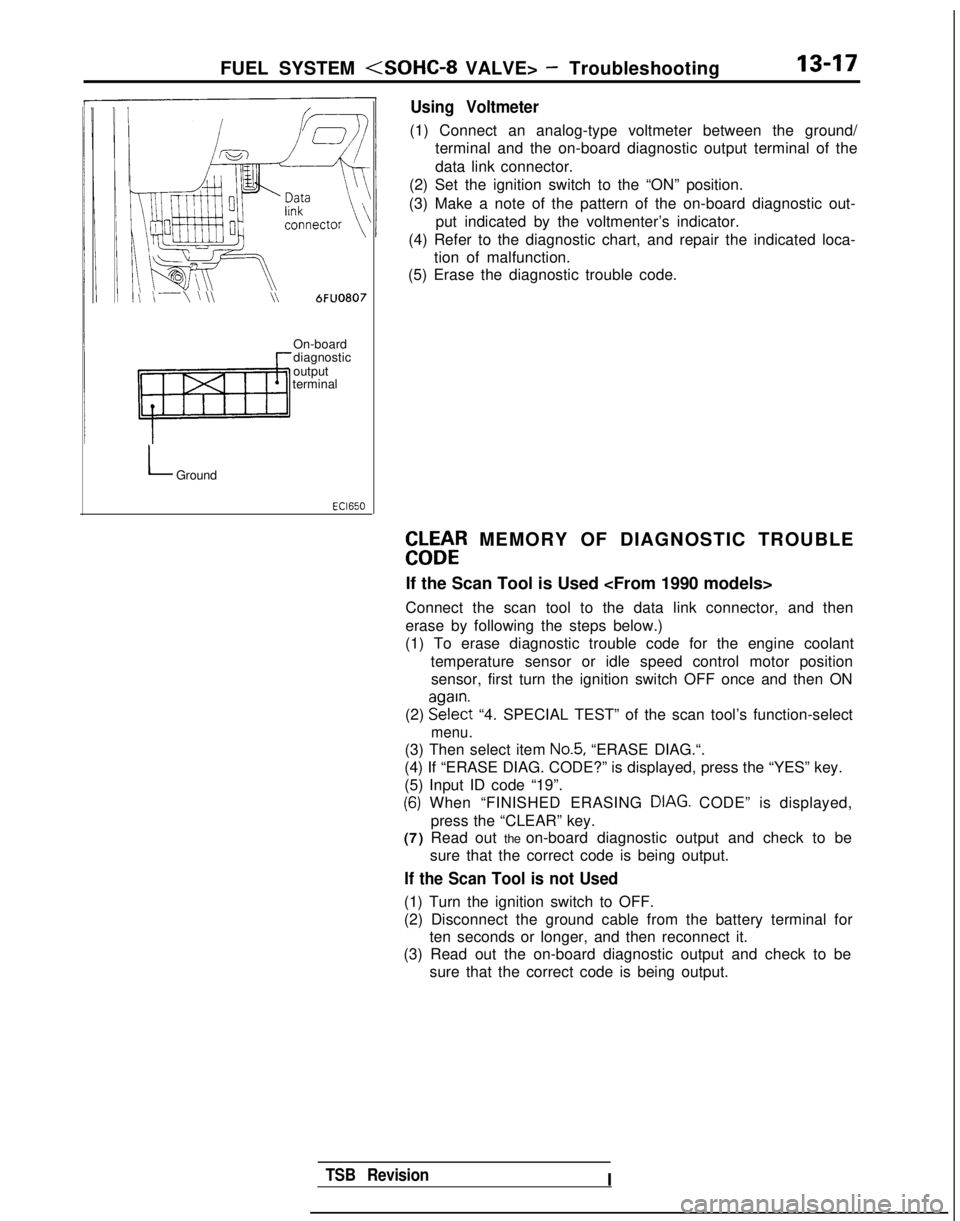
Using Voltmeter
(1) Connect an analog-type voltmeter between the ground/
terminal and the on-board diagnostic output terminal of the
data link connector.
(2) Set the ignition switch to the “ON” position.
(3) Make a note of the pattern of the on-board diagnostic out- put indicated by the voltmenter’s indicator.
(4) Refer to the diagnostic chart, and repair the indicated loca- tion of malfunction.
(5) Erase the diagnostic trouble code.
On-board
diagnostic
output
terminal
LGround
EbLbtR MEMORY OF DIAGNOSTIC TROUBLE
If the Scan Tool is Used
Connect the scan tool to the data link connector, and then
erase by following the steps below.)
(1) To erase diagnostic trouble code for the engine coolant
temperature sensor or idle speed control motor positionsensor, first turn the ignition switch OFF once and then ON
(2) EE?$t
“4. SPECIAL TEST” of the scan tool’s function-select
menu.
(3) Then select item No.5, “ERASE DIAG.“.
(4) If “ERASE DIAG. CODE?” is displayed, press the “YES” k\
ey.
(5) Input ID code “19”.
(6) When “FINISHED ERASING DIAG. CODE” is displayed,> Ipress the “CLEAR” key.
(7) Read out the on-board diagnostic output and check to be
sure that the correct code is being output.
If the Scan Tool is not Used
(1) Turn the ignition switch to OFF.
(2) Disconnect the ground cable from the battery terminal forten seconds or longer, and then reconnect it.
(3) Read out the on-board diagnostic output and check to be
sure that the correct code is being output.
TSB RevisionI
Page 164 of 1273
13-22
FUEL SYSTEM
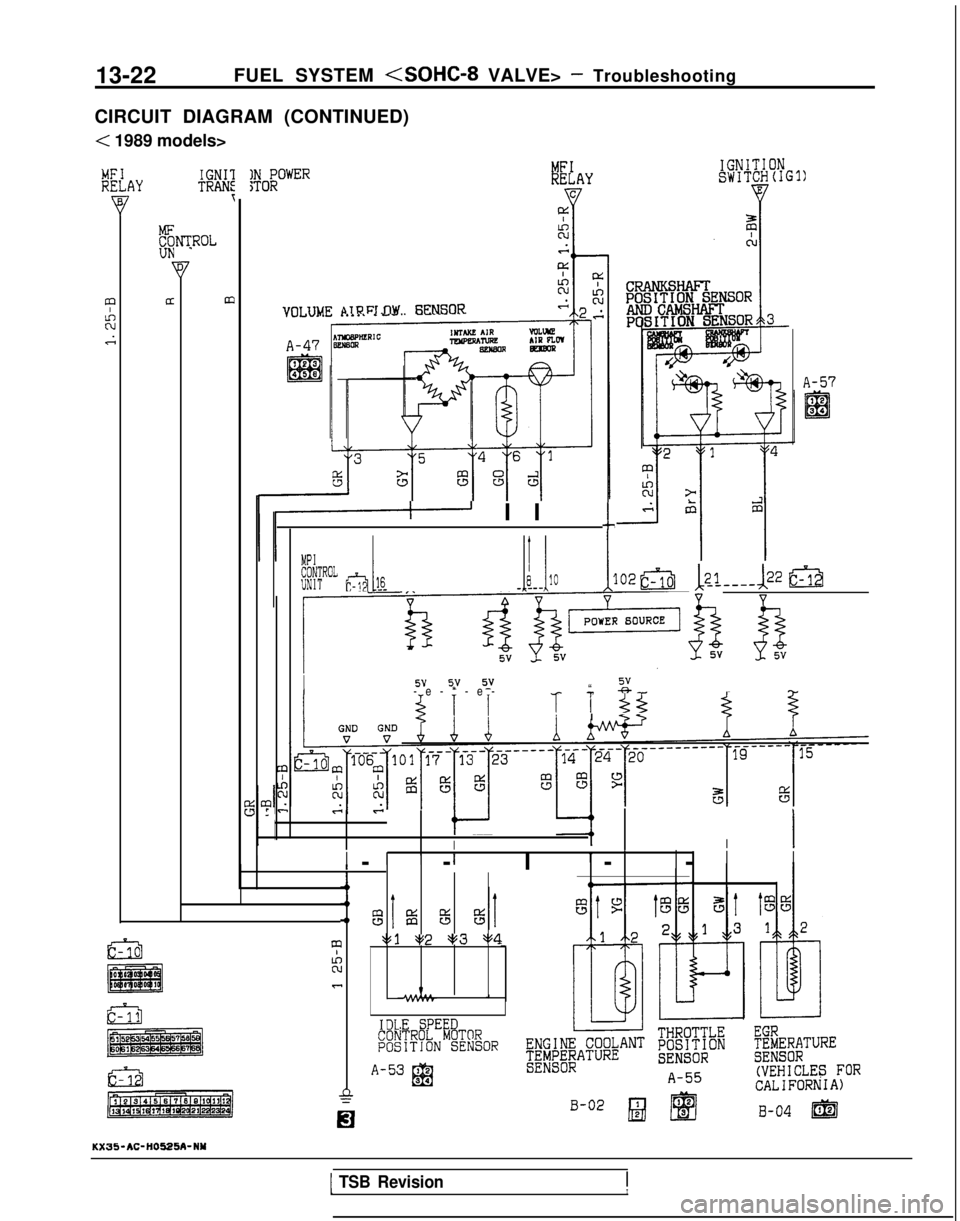
CIRCUIT DIAGRAM (CONTINUED)
< 1989 models>
IGNITIONSWITCHlIGl)#OF?OWERMFIRELAYIGNIlTRANf
;ROLKUN1
am\lR Fl.tlW i=XNSOR
A-57
II Il-
EF g?JEi _______ JLllOI:02&j12_1---& im
Y-+-I
k$$
Yh
I5VI I 5Y
syv s_v-e-*-e
-
“,
*-r
-5. IIII 5.5
c
L
III I
III1II --I-
-
I
II,---
1’ 8Iis%%
Gi3mv1 a+2 pg3 $14I
?Ic
IDLE SPEEDCONTROL MOTORPOSITJON SENSOR
A-53 12El(VEHICLES FOR94CALIFORNIA)
B-02 B @
KX35-AC-HO525A-NY
B-04 m
1 TSB Revision1I
Page 165 of 1273
FUEL SYSTEM
--
r-B-20 I
LXYG~!tEN6OR 1
’I
W!E~W~,F;~R
-2 EVAPORATIVE ! ““L;,$ m&S-ON
h SOLENOID,\,C” 1 PI FR
*q
1:
2_1 El ,
Lk.i,i iiI
NJECTOi- 11
B-12 =
m
2
7'
2
A-56
IIQI2
/A T//
cpII
Ii
ime Ii i aI
%
i
‘OR
7VE
ICI A
I
“d
OT
4
-1 ;;I
I
5v
r5
s.- -
I
1
4J
POWERPRESSU
' OXYGEN SENSOR'(VEHICLES FOR
FEDE;zd
C-18 FRONT SIDE
DATA LINKCONNECTOR
4
IENG)
(DATA)
c-40
plqismq
C-38
7
F
J/B
cp4
", H
I e
Ell94
TSB RevisionI
Page 169 of 1273
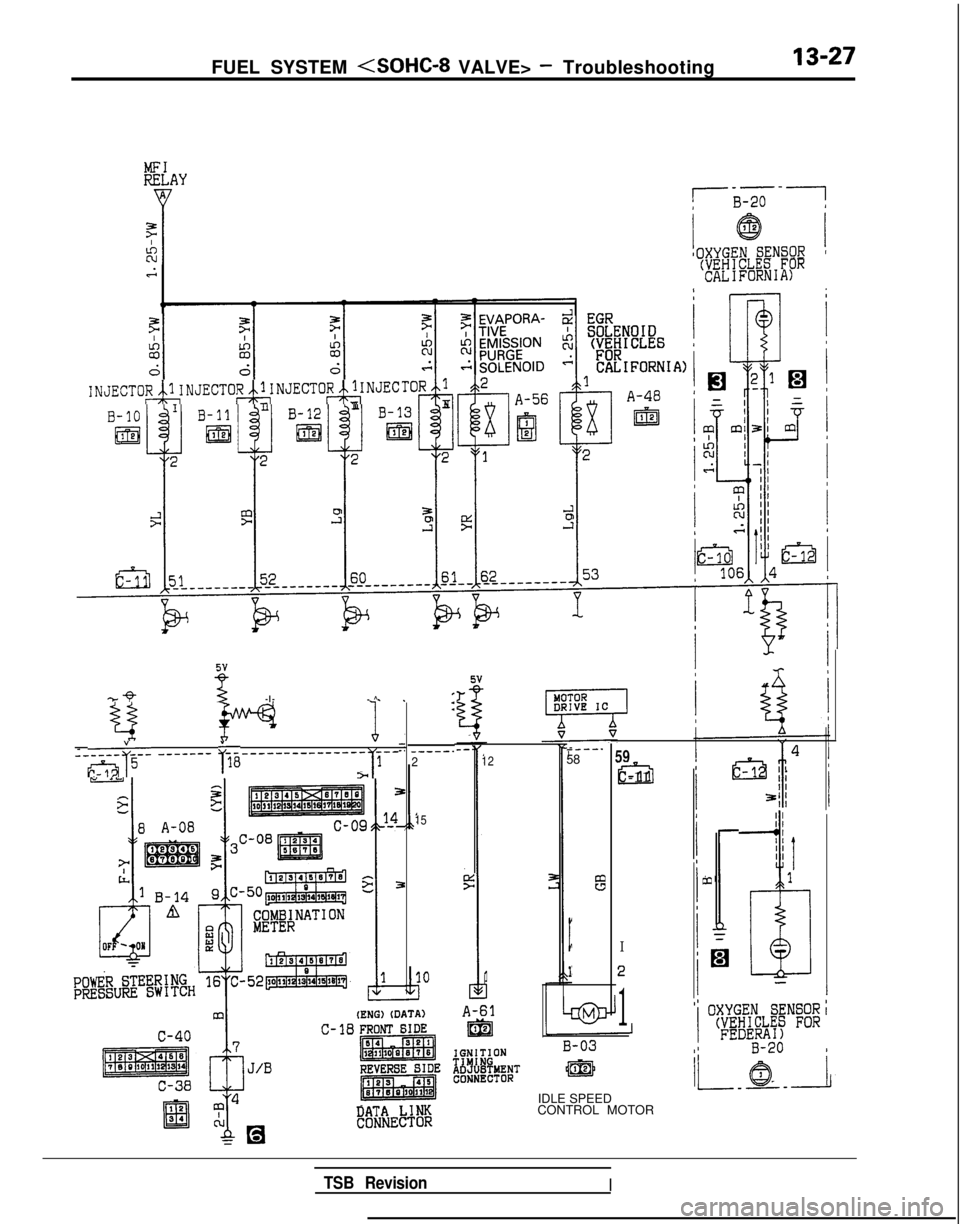
FUEL SYSTEM (SOHC-8 VALVE> - Troubleshooting13-27
INJECTOR&INJECTOR&INJECTOR&NJEC
--
!-B-20 -7
!OXYGE!!ENSOR I'(VEHICLES FORCALIFORNIA)
5v
-w-Qz-I-
-
^
_____---______-_- ---____--&vs-- -__---- T18
I1
>
,..
-----.2
15
12
I
----.58
8
I
1
IDLE SPEEDDATA LINKCONTROL MOTORCONNECTOR
59
cl-11
I
2
1
m
II
!II II1
ib -
I
' OXYGEN SENSOR'(VEHICLES FOR
FEDE89":;
i 63 i
TSB RevisionI
Page 172 of 1273
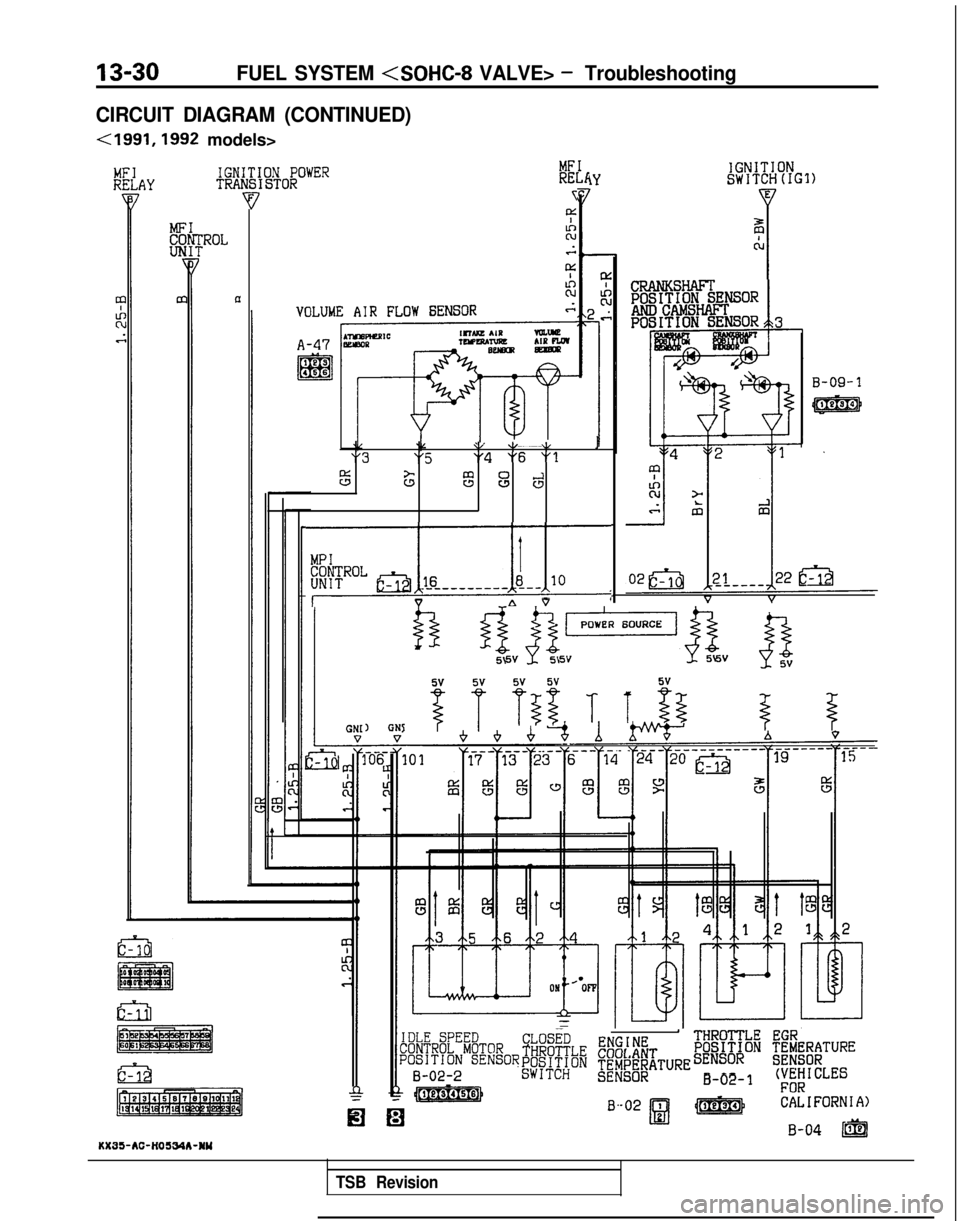
13-30FUEL SYSTEM
CIRCUIT DIAGRAM (CONTINUED)
<1991,1992 models>
IGNITIONSWITCH(IG1)IGNITION POWERTRANSISTOR
FROL
91
\lxI
z;.
F
R
VOLUME AIR FLOW SENSORs
LYAYE
z m
1
rl
\I\I/ ,,I"3"5"4 "6 "1
E
stz
8
d
j,
Y4Y (
gj ~~p=q~ @
5v5v5v
) f $ T$z T T $5$ $GNI
CLOSED'
THROTTLE :;:/,fT
THROTTLE EGRPOSITION ;;;;!;TURE
@~#ON ~&~~~~ATUREsENSoRB-02-1(VEHICLESFOR
B-02
1 4-1RI
CALIFORNIA)
B-04 /@KX35-AC-HOSWA-NY
TSB Revision
Page 173 of 1273
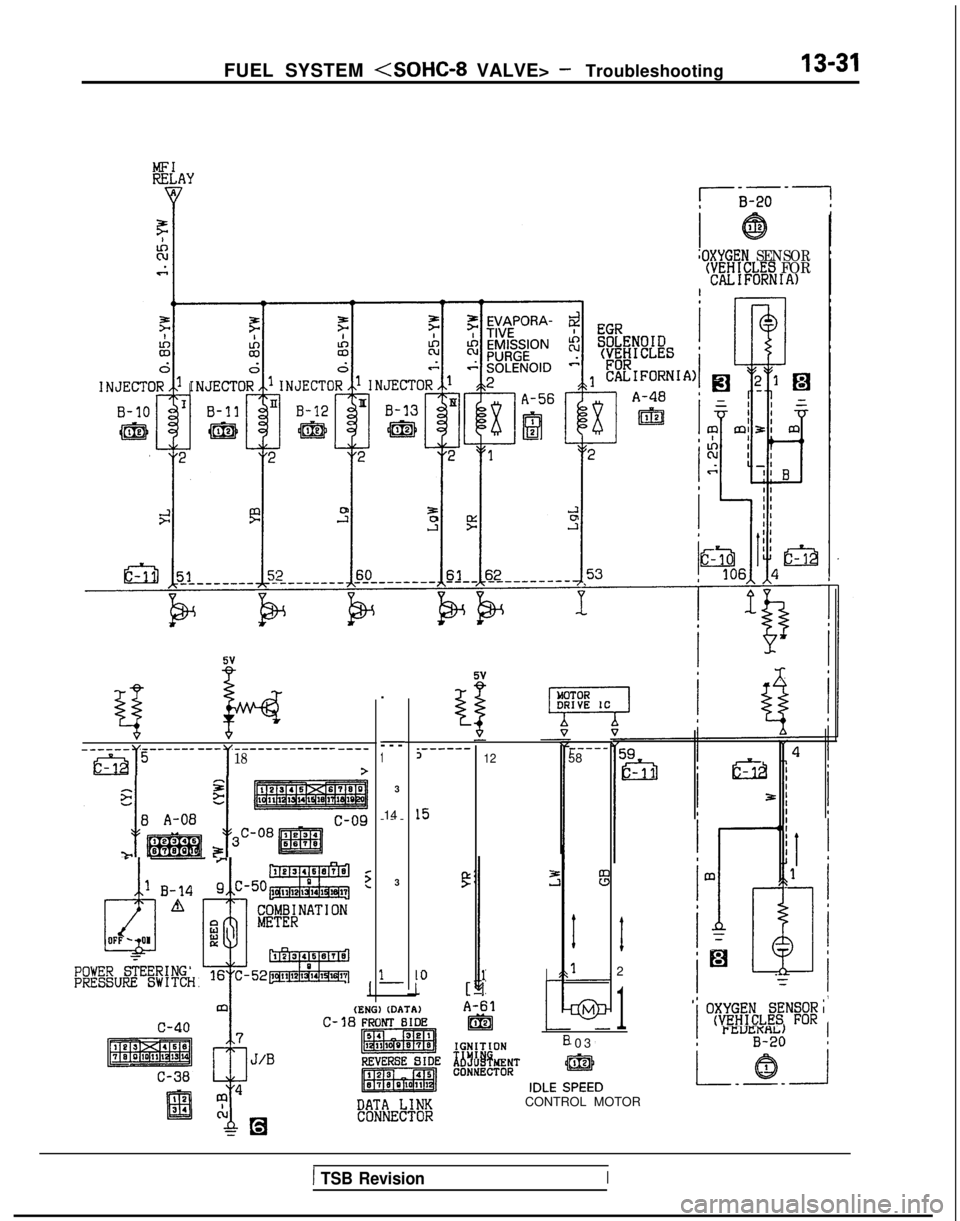
FUEL SYSTEM
MFIRELAY
IIOXYGEN SENSOR(VEHICLES FORCALIFORNIA)
g k______ -___----__ -------------
mlI
----518>
EF
!, -I
s A-08c-09
f@p&g~,,-yg@
POWER STEERINGPRESSURE SWITCH
.
---
-
1
3
14
--
-
3
1-
I
_------3
15
P
10
I [
12 t-----58
(ENG)
(DATA)
c-40-0
3
1
2
1
C-38
DATA LINKCONTROL MOTORCONNECTOR
' OXYGEN SENSOR'(VEHICLES FOR
1 TSB RevisionI
Page 176 of 1273
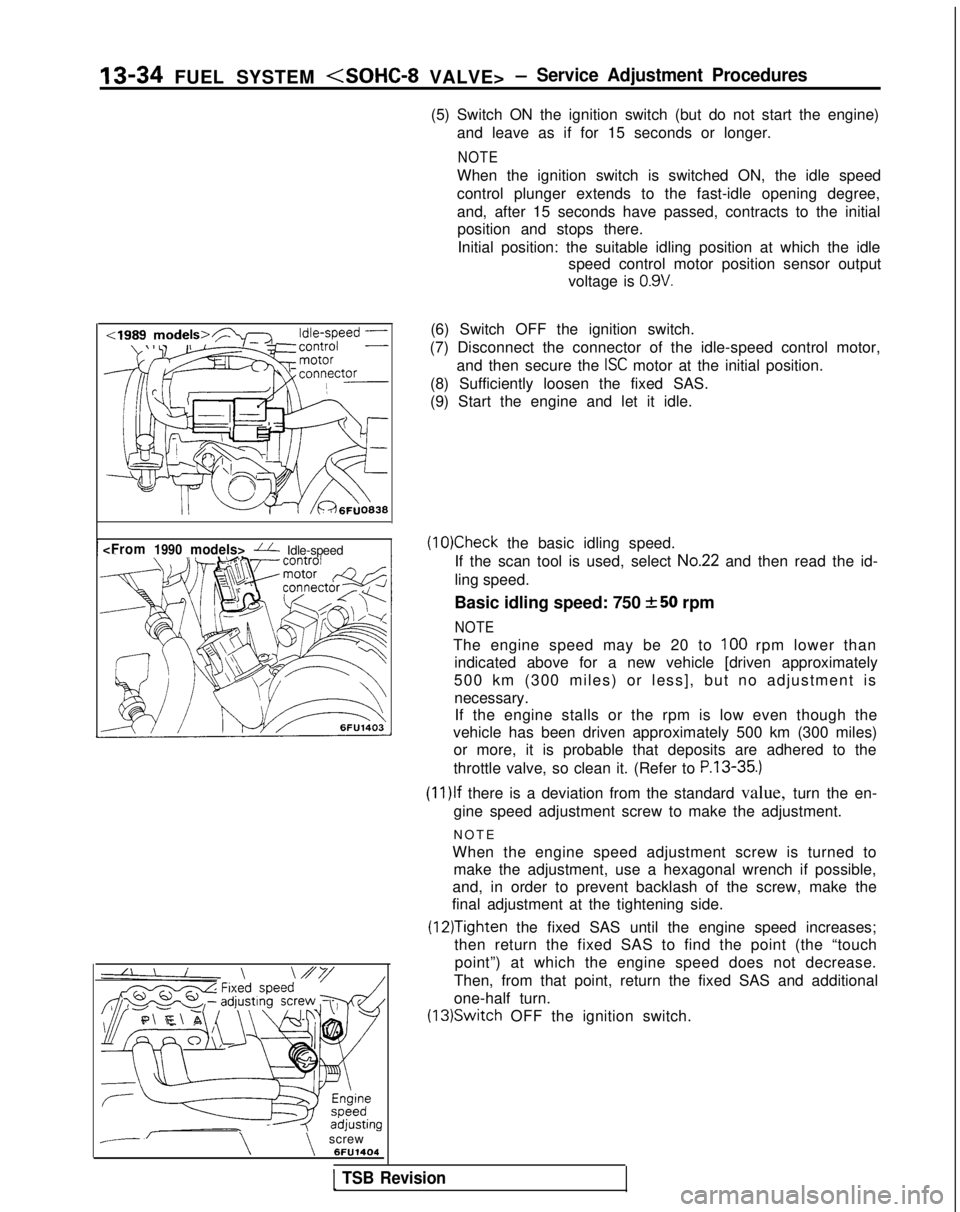
13-34 FUEL SYSTEM
(5) Switch ON the ignition switch (but do not start the engine)and leave as if for 15 seconds or longer.
NOTE
When the ignition switch is switched ON, the idle speed
control plunger extends to the fast-idle opening degree,
and, after 15 seconds have passed, contracts to the initialposition and stops there.
Initial position: the suitable idling position at which the idle speed control motor position sensor output
voltage is
0.9V.
--\\screw 6FU1404(6) Switch OFF the ignition switch.
(7) Disconnect the connector of the idle-speed control motor, and then secure the
ISC motor at the initial position.
(8) Sufficiently loosen the fixed SAS.
(9) Start the engine and let it idle.
(10)Check the basic idling speed.
If the scan tool is used, select
No.22 and then read the id-
ling speed.
Basic idling speed: 750
+-50 rpm
NOTE
The engine speed may be 20 to 100 rpm lower than
indicated above for a new vehicle [driven approximately
500 km (300 miles) or less], but no adjustment is necessary.If the engine stalls or the rpm is low even though the
vehicle has been driven approximately 500 km (300 miles) or more, it is probable that deposits are adhered to the
throttle valve, so clean it. (Refer to
P.13-35.)
(1l)lf there is a deviation from the standard value, turn the en-
gine speed adjustment screw to make the adjustment.
NOT
E
When the engine speed adjustment screw is turned to make the adjustment, use a hexagonal wrench if possible,
and, in order to prevent backlash of the screw, make the
final adjustment at the tightening side.
(12)Tighten the fixed SAS until the engine speed increases;
then return the fixed SAS to find the point (the “touch
point”) at which the engine speed does not decrease.
Then, from that point, return the fixed SAS and additional
one-half turn. (13)Switch
OFF the ignition switch.
1 TSB Revision
Page 177 of 1273
FUEL SYSTEM
(14)Adjust the play of the accelerator cable. (Refer to P.13-
329.)
(15)Connect the idle-speed control motor’s connector.
(16)Adjust the throttle-position sensor.
(17)Start the engine again and let it run at idle speed for about
ten minutes; check to be sure that the idling condition is
normal.
THROTTLE BODY (THROTTLE VALVE AREA)
CLEANING
MllFlCK
(1)Start the engine and warm it up until the temperature of the
engine coolant reaches
80°C (176°F) or higher; then stop
the engine.
(2) Disconnect the air intake hose at the throttle body side.
(3) Spray cleaning liquid (from the intake port of the throttle body) onto the valve, and then leave as is for about fiveminutes.
(4) Start the engine and race it a few times; then let it run at idle speed for about one minute.
NOTE
If the engine idling speed is unstable (or the engine stalls),
let the engine run with the throttle valve slightly open.
(5) If deposits are not removed from the throttle valve, repeat steps (3) and (4).
(6) Connect the air intake hose.
(7) Using the scan tool, erase the diagnostic trouble code, or disconnect the battery’s ground cable for ten seconds orlonger and then reconnect it.
(8) Adjust the basic idle speed (engine speed adjusting screw). (Refer to
P.13-33.)
(9) Adjust the throttle position sensor.
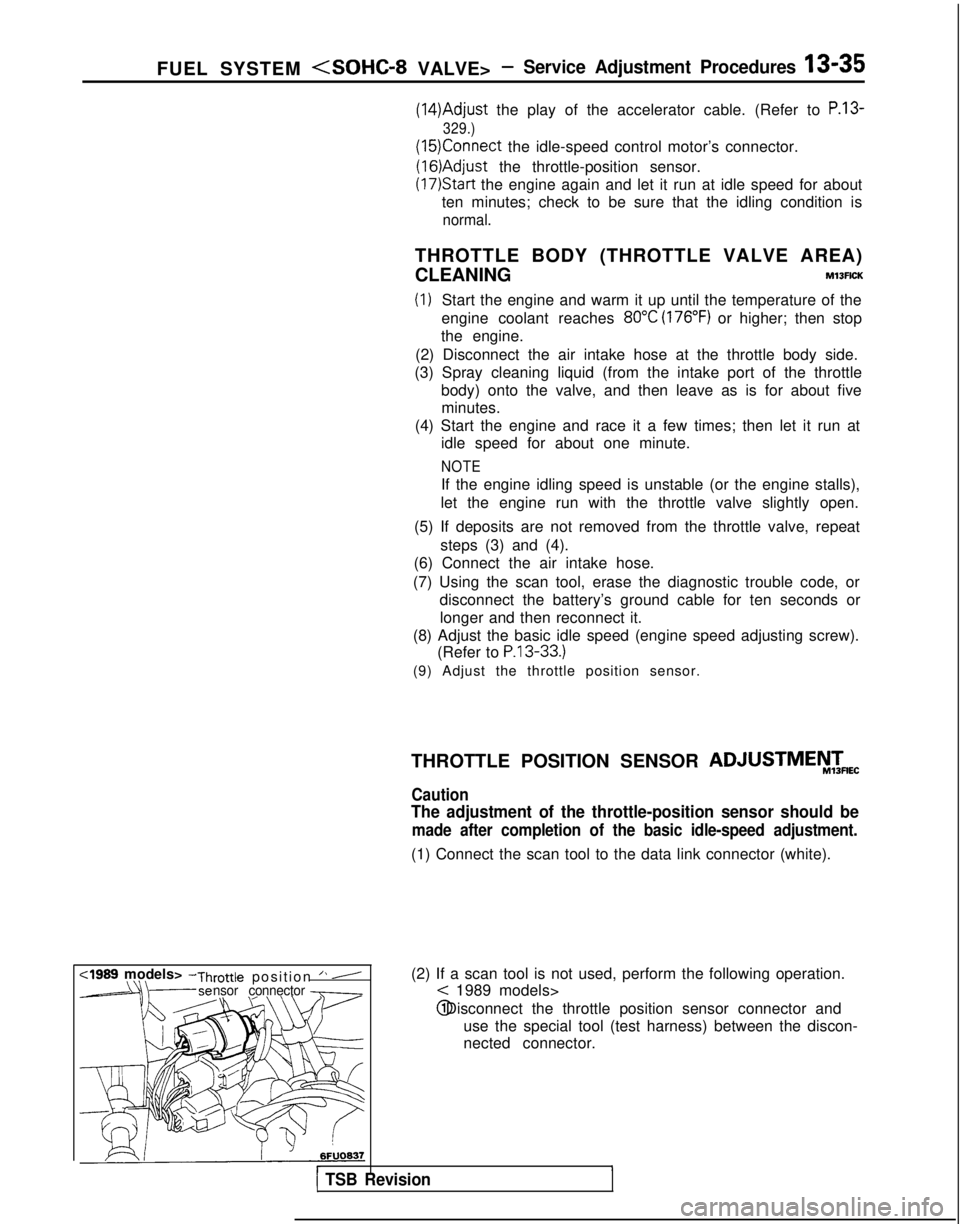
(2) If a scan tool is not used, perform the following operation.
< 1989 models> @ Disconnect the throttle position sensor connector and
use the special tool (test harness) between the discon-
nected connector.
r1 TSB Revision
THROTTLE POSITION SENSOR ADJUSTMEiW&
Caution
The adjustment of the throttle-position sensor should be
made after completion of the basic idle-speed adjustment.
(1) Connect the scan tool to the data link connector (white).
,