sensor MITSUBISHI GALANT 1989 Service Manual PDF
[x] Cancel search | Manufacturer: MITSUBISHI, Model Year: 1989, Model line: GALANT, Model: MITSUBISHI GALANT 1989Pages: 1273, PDF Size: 37.62 MB
Page 207 of 1273
FUEL SYSTEM
(1) Improper adjustment of the basic idling speed.
(2) Deposits adhering to the ttirottle valve.
(3) Air being taken into the intake manifold due to a gasket leak, etc.
OPERATION
ISC motor position sensor is a variable resistor type,
and is integrated in the
ISC motor system. The slid-
ing pin of
ISC motor position sensor is in contact
with the end of the plunger. Therefore, as the plun- ger moves, the internal resistance of
ISC motor pos-
ition sensor varies. This leads to the variation of the (4) Improper seating of the EGR valve seat.
(5) lmcomplete combustion within a cylinder. (Mal-
function of spark plugs, ignition coil, injectors,
compression pressure, etc.)
the plunger position of the
ISC motor system, and
sends the signal to ECM. ECM processes the
ISC
motor position sensor signal, idle signal, coolant
temperature signal, load signal (A/T &
A/C) and ve-
hicle speed signal to control the opening angle of
the throttle valve and revolution speed during
en-
output voltage. ISC motor position sensor detects gine idling.
TROUBLESHOOTING HINTS
Since idling is not controlled when ISC motor posi-
tion sensor is troubled, idling may not be evenly
maintained.
INSPECTION
Using Scan tool
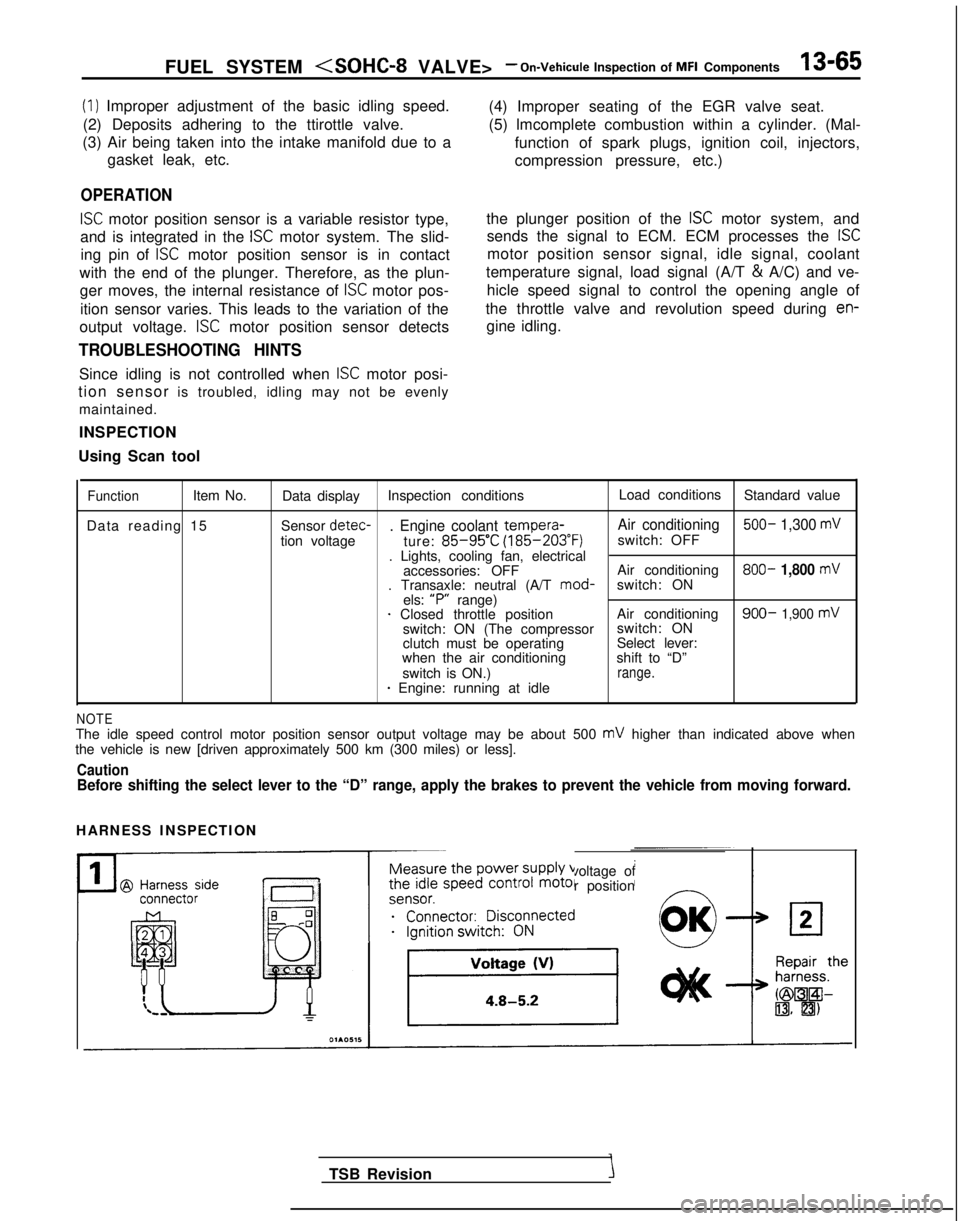
FunctionItem No. Data display Inspection conditions Load conditions
Standard value
Data reading 15 Sensor detec-
. Engine coolant tempera-
Air conditioning 500- 1,300 mV
tion voltage
ture: 85-95’C (185-203°F)
switch: OFF
. Lights, cooling fan, electrical accessories: OFF Air conditioning 800-
1,800 mV. Transaxle: neutral (A/T
mod-
switch: ON
els: “P”
range)
1 Closed throttle position Air conditioning900- 1,900 mVswitch: ON (The compressorswitch: ON
clutch must be operating Select lever:
when the air conditioning shift to “D”
switch is ON.)
range.* Engine: running at idle
NOTEThe idle speed control motor position sensor output voltage may be about\
500 mV higher than indicated above when
the vehicle is new [driven approximately 500 km (300 miles) or less].
CautionBefore shifting the select lever to the “D” range, apply the brake\
s to prevent the vehicle from moving forward.
HARNESS INSPECTION
Measure the power supply voltage of
the idle speed control motor position
ei;;;it;;sco$ected
__...._ -.-
TSB Revision
Page 208 of 1273
13-66 FUEL SYSTEM
Harness
sde
connectorI
OlAO362
@ Harness sideconnector
Engine control
module harnessside connector
I-
r
MD9984646FUO666
MD9984646FUo666
A
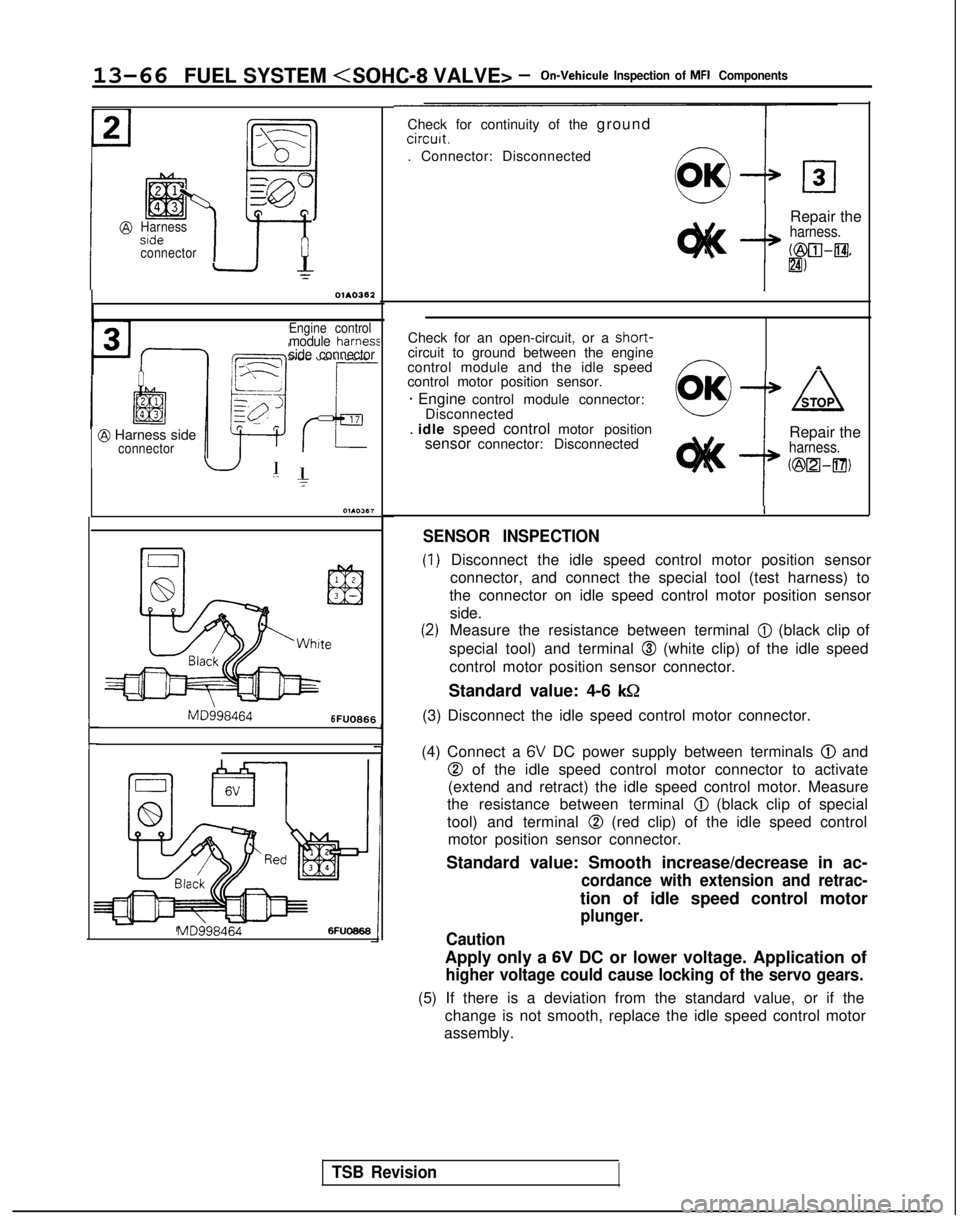
Check for continuity of the groundcircuit.
. Connector: Disconnected
t
Repair theharness.
l&l)
Check for an open-circuit, or a short-circuit to ground between the engine
control module and the idle speed
control motor position sensor.
* Engine control module connector:f-
A
1
Disconnected
. idle speed control motor position sensor connector: Disconnected Repair the
harness.
~@[z1-8)
I
SENSOR INSPECTION
Disconnect the idle speed control motor position sensor
connector, and connect the special tool (test harness) to
the connector on idle speed control motor position sensor side.
Measure the resistance between terminal
@ (black clip of
special tool) and terminal
0 (white clip) of the idle speed
control motor position sensor connector.
Standard value: 4-6
kS2
(3) Disconnect the idle speed control motor connector.
(4) Connect a
6V DC power supply between terminals 0 and
@ of the idle speed control motor connector to activate
(extend and retract) the idle speed control motor. Measure
the resistance between terminal
@ (black clip of special
tool) and terminal
0 (red clip) of the idle speed control
motor position sensor connector.
Standard value: Smooth increase/decrease in ac-
cordance with extension and retrac-
tion of idle speed control motor
plunger.
Caution
Apply only a 6V DC or lower voltage. Application of
higher voltage could cause locking of the servo gears.
(5) If there is a deviation from the standard value, or if the change is not smooth, replace the idle speed control motor
assembly.
TSB Revision
Page 209 of 1273
.-•r12-67FUEL SYSTEM
IDLE SPEED CONTROL
MOTOR POSiTiON SENSOR
@ Component sideconnectorIdle speed control mc)tor position sensor
‘{*q-r
T@ Harness sideLconnector
Voltagebetween
@n-@B
1.Plunger strokeI01R0101
I-@=%260jl
En$eecontrol
I3A23
’
A
L7A14 "2
4
I!-
Engine control module connector
6FU1246
01 LO838
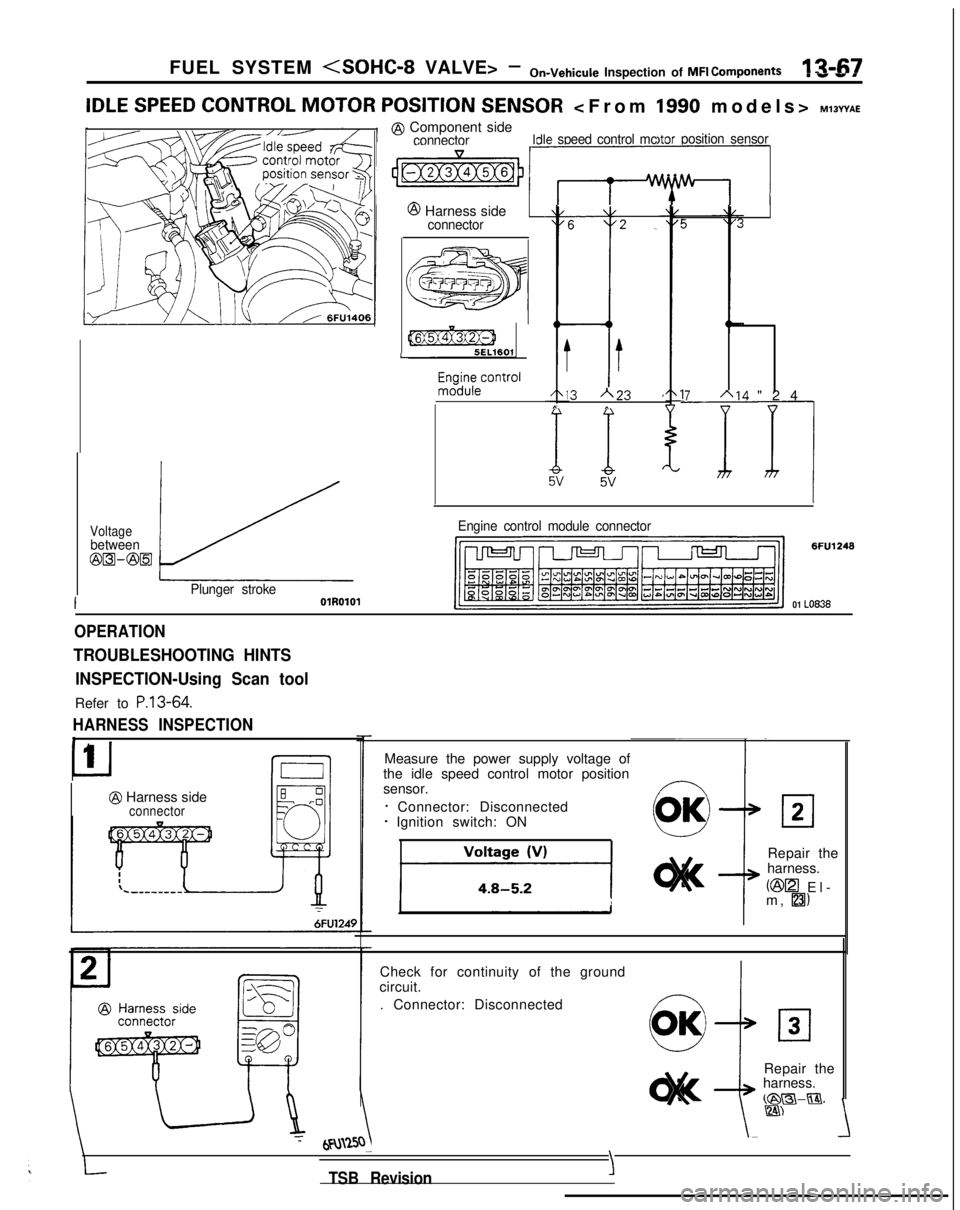
OPERATION
TROUBLESHOOTING HINTS INSPECTION-Using Scan tool
Refer to P.13-64.
HARNESS INSPECTIONL
L-J1
@ Harness sideconnector
Measure the power supply voltage of
the idle speed control motor position
sensor.
* Connector: Disconnected- Ignition switch: ON
Check for continuity of the ground
circuit.
. Connector: Disconnected Repair the
harness.
@[zI El
-
m,
[231,
TSB Revision\
Repair the
harness.
K&y-m*
Page 210 of 1273
13-68 FUEL SYSTEM
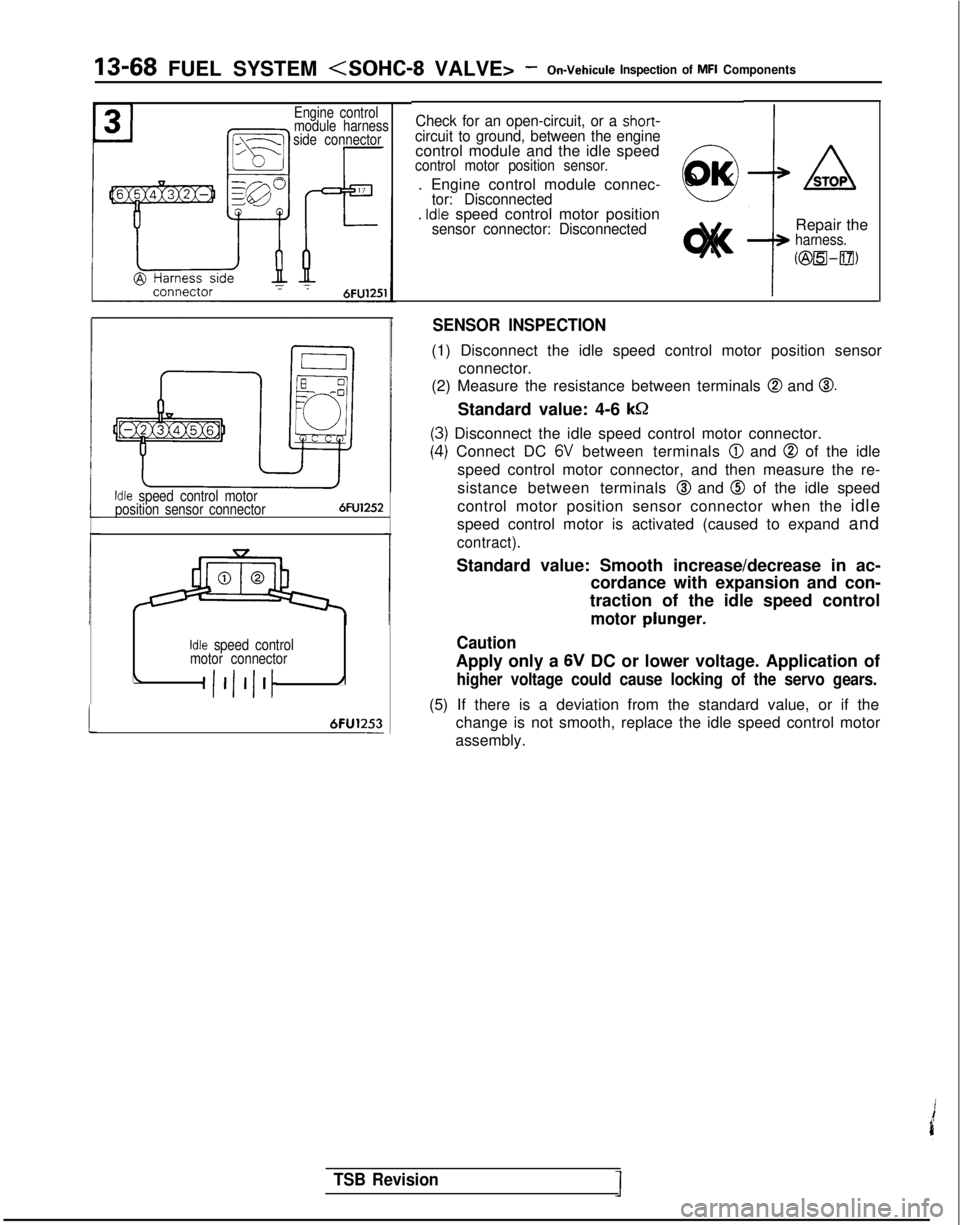
Engine control
module harness
side connectorCheck for an open-circuit, or a short-circuit to ground, between the enginecontrol module and the idle speedcontrol motor position sensor.
. Engine control module connec-tor: Disconnected. Idle speed control motor positionsensor connector: Disconnected
0
O
K
1
ASTOP
i
Repair theharness.
KzEwDlfl,
!
Idle speed control motor
position sensor connector6FU1252
Idle speed control
motor connector
\A 6FU1253
-
SENSOR INSPECTION
(1) Disconnect the idle speed control motor position sensor
connector.
(2) Measure the resistance between terminals
@ and 0.
Standard value: 4-6 k&2
I) Disconnect the idle speed control motor connector.
.) Connect DC 6V between terminals @ and @ of the idle
speed control motor connector, and then measure the re-
sistance between terminals
@ and @ of the idle speed
control motor position sensor connector when the idle
speed control motor is activated (caused to expand and
contract).
Standard value: Smooth increase/decrease in ac-
cordance with expansion and con-
traction of the idle speed control
motor plunger.
Caution
Apply only a 6V DC or lower voltage. Application of
higher voltage could cause locking of the servo gears.
(5) If there is a deviation from the standard value, or if the change is not smooth, replace the idle speed control motor
assembly.
TSB Revision
Page 211 of 1273
FUEL SYSTEM
of MFI Components13-69
CAMSHAFT POSITION SENSOR
\ /‘4 iI ‘j6FUO857
r
1
Out put characteristic ‘“!I
pm
One rotation of distributorOlR0102
Ignition switch (IG,) ~~~!%k?nt
side ,Distributor4 3
Camshaft position
sensor
Distributor
connector 5EL1401
@ Harness sideconnectorT
Engine control moduleA22
V
L
6FU1255
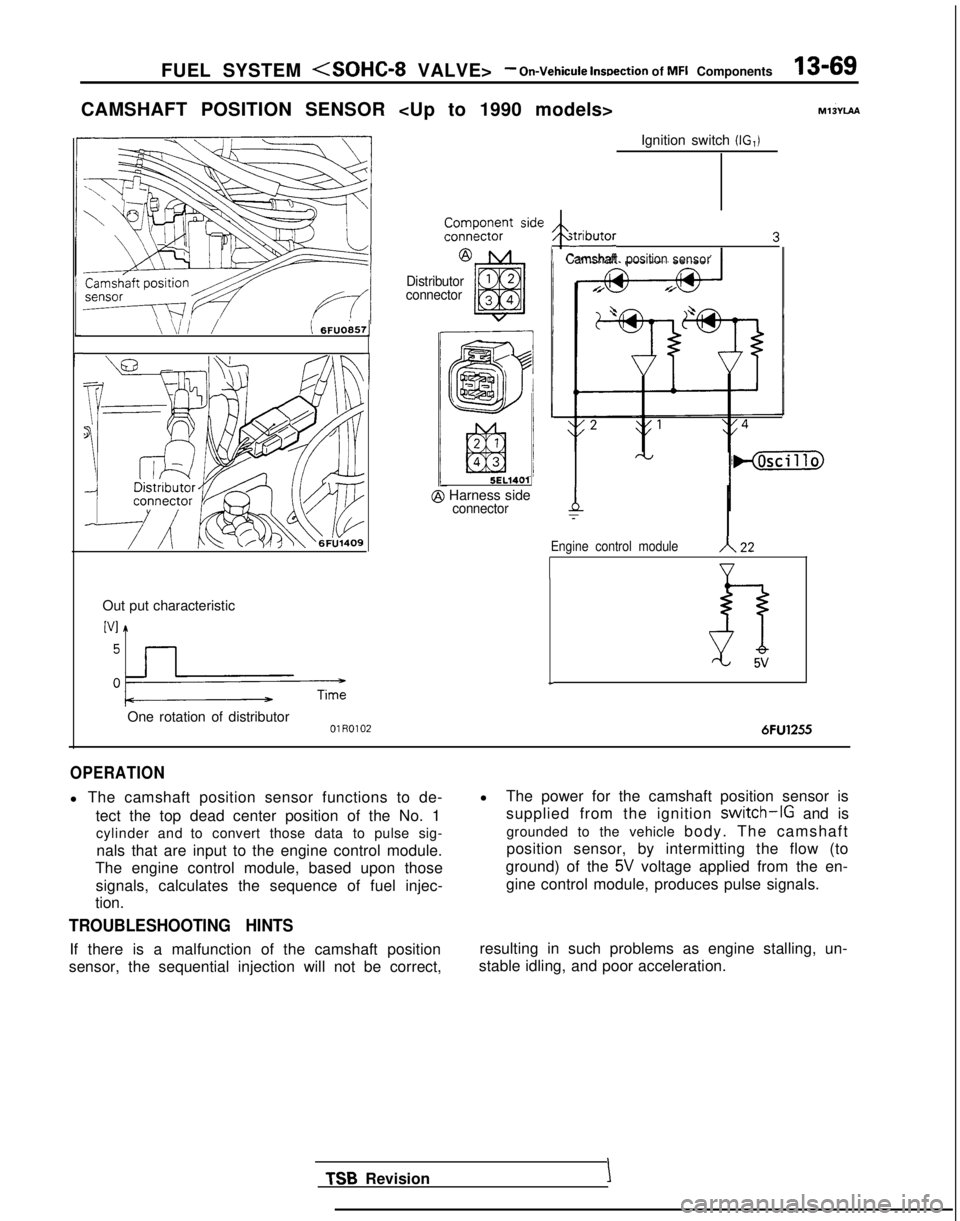
OPERATION
l The camshaft position sensor functions to de-
tect the top dead center position of the No. 1cylinder and to convert those data to pulse sig-
nals that are input to the engine control module.
The engine control module, based upon those
signals, calculates the sequence of fuel injec-
tion.
TROUBLESHOOTING HINTS
If there is a malfunction of the camshaft position
sensor, the sequential injection will not be correct, l
The power for the camshaft position sensor is
supplied from the ignition
switch-IG and is
grounded to the vehicle body. The camshaft
position sensor, by intermitting the flow (to
ground) of the
5V voltage applied from the en-
gine control module, produces pulse signals.
resulting in such problems as engine stalling, un-
stable idling, and poor acceleration.
TSB RevisionI
Page 213 of 1273
FUEL SYSTEM
CAMSHAFT POSITION SENSOR
sensor/
WV?: (I 6FUO857
Out put charactenstic
I->Time
One rotatton of distributor01 R0102
@ Component side
connector
Ignition switch (IG,)
I
\/\/\/\/\/\/4 2
&T]
f-b
9r
Engine control moduleA 22
h
5v
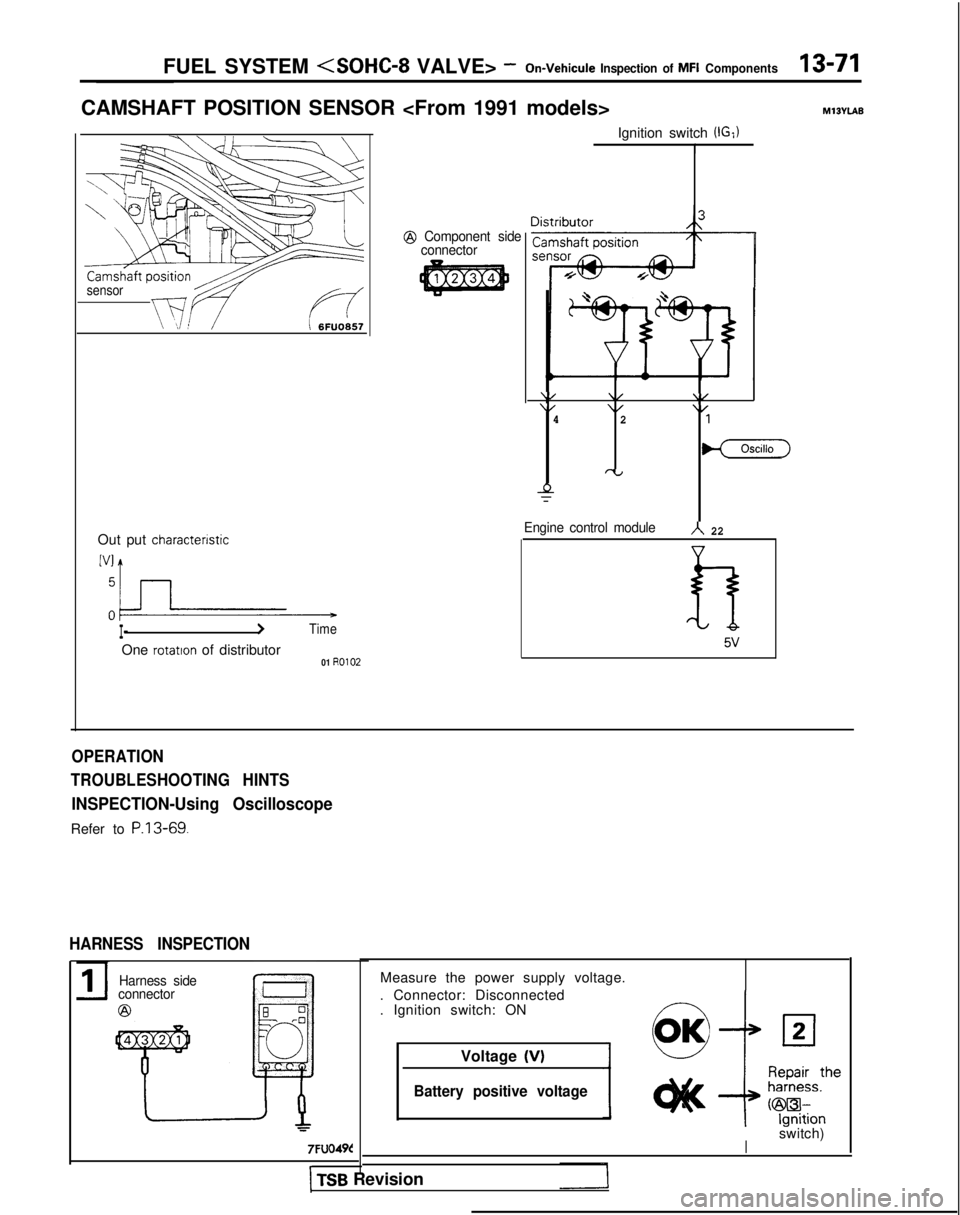
OPERATION
TROUBLESHOOTING HINTS
INSPECTION-Using Oscilloscope
Refer to P.13-69.
HARNESS INSPECTION
Harness side
connector
@
7FUO49t
r1 TSB Revision Measure the power supply voltage.
. Connector: Disconnected
. Ignition switch: ON
Voltage
(V)
Battery positive voltage
Iswitch)
Page 215 of 1273
FUEL SYSTEM
inspection of MFI Components13-73
CRANKSHAFT POSITION SENSOR
\IDikZ!utoJP
[VI 1 Out put characteristic
One rotation of distributor Ignition switch
(IG,)
@ Component sideconnector
Distributor3
Distributor
connector
@ Harness sideconnector
/ CraTSiti0 y$/
A21 Engine control module
LD5vLI
6Fu1256
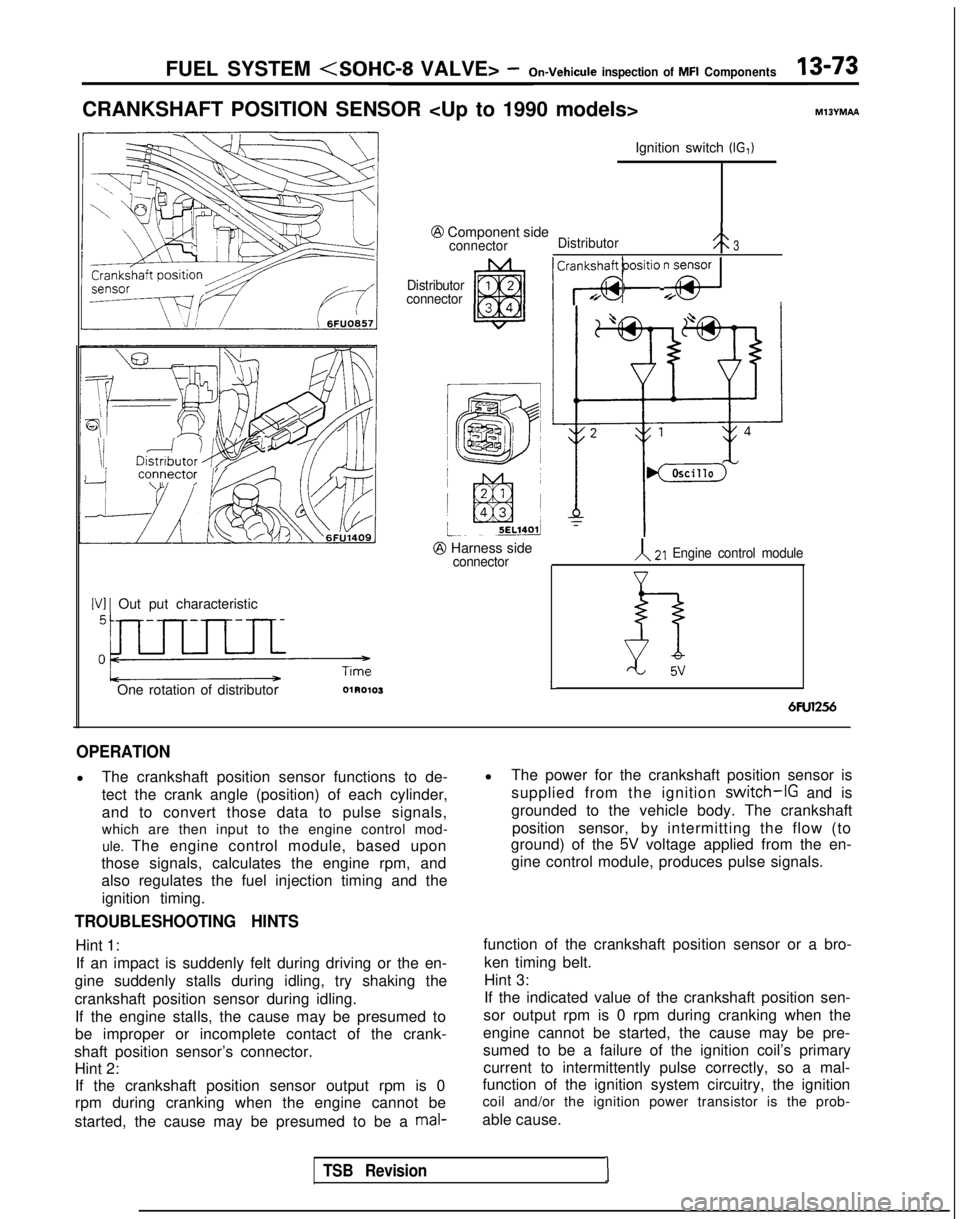
OPERATION
l The crankshaft position sensor functions to de-
tect the crank angle (position) of each cylinder,
and to convert those data to pulse signals,
which are then input to the engine control mod-
ule. The engine control module, based upon
those signals, calculates the engine rpm, and
also regulates the fuel injection timing and the
ignition timing.
TROUBLESHOOTING HINTS
Hint 1:If an impact is suddenly felt during driving or the en-
gine suddenly stalls during idling, try shaking the
crankshaft position sensor during idling. If the engine stalls, the cause may be presumed to
be improper or incomplete contact of the crank-
shaft position sensor’s connector. Hint 2:If the crankshaft position sensor output rpm is 0
rpm during cranking when the engine cannot be
started, the cause may be presumed to be a
mal-
l The power for the crankshaft position sensor is
supplied from the ignition
switch-IG and is
grounded to the vehicle body. The crankshaft position sensor, by intermitting the flow (to
ground) of the
5V voltage applied from the en-
gine control module, produces pulse signals.
function of the crankshaft position sensor or a bro- ken timing belt.
Hint 3:
If the indicated value of the crankshaft position sen-
sor output rpm is 0 rpm during cranking when the
engine cannot be started, the cause may be pre-
sumed to be a failure of the ignition coil’s primary current to intermittently pulse correctly, so a mal-
function of the ignition system circuitry, the ignition
coil and/or the ignition power transistor is the prob-
able cause.
TSB Revision1
Page 216 of 1273
13-74 FUEL SYSTEM
Hint 4:
If idling is possible even though the crankshaft posi-
tion sensor indicated rpm is a deviation from the standard value, the cause is usually a malfunction of
something other than the crankshaft position sen-
sor.
Examples:
(1) Malfunction of the coolant-temperature sensor.
(2) Malfunction of the idling-speed control motor.
(3) Improper adjustment of the standard idling
speed.
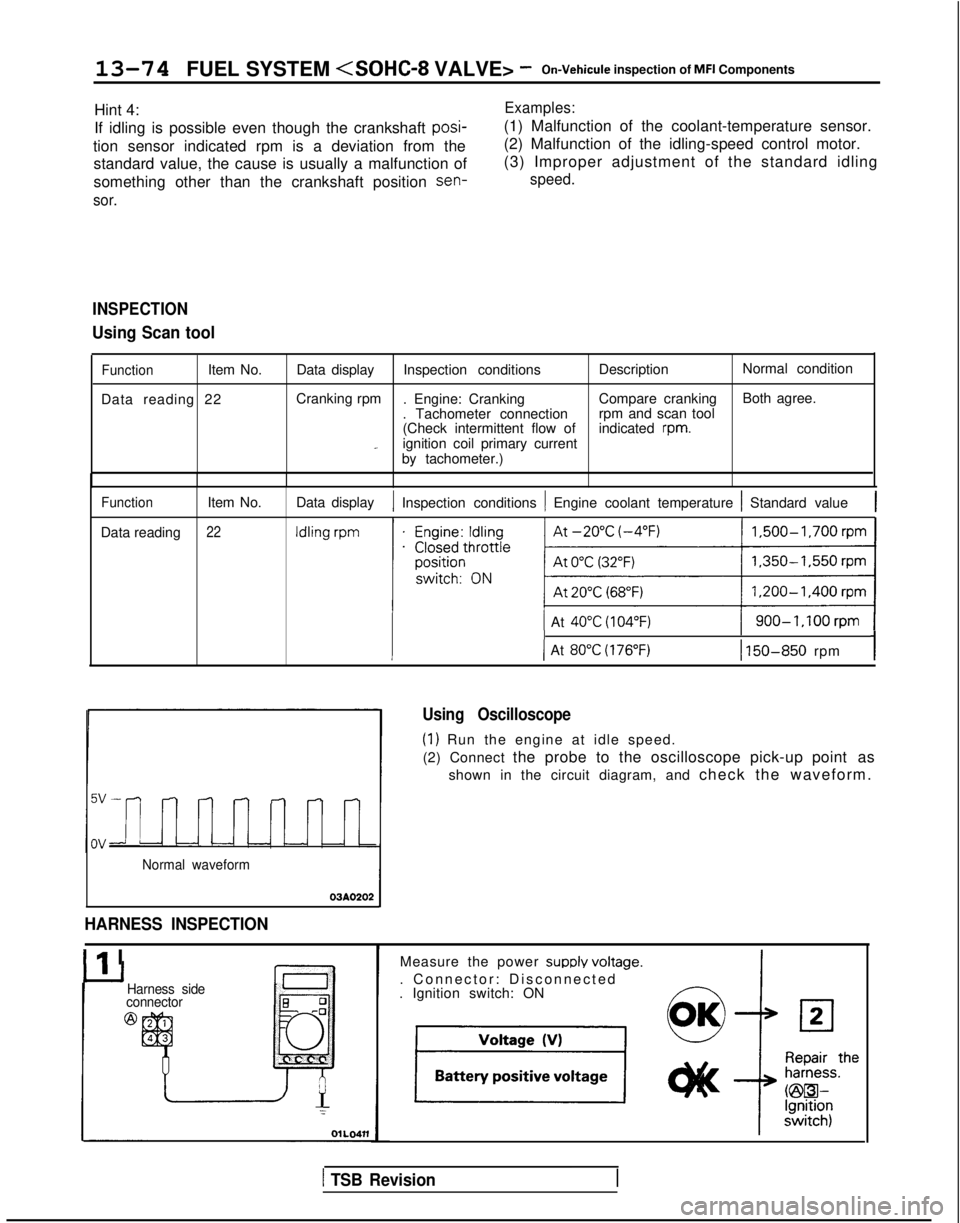
INSPECTION
Using Scan tool
FunctionItem No.
Data reading 22 Data display
Inspection conditions DescriptionNormal condition
Cranking rpm . Engine: Cranking Compare crankingBoth agree.
. Tachometer connection rpm and scan tool
(Check intermittent flow of indicated
rpm._ignition coil primary current
by tachometer.)
Function
Data reading Item No.22
Data display1 Inspection conditions 1 Engine coolant temperature 1 Standard value1
1 At 40°C (104°F)1 900-1,100rpm 1
III-I( At 80°C (176°F)1 150-850 rpm
Normal waveform
03AO202
HARNESS INSPECTION
Ilr I
Using Oscilloscope
(1) Run the engine at idle speed.
(2) Connect the probe to the oscilloscope pick-up point as
shown in the circuit diagram, and check the waveform.
Harness side
connector
@
Measure the power SUPPIY voltaoe.
. Connector: Disconnected
-. Ignition switch: ON
1 TSB Revision
Page 217 of 1273
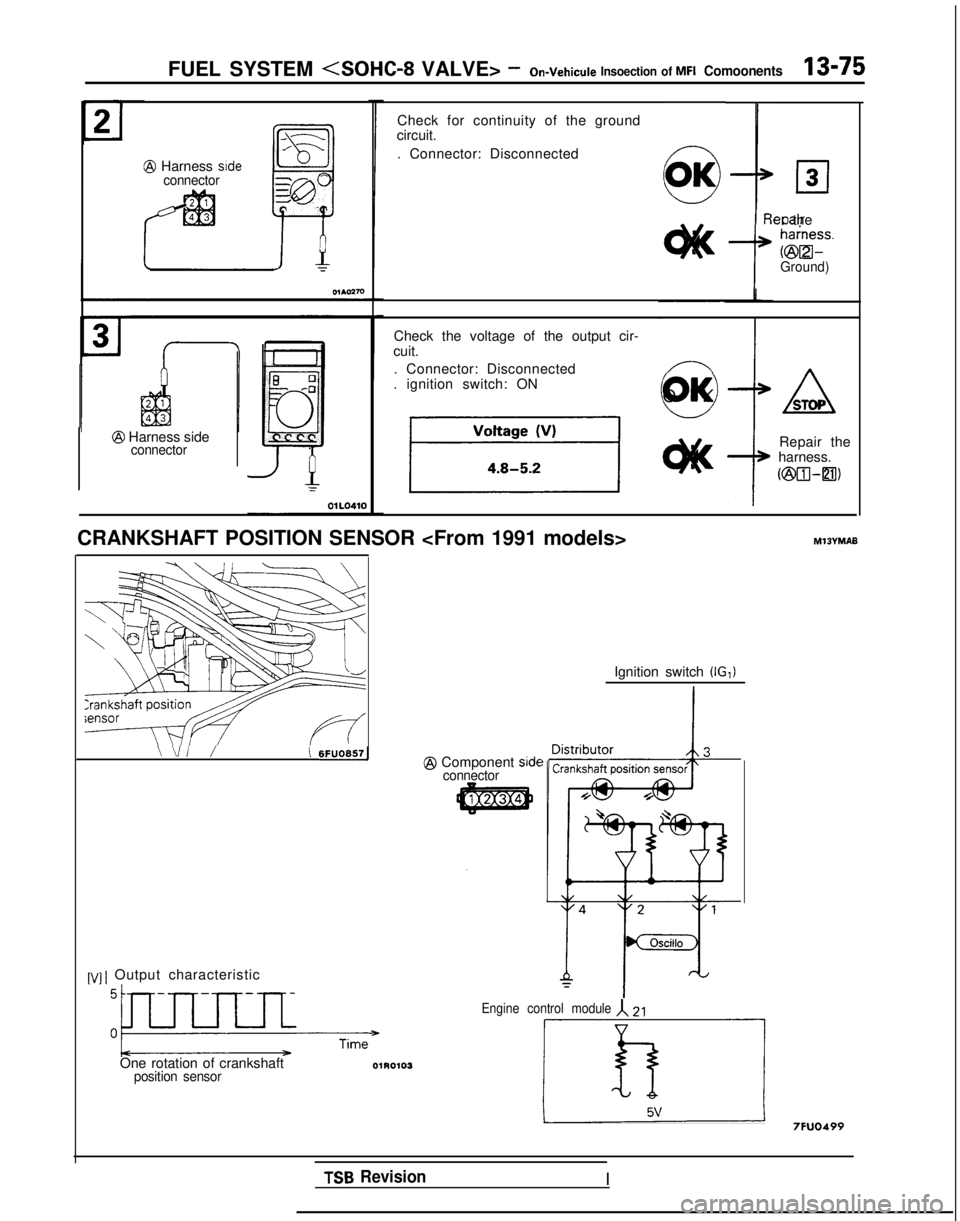
FUEL SYSTEM
@ Harness srdeconnector
@ Harness sideconnector
Check for continuity of the ground
circuit.
. Connector: Disconnected
1 Reoair the
t
hainess.
(@B-Ground)
Check the voltage of the output cir-
cuit.
. Connector: Disconnected
. ignition switch: ON
u
O
K
ASTOP
Repair the
harness.
(@m-m)
CRANKSHAFT POSITION SENSOR
m/i /i 6FUO6571
[VI 1 Output characteristic
@ Component sideconnector
Ignition switch (IG1)
One rotation of crankshaftposition sensor
01R0’05
TSB Revision
Engine control module,( 21
m---l 7F”04pp
I
Page 222 of 1273
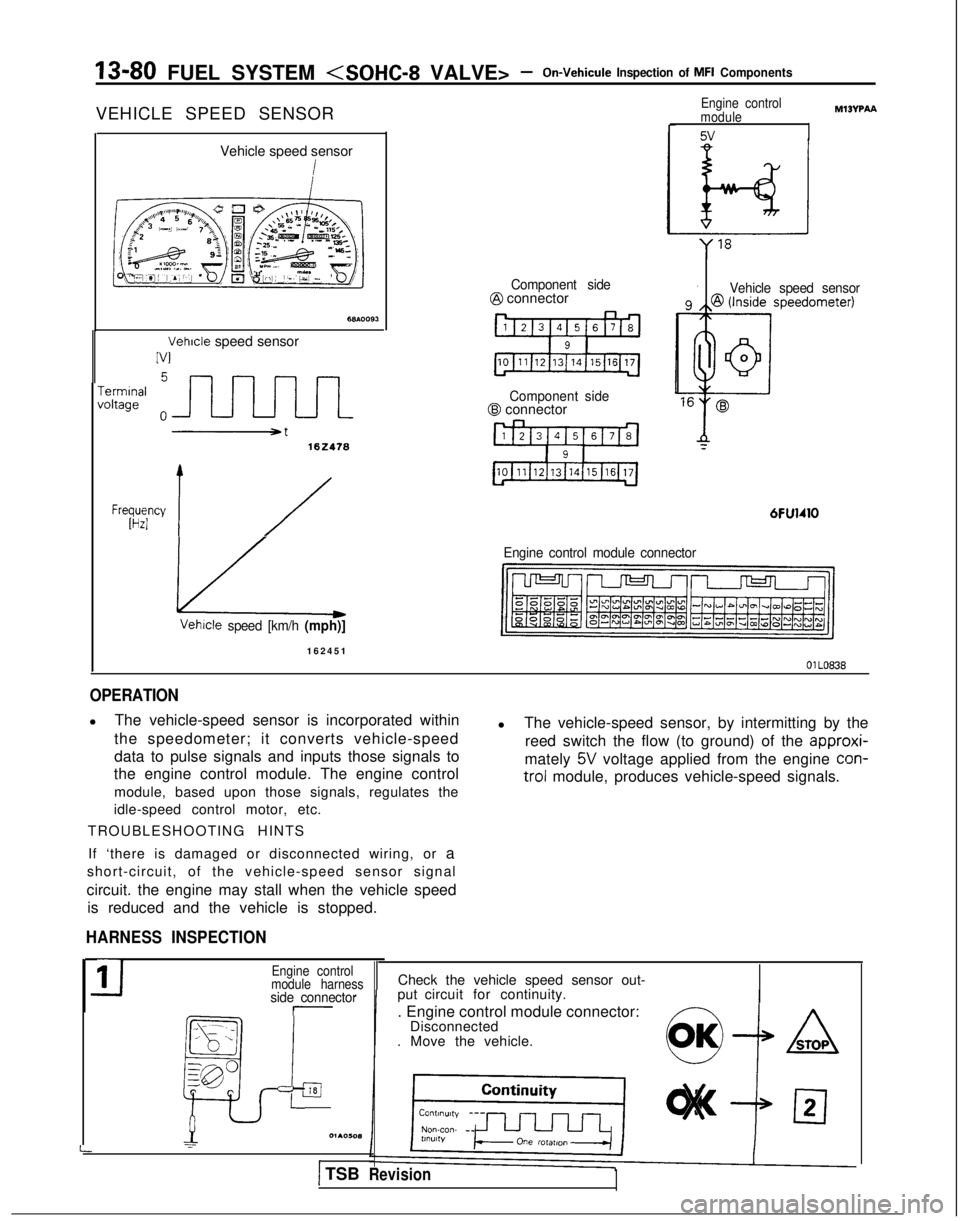
13-80 FUEL SYSTEM
VEHICLE SPEED SENSOR
Vehicle speed sensor
Vehicle speed sensor
IV1
-errnInafoltage
102418
Frwyy 1/
Component side@ connector
Component side@ connector
6FU1410
Engine control
module
5v
MIBVPAA
Vehicle speed sensor
Engine control module connector Vetwle
speed [km/h (mph)]
16245
1
OlLO838
OPERATION
l
The vehicle-speed sensor is incorporated within
the speedometer; it converts vehicle-speed
data to pulse signals and inputs those signals to
the engine control module. The engine control
module, based upon those signals, regulates the
idle-speed control motor, etc.
TROUBLESHOOTING HINTS l
The vehicle-speed sensor, by intermitting by the
reed switch the flow (to ground) of the approxi-
mately
5V voltage applied from the engine con-
trol
module, produces vehicle-speed signals.
If ‘there is damaged or disconnected wiring, or a
short-circuit, of the vehicle-speed sensor signal
circuit. the engine may stall when the vehicle speed is reduced and the vehicle is stopped.
HARNESS INSPECTION
-side connector
_--- _
ia
_, - .,
:_--
gp
p
L
11Engine control
module harness
=l01AOW(1
I
Check the vehicle speed sensor out-
put circuit for continuity.
. Engine control module connector: Disconnected
. Move the vehicle.
) TSBRevision