engine MITSUBISHI GALANT 1989 Service Repair Manual
[x] Cancel search | Manufacturer: MITSUBISHI, Model Year: 1989, Model line: GALANT, Model: MITSUBISHI GALANT 1989Pages: 1273, PDF Size: 37.62 MB
Page 639 of 1273
EMISSION CONTROL SYSTEMS -Evaporative Emission Control System17-19
When engine is hot-coolant temperature:
70% (158°F) or higher
Engine operating
condition Applying vacuumResult
Idling
Vacuum is maintained
3,000 rpm withinTry applyingthree minutes after vacuumstarting engine
Vacuum leaks
3,000 rpm after
three minutes
have elapsedafter startingengine
375 mmHg(14.8 in.Hg.1Vacuum will be main-tained momentarily,after which it willleaks.
NOTE
The vacuum will leak
continuously if the
altitude is 2,200
m(7,200 ft.) or higher,
or the intake air
temperature is
50°C(122°F) or higher.
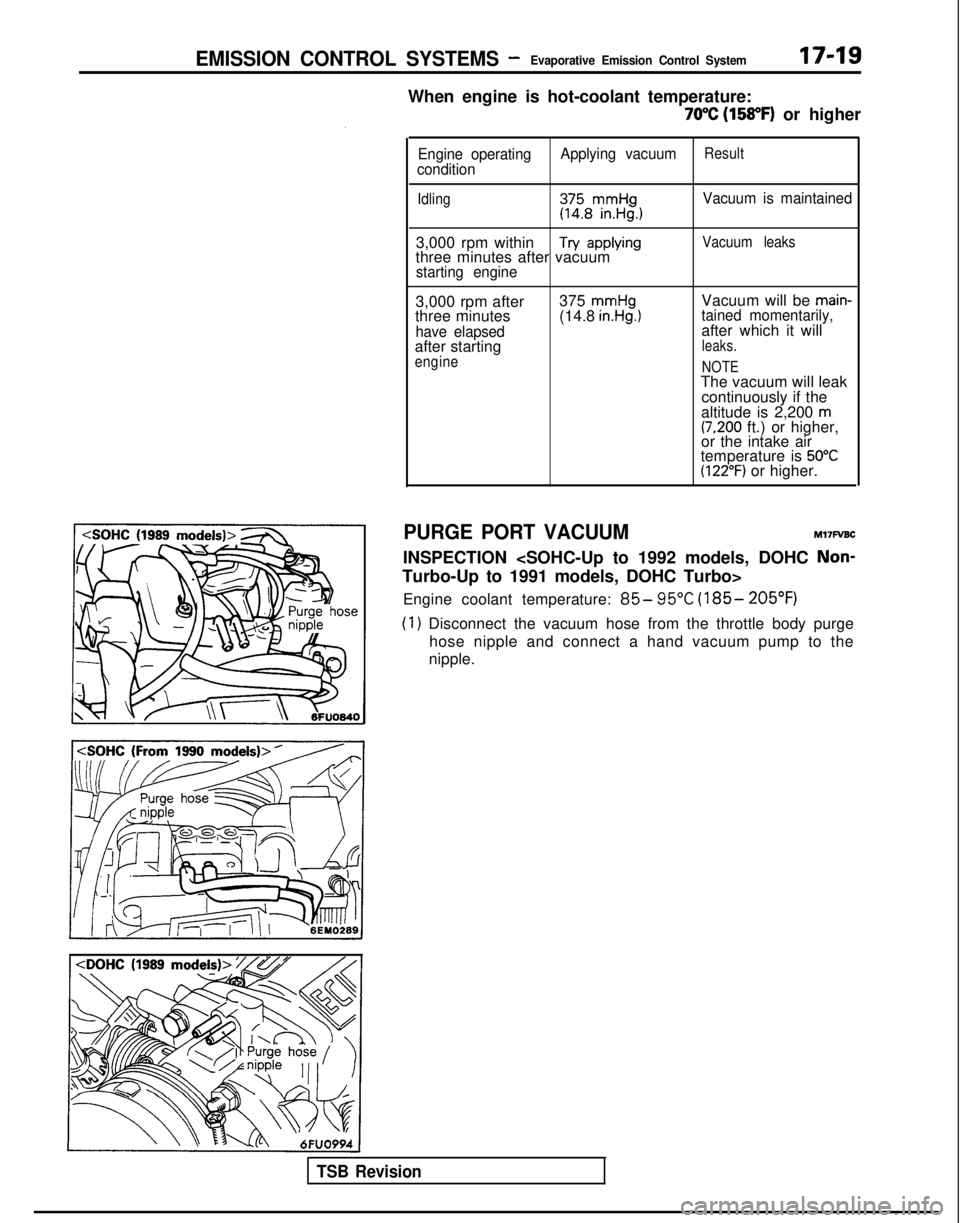
PURGE PORT VACUUM MITFVBC
INSPECTION
Turbo-Up to 1991 models, DOHC Turbo> Engine coolant temperature:
85- 95°C (185- 205°F)
(1) Disconnect the vacuum hose from the throttle body purge hose nipple and connect a hand vacuum pump to the
nipple.
TSB Revision
Page 640 of 1273
17-20EMISSION CONTROL SYSTEMS -Evaporative Emission Control System
Engine speed (rpm)>
3FU262
E2id>
‘_/- )Engine
speed
(rpm)1 FU446
1 TSB Revision
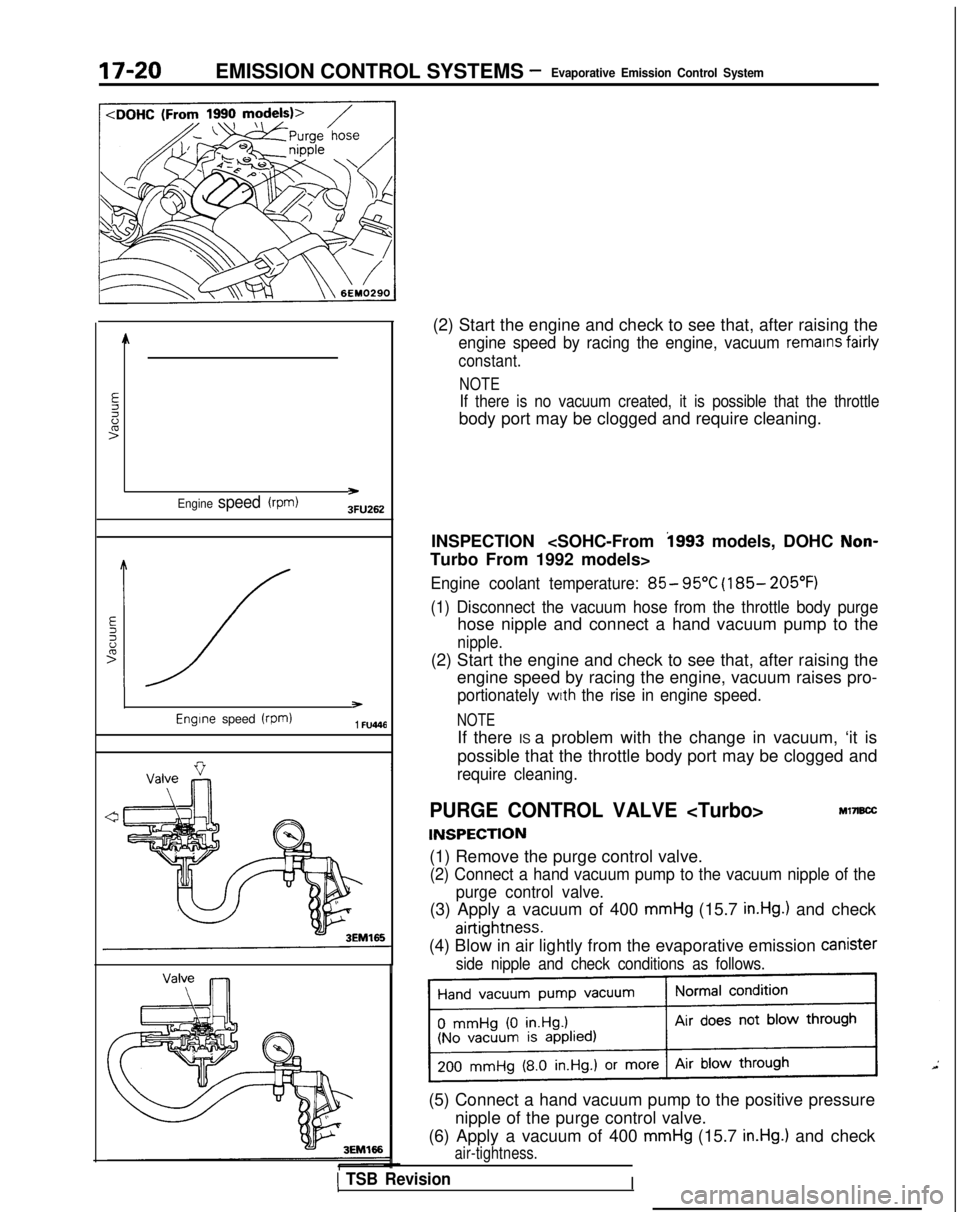
(2) Start the engine and check to see that, after raising the
engine speed by racing the engine, vacuum remains fairly
constant.
NOTE
If there is no vacuum created, it is possible that the throttle
body port may be clogged and require cleaning.
INSPECTION
Turbo From 1992 models>
Engine coolant temperature: 85- 95°C (185- 205°F)
(1) Disconnect the vacuum hose from the throttle body purge
hose nipple and connect a hand vacuum pump to the
nipple.
(2) Start the engine and check to see that, after raising the engine speed by racing the engine, vacuum raises pro-
portionately with the rise in engine speed.
NOTE
If there IS a problem with the change in vacuum, ‘it is
possible that the throttle body port may be clogged and
require cleaning.
PURGE CONTROL VALVE
INSPECTION
Ml7B.X
(1) Remove the purge control valve.
(2) Connect a hand vacuum pump to the vacuum nipple of the
purge control valve.
(3) Apply a vacuum of 400 mmHg (15.7 in.Hg.) and check
airtightness.
(4) Blow in air lightly from the evaporative emission Canister
side nipple and check conditions as follows.
(5) Connect a hand vacuum pump to the positive pressure
nipple of the purge control valve.
(6) Apply a vacuum of 400
mmHg (15.7 in.Hg.) and check
air-tightness.
I
Page 641 of 1273

EMISSION CONTROL SYSTEMS -Evaporative Emission Control System17-21EC1510
6EM137
EVAPORATIVE EMlS$lON
PURGE SOLENOID
INSPECTIONM17lBFD
NOTE
When disconnecting the vacuum hose, make an identification
mark on it so that it can be reconnected to the original posi-
tion.
(1) Disconnect the vacuum hoses (non stripe and red stripe
hoses) from the solenoid valve
(2) Disconnect the harness connector from solenoid valve.
(3) Connect a hand vacuum pump to the nipple to which the red-striped vacuum hose was connected.
(4) Apply a vacuum and check for air-tightness when voltage applied directly to the evaporative emission purge solenoid
when the voltage is discontinued.
Battery voltageResult
Non-Turbo When appliedVacuum leaks
When discontinued Vacuum is maintained
TurboWhen appliedVacuum is maintained
When discontinued Vacuum leaks
(5) Measure the resistance between the terminals of the sole-
noid valve.
Standard value: 36-44 Q [at 20°C (68”F)l
VOLUME AIR FLOW SENSOR, ENGINE
COOLANT TEMPERATURE SENSOR AND
INTAKE AIR TEMPERATURE SENSOR
M17IBGB
To inspect these parts, refer to GROUP 13-On-Vehicle Inspec-
tion of
MFI Components.
AIR CONDITIONING SWITCH Ml7IBHB
To inspect the air conditioning switch, refer to GROUP
55-Air
Conditioning Switch.
FUEL TANK PRESSURE CONTROL VALVE MI’IIBEB
To inspect the fuel tank pressure control valve, refer to GROUP
13-Fuel
Tank.
EVAPORATIVE EMISSION CANISTERM17lBlB
To inspect the evaporative emission canister, refer to GROUP
13-Fuel Line and Vapor Line.
FUEL TANK FILLER TUBE CAP INSPECTIONM,7,w~
Check the gasket of the fuel tank filler tube cap, and the filler
cap itself, for damage or deformation; replace the
cap if neces-
sary.
TSB RevisionI
Page 645 of 1273

EMISSION CONTROL SYSTEMS -Exhaust Gas Recirculation (EGR) System17-25
.
EGR SYSTEM INSPECTION
(1) Disconnect the vacuum hose (green stripe) from the throttle body, and connect a hand vacuum pump to the
vacuum hose.
(2) Under the engine conditions described below, provide a
vacuum by using the hand vacuum pump, and then check.
WhenEngine is Cold-
coolant temperature 50°C (122°F) or below
Engine operatingconditionApplying vacuumResul
t
IdlingTry applying vacuum Vacuum leaks
When Engine is Hot-
coolant temperature 85”-95°C (185”-205°F) or higher
Engine operatingconditionApplying vacuumResult
Idling45 mmHg(1.7 in.Hg.1Vacuum is maintained
Changes from
idling to slightlyunstable
Vacuum is maintained
EGR SYSTEM INSPECTION
(1) Disconnect the vacuum hose (green striped hose) from the exhaust gas recirculation
(EGR) valve, and then connect a
manual vacuum pump via the three-way terminal.
(2) Check the following points when the engine is cold [enginecoolant temperature is
20°C (68°F) or below] and when the
engine is warm [engine coolant temperature is
70°C (158°F)
or higher].
116EMOZW
TSB Revision
Page 646 of 1273

17-26EMISSION CONTROL SYSTEMS- Exhaust Gas Recirculation (EGR) System
~
I6EM0224 1
(3) Disconnect the three-way terminal and connect the manual
vacuum pump directly to the exhaust gas recirculation
(EGR) valve.
(4) Check whether the engine stalls or the idling is unstable
when a vacuum of 155 mmHg (5.9 in.Hg) or higher is
applied during idling.
EGR VALVE CONTROL VACUUM
INSPECTION M17WBB
Engine coolant temperature: 85-95°C
(185-205°F)
(1) Disconnect the vacuum hose from the throttle body EGR
vacuum nipple and connect a hand vacuum pump to the
nipple.
TSB Revision
Page 647 of 1273
![MITSUBISHI GALANT 1989 Service Repair Manual EMISSION CONTROL SYSTEMS -Exhaust Gas Recirculation (EGR) System1 T-27
1 <DOHC (From 1990 models)>/]
LEngine speed (rpm)
lFU446
4zJ -6EM159
(2) Start the engine and check to see that, after raising th](/img/19/57312/w960_57312-646.png "MITSUBISHI GALANT 1989 Service Repair Manual EMISSION CONTROL SYSTEMS -Exhaust Gas Recirculation (EGR) System1 T-27
1 <DOHC (From 1990 models)>/]
LEngine speed (rpm)
lFU446
4zJ -6EM159
(2) Start the engine and check to see that, after raising th")
EMISSION CONTROL SYSTEMS -Exhaust Gas Recirculation (EGR) System1 T-27
1
LEngine speed (rpm)
lFU446
4zJ -6EM159
(2) Start the engine and check to see that, after raising the
engine speed by racing the engine, vacuum raises prop-
ortionately with the rise in engine speed.
NOTE
if there is a problem with the change in vacuum, it is
possible that the throttle body port may be clogged and
require cleaning.
EGR VALVE
INSPECTION MI’IICKF
(1) Remove the EGR valve and check it for sticking, deposit of
carbon, etc.
If such condition exists, clean with adequate solvent to en-
sure tight valve seat contact.
(2) Connect a hand vacuum pump to the EGR valve.
(3) Apply a vacuum of 500 mmHg (19.6 in.Hg.) and check air
tightness.
(4)Blow in air from one passage of the EGR to check condition
as follows.
INSTALLATION
(1) Install a new gasket and EGR valve, tighten bolts to
specified torque.
Specified tightening torque: 17-26 Nm (12-19 ft.lbs.1
THERMAL VACUUM VALVE
INSPECTION
(1)Disconnect the vacuum hoses from the thermal vacuum
valve, and connect a hand vacuum pump to nipple of the
thermal vacuum valve.
(2) Apply a vacuum and check the air passage through the
thermal vacuum valve.
Page 649 of 1273
I6EM0187
EMISSION CONTROL SYSTEMSExhaust Gas Recirculation (EGR) System/- Catalytic Converter/Air-fuel Ratio Control (MPI) System17-29
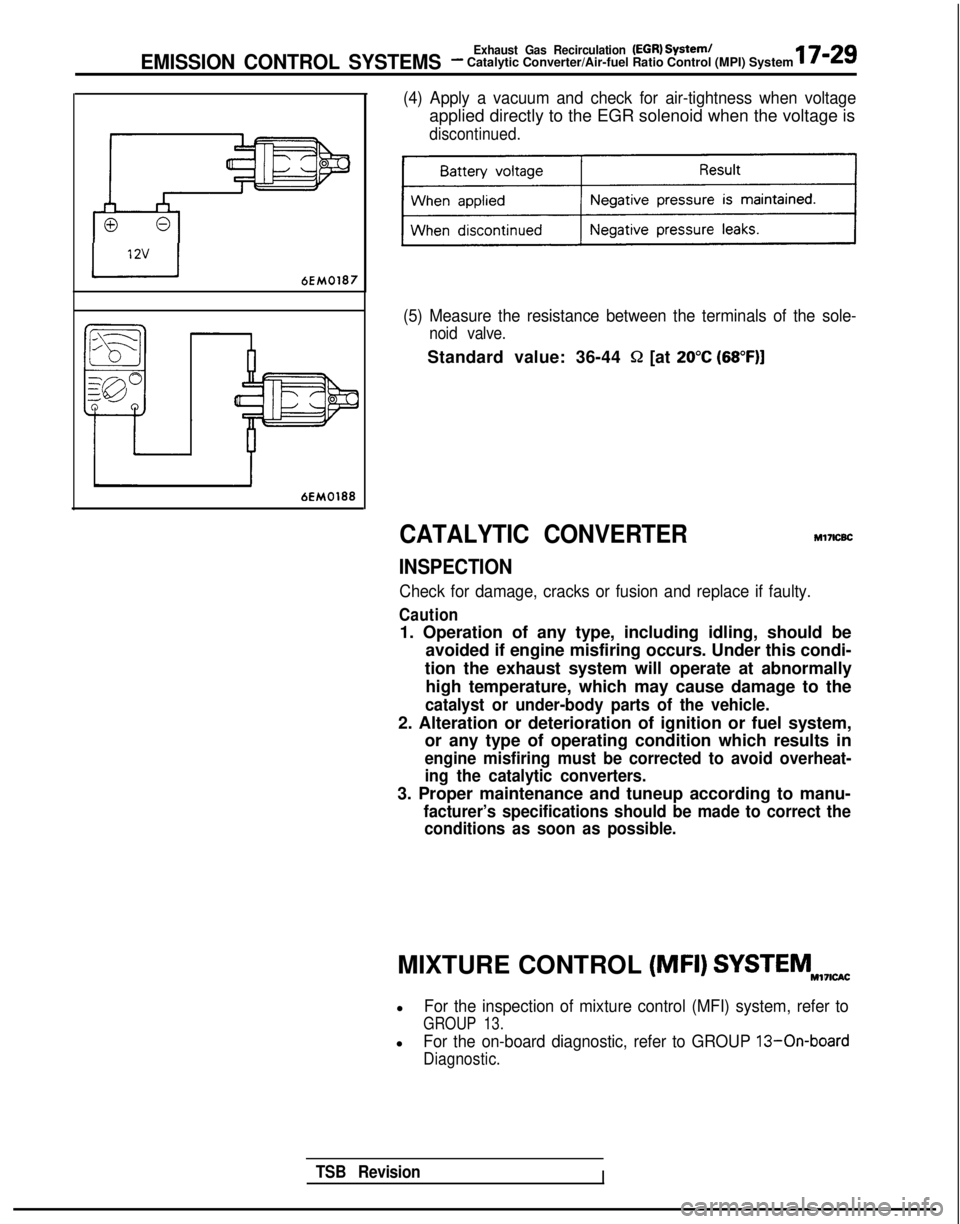
(4) Apply a vacuum and check for air-tightness when voltage
applied directly to the EGR solenoid when the voltage is
discontinued.
(5) Measure the resistance between the terminals of the sole-
noid valve.
Standard value: 36-44 Q [at 20°C (68”F)]
CATALYTIC CONVERTERMl7lcBc
INSPECTION
Check for damage, cracks or fusion and replace if faulty.
Caution
1. Operation of any type, including idling, should be
avoided if engine misfiring occurs. Under this condi-
tion the exhaust system will operate at abnormally high temperature, which may cause damage to the
catalyst or under-body parts of the vehicle.
2. Alteration or deterioration of ignition or fuel system, or any type of operating condition which results in
engine misfiring must be corrected to avoid overheat-
ing the catalytic converters.
3. Proper maintenance and tuneup according to manu-
facturer’s specifications should be made to correct theconditions as soon as possible.
TSB RevisionI
MIXTURE CONTROL (MFI) SYSTEMNI,I,w
lFor the inspection of mixture control (MFI) system, refer to
GROUP 13.
lFor the on-board diagnostic, refer to GROUP 13-On-board
Diagnostic.
Page 651 of 1273

21-1
CLUTCH
CONTENTS
CLUTCH CONTROL. . . . . . . . . . . . . . . . . . . . . . . . . . . . . . . . . . . . \
. . . . .10SPECIFICATIONS. . . . . . . . . . . . . . . ..*...........................2
CLUTCHMASTER CYLINDER. . . . . . . . . . . . . . . . . . . . . . . .12GeneralSpecifications. . . . . . . . . . . . . . . . . . . . . . . . . . . . . . . . . .2
CLUTCH PEDALLubricants . . . . . . . . . . . . . . . . . . . . . . . . . . . . . . .\
. . . . . . . . . . . . . . . . . . . . . . .3. . . . . . . . . . . . . . . . . . . . . . . . . . . . . . . . . . . . \
. . . . . . . . . .7
ServiceSpecifications. . . . . . . . . . . . . . . . . . . . . . . . . . . . . . . . . . .2
CLUTCHRELEASECYLINDER. . . . . . . . . . . . . . . . . . . . . . .13Torque Specifications . . . . . . . . . .._.......................3
SERVICE ADJUSTMENT PROCEDURES . . . . . . . 5TROUBLESHOOTING. . . . . . . . . . . . . . . . . . . . . . . . . . . . . . . . . . . . \
. .4
Bleeding. . . . . . . . . . . . . . . . . . . . . . . . . . . . . . . .6Clutch chatters
Clutch Pedal Inspection and Adjustment . . . .
5Clutch noise
Clutch pedal feels “heavy”
Clutch slips
Gear shift malfunction
CAUTION When
servicing clutch assemblies or com-
ponents for vehicles with SOHC engine
(Up to 1991 models), do NOT create dust
by sanding or by cleaning clutch parts
with a dry brush or with compressed air.
(A water dampened cloth should be used).
The clutch disc contains “Asbestos Fibers”
which can become airborne if dust is
created during service operations. Breath-
ing dust containing “Asbestos Fibers”
may cause serious bodily harm.
Page 652 of 1273
21-2CLUTCH - Specifications
SPECIFICATIONS
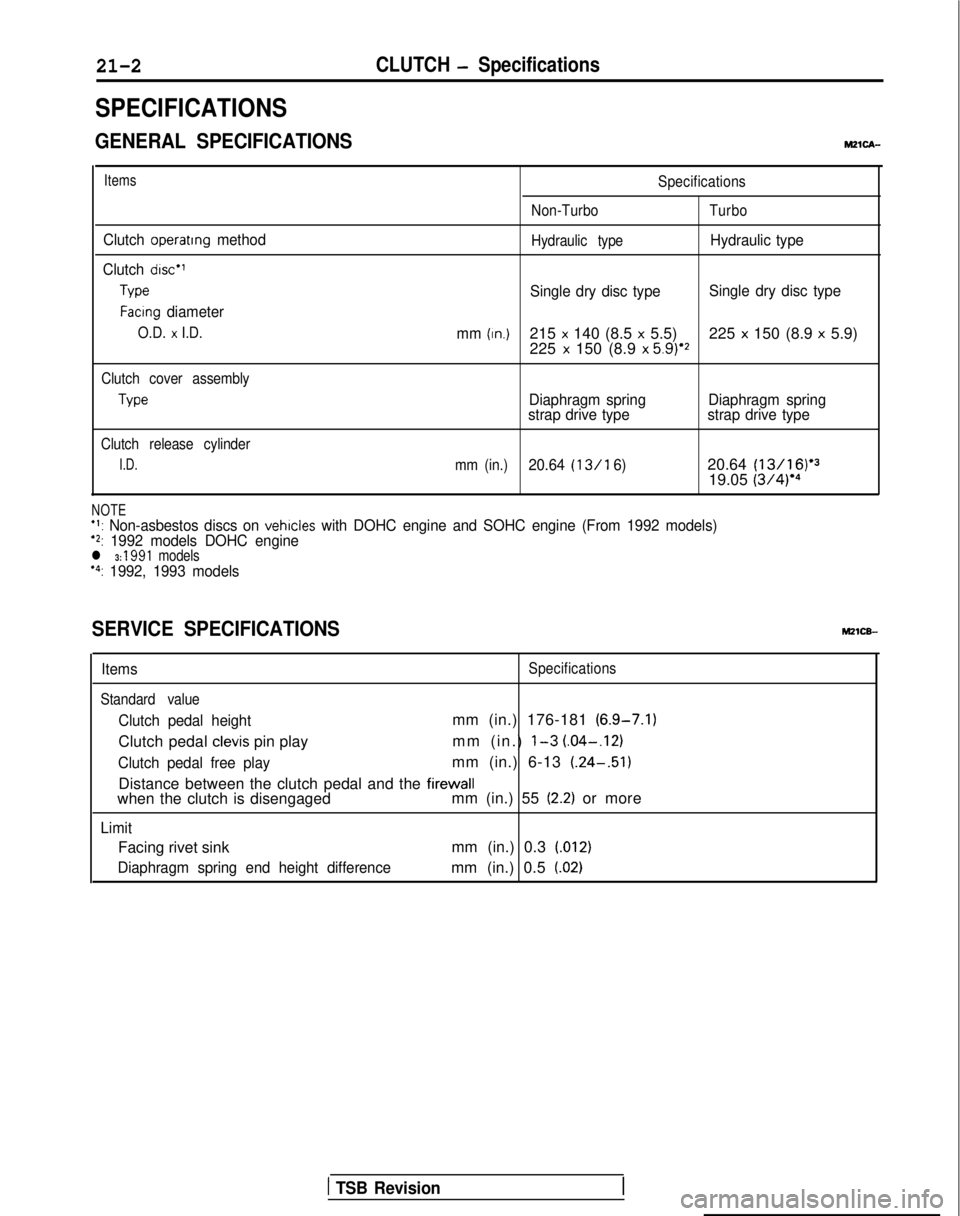
GENERAL SPECIFICATIONSMZlCA-
Items
Clutch operattng method
Clutch disc”
Type
Facing diameter
O.D. x I.D.
Specifications
Non-Turbo Turbo
Hydraulic type
Hydraulic type
Single dry disc type Single dry disc type
mm
(In.)215 x 140 (8.5 x 5.5) 225 x 150 (8.9 x 5.9)
225 x 150 (8.9 x 5.9)‘2
Clutch cover assembly
Type
Clutch release cylinder
I.D.
Diaphragm spring Diaphragm spring
strap drive type strap drive type
mm (in.)20.64 (13/l 6)20.64 (13/16)‘3
19.05 (3/4)‘4
NOTE+l: Non-asbestos discs on vehicles with DOHC engine and SOHC engine (From 1992 models)‘2: 1992 models DOHC enginel 3: 1991 models“: 1992, 1993 models
SERVICE SPECIFICATIONS
ItemsSpecifications
Standard value
Clutch pedal heightmm (in.) 176-181 (6.9-7.1)
Clutch pedal
clevis pin play mm (in.) l-3 (.04-.I21
Clutch pedal free playmm (in.) 6-13
(.24-.51)
Distance between the clutch pedal and the
firewallwhen the clutch is disengaged mm (in.) 55 (2.2) or more
Limit
Facing rivet sinkmm (in.) 0.3 1.012)
Diaphragm spring end height differencemm (in.) 0.5 f.02)
1 TSB Revision
Page 667 of 1273
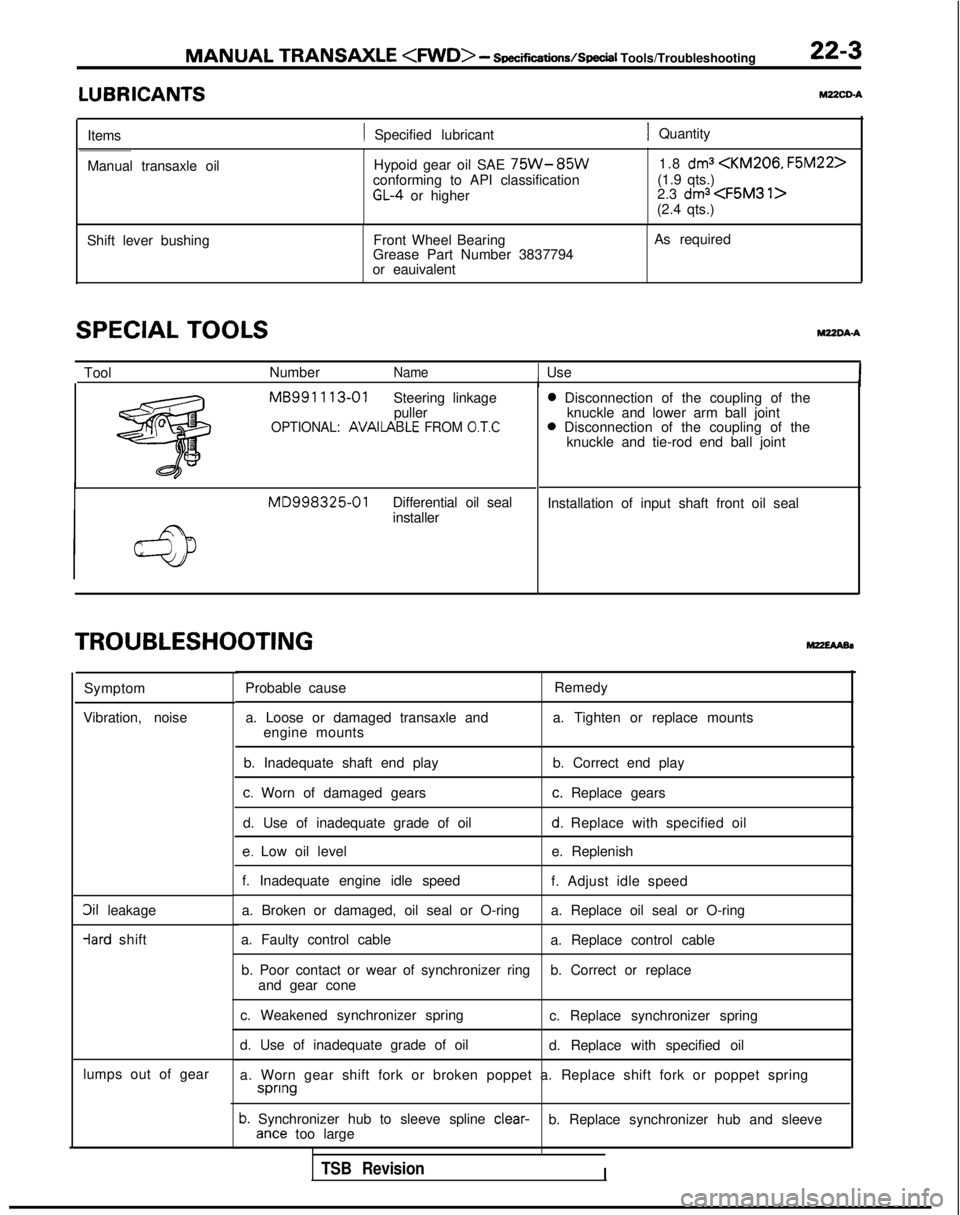
MANUAL TRANSAXLE
- Soec~cations/SpeciI
Tools/Troubleshooting 22-3
LUBRICANTSYZZCD-A
Items1 Specified lubricant1 Quantity
Manual transaxle oil Hypoid gear oil SAE
75W-85Wconforming to API classificationGL-4 or higher1.8
dma
(1.9 qts.)
2.3 dma
Shift lever bushing Front Wheel Bearing
Grease Part Number 3837794
or eauivalent As required
SPECIAL TOOLSWDA-A
Tool
NumberName1 UseI MB991
113-01
Steering linkage
puller
OPTIONAL: AVAIlABLE FROM 0.T.C
MD998325-01Differential oil seal
installer 0
Disconnection of the coupling of the
knuckle and lower arm ball joint 0
Disconnection of the coupling of the
knuckle and tie-rod end ball joint
Installation of input shaft front oil seal
TROUBLESHOOTING
Symptom
Vibration, noise
3il leakage -lard
shift
lumps out of gear Probable cause
Remedy
a. Loose or damaged transaxle and a. Tighten or replace mounts
engine mounts
b. Inadequate shaft end play b. Correct end play
c. Worn of damaged gearsc. Replace gears
d. Use of inadequate grade of oil
d. Replace with specified oil
e. Low oil level e. Replenish
f. Inadequate engine idle speed f. Adjust idle speed
a. Broken or damaged, oil seal or O-ring a. Replace oil seal or O-ring
a. Faulty control cable a. Replace control cable
b. Poor contact or wear of synchronizer ring b. Correct or replace
and gear cone
c. Weakened synchronizer spring c. Replace synchronizer spring
d. Use of inadequate grade of oil d. Replace with specified oil
a. Worn gear shift fork or broken poppet a. Replace shift fork or poppet\
spring spnng
b. Synchronizer hub to sleeve spline
clear-
b. Replace synchronizer hub and sleeveante too large
TSB RevisionI