engine MITSUBISHI GALANT 1989 Service Repair Manual
[x] Cancel search | Manufacturer: MITSUBISHI, Model Year: 1989, Model line: GALANT, Model: MITSUBISHI GALANT 1989Pages: 1273, PDF Size: 37.62 MB
Page 610 of 1273
15-24INTAKE AND EXHAUST - Turbocharger
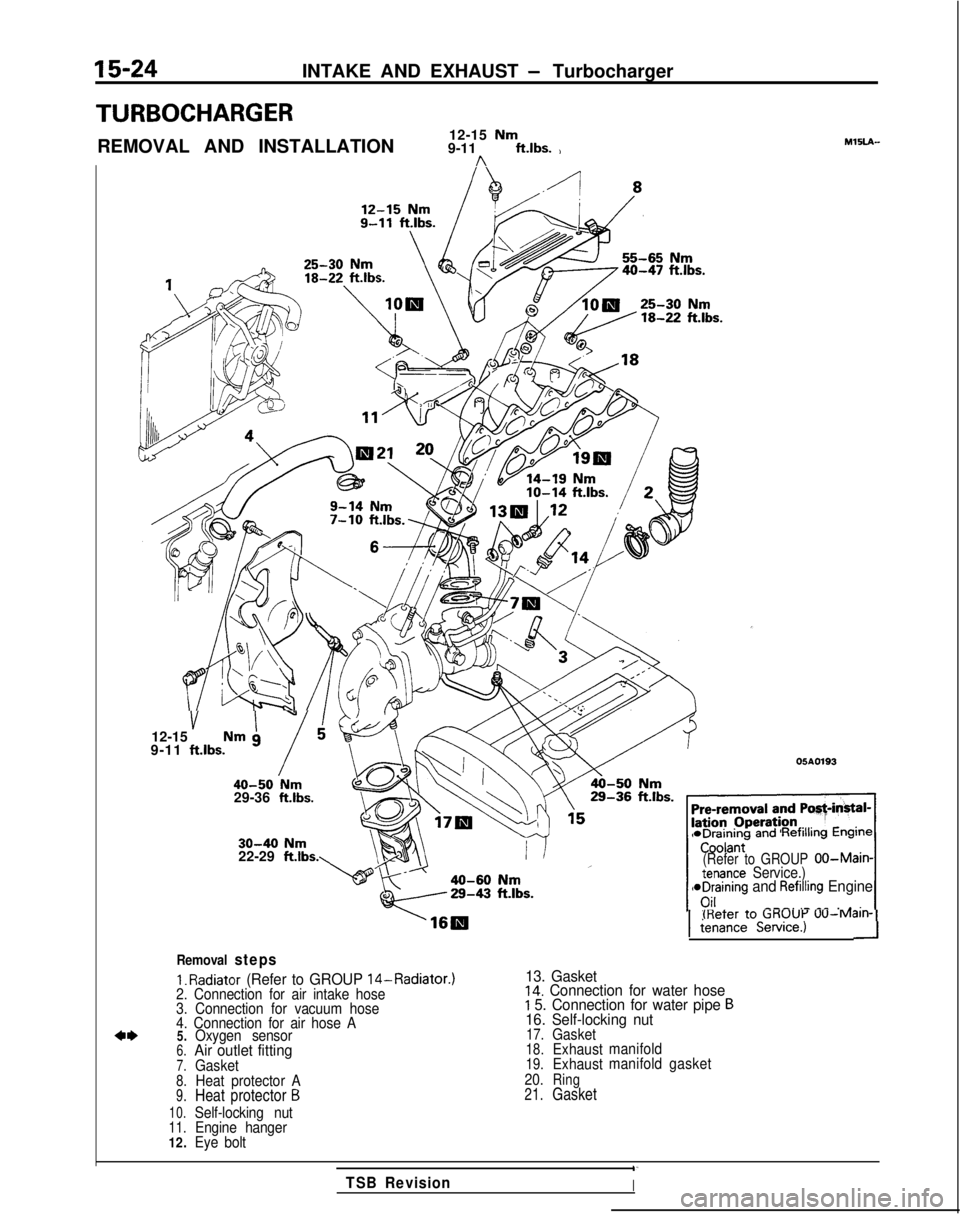
TURBOCHARGER
REMOVAL AND INSTALLATION12-15 Nm9-11 ft.lbs. )n
MlSLA-
40-47 ftlbs.
v I”12-15 Nm g
9-11 ftlbs.
i40-50 Nm29-36 ft.lbs.
05A0193
30-40 Nm22-29 ftlbs. *Draining
andRefilling Engine
(Refer to GROUPOO-Main-tenance Service.)aDraining and Refilling Engine
---. .- _^ . ._;_I(Refer to CiKUUi-’
UU-M~III-11
tenance Service.)-I
Removal steps
1.
Radiator (Refer to GROUP 14-Radiator.)
13. Gasket2. Connection for air intake hose14. Connection for water hose
3. Connection for vacuum hoseI 5. Connection for water pipe B
4. Connection for air hose A16. Self-locking nut
4*5.Oxygen sensor17.Gasket
6.Air outlet fitting18.Exhaust
manifold
7.Gasket19.Exhaustmanifold
gasket
8.Heat protector A 20.Ring
9.Heat protector B21.Gasket
10.Self-locking nut11.Engine hanger
12. Eye bolt
1‘
TSB RevisionI
Page 613 of 1273
INTAKE AND EXHAUST -Exhaust Manifold (SOHC-8 VALVE>15-27
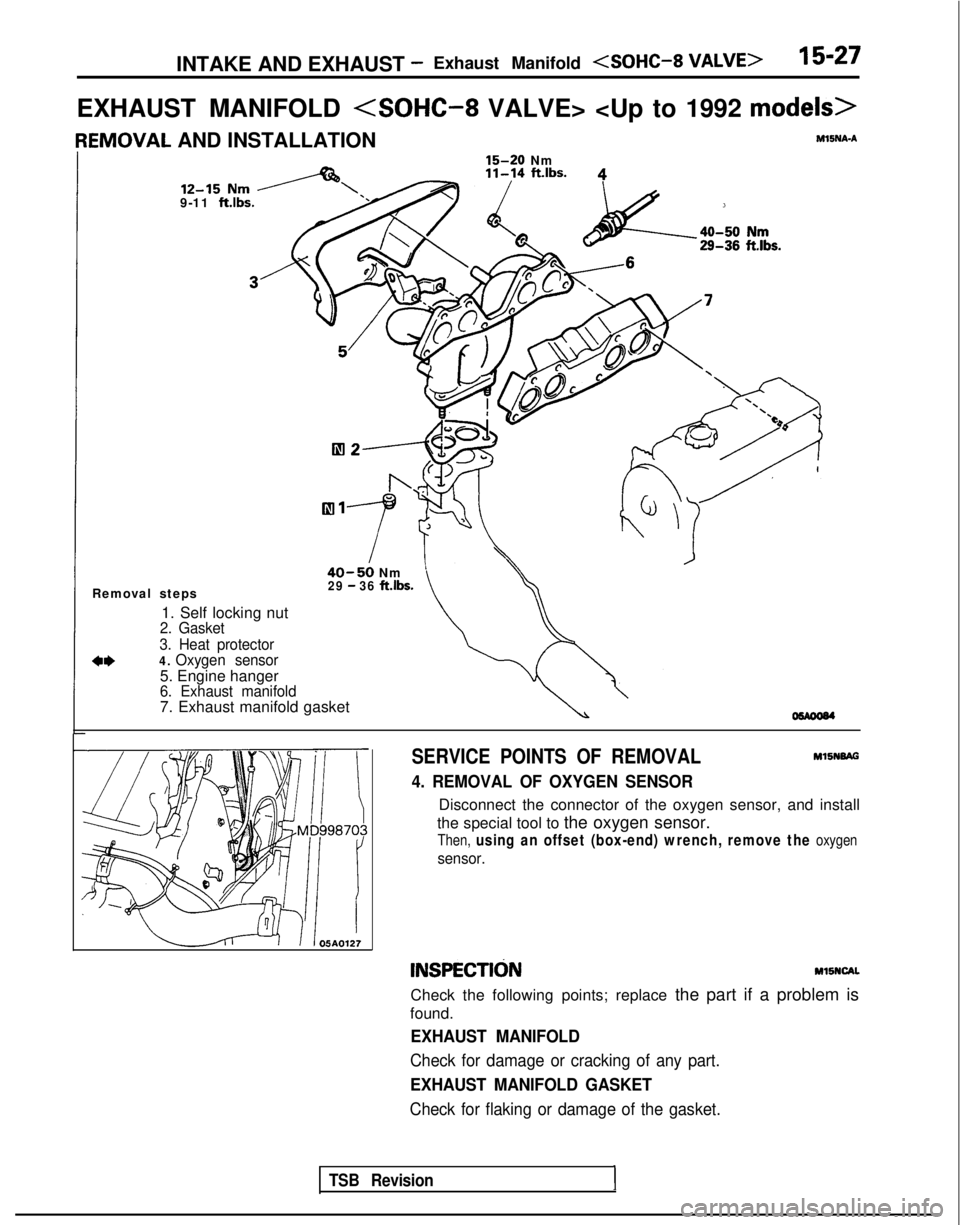
EXHAUST MANIFOLD
IEMOVAL AND INSTALLATIONYSNA-A
15-20
Nm
9-11 ftlbs.
40-50 Nm
Removal steps29 - 36 ft.lbs.
1. Self locking nut2. Gasket
3. Heat protector
a*4. Oxygen sensor
5. Engine hanger6. Exhaust manifold7. Exhaust manifold gasket
SERVICE POINTS OF REMOVAL MlSNBAG
4. REMOVAL OF OXYGEN SENSOR
Disconnect the connector of the oxygen sensor, and install
the special tool to the oxygen sensor.
Then, using an offset (box-end) wrench, remove the oxygen
sensor.
INSPECTldNMllNCAL
Check the following points; replace the part if a problem is
found.
EXHAUST MANIFOLD
Check for damage or cracking of any part.
EXHAUST MANIFOLD GASKET
Check for flaking or damage of the gasket.
TSB Revision1
Page 614 of 1273
15-28INTAKE AND EXHAUST - Exhaust Manifold
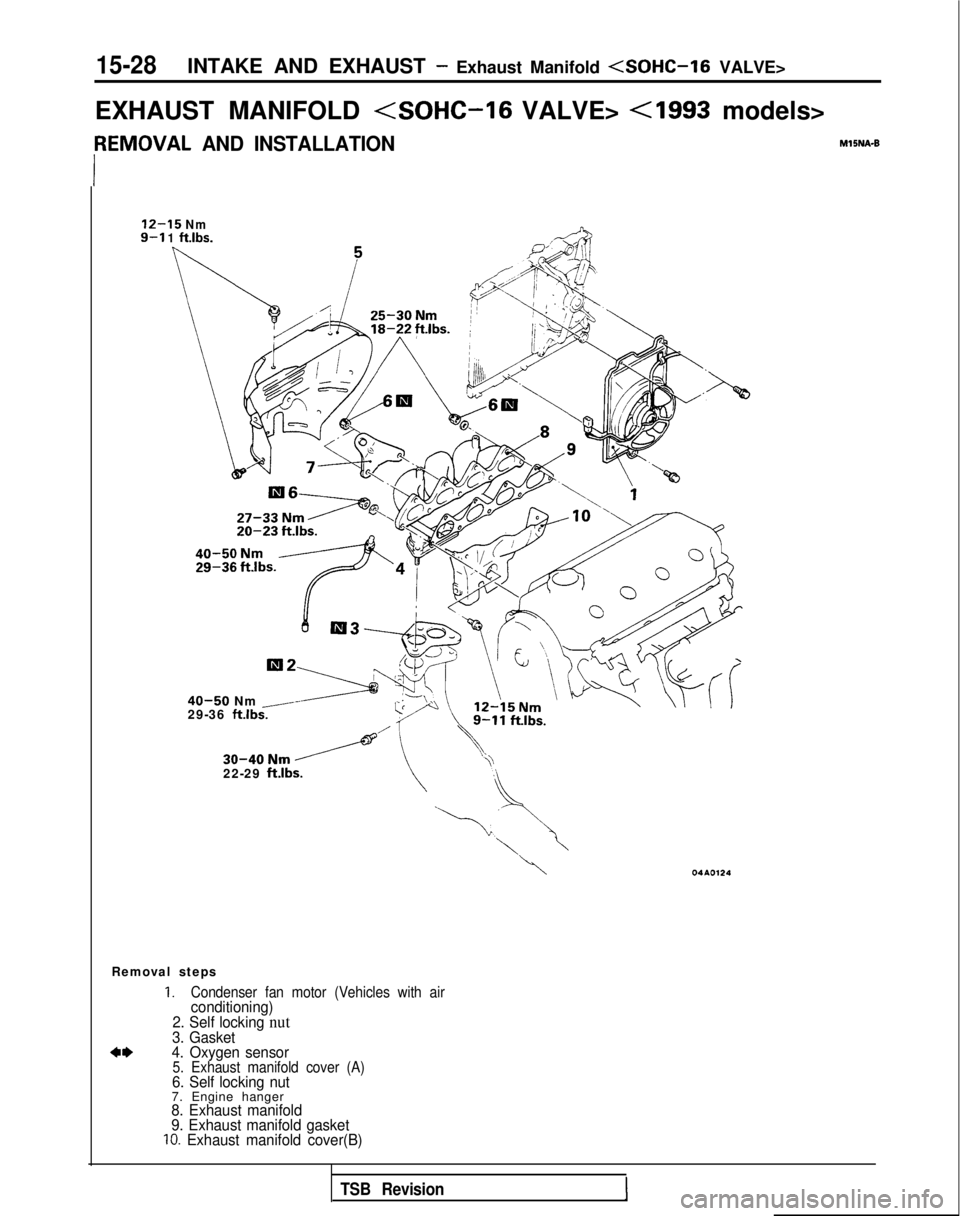
EXHAUST MANIFOLD
PEMOVAL AND INSTALLATION MlSNA-B
.15 Nm
1 ft.lbs.
7-l
40-50Nm ----‘--A
40-50 Nm /-29-36 ft.lbs.
30-40Nmj’22-29 ft.lbs.
Removal steps
1.Condenser fan motor (Vehicles with airconditioning)
2. Self locking nut
3. Gasket
4*4. Oxygen sensor5. Exhaust manifold cover (A)6. Self locking nut7. Engine hanger8. Exhaust manifold
9. Exhaust manifold gasket
IO. Exhaust manifold cover(B)
TSB Revision1
Page 616 of 1273
15-30 INTAKE AND EXHAUST -Exhaust Manifold
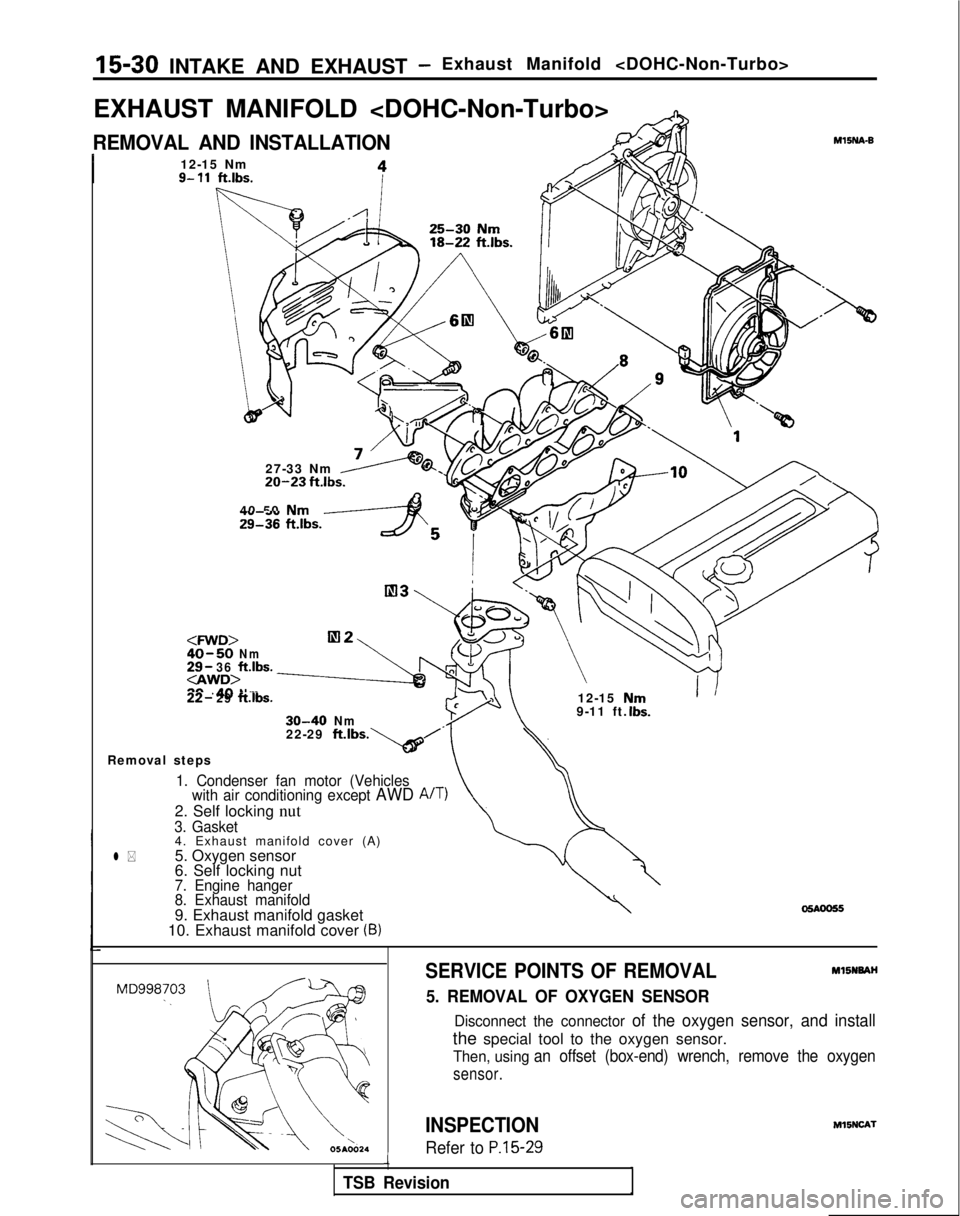
EXHAUST MANIFOLD
REMOVAL AND INSTALLATION
I12-15 Nm9- 11ft.lbs.
27-33 Nm20-23 fklbs.
40 50 Nm29136 ft.lbs.yAS
30-40Nm9-11 ft.
\
UrnIbs.
MlINA-B
22-29 ft.lbs
Removal steps*b’.
1. Condenser fan motor (Vehicles with air conditioning except AWD A/T)
2. Self locking nut3. Gasket4. Exhaust manifold cover (A)
l *5. Oxygen sensor
6. Self locking nut
7. Engine hanger
8. Exhaust manifold
9. Exhaust manifold gasket
10. Exhaust manifold cover (B)
SERVICE POINTS OF REMOVALMl5NNAH
5. REMOVAL OF OXYGEN SENSOR
Disconnect the connector of the oxygen sensor, and install
the special tool to the oxygen sensor.
Then, using an offset (box-end) wrench, remove the oxygen
sensor.
INSPECTION
Refer to P.15-29i
TSB Revision M15NCA-l
Page 617 of 1273
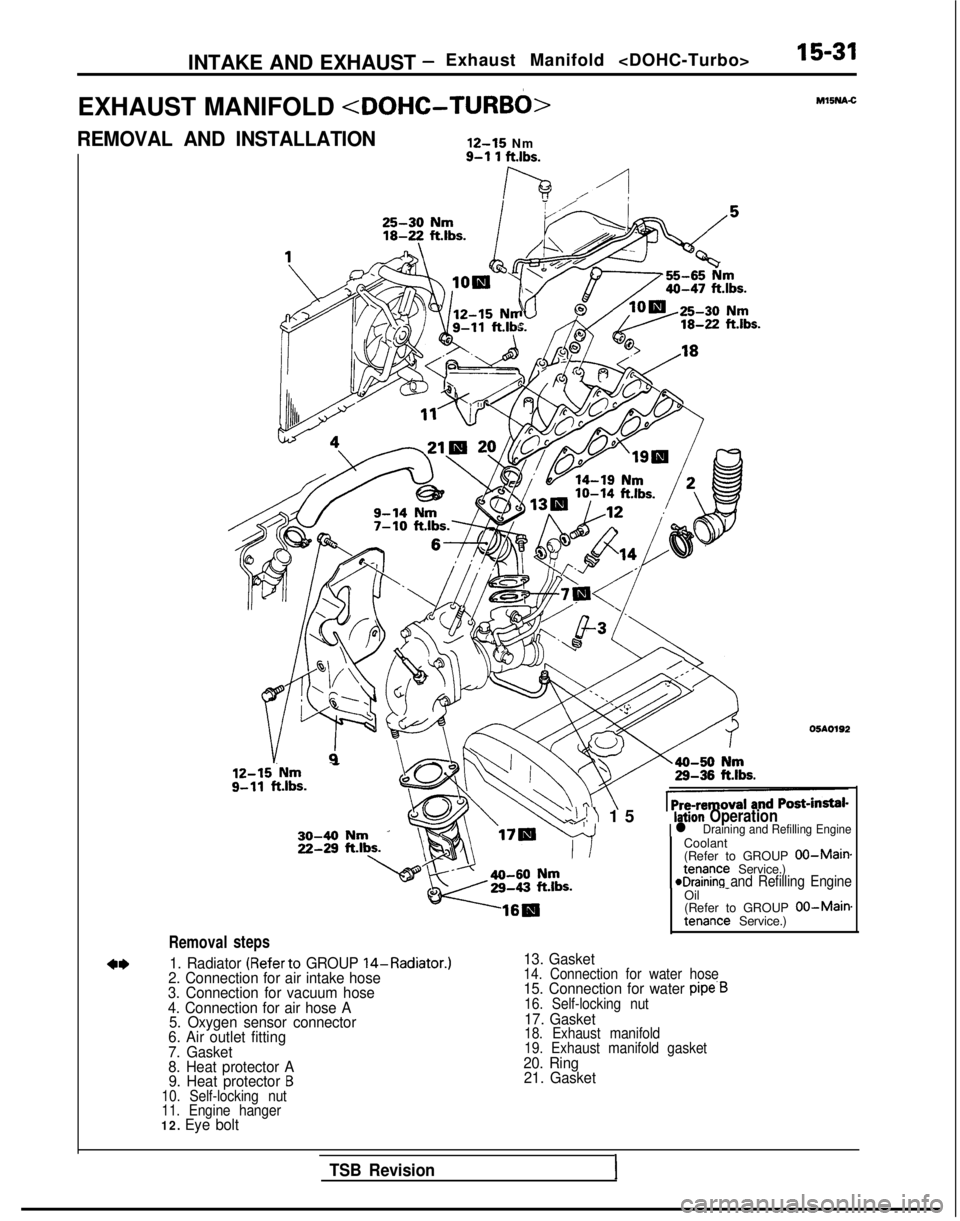
INTAKE AND EXHAUST -Exhaust Manifold
EXHAUST MANIFOLD
REMOVAL AND INSTALLATION
12-15
Nm
Removal
12-15.Nm - g-11
ft.lbs.
steps
9-l 1 ftlbs.
lh ./-I
‘Uc Ml5NA.C
05AO192
Coolant
(Refer to GROUP
00-Maimtenance Service.)eDraining and Refilling Engine
1. Radiator (Referto GROUP 14-Radiator.)
2. Connection for air intake hose
3. Connection for vacuum hose
4. Connection for air hose A 5. Oxygen sensor connector
6. Air outlet fitting
7. Gasket
8. Heat protector A 9. Heat protector
B10. Self-locking nut
11. Engine hanger
12. Eye bolt
‘\!I 1
5
Ilation Operationl Draining and Refilling Engine
Oil
-
(Refer to GROUP 00-Main.tenance Service.)
13. Gasket14. Connection for water hose15. Connection for water pipe.B16. Self-locking nut17. Gasket18. Exhaust manifold
19. Exhaust manifold gasket
20. Ring
21. Gasket
TSB Revision1
Page 621 of 1273

EMISSION CONTROL
SYSTEMS
CONTENTSr.w?API-
CATALYTIC CONVERTER.....................29
EVAPORATIVE EMISSION CONTROL
SYSTEM..........................................15
Air Conditioning Switch........................21
Component Location...........................15
Evaporative Emission Canister................21
Evaporative Emission Purge Solenoid.......21
Fuel Tank Filler Tube Cap Inspection........21
Fuel Tank Pressure Control Valve............21
Purge Control System Inspection
Purge Control System Inspection
.......................................
18
Purge Control Valve
..............20
Purge Port Vacuum............................19
Volume Air Flow Sensor, Engine Coolant
Temperature Sensor and Intake Air
Temperature Sensor
...........................21
EXHAUST GAS RECIRCULATION (EGR)
SYSTEM..........................................22
Component Location...........................22
EGR Solenoid
EGR System Inspection
......25
EGR System Inspection
EGR Temperature Sensor
EGR Valve
......................................27
EGR Valve Control Vacuum..................26
Thermal Vacuum Valve
MIXTURE CONTROL (MFI) SYSTEM. . . . . . . . 29
POSITIVE CRANKCASE VENTILATION
SYSTEM..........................................13
Component Location..........................13
Crankcase Ventilation System Inspection
...14
Positive Crankcase Ventilation (PCV)
Valve Inspection
...............................14
SPECIFICATIONS..................................2
General Specifications...........................2
Sealant............................................2
Service Specifications...........................2
Torque Specifications...........................2
TROUBLESHOOTING.............................3
VACUUM HOSES.................................4
Vacuum Circuit Diagram........................9
Vacuum Hoses Routing.........................4
Page 623 of 1273

EMISSION CONTROL SYSTEMS - Troubleshooting17-3
TROUBLESHOOTINGMVEA-
SymptomProbable causeRemedy
Engine will not start or hardVacuum hose disconnected or Repair or replaceto startdamaged
The EGR valve is not closed. Repair or replace
Malfunction of the evaporativeRepair or replace
emission purge solenoid
Rough idle or engine stalls The EGR valve is not closed.Repair or replace
Vacuum hose disconnected or damaged Repair or replace
Malfunction of the positive crankcaseReplaceventilation valve
Malfunction of the purge control system Check the system; if there is a
problem, check its component parts.
Engine hesitates or poorIcceleration
Zxcessive oil consumption
)oor fuel mileage
Malfunction of the exhaust gasrecirculation system
Positive crankcase ventilation line
clogged
Malfunction of the exhaust gas
recirculation system Check the system; if there is a
problem, check its component parts.
Check positive crankcase ventilation
system
Check the system; if there is a problem,
check its component parts.
TSB Revision
Page 634 of 1273
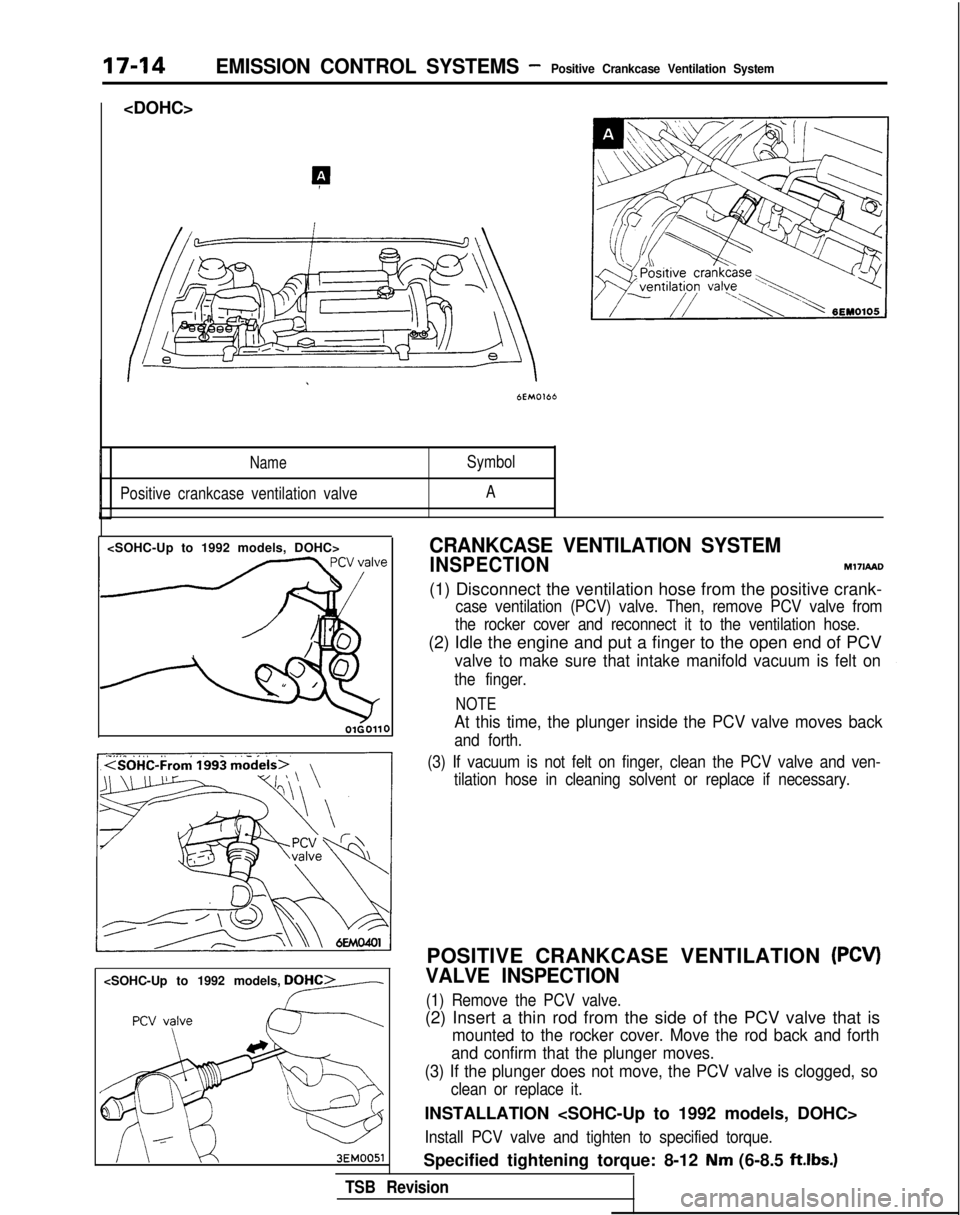
17-14EMISSION CONTROL SYSTEMS -Positive Crankcase Ventilation System
NameSymbol
Positive crankcase ventilation valve A
OlGOllO
INSPECTIONM17IAAO
(1) Disconnect the ventilation hose from the positive crank-
case ventilation (PCV) valve. Then, remove PCV valve from
the rocker cover and reconnect it to the ventilation hose.
(2) Idle the engine and put a finger to the open end of PCV
valve to make sure that intake manifold vacuum is felt on
the finger.
NOTE
At this time, the plunger inside the PCV valve moves back
and forth.
(3) If vacuum is not felt on finger, clean the PCV valve and ven- tilation hose in cleaning solvent or replace if necessary.
POSITIVE CRANKCASE VENTILATION (PCV)
VALVE INSPECTION
(1) Remove the PCV valve.
(2) Insert a thin rod from the side of the PCV valve that is
mounted to the rocker cover. Move the rod back and forth
and confirm that the plunger moves.
(3) If the plunger does not move, the PCV valve is clogged, so
clean or replace it.
INSTALLATION
Install PCV valve and tighten to specified torque.
Specified tightening torque: 8-12 Nm (6-8.5 ftlbs.)
TSB Revision
Page 637 of 1273
EMISSION CONTROL SYSTEMS -Evaporative Emission Control System17-17
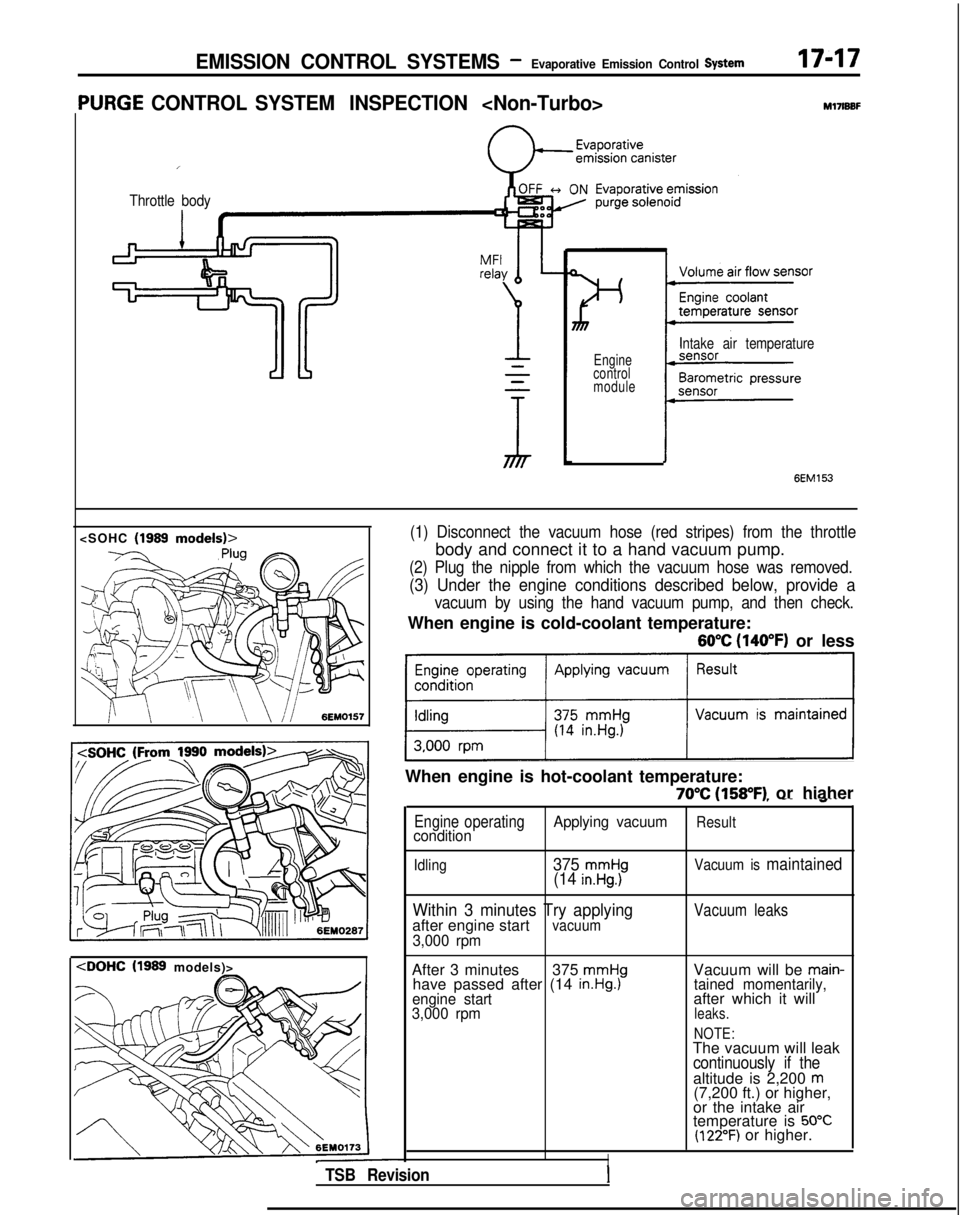
‘URGE CONTROL SYSTEM INSPECTION
I
Throttle body
M17lBBF
Engine
control
module
Intake air temperature
models)>
6EM153
(1) Disconnect the vacuum hose (red stripes) from the throttle
body and connect it to a hand vacuum pump.
(2) Plug the nipple from which the vacuum hose was removed.
(3) Under the engine conditions described below, provide a
vacuum by using the hand vacuum pump, and then check.
When engine is cold-coolant temperature:
60°C (140°F) or less
~1
When engine is hot-coolant temperature:
70°C (158°F) or hiaher, -- ---~“----
Engine operatingApplying vacuumResultcondition
Idling375 mmHg(14 in.Hg.)Vacuum is maintained
Within 3 minutes Try applyingafter engine startvacuum3,000 rpm
Vacuum leaks
After 3 minutes 375 mmHghave passed after (14 in.Hg.)engine start
3,000 rpm
Vacuum will be main-tained momentarily,after which it willleaks.
NOTE:
The vacuum will leakcontinuously if thealtitude is 2,200 m(7,200 ft.) or higher,
or the intake air
temperature is
50°C(122°F) or higher.
ITSB RevisionI
Page 638 of 1273
EMISSION CONTROL SYSTEMS -Evaporative Emission Control System
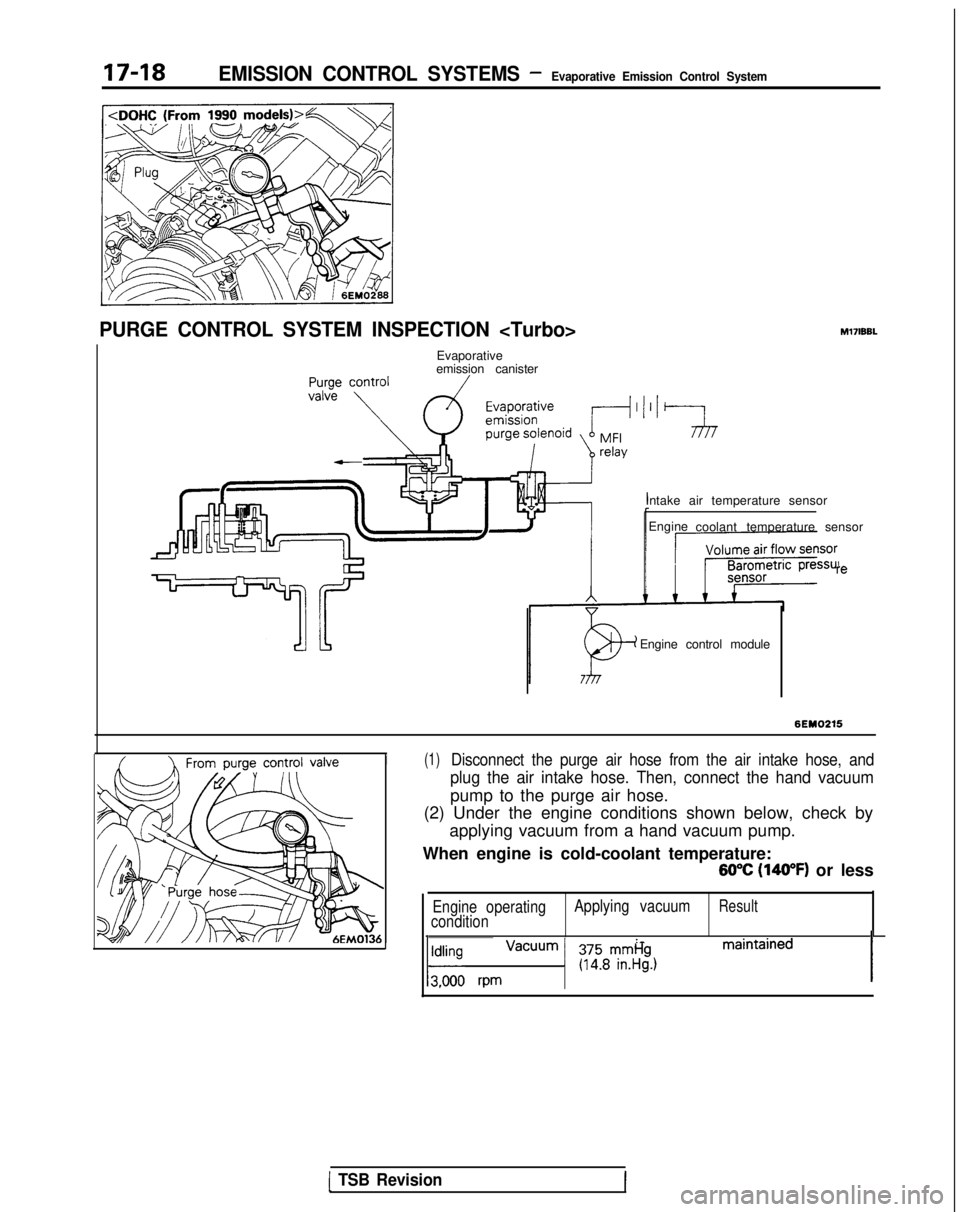
PURGE CONTROL SYSTEM INSPECTION
Evaporative
emission canister
Intake air temperature sensorEngine coolant temperature sensor re
Engine control module
I(1)Disconnect the purge air hose from the air intake hose, and
plug the air intake hose. Then, connect the hand vacuum
pump to the purge air hose.
(2) Under the engine conditions shown below, check by
applying vacuum from a hand vacuum pump.
When engine is cold-coolant temperature:
60°C (140°F) or less
Engine operating Applying vacuumResultcondition
1 vacuum is maintained 1ldldl rpm1 gy?r$y)
[ TSB Revision