key MITSUBISHI GALANT 1989 Service Repair Manual
[x] Cancel search | Manufacturer: MITSUBISHI, Model Year: 1989, Model line: GALANT, Model: MITSUBISHI GALANT 1989Pages: 1273, PDF Size: 37.62 MB
Page 19 of 1273
GENERAL - Towina and Hoisting
00-l 7
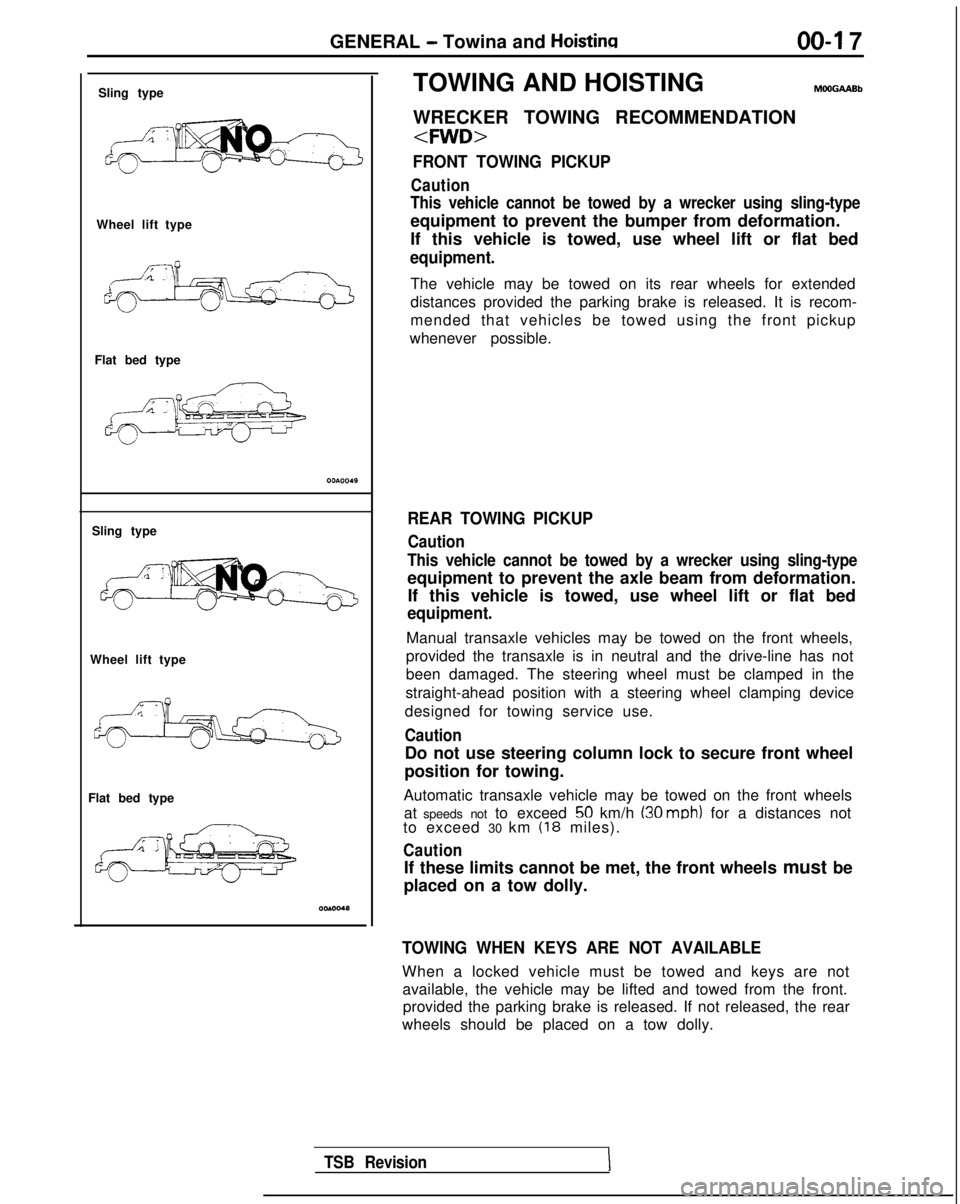
Sling type
Wheel lift type
Flat bed type
Sling type
Wheel lift type
Flat bed type TOWING AND HOISTING
WRECKER TOWING RECOMMENDATION
FRONT TOWING PICKUP
Caution
This vehicle cannot be towed by a wrecker using sling-type
equipment to prevent the bumper from deformation.
If this vehicle is towed, use wheel lift or flat bed
equipment.
The vehicle may be towed on its rear wheels for extended
distances provided the parking brake is released. It is recom-
mended that vehicles be towed using the front pickup
whenever possible.
REAR TOWING PICKUP
Caution
This vehicle cannot be towed by a wrecker using sling-type
equipment to prevent the axle beam from deformation. If this vehicle is towed, use wheel lift or flat bed
equipment.
Manual transaxle vehicles may be towed on the front wheels,
provided the transaxle is in neutral and the drive-line has not
been damaged. The steering wheel must be clamped in the
straight-ahead position with a steering wheel clamping device
designed for towing service use.
Caution
Do not use steering column lock to secure front wheel
position for towing.
Automatic transaxle vehicle may be towed on the front wheels at speeds not to exceed
50 km/h (30 mob) for a distances not
to exceed 30 km (18 miles).
Caution
If these limits cannot be met, the front wheels must be
placed on a tow dolly.
TOWING WHEN KEYS ARE NOT AVAILABLE
When a locked vehicle must be towed and keys are not available, the vehicle may be lifted and towed from the front.provided the parking brake is released. If not released, the rear
wheels should be placed on a tow dolly.
TSB Revision
Page 84 of 1273
11-34
ENGINE
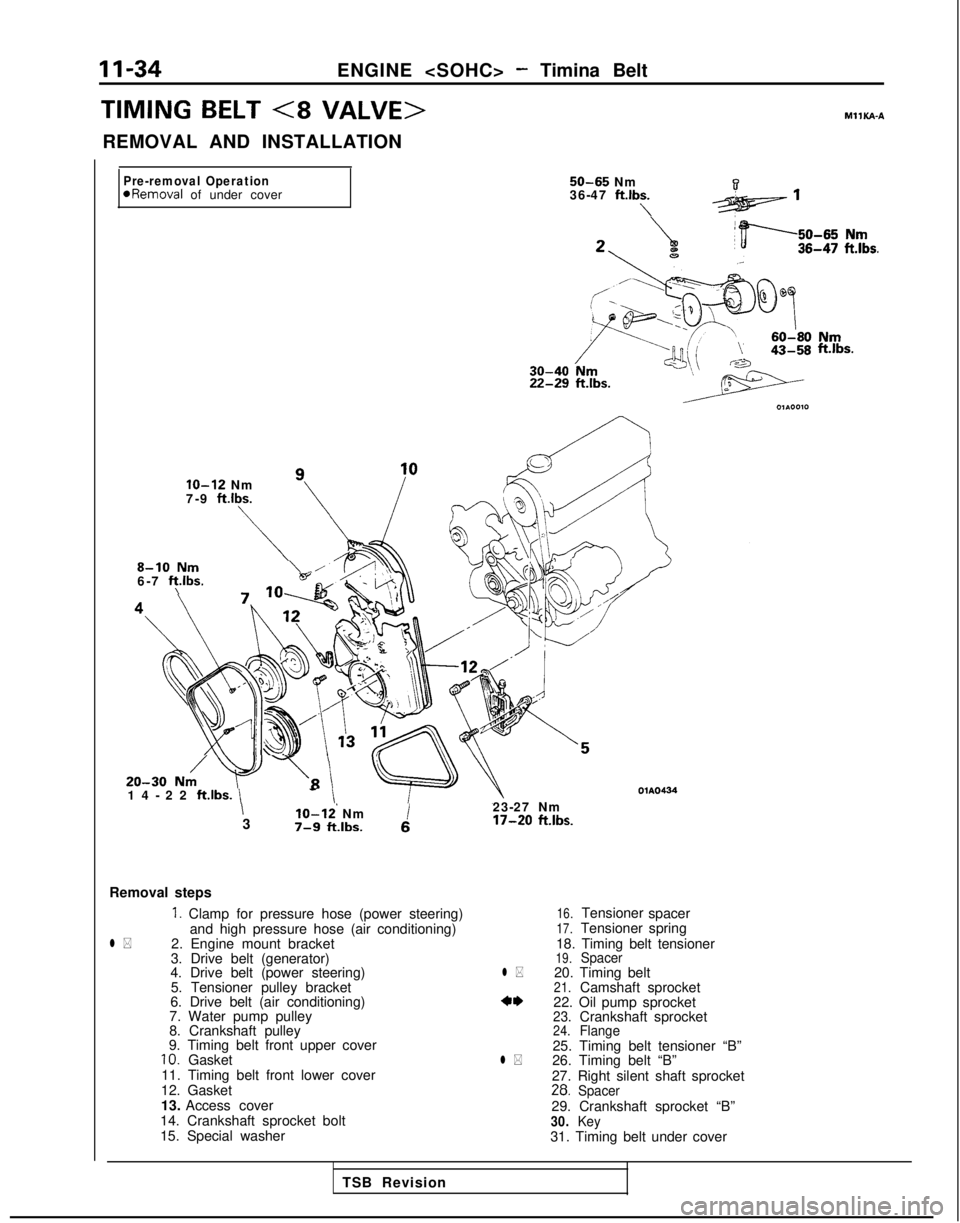
TIMING BELT (8 VALVE>MIlKA-A
REMOVAL AND INSTALLATION
Pre-removal OperationaRemoval of under cover 50-65
Nm
36-47 ftlbs.
\ 22-29
ft.lbs.
ft.lbs.
IO-12 Nm
7-9 ft.lbs. 10
m\../.8-10 N6-7 ft.lbs.\
20-30 N,/ v \R \OlAO43414-22 ft.lbs. \I3
10-12’
Nm7-S ftlbs.
6
23-27 Nm 17-20
ft.lbs.
Removal steps
1. Clamp for pressure hose (power steering)
and high pressure hose (air conditioning)
l *2. Engine mount bracket
3. Drive belt (generator)
4. Drive belt (power steering)
5. Tensioner pulley bracket
6. Drive belt (air conditioning)
7. Water pump pulley
8. Crankshaft pulley
9. Timing belt front upper cover
10. Gasket
11. Timing belt front lower cover
12. Gasket
13. Access cover
14. Crankshaft sprocket bolt
15. Special washer
16.Tensioner spacer17.Tensioner spring
18. Timing belt tensioner
19.Spacerl *20. Timing belt21.Camshaft sprocket*‘I)22. Oil pump sprocket23.24.Crankshaft sprocketFlange25. Timing belt tensioner “B”l *26. Timing belt “B”
27. Right silent shaft sprocket
28.Spacer29. Crankshaft sprocket “B”30.Key31. Timing belt under cover
TSB Revision
Page 85 of 1273
ENGINE
IPost-installation Operationl installation of under coverIaService Adjustment Procedures
(Refer to P.ll-7.)I 50-60
Nm36-43 ftlbs.
31
\\15-22 Nm
11-16 ft.lbs. 24
01 A0437
30. KevIL. -I"..--+A ‘IIT:m;nn halt fmnf lower cover
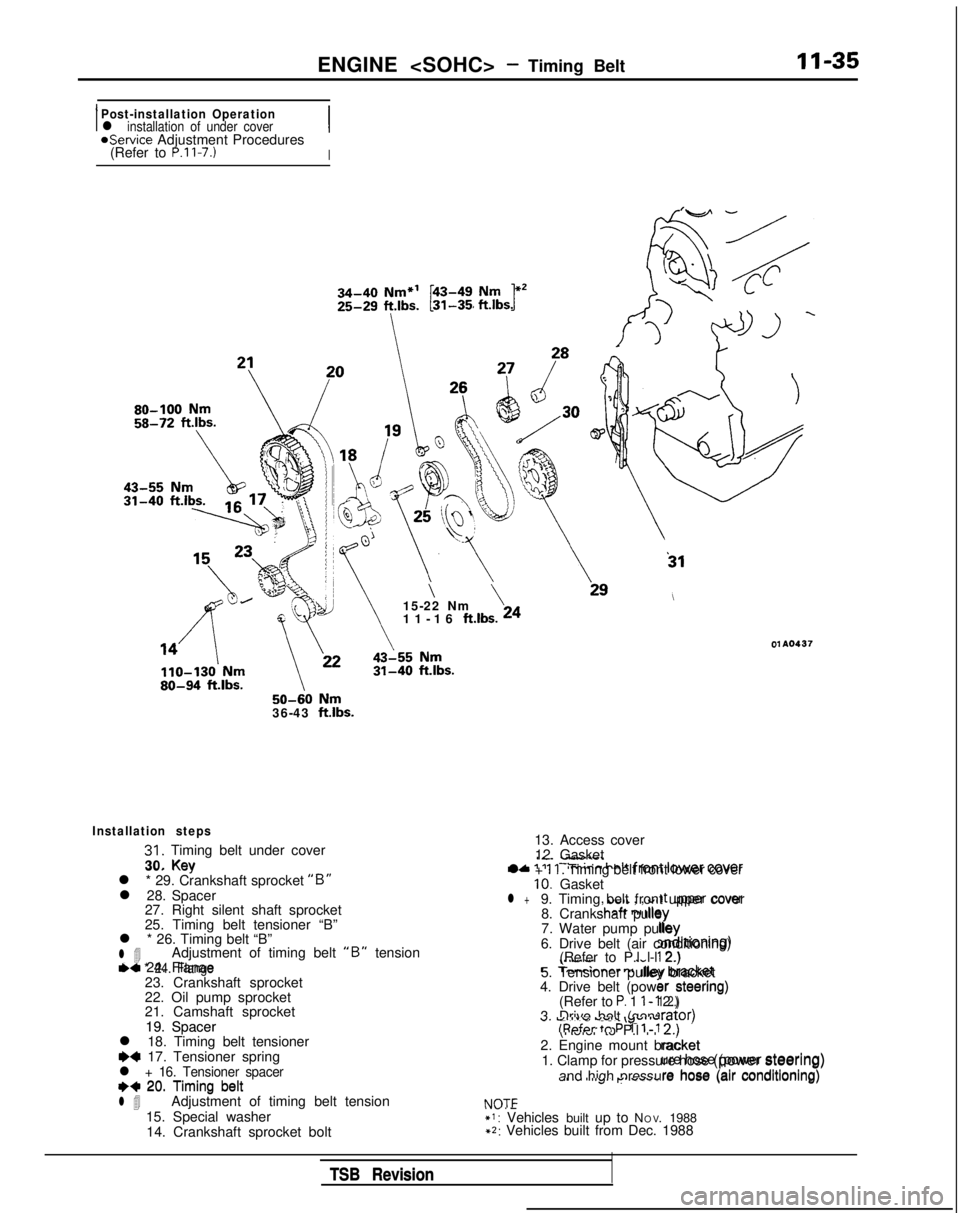
Installation steps
31. Timing belt under cover
30. Key
l * 29. Crankshaft sprocket
“B”l 28. Spacer 27. Right silent shaft sprocket
25. Timing belt tensioner “B”
l * 26. Timing belt “B”
l 4Adjustment of timing belt “B” tensionl * 24. Flange23. Crankshaft sprocket
22. Oil pump sprocket
21. Camshaft sprocket
19. Spacer
l 18. Timing belt tensioner
~~ 17. Tensioner springl + 16. Tensioner spacer++ 20. Timing beltl 4Adjustment of timing belt tension
15. Special washer 14. Crankshaft sprocket bolt
tic 24. Flanae
, UtiIL , , WI ,t upper cover!hcaft n, dlqy
lb. :;d)rtroning)
\..“.w.
.-c
T-mrinnar r
nliny bracket
er steering)1 2.)
19. Spacer
++ 20. Timing belt13. Access cover
12. Gasket
l +
11. Timing belt front lower cover10. Gasketl +9. Timing belt front upper cover 8. Crankshaft pulley
7. Water pump pulley
6. Drive belt (air conditioning) (Refer to P.l l-l 2.)
5. Tensioner pulley bracket
4. Drive belt (power steering)
(Refer to
P. 1 l-l 2.)
3. Drive belt (generator) (Refer to P.l l-l 2.)
2. Engine mount bracket 1. Clamp for pressure hose (power steering)
and high pressure hose (air conditioning)
NOTE*I: Vehicles built up to N O
V. 1988
+2: Vehicles built from Dec. 1988 lrator)
U. Vll”” ““SC \y”v’ulRpfcw tn P 1 l-l
2.)
racket
NOT=
ure hose (power steering)
s-4, I” I “..J’I p.. .#““.are hose (air conditioning)
TSB Revision
TSB Revision
Page 93 of 1273
ENGINE
+/@Service Adjustment Procedures
24?5
20-;7 Nmio
14-20 ft.lbs.\ is\ i7
Nm50-60 Nm80-94 ft.lbs.36-43 ft.lbs.
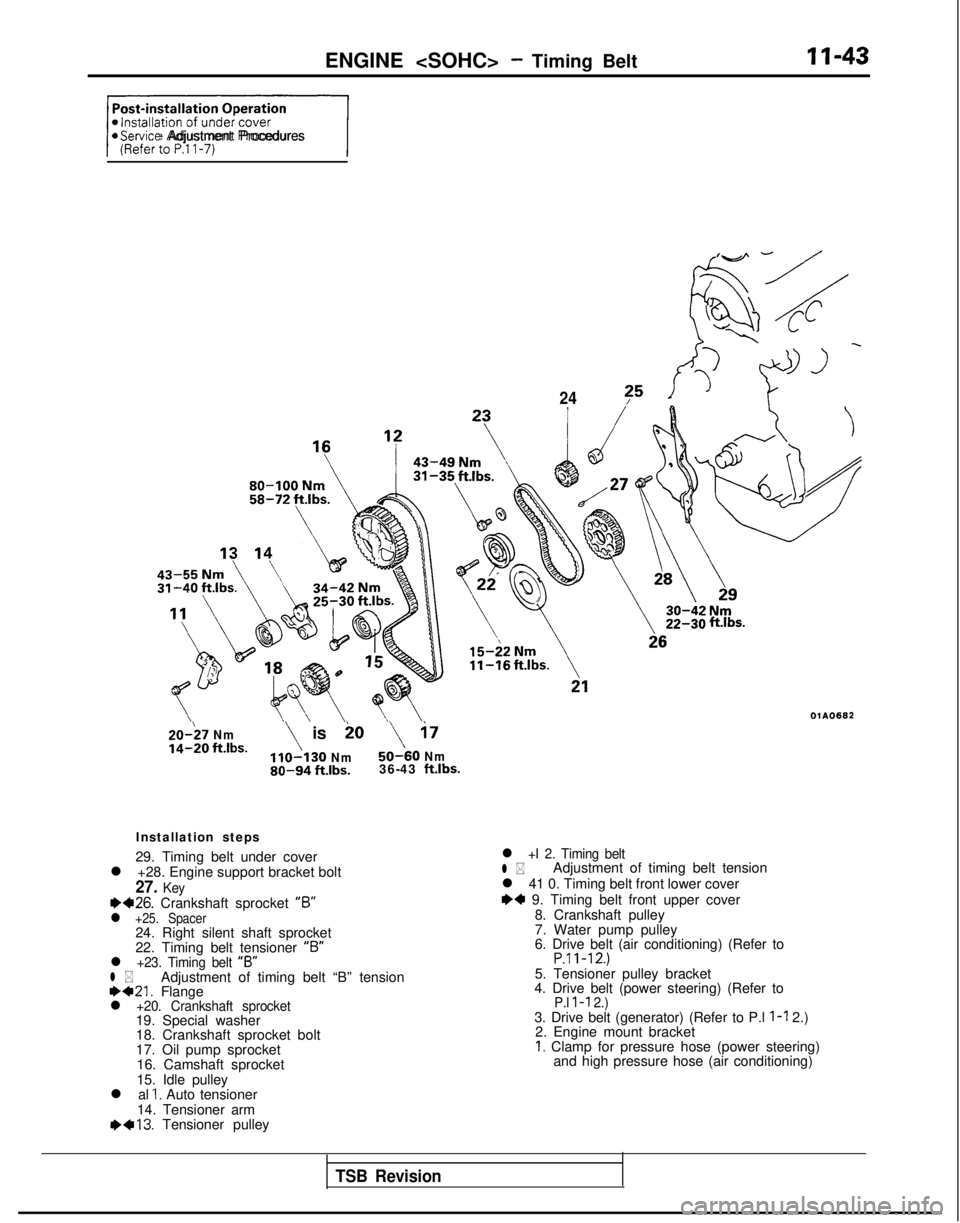
Installation steps
29. Timing belt under cover
l +28. Engine support bracket bolt
27. Keyea26. Crankshaft sprocket “6”l +25. Spacer24. Right silent shaft sprocket
22. Timing belt tensioner “B”
l +23. Timing belt
“B”l *Adjustment of timing belt “B” tension1)421. Flangel +20. Crankshaft sprocket19. Special washer
18. Crankshaft sprocket bolt
17. Oil pump sprocket
16. Camshaft sprocket
15. Idle pulley
l al
1. Auto tensioner
14. Tensioner arm 1)+13.
Tensioner pulley
ftlbs.
OlAO682
l +I 2. Timing beltl *Adjustment of timing belt tension
l 41 0. Timing belt front lower cover
I)+ 9. Timing belt front upper cover 8. Crankshaft pulley
7. Water pump pulley
6. Drive belt (air conditioning) (Refer to
P.ll-12.)5. Tensioner pulley bracket
4. Drive belt (power steering) (Refer to
P.l l-l 2.)3. Drive belt (generator) (Refer to P.l l-l 2.)
2. Engine mount bracket
I. Clamp for pressure hose (power steering) and high pressure hose (air conditioning)
TSB Revision
Page 153 of 1273
FUEL SYSTEM
ON-BOARD DIAGNOSTIC-
The engine control module monitors the input/out-
put signals (some signals at all times and the others
under specified conditions) of the engine control
module.
When it is noticed that an irregularity has continued
for a specified time or longer from when the irregu- lar signal is initially monitored, passing a certain
number, the engine control module judges that an
irregularity has occurred, memorizes the diagnostic
trouble code, and outputs the signal to the on-board
diagnostic output terminal.
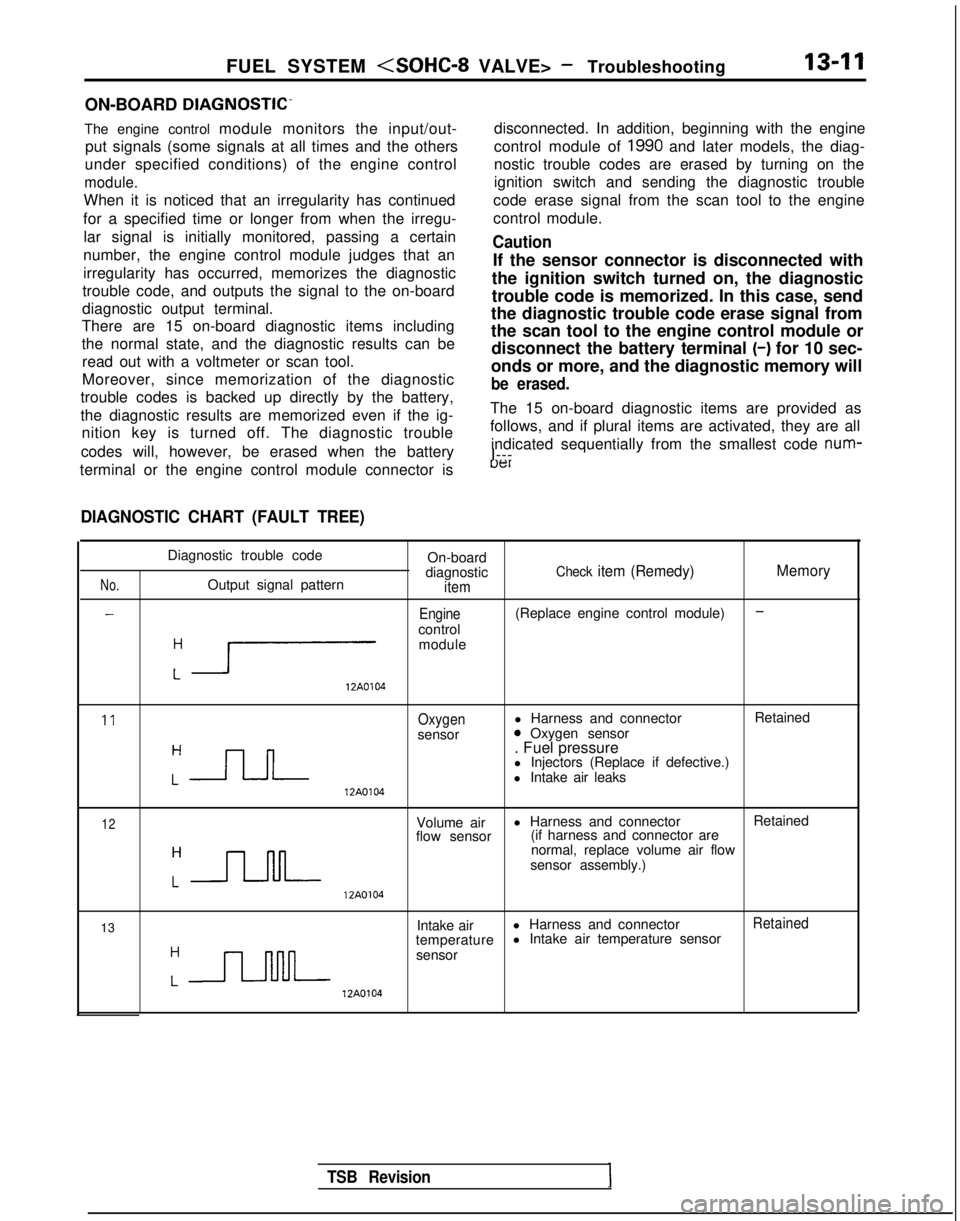
There are 15 on-board diagnostic items including
the normal state, and the diagnostic results can be
read out with a voltmeter or scan tool.
Moreover, since memorization of the diagnostic
trouble codes is backed up directly by the battery,
the diagnostic results are memorized even if the ig- nition key is turned off. The diagnostic trouble
codes will, however, be erased when the battery disconnected. In addition, beginning with the engine
control module of
1990 and later models, the diag-
nostic trouble codes are erased by turning on the
ignition switch and sending the diagnostic trouble
code erase signal from the scan tool to the engine
control module.
Caution
If the sensor connector is disconnected with
the ignition switch turned on, the diagnostic
trouble code is memorized. In this case, send
the diagnostic trouble code erase signal from
the scan tool to the engine control module or disconnect the battery terminal (-)
for 10 sec-
onds or more, and the diagnostic memory will
be erased.
The 15 on-board diagnostic items are provided as
follows, and if plural items are activated, they are all
indicated sequentially from the smallest code num-
I---
terminal or the engine control module connector is
uer
DIAGNOSTIC CHART (FAULT TREE)
No.
-
Diagnostic trouble code On-board
diagnostic
Check item (Remedy) MemoryOutput signal patternitem
-Engine(Replace engine control module)
control
:r
module 12A0104
11Oxygenl Harness and connector
Retained
sensor0 Oxygen sensor
:-JLJ--
. Fuel pressure
l Injectors (Replace if defective.)
l Intake air leaks 12A0104
12Volume air
l Harness and connector
Retained
flow sensor (if harness and connector are
:-JJ-M-
normal, replace volume air flow
sensor assembly.) 12A0104
13 Intake air
l Harness and connector
Retained
temperature l Intake air temperature sensor
:n
sensor 12A0104
TSB Revision
Page 158 of 1273

13-16
FUEL SYSTEM
FAILSAFE/BACK-UP FUNCTIONS LIST
If trouble with any major sensor is detected by the on-board diagnostic,\
the vehicle will be kept in the safe
driving conditions according to the preset control logic.
Trouble item Control content for trouble
Volume air flow Fuel injection timing and ignition timing are determined according to th\
e throttle position
sensor sensor
(TPS) and engine revolution speed signal (crankshaft position sensor signal)\
.
Intake air temperature The control is executed with the suction air temperature regarded as
25°C (77°F).
sensor
Throttle position The fuel injection rate is not increased for acceleration according to t\
he throttle position
sensor
(TPS)sensor signal.
Idle speed control After the idle speed control motor plunger is driven and contracted, the\
idle revolution speed
motor position sensor is not controlled.
Engine coolant The control is executed with the engine coolant temperature regarded as \
8OO.C (176°F).temperature sensor (Even if the sensor signal becomes normal again, the control is continued
until the ignltlon
switch is turned off.)
Camshaft position Simultaneous injection of fuel is executed for all cylinders. (In this \
case, the
No.1 cylinder top
sensor dead center is not detected at all after the ignition key is turned on.)\
Barometric pressure The control is executed with the pressure regarded as 760 mmHg
(30
in.Hg).
sensor
Oxygen sensor Closed loop control of the air/fuel mixture ratio is not executed.
i
READ OUT OF DIAGNOSTIC TROUBLE CODE
Precautions for operation
(1) When battery voltage is low, no detection of failure is possible. Be sure to check the battery for voltage and
other conditions before starting the test.
(2) On-board diagnostic item is erased if the battery or the engine control module connector is discon-
nected. Do not disconnect the battery before the di-
agnostic result is completely read.
Using Scan Tool
(1) Switch OFF the ignition switch.
(2) Connect the power-source terminal of the scan tool to the
cigarette lighter socket.
(3) Connect the scan tool to the data link connector. (4) Turn ignition switch to ON.
(5) Using the scan tool, read out and make a note of the
on-
board diagnostic output.
(6) Refer to the diagnostic chart, and repair the indicated loca-
tion of malfunction.
(7) Erase the diagnostic trouble code. (Refer to
P.13-17.)
1 TSB RevisionI
Page 159 of 1273
FUEL SYSTEM
\ I\-\\\\\\6FUO807
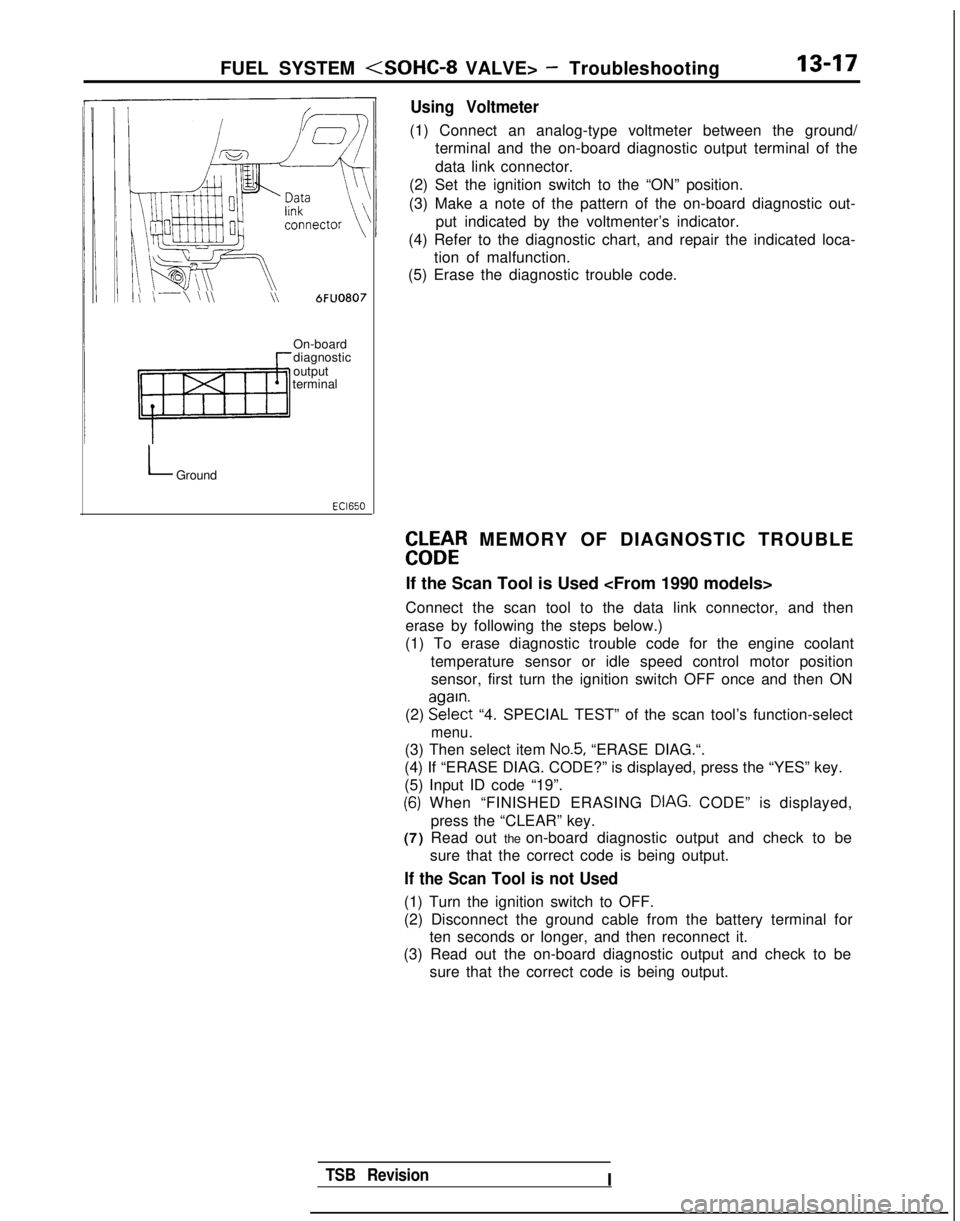
Using Voltmeter
(1) Connect an analog-type voltmeter between the ground/
terminal and the on-board diagnostic output terminal of the
data link connector.
(2) Set the ignition switch to the “ON” position.
(3) Make a note of the pattern of the on-board diagnostic out- put indicated by the voltmenter’s indicator.
(4) Refer to the diagnostic chart, and repair the indicated loca- tion of malfunction.
(5) Erase the diagnostic trouble code.
On-board
diagnostic
output
terminal
LGround
EbLbtR MEMORY OF DIAGNOSTIC TROUBLE
If the Scan Tool is Used
Connect the scan tool to the data link connector, and then
erase by following the steps below.)
(1) To erase diagnostic trouble code for the engine coolant
temperature sensor or idle speed control motor positionsensor, first turn the ignition switch OFF once and then ON
(2) EE?$t
“4. SPECIAL TEST” of the scan tool’s function-select
menu.
(3) Then select item No.5, “ERASE DIAG.“.
(4) If “ERASE DIAG. CODE?” is displayed, press the “YES” k\
ey.
(5) Input ID code “19”.
(6) When “FINISHED ERASING DIAG. CODE” is displayed,> Ipress the “CLEAR” key.
(7) Read out the on-board diagnostic output and check to be
sure that the correct code is being output.
If the Scan Tool is not Used
(1) Turn the ignition switch to OFF.
(2) Disconnect the ground cable from the battery terminal forten seconds or longer, and then reconnect it.
(3) Read out the on-board diagnostic output and check to be
sure that the correct code is being output.
TSB RevisionI
Page 183 of 1273
FUEL SYSTEM
Ciaarette
COMPONENTS INSPECTION PROCEDURE-
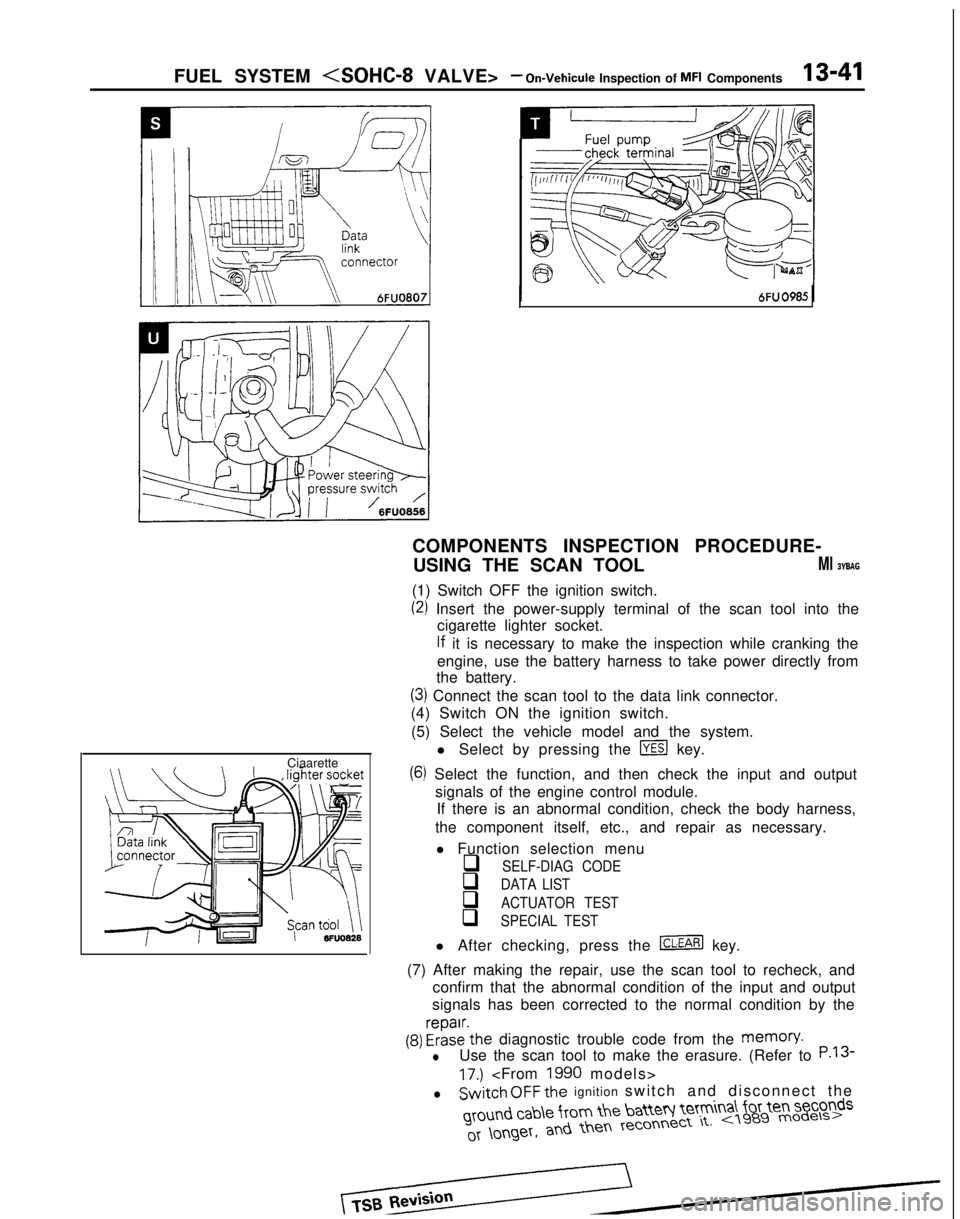
USING THE SCAN TOOL
Ml BYBAG
(1) Switch OFF the ignition switch.
(2) Insert the power-supply terminal of the scan tool into the cigarette lighter socket.
lf it is necessary to make the inspection while cranking the
engine, use the battery harness to take power directly from
the battery.
(3) Connect the scan tool to the data link connector.
(4) Switch ON the ignition switch.
(5) Select the vehicle model and the system. l Select by pressing the
m key.
(6) Select the function, and then check the input and outputsignals of the engine control module.If there is an abnormal condition, check the body harness,
the component itself, etc., and repair as necessary.
l Function selection menu
q SELF-DIAG CODE
q DATA LIST
q ACTUATOR TEST
q SPECIAL TEST
l After checking, press the m key.
(7) After making the repair, use the scan tool to recheck, and confirm that the abnormal condition of the input and output
signals has been corrected to the normal condition by the
(9) FrizE’the diagnostic trouble code from the memory.
lUse the scan tool to make the erasure. (Refer to P.13
17.)
lSwitch OFF the ignition switch and disconnect the ground
cab\e from the batteq Ie’tm
a\ for ten seconds
Page 263 of 1273
FUEL SYSTEM
ON-BOARD DIAGNOSTIC
The engine control module monitors the input/out- put signals (some signals at all times and the others
under specified conditions) of the engine control
module.
When it is noticed that an irregularity has continued
for a specified time or longer from when the irregu- lar signal is initially monitored, passing a certain
number, the engine control module judges that an irregularity has occurred, memorizes the diagnostic
trouble code, and outputs the signal to the on-board
diagnostic output terminal.
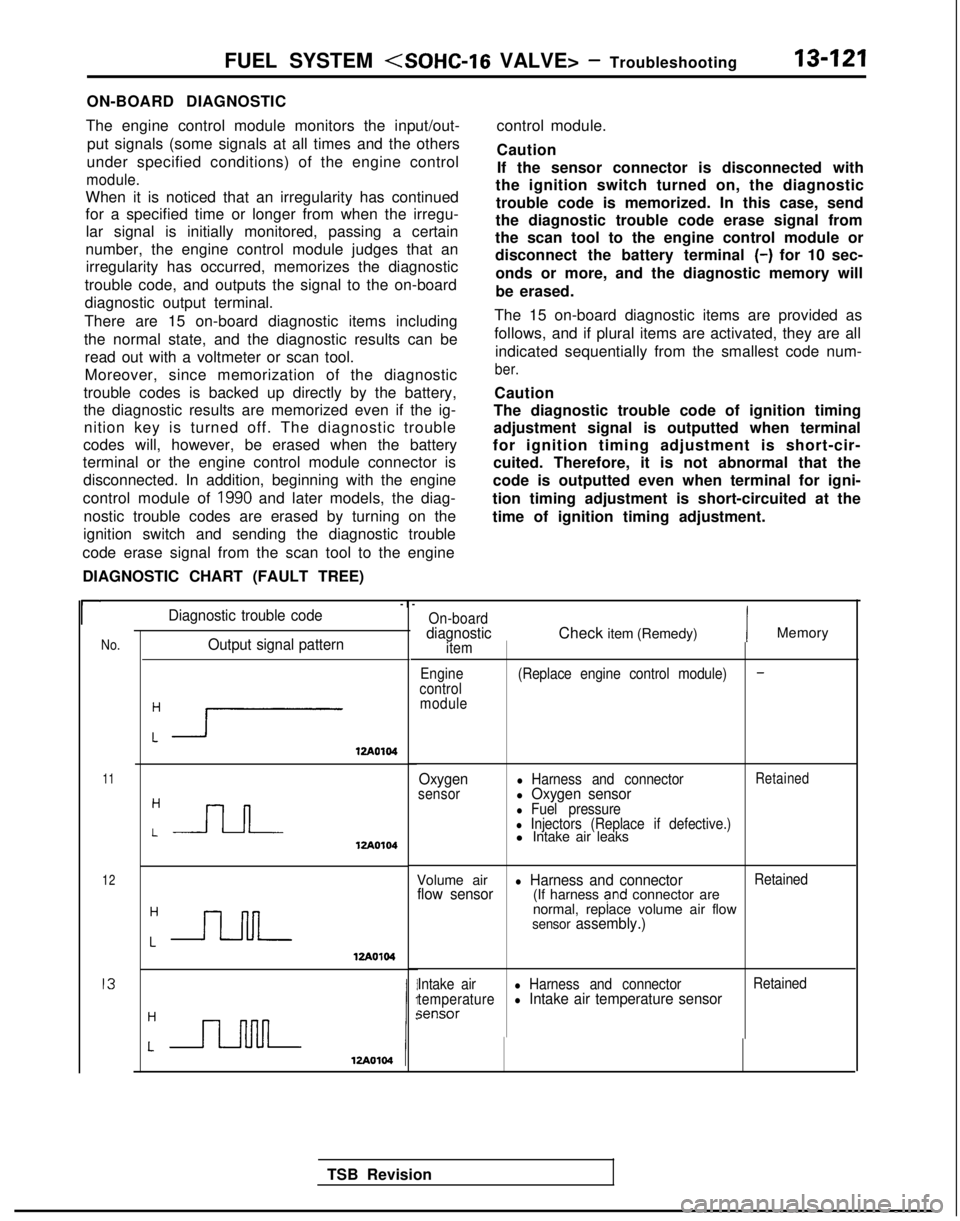
There are 15 on-board diagnostic items including
the normal state, and the diagnostic results can be read out with a voltmeter or scan tool.
Moreover, since memorization of the diagnostic
trouble codes is backed up directly by the battery,
the diagnostic results are memorized even if the ig- nition key is turned off. The diagnostic trouble
codes will, however, be erased when the battery
terminal or the engine control module connector is
disconnected. In addition, beginning with the engine
control module of
1990 and later models, the diag-
nostic trouble codes are erased by turning on the
ignition switch and sending the diagnostic trouble
code erase signal from the scan tool to the engine
DIAGNOSTIC CHART (FAULT TREE) control module.
Caution
If the sensor connector is disconnected with
the ignition switch turned on, the diagnostic
trouble code is memorized. In this case, send
the diagnostic trouble code erase signal from
the scan tool to the engine control module or
disconnect the battery terminal
(-) for 10 sec-
onds or more, and the diagnostic memory will
be erased.
The 15 on-board diagnostic items are provided as
follows, and if plural items are activated, they are all indicated sequentially from the smallest code num-
ber.
Caution
The diagnostic trouble code of ignition timing
adjustment signal is outputted when terminal
for ignition timing adjustment is short-cir- cuited. Therefore, it is not abnormal that the
code is outputted even when terminal for igni-
tion timing adjustment is short-circuited at the
time of ignition timing adjustment.
r
No.Output signal pattern
:i1zA0104
11
12
I3
:-J-l-J-12Ao104
Diagnostic trouble code-I
-
On-boarddiagnosticitem
Engine
control moduleCheck item (Remedy)IMemory
(Replace engine control module)-
Oxygensensorl Harness and connectorRetainedl Oxygen sensorl Fuel pressurel Injectors (Replace if defective.)l Intake air leaks
Volume air
l Harness and connectorRetainedflow sensor(If harness and connector are
normal, replace volume air flow
sensor assembly.)
Intake airl Harness and connector Retained
temperaturel Intake air temperature sensorsensor
TSB Revision
Page 268 of 1273

13-126FUEL SYSTEM
FAILSAFE/BACK-UP FUNCTIONS LIST
If trouble with any major sensor is detected by the on-board diagnostic,\
the vehicle will be kept in the safe
driving conditions according to the preset control logic.
Trouble item Control content for trouble
Volume air flow(1)Fuel injection timing and ignition timing are determined according to th\
e throttle positionsensorsensor (TPS) and engine revolution speed signal (crankshaft position \
sensor signal).(2)The IAC motor is fixed in the appointed position so idle air control is not per\
formed.
Intake air temperature The control is executed with the suction air temperature regarded as
25°C (77°F).sensor
Throttle position The fuel injection rate is not increased for acceleration according to t\
he throttle position
sensor (TPS)sensor signal.
Engine coolantThe control is executed with the coolant temperature regarded as 80°C (176’F).temperature sensor
Camshaft positionSimultaneous injection of fuel is executed for all cylinders. (In this \
case, the
No.1 cylinder top
jenS0r
dead center is not detected at all after the ignition key is turned
on.)3arometric
pressure The control is executed with the pressure regarded as 760 mmHg
(30 in. Hg.).
sensor
AC valve position Idle air control motor is not performed.;ensor
Ixygen sensor
Closed loop control of the air/fuel mixture ratio is not executed.
READ OUT OF DIAGNOSTIC TROUBLE CODE
Refer to P.13-16.
EbW&R MEMORY OF DIAGNOSTIC TROUBLE
Refer to
P.13-17.
TSB Revision