roof MITSUBISHI GRANDIS 2008 (in English) User Guide
[x] Cancel search | Manufacturer: MITSUBISHI, Model Year: 2008, Model line: GRANDIS, Model: MITSUBISHI GRANDIS 2008Pages: 458, PDF Size: 18.52 MB
Page 114 of 458

2-66 Seat and seat belts
2
The front air bags ARE NOT DESIGNED TO
DEPLOY when... The front air bags are not designed to deploy in conditions
where they cannot typically provide protection to the occupant.
Such conditions are shown in the illustration.
Because the front air bags do not protect the occupant in all
types of collisions, be sure to always properly wear your seat
belts.
Side collisions
Vehicle rolls onto its side or roof Rear end collisions
BK-XP08E1ENUK.en-uk.book Page 66 Monday, August 13, 2007 2:20 PM
Page 118 of 458

2-70 Seat and seat belts
2
Curtain air bag system
E00409100038
The curtain air bags are contained in the front pillars and roof
side rail. The curtain air bag is designed to inflate only on the
side of the vehicle that is impacted, even with no passenger in
the front seat or second seat.
Deployment of side air bags and curtain air bags
E00407700649
The side air bags and curtain air bags ARE
DESIGNED TO DEPLOY when...The side air bags and curtain air bags are designed to deploy
when the vehicle suffers a moderate to severe side impact to
the middle of the passenger compartment.
The typical condition is shown in the illustration.
The seat belts in your vehicle are your primary means of pro-
tection in a collision. The SRS (Supplemental Restraint Sys-
tem) side air bags and curtain air bags are designed to provide
additional protection. Therefore, for your safety and the safety
of all occupants, be sure to always properly wear your seat
belts.
BK-XP08E1ENUK.en-uk.book Page 70 Monday, August 13, 2007 2:20 PM
Page 120 of 458

2-72 Seat and seat belts
2
The side air bags and curtain air bags ARE NOT
DESIGNED TO DEPLOY when...The side air bags and curtain air bags are not designed to
deploy in conditions where they cannot usually provide protec-
tion to the occupant. Typical conditions are shown in the illus-
tration.
Oblique side impacts
Vehicle rolls onto its side or roof
Head-on collisions
Rear end collisions
BK-XP08E1ENUK.en-uk.book Page 72 Monday, August 13, 2007 2:20 PM
Page 123 of 458

Seat and seat belts
2-75
2
WARNING
!●Do not attach a microphone (A) or any other device
or object around the part where the curtain air bags
activate such as on the windscreen, side door glass,
front and rear pillars and roof side or assist grips.
When the curtain air bags inflate, the microphone
or other device or object will be hurled with great
force or the curtain air bags may not activate cor-
rectly, resulting in death or serious injury.
WARNING
!●Do not put a hanger or any heavy or pointed object
on the coat hook.
If the curtain air bag was activated, any such item
could be propelled away with great force and could
prevent the curtain air bag from inflating correctly.
Hang clothes directly on the coat hook (without
using a hanger).
Make sure there are no heavy or sharp objects in the
pockets of clothes that you hang on the coat hook.●Do not allow the child to lean against or close to the
front door even if the child is seated in a child
restraint system.
The child’s head should also not be leaned against or
be close to the area where the side air bags and cur-
tain air bags are located. It is dangerous if the side
air bags and curtain air bags inflate.
Failure to follow all of these instructions could lead
to serious or fatal injury to the child.●We recommend work around and on the side air
bags and curtain air bags system to be done by a
MITSUBISHI MOTORS Authorized Service Point.
Improper work could result in inadvertent deploy-
ment of side air bags and curtain air bags, or could
render side air bags and curtain air bags inopera-
tive; either situation could result in serious injury.
BK-XP08E1ENUK.en-uk.book Page 75 Monday, August 13, 2007 2:20 PM
Page 125 of 458

Seat and seat belts
2-77
2
SRS servicing
E00407900726
NOTE●When you transfer ownership of the vehicle to some other
person, we urge you to alert the new owner that it is
equipped with the SRS and refer that owner to the applica-
ble section in this owner’s manual.
●If you junk or scrap the vehicle, we urge you to first take
the vehicle to a MITSUBISHI MOTORS Authorized
Service Point so that the SRS can be rendered safe.
WARNING
!●We recommend any maintenance performed on or
near the components of the SRS to be performed by
a MITSUBISHI MOTORS Authorized Service
Point.
Improper work on the SRS components or wiring
could result in inadvertent deployment of the air
bags, or could render the SRS inoperative; either
situation could result in serious injury.●Do not modify your steering wheel, seat belt retrac-
tor or any other SRS components. For example,
replacement of the steering wheel, or modifications
to the front bumper or body structure can adversely
affect SRS performance and lead to possible injury.●If your vehicle has received any damage, we recom-
mend you to have the SRS inspected to ensure it is in
proper working order.●Do not modify your front seats, centre pillar and
centre console.
It can adversely affect SRS performance and lead to
possible injury.
Also, if you have found any tear or open seam in the
seat fabric at the portion near the side air bag, we
recommend you to have the seat inspected.●If you have found any scratch, crack or damage to
the portion of the front and rear pillars and roof side
rail, you should have the SRS inspected by a MIT-
SUBISHI MOTORS Authorized Service Point.
BK-XP08E1ENUK.en-uk.book Page 77 Monday, August 13, 2007 2:20 PM
Page 174 of 458

4-2 Starting and driving
4Economical driving
E00600100372
For economical driving, there are some technical requirements
that have to be met. The prerequisite for low fuel consumption
is a properly adjusted engine. In order to achieve longer life of
the vehicle and the most economical operation, we recommend
you have the vehicle checked at regular intervals in accordance
with the service standards.
Fuel economy and generation of exhaust gas and noise are
highly influenced by personal driving habits as well as the par-
ticular operating conditions. The following points should be
observed in order to minimize wear of brakes, tyres and engine
as well as to reduce environmental pollution.StartingAvoid rapid acceleration and sudden starts; such operation will
result in higher fuel consumption.ShiftingShift only at an appropriate speed and engine speed. Always
use the highest gear possible.City trafficFrequent starting and stopping increases the average fuel con-
sumption. Use roads with smooth traffic flow whenever possi-
ble. When driving on congested roads, avoid use of a low gear
at high engine speeds.IdlingThe vehicle consumes fuel even during idling. Avoid extended
idling whenever possible.
SpeedThe higher the vehicle speed, the more fuel consumed. Avoid
driving at full speed. Even a slight release of the accelerator
pedal will save a significant amount of fuel.Tyre inflation pressureCheck the tyre inflation pressures at regular intervals. Low tyre
inflation pressure increases road resistance and fuel consump-
tion. In addition, low tyre pressures adversely affect tyre wear
and driving stability.LoadDo not drive with unnecessary articles in the luggage compart-
ment. Especially during city driving where frequent starting
and stopping is necessary, the increased weight of the vehicle
will greatly affect fuel consumption. Also avoid driving with
unnecessary luggage, etc., on the roof; the increased air resist-
ance will increase fuel consumption.Cold engine startingStarting of a cold engine consumes more fuel.
Unnecessary fuel consumption is also caused by keeping a hot
engine running. After the engine is started, commence driving
as soon as possible.Air conditioningThe use of the air conditioning will increase the fuel consump-
tion.
BK-XP08E1ENUK.en-uk.book Page 2 Monday, August 13, 2007 2:20 PM
Page 230 of 458

4-58 Starting and driving
4
Loading a roof carrier*NOTE●We recommend you to use a genuine MITSUBISHI roof
carrier, since the brackets to be used have a special shape.
For details, we recommend you to consult a MITSUBI-
SHI MOTORS Authorized Service Point.
Roof carrier mounting brackets*When installing the roof carrier, use the brackets (A). The
brackets (A) are located under each roof drip moulding (B).NOTE●We recommend you to use a genuine MITSUBISHI roof
carrier, since the brackets to be used have a special shape.
For details, we recommend you to consult a MITSUBI-
SHI Authorized Service Point.
CAUTION
!●Do not load luggage directly onto the roof. Use a roof
carrier that properly fits your vehicle.
For installation, refer to the instruction manual
accompanying the roof carrier.
BK-XP08E1ENUK.en-uk.book Page 58 Monday, August 13, 2007 2:20 PM
Page 231 of 458

Starting and driving
4-59
4
Roof carrier precaution
NOTE●To prevent wind noise or reduction in fuel economy,
remove the roof carrier when not in use.
●Before using an automatic car wash, check with the
attendant to determine if the roof carrier should be
removed.
●Be sure that adequate clearance is maintained for raising
the sunroof (if so equipped) and/or the tailgate when
installing a roof carrier.
CAUTION
!●Make sure that the weight of the luggage does not
exceed the allowable roof load.
If the allowable roof load is exceeded, this may cause
damage to the vehicle.
The roof load is the total allowable load on the roof
(the weight of the roof carrier plus the weight of lug-
gage placed on the roof carrier).
For specific figures, please refer to “Maximum roof
load” on page 9-8.●When luggage is loaded onto the vehicle, please
make sure to drive slowly and avoid excessive
maneuvers such as sudden braking or quick turn-
ing.
In addition, place the luggage on the carrier so that
its weight is distributed evenly with the heaviest
items on the bottom. Do not load items that are
wider than the roof carrier.
The additional weight on the roof could raise the
vehicle’s centre of gravity and affect vehicle han-
dling characteristics.
As a result, driving errors or emergency maneuvers
could lead to a loss of control and result in an acci-
dent.
●Before driving and after travelling a short distance,
always check the load to make sure it is securely fas-
tened to the roof carrier.
Check periodically during your travel that the load
remains secure. If the load is not secure, it could fall
from the vehicle and damage your vehicle, another
vehicle or create road hazard.
CAUTION
!
BK-XP08E1ENUK.en-uk.book Page 59 Monday, August 13, 2007 2:20 PM
Page 236 of 458
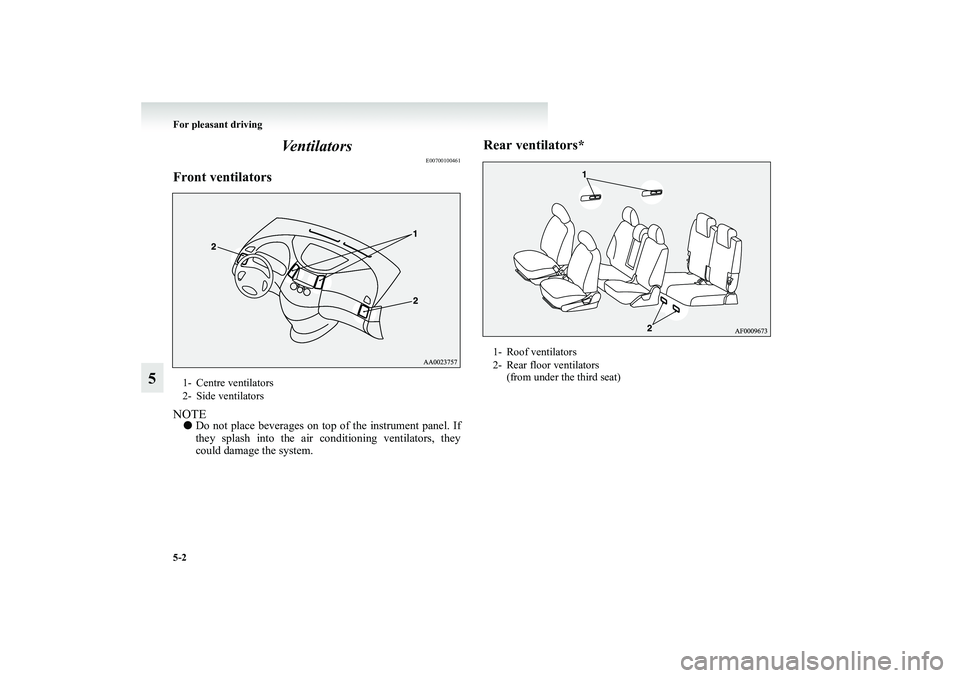
5-2 For pleasant driving
5Ventilators
E00700100461
Front ventilatorsNOTE●Do not place beverages on top of the instrument panel. If
they splash into the air conditioning ventilators, they
could damage the system.
Rear ventilators*
1- Centre ventilators
2- Side ventilators
1- Roof ventilators
2- Rear floor ventilators
(from under the third seat)
BK-XP08E1ENUK.en-uk.book Page 2 Monday, August 13, 2007 2:20 PM
Page 237 of 458

For pleasant driving
5-3
5
Air flow and direction adjustments
E00700200101
Front ventilatorsThe ventilator can be opened and closed with the dial (A).
() - Open
( ) - Close
Adjust the direction of the air flow by moving the knob (B).
Rear ventilators (roof ventilators only)Adjust the direction of the air flow by moving the knob (A).NOTE●The cool air from the ventilators may appear as a mist.
This is due to moist air being suddenly cooled by the air
conditioning. This will clear after a few moments.
BK-XP08E1ENUK.en-uk.book Page 3 Monday, August 13, 2007 2:20 PM