light MITSUBISHI GRANDIS 2008 (in English) Owner's Guide
[x] Cancel search | Manufacturer: MITSUBISHI, Model Year: 2008, Model line: GRANDIS, Model: MITSUBISHI GRANDIS 2008Pages: 458, PDF Size: 18.52 MB
Page 290 of 458

5-56 For pleasant driving
5
The lighter will automatically return to its original position
with a “click” when ready. Pull it out for use.
After use, insert the lighter to its original position in the socket.NOTE●Do not leave the cigarette lighter removed from its socket,
because the socket might become clogged by foreign
material and be short-circuited.1- Push all the way in.
CAUTION
!●Do not touch heating element or lighter housing,
hold the knob only to prevent burns.●Do not allow children to operate or play with the cig-
arette lighter as burns may occur.RHD
●Something is wrong with the cigarette lighter if it
does not pop back out within approximately 30 sec-
onds of being pushed in.
Leaving the cigarette lighter pushed in for an
extended period could cause fire. If it does not pop
out by itself, we recommend you to have it checked.●Do not leave the cigarette lighter pushed in or insert
the cigarette lighter from another vehicle. Other-
wise, the lighter may overheat and cause fire.●It is recommended that only the lighter be inserted
in its socket.
Use of “plug-in” type accessories may damage the
socket and result in poor retention of the lighter.●When the cigarette lighter socket is used as a power
source for an electric appliance, be sure that the
electric appliance operates at 12 V and has an elec-
tric capacity of 120 W or less. In addition, long use
of the electric appliance without running the engine
may run down the battery.
CAUTION
!
BK-XP08E1ENUK.en-uk.book Page 56 Monday, August 13, 2007 2:20 PM
Page 297 of 458

For pleasant driving
5-63
5
Lamps (room lamps, etc.) auto-cutout function
(vehicles with keyless entry system)
E00712900293
If any of the interior lamps are left switched on with the igni-
tion key in any position other than “ON” or “ACC”, it goes off
automatically after approximately 30 minutes to prevent com-
plete discharge of the battery.
The lamp comes on again if the ignition key is turned to the
“ON” or “ACC” position, any door or tailgate is opened and
closed, or the keyless entry remote control is operated.NOTE●The interior lamp auto-cut function can be deactivated.
We recommend you to consult a MITSUBISHI MOTORS
Authorized Service Point for detailed information and
assistance.
On a vehicle equipped with a Multi Display Station
(MDS), the functions can be adjusted on the screen. For
details, refer to a separate operation manual.
Storage spaces
E00713100928
NOTE●Do not leave valuables in any storage space when leaving
the vehicle.
CAUTION
!●Never leave lighters, cans of carbonated drink, and
spectacles in the cabin when parking the vehicle in
hot sunshine. The cabin will become extremely hot,
so lighters and other flammable items may catch fire
and unopened drink cans (including beer cans) may
rupture. The heat may also deform or crack plastic
spectacle lenses and other spectacle parts that are
made of plastic.●Keep the lids of storage spaces closed while driving
the vehicle. A lid or the contents of a storage space
could otherwise cause injuries.
BK-XP08E1ENUK.en-uk.book Page 63 Monday, August 13, 2007 2:20 PM
Page 312 of 458

5-78 For pleasant driving
5Cargo net
E00715800020
To use, attach the net to the hooks according to the illustration.
The cargo net is used to cover light articles in the luggage com-
partment to prevent them from tumbling.
Warning triangle retaining bands
E00715200079
Band (B) to be used for retaining a warning triangle can be
accessed with the third seat stowed and the luggage floor board
(A) raised. (Refer to “Stowing the third seat” on page 2-22.)NOTE●Some warning triangles may not fit fully into the storage
space and may thus be damaged by the third seat.
BK-XP08E1ENUK.en-uk.book Page 78 Monday, August 13, 2007 2:20 PM
Page 327 of 458

For emergencies
6-15
6
9. Insert the bar (F) into the wheel nut wrench (G). Then put
the end of the bar into the shaft’s jack end, as shown in the
illustration.
Slowly rotate the wheel nut wrench until the tyre is raised
slightly off the ground surface.
WARNING
!●Stop jacking up the vehicle as soon as the tyre is
raised off the ground. It is dangerous to raise the
vehicle any higher.●Do not get under your vehicle while using the jack.●Do not bump the raised vehicle or leave it sitting on
the jack for a long time. Both are very dangerous.●Do not use a jack except the one that came with your
vehicle.●The jack should not be used for any purpose other
than to change a tyre.
●No one should be in your vehicle when using the
jack.●Do not start or run the engine while your vehicle is
on the jack.●Do not turn the raised wheel. The tyres still on the
ground could turn and make your vehicle fall off the
jack.
WARNING
!
BK-XP08E1ENUK.en-uk.book Page 15 Monday, August 13, 2007 2:20 PM
Page 328 of 458

6-16 For emergencies
6Spare wheel
E00801101176
Check the air pressure of the spare tyre frequently and make
sure it is ready for emergency use at any time.
Maintaining the spare wheel at the highest specified air pres-
sure will ensure that it can always be used under any conditions
(city/high-speed driving, varying load weight, etc.).
The spare wheel is stored under the rear of the body.Compact spare wheelThe compact spare tyre is designed to save space in the lug-
gage compartment and its lighter weight makes it easier to use
if a flat tyre occurs.
CAUTION
!●The pressure should be periodically checked and
maintained at the specified pressure while the tyre is
stowed.
Driving with an insufficient tyre pressure can lead to
an accident. If you have no choice but to drive with
an insufficient tyre pressure, keep your speed down
and inflate the tyre to the correct pressure as soon as
possible. (Refer to “Tyre inflation pressures” on
page 8-21.)●The compact spare wheel is for temporary use only
and should be removed as soon as the original wheel
can be repaired or replaced.●The vehicle must not be driven at speeds in excess of
80 km/h (50 mph) while using the compact spare
wheel.
●The compact spare tyre is not as good as a standard
tyre in controllability and stability. When the com-
pact spare tyre is used, avoid quick starts, sudden
braking and sharp steering.●Avoid driving through automatic vehicle washers
and over obstacles that could possibly damage the
vehicle’s undercarriage. Because the compact spare
wheel is smaller than the original wheel, the ground
clearance is slightly reduced.●The compact spare wheel is specifically designed for
your vehicle and it should not be used on any other
vehicle.
CAUTION
!
BK-XP08E1ENUK.en-uk.book Page 16 Monday, August 13, 2007 2:20 PM
Page 329 of 458

For emergencies
6-17
6
NOTE●The wheel hanger is designed for a compact spare wheel
only. It cannot be used for storage of any other kind of
wheel.
Store any wheel with a punctured tyre in the luggage area.
●Check that the compact spare wheel is not loose by trying
to joggle it with your hands or feet. If it is loose, the wheel
hanger or hook may be deformed. Store the wheel inside
the luggage area, and have it repaired.
CAUTION
!●Do not use tyre chain with your compact spare
wheel. Because of the smaller tyre size, a tyre chain
will not fit properly. This could cause damage to the
wheel and result in loss of the chain.
If a front tyre becomes flat when using tyre chains,
first replace a rear wheel with the compact spare
wheel and then use the removed rear wheel to
replace the flat front wheel so that you can continue
to use the chains.
CAUTION
!●The compact spare tyre should not be used on any
other wheels, nor should standard tyres, snow tyres,
wheel covers or trim rings be used with the compact
spare wheel. If such use is attempted, damage to
these items or other vehicle components may occur.●Upon installation of the compact spare tyre, the
overall vehicle height is slightly lowered as the tyre
is smaller in diameter than the standard tyre. When
passing over the projections on the road, use care
not to drive the vehicle with the same feeling as used
in driving with the standard tyre on.●Do not install more than one compact spare wheel at
the same time.●When the tread wear indicators appear, the tyre
must be replaced.
Refer to “Wheel condition” on page 8-23.
BK-XP08E1ENUK.en-uk.book Page 17 Monday, August 13, 2007 2:20 PM
Page 334 of 458
6-22 For emergencies
6
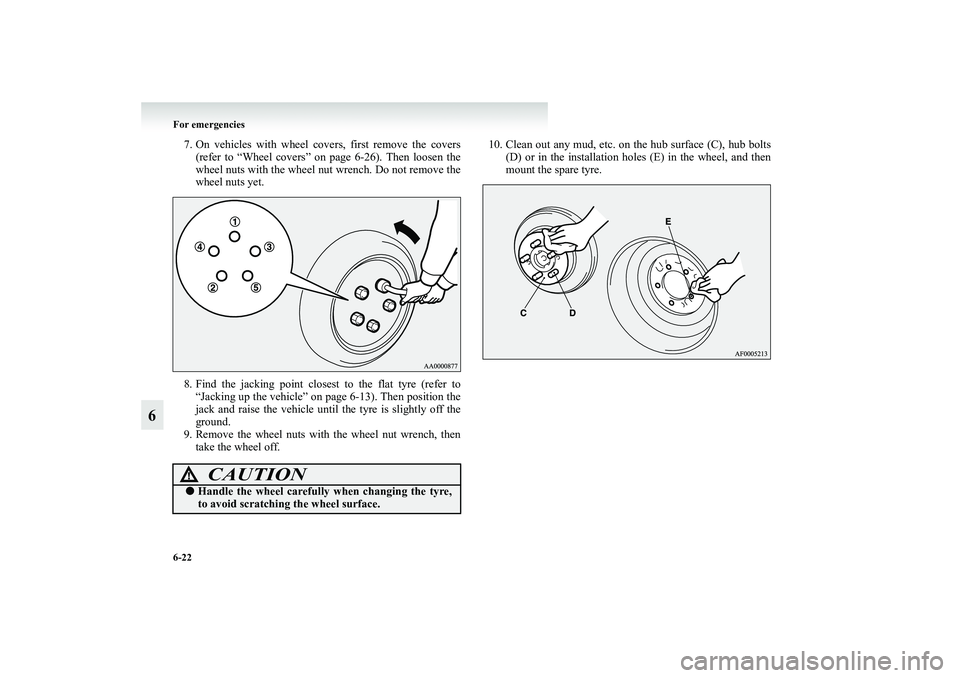
7. On vehicles with wheel covers, first remove the covers
(refer to “Wheel covers” on page 6-26). Then loosen the
wheel nuts with the wheel nut wrench. Do not remove the
wheel nuts yet.
8. Find the jacking point closest to the flat tyre (refer to
“Jacking up the vehicle” on page 6-13). Then position the
jack and raise the vehicle until the tyre is slightly off the
ground.
9. Remove the wheel nuts with the wheel nut wrench, then
take the wheel off.10. Clean out any mud, etc. on the hub surface (C), hub bolts
(D) or in the installation holes (E) in the wheel, and then
mount the spare tyre.
CAUTION
!●Handle the wheel carefully when changing the tyre,
to avoid scratching the wheel surface.
BK-XP08E1ENUK.en-uk.book Page 22 Monday, August 13, 2007 2:20 PM
Page 335 of 458
For emergencies
6-23
6
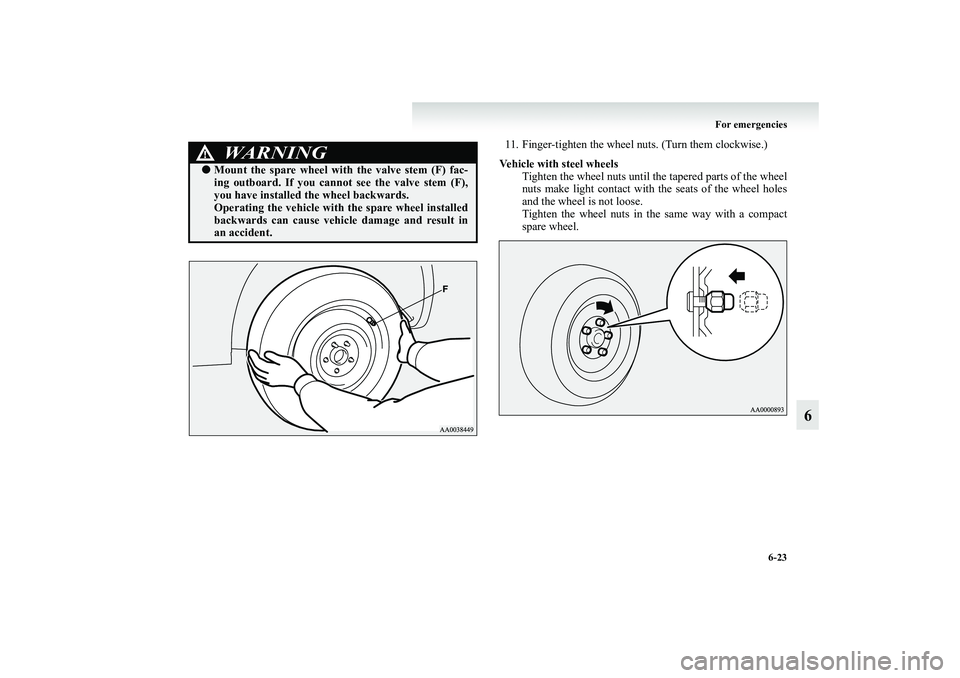
11. Finger-tighten the wheel nuts. (Turn them clockwise.)
Vehicle with steel wheels
Tighten the wheel nuts until the tapered parts of the wheel
nuts make light contact with the seats of the wheel holes
and the wheel is not loose.
Tighten the wheel nuts in the same way with a compact
spare wheel.
WARNING
!●Mount the spare wheel with the valve stem (F) fac-
ing outboard. If you cannot see the valve stem (F),
you have installed the wheel backwards.
Operating the vehicle with the spare wheel installed
backwards can cause vehicle damage and result in
an accident.
BK-XP08E1ENUK.en-uk.book Page 23 Monday, August 13, 2007 2:20 PM
Page 336 of 458
6-24 For emergencies
6
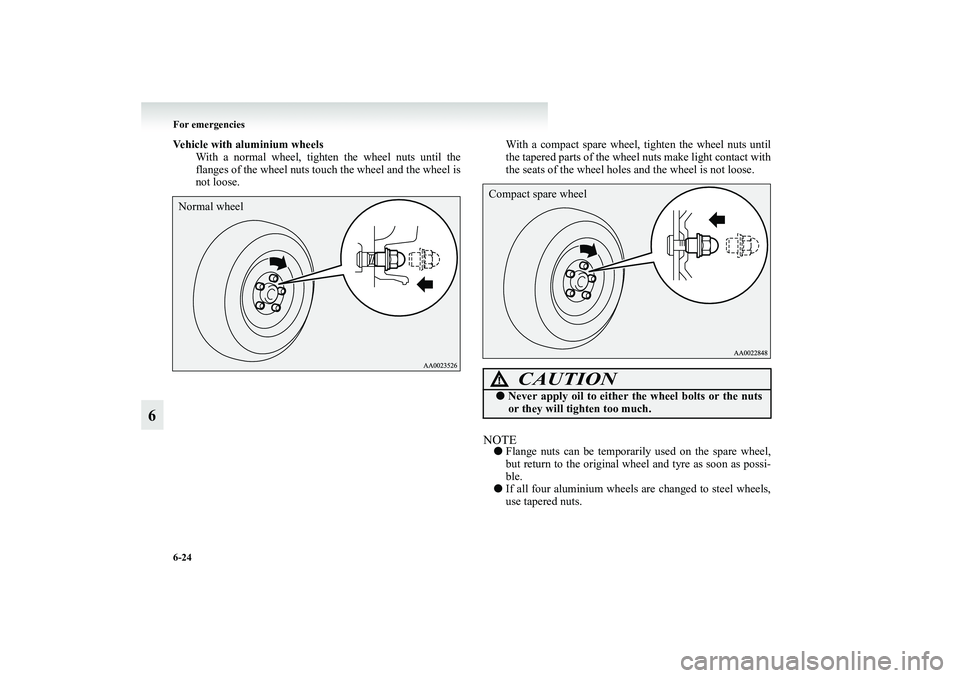
Vehicle with aluminium wheels
With a normal wheel, tighten the wheel nuts until the
flanges of the wheel nuts touch the wheel and the wheel is
not loose.With a compact spare wheel, tighten the wheel nuts until
the tapered parts of the wheel nuts make light contact with
the seats of the wheel holes and the wheel is not loose.
NOTE●Flange nuts can be temporarily used on the spare wheel,
but return to the original wheel and tyre as soon as possi-
ble.
●If all four aluminium wheels are changed to steel wheels,
use tapered nuts.
Normal wheel
CAUTION
!●Never apply oil to either the wheel bolts or the nuts
or they will tighten too much.Compact spare wheel
BK-XP08E1ENUK.en-uk.book Page 24 Monday, August 13, 2007 2:20 PM
Page 347 of 458

For emergencies
6-35
6 Operation under adverse driving conditions
E00801701404
If your vehicle becomes stuck in sand, mud or
snowIf the vehicle becomes stuck in snow, sand, or mud, it can often
be moved by a rocking motion. Move the selector lever alter-
nately between the Sports mode and “R” (REVERSE) position
(with M/T, between 1st and Reverse), while applying slight
pressure to the accelerator pedal.
Avoid racing the engine or spinning the wheels. Prolonged
efforts to free a stuck vehicle may result in overheating and
transmission failure. Allow the engine to idle for a few minutes
to let the transmission cool between rocking attempts.
If the vehicle remains stuck after several rocking attempts, seek
other assistance.
On a flooded road●Avoid flooded roads. Water could enter the brake discs,
resulting in temporarily ineffective brakes. In such cases,
lightly depress the brake pedal to see if the brakes operate
properly. If they do not, lightly depress the pedal several
times while driving in order to dry the brake pads.
●When driving in rain or on a road with many puddles a
layer of water may form between the tyres and the road
surface.
This reduces a tyre’s frictional resistance on the road,
resulting in loss of steering stability and braking capabil-
ity.
To cope with this, observe the following items:
WARNING
!●When attempting to rock your vehicle out of a stuck
position, be sure that the area around the vehicle is
clear of people and physical objects. The rocking
motion may cause the vehicle to suddenly launch
forward or backward, causing injury or damage to
nearby people or objects.
(a) Drive your vehicle at a slow speed.
(b) Do not drive on worn tyres. Always maintain the
specified tyre inflation pressures.
BK-XP08E1ENUK.en-uk.book Page 35 Monday, August 13, 2007 2:20 PM