brake MITSUBISHI GRANDIS 2008 Owner's Manual (in English)
[x] Cancel search | Manufacturer: MITSUBISHI, Model Year: 2008, Model line: GRANDIS, Model: MITSUBISHI GRANDIS 2008Pages: 458, PDF Size: 18.52 MB
Page 6 of 458
Overview
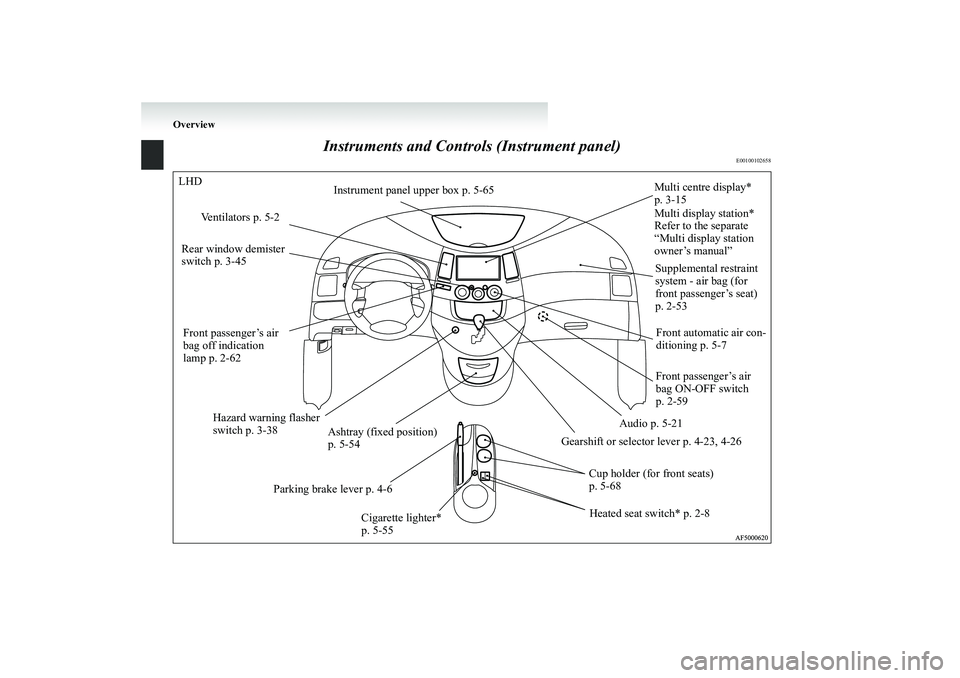
Instruments and Controls (Instrument panel)
E00100102658
LHD
Multi centre display*
p. 3-15
Ventilators p. 5-2
Rear window demister
switch p. 3-45
Hazard warning flasher
switch p. 3-38
Ashtray (fixed position)
p. 5-54
Cup holder (for front seats)
p. 5-68 Gearshift or selector lever p. 4-23, 4-26
Parking brake lever p. 4-6
Cigarette lighter*
p. 5-55Supplemental restraint
system - air bag (for
front passenger’s seat)
p. 2-53
Front automatic air con-
ditioning p. 5-7
Audio p. 5-21 Instrument panel upper box p. 5-65
Heated seat switch* p. 2-8Front passenger’s air
bag ON-OFF switch
p. 2-59 Front passenger’s air
bag off indication
lamp p. 2-62Multi display station*
Refer to the separate
“Multi display station
owner’s manual”BK-XP08E1ENUK.en-uk.book Page 3 Monday, August 13, 2007 2:20 PM
Page 7 of 458

Overview
RHD
Instrument panel upper box p. 5-65
Ventilators p. 5-2
Supplemental restraint
system - air bag (for
front passenger’s seat)
p. 2-53
Rear window demister
switch p. 3-45
Front passenger’s air bag
ON-OFF switch p. 2-59
Gearshift or selector lever
p. 4-23, 4-26
Ashtray (fixed position)
p. 5-54
Cup holder (for front seats)
p. 5-68
Heated seat switch* p. 2-8Hazard warning flasher switch p. 3-38
Parking brake lever p. 4-6Front automatic air
conditioning p. 5-7
Audio p. 5-21Multi centre display*
p. 3-15
Front passenger’s air
bag off indication lamp
p. 2-62 Multi display station*
Refer to the separate
“Multi display station
owner’s manual”
BK-XP08E1ENUK.en-uk.book Page 4 Monday, August 13, 2007 2:20 PM
Page 81 of 458

Seat and seat belts
2-33
2 Seat belts
E00404800593
To protect you and your passengers in the event of an accident,
it is the most important that the seat belts be worn correctly
when you drive.
The front seat belts have a pre-tensioner system. These belts
are used the same way as a conventional seat belt.
Refer to “Seat belt pre-tensioner system and force limiter sys-
tem” on page 2-39.
WARNING
!●Always place the shoulder belt over your shoulder
and across your chest. Never put it behind you or
under your arm.●One seat belt should be used by only one person.
Doing otherwise can be dangerous.●The seat belt will provide its wearer with maximum
protection if the recliner seatback is placed in fully
upright position. When the seatback is reclined,
there is greater risk that the passenger will slide
under the belt, especially in a forward impact acci-
dent, and may be injured by the belt or by striking
the instrument panel or seatbacks.●Seat belts should always be worn by every adult who
drives or rides in this vehicle, and by all children
who are large enough to wear seat belts properly.●Remove any twists when using the belt.●No modifications or additions should be made by the
user which will either prevent the seat belt adjusting
devices from operating to remove slack, or prevent
the seat belt assembly from being adjusted to
remove slack.●To reduce risk of serious or fatal injury in an acci-
dent, including the deploying driver air bag, the
driver should adjust the driver’s seat to the rear
most position that still allows good visibility and
good control of the steering wheel, the brake and
accelerator, and vehicle controls.
BK-XP08E1ENUK.en-uk.book Page 33 Monday, August 13, 2007 2:20 PM
Page 134 of 458

3-8 Instruments and controls
3Indicator and warning lamps
E00501501337
1- CRUISE indication lamp* → p. 4-46
2- ASC indication lamp* → p. 4-43
3- Turn-signal indication lamps/Hazard warning indication
lamps → p. 3-9
4- Rear fog lamp indication lamp → p. 3-9
5- Front fog lamp indication lamp → p. 3-9
6- High-beam indication lamp → p. 3-9
7- Diesel particulate filter (DPF) warning lamp (diesel-
powered vehicles)* → p. 4-21
8- Position lamp indication lamp → p. 3-9
9- Automatic headlamp levelling warning lamp* → p. 3-35
10- Diesel preheat indication lamp (diesel-powered vehicles)
→ p. 3-9
11- Charge warning lamp → p. 3-13
12- Oil pressure warning lamp → p. 3-1413- Check engine warning lamp → p. 3-11
14- TCL OFF indication lamp* → p. 4-43
15- SONAR OFF indication lamp* → p. 4-57
16- Anti-lock brake system (ABS) warning lamp → p. 4-38
17- Brake warning lamp → p. 3-10
18- Seat belt reminder/warning lamp → p. 2-35
19- Sports mode indication lamp (vehicles with A/T) → p. 4-32
20- Selector lever position indication lamps
(vehicles with A/T, “N” indication lamp is used also as A/T
warning lamp) → p. 4-28
21- Supplemental restraint system (SRS) warning lamp
→ p. 2-76
22- Door-ajar warning lamp → p. 3-14
23- Low fuel warning lamp → p. 3-6
BK-XP08E1ENUK.en-uk.book Page 8 Monday, August 13, 2007 2:20 PM
Page 136 of 458

3-10 Instruments and controls
3
●When the engine is warm, the diesel preheat
indication lamp does not come on even if
the ignition switch is placed in the “ON”
position.
Warning lamps
E00502400017
Brake warning lamp
E00502501015
This lamp illuminates when the ignition switch
is turned “ON”, and the lamp goes off after a few
seconds.
Always make sure that the lamp goes out before
beginning to drive.
With the ignition switch “ON”, the brake warn-
ing lamp illuminates under the following condi-
tions:
●When the parking brake lever has been
engaged.
●When the brake fluid level in the reservoir
falls to a low level.
CAUTION
!●If either of the situations described
below occurs, there is a risk of reduced
brake effectiveness. Stop the vehicle in
a safe place to have it checked.
• The brake warning lamp does not
illuminate when the parking brake is
applied or does not turn off when the
parking brake is released.
• The brake warning lamp remains
illuminated during driving.
BK-XP08E1ENUK.en-uk.book Page 10 Monday, August 13, 2007 2:20 PM
Page 137 of 458
Instruments and controls
3-11
3
Check engine warning lamp (petrol-
powered vehicles)
E00502600501
This lamp is a part of an onboard diagnostic sys-
tem which monitors the emissions, engine and
automatic transmission control systems.
If a problem is detected in one of these systems,
this lamp illuminates or flashes.
Although your vehicle will usually be drivable
and not need towing, we recommend you to have
the system checked as soon as possible.
This lamp will also illuminate for a few seconds
when the ignition key is turned to the “ON” posi-
tion. If it does not go off after a few seconds, we
recommend you to have the vehicle checked.
●If the brake warning lamp comes on at
the same time as the ABS warning
lamp, the brake force distribution
function may not be working, so hard
braking could make the vehicle unsta-
ble. Avoid hard braking and high-
speed driving. Stop the vehicle in a safe
place and we recommend you to con-
sult a MITSUBISHI MOTORS
Authorized Service Point.●The vehicle should be brought to a halt
in the following manner when brake
performance has deteriorated.
• Depress the brake pedal harder than
usual.
Even if the brake pedal moves down
to the very end of its possible stroke,
keep it pressed down hard.
• Should the brakes fail, use engine
braking to reduce your speed and
slowly pull the parking brake lever to
park your vehicle.
Depress the brake pedal to operate
the stop lamp (brake lamp) to alert
the vehicles behind you.CAUTION
!
CAUTION
!●Prolonged driving with this lamp on
may cause further damage to the emis-
sion control system. It could also affect
fuel economy and drivability.●If the lamp does not illuminate when
the ignition key is turned to the “ON”
position, we recommend you to have
the system checked.
BK-XP08E1ENUK.en-uk.book Page 11 Monday, August 13, 2007 2:20 PM
Page 138 of 458

3-12 Instruments and controls
3
NOTE●The engine electronic control module
accommodating the onboard diagnostic sys-
tem has various fault data (especially about
the exhaust emission) stored.
This data will be erased if a battery cable is
disconnected which will make a rapid diag-
nosis difficult. Do not disconnect a battery
cable when the check engine warning lamp
is ON.
Check engine warning lamp (diesel-
powered vehicles)
E00502600628
This lamp is a part of an onboard diagnostic sys-
tem which monitors the emissions control sys-
tems.
If a problem is detected in one of these systems,
this lamp illuminates.
Although your vehicle will usually be drivable
and not need towing, we recommend you to have
the system checked as soon as possible.
This lamp will also illuminate for a few seconds
when the ignition key is turned to the “ON” posi-
tion. If it does not go off after a few seconds, we
recommend you to have the vehicle checked.
●If the lamp illuminates or flashes while
the engine is running, avoid driving at
high speeds and we recommend you to
have the system checked.
During vehicle operation with the
lamp illuminated or flashing, the vehi-
cle may not accelerate when you
depress the accelerator pedal.
When the vehicle is stationary with the
lamp illuminated or flashing, you must
depress the brake pedal more firmly
than usual since the engine idling
speed is higher than usual and the
vehicle with an A/T has a stronger ten-
dency to creep forward.
CAUTION
!
CAUTION
!●Prolonged driving with this lamp on
may cause further damage to the emis-
sion control system. It could also affect
fuel economy and drivability.●If the lamp does not illuminate when
the ignition key is turned to the “ON”
position, we recommend you to have
the system checked.
BK-XP08E1ENUK.en-uk.book Page 12 Monday, August 13, 2007 2:20 PM
Page 139 of 458

Instruments and controls
3-13
3
NOTE●The engine electronic control module
accommodating the onboard diagnostic sys-
tem has various fault data (especially about
the exhaust emission) stored.
This data will be erased if a battery cable is
disconnected which will make a rapid diag-
nosis difficult. Do not disconnect a battery
cable when the check engine warning lamp
is ON.
Charge warning lamp
E00502700300
This lamp illuminates when the ignition key is
turned “ON”, and the lamp goes off after the
engine has started.
●If the lamp illuminates while the
engine is running, avoid driving at
high speeds and we recommend you to
have the system checked.
During vehicle operation with the
lamp illuminated, the vehicle may not
accelerate when you depress the accel-
erator pedal.
When the vehicle is stationary with the
lamp illuminated, you must depress
the brake pedal more firmly than usual
since the engine idling speed is higher
than usual.
CAUTION
!
CAUTION
!●If it illuminates while the engine is run-
ning, there is a problem in the charg-
ing system. In this case, immediately
park your vehicle in a safe place and
we recommend you to have it checked.
BK-XP08E1ENUK.en-uk.book Page 13 Monday, August 13, 2007 2:20 PM
Page 173 of 458
4
Starting and driving
Economical driving . . . . . . . . . . . . . . . . . . . . . . . .4- 2
Driving, alcohol and drugs. . . . . . . . . . . . . . . . . . .4- 3
Safe driving techniques . . . . . . . . . . . . . . . . . . . . .4- 3
Running-in recommendations . . . . . . . . . . . . . . . .4- 5
Parking brake . . . . . . . . . . . . . . . . . . . . . . . . . . . . .4- 6
Parking . . . . . . . . . . . . . . . . . . . . . . . . . . . . . . . . . .4- 7
Steering wheel height adjustment . . . . . . . . . . . . .4- 8
Inside rear-view mirror . . . . . . . . . . . . . . . . . . . . .4- 9
Outside rear-view mirrors . . . . . . . . . . . . . . . . . . .4- 10
Ignition switch . . . . . . . . . . . . . . . . . . . . . . . . . . . .4- 14
Steering wheel lock . . . . . . . . . . . . . . . . . . . . . . . .4- 17
Starting . . . . . . . . . . . . . . . . . . . . . . . . . . . . . . . . . .4- 18
Diesel particulate filter (DPF)* . . . . . . . . . . . . . . .4- 21
Manual transmission . . . . . . . . . . . . . . . . . . . . . . .4- 23
Automatic transmission INVECS-II
Sports Mode 4A/T (Intelligent & Innovative
Vehicle Electronic Control System II) . . . . . . . .4- 26
Braking. . . . . . . . . . . . . . . . . . . . . . . . . . . . . . . . . .4- 35
Anti-lock brake system (ABS) . . . . . . . . . . . . . . . .4- 36
Power steering system . . . . . . . . . . . . . . . . . . . . . .4- 40Active stability control (ASC)*. . . . . . . . . . . . . . . 4- 41
Auto-speed (cruise) control* . . . . . . . . . . . . . . . . . 4- 45
Corner sensor system* . . . . . . . . . . . . . . . . . . . . . 4- 51
Cargo loads . . . . . . . . . . . . . . . . . . . . . . . . . . . . . . 4- 57
Trailer towing . . . . . . . . . . . . . . . . . . . . . . . . . . . . 4- 60
BK-XP08E1ENUK.en-uk.book Page 1 Monday, August 13, 2007 2:20 PM
Page 174 of 458

4-2 Starting and driving
4Economical driving
E00600100372
For economical driving, there are some technical requirements
that have to be met. The prerequisite for low fuel consumption
is a properly adjusted engine. In order to achieve longer life of
the vehicle and the most economical operation, we recommend
you have the vehicle checked at regular intervals in accordance
with the service standards.
Fuel economy and generation of exhaust gas and noise are
highly influenced by personal driving habits as well as the par-
ticular operating conditions. The following points should be
observed in order to minimize wear of brakes, tyres and engine
as well as to reduce environmental pollution.StartingAvoid rapid acceleration and sudden starts; such operation will
result in higher fuel consumption.ShiftingShift only at an appropriate speed and engine speed. Always
use the highest gear possible.City trafficFrequent starting and stopping increases the average fuel con-
sumption. Use roads with smooth traffic flow whenever possi-
ble. When driving on congested roads, avoid use of a low gear
at high engine speeds.IdlingThe vehicle consumes fuel even during idling. Avoid extended
idling whenever possible.
SpeedThe higher the vehicle speed, the more fuel consumed. Avoid
driving at full speed. Even a slight release of the accelerator
pedal will save a significant amount of fuel.Tyre inflation pressureCheck the tyre inflation pressures at regular intervals. Low tyre
inflation pressure increases road resistance and fuel consump-
tion. In addition, low tyre pressures adversely affect tyre wear
and driving stability.LoadDo not drive with unnecessary articles in the luggage compart-
ment. Especially during city driving where frequent starting
and stopping is necessary, the increased weight of the vehicle
will greatly affect fuel consumption. Also avoid driving with
unnecessary luggage, etc., on the roof; the increased air resist-
ance will increase fuel consumption.Cold engine startingStarting of a cold engine consumes more fuel.
Unnecessary fuel consumption is also caused by keeping a hot
engine running. After the engine is started, commence driving
as soon as possible.Air conditioningThe use of the air conditioning will increase the fuel consump-
tion.
BK-XP08E1ENUK.en-uk.book Page 2 Monday, August 13, 2007 2:20 PM