ECU MITSUBISHI iMiEV 2014 1.G Owner's Guide
[x] Cancel search | Manufacturer: MITSUBISHI, Model Year: 2014, Model line: iMiEV, Model: MITSUBISHI iMiEV 2014 1.GPages: 262, PDF Size: 26.84 MB
Page 210 of 262
Operation under adverse driving conditions
For emergencies 8-13
8
If a wheel gets stuck in
a ditch, do not try to
tow the vehicle. Please contact a certifie
d i-MiEV dealer or a
commercial tow truck service for assistance.There may be local re
gulations concerning
towing in your area. Obey the regulations in the area where you are driving your vehicle.
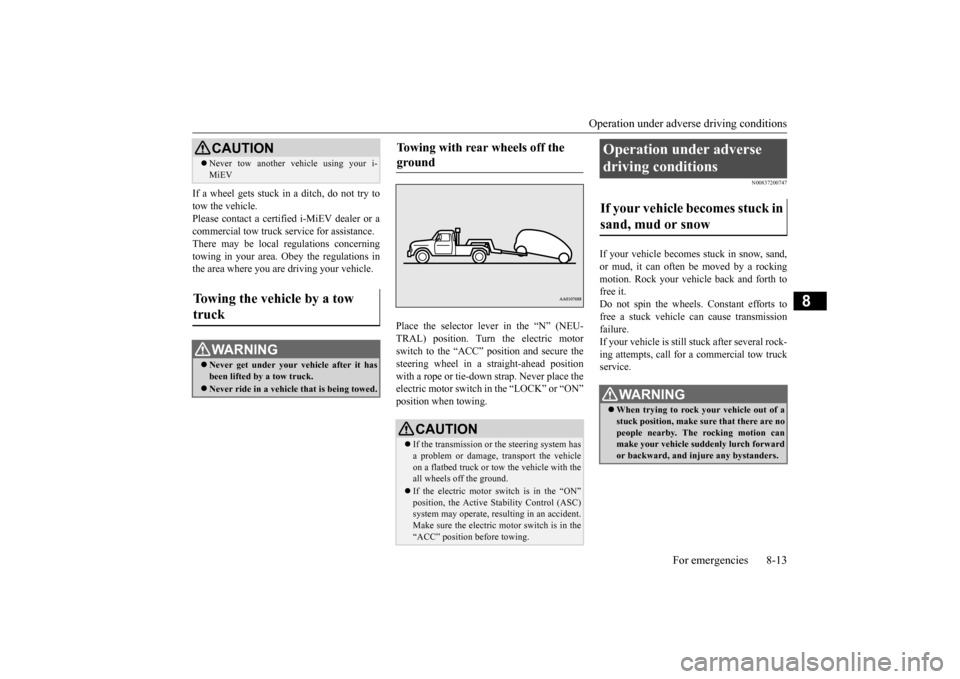
Place the selector lever in the “N” (NEU- TRAL) position. Turn the electric motorswitch to the “ACC” position and secure the steering wheel in a st
raight-ahead position
with a rope or tie-down strap. Never place theelectric motor switch in the “LOCK” or “ON” position when towing.
N00837200747
If your vehicle becomes stuck in snow, sand, or mud, it can often be moved by a rocking motion. Rock your vehicle back and forth to free it.Do not spin the wheels. Constant efforts to free a stuck vehicle can cause transmission failure.If your vehicle is still
stuck after several rock-
ing attempts, call for a commercial tow truck service.
Never tow another ve
hicle using your i-
MiEV
Towing the vehicle by a tow truck
WA R N I N G Never get under your vehicle after it has been lifted by a tow truck. Never ride in a vehicl
e that is being towed.
CAUTION
Towing with rear wheels off the ground
CAUTION If the transmission or the steering system has a problem or damage,
transport the vehicle
on a flatbed truck or to
w the vehicle with the
all wheels off the ground. If the electric motor switch is in the “ON” position, the Active St
ability Control (ASC)
system may operate, resu
lting in an accident.
Make sure the electric motor switch is in the “ACC” position before towing.
Operation under adverse driving conditions If your vehicle becomes stuck in sand, mud or snow
WA R N I N G When trying to rock
your vehicle out of a
stuck position, make sure that there are no people nearby. The rocking motion canmake your vehicle suddenly lurch forward or backward, and inju
re any bystanders.
BK0209800US.book 13 ページ 2014年1月14日 火曜日 午前9時26分
Page 215 of 262
View under the hood and
electric motor unit room
9-4 Vehicle care and maintenance
9
Make sure the hood is securely locked by softly lifting the centre of the hood. Slowly lower the hood about 12 inches (30 cm), then let it drop from its own weight.
N00937600700
N00937800539
CAUTION Always insert the support prop into the hole specially made for
it. Propping the hood at
any other place could
cause the prop to slip
out and lead to
an accident.
The hood prop can fall out if the hood is lifted by a strong wind.
To close
CAUTION Be careful not to trap your hands or fingers when closing the hood.
Make sure the hood is firmly closed before driving.If you drive without the hood completelyclosed, it could open up while driving.NOTE
If this does not close the hood properly, drop it again from a slightly higher position. Do not push down strongly on the hood. Depending on how strongly or where you push down, you could create a dent in the hood.
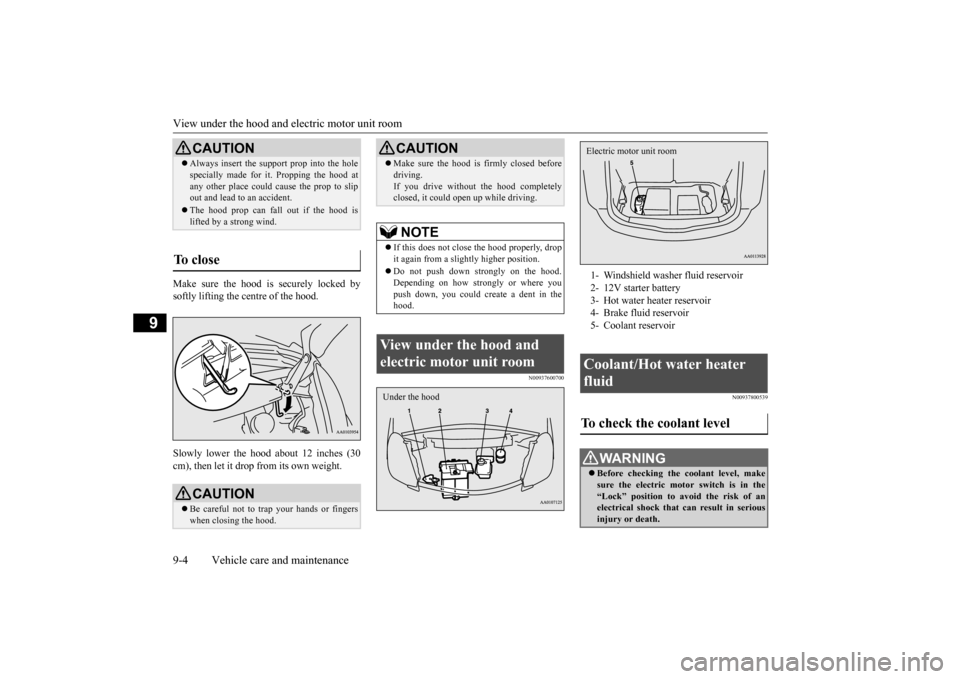
View under the hood and electric motor unit room
CAUTION
Under the hood
1- Windshield washer fluid reservoir 2- 12V starter battery 3- Hot water heater reservoir 4- Brake fluid reservoir5- Coolant reservoirCoolant/Hot water heater fluid To check the coolant level
WA R N I N G Before checking the
coolant level, make
sure the electric motor switch is in the“Lock” position to
avoid the risk of an
electrical shock that can result in serious injury or death.Electric motor unit room
BK0209800US.book 4 ページ 2014年1月14日 火曜日 午前9時26分
Page 219 of 262
12V starter battery 9-8 Vehicle care and maintenance
9
N00901300054
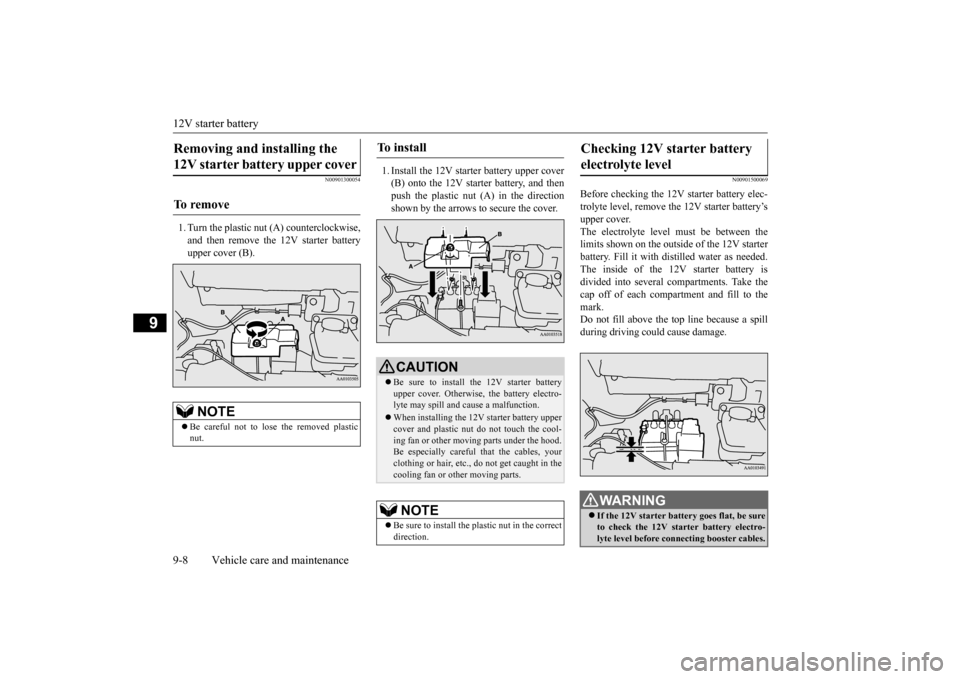
1. Turn the plastic nut (A) counterclockwise, and then remove the 12V starter battery upper cover (B).
1. Install the 12V starter battery upper cover (B) onto the 12V starter battery, and then push the plastic nut (A) in the direction shown by the arrows to secure the cover.
N00901500069
Before checking the 12V starter battery elec-trolyte level, remove th
e 12V starter battery’s
upper cover. The electrolyte level
must be between the
limits shown on the outside of the 12V starterbattery. Fill it with distilled water as needed. The inside of the 12V starter battery is divided into several compartments. Take the cap off of each compartment and fill to the mark.Do not fill above the t
op line because a spill
during driving could cause damage.
Removing and installing the 12V starter battery upper cover To r e m o v e
NOTE
Be careful not to lose the removed plastic nut.
To install
CAUTION Be sure to install the 12V starter battery upper cover. Otherwise,
the battery electro-
lyte may spill and
cause a malfunction.
When installing the 12V
starter battery upper
cover and plastic nut
do not touch the cool-
ing fan or other moving parts under the hood.Be especially carefu
l that the cables, your
clothing or hair, etc.,
do not get caught in the
cooling fan or ot
her moving parts.
NOTE
Be sure to install the plastic nut in the correct direction.
Checking 12V starter battery electrolyte level
WA R N I N G If the 12V starter battery goes flat, be sure to check the 12V star
ter battery electro-
lyte level before connecting booster cables.
BK0209800US.book 8 ページ 2014年1月14日 火曜日 午前9時26分
Page 220 of 262
12V starter battery
Vehicle care and maintenance 9-9
9
N00901600057
The 12V starter battery is weaker in cold tem- peratures. This has to do with its chemicaland physical propertie
s and is why a very
cold 12V starter battery, especially one with a
low charge, will have a hard time starting your vehicle.It is recommended that you have your 12V starter battery and charging system checked by a certified i-MiEV dealer before the startof cold weather. If necessary, have it charged. This will guarantee more reliable starting, and longer 12V starter battery life.
N00901701114
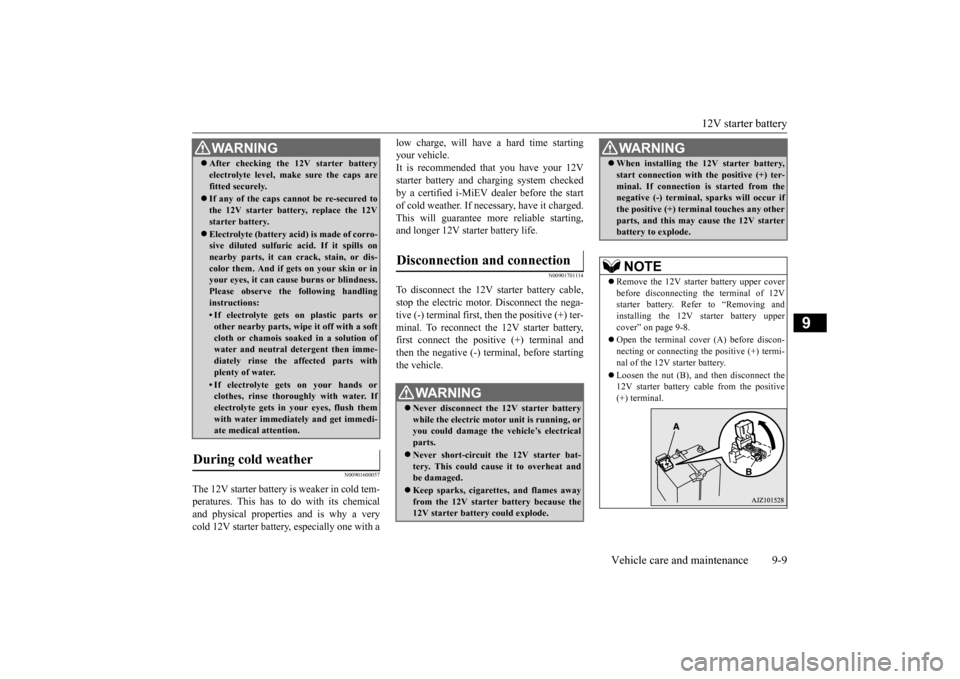
To disconnect the 12V starter battery cable,stop the electric motor.
Disconnect the nega-
tive (-) terminal first, then the positive (+) ter- minal. To reconnect th
e 12V starter battery,
first connect the positi
ve (+) terminal and
then the negative (-) terminal, before starting the vehicle.
After checking the 12V starter battery electrolyte level, make sure the caps arefitted securely. If any of the caps cannot be re-secured to the 12V starter battery, replace the 12Vstarter battery. Electrolyte (battery acid) is made of corro- sive diluted sulfuric acid. If it spills on nearby parts, it can crack, stain, or dis- color them. And if gets on your skin or inyour eyes, it can cause burns or blindness. Please observe the following handling instructions:• If electrolyte gets on plastic parts orother nearby parts, wi
pe it off with a soft
cloth or chamois soak
ed in a solution of
water and neutral detergent then imme- diately rinse the affected parts withplenty of water.• If electrolyte gets on your hands orclothes, rinse thoroughly with water. If electrolyte gets in your eyes, flush them with water immediat
ely and get immedi-
ate medical attention.
During cold weather
WA R N I N G
Disconnection and connection
WA R N I N G Never disconnect the
12V starter battery
while the electric motor unit is running, or you could damage the
vehicle’s electrical
parts. Never short-circuit
the 12V starter bat-
tery. This could cause it to overheat and be damaged. Keep sparks, cigarette
s, and flames away
from the 12V starter battery because the 12V starter battery could explode.
When installing the
12V starter battery,
start connection with the positive (+) ter-minal. If connection is started from thenegative (-) terminal,
sparks will occur if
the positive (+) termin
al touches any other
parts, and this may cause the 12V starterbattery to explode.NOTE
Remove the 12V starte
r battery upper cover
before disconnecting the terminal of 12V starter battery. Refer to “Removing and installing the 12V st
arter battery upper
cover” on page 9-8. Open the terminal cover (A) before discon- necting or connecting the positive (+) termi- nal of the 12V
starter battery.
Loosen the nut (B), and then disconnect the 12V starter batt
ery cable from the positive
(+) terminal.WA R N I N G
BK0209800US.book 9 ページ 2014年1月14日 火曜日 午前9時26分
Page 221 of 262
Tires 9-10 Vehicle care and maintenance
9
N00939201619
It is important to familiarize yourself with the following terms: Cold tire pressure: • The measured pressure after the vehiclehas been parked for
at least three hours,
or • The measured pressure when the vehicleis driven less than 1 mile (1.6 km) after having been parked for three hours.
Maximum inflation pressure: the maxi- mum permissible cold
tire inflation pres-
sure for this tire. Recommended inflation pressure: the inflation pressure for optimum tire perfor- mance.
WA R N I N G Open doors and wind
ows in any closed
space where you may be charging orworking with the 12V starter battery. Always wear protective clothing and gog- gles when working wi
th the 12V starter
battery, or have a sk
illed automobile tech-
nician do it. If you are quick-charging your 12V starter battery, first disconnect the 12V starter battery cables. In order to prevent a short circuit, be sure to disconnect the negative (-) terminalfirst, and reconnect it last. If the electrolyte level
is very low, have the
12V starter battery checked at a certified i-MiEV dealer. 12V starter battery te
rminals and related
accessories contain
lead and lead com-
pounds. Wash hands after handling. CAUTION When replacing the
12V starter battery,
remove the connected
positive (+) and nega-
tive (-) terminals after turning the electric motor switch to the “LOCK” position andwaiting at least 1 minut
e. If the 12V starter
battery terminal is removed just after the electric motor switch is turned to the “LOCK” position, this
may cause damage to
components of the electric motor unit.
NOTE
Before cleaning the 12V starter battery, tighten all the filler port
caps to keep dirt and
moisture out. Check each 12V starter battery terminal for corrosion. If necessary, clean the terminalswith a solution of baking soda and water. Grease the posts and cl
amps after cleaning or
tightening them. Check to see that the 12V starter battery is securely installed and
cannot be moved. Also
check each terminal for tightness. If you will not be driv
ing your vehicle for a
long period of time, re
move the 12V starter
battery and store it in a place where the 12V starter battery fluid wi
ll not freeze. Memory
data for settings made by the user may be erased when the 12V starter battery is removed. If this happens, reset the settingsagain using the releva
nt procedures. The
12V starter battery
only should be stored
with a full charge.
Tires
WA R N I N G Driving with tires that are worn, damaged or improperly inflated is dangerous.These type tire conditions will adversely affect vehicle performance. These type tire conditions can also cause atread separation or blowout which may result in an accide
nt causing serious
injury or death. Tires degrade over ti
me with age even
when they are not being used. It is recom-mended that tires ove
r 6 years generally
be replaced even if
damage is not obvious.
BK0209800US.book 10 ページ 2014年1月14日 火曜日 午前9時26分
Page 232 of 262
Fuses
Vehicle care and maintenance 9-21
9
Some fuses may not be installed on your vehicle, depending on
the vehicle model
or specifications. The table above show
s the main equip-
ment corresponding to each fuse.
N00901100078 N00954900115
1. Before replacing a fuse, always turn off the electrical item connected to the fuse and turn the electric motor switch to the “LOCK” position.
2. Remove the fuse puller (A) from the inside of the fuse cover in the passengercompartment. 3. Clamp it on the fuse you wish to remove, and pull the fuse straight out from the fuseblock.
4. Use the fuse location diagrams and their corresponding tables, to check the fusethat is related to the problem. If the fuse is not blown, something
else must be caus-
ing the problem.Contact a certified i-
MiEV dealer to have
the problem checked. 5. Insert a new fuse of the same capacity securely into the appropriate slot.
Identification of fuse Capacity
Color
7.5 A Brown 10 A Red 15 A Blue 20 A Yellow 30 A
Green (fuse type) /Pink (fusible
link type)
40 A Green (fusible link type)
Fuse replacement
B- Fuse is OK C- Blown fuseCAUTION Never use a fuse with a capacity greater than the one listed or any substitute, such as wire,foil etc. This would
cause the circuit wiring
to heat up and could cause a fire.
BK0209800US.book 21 ページ 2014年1月14日 火曜日 午前9時26分