Battery MITSUBISHI iMiEV 2014 1.G Repair Manual
[x] Cancel search | Manufacturer: MITSUBISHI, Model Year: 2014, Model line: iMiEV, Model: MITSUBISHI iMiEV 2014 1.GPages: 262, PDF Size: 26.84 MB
Page 148 of 262
Warning lights
Features and controls 5-43
5
N00573500028
This light will illuminate when there is a problem with the charging system for the 12V starter battery.Normally, when the electric motor switch is turned to the “ON” position, this light will illuminate. Then, when the electric motor unitis started and the ready indicator illuminates, the light will go out.
N00520900316
This light comes on when any door or liftgate is open or not completely closed.When the vehicle is moving at more than 5 mph (8 km/h) and any door or liftgate is open or ajar, a tone will sound 16 times and thewarning light will fl
ash 16 times to inform
the driver that a door or liftgate is not prop- erly shut.
N00573600029
This warning light will illuminate when thereis a problem with a high voltage component.Refer to “Service prec
autions” on page 9-2.
N00573700020
NOTE
When the brake warning light illuminates, the warning buzzer may also sound. When the brake pedal has been repeatedly depressed over a short period of time, the brake warning light may come on and thebrake warning buzzer may sound. The ser- vice brake system is working normally, if the warning light goes out and the buzzer stopssounding in a few seconds.
12V starter battery charging system warning light
CAUTION If the warning light stays on after the ready indicator illuminates,
there may be a prob-
lem with the charging system for the 12Vstarter battery.• Immediately park your
vehicle in a safe
place and contact a cert
ified i-MiEV dealer.
• Do not charge the
12V starter battery.
Door-ajar warning light and buzzer
CAUTION Before driving, make sure that the door-ajar warning light is off. NOTE
The flashing of the warning light and the buzzer can be disabled. For further details, plea
se contact a certified
i-MiEV dealer. When the driver’s door is open, the door-ajar warning buzzer does not
sound because the
electric motor remi
nder sounds instead.
Electric motor unit warning light
CAUTION If this light illuminates while driving, imme- diately park your vehicle in a safe place andcontact a certified i-MiEV dealer.
Power down warning light
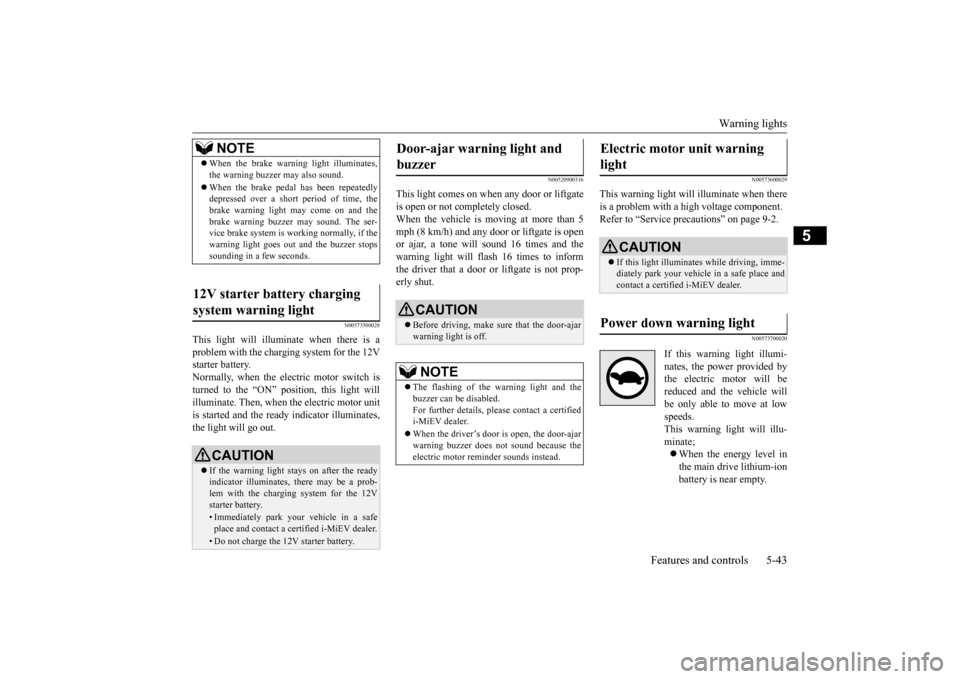
If this warning light illumi- nates, the power provided bythe electric motor will be reduced and the vehicle will be only able to move at lowspeeds. This warning light will illu- minate; When the energy level in the main drive lithium-ion battery is near empty.
BK0209800US.book 43 ページ 2014年1月14日 火曜日 午前9時26分
Page 149 of 262
Combination headlights and dimmer switch 5-44 Features and controls
5
If the warning light illuminates when the out- side air temperature is very low, move thevehicle to a warmer location. If the warning light illuminates after the vehi- cle has been driven continuously uphill orwhen the outside air te
mperature is very high,
stop the vehicle in a safe place so the electric motor unit and/or the main drive lithium-ionbattery can cool down. When they have cooled down, the warni
ng light will go off. If
the warning light does not
turn off, contact a
certified i-MiEV dealer.
N00522501805
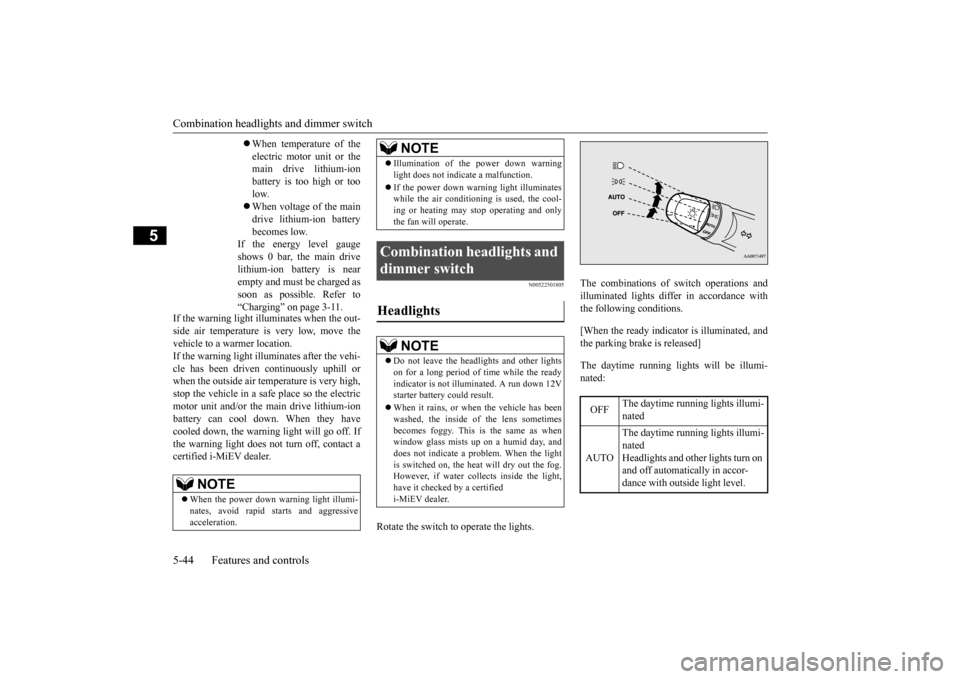
Rotate the switch to operate the lights.
The combinations of
switch operations and
illuminated lights differ in accordance withthe following conditions. [When the ready indicato
r is illuminated, and
the parking brake is released] The daytime running lights will be illumi- nated:
When temperature of the electric motor unit or the main drive lithium-ionbattery is too high or too low. When voltage of the main drive lithium-ion battery becomes low.
If the energy level gaugeshows 0 bar, the main drive lithium-ion battery is near empty and must be charged as soon as possible. Refer to “Charging” on page 3-11.
NOTE
When the power down warning light illumi- nates, avoid rapid st
arts and aggressive
acceleration.
Illumination of the
power down warning
light does not indica
te a malfunction.
If the power down warn
ing light illuminates
while the air conditioning is used, the cool- ing or heating may stop operating and onlythe fan will operate.
Combination headlights and dimmer switch Headlights
NOTE
Do not leave the head
lights and ot
her lights
on for a long period of time while the readyindicator is not illum
inated. A run down 12V
starter battery
could result.
When it rains, or wh
en the vehicle has been
washed, the inside of the lens sometimes becomes foggy. This is the same as whenwindow glass mists up
on a humid day, and
does not indicate a problem. When the light is switched on, the heat
will dry out the fog.
However, if water collects inside the light,have it checked by a certified i-MiEV dealer.NOTE
OFF
The daytime running lights illumi- nated
AUTO
The daytime running lights illumi- nated Headlights and other lights turn on and off automatically in accor-dance with outside light level.
BK0209800US.book 44 ページ 2014年1月14日 火曜日 午前9時26分
Page 152 of 262
Hazard warning flasher switch Features and controls 5-47
5
N00522700305
If you press the flasher switch, the front and rear turn signals will flash intermittently, and so will the hazard warn
ing lights. This is an
emergency warning syst
em and should not be
used when the vehicle is in motion, except for emergencies. If you need to leave your vehicle, the flasherswill keep working after the key is removed from the electric motor switch.
N00522801433
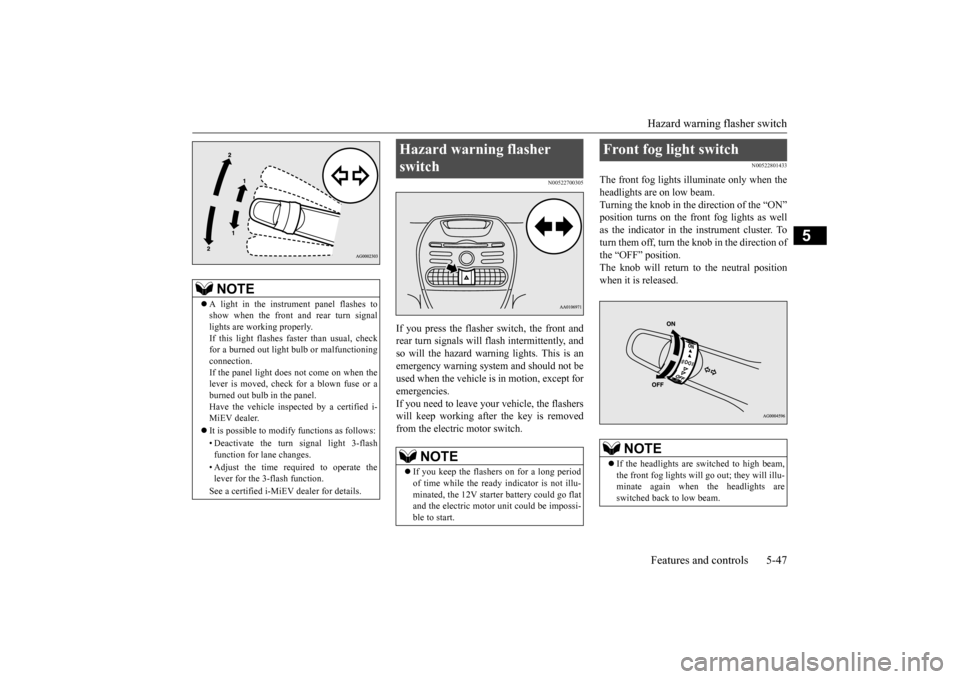
The front fog lights illuminate only when theheadlights are on low beam. Turning the knob in the direction of the “ON”position turns on the front fog lights as well as the indicator in the instrument cluster. To turn them off, turn the knob in the direction ofthe “OFF” position. The knob will return to the neutral position when it is released.
NOTE
A light in the instrument panel flashes to show when the front and rear turn signallights are working properly. If this light flashes fa
ster than usual, check
for a burned out light bulb or malfunctioningconnection. If the panel light does not come on when the lever is moved, check for a blown fuse or aburned out bulb in the panel. Have the vehicle insp
ected by a certified i-
MiEV dealer. It is possible to modify functions as follows: • Deactivate the turn signal light 3-flash function for lane changes. • Adjust the time required to operate the lever for the 3-flash function. See a certified i-MiEV dealer for details.
Hazard warning flasher switch
NOTE
If you keep the flashers on for a long period of time while the ready
indicator is not illu-
minated, the 12V starte
r battery could go flat
and the electric motor unit could be impossi- ble to start.
Front fog light switch
NOTE
If the headlights are sw
itched to high beam,
the front fog lights will go out; they will illu- minate again when the headlights areswitched back to low beam.
BK0209800US.book 47 ページ 2014年1月14日 火曜日 午前9時26分
Page 156 of 262
Sun visors
Features and controls 5-51
5
N00524600340
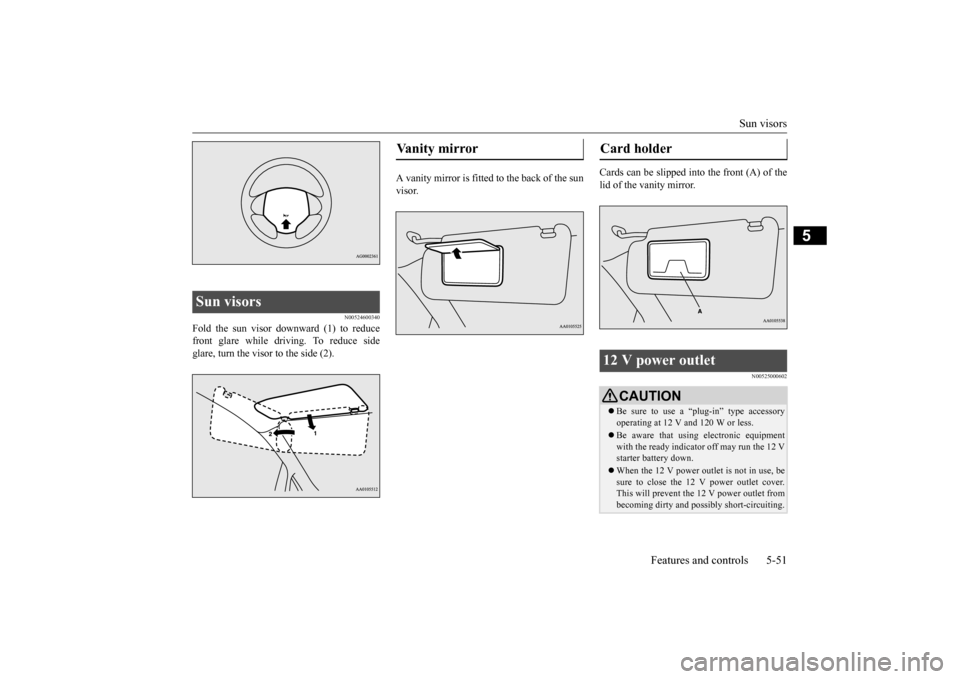
Fold the sun visor downward (1) to reduce front glare while driving. To reduce side glare, turn the visor to the side (2).
A vanity mirror is fitted to the back of the sun visor.
Cards can be slipped into the front (A) of the lid of the vanity mirror.
N00525000602
Sun visors
Vanity mirror
Card holder 12 V power outlet
CAUTION Be sure to use a “plug-in” type accessory operating at 12 V and 120 W or less. Be aware that using
electronic equipment
with the ready indicator off may run the 12 V starter battery down. When the 12 V power outlet is not in use, be sure to close the 12 V power outlet cover. This will prevent the 12 V power outlet frombecoming dirty and possi
bly short-circuiting.
BK0209800US.book 51 ページ 2014年1月14日 火曜日 午前9時26分
Page 163 of 262
Economical driving 6-2 Driving safety
6
N00628500029
For economical driving,
there are some tech-
nical requirements that
have to be met. In
order to achieve longer life of the vehicle andthe most economical
operation, we recom-
mend you to have the vehicle checked at reg- ular intervals according to the “WARRANTYAND MAINTENANCE MANUAL”. Avoid driving with the
accelerator pedal fully
depressed, such as for unnecessarily sudden starts, accelerati
on and deceleration.
Smoothly depress the
accelerator pedal.
Observe the speed limit and keep the speed as constant as possi
ble while driving.
Parking for a long period with the ready indi- cator illuminated will shorten the cruisingrange. At higher the vehicle speed the more main drive lithium-ion battery
is consumed. Avoid
driving at full speed. Even a slight release of the accelerator pedal wi
ll save a significant
amount of main drive lithium-ion battery charge. Check the tire inflation pressures at regular intervals Low tire inflat
ion pressure increases
road resistance. In addi
tion, low tire pressures
adversely affect tire we
ar and driving stabil-
ity. Do not drive with unnecessary articles in the luggage compartment. Too much cooling/heating can affect the cruising range, so maintain an appropriatetemperature to exte
nd the cruising range.
N00628900010
Drunk driving is one of the most frequent causes of accidents.
Your driving ability ca
n be seriously impaired
even with blood alcohol levels far below thelegal minimum. If you
have been drinking,
don’t drive. Ride with a designated non- drinking driver, call a cab or a friend, or usepublic transportation. Drinking coffee or tak- ing a cold shower will not make you sober. Similarly, prescription and nonprescriptiondrugs affect your aler
tness, perception and
reaction time. Consul
t with your doctor or
pharmacist before dr
iving while under the
influence of any of
these medications.
N00628600017
The original equipmen
t floor mat provided
with your vehicle was
specifically designed
for your vehicle. Always properly position the floor mat and assure it does not interfere with operation of the pedals. Always use theretaining clip on the driver’s floorboard to secure the floor mat. When used, this clip will help prevent the floor mat from moving for-ward and possibly interfering with the opera- tion of the pedals. To prevent the floor mat
Economical driving Starting and acceleration Idling Speed
Tire inflation pressure Cargo loads Air conditioning Driving, alcohol and drugs
WA R N I N G NEVER DRINK AND DRIVE. Your perceptions ar
e less accurate, your
reflexes are slower and your judgment is impaired.
Floor mat
BK0209800US.book 2 ページ 2014年1月14日 火曜日 午前9時26分
Page 166 of 262
Driving during cold weather
Driving safety 6-5
6
N00629400416
Check the 12V starter battery, including terminals and cables. During extremely cold weather, the 12V starter battery willnot be as strong and its power level may drop. Before driving the vehicle, check to see ifthe headlights are as bright as normal. Charge or replace th
e 12V starter battery
if necessary. During extreme cold weather, it is possible that a very low 12V starter battery
could freeze.
Check the antifreeze. If there is not enough coolant because of aleak, add high-quality ethylene glycol antifreeze and water. Use Mitsubishi Motors Genuine Super Long Life CoolantPremium or an equivalent. The recom- mended blend is about 50 % water and 50 % anti-freeze. Use a higher concentration(not over 60 %) when the outside temper- ature is -31 °F (-35 °C) or lower. When the electric motor unit is working very hard (for example,
during mountain driv-
ing and/or when the outside temperatureis high), use a 50 % concentration. This blend will provide adequate protection from corrosion and boiling.
N00629501531
All the parts of the brake system are critical to safety. Have the vehicle serviced by a certi- fied i-MiEV dealer at regular intervalsaccording to the “WARRANTY AND MAINTENANCE MANUAL”.
Check the brake system while driving at a low speed immediately
after starting, espe-
cially when the brakes are wet, to confirmthey work normally. A film of water can be formed on the brake discs and prevent normal braking after driv-ing in heavy rain or through large puddles, or after the vehicle is washed. If this occurs, dry the brakes out by drivi
ng slowly while lightly
depressing the brake pedal. On snowy roads, ice can form on the braking system, making the brakes less effective. While driving in such
conditions, pay close
attention to preceding and following vehicles and to the condition of the road surface. From time to time, lightly depress the brake pedaland check how effective the brakes are. Put the selector lever to “B” (REGENERA- TIVE BRAKE MODE) or “ECO” (ECO MODE) position according to the grade of the slope and vehicle sp
eed. This will allow
Driving during cold weather
WA R N I N GThe 12V starter batter
y gives off explosive
hydrogen gas. Any spark or flame cancause the 12V starter battery to explode, which could cause serious injury or death. Always wear protecti
ve clothes and a face
mask when working wi
th your 12V starter
battery, or let a skil
led mechanic do it.
WA R N I N GNever open the coolan
t reservoir cap while
it is hot. You could be seriously burned.
Braking
When brakes are wet When driving in cold weather When driving downhill
BK0209800US.book 5 ページ 2014年1月14日 火曜日 午前9時26分
Page 167 of 262
Parking 6-6 Driving safety
6
effective use of the re
generative brake and
prevent the service brake from overheating.If the brake pedal is continuously or fre- quently depressed on downhill roads, the ser- vice brake could overheat and the brakeperformance will be reduced.
N00629600317
When parking on a hill, set the parking brake, and turn the front wheels toward the curb on a downhill, or away from the curb on an uphill.If necessary, apply
chocks to wheels.
Never leave the electric motor unit running while you take a short sleep/rest.
Your front bumper can be damaged if you scrape it over curbs or parking stop blocks. Be careful when traveling up or down steep slopes where your bumper can scrape theroad. Always remove the key from the electric motor switch and lock all doors and the lift- gate when leaving
the vehicle unattended.
Always try to park your vehicle in a well litarea. More effort could be required to turn the steering wheel. Refer to “Electric power steering system(EPS)” on page 5-27.
NOTE
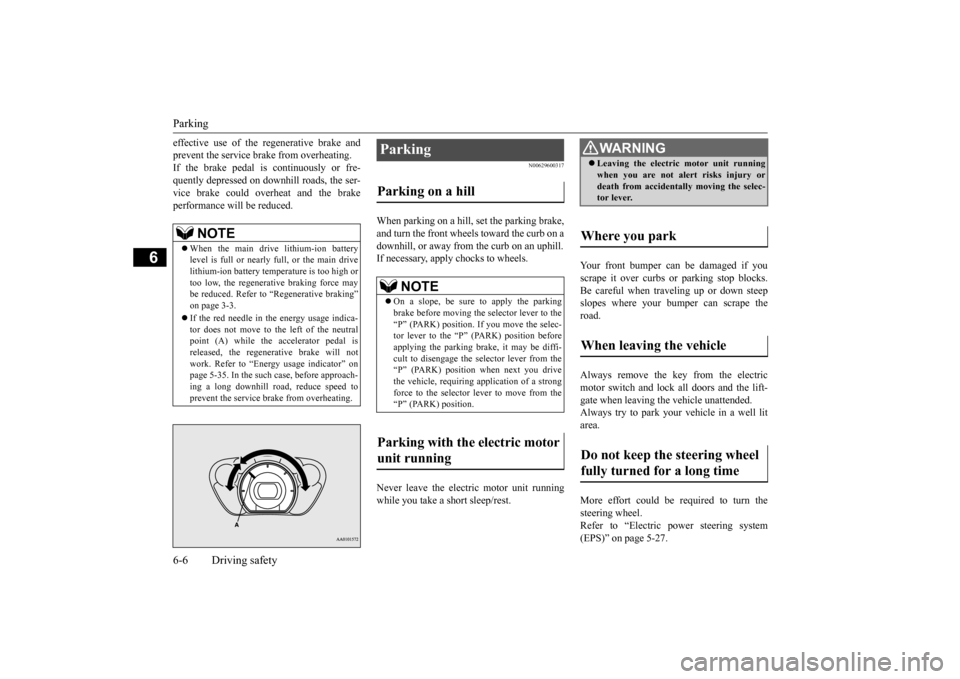
When the main drive lithium-ion battery level is full or nearly full, or the main drivelithium-ion battery temperature is too high or too low, the regenerative braking force may be reduced. Refer to “Regenerative braking”on page 3-3. If the red needle in the energy usage indica- tor does not move to the left of the neutral point (A) while the accelerator pedal is released, the regenera
tive brake will not
work. Refer to “Ener
gy usage indicator” on
page 5-35. In the such case, before approach- ing a long downhill road, reduce speed toprevent the service brake from overheating.
Parking Parking on a hill
NOTE
On a slope, be sure to apply the parking brake before moving the selector lever to the“P” (PARK) position. If you move the selec- tor lever to the “P” (PARK) position before applying the parking br
ake, it may be diffi-
cult to disengage the
selector lever from the
“P” (PARK) position when next you drive the vehicle, requiring a
pplication of a strong
force to the selector lever to move from the “P” (PARK) position.
Parking with the electric motor unit running
WA R N I N G Leaving the electric motor unit running when you are not alert risks injury ordeath from accidental
ly moving the selec-
tor lever.
Where you park When leaving the vehicle Do not keep the steering wheel fully turned for a long time
BK0209800US.book 6 ページ 2014年1月14日 火曜日 午前9時26分
Page 168 of 262
Loading information Driving safety 6-7
6
N00629900411
It is very importa
nt to know how much
weight your vehicle can carry. This weight is called the vehicle capacity weight andincludes the weight of all occupants, cargo and non-factory-installed options. The tire and loading information placard located onthe driver’s door sill of your vehicle will show how much weight it may properly carry. It is important to famil
iarize yourself with the
following terms before loading your vehicle: Vehicle maximum load on the tire: load on an individual tire that is determined bydistributing to each axle its share of the maximum loaded vehicle weight and dividing by two. Vehicle normal load on the tire: load on an individual tire that is determined by dis- tributing to each axle its share of the curbweight, accessory weight, and normal occupant weight and dividing by two.
Maximum loaded vehi
cle weight: the sum
of -(a) Curb weight; (b) Accessory weight; (c) Vehicle capacity weight; and(d) Production options weight. Curb weight: the weight of a motor vehi- cle with standard equipment including themaximum capacity of
oil, and coolant.
Accessory weight: the combined weight (in excess of those st
andard items which
may be replaced) of automatic transmis- sion, power steering, power brakes, powerwindows, power seats,
radio, and heater,
to the extent that these items are available as factory- installe
d equipment (whether
installed or not). Vehicle capacity weight: the rated cargo and luggage load plus 150 lbs (68 kg)
*
times the vehicle’s designated seating capacity. Production options weight: the combined weight of those installed regular produc- tion options weighing over 5 lbs (2.3 kg) in excess of those standard items whichthey replace, not prev
iously considered in
curb weight or accessory weight, includ- ing heavy duty brakes,
ride levelers, roof
rack, heavy duty battery, and special trim. Normal occupant weight: 150 lbs (68 kg)
*
times the number of specified occupants.(In your vehicle the number is 2)
Occupant distribution: distribution of occupants in a vehicle as specified. (Inyour vehicle the distribution is 2 in front seat)
N00630100370
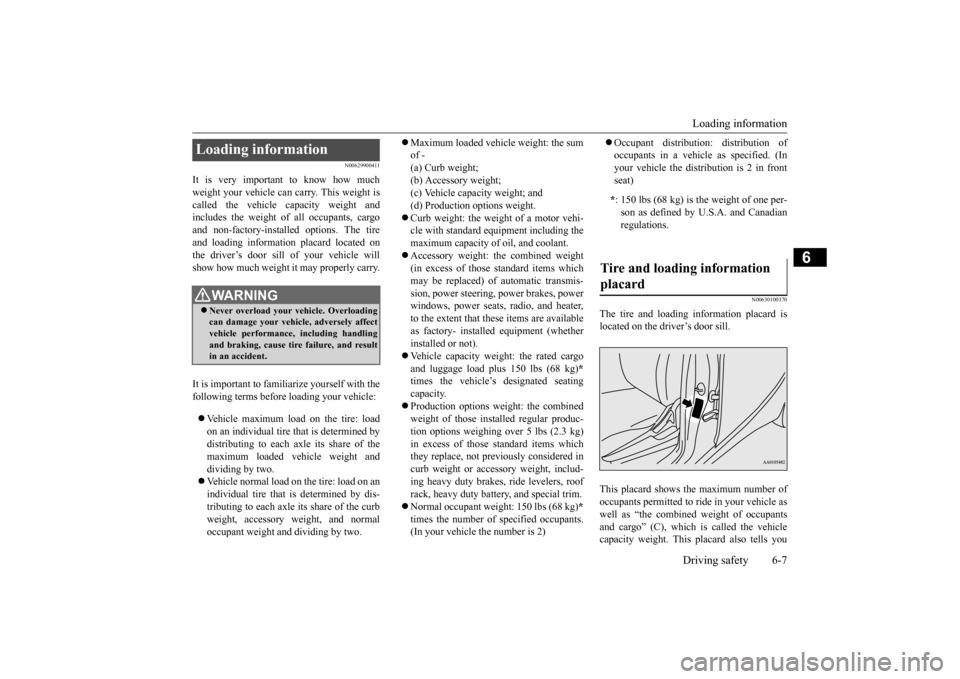
The tire and loading information placard is located on the driver’s door sill. This placard shows the maximum number of occupants permitted to
ride in your vehicle as
well as “the combined
weight of occupants
and cargo” (C), which
is called the vehicle
capacity weight. This
placard also tells you
Loading information
WA R N I N GNever overload your ve
hicle. Overloading
can damage your vehicl
e, adversely affect
vehicle performance, including handlingand braking, cause tire failure, and result in an accident.
* : 150 lbs (68 kg) is the weight of one per- son as defined by U.
S.A. and Canadian
regulations.
Tire and loading information placard
BK0209800US.book 7 ページ 2014年1月14日 火曜日 午前9時26分
Page 187 of 262
AM/FM electronically tune
d radio with CD player
7-14 Comfort controls
7
3. Press the SEEK button
to tune to a station,
or press the MEMORY button either or to tune in to a station memorized. Refer to “Automatic tuning”, “Manualtuning” or “To enter frequencies into the memory”.
After pressing the SEEK button, a receivable station will be automatically selected andreception of the st
ation will begin.
Press the SCAN button.
The radio will tune
consecutively to each
available station for
about 5 seconds per stat
ion. If you want to
stop scanning, press the SCAN button again. The frequency display of the current stationflashes once per second during SCAN. The frequency changes every time the SEEK button is pressed. Press the button to select the desired station.
As many as 6 AM and 12 FM stations can be entered into the memory. To store a frequency in the memory, follow these steps: 1. Press the SEEK button to tune to the fre- quency you wish to keep in the memory. 2. Press the MEMORY button either or
until it beeps. The sound will be momentarily inter- rupted while the frequency is beingentered into the memory. 3. To recall a frequency
that has been saved
in memory, press the MEMORY button briefly for no longer than about 1 second.
N00735300743
Automatic tuning SCAN functionManual tuning
To enter frequencies into the mem- ory
NOTE
Disconnecting the 12V st
arter battery cables
erases all the radio stat
ion settings stored in
the memory.
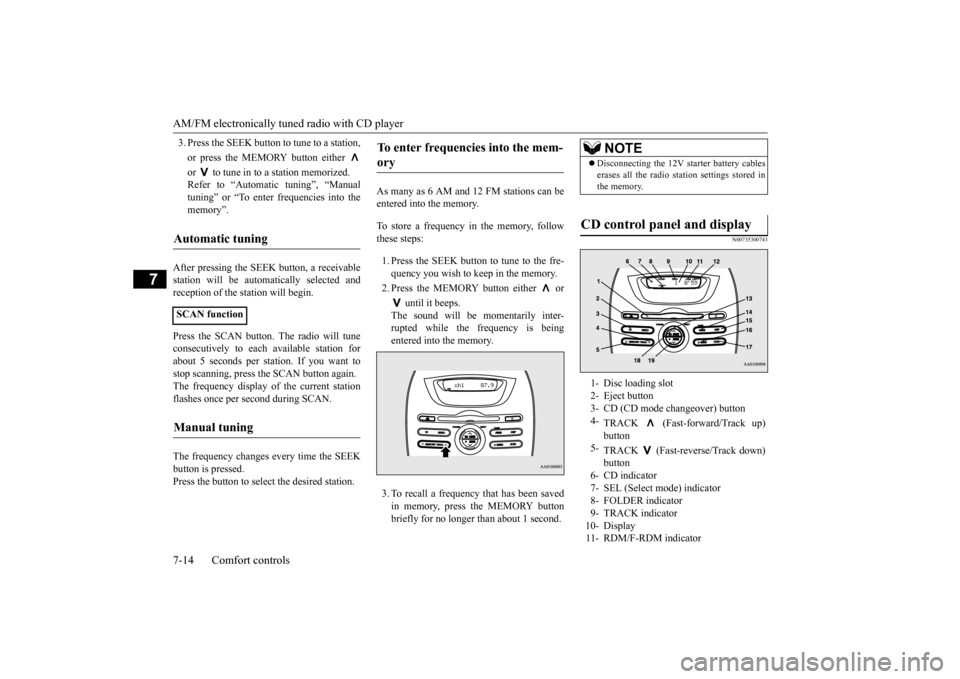
CD control panel and display 1- Disc loading slot 2- Eject button3- CD (CD mode changeover) button 4-
TRACK (Fast-forward/Track up) button
5-
TRACK (Fast-reverse/Track down) button
6- CD indicator 7- SEL (Select mode) indicator 8- FOLDER indicator9- TRACK indicator 10- Display 11- RDM/F-RDM indicator
BK0209800US.book 14 ページ 2014年1月14日 火曜日 午前9時26分
Page 196 of 262
General information about your radio
Comfort controls 7-23
7
4. When the time is set, press the clock but- ton to stop the clock display from flash-ing.
N00733900439
Your vehicle’s radio receives both AM andFM stations. The quality of your reception is affected by distance, obstacles, a
nd signal interference.
This radio complies with
Part 15 of Federal
Communications Commission (FCC) Rules (for vehicles sold in U.S.A.). Operation is subject to the following conditions: The device may not cause harmful inter- ference. This device must ac
cept any interference
recieved, including interference that maycause undesirable operation.
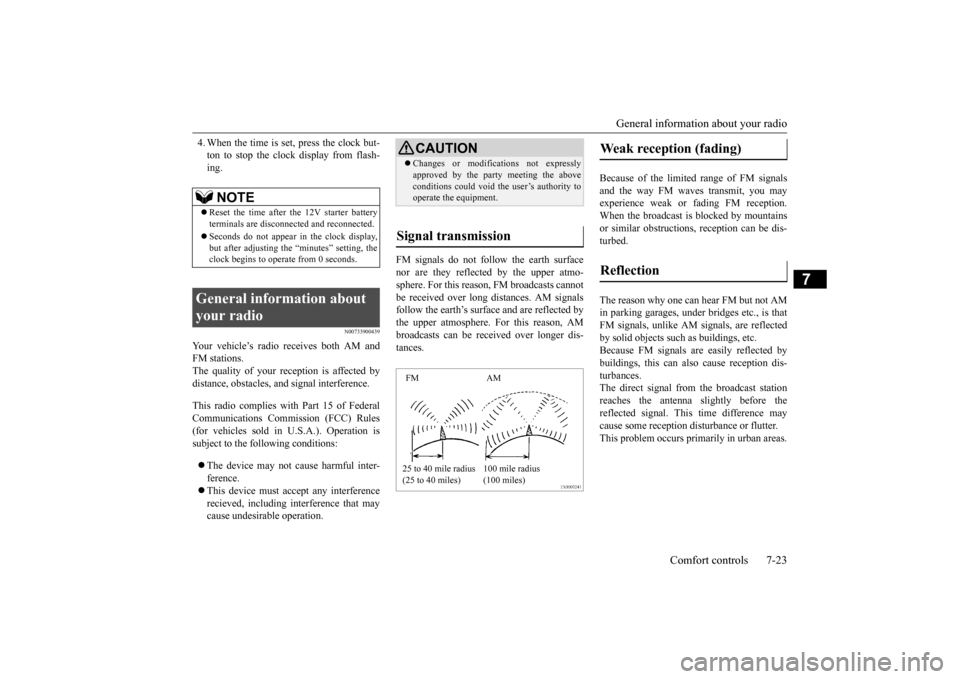
FM signals do not follow the earth surface nor are they reflected by the upper atmo-sphere. For this reason
, FM broadcasts cannot
be received over long
distances. AM signals
follow the earth’s surface and are reflected bythe upper atmosphere. For this reason, AM broadcasts can be rece
ived over longer dis-
tances.
Because of the limited
range of FM signals
and the way FM waves transmit, you may experience weak or
fading FM reception.
When the broadcast is blocked by mountains or similar obstructions,
reception can be dis-
turbed. The reason why one can hear FM but not AM in parking garages, under
bridges etc., is that
FM signals, unlike AM
signals, are reflected
by solid objects such
as buildings, etc.
Because FM signals ar
e easily reflected by
buildings, this can also cause reception dis- turbances.The direct signal from
the broadcast station
reaches the antenna sl
ightly before the
reflected signal. This
time difference may
cause some reception di
sturbance or flutter.
This problem occurs primarily in urban areas.
NOTE
Reset the time after the 12V starter battery terminals are disconnect
ed and reconnected.
Seconds do not appear
in the clock display,
but after adjusting the “minutes” setting, theclock begins to operate from 0 seconds.
General information about your radio
CAUTION Changes or modifica
tions not expressly
approved by the party meeting the aboveconditions could void the user’s authority tooperate the equipment.
Signal transmission FM AM 25 to 40 mile radius (25 to 40 miles)
100 mile radius (100 miles)
Weak reception (fading) Reflection
BK0209800US.book 23 ページ 2014年1月14日 火曜日 午前9時26分