key MITSUBISHI L200 2004 (in English) Owner's Guide
[x] Cancel search | Manufacturer: MITSUBISHI, Model Year: 2004, Model line: L200, Model: MITSUBISHI L200 2004Pages: 264, PDF Size: 4.14 MB
Page 84 of 264
INSTRUMENTS AND CONTROLS
4-20
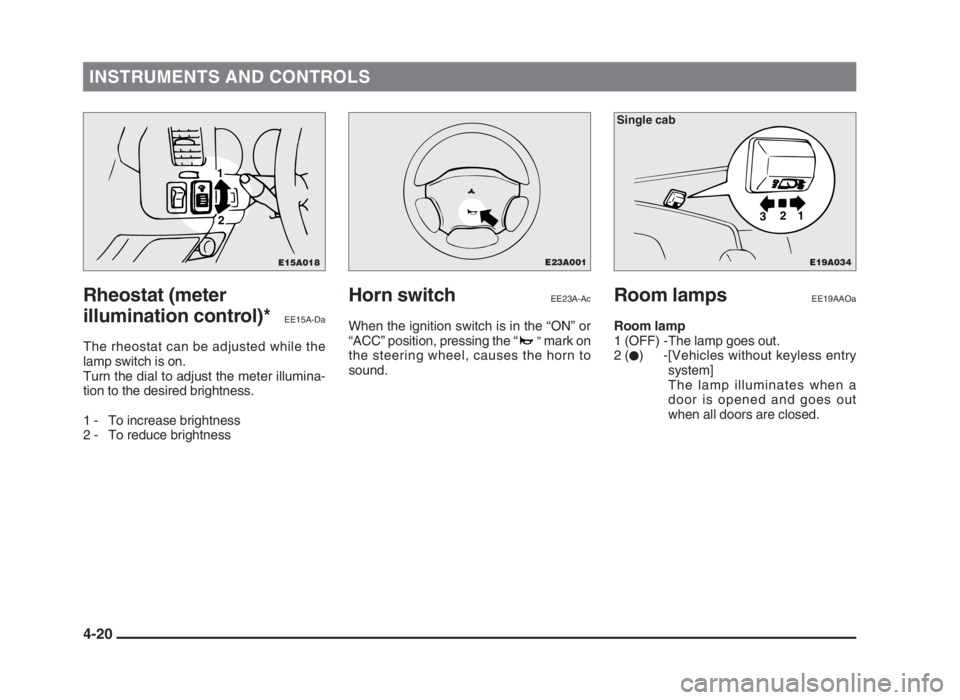
Rheostat (meter
illumination control)*
EE15A-Da
The rheostat can be adjusted while the
lamp switch is on.
Turn the dial to adjust the meter illumina-
tion to the desired brightness.
1 - To increase brightness
2 - To reduce brightness
Room lampsEE19AAOa
Room lamp
1 (OFF) -The lamp goes out.
2 (
•) -[Vehicles without keyless entry
system]
The lamp illuminates when a
door is opened and goes out
when all doors are closed.
Horn switchEE23A-Ac
When the ignition switch is in the “ON” or
“ACC” position, pressing the “”mark on
the steering wheel, causes the horn to
sound.
E19A034
1 2
3
Single cab
E23A001E15A018
1
2
04engL2_240082_4 22-01-2004 13:20 Page 4-20
Page 85 of 264
![MITSUBISHI L200 2004 (in English) Owners Guide INSTRUMENTS AND CONTROLS
4-21
[Vehicles with keyless entry system]
The room lamp goes on when a door
is opened. When all doors are closed,
the room lamp is illuminated and
dimmed gradually for 30 seco](/img/19/34872/w960_34872-84.png "MITSUBISHI L200 2004 (in English) Owners Guide INSTRUMENTS AND CONTROLS
4-21
[Vehicles with keyless entry system]
The room lamp goes on when a door
is opened. When all doors are closed,
the room lamp is illuminated and
dimmed gradually for 30 seco")
INSTRUMENTS AND CONTROLS
4-21
[Vehicles with keyless entry system]
The room lamp goes on when a door
is opened. When all doors are closed,
the room lamp is illuminated and
dimmed gradually for 30 seconds
then goes out.
However, the lamp goes out immedi-
ately without being dimmed in case of
the followings:
• The ignition switch is turned “ON”.
• All doors are locked using the key
mechanism of the driver’s door, the
lock knob of the driver’s door, or the
remote control switch of the keyless
entry system.NOTE
If the ignition key is removed with the
doors closed, the room lamp is dimmed
gradually for 30 seconds and then goes
out.
3 (ON) -The lamp illuminates.Personal lamps*
Push the button to turn on the lamp. Push
it again to turn it off.
NOTE
If you leave the lamps on without running
the engine, you will run down the battery.
Before you leave the vehicle, make sure
that all the lamps are off.
E19A058E19A052
1
2
3
Club cab, Double cab
04engL2_240082_4 22-01-2004 13:20 Page 4-21
Page 90 of 264
STARTING AND DRIVING
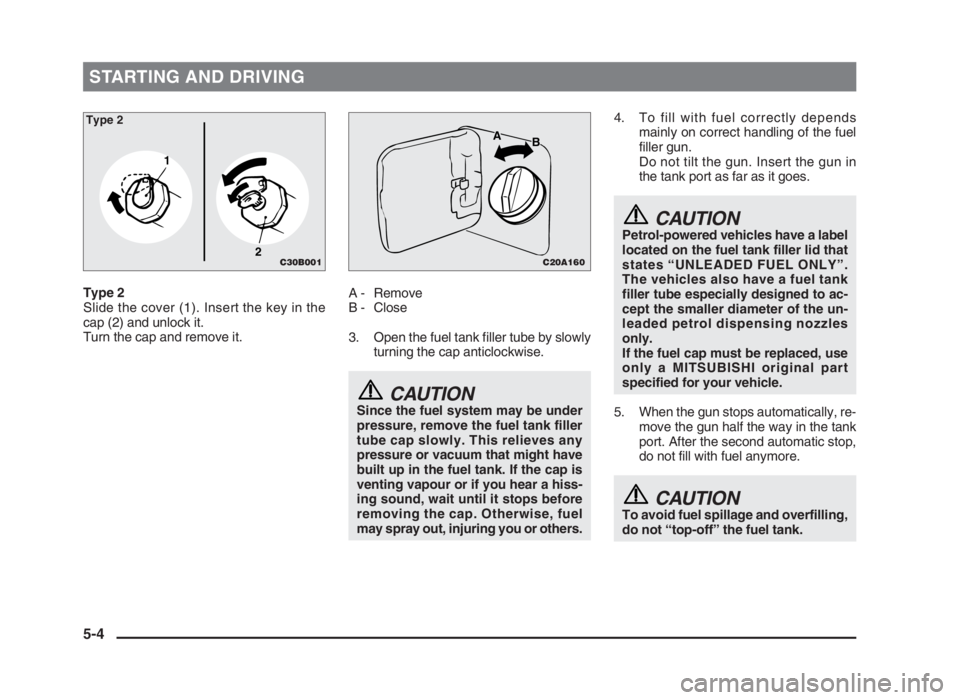
Type 2
Slide the cover (1). Insert the key in the
cap (2) and unlock it.
Turn the cap and remove it.A - Remove
B - Close
3. Open the fuel tank filler tube by slowly
turning the cap anticlockwise.
CAUTIONSince the fuel system may be under
pressure, remove the fuel tank filler
tube cap slowly. This relieves any
pressure or vacuum that might have
built up in the fuel tank. If the cap is
venting vapour or if you hear a hiss-
ing sound, wait until it stops before
removing the cap. Otherwise, fuel
may spray out, injuring you or others.
4. To fill with fuel correctly depends
mainly on correct handling of the fuel
filler gun.
Do not tilt the gun. Insert the gun in
the tank port as far as it goes.
CAUTIONPetrol-powered vehicles have a label
located on the fuel tank filler lid that
states “UNLEADED FUEL ONLY”.
The vehicles also have a fuel tank
filler tube especially designed to ac-
cept the smaller diameter of the un-
leaded petrol dispensing nozzles
only.
If the fuel cap must be replaced, use
only a MITSUBISHI original part
specified for your vehicle.
5. When the gun stops automatically, re-
move the gun half the way in the tank
port. After the second automatic stop,
do not fill with fuel anymore.
CAUTIONTo avoid fuel spillage and overfilling,
do not “top-off” the fuel tank.
5-4
C30B001
1
2
Type 2
B A
C20A160
05engL2_240082_4 22-01-2004 13:04 Page 5-4
Page 95 of 264
STARTING AND DRIVING
5-9
mm
*
1: Single cab, double cab
*2: Club cab
NOTE
The values under item 10 are applicable
to unladen vehicles. These values can
also be varied depending on the tyre size,
optional equipment and suspension con-
ditions.
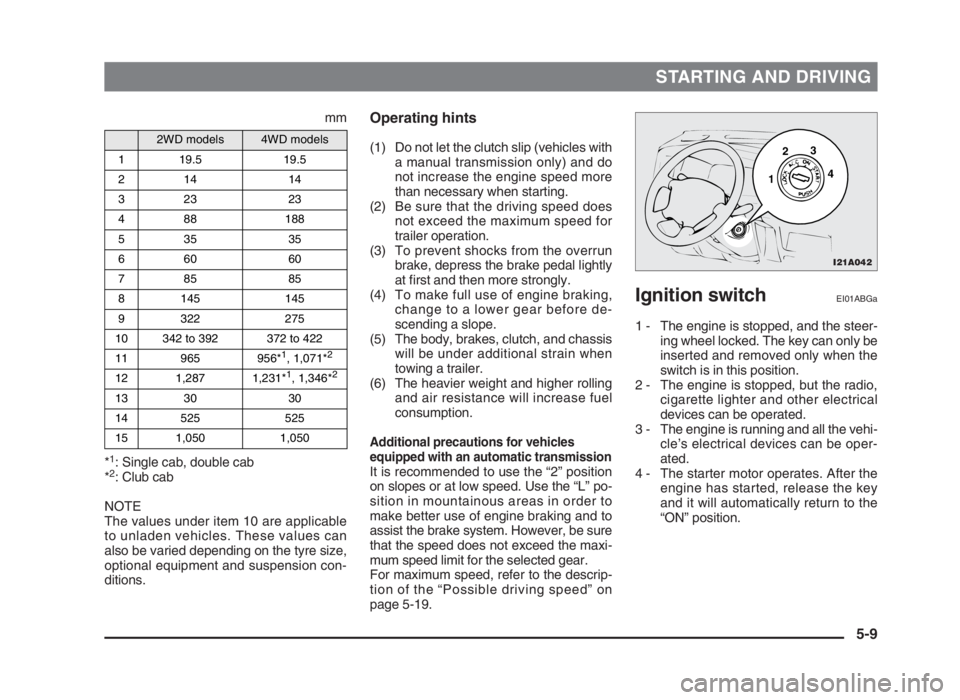
Ignition switchEI01ABGa
1 - The engine is stopped, and the steer-
ing wheel locked. The key can only be
inserted and removed only when the
switch is in this position.
2 - The engine is stopped, but the radio,
cigarette lighter and other electrical
devices can be operated.
3 - The engine is running and all the vehi-
cle’s electrical devices can be oper-
ated.
4 - The starter motor operates. After the
engine has started, release the key
and it will automatically return to the
“ON” position.
Operating hints
(1) Do not let the clutch slip (vehicles with
a manual transmission only) and do
not increase the engine speed more
than necessary when starting.
(2) Be sure that the driving speed does
not exceed the maximum speed for
trailer operation.
(3) To prevent shocks from the overrun
brake, depress the brake pedal lightly
at first and then more strongly.
(4) To make full use of engine braking,
change to a lower gear before de-
scending a slope.
(5) The body, brakes, clutch, and chassis
will be under additional strain when
towing a trailer.
(6) The heavier weight and higher rolling
and air resistance will increase fuel
consumption.
Additional precautions for vehicles
equipped with an automatic transmission
It is recommended to use the “2” position
on slopes or at low speed. Use the “L” po-
sition in mountainous areas in order to
make better use of engine braking and to
assist the brake system. However, be sure
that the speed does not exceed the maxi-
mum speed limit for the selected gear.
For maximum speed, refer to the descrip-
tion of the “Possible driving speed” on
page 5-19.
2WD models4WD models
1 19.5 19.5
214 14
323 23
4 88 188
535 35
660 60
785 85
8 145 145
9 322 275
10 342 to 392 372 to 422
11 965 956*
1, 1,071*2
12 1,287 1,231*1, 1,346*2
13 30 30
14 525 525
15 1,050 1,050
I21A042
2
13
4
05engL2_240082_4 22-01-2004 13:04 Page 5-9
Page 96 of 264
STARTING AND DRIVING
5-10
NOTE
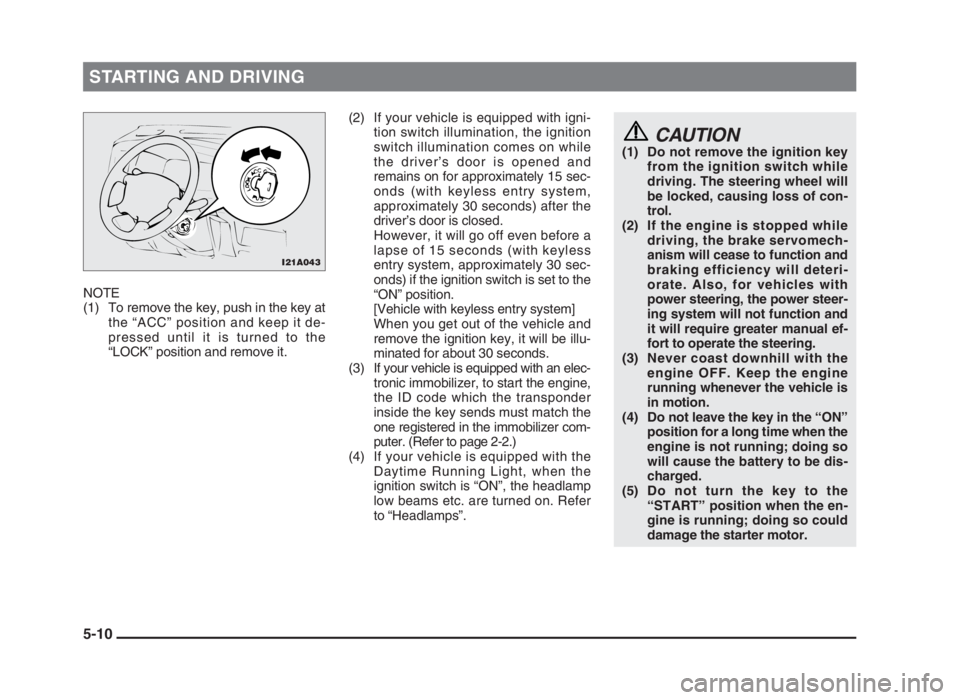
(1) To remove the key, push in the key at
the “ACC” position and keep it de-
pressed until it is turned to the
“LOCK” position and remove it.(2) If your vehicle is equipped with igni-
tion switch illumination, the ignition
switch illumination comes on while
the driver’s door is opened and
remains on for approximately 15 sec-
onds (with keyless entry system,
approximately 30 seconds) after the
driver’s door is closed.
However, it will go off even before a
lapse of 15 seconds (with keyless
entry system, approximately 30 sec-
onds) if the ignition switch is set to the
“ON” position.
[Vehicle with keyless entry system]
When you get out of the vehicle and
remove the ignition key, it will be illu-
minated for about 30 seconds.
(3) If your vehicle is equipped with an elec-
tronic immobilizer, to start the engine,
the ID code which the transponder
inside the key sends must match the
one registered in the immobilizer com-
puter. (Refer to page 2-2.)
(4) If your vehicle is equipped with the
Daytime Running Light, when the
ignition switch is “ON”, the headlamp
low beams etc. are turned on. Refer
to “Headlamps”.
CAUTION(1) Do not remove the ignition key
from the ignition switch while
driving. The steering wheel will
be locked, causing loss of con-
trol.
(2) If the engine is stopped while
driving, the brake servomech-
anism will cease to function and
braking efficiency will deteri-
orate. Also, for vehicles with
power steering, the power steer-
ing system will not function and
it will require greater manual ef-
fort to operate the steering.
(3) Never coast downhill with the
engine OFF. Keep the engine
running whenever the vehicle is
in motion.
(4) Do not leave the key in the “ON”
position for a long time when the
engine is not running; doing so
will cause the battery to be dis-
charged.
(5) Do not turn the key to the
“START” position when the en-
gine is running; doing so could
damage the starter motor.
I21A043
05engL2_240082_4 22-01-2004 13:04 Page 5-10
Page 97 of 264
STARTING AND DRIVING
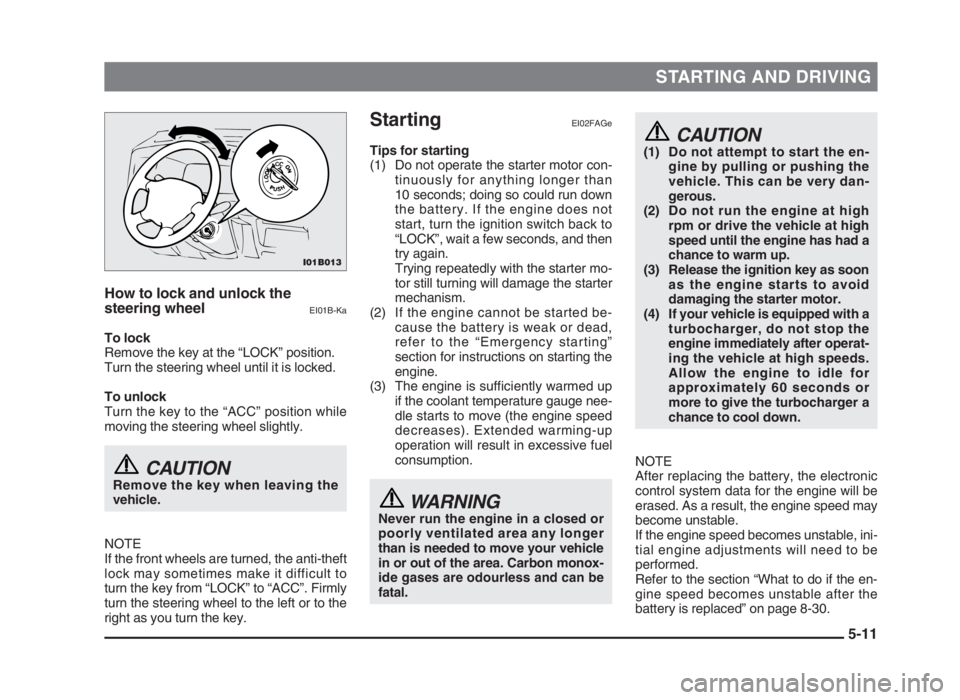
5-11 How to lock and unlock the
steering wheel
EI01B-Ka
To lock
Remove the key at the “LOCK” position.
Turn the steering wheel until it is locked.
To unlock
Turn the key to the “ACC” position while
moving the steering wheel slightly.
CAUTIONRemove the key when leaving the
vehicle.
NOTE
If the front wheels are turned, the anti-theft
lock may sometimes make it difficult to
turn the key from “LOCK” to “ACC”. Firmly
turn the steering wheel to the left or to the
right as you turn the key.
CAUTION(1) Do not attempt to start the en-
gine by pulling or pushing the
vehicle. This can be very dan-
gerous.
(2) Do not run the engine at high
rpm or drive the vehicle at high
speed until the engine has had a
chance to warm up.
(3) Release the ignition key as soon
as the engine starts to avoid
damaging the starter motor.
(4) If your vehicle is equipped with a
turbocharger, do not stop the
engine immediately after operat-
ing the vehicle at high speeds.
Allow the engine to idle for
approximately 60 seconds or
more to give the turbocharger a
chance to cool down.
NOTE
After replacing the battery, the electronic
control system data for the engine will be
erased. As a result, the engine speed may
become unstable.
If the engine speed becomes unstable, ini-
tial engine adjustments will need to be
performed.
Refer to the section “What to do if the en-
gine speed becomes unstable after the
battery is replaced” on page 8-30.
StartingEI02FAGe
Tips for starting
(1) Do not operate the starter motor con-
tinuously for anything longer than
10 seconds; doing so could run down
the battery. If the engine does not
start, turn the ignition switch back to
“LOCK”, wait a few seconds, and then
try again.
Trying repeatedly with the starter mo-
tor still turning will damage the starter
mechanism.
(2) If the engine cannot be started be-
cause the battery is weak or dead,
refer to the “Emergency starting”
section for instructions on starting the
engine.
(3) The engine is sufficiently warmed up
if the coolant temperature gauge nee-
dle starts to move (the engine speed
decreases). Extended warming-up
operation will result in excessive fuel
consumption.
WARNING
Never run the engine in a closed or
poorly ventilated area any longer
than is needed to move your vehicle
in or out of the area. Carbon monox-
ide
gases are odourless and can be
fatal.
I01B013
05engL2_240082_4 22-01-2004 13:04 Page 5-11
Page 98 of 264
STARTING AND DRIVING
5-12
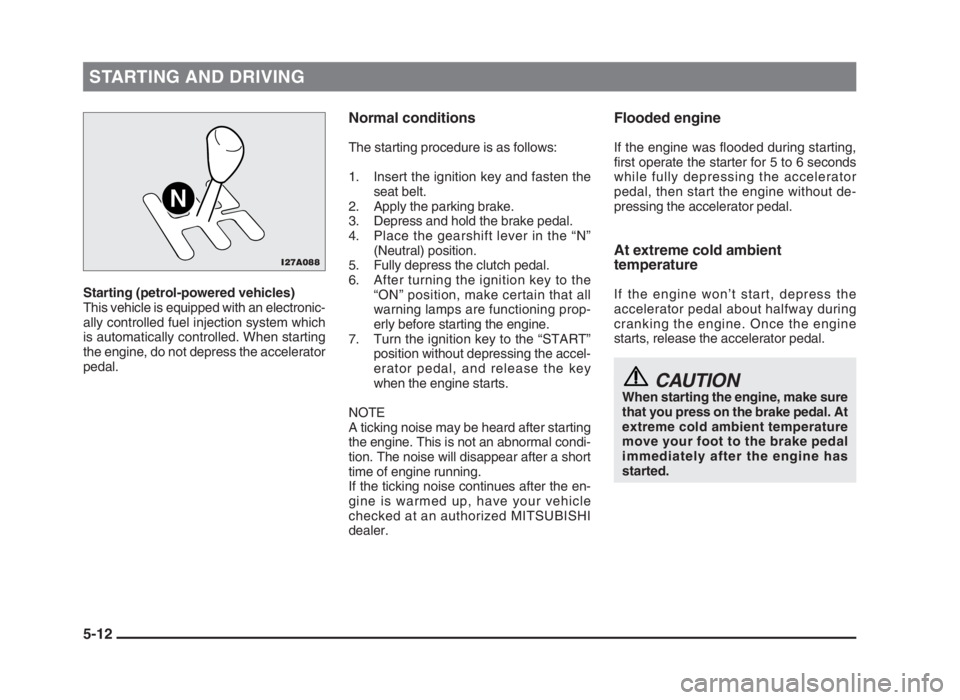
Starting (petrol-powered vehicles)
This vehicle is equipped with an electronic-
ally controlled fuel injection system which
is automatically controlled. When starting
the engine, do not depress the accelerator
pedal.
Normal conditions
The starting procedure is as follows:
1. Insert the ignition key and fasten the
seat belt.
2. Apply the parking brake.
3. Depress and hold the brake pedal.
4. Place the gearshift lever in the “N”
(Neutral) position.
5. Fully depress the clutch pedal.
6. After turning the ignition key to the
“ON” position, make certain that all
warning lamps are functioning prop-
erly before starting the engine.
7. Turn the ignition key to the “START”
position without depressing the accel-
erator pedal, and release the key
when the engine starts.
NOTE
A ticking noise may be heard after starting
the engine. This is not an abnormal condi-
tion. The noise will disappear after a short
time of engine running.
If the ticking noise continues after the en-
gine is warmed up, have your vehicle
checked at an authorized MITSUBISHI
dealer.
Flooded engine
If the engine was flooded during starting,
first operate the starter for 5 to 6 seconds
while fully depressing the accelerator
pedal, then start the engine without de-
pressing the accelerator pedal.
At extreme cold ambient
temperature
If the engine won’t start, depress the
accelerator pedal about halfway during
cranking the engine. Once the engine
starts, release the accelerator pedal.
CAUTIONWhen starting the engine, make sure
that you press on the brake pedal. At
extreme cold ambient temperature
move your foot to the brake pedal
immediately after the engine has
started.
I27A088
05engL2_240082_4 22-01-2004 13:04 Page 5-12
Page 99 of 264
STARTING AND DRIVING
5-13 Starting (diesel-powered vehicles)
EI02BAH
1. Insert the ignition key and fasten the
seat belt.
2. Apply the parking brake.
3. Depress and hold the brake pedal.
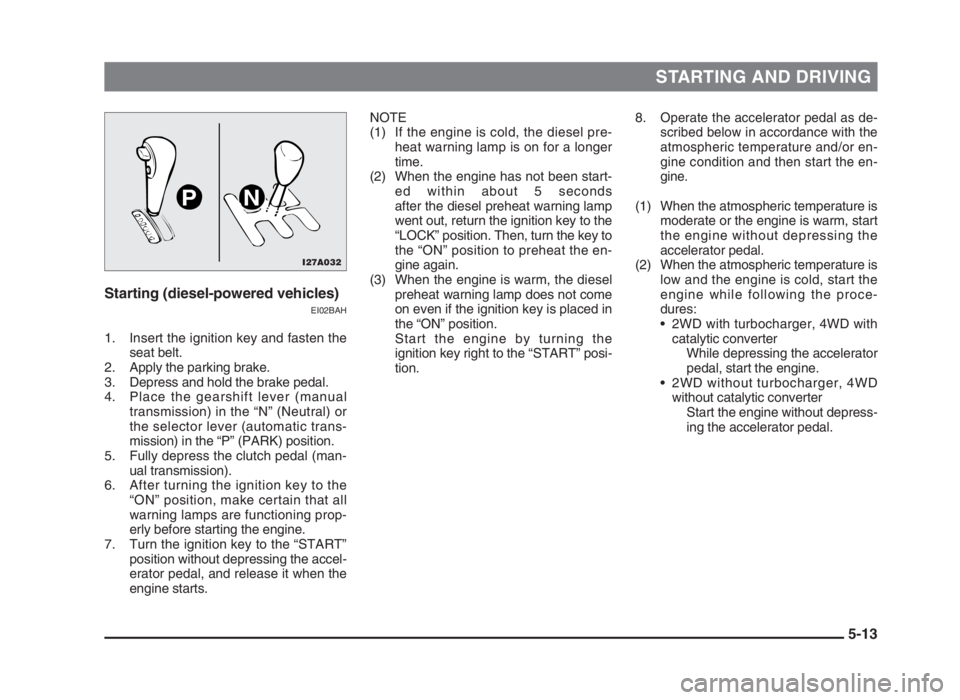
4. Place the gearshift lever (manual
transmission) in the “N” (Neutral) or
the selector lever (automatic trans-
mission) in the “P” (PARK) position.
5. Fully depress the clutch pedal (man-
ual transmission).
6. After turning the ignition key to the
“ON” position, make certain that all
warning lamps are functioning prop-
erly before starting the engine.
7. Turn the ignition key to the “START”
position without depressing the accel-
erator pedal, and release it when the
engine starts.8.
Operate the accelerator pedal as de-
scribed below in accordance with the
atmospheric temperature and/or en-
gine condition and then start the en-
gine.
(1) When the atmospheric temperature is
moderate or the engine is warm, start
the engine without depressing the
accelerator pedal.
(2) When the atmospheric temperature is
low and the engine is cold, start the
engine while following the proce-
dures:
• 2WD with turbocharger, 4WD with
catalytic converter
While depressing the accelerator
pedal, start the engine.
• 2WD without turbocharger, 4WD
without catalytic converter
Start the engine without depress-
ing the accelerator pedal. NOTE
(1) If the engine is cold, the diesel pre-
heat warning lamp is on for a longer
time.
(2) When the engine has not been start-
ed within about 5 seconds
after the diesel preheat warning lamp
went out, return the ignition key to the
“LOCK” position. Then, turn the key to
the “ON” position to preheat the en-
gine again.
(3) When the engine is warm, the diesel
preheat warning lamp does not come
on even if the ignition key is placed in
the “ON” position.
Start the engine by turning the
ignition key right to the “START” posi-
tion.
I27A032
PN
05engL2_240082_4 22-01-2004 13:04 Page 5-13
Page 106 of 264
STARTING AND DRIVING
5-20 Parking
EI04H-Be
To park the vehicle, first bring it to a com-
plete stop, fully engage the parking brake,
and then move the selector lever to the “P”
(PARK) position.
If you are going to leave the vehicle unat-
tended, always switch off the engine and
remove the ignition key.
NOTE
On a slope, be sure to apply the parking
brake before moving the selector lever to
the “P” (PARK) position. If you move the
selector lever to the “P” (PARK) position
without first applying the parking brake, a
stronger than normal resistance force may
be encountered. In this situation, move
the selector lever strongly when you next
wish to drive.
Transfer shift lever
(4WD vehicles)
EI03B-W
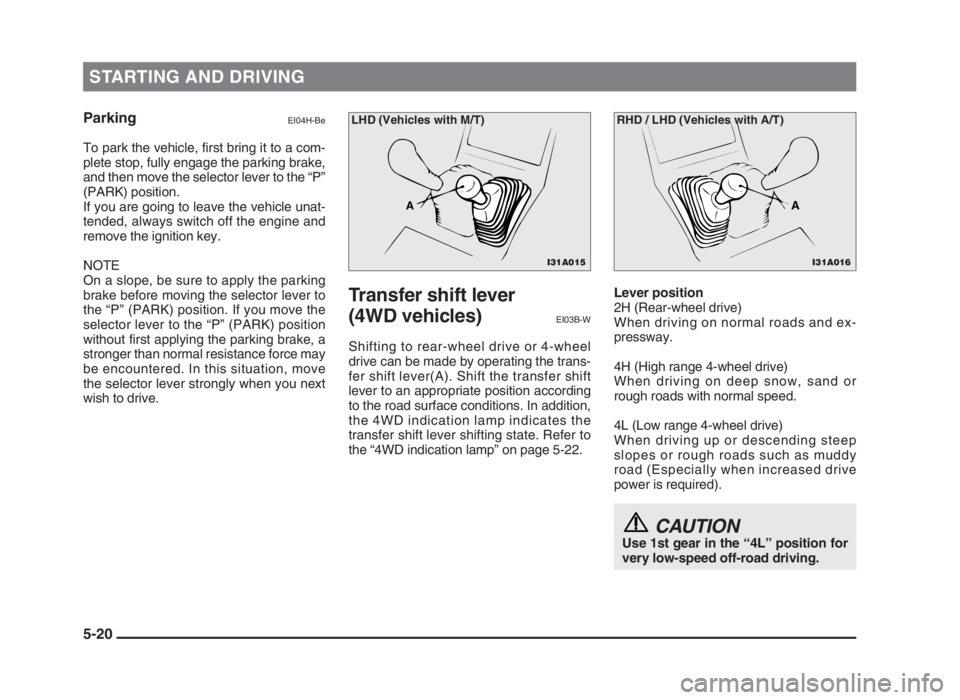
Shifting to rear-wheel drive or 4-wheel
drive can be made by operating the trans-
fer shift lever(A). Shift the transfer shift
lever to an appropriate position according
to the road surface conditions. In addition,
the 4WD indication lamp indicates the
transfer shift lever shifting state. Refer to
the “4WD indication lamp” on page 5-22.Lever position
2H (Rear-wheel drive)
When driving on normal roads and ex-
pressway.
4H (High range 4-wheel drive)
When driving on deep snow, sand or
rough roads with normal speed.
4L (Low range 4-wheel drive)
When driving up or descending steep
slopes or rough roads such as muddy
road (Especially when increased drive
power is required).
CAUTIONUse 1st gear in the “4L” position for
very low-speed off-road driving.
I31A015
A
LHD (Vehicles with M/T)
I31A016
A
RHD / LHD (Vehicles with A/T)
05engL2_240082_4 22-01-2004 13:05 Page 5-20
Page 118 of 264
STARTING AND DRIVING
5-32
ParkingEI22A-Ak
Parking on a slope
Fully engage the parking brake, and then
move the gearshift lever to 1st (on an up-
hill) or reverse (on a downhill) position on
manual transmission vehicle.
On automatic transmission vehicle, move
the selector lever to “P” (PARK) position.
When parking on a hill, apply chocks to
wheels for greater safety.
Parking with the engine running
Do not keep the engine running in a
closed or poorly ventilated place. Carbon
monoxide gas is odourless and extremely
poisonous and dangerous.
Where you park
Do not park in a place where there are in-
flammable objects such as dry grass,
leaves, etc. because the exhaust system
with catalyst produces very high tempera-
tures. This may cause a fire.
When leaving the vehicle
Always remove the key from the ignition
switch and lock all doors when leaving the
vehicle unattended.
Always try to park your vehicle in a well lit
area.
BrakingEI23A-Me
All the parts of the brake system are cri-
tical to safety. Have the vehicle serviced
by an authorized MITSUBISHI dealer at
regular intervals according to the service
booklet.
Brake system
(1) The service brake is divided into two
brake circuits so that when one brake
circuit fails, the other is available to
stop the vehicle. If this occurs, how-
ever, the brake pedal must be de-
pressed further than usual; stop driv-
ing as soon as possible and have the
brake system repaired at the nearest
authorized MITSUBISHI dealer.
(2) The brake boosting force is lost after
the brake pedal is depressed once or
twice while the engine is off. If this oc-
curs, the brake will require greater force
than usual. This is especially important
when the vehicle is being towed.
(3) On diesel-powered vehicles, the
brake booster will no longer function if
the V-belt is broken, and the brake
failure warning lamp will illuminate to
inform the driver. If this happens, use
engine braking (down-shifting) to re-
duce the speed of the vehicle and
then depress the brake pedal withmore force than usual to stop the
vehicle in a safe place, and have the
brake system serviced at the nearest
authorized MITSUBISHI dealer.
Warning lamp
The brake warning lamp lets you know if
your brake system is working properly.
Read “Brake warning lamp” on page 4-9.
When brakes are wet
Check the brake system while driving at a
low speed immediately after starting, es-
pecially when the brakes are wet, to con-
firm they work normally.
A film of water can form on the brake discs
or brake drums and prevent normal func-
tioning after driving in heavy rain or
through large puddles, or after the vehicle
is washed. If this occurs, dry the brakes
out by driving slowly while lightly depress-
ing the brake pedal.
When driving downhill
It is important to take advantage of the en-
gine braking by shifting to a lower gear
while driving on steep downhill roads in
order to prevent the brakes from overheat-
ing.
05engL2_240082_4 22-01-2004 13:05 Page 5-32