engine MITSUBISHI L200 2017 (in English) Manual Online
[x] Cancel search | Manufacturer: MITSUBISHI, Model Year: 2017, Model line: L200, Model: MITSUBISHI L200 2017Pages: 426, PDF Size: 14.12 MB
Page 176 of 426
CAUTIONlDo not install any aftermarket limited-slip
differential (LSD) on your vehicle. The Ac-
tive Stability Control function may stop functioning properly.NOTEl An operation noise may be emitted from the
engine compartment in the following situa-
tions. The sound is associated with checking the operations of the ASTC. At this time,
you may feel a shock from the brake pedal if
you depress it. These do not indicate a mal- function.
• When the ignition switch is set to the
“ON” position or the operation mode is put in ON.
• When the vehicle is driven for a while af-
ter the engine is turned on.
l When the ASTC is activated, you may feel a
vibration in the vehicle body or hear a whin-
ing sound from the engine compartment.
This indicates that the system is operating normally. It does not indicate a malfunction.
l When the anti-lock brake system warning
lamp is illuminated, the ASTC is not active.NOTEl On vehicles with the rear differential lock,
the ASTC and ABS functions are suspended
while the rear differential lock is activated. ASTC indication lamp, ASTC OFF indica-
tion lamp and ABS warning lamp are illumi- nated while these functions are suspended. It
does not indicate a problem. When the rear differential lock is disengaged, these lamps
go out and function again.
Refer to “ABS warning lamp” on page 6-57,
“ASTC indication lamp, ASTC OFF indica-
tion lamp” on page 6-62.Active Stability Control func-
tion
E00616901200
The Active Stability Control function is de- signed to help the driver maintain control of the vehicle on slippery roads or during rapid
steering manoeuvres. It works by controlling the engine output and brake on each wheel.
NOTEl The Active Stability Control function does
not operate when the drive mode-selector isin the “4L” position (Easy select 4WD),“4LLc” position (Super select 4WD II).
When the Active Stability Control function
is operating with the drive mode-selector in the “2H” or “4H” position (Easy select
4WD), “2H”, “4H” or “4HLc” position (Su-
per select 4WD II), setting the drive mode- selector to the “4L” (Easy select 4WD), “4LLc” position (Super select 4WD II) posi-
tion makes the Active Stability Control func-
tion deactivate automatically.
l The Active Stability Control function oper-
ates at speeds of about 15 km/h (9 mph) or
higher.
l On vehicles with rear differential locks, the
Active Stability Control function does notoperate when the rear differential lock is ac-
tivated.“ASC OFF” switch
E00639800036
The Active Stability Control function is auto-
matically activated when the ignition switchis turned to the “ON” position or the opera-
tion mode is put in ON. You can deactivate
the system by pressing down the “ASC OFF”
switch for 3 seconds or longer.
Active Stability & Traction Control (ASTC)*
6-60OKTE17E1Starting and driving6
Page 177 of 426
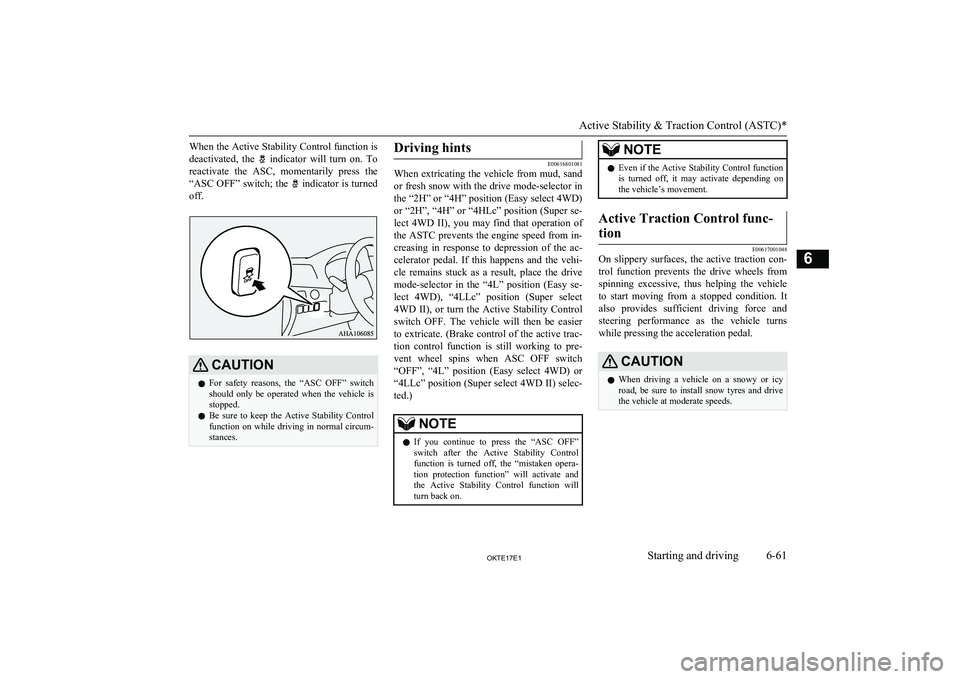
When the Active Stability Control function isdeactivated, the
indicator will turn on. To
reactivate the ASC, momentarily press the “ASC OFF” switch; the
indicator is turned
off.
CAUTIONl For safety reasons, the “ASC OFF” switch
should only be operated when the vehicle isstopped.
l Be sure to keep the Active Stability Control
function on while driving in normal circum-
stances.Driving hints
E00616801081
When extricating the vehicle from mud, sand
or fresh snow with the drive mode-selector in
the “2H” or “4H” position (Easy select 4WD) or “2H”, “4H” or “4HLc” position (Super se-
lect 4WD II), you may find that operation of
the ASTC prevents the engine speed from in- creasing in response to depression of the ac-celerator pedal. If this happens and the vehi-cle remains stuck as a result, place the drive
mode-selector in the “4L” position (Easy se- lect 4WD), “4LLc” position (Super select4WD II), or turn the Active Stability Control
switch OFF. The vehicle will then be easier
to extricate. (Brake control of the active trac- tion control function is still working to pre-
vent wheel spins when ASC OFF switch “OFF”, “4L” position (Easy select 4WD) or“4LLc” position (Super select 4WD II) selec-
ted.)
NOTEl If you continue to press the “ASC OFF”
switch after the Active Stability Control
function is turned off, the “mistaken opera- tion protection function” will activate and the Active Stability Control function will
turn back on.NOTEl Even if the Active Stability Control function
is turned off, it may activate depending on
the vehicle’s movement.Active Traction Control func-
tion
E00617001048
On slippery surfaces, the active traction con- trol function prevents the drive wheels from spinning excessive, thus helping the vehicle
to start moving from a stopped condition. It
also provides sufficient driving force and
steering performance as the vehicle turns while pressing the acceleration pedal.
CAUTIONl When driving a vehicle on a snowy or icy
road, be sure to install snow tyres and drive
the vehicle at moderate speeds.
Active Stability & Traction Control (ASTC)*
6-61OKTE17E1Starting and driving6
Page 178 of 426
ASTC indication lamp, ASTCOFF indication lamp
E00617101166
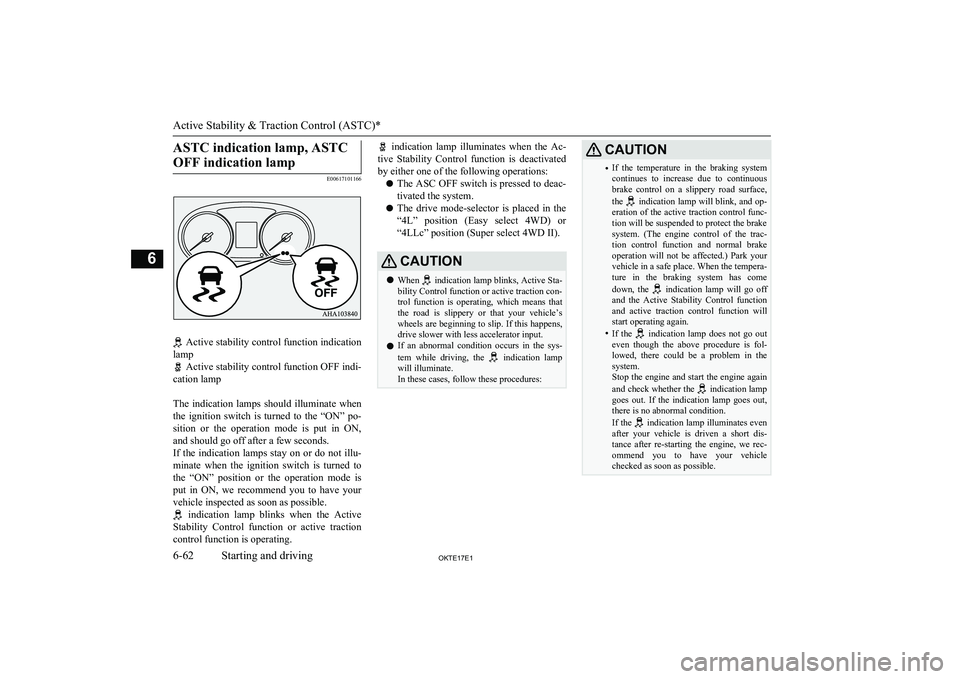
Active stability control function indication
lamp
Active stability control function OFF indi-
cation lamp
The indication lamps should illuminate when the ignition switch is turned to the “ON” po-
sition or the operation mode is put in ON, and should go off after a few seconds.
If the indication lamps stay on or do not illu-
minate when the ignition switch is turned to the “ON” position or the operation mode is put in ON, we recommend you to have your
vehicle inspected as soon as possible.
indication lamp blinks when the Active
Stability Control function or active traction
control function is operating.
indication lamp illuminates when the Ac-
tive Stability Control function is deactivated by either one of the following operations:
l The ASC OFF switch is pressed to deac-
tivated the system.
l The drive mode-selector is placed in the
“4L” position (Easy select 4WD) or “4LLc” position (Super select 4WD II).CAUTIONl When
indication lamp blinks, Active Sta-
bility Control function or active traction con-
trol function is operating, which means that
the road is slippery or that your vehicle’s
wheels are beginning to slip. If this happens, drive slower with less accelerator input.
l If an abnormal condition occurs in the sys-
tem while driving, the
indication lamp
will illuminate.
In these cases, follow these procedures:
CAUTION• If the temperature in the braking system
continues to increase due to continuous
brake control on a slippery road surface,
the
indication lamp will blink, and op-
eration of the active traction control func-
tion will be suspended to protect the brake
system. (The engine control of the trac- tion control function and normal brake operation will not be affected.) Park yourvehicle in a safe place. When the tempera-
ture in the braking system has come
down, the
indication lamp will go off
and the Active Stability Control function and active traction control function willstart operating again.
• If the
indication lamp does not go out
even though the above procedure is fol-
lowed, there could be a problem in the system.
Stop the engine and start the engine again
and check whether the
indication lamp
goes out. If the indication lamp goes out, there is no abnormal condition.
If the
indication lamp illuminates even
after your vehicle is driven a short dis-
tance after re-starting the engine, we rec-
ommend you to have your vehicle checked as soon as possible.
Active Stability & Traction Control (ASTC)*
6-62OKTE17E1Starting and driving6
Page 179 of 426
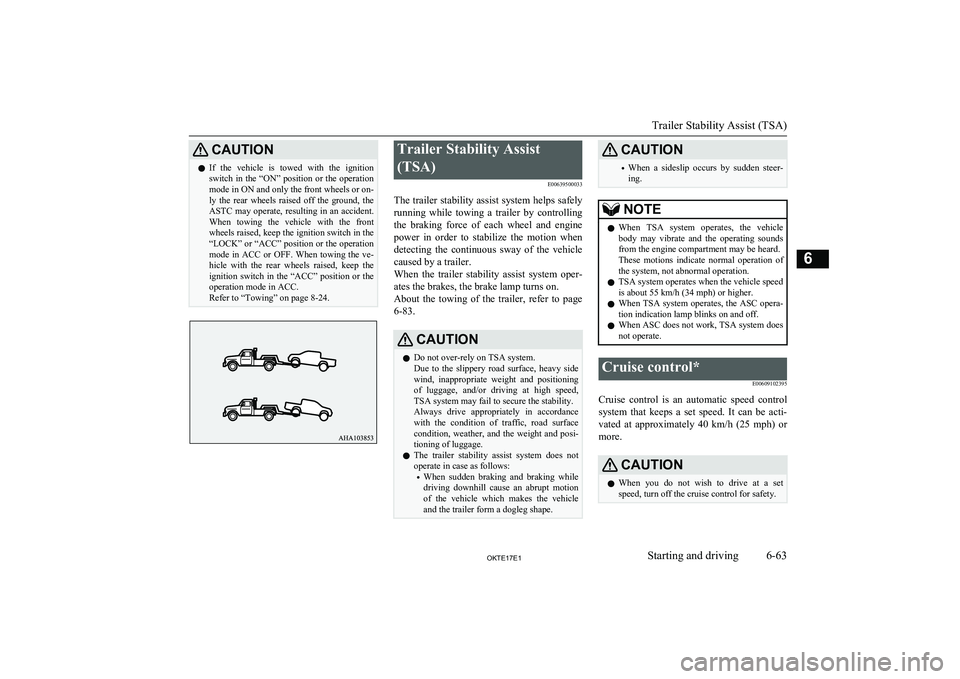
CAUTIONlIf the vehicle is towed with the ignition
switch in the “ON” position or the operation
mode in ON and only the front wheels or on- ly the rear wheels raised off the ground, the
ASTC may operate, resulting in an accident. When towing the vehicle with the front
wheels raised, keep the ignition switch in the “LOCK” or “ACC” position or the operation
mode in ACC or OFF. When towing the ve- hicle with the rear wheels raised, keep the
ignition switch in the “ACC” position or the operation mode in ACC.
Refer to “Towing” on page 8-24.Trailer Stability Assist
(TSA) E00639500033
The trailer stability assist system helps safely running while towing a trailer by controllingthe braking force of each wheel and enginepower in order to stabilize the motion when
detecting the continuous sway of the vehicle
caused by a trailer.
When the trailer stability assist system oper- ates the brakes, the brake lamp turns on.
About the towing of the trailer, refer to page 6-83.CAUTIONl Do not over-rely on TSA system.
Due to the slippery road surface, heavy side
wind, inappropriate weight and positioning
of luggage, and/or driving at high speed, TSA system may fail to secure the stability.
Always drive appropriately in accordance with the condition of traffic, road surface
condition, weather, and the weight and posi- tioning of luggage.
l The trailer stability assist system does not
operate in case as follows:
• When sudden braking and braking while
driving downhill cause an abrupt motion
of the vehicle which makes the vehicle
and the trailer form a dogleg shape.CAUTION• When a sideslip occurs by sudden steer-
ing.NOTEl When TSA system operates, the vehicle
body may vibrate and the operating sounds
from the engine compartment may be heard.
These motions indicate normal operation of
the system, not abnormal operation.
l TSA system operates when the vehicle speed
is about 55 km/h (34 mph) or higher.
l When TSA system operates, the ASC opera-
tion indication lamp blinks on and off.
l When ASC does not work, TSA system does
not operate.Cruise control*
E00609102395
Cruise control is an automatic speed controlsystem that keeps a set speed. It can be acti-vated at approximately 40 km/h (25 mph) or
more.
CAUTIONl When you do not wish to drive at a set
speed, turn off the cruise control for safety.
Trailer Stability Assist (TSA)
6-63OKTE17E1Starting and driving6
Page 180 of 426
CAUTIONlOn vehicles with
M/T, do not move the
gearshift lever to the “N” (Neutral) position
while driving at a set speed without depress- ing the clutch pedal. The engine will run too
fast and might be damaged.
l Do not use cruise control when driving con-
ditions will not allow you to stay at the same
speed, such as in heavy traffic or on roads that are winding, icy, snow-covered, wet,
slippery, on a steep downhill slope.NOTEl Cruise control may not be able to keep your
speed on uphills or downhills.
l Your speed may decrease on a steep uphill.
You may use the accelerator pedal if you
want to stay at your set speed.
l Your speed may increase to more than the
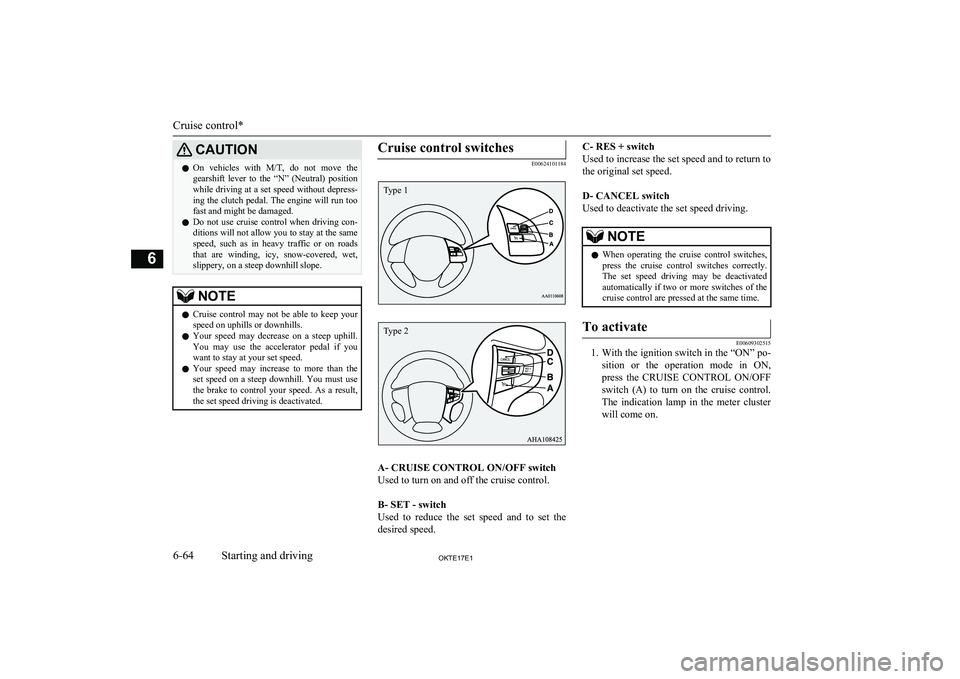
set speed on a steep downhill. You must use the brake to control your speed. As a result, the set speed driving is deactivated.Cruise control switches
E00624101184
A- CRUISE CONTROL ON/OFF switch
Used to turn on and off the cruise control.
B- SET - switch
Used to reduce the set speed and to set the
desired speed.
C- RES + switch
Used to increase the set speed and to return to
the original set speed.
D- CANCEL switch
Used to deactivate the set speed driving.NOTEl When operating the cruise control switches,
press the cruise control switches correctly.
The set speed driving may be deactivated automatically if two or more switches of the
cruise control are pressed at the same time.To activate
E00609302515
1. With the ignition switch in the “ON” po-
sition or the operation mode in ON, press the CRUISE CONTROL ON/OFF
switch (A) to turn on the cruise control. The indication lamp in the meter clusterwill come on.
Cruise control*
6-64OKTE17E1Starting and driving6 Type 1 Type 2
Page 184 of 426
Refer to “To resume the set speed” on page
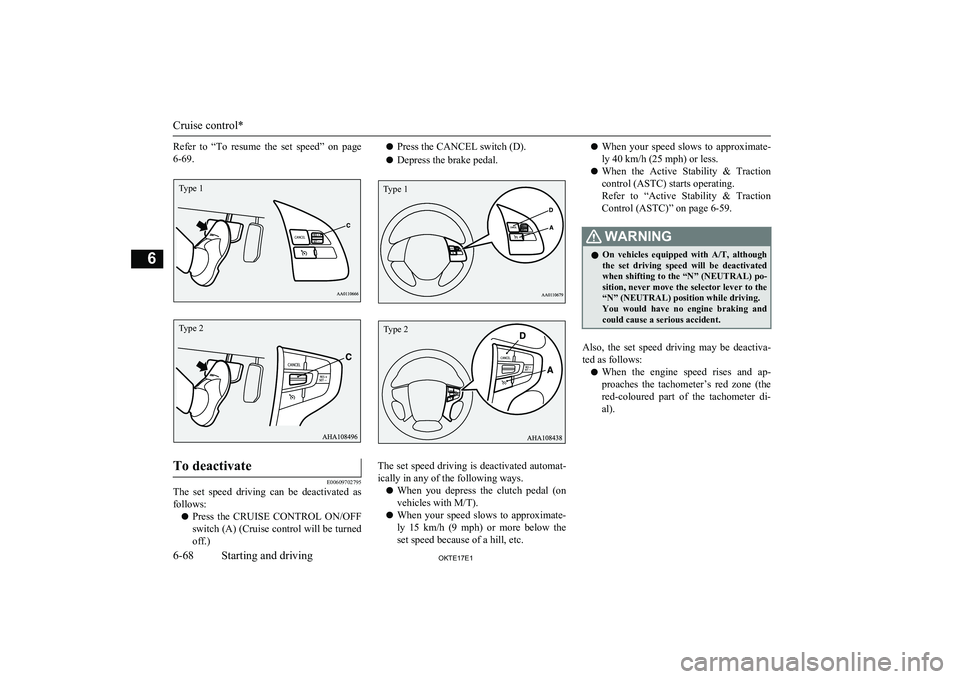
6-69.To deactivate
E00609702795
The set speed driving can be deactivated as
follows:
l Press the CRUISE CONTROL ON/OFF
switch (A) (Cruise control will be turned off.)
l Press the CANCEL switch (D).
l Depress the brake pedal.
The set speed driving is deactivated automat-
ically in any of the following ways.
l When you depress the clutch pedal (on
vehicles with M/T).
l When your speed slows to approximate-
ly 15 km/h (9 mph) or more below the set speed because of a hill, etc.
l When your speed slows to approximate-
ly 40 km/h (25 mph) or less.
l When the Active Stability & Traction
control (ASTC) starts operating.
Refer to “Active Stability & Traction Control (ASTC)” on page 6-59.WARNINGl On vehicles equipped with
A/T, although
the set driving speed will be deactivated
when shifting to the “N” (NEUTRAL) po- sition, never move the selector lever to the
“N” (NEUTRAL) position while driving.
You would have no engine braking and
could cause a serious accident.
Also, the set speed driving may be deactiva-
ted as follows:
l When the engine speed rises and ap-
proaches the tachometer’s red zone (the red-coloured part of the tachometer di-
al).
Cruise control*
6-68OKTE17E1Starting and driving6Type 1 Type 2 Type 1 Type 2
Page 185 of 426
CAUTIONlWhen the set speed driving is deactivated
automatically in any situation other thanthose listed above, there may be a system
malfunction.
Press the CRUISE CONTROL ON/OFF switch to turn off the cruise control and have your vehicle inspected by a MITSUBISHI
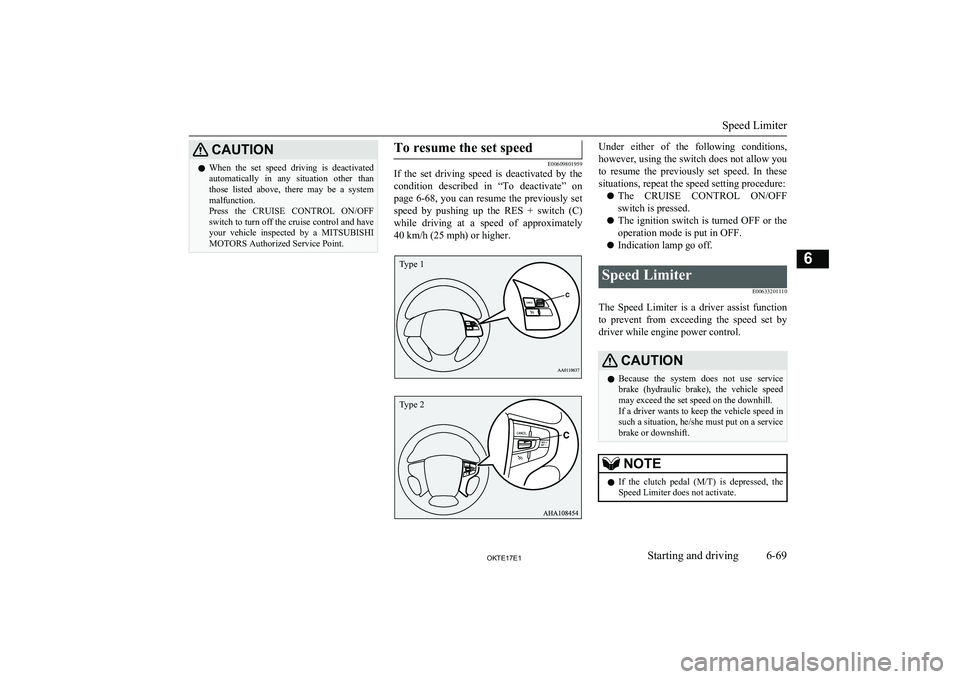
MOTORS Authorized Service Point.To resume the set speed
E00609801959
If the set driving speed is deactivated by the
condition described in “To deactivate” on
page 6-68, you can resume the previously set
speed by pushing up the RES + switch (C)
while driving at a speed of approximately 40 km/h (25 mph) or higher.
Under either of the following conditions, however, using the switch does not allow you
to resume the previously set speed. In these
situations, repeat the speed setting procedure:
l The CRUISE CONTROL ON/OFF
switch is pressed.
l The ignition switch is turned OFF or the
operation mode is put in OFF.
l Indication lamp go off.Speed Limiter
E00633201110
The Speed Limiter is a driver assist functionto prevent from exceeding the speed set by
driver while engine power control.
CAUTIONl Because the system does not use service
brake (hydraulic brake), the vehicle speed may exceed the set speed on the downhill.
If a driver wants to keep the vehicle speed in such a situation, he/she must put on a servicebrake or downshift.NOTEl If the clutch pedal
(M/T) is depressed, the
Speed Limiter does not activate.
Speed Limiter
6-69OKTE17E1Starting and driving6 Type 1 Type 2
Page 186 of 426
If the vehicle speed exceeds the set speed,control state “LIMIT” and the Speed Limit-
er’s symbol will blink in the combination me-
ter.
If the vehicle speed exceeds the set speed af- ter indicated control state “LIMIT” and the
Speed Limiter’s symbol, beep alert will sound a certain period of time.
While running without blinked control state “LIMIT” and the Speed Limiter’s symbol, if
you decrease the set speed and vehicle speed is more than set speed, control state “LIMIT” and the Speed Limiter’s symbol blinking
starts but beep alert is delayed.
In this case, when vehicle speed keeps ex- ceeding set speed for about 30 seconds after
control state “LIMIT” and the Speed Limit- er’s symbol are blinked, beep alert will sound
a certain period of time.
If the vehicle speeds decreases less than set
speeds, control state “LIMIT” and the Speed Limiter’s symbol stop blinking. When beep
alert is sounding, the beep alert also goes off.NOTEl However, this gives priority to audio and
visual signal of safety reasons or driver’s de-mand.NOTEl If the set speed is too lower based on current
shift position, the Speed Limiter may notlimit the vehicle speed to prevent engine
stall.Speed Limiter control switches
E00633301094
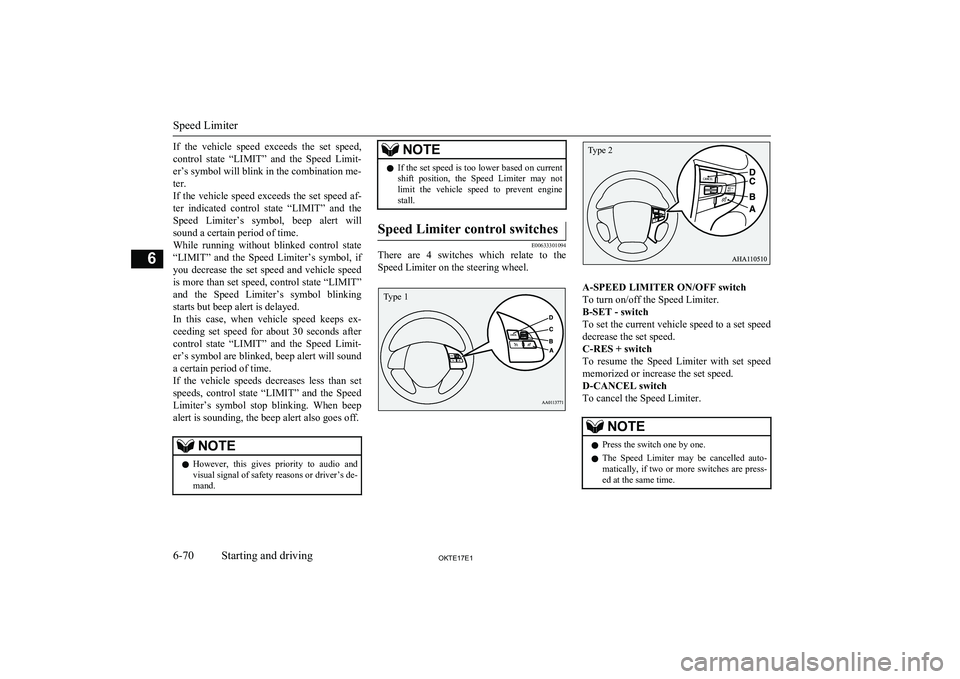
There are 4 switches which relate to the
Speed Limiter on the steering wheel.
A-SPEED LIMITER ON/OFF switch
To turn on/off the Speed Limiter.
B-SET - switch
To set the current vehicle speed to a set speed decrease the set speed.
C-RES + switch
To resume the Speed Limiter with set speed memorized or increase the set speed.
D-CANCEL switch
To cancel the Speed Limiter.
NOTEl Press the switch one by one.
l The Speed Limiter may be cancelled auto-
matically, if two or more switches are press-ed at the same time.
Speed Limiter
6-70OKTE17E1Starting and driving6 Type 1 Type 2
Page 200 of 426
Check that your towing bar coupling ball
does not obscure your vehicle’s licence plate when the trailer or caravan is disconnected. Ifit obscures the licence plate, please remove
the towing bar coupling ball. And if the tow-
ing bar coupling ball is lockable by using a
key or any kind of tools, please remove the coupling ball and use a towing bar coupling
ball which can be removed or repositioned
without the use of a key or any kind of tools instead.
The regulations concerning the towing of a
trailer may differ from country to country.
You are advised to obey the regulations in
each area.CAUTIONl Danger of Accident!
A towing bar should be fitted according to
MITSUBISHI MOTORS guidelines.NOTEl If you are going to tow a trailer, pay careful
attention to the following points.Maximum towable weight with
brake and maximum trailer- nose weight
Never exceed the maximum towable weight
with brake and the maximum trailer-nose weight as listed in the specifications. (Referto “Vehicle weight” on page 11-11.)
If you tow a trailer at an altitude of more than
1,000 m above sea-level, reduce your weight
by 10 % of the gross combination weight for
every increase of 1,000 m above sea-level, as the engine output is lowered owing to de-
crease in atmospheric pressure.
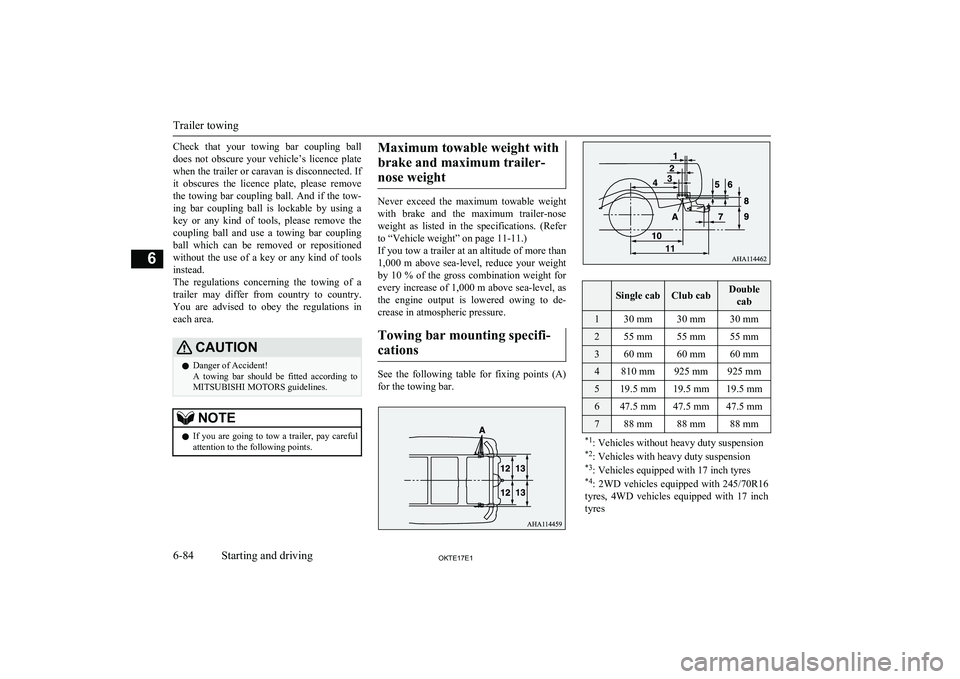
Towing bar mounting specifi-cations
See the following table for fixing points (A) for the towing bar.
Single cabClub cabDouble
cab130 mm30 mm30 mm255 mm55 mm55 mm360 mm60 mm60 mm4810 mm925 mm925 mm519.5 mm19.5 mm19.5 mm647.5 mm47.5 mm47.5 mm788 mm88 mm88 mm*1: Vehicles without heavy duty suspension
*2 : Vehicles with heavy duty suspension
*3 : Vehicles equipped with 17 inch tyres
*4 : 2WD vehicles equipped with 245/70R16
tyres, 4WD vehicles equipped with 17 inch tyres
Trailer towing
6-84OKTE17E1Starting and driving6
Page 201 of 426
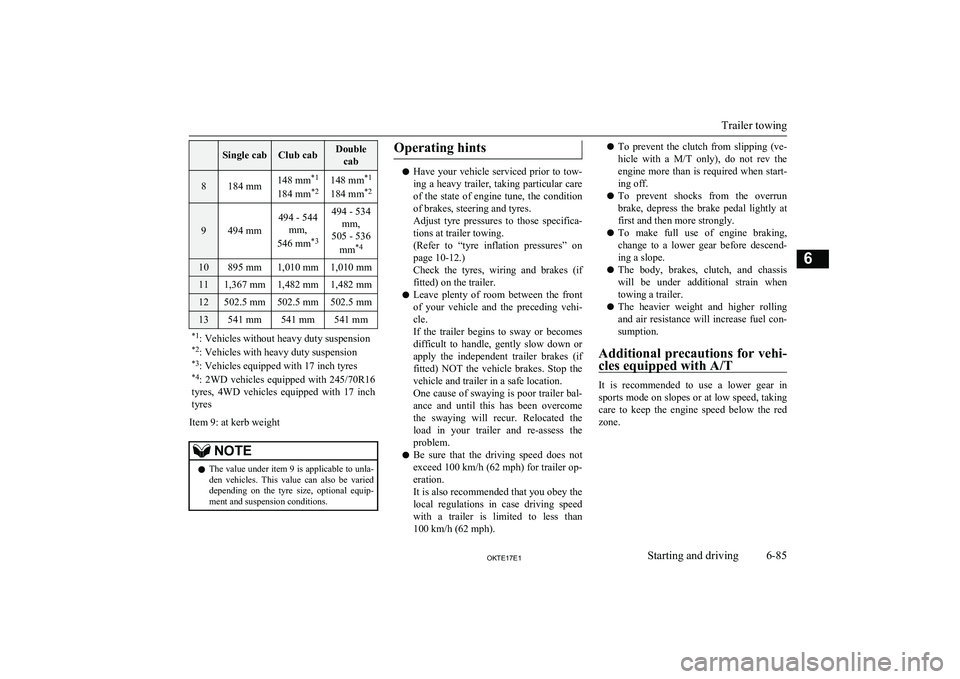
Single cabClub cabDoublecab8184 mm148 mm *1
184 mm *2148 mm *1
184 mm *2
9494 mm
494 - 544
mm,
546 mm *3494 - 534
mm,
505 - 536
mm *410895 mm1,010 mm1,010 mm111,367 mm1,482 mm1,482 mm12502.5 mm502.5 mm502.5 mm13541 mm541 mm541 mm*1
: Vehicles without heavy duty suspension
*2 : Vehicles with heavy duty suspension
*3 : Vehicles equipped with 17 inch tyres
*4 : 2WD vehicles equipped with 245/70R16
tyres, 4WD vehicles equipped with 17 inch
tyres
Item 9: at kerb weight
NOTEl The value under item 9 is applicable to unla-
den vehicles. This value can also be varied depending on the tyre size, optional equip-
ment and suspension conditions.Operating hints
l Have your vehicle serviced prior to tow-
ing a heavy trailer, taking particular care
of the state of engine tune, the condition of brakes, steering and tyres.
Adjust tyre pressures to those specifica- tions at trailer towing.
(Refer to “tyre inflation pressures” on
page 10-12.)
Check the tyres, wiring and brakes (if fitted) on the trailer.
l Leave plenty of room between the front
of your vehicle and the preceding vehi- cle.
If the trailer begins to sway or becomes difficult to handle, gently slow down or
apply the independent trailer brakes (if fitted) NOT the vehicle brakes. Stop the
vehicle and trailer in a safe location.
One cause of swaying is poor trailer bal-
ance and until this has been overcome the swaying will recur. Relocated the load in your trailer and re-assess the
problem.
l Be sure that the driving speed does not
exceed 100 km/h (62 mph) for trailer op-
eration.
It is also recommended that you obey the
local regulations in case driving speed with a trailer is limited to less than
100 km/h (62 mph).
l To prevent the clutch from slipping (ve-
hicle with a M/T only), do not rev the
engine more than is required when start-
ing off.
l To prevent shocks from the overrun
brake, depress the brake pedal lightly at
first and then more strongly.
l To make full use of engine braking,
change to a lower gear before descend-
ing a slope.
l The body, brakes, clutch, and chassis
will be under additional strain when
towing a trailer.
l The heavier weight and higher rolling
and air resistance will increase fuel con- sumption.
Additional precautions for vehi-
cles equipped with A/T
It is recommended to use a lower gear in
sports mode on slopes or at low speed, taking care to keep the engine speed below the red
zone.
Trailer towing
6-85OKTE17E1Starting and driving6