bulb MITSUBISHI L200 2018 Owner's Manual (in English)
[x] Cancel search | Manufacturer: MITSUBISHI, Model Year: 2018, Model line: L200, Model: MITSUBISHI L200 2018Pages: 466, PDF Size: 28.42 MB
Page 107 of 466
refer to “Capacity” on page 11-17.Combination headlampsand dipper switch E00506004514
Headlamps
NOTElDo not leave the lamps on for a long time
while the engine is stationary (not running).A run-down battery could result.
l When it rains, or when the vehicle has been
washed, the inside of the lens sometimes be-
comes foggy, but this does not indicate a
functional problem.
When the lamp is switched on, the heat will remove the fog. However, if water gathers
inside the lamp, we recommend you to have it checked.
l The bulbs of the high intensity discharge
headlamps (if so equipped) have the follow-
ing characteristics.
• While the headlamps are used, the light
will gradually become a bluish-white col- our.
• The life time of a bulb becomes shorter as
it is repeatedly turned on and off. Whenthe bulb approaches the end of its life time, the brightness may decrease, the
bulb may flicker, and the light may be- come a reddish colour. If this occurs, have
the vehicle inspected by a MITSUBISHI
MOTORS Authorized Service Point.NOTE
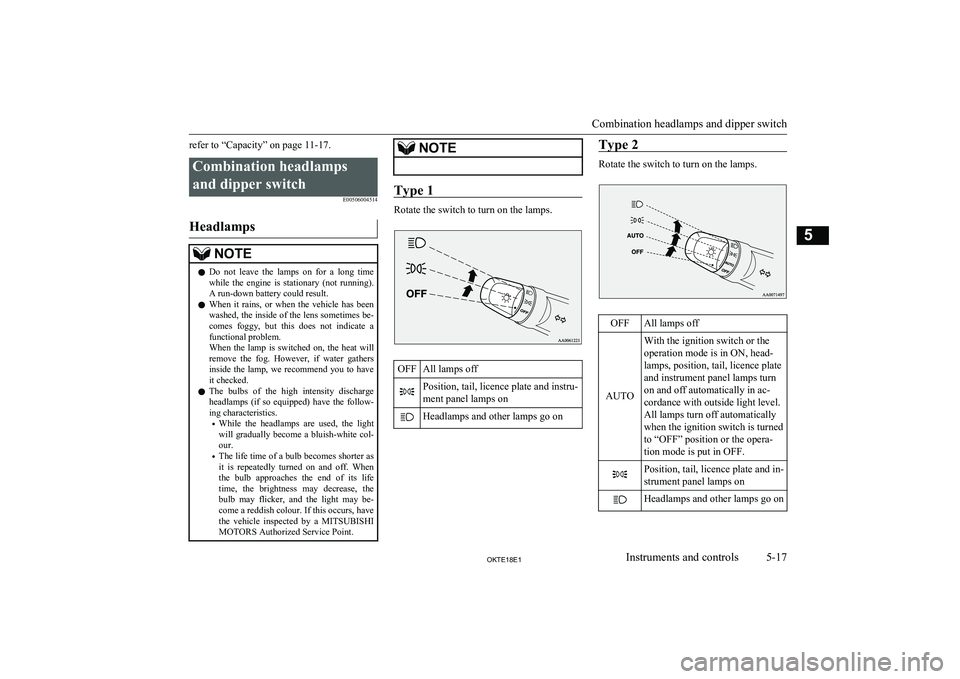
Type 1
Rotate the switch to turn on the lamps.
OFFAll lamps offPosition, tail, licence plate and instru-
ment panel lamps onHeadlamps and other lamps go onType 2
Rotate the switch to turn on the lamps.
OFFAll lamps off
AUTO
With the ignition switch or the
operation mode is in ON, head-
lamps, position, tail, licence plate
and instrument panel lamps turn
on and off automatically in ac-
cordance with outside light level.
All lamps turn off automatically
when the ignition switch is turned
to “OFF” position or the opera-
tion mode is put in OFF.Position, tail, licence plate and in-
strument panel lamps onHeadlamps and other lamps go on
Combination headlamps and dipper switch
5-17OKTE18E1Instruments and controls5
Page 111 of 466
2- Lane-change signalsWhen moving the lever to (2) slightly tochange a lane, the turn-signal lamps and
indication lamp in the instrument cluster will only flash while the lever is operat- ed.
Also, when you move the lever to (2) slightly then release it, the turn-signal lamps and indication lamp in the instru-
ment cluster will flash 3 times.NOTEl If the lamp flashes unusually quickly, the
bulb in a turn-signal lamp may have burned out. We recommend you to have the vehicle
inspected.
l It is possible to activate the following func-
tions.
• Flashing of the turn-signal lamps when
the lever is operated with the ignition
switch or the operation mode is in ACC.
• The turn-signal lamps 3-flash function for
lane changes can be deactivated.
• The time required to operate the lever for
the 3-flash function can be adjusted.
• Changing of the tone of a sounding buz-
zer as the turn-signal lamps flash.
For further information, we recommend you
to consult a MITSUBISHI MOTORS Au-
thorized Service Point.Hazard warning flasher
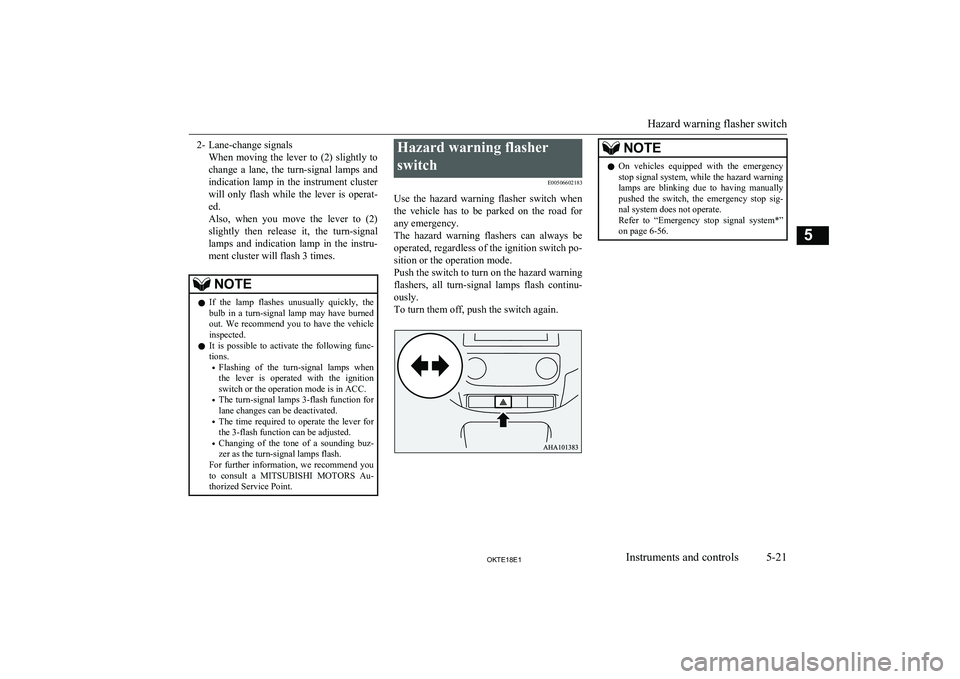
switch E00506602183
Use the hazard warning flasher switch when
the vehicle has to be parked on the road for
any emergency.
The hazard warning flashers can always be operated, regardless of the ignition switch po-
sition or the operation mode.
Push the switch to turn on the hazard warning flashers, all turn-signal lamps flash continu-
ously.
To turn them off, push the switch again.NOTEl On vehicles equipped with the emergency
stop signal system, while the hazard warning lamps are blinking due to having manually
pushed the switch, the emergency stop sig-
nal system does not operate.
Refer to “Emergency stop signal system*” on page 6-56.
Hazard warning flasher switch
5-21OKTE18E1Instruments and controls5
Page 170 of 466
lRemove the insects, dried grass, etc.
clogging the radiator core and A/T oil
cooler.
l After crossing a stream, be sure to have
the following items inspected at a MITSUBISHI MOTORS Authorized
Service Point and take the necessary
measures. • Check the brake system and, if neces-
sary, have it serviced.
• Check the engine, transmission, trans-
fer, and differential oil or grease level and turbidity. If the oil or grease is
milky, it indicates water contamina-
tion. Replace it with new oil or grease.
• Grease the propeller shaft.
• Check the inside of the vehicle. If in-
gress of water is found, dry the carpetetc.
• Inspect the headlamps. If the head-
lamp bulb is flooded with water, have
the headlamp drained off.Cautions on handling of 4-
wheel drive vehicles E00606802102
Tyres and wheels
Since the driving torque can be applied to the 4 wheels, the performance of the vehiclewhen operating in 4-wheel drive is greatly af-
fected by the condition of the tyres.
Pay close attention to the tyres.
l Install specified tyres on all wheels. Re-
fer to “Tyres and wheels” on page 11-15.
l Be sure to the appropriate tyre inflation
pressure according to no cargo or cargo.
Refer to “Tyre inflation pressures” on
page 10-12.
l Be sure to fit all 4 tyres and wheels of
the same size and type.
When replacement of any of the tyres or wheels is necessary, replace all of them.
l All tyres should be rotated whenever the
wear difference between the front and
rear tyres is recognizable.
Good vehicle performance cannot be expec-
ted if there is a difference in wear between tyres. Refer to “Tyre rotation” on page 10-13.
l Check the tyre inflation pressure regular-
ly.
CAUTIONl Always use tyres of the same size, same
type, and same brand, and which have no wear differences. Using the tyres which dif-
fer in size, type, brands or the degree of wear or the inappropriate tyre inflation pres-
sure, will increase the differential oil tem- perature and may be impossible to shift the transfer, resulting in possible damage to the
driving system. Further, the drive train will be subjected to excessive loading, possibly
leading to oil leakage, component seizure, or
other serious faults.
Towing
If towing is necessary, we recommend you to
have it done by your MITSUBISHI
MOTORS Authorized Service Point or a
commercial tow truck service.
In the following cases, transport the vehicle
using a tow truck.
l The engine runs but the vehicle does not
move or abnormal noise is produced.
l Inspection of the vehicle’s underside re-
veals that oil or some other fluid is leak- ing.
Cautions on handling of 4-wheel drive vehicles
6-52OKTE18E1Starting and driving6
Page 349 of 466
Service precautions........................................................................... 10-02
Catalytic converter............................................................................ 10-03
Bonnet............................................................................................... 10-04
Engine oil.......................................................................................... 10-05 Engine coolant...................................................................................10-06
Washer fluid...................................................................................... 10-08
Brake fluid.........................................................................................10-08
Clutch fluid*..................................................................................... 10-09 Power steering fluid.......................................................................... 10-09
Battery............................................................................................... 10-10 Tyres..................................................................................................10-12Wiper blade rubber replacement....................................................... 10-15
General maintenance......................................................................... 10-16
Fusible links...................................................................................... 10-17
Fuses..................................................................................................10-17
Replacement of lamp bulbs............................................................... 10-22
Masking the headlamps.....................................................................10-31Maintenance
OKTE18E110
Page 364 of 466
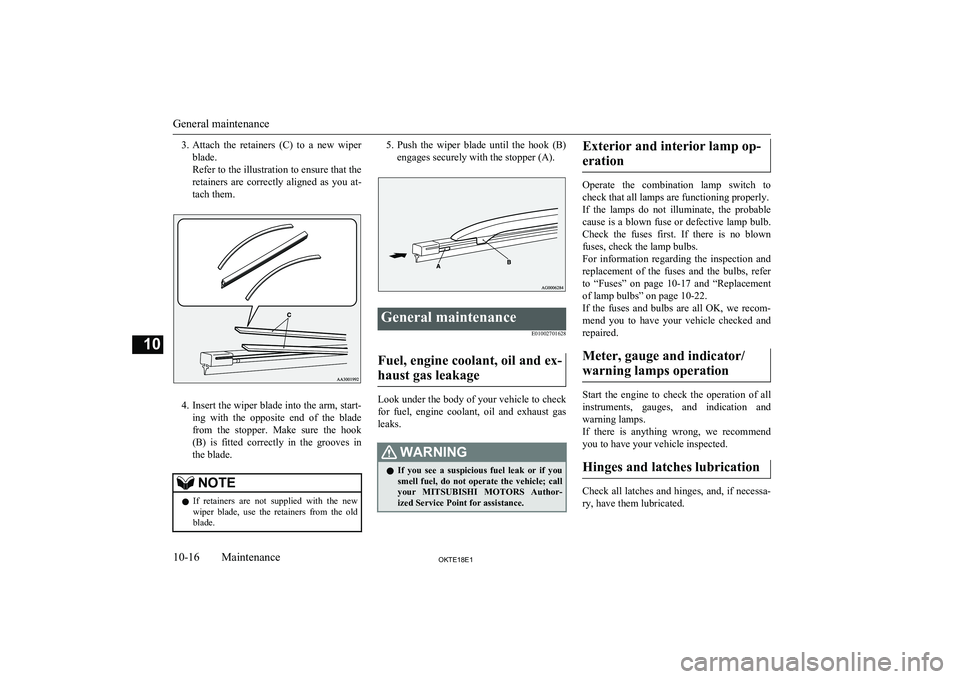
3.Attach the retainers (C) to a new wiper
blade.
Refer to the illustration to ensure that the
retainers are correctly aligned as you at- tach them.
4. Insert the wiper blade into the arm, start-
ing with the opposite end of the blade from the stopper. Make sure the hook
(B) is fitted correctly in the grooves inthe blade.
NOTEl If retainers are not supplied with the new
wiper blade, use the retainers from the old
blade.5. Push the wiper blade until the hook (B)
engages securely with the stopper (A).General maintenance
E01002701628
Fuel, engine coolant, oil and ex-
haust gas leakage
Look under the body of your vehicle to check
for fuel, engine coolant, oil and exhaust gas
leaks.
WARNINGl If you see a suspicious fuel leak or if you
smell fuel, do not operate the vehicle; call
your MITSUBISHI MOTORS Author-
ized Service Point for assistance.Exterior and interior lamp op-
eration
Operate the combination lamp switch to
check that all lamps are functioning properly.
If the lamps do not illuminate, the probable cause is a blown fuse or defective lamp bulb.
Check the fuses first. If there is no blown
fuses, check the lamp bulbs.
For information regarding the inspection and
replacement of the fuses and the bulbs, refer
to “Fuses” on page 10-17 and “Replacement
of lamp bulbs” on page 10-22.
If the fuses and bulbs are all OK, we recom-
mend you to have your vehicle checked and repaired.
Meter, gauge and indicator/ warning lamps operation
Start the engine to check the operation of all
instruments, gauges, and indication and warning lamps.
If there is anything wrong, we recommend
you to have your vehicle inspected.
Hinges and latches lubrication
Check all latches and hinges, and, if necessa- ry, have them lubricated.
General maintenance
10-16OKTE18E1Maintenance10
Page 370 of 466
Replacement of lamp bulbsE01003102121
Before replacing a bulb, ensure the lamp is off. Do not touch the glass part of the new
bulb with your bare fingers; the skin oil left
on the glass will evaporate when the bulb gets hot and the vapour will condense on the
reflector and dim the surface.CAUTIONl Bulbs are extremely hot immediately after
being turned off.
When replacing a bulb, wait for it to cool sufficiently before touching it. You couldotherwise be burnt.
l Handle halogen lamp bulbs with care. The
gas inside halogen lamp bulbs is highly pres-
surized, so dropping, knocking, or scratching
a halogen lamp bulb can cause it to shatter.CAUTIONl Never hold the halogen lamp bulb with a
bare hand, dirty glove, etc.
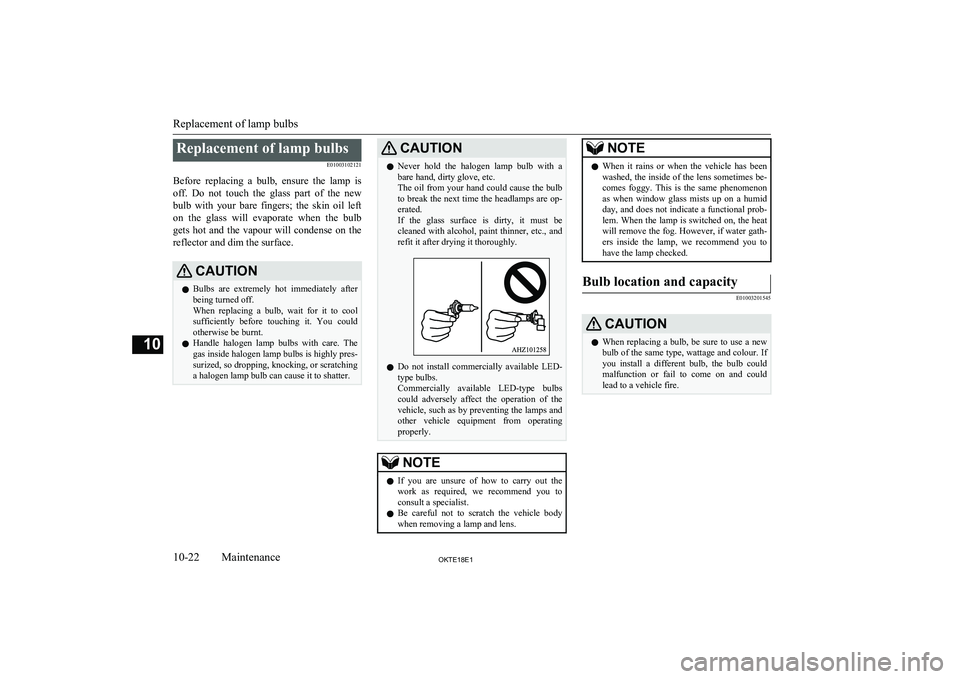
The oil from your hand could cause the bulb to break the next time the headlamps are op-
erated.
If the glass surface is dirty, it must be cleaned with alcohol, paint thinner, etc., and
refit it after drying it thoroughly.
l Do not install commercially available LED-
type bulbs.
Commercially available LED-type bulbs
could adversely affect the operation of the vehicle, such as by preventing the lamps and
other vehicle equipment from operating properly.
NOTEl If you are unsure of how to carry out the
work as required, we recommend you to consult a specialist.
l Be careful not to scratch the vehicle body
when removing a lamp and lens.NOTEl When it rains or when the vehicle has been
washed, the inside of the lens sometimes be-
comes foggy. This is the same phenomenon as when window glass mists up on a humid
day, and does not indicate a functional prob- lem. When the lamp is switched on, the heat
will remove the fog. However, if water gath- ers inside the lamp, we recommend you tohave the lamp checked.Bulb location and capacity
E01003201545
CAUTIONl When replacing a bulb, be sure to use a new
bulb of the same type, wattage and colour. If you install a different bulb, the bulb could malfunction or fail to come on and could
lead to a vehicle fire.
Replacement of lamp bulbs
10-22OKTE18E1Maintenance10
Page 371 of 466
Outside
E01003305254
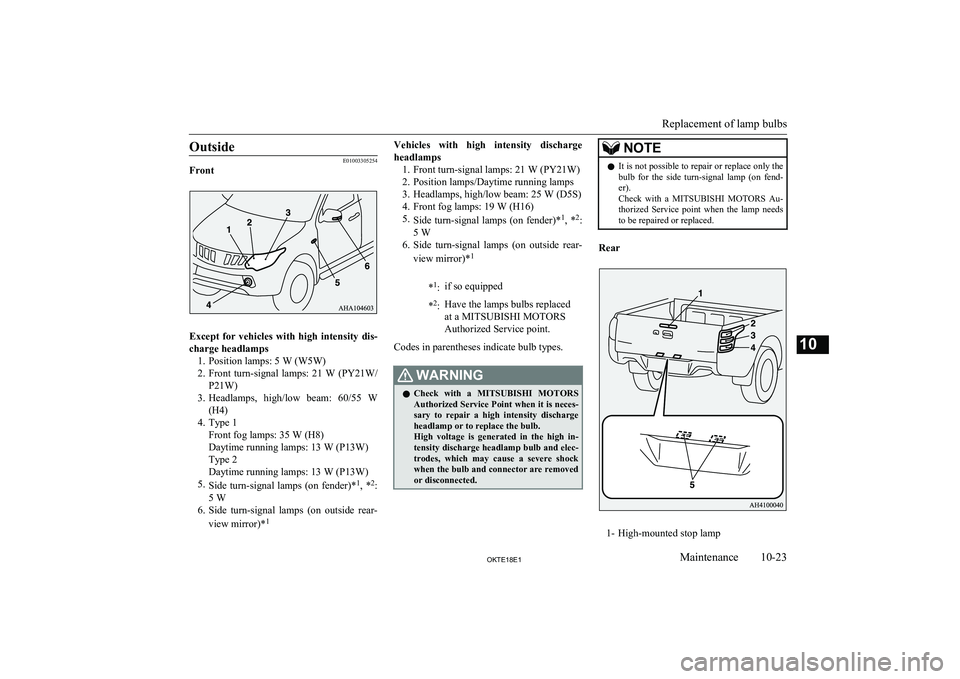
Front
Except for vehicles with high intensity dis-
charge headlamps 1. Position lamps: 5 W (W5W)
2. Front turn-signal lamps: 21 W (PY21W/
P21W)
3. Headlamps, high/low beam: 60/55 W
(H4)
4. Type 1 Front fog lamps: 35 W (H8)
Daytime running lamps: 13 W (P13W)
Type 2
Daytime running lamps: 13 W (P13W)
5. Side turn-signal lamps (on fender)* 1
, * 2
:
5 W
6. Side turn-signal lamps (on outside rear-
view mirror)* 1
Vehicles with high intensity discharge
headlamps 1. Front turn-signal lamps: 21 W (PY21W)
2. Position lamps/Daytime running lamps
3. Headlamps, high/low beam: 25 W (D5S) 4. Front fog lamps: 19 W (H16)
5. Side turn-signal lamps (on fender)* 1
, * 2
:
5 W
6. Side turn-signal lamps (on outside rear-
view mirror)* 1*1
:if so equipped* 2
:Have the lamps bulbs replaced
at a MITSUBISHI MOTORS
Authorized Service point.
Codes in parentheses indicate bulb types.
WARNINGl Check with a
MITSUBISHI MOTORS
Authorized Service Point when it is neces- sary to repair a high intensity discharge
headlamp or to replace the bulb.
High voltage is generated in the high in-
tensity discharge headlamp bulb and elec- trodes, which may cause a severe shock
when the bulb and connector are removed or disconnected.NOTEl It is not possible to repair or replace only the
bulb for the side turn-signal lamp (on fend-
er).
Check with a MITSUBISHI MOTORS Au-
thorized Service point when the lamp needs to be repaired or replaced.
Rear
1- High-mounted stop lamp
Replacement of lamp bulbs
10-23OKTE18E1Maintenance10
Page 372 of 466
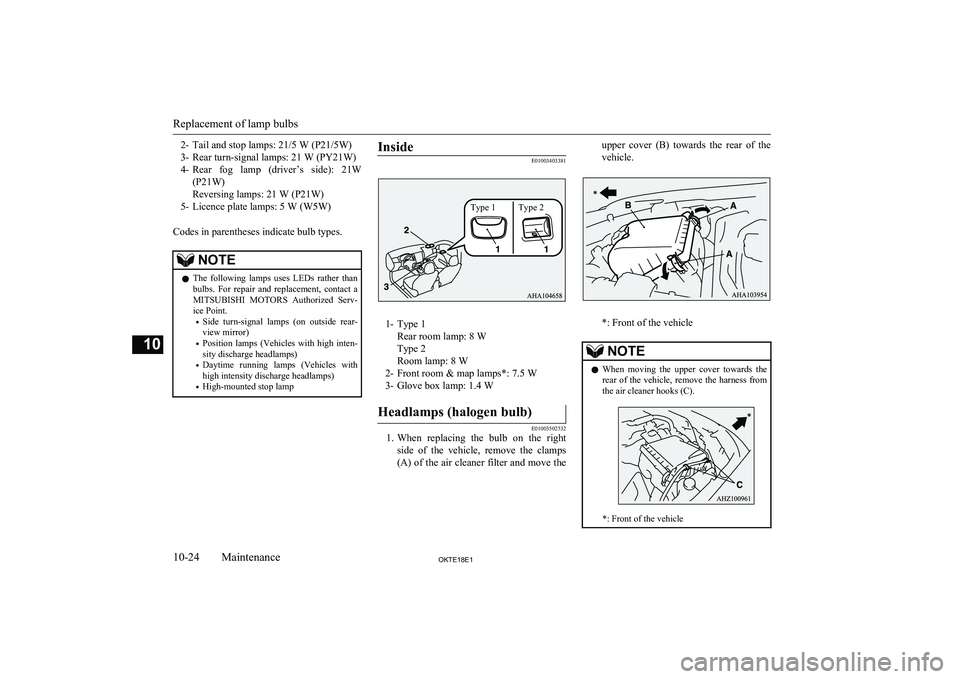
2- Tail and stop lamps: 21/5 W (P21/5W)
3- Rear turn-signal lamps: 21 W (PY21W) 4- Rear fog lamp (driver’s side): 21W
(P21W)
Reversing lamps: 21 W (P21W)
5- Licence plate lamps: 5 W (W5W)
Codes in parentheses indicate bulb types.NOTEl The following lamps uses LEDs rather than
bulbs. For repair and replacement, contact a
MITSUBISHI MOTORS Authorized Serv-
ice Point.
• Side turn-signal lamps (on outside rear-
view mirror)
• Position lamps (Vehicles with high inten-
sity discharge headlamps)
• Daytime running lamps (Vehicles with
high intensity discharge headlamps)
• High-mounted stop lampInside
E01003403381
1- Type 1
Rear room lamp: 8 W
Type 2
Room lamp: 8 W
2- Front room & map lamps*: 7.5 W
3- Glove box lamp: 1.4 W
Headlamps (halogen bulb)
E01003502532
1. When replacing the bulb on the right
side of the vehicle, remove the clamps
(A) of the air cleaner filter and move the
upper cover (B) towards the rear of the
vehicle.
*: Front of the vehicle
NOTEl When moving the upper cover towards the
rear of the vehicle, remove the harness fromthe air cleaner hooks (C).
*: Front of the vehicle
Replacement of lamp bulbs
10-24OKTE18E1Maintenance10 Type 1 Type 2
Page 373 of 466
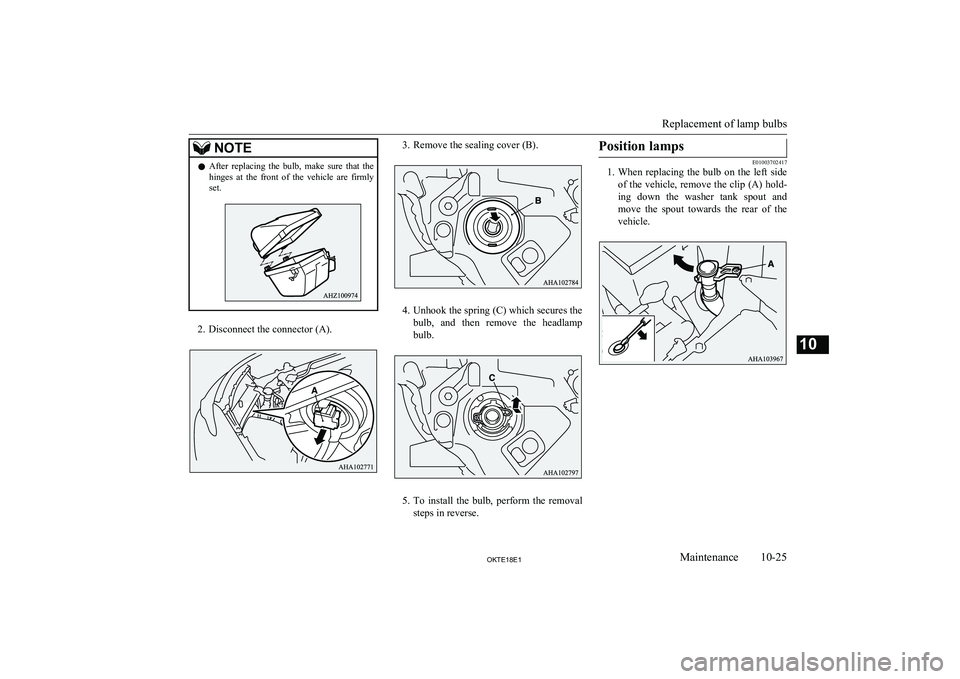
NOTElAfter replacing the bulb, make sure that the
hinges at the front of the vehicle are firmly
set.
2. Disconnect the connector (A).
3. Remove the sealing cover (B).
4. Unhook the spring (C) which secures the
bulb, and then remove the headlamp bulb.
5. To install the bulb, perform the removal
steps in reverse.
Position lamps
E01003702417
1. When replacing the bulb on the left side
of the vehicle, remove the clip (A) hold-
ing down the washer tank spout and
move the spout towards the rear of the vehicle.
Replacement of lamp bulbs
10-25OKTE18E1Maintenance10
Page 374 of 466
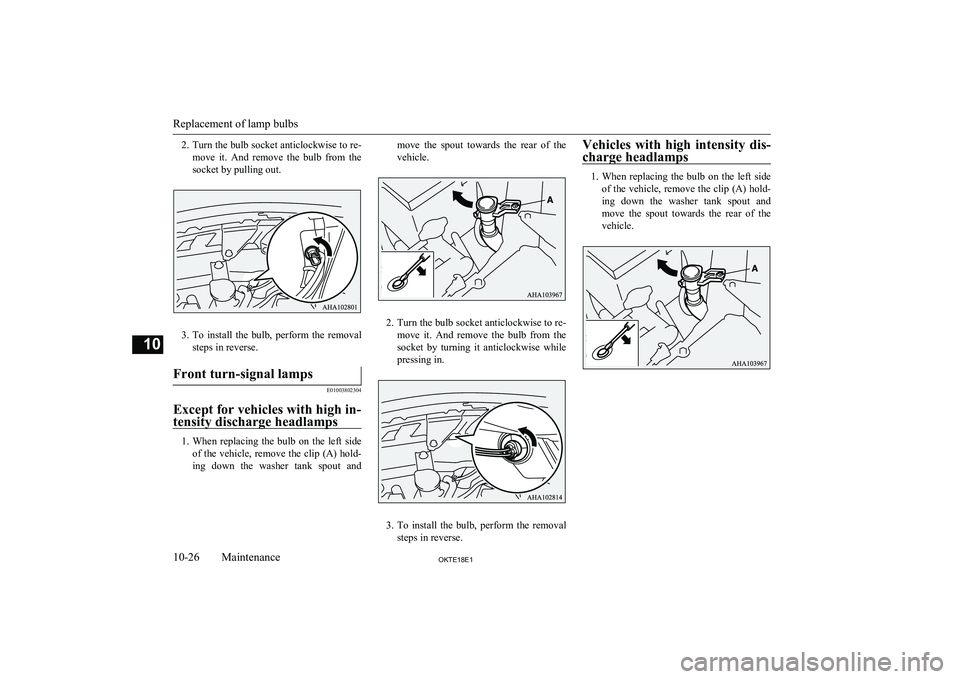
2.Turn the bulb socket anticlockwise to re-
move it. And remove the bulb from the
socket by pulling out.
3. To install the bulb, perform the removal
steps in reverse.
Front turn-signal lamps
E01003802304
Except for vehicles with high in- tensity discharge headlamps
1. When replacing the bulb on the left side
of the vehicle, remove the clip (A) hold- ing down the washer tank spout and
move the spout towards the rear of the
vehicle.
2. Turn the bulb socket anticlockwise to re-
move it. And remove the bulb from the
socket by turning it anticlockwise while pressing in.
3. To install the bulb, perform the removal
steps in reverse.
Vehicles with high intensity dis-
charge headlamps
1. When replacing the bulb on the left side
of the vehicle, remove the clip (A) hold- ing down the washer tank spout and
move the spout towards the rear of the vehicle.Replacement of lamp bulbs
10-26OKTE18E1Maintenance10