brake MITSUBISHI LANCER 2014 8.G Owner's Manual
[x] Cancel search | Manufacturer: MITSUBISHI, Model Year: 2014, Model line: LANCER, Model: MITSUBISHI LANCER 2014 8.GPages: 434, PDF Size: 57.5 MB
Page 129 of 434
Continuously variable transm
ission (CVT) (if so equipped)
5-62 Features and controls
5
N00512900131
For the best fuel economy and performance in using your manual transaxle, upshift as listedbelow. At low altitude locations, shift at the vehicle speeds listed. Upshifting earlier during cruise conditions (relatively steady speeds) willimprove your fuel economy. At high altitude locations, upshift as listed below.
N00513000096
It is recommended that you downshift to a lower gear when needed to maintain the desired speed, according to the table.Avoid downshifting at too high a speed. The engine may suffer damage. To maintain a safe speed and prolong brakelife, shift down to 2nd or 1st when descend- ing a steep hill. Downshifting is also important to avoid “lug-ging” the engine at too low a speed, such aswhen turning a corner or when driving up a steep hill.
N00513100215
The table below shows the maximum recom- mended driving speed for in each gear. Donot drive near or at these speeds for pro- longed periods of time. Do not use the gearshift lever as a handrest. This can result in premature wear of the transaxle shift forks.
N00513200229
The CVT will automati
cally and continuously
change its gear ratio depending on road and
Upshifting
Shift point
Upshift speeds
Acceleration
Cruise
1st gear to 2nd gear
15 mph (24 km/h)
15 mph (24 km/h)
2nd gear to 3rd gear
28 mph (45 km/h)
19 mph (31 km/h)
3rd gear to 4th gear
36 mph (58 km/h)
33 mph (53 km/h)
4th gear to 5th gear
45 mph (72 km/h)
45 mph (72 km/h)
Shift point
Upshift speeds
1st gear to 2nd gear 15 mph (24 km/h)2nd gear to 3rd gear 25 mph (40 km/h)3rd gear to 4th gear 40 mph (64 km/h)
4th gear to 5th gear 45 mph (72 km/h)Downshifting
Recommended downshifting speed
Downshifting speed
Shift point
Under 20 mph (32 km/h)
Shift down from cur- rent gear to 2nd gear.
20 to 30 mph (32 to
48 km/h)
Shift down from cur- rent gear to 3rd gear.
Shift point
Upshift speeds
Driving precautions
Maximum possible driving speed
Shift points
Maximum possible driving
speed
1st gear 31 mph (50 km/h)2nd gear 62 mph (100 km/h)3rd gear 87 mph (140 km/h)4th gear 121 mph (195 km/h)Continuously variable transmission (CVT)
(if so
equipped)
Page 130 of 434
Continuously variable transmission (CVT) (if so equipped)
Features and controls 5-63
5
driving conditions. This helps achieve smooth driving and excellent fuel efficiency. Also you can manually shift up and shift down the transmission. Refer to “Sportsmode” on page 5-67. The transmission prevents unnecessary upshifts even when the accelerator pedal isreleased and ensures smooth driving. According to the condi
tions, the transmission
will automatically shift to a lower gear ratio to achieve stronger engine braking. This may help reduce your need to use the servicebrake.
N00513800384
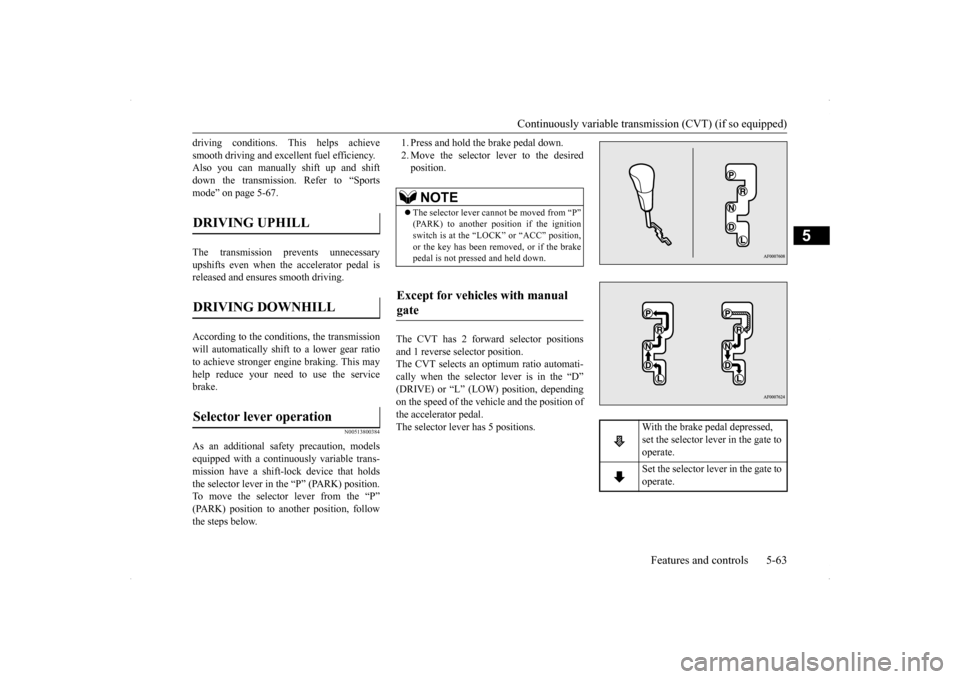
As an additional safety precaution, modelsequipped with a continuously variable trans- mission have a shift-lock device that holds the selector lever in the “P” (PARK) position.To move the selector lever from the “P” (PARK) position to another position, follow the steps below.
1. Press and hold the brake pedal down. 2. Move the selector lever to the desired position.
The CVT has 2 forward selector positions and 1 reverse selector position. The CVT selects an optimum ratio automati-cally when the selector lever is in the “D” (DRIVE) or “L” (LOW) position, depending on the speed of the vehicle and the position ofthe accelerator pedal. The selector lever has 5 positions.
DRIVING UPHILL
DRIVING DOWNHILL
Selector lever operation
NOTE
The selector lever cannot be moved from “P” (PARK) to another position if the ignition switch is at the “LOCK” or “ACC” position, or the key has been removed, or if the brakepedal is not pressed and held down.
Except for vehicles with manual gate
With the brake pedal depressed, set the selector lever in the gate to operate. Set the selector lever in the gate to operate.
Page 131 of 434
Continuously variable transm
ission (CVT) (if so equipped)
5-64 Features and controls
5
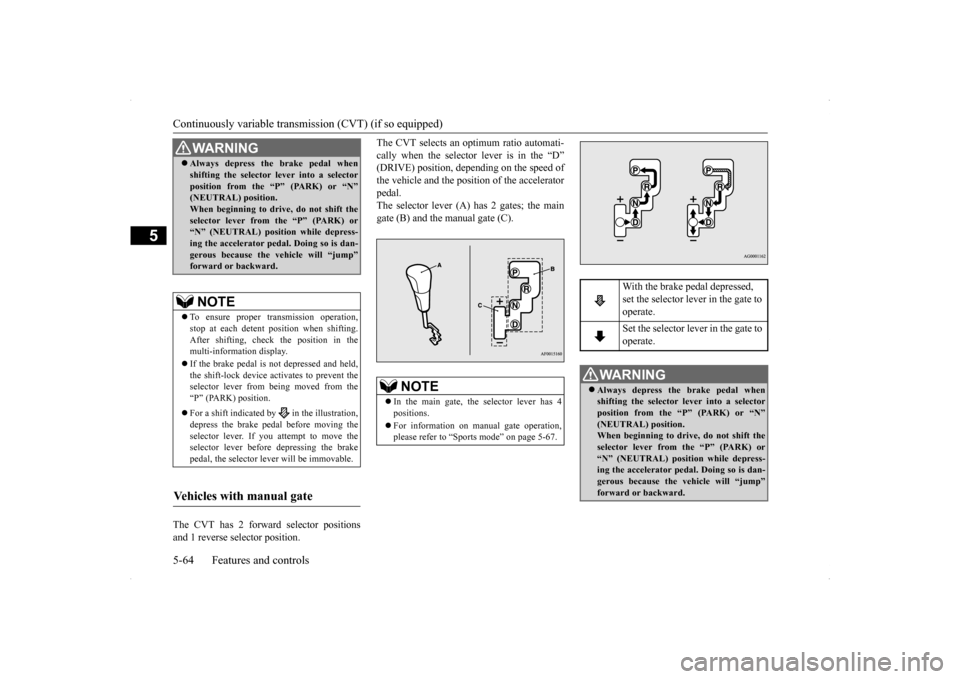
The CVT has 2 forward selector positions and 1 reverse selector position.
The CVT selects an optimum ratio automati- cally when the selector lever is in the “D” (DRIVE) position, depending on the speed of the vehicle and the position of the acceleratorpedal. The selector lever (A) has 2 gates; the main gate (B) and the manual gate (C).
WA R N I N G Always depress the brake pedal when shifting the selector lever into a selector position from the “P” (PARK) or “N” (NEUTRAL) position. When beginning to driv
e, do not shift the
selector lever from the “P” (PARK) or “N” (NEUTRAL) position while depress- ing the accelerator pedal. Doing so is dan-gerous because the vehicle will “jump” forward or backward.NOTE
To ensure proper transmission operation, stop at each detent position when shifting. After shifting, check the position in the multi-information display. If the brake pedal is not depressed and held, the shift-lock device activates to prevent theselector lever from being moved from the “P” (PARK) position. For a shift indicated by in the illustration, depress the brake pedal before moving the selector lever. If you attempt to move the selector lever before depressing the brakepedal, the selector lever will be immovable.
Vehicles with manual gate
NOTE
In the main gate, the selector lever has 4 positions. For information on manual gate operation, please refer to “Sports mode” on page 5-67.
With the brake pedal depressed, set the selector lever in the gate to operate. Set the selector lever in the gate to operate.
WA R N I N G Always depress the brake pedal when shifting the selector lever into a selector position from the “P” (PARK) or “N”(NEUTRAL) position. When beginning to drive, do not shift the selector lever from the “P” (PARK) or“N” (NEUTRAL) position while depress- ing the accelerator pedal. Doing so is dan- gerous because the vehicle will “jump”forward or backward.
Page 132 of 434
Continuously variable transmission (CVT) (if so equipped)
Features and controls 5-65
5
N00563100021
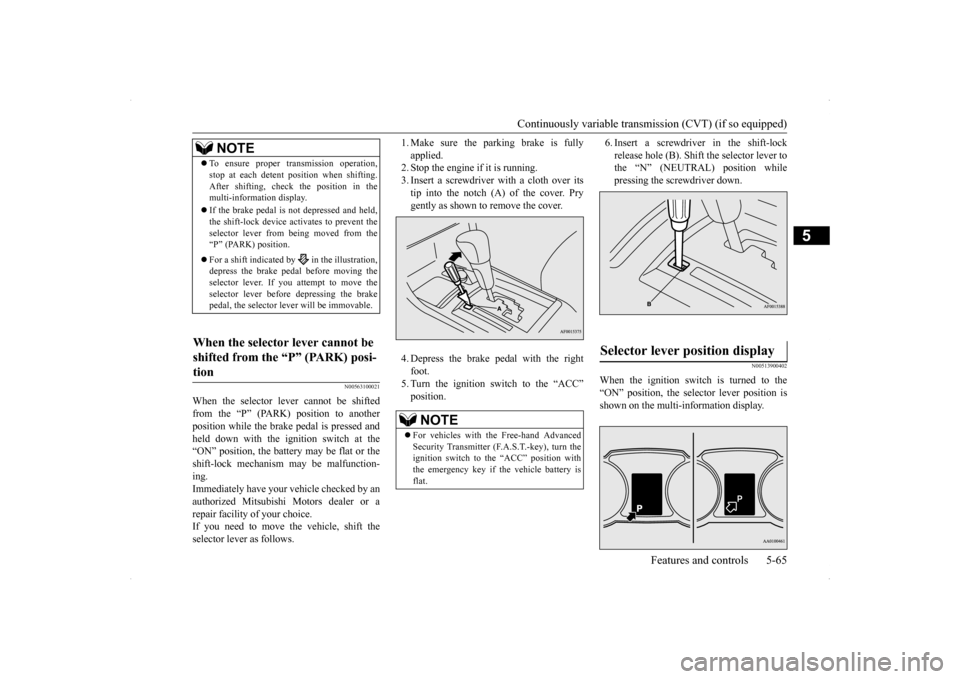
When the selector lever cannot be shifted from the “P” (PARK) position to anotherposition while the brake pedal is pressed andheld down with the ignition switch at the “ON” position, the battery may be flat or the shift-lock mechanism may be malfunction-ing. Immediately have your vehicle checked by an authorized Mitsubishi Motors dealer or arepair facility of your choice. If you need to move the vehicle, shift the selector lever as follows.
1. Make sure the parking brake is fully applied. 2. Stop the engine if it is running. 3. Insert a screwdriver with a cloth over itstip into the notch (A) of the cover. Pry gently as shown to remove the cover. 4. Depress the brake pedal with the right foot.5. Turn the ignition switch to the “ACC”position.
6. Insert a screwdriver in the shift-lock release hole (B). Shift the selector lever to the “N” (NEUTRAL) position while pressing the screwdriver down.
N00513900402
When the ignition switch is turned to the“ON” position, the selector lever position is shown on the multi-information display.
NOTE
To ensure proper transmission operation, stop at each detent position when shifting. After shifting, check the position in the multi-information display. If the brake pedal is not depressed and held, the shift-lock device activates to prevent the selector lever from being moved from the“P” (PARK) position. For a shift indicated by in the illustration, depress the brake pedal before moving the selector lever. If y
ou attempt to move the
selector lever before depressing the brake pedal, the selector lever will be immovable.
When the selector lever cannot be shifted from the “P” (PARK) posi-tion
NOTE
For vehicles with the Free-hand Advanced Security Transmitter (F.A.S.T.-key), turn the ignition switch to the “ACC” position withthe emergency key if the vehicle battery is flat.
Selector lever position display
Page 134 of 434
Continuously variable transmission (CVT) (if so equipped)
Features and controls 5-67
5
This position is used for most city and high- way driving. The trans
mission will automati-
cally and continuously change its gear ratio depending on road and driving conditions. This position is for driv
ing up very steep hills
and for engine braking at low speeds when driving down steep hills.
N00514400417
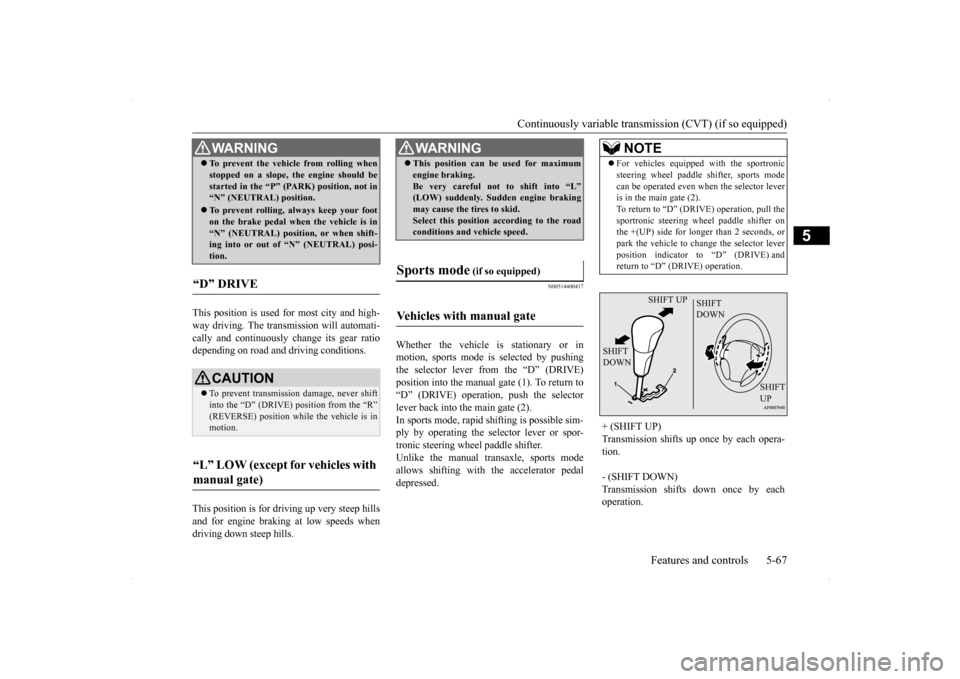
Whether the vehicle is stationary or inmotion, sports mode is selected by pushingthe selector lever from the “D” (DRIVE) position into the manual gate (1). To return to “D” (DRIVE) operation, push the selectorlever back into the main gate (2). In sports mode, rapid
shifting is possible sim-
ply by operating the selector lever or spor-tronic steering wheel paddle shifter. Unlike the manual transaxle, sports mode allows shifting with the accelerator pedaldepressed.
To prevent the vehicle from rolling when stopped on a slope, the engine should be started in the “P” (PARK) position, not in “N” (NEUTRAL) position. To prevent rolling, always keep your foot on the brake pedal when the vehicle is in “N” (NEUTRAL) position, or when shift-ing into or out of “N” (NEUTRAL) posi- tion.
“D” DRIVE
CAUTION To prevent transmission damage, never shift into the “D” (DRIVE) position from the “R” (REVERSE) position while the vehicle is inmotion.
“L” LOW (except for vehicles with manual gate)
WA R N I N G
WA R N I N G This position can be used for maximum engine braking. Be very careful not to shift into “L” (LOW) suddenly. Sudden engine braking may cause the tires to skid.Select this position according to the road conditions and vehicle speed.
Sports mode
(if so equipped)
Vehicles with manual gate
NOTE
For vehicles equipped with the sportronic steering wheel paddle shifter, sports mode can be operated even when the selector lever is in the main gate (2). To return to “D” (DRIVE) operation, pull thesportronic steering wheel paddle shifter on the +(UP) side for longer than 2 seconds, or park the vehicle to change the selector leverposition indicator to “D” (DRIVE) and return to “D” (DRIVE) operation.
+ (SHIFT UP) Transmission shifts up once by each opera- tion. - (SHIFT DOWN) Transmission shifts down once by each operation.
SHIFT UP
SHIFT DOWN
SHIFT DOWN
SHIFT UP
Page 137 of 434
Continuously variable transm
ission (CVT) (if so equipped)
5-70 Features and controls
5
N00514500287
N00514900063
To gain extra acceleration in “D” (DRIVE) position (when passing another vehicle) push the accelerator to the floor if it is safe to do so in traffic conditions. The CVT will automati-cally downshift.
N00515000074
For short waiting periods, such as at traffic lights, the vehicle can be left in selector lever position and held stationary with the servicebrake.
For longer waiting periods with the engine running, the selector lever should be placed in the “N” (NEUTRAL) position.
N00515100062
To park the vehicle, first bring it to a com- plete stop, fully engage the parking brake,and then move the selector lever to the “P” (PARK) position. If you are going to l
eave the vehicle unat-
tended, always switch off the engine and carry the key.
Operation of the CVT
CAUTION Before selecting a position with the engine running and the vehicle stationary, fully depress the brake pedal to prevent the vehi- cle from creeping.Do not release the brakes until you are ready to drive away. The vehicle will begin to move as soon as the CVT is engaged, espe-cially when the engine speed is high (fast idle or air conditioning on). Depress the brake pedal with the right foot. Using the left foot could cause driver move- ment delay in case of an emergency. To prevent sudden acceleration, never run the engine at high rpms when shifting fromthe “P” (PARK) or “N” (NEUTRAL) posi- tion. Operating the accelerator pedal while the other foot is resting on the brake pedal will affect braking efficiency and may cause pre-mature wear of brake pads. Use the selector lever in the correct shift position in accordance with driving condi- tions. Never coast downhill backward in the driv- ing shift position { “D” (DRIVE), “L” (LOW) or sports mode} or coast forward inthe “R” (REVERSE) position. Engine stopping and increased brake pedal and steering effort could lead to an accident.
Do not rev the engine with the brake pedal pressed when the vehicle is stationary. This can damage the CVT. Also, when you depress the accelerator pedal while holding down the brake pedal with theselector lever in the “D” (DRIVE) position, the engine revolutions may not rise as high as when performing the same operation withthe selector lever in the “N” (NEUTRAL) position.
Passing acceleration
NOTE
In sports mode, downshifts do not take place when the accelerator is depressed all the way to the floor.
Wa i t i n g
CAUTION
CAUTION To avoid transmission overheating, never try to keep your vehicle stationary on a hill by using the accelerator pedal. Always apply the parking brake and/or service brake. Unexpected acceleration may occur if the selector lever is in a position other than “P”(PARK) or “N” (NEUTRAL). Before driving off from a stop, make sure that the selector lever is in “D” (DRIVE)position or “Sports mode” position.
Parking
Page 138 of 434
Twin Clutch SST (Sportronic Shif
t Transmission) (if so equipped) Features and controls 5-71
5
N00515300194
If the CVT does not shift while driving, or your vehicle does not pick up enough speed when starting on an uphill slope, there may be something unusual happening in the transmis-sion, causing a safety device to activate. Have your vehicle checked at an authorized Mit- subishi Motors dealer or a repair facility ofyour choice as soon as possible. 1. If your vehicle has difficulty moving uphill, shift the selector lever into “L” (LOW) position (except for vehicles withsport mode) or 2nd shift range of the sports mode. This method might not work dependingon the type of transmission malfunction.
2. Once the vehicle is moving on a level road, move the selector lever back to “D” (DRIVE) position.
N00539700059
The Twin Clutch SST is a transmission that,through integrated control of the engine and transmission, is able to achieve both thesmooth shifting of an automatic transaxle and the acceleration and fuel economy close to a manual transaxle. In addition, the controlmode can be selected from two types to suit the driving conditions. Together with manual shifting, the transmis-sion is capable of responding to a variety of driving circumstances. Twin Clutch SST control mode
P.5-76
Manual shift
P.5-77
N00539800050
As an additional safe
ty precaution, models
equipped with a Twin Clutch SST have ashift-lock device that holds the gearshift lever in the “P” (PARK) position. To move the gearshift lever from the “P” (PARK) positionto another position, follow the steps below. 1. Press and hold the brake pedal down. 2. Move the gearshift lever to the desired position.
The Twin Clutch SST has 6 forward gears and 1 reverse gear. The individual gears are selected automati-cally, depending on the position of the gear- shift lever, the speed of the vehicle and the position of the accelerator pedal.The gearshift lever (A) has 2 gates; the main shift gate (B) and the manual shift gate (C).
NOTE
On a slope, be sure to apply the parking brake before moving the selector lever to the “P” (PARK) position. If you move the selec- tor lever to the “P” (PARK) position before applying the parking brake, it may be diffi-cult to disengage the selector lever from the “P” (PARK) position when next you drive the vehicle, requiring application of a strongforce to the selector le
ver to move from the
“P” (PARK) position.
When the CVT makes no speed change
NOTE
When the warning display or the warning display appears on the information screen in the multi-information display, therecould be a malfunction in the CVT. Refer to “Continuously variable transmission (CVT): Warning display” on page 5-66.
Twin Clutch SST (Spor- tronic Shift Transmission)
(if
so equipped)
Gearshift lever operation
NOTE
The gearshift lever cannot be moved from “P” (PARK) to another position if the igni-tion switch is at the “LOCK” or “ACC” posi- tion, or the key has been removed, or if the brake pedal is not pressed and held down.
Page 139 of 434
Twin Clutch SST (Sportronic Shif
t Transmission) (if so equipped)
5-72 Features and controls
5
NOTE
In the main shift gate, the gearshift lever has 4 positions. For information on manual shift gate opera- tion, please refer to “Manual shift” on page 5-77.
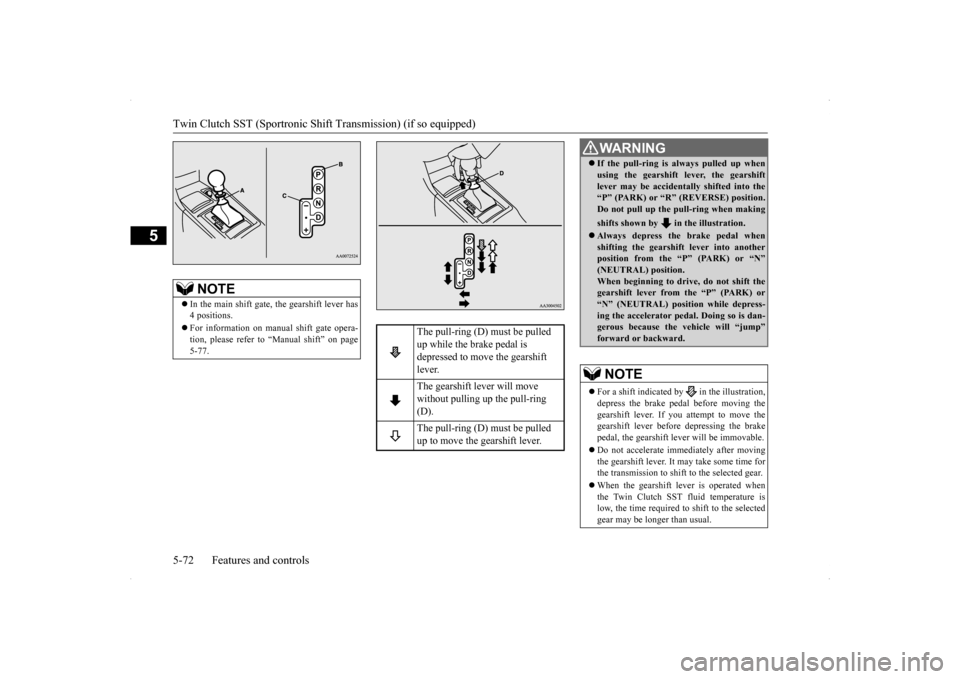
The pull-ring (D) must be pulled up while the brake pedal is depressed to move the gearshift lever. The gearshift lever will move without pulling up the pull-ring (D). The pull-ring (D) must be pulled up to move the gearshift lever.
WA R N I N G If the pull-ring is always pulled up when using the gearshift lever, the gearshift lever may be accidentally shifted into the “P” (PARK) or “R” (REVERSE) position. Do not pull up the pull-ring when making shifts shown by in the illustration. Always depress the brake pedal when shifting the gearshift lever into another position from the “P” (PARK) or “N”(NEUTRAL) position. When beginning to drive, do not shift the gearshift lever from the “P” (PARK) or“N” (NEUTRAL) position while depress- ing the accelerator pedal. Doing so is dan- gerous because the vehicle will “jump”forward or backward.NOTE
For a shift indicated by in the illustration, depress the brake pedal before moving the gearshift lever. If you attempt to move thegearshift lever before depressing the brake pedal, the gearshift lever will be immovable. Do not accelerate immediately after moving the gearshift lever. It may take some time for the transmission to shift to the selected gear. When the gearshift lever is operated when the Twin Clutch SST fluid temperature islow, the time required to shift to the selected gear may be longer than usual.
Page 140 of 434
Twin Clutch SST (Sportronic Shif
t Transmission) (if so equipped) Features and controls 5-73
5
N00539900064
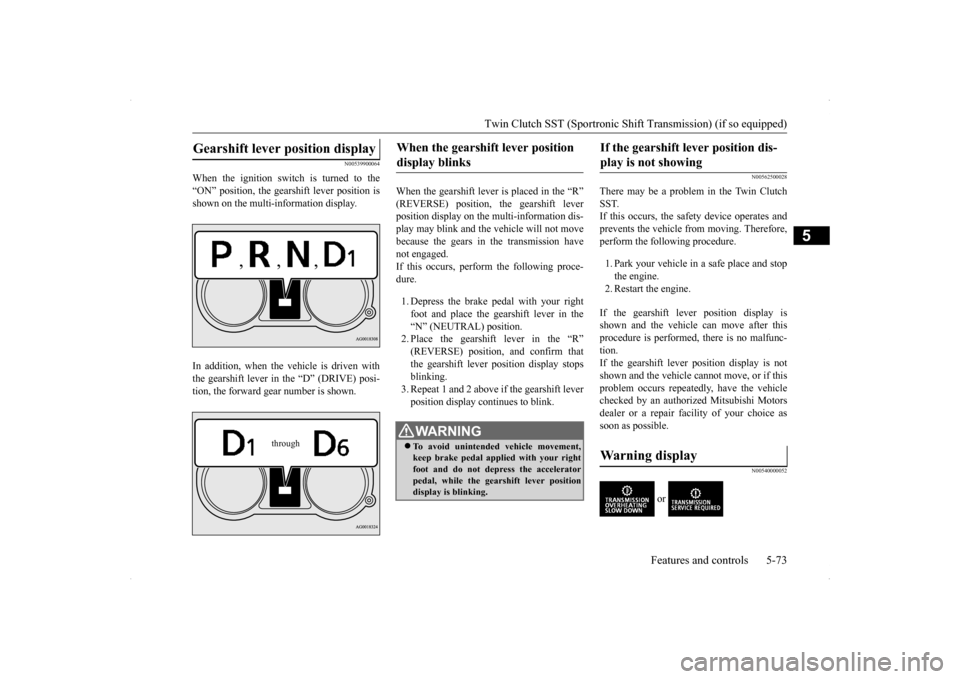
When the ignition switch is turned to the “ON” position, the gearshift lever position isshown on the multi-information display. In addition, when the vehicle is driven with the gearshift lever in the “D” (DRIVE) posi-tion, the forward gear number is shown.
When the gearshift lever is placed in the “R” (REVERSE) position, the gearshift lever position display on th
e multi-information dis-
play may blink and the vehicle will not move because the gears in the transmission have not engaged.If this occurs, perform the following proce-dure. 1. Depress the brake pedal with your right foot and place the gearshift lever in the “N” (NEUTRAL) position. 2. Place the gearshift lever in the “R” (REVERSE) position, and confirm that the gearshift lever position display stopsblinking. 3. Repeat 1 and 2 above if the gearshift lever position display continues to blink.
N00562500028
There may be a problem in the Twin Clutch SST. If this occurs, the safety device operates andprevents the vehicle from moving. Therefore, perform the following procedure. 1. Park your vehicle in a safe place and stop the engine.2. Restart the engine. If the gearshift lever position display is shown and the vehicle can move after this procedure is performed, there is no malfunc- tion.If the gearshift lever position display is not shown and the vehicle cannot move, or if this problem occurs repeatedly, have the vehiclechecked by an authorized Mitsubishi Motors dealer or a repair facility of your choice as soon as possible.
N00540000052
or
Gearshift lever position display
through
When the gearshift lever position display blinks
WA R N I N G To avoid unintended vehicle movement, keep brake pedal applied with your right foot and do not depress the accelerator pedal, while the gearshift lever position display is blinking.
If the gearshift lever position dis- play is not showing
Warning display
Page 141 of 434
Twin Clutch SST (Sportronic Shif
t Transmission) (if so equipped)
5-74 Features and controls
5
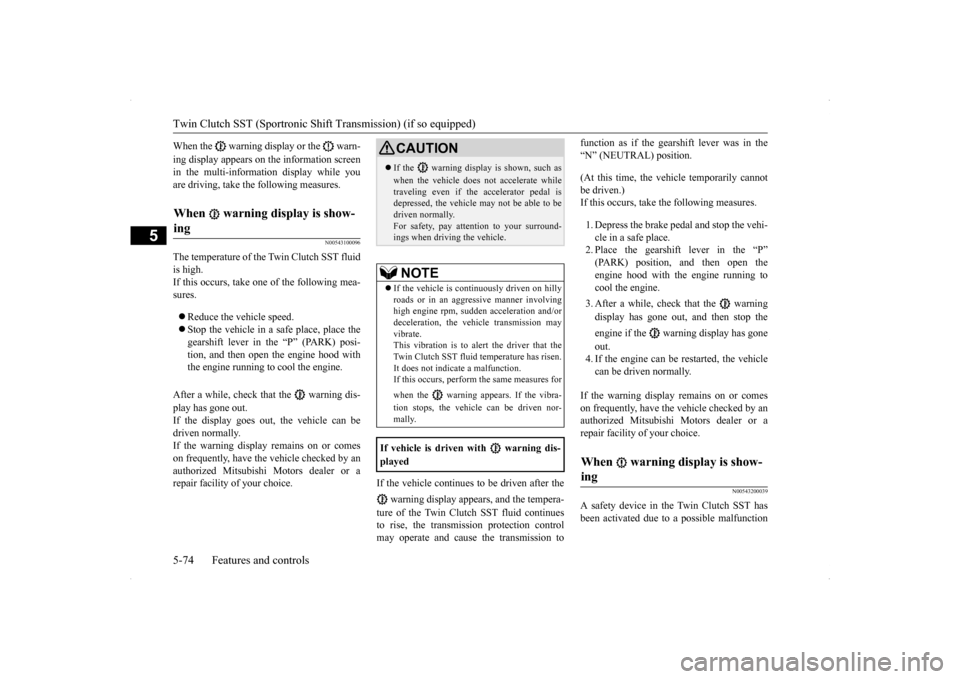
When the warning display or the warn- ing display appears on the information screen in the multi-information display while you are driving, take the following measures.
N00543100096
The temperature of the Twin Clutch SST fluidis high. If this occurs, take one of the following mea- sures. Reduce the vehicle speed. Stop the vehicle in a safe place, place the gearshift lever in the “P” (PARK) posi- tion, and then open the engine hood withthe engine running to cool the engine.
After a while, check that the warning dis- play has gone out. If the display goes out, the vehicle can be driven normally.If the warning display remains on or comes on frequently, have the vehicle checked by an authorized Mitsubishi Motors dealer or arepair facility of your choice.
If the vehicle continues to be driven after the warning display appears, and the tempera- ture of the Twin Clutch SST fluid continues to rise, the transmission protection controlmay operate and cause the transmission to
function as if the gearshift lever was in the “N” (NEUTRAL) position. (At this time, the vehicle temporarily cannot be driven.) If this occurs, take the following measures. 1. Depress the brake pedal and stop the vehi- cle in a safe place. 2. Place the gearshift lever in the “P” (PARK) position, and then open theengine hood with the engine running tocool the engine. 3. After a while, check that the warning display has gone out, and then stop the engine if the warning display has gone out. 4. If the engine can be restarted, the vehicle can be driven normally.
If the warning display remains on or comes on frequently, have the vehicle checked by an authorized Mitsubishi Motors dealer or a repair facility of your choice.
N00543200039
A safety device in the Twin Clutch SST has been activated due to a possible malfunction
When warning display is show- ing
CAUTION If the warning display is shown, such as when the vehicle does not accelerate while traveling even if the accelerator pedal is depressed, the vehicle may not be able to bedriven normally. For safety, pay attention to your surround- ings when driving the vehicle.NOTE
If the vehicle is continuously driven on hilly roads or in an aggressive manner involving high engine rpm, sudden acceleration and/or deceleration, the vehicle transmission may vibrate.This vibration is to alert the driver that the Twin Clutch SST fluid temperature has risen. It does not indicate a malfunction.If this occurs, perform the same measures for when the warning appears. If the vibra- tion stops, the vehicle can be driven nor- mally.
If vehicle is driven with warning dis- played
When warning display is show- ing