Top MITSUBISHI LANCER 2016 8.G Owners Manual
[x] Cancel search | Manufacturer: MITSUBISHI, Model Year: 2016, Model line: LANCER, Model: MITSUBISHI LANCER 2016 8.GPages: 392, PDF Size: 13.12 MB
Page 328 of 392
Service precautions 9-2 Vehicle care and maintenance
9
N00937301430
Taking regular care of your vehicle will pre- serve its value and appearance as long as pos-sible. You can do some of the maintenance work yourself, and the rest should only be per- formed by an authorized Mitsubishi Motorsdealer or a repair facility of your choice.If you discover a malfunction or other prob- lem, have it corrected by an authorized Mit- subishi Motors dealer or a repair facility ofyour choice. This section describes the maintenance inspections that you can do yourself, if you sodesire. Follow the instructions and precau- tions for each procedure.
Have you purchased the Mitsubishi Motors Diamond Care Protection Plan? The Plan supplements your new vehicle warranties. See your authorized Mitsubishi Motors dealerfor details.
N00937400131
The catalytic converter requires you to useunleaded fuel only. Leaded gasoline will destroy the emission-control effectiveness of the converter. Normally, the catalytic converter does not require maintenance. However, it is important to keep the engine properly tuned for the con- verter to continue to work properly.
Service precautions
WA R N I N G When checking or servicing the inside of the engine compartment, be sure theengine is stopped and has had a chance to cool down. If you need to work in the engine compart- ment with the engine running, be espe-cially careful that your clothing, hair, etc. does not get caught in
the fan, drive belts,
or other moving parts.
After performing the maintenance work, make sure that no tools or cloths are left behind in the engine compartment. If they are left behind, a fire or damage to the vehicle may occur. The fan can turn on automatically even if the engine is not running. Turn the igni-tion switch to the “LOCK” position to be safe while you work in the engine com- partment. Do not smoke or allow open flames around fuel or the battery. The fumes are flamma-ble. Be extremely careful when working around the battery. It contains poisonous and corrosive sulfuric acid. Do not get under your vehicle while it is on a jack. Always use properly rated automotivejack stands. Handling your vehicle’s parts and materi- als in the wrong way can injure you. Ask an authorized Mitsubishi Motors dealer or a repair facility of your choice if youhave questions. WA R N I N G
Catalytic converter
BK0230300US.bo
ok 2 ページ 2015年7月30日 木曜日 午後8時38分
Page 329 of 392
Engine hood
Vehicle care and maintenance 9-3
9
To reduce the possibility of catalytic con- verter damage: Use UNLEADED GASOLINE ONLY of the type of recommended in “Fuel selec- tion”. Do not drive with an extremely low fuel level. Running out of gas could damage the catalytic converter. Do not try to start the engine by pushing or towing the vehicle. If the battery is weak or run down, use jumper cables to properly start the engine.
Do not idle the engine with any spark plug wires disconnected or removed, such as when performing diagnostic tests. Do not idle the engine for a long time if it is idling roughly or otherwise obviously malfunctioning. To prevent the catalytic converter from being damaged from unburned gas, do not race the engine when turning off the igni- tion switch. Stop driving the vehicle if you think the performance is less than normal, the engine is running oddly or there is any other engine trouble, such as with theignition, etc. If you
are not able to stop
driving immediately, slow down and drive for only a short time. Have an inspectionmade by an authorized Mitsubishi Motors dealer or a repair facility of your choice as soon as possible. In unusual situations involving major engine problems, a burning odor may indicate severe and abnormal catalyticconverter overheating. If this occurs, stop in a safe place, shut the engine off and let the vehicle cool. Once the engine is cool,immediately take your vehicle to a dealer or a repair facility of your choice for ser- vice.
N00937501591
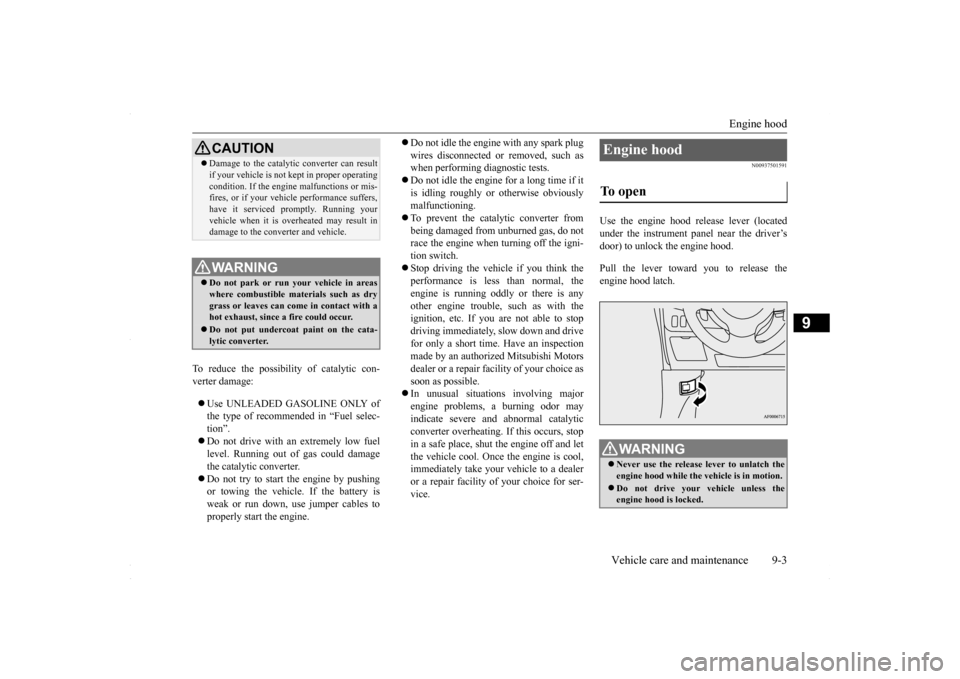
Use the engine hood release lever (locatedunder the instrument panel near the driver’sdoor) to unlock the engine hood. Pull the lever toward you to release the engine hood latch.
CAUTION Damage to the catalytic converter can result if your vehicle is not kept in proper operating condition. If the engine malfunctions or mis- fires, or if your vehicle performance suffers, have it serviced promptly. Running yourvehicle when it is overheated may result in damage to the converter and vehicle.WA R N I N G Do not park or run your vehicle in areas where combustible materials such as dry grass or leaves can come in contact with a hot exhaust, since a fire could occur. Do not put undercoat paint on the cata- lytic converter.
Engine hood To open
WA R N I N G Never use the release lever to unlatch the engine hood while the vehicle is in motion. Do not drive your vehicle unless the engine hood is locked.
BK0230300US.bo
ok 3 ページ 2015年7月30日 木曜日 午後8時38分
Page 332 of 392
Engine oil and oil filter 9-6 Vehicle care and maintenance
9
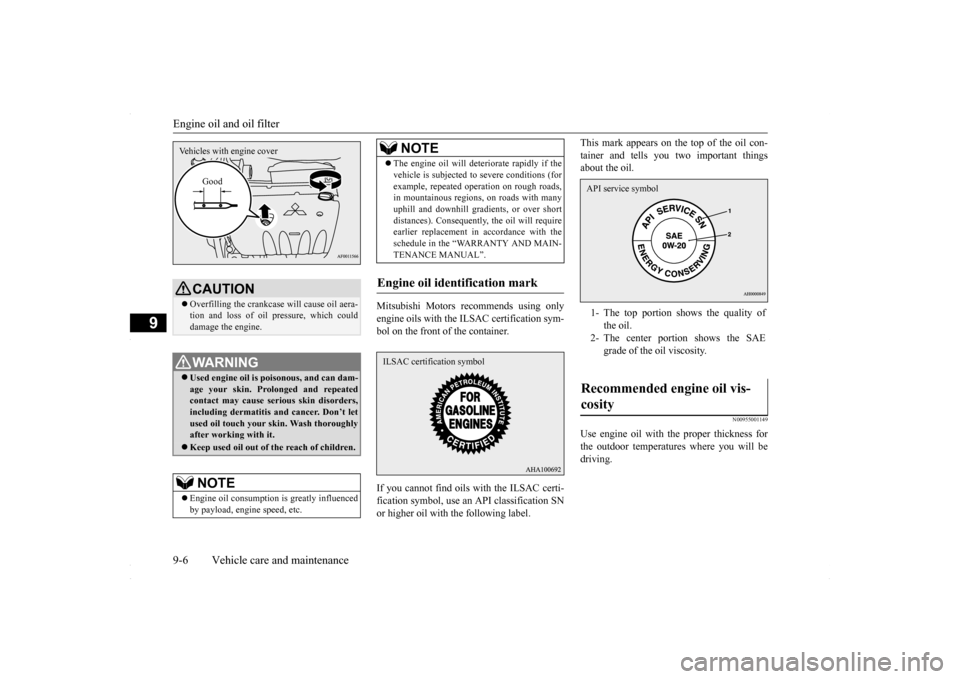
Mitsubishi Motors recommends using only engine oils with the ILSAC certification sym- bol on the front of the container. If you cannot find oils with the ILSAC certi- fication symbol, use an API classification SNor higher oil with the following label.
This mark appears on th
e top of the oil con-
tainer and tells you two important things about the oil.
N00955001149
Use engine oil with the proper thickness for the outdoor temperatures where you will be driving.
CAUTION Overfilling the crankcase will cause oil aera- tion and loss of oil pressure, which could damage the engine.WA R N I N G Used engine oil is poisonous, and can dam- age your skin. Prolonged and repeated contact may cause serious skin disorders, including dermatitis and cancer. Don’t letused oil touch your skin. Wash thoroughly after working with it. Keep used oil out of the reach of children.NOTE
Engine oil consumption is greatly influenced by payload, engine speed, etc.Vehicles with engine cover
Good
The engine oil will deteriorate rapidly if the vehicle is subjected to severe conditions (for example, repeated operation on rough roads, in mountainous regions, on roads with many uphill and downhill gradients, or over shortdistances). Consequently, the oil will require earlier replacement in accordance with the schedule in the “WARRANTY AND MAIN-TENANCE MANUAL”.
Engine oil identification mark
NOTE
ILSAC certification symbol
1- The top portion shows the quality of
the oil.
2- The center portion shows the SAE
grade of the oil viscosity.
Recommended engine oil vis- cosity API service symbol
BK0230300US.bo
ok 6 ページ 2015年7月30日 木曜日 午後8時38分
Page 334 of 392
Air cleaner filter 9-8 Vehicle care and maintenance
9
The radiator cap must be tight sealed to pre- vent losing coolant which may result in engine damage. Only use a Genuine Mitsubi-shi Parts radiator cap, or an approved equiva- lent.
Do not overfill the reserve tank. Your vehicle uses a special radiator cap that stays sealed and lets the coolant flow from the reserve tank back to the radiatorwhen the engine cools down. If you need to change the cap, use the exact same kind. Check the coolant freeze point in the radi- ator with the proper gauge, and only when it is safe. If you add antifreeze, the con-tents of the reserve tank must be protected against freezing. Keep the front of the radiator and con- denser clean. If the temperature of the engine coolant does not rise after the engine is warmed-up, take your vehicle to an authorized Mitsubishi Motors dealer or a repair facil- ity of your choice to have the thermostatchecked, and replaced if necessary.
N00937901508
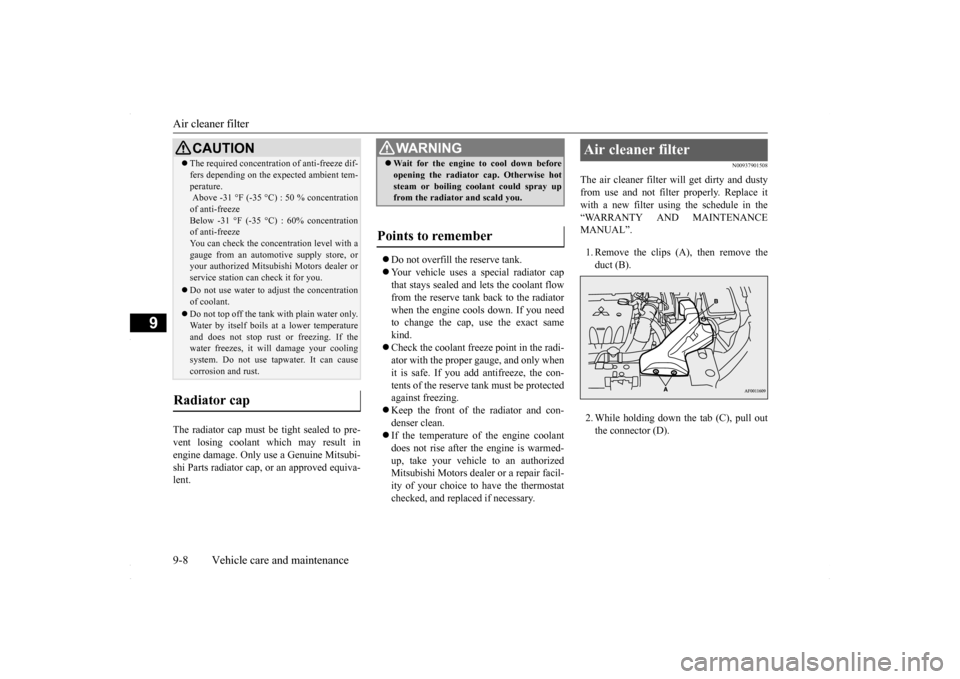
The air cleaner filter will get dirty and dustyfrom use and not filter properly. Replace itwith a new filter using the schedule in the “WARRANTY AND MAINTENANCE MANUAL”. 1. Remove the clips (A), then remove the duct (B). 2. While holding down the tab (C), pull out the connector (D).
The required concentration of anti-freeze dif- fers depending on the expected ambient tem- perature. Above -31 °F (-35 °C) : 50 % concentration of anti-freezeBelow -31 °F (-35 °C) : 60% concentration of anti-freeze You can check the concentration level with agauge from an automotive supply store, or your authorized Mitsubishi Motors dealer or service station can check it for you. Do not use water to adjust the concentration of coolant. Do not top off the tank with plain water only. Water by itself boils at a lower temperatureand does not stop rust or freezing. If the water freezes, it will damage your cooling system. Do not use tapwater. It can causecorrosion and rust.
Radiator cap
CAUTION
WA R N I N G Wait for the engine to cool down before opening the radiator cap. Otherwise hot steam or boiling coolant could spray up from the radiator and scald you.
Points to remember
Air cleaner filter
BK0230300US.bo
ok 8 ページ 2015年7月30日 木曜日 午後8時38分
Page 338 of 392
Power steering fluid (if so equipped) 9-12 Vehicle care and maintenance
9
N00939000388
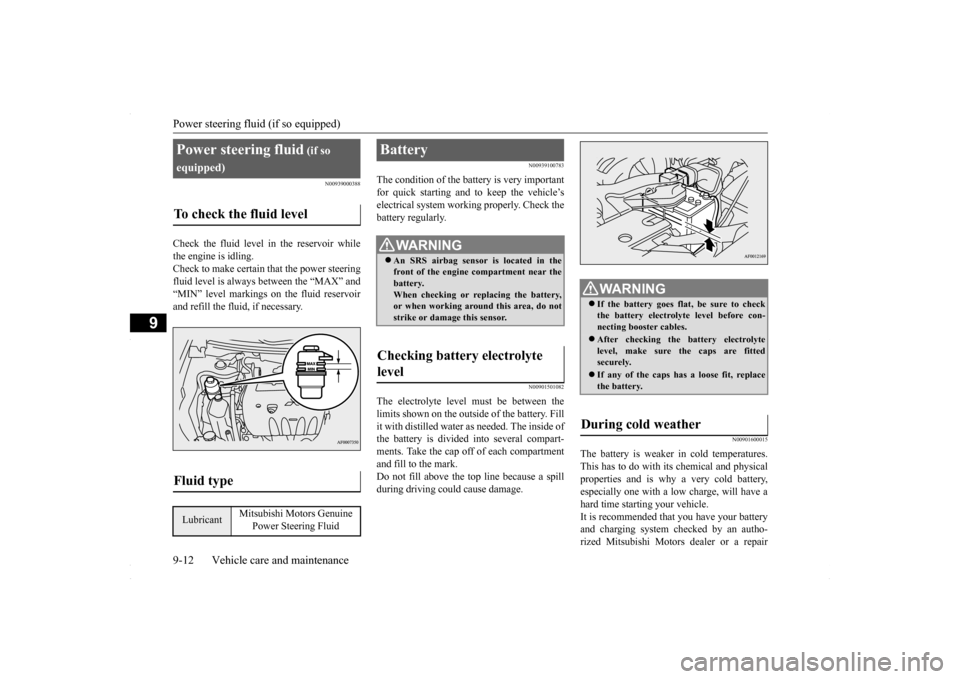
Check the fluid level in the reservoir while the engine is idling. Check to make certain that the power steering fluid level is always between the “MAX” and“MIN” level markings on the fluid reservoirand refill the fluid, if necessary.
N00939100783
The condition of the battery is very importantfor quick starting and to keep the vehicle’selectrical system working properly. Check the battery regularly.
N00901501082
The electrolyte level must be between the limits shown on the outside of the battery. Fillit with distilled water as needed. The inside of the battery is divided into several compart- ments. Take the cap off of each compartmentand fill to the mark. Do not fill above the top line because a spill during driving could cause damage.
N00901600015
The battery is weaker in cold temperatures.This has to do with its chemical and physical properties and is why a very cold battery, especially one with a low charge, will have ahard time starting your vehicle. It is recommended that you have your battery and charging system checked by an autho-rized Mitsubishi Motors dealer or a repair
Power steering fluid
(if so
equipped)To check the fluid level
Fluid type
Lubricant
Mitsubishi Motors Genuine
Power Steering Fluid
Battery
WA R N I N G An SRS airbag sensor is located in the front of the engine compartment near the battery. When checking or replacing the battery,or when working around this area, do not strike or damage this sensor.
Checking battery electrolyte level
WA R N I N G If the battery goes flat, be sure to check the battery electrolyte level before con- necting booster cables. After checking the battery electrolyte level, make sure the caps are fitted securely. If any of the caps has a loose fit, replace the battery.
During cold weather
BK0230300US.bo
ok 12 ページ 2015年7月30日 木曜日 午後8時38分
Page 339 of 392
Battery
Vehicle care and maintenance 9-13
9
facility of your choice before the start of cold weather. If necessary, have it charged. This will guarantee more reliable starting, and lon- ger battery life.
N00901701143
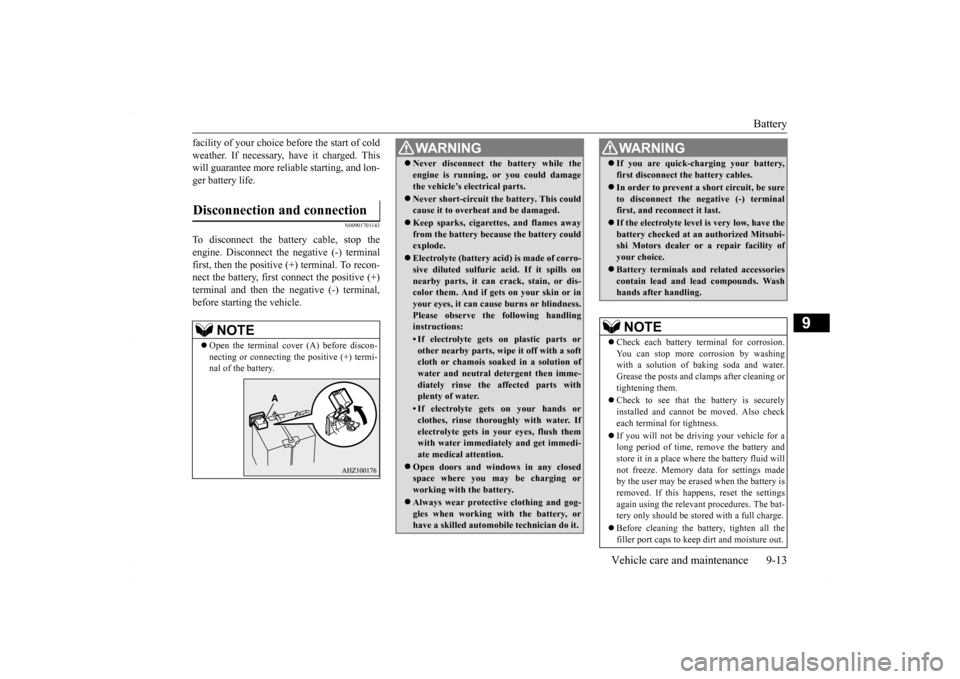
To disconnect the battery cable, stop theengine. Disconnect the negative (-) terminalfirst, then the positive (+) terminal. To recon-nect the battery, first connect the positive (+) terminal and then the negative (-) terminal, before starting the vehicle. Disconnection and connection
NOTE
Open the terminal cover (A) before discon- necting or connecting the positive (+) termi- nal of the battery.
WA R N I N G Never disconnect the battery while the engine is running, or you could damage the vehicle’s electrical parts. Never short-circuit the battery. This could cause it to overheat and be damaged. Keep sparks, cigarettes, and flames away from the battery because the battery could explode. Electrolyte (battery acid) is made of corro- sive diluted sulfuric
acid. If it spills on
nearby parts, it can crack, stain, or dis-color them. And if gets on your skin or in your eyes, it can cause burns or blindness. Please observe the following handlinginstructions:• If electrolyte gets on plastic parts orother nearby parts, wi
pe it off with a soft
cloth or chamois soaked in a solution of water and neutral detergent then imme-diately rinse the affected parts with plenty of water.• If electrolyte gets on your hands orclothes, rinse thoroughly with water. If electrolyte gets in your eyes, flush themwith water immediately and get immedi- ate medical attention.
Open doors and windows in any closed space where you may be charging or working with the battery. Always wear protective clothing and gog- gles when working with the battery, or have a skilled automobile technician do it.
If you are quick-charging your battery, first disconnect the
battery cables.
In order to prevent a short circuit, be sure to disconnect the negative (-) terminalfirst, and reconnect it last. If the electrolyte level is very low, have the battery checked at an authorized Mitsubi- shi Motors dealer or a repair facility of your choice. Battery terminals and related accessories contain lead and lead compounds. Washhands after handling. NOTE
Check each battery terminal for corrosion. You can stop more corrosion by washing with a solution of baking soda and water.Grease the posts and clamps after cleaning or tightening them. Check to see that the battery is securely installed and cannot be moved. Also check each terminal for tightness. If you will not be driving your vehicle for a long period of time, remove the battery and store it in a place where the battery fluid will not freeze. Memory data for settings madeby the user may be erased when the battery is removed. If this happens, reset the settings again using the relevant procedures. The bat-tery only should be stored with a full charge. Before cleaning the battery, tighten all the filler port caps to keep dirt and moisture out.WA R N I N G
BK0230300US.bo
ok 13 ページ 2015年7月30日 木曜日 午後8時38分
Page 342 of 392
Tires 9-16 Vehicle care and maintenance
9
Maximum load indicates the maxi- mum load this tire is designed to carry.
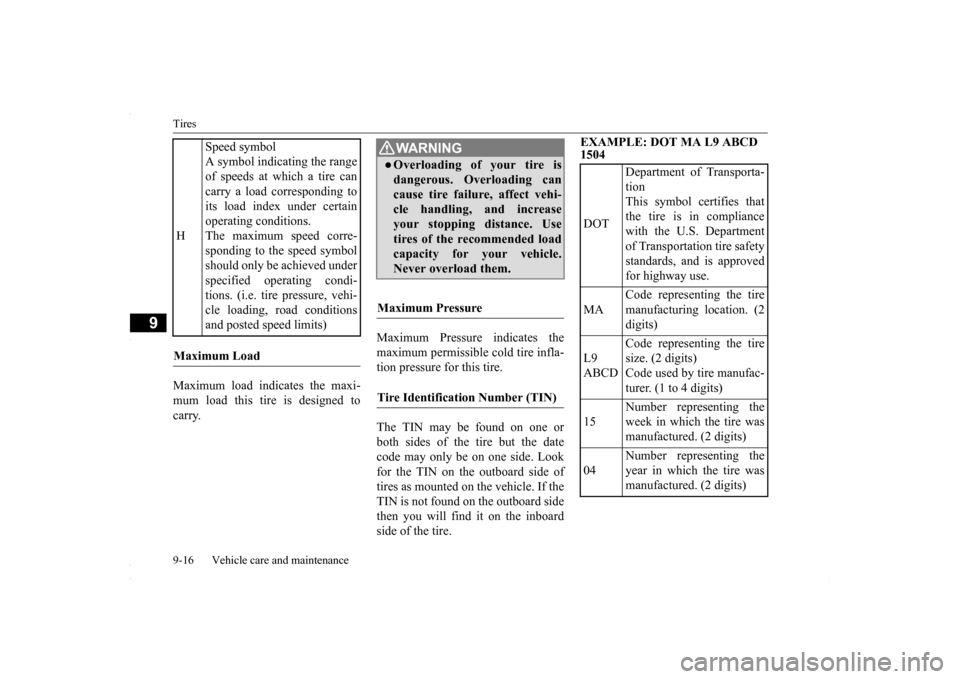
Maximum Pressure indicates the maximum permissible cold tire infla- tion pressure for this tire. The TIN may be found on one or both sides of the tire but the date code may only be on one side. Look for the TIN on the outboard side of tires as mounted on the vehicle. If the TIN is not found on the outboard sidethen you will find it on the inboard side of the tire.
EXAMPLE: DOT MA L9 ABCD 1504
H
Speed symbol A symbol indicating the range of speeds at which a tire can carry a load corresponding toits load index under certain operating conditions. The maximum speed corre-sponding to the speed symbol should only be achieved under specified operating condi-tions. (i.e. tire pressure, vehi- cle loading, road conditions and posted speed limits)
Maximum Load
WA R N I N GOverloading of your tire is dangerous. Overloading can cause tire failure, affect vehi-cle handling, and increase your stopping distance. Use tires of the recommended loadcapacity for your vehicle. Never overload them.
Maximum Pressure Tire Identification Number (TIN)
DOT
Department of Transporta- tion This symbol certifies thatthe tire is in compliance with the U.S. Department of Transportation tire safetystandards, and is approved for highway use.
MA
Code representing the tire manufacturing location. (2 digits)
L9 ABCD
Code representing the tire size. (2 digits)Code used by tire manufac- turer. (1 to 4 digits)
15
Number representing the week in which the tire wasmanufactured. (2 digits)
04
Number representing the year in which the tire was manufactured. (2 digits)
BK0230300US.bo
ok 16 ページ 2015年7月30日 木曜日 午後8時38分
Page 343 of 392
Tires
Vehicle care and maintenance 9-17
9
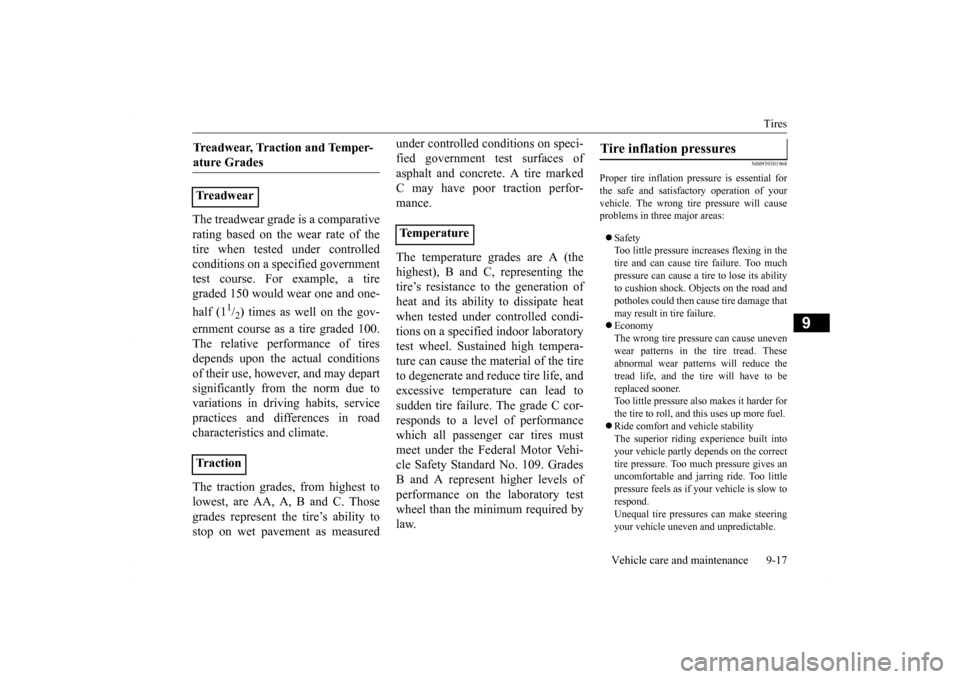
The treadwear grade is a comparative rating based on the wear rate of the tire when tested under controlledconditions on a specified government test course. For example, a tire graded 150 would wear one and one- half (1
1/2) times as well on the gov-
ernment course as a tire graded 100. The relative performance of tiresdepends upon the actual conditions of their use, however, and may depart significantly from the norm due tovariations in driving habits, service practices and differences in road characteristics and climate. The traction grades, from highest to lowest, are AA, A, B and C. Thosegrades represent the tire’s ability to stop on wet pavement as measured
under controlled conditions on speci- fied government test surfaces of asphalt and concrete. A tire marked C may have poor traction perfor- mance. The temperature grades are A (the highest), B and C, representing the tire’s resistance to the generation ofheat and its ability to dissipate heat when tested under controlled condi- tions on a specified indoor laboratorytest wheel. Sustained high tempera- ture can cause the material of the tire to degenerate and reduce tire life, andexcessive temperature can lead to sudden tire failure. The grade C cor- responds to a level of performancewhich all passenger car tires must meet under the Federal Motor Vehi- cle Safety Standard No. 109. Grades B and A represent higher levels of performance on the laboratory testwheel than the minimum required by law.
N00939301968
Proper tire inflation pressure is essential for the safe and satisfactory operation of yourvehicle. The wrong tire pressure will cause problems in three major areas: Safety Too little pressure increases flexing in thetire and can cause tire failure. Too muchpressure can cause a tire to lose its ability to cushion shock. Objects on the road and potholes could then cause tire damage thatmay result in tire failure. Economy The wrong tire pressure can cause unevenwear patterns in the tire tread. These abnormal wear patterns will reduce the tread life, and the tire will have to bereplaced sooner. Too little pressure also makes it harder for the tire to roll, and this uses up more fuel. Ride comfort and vehicle stability The superior riding experience built into your vehicle partly depends on the correcttire pressure. Too much pressure gives an uncomfortable and jarring ride. Too little pressure feels as if your vehicle is slow torespond. Unequal tire pressures can make steering your vehicle uneven and unpredictable.
Treadwear, Traction and Temper- ature Grades Treadwear Tr a c t i o n
Temperature
Tire inflation pressures
BK0230300US.bo
ok 17 ページ 2015年7月30日 木曜日 午後8時38分
Page 348 of 392
Emission-control system maintenance 9-22 Vehicle care and maintenance
9
N00940800201
Your vehicle is equipped with an emission- control system that meets all the requirementsof the U.S. Environmental Protection Agency and Environment Canada. The emission-con- trol system is made of: a positive crankcase ventilation system an evaporative emission-control system an exhaust emission-control system
The maintenance services listed in the “WARRANTY AND MAINTENANCE MANUAL” must be performed at the timesor mileages listed to keep the emission-con- trol system working properly. These, and all the other “general” maintenance serviceslisted in this manual, need to be performed to keep your vehicle running properly and reli- ably. You may need more frequent maintenance if you drive your vehicle in harsh conditions such as dusty areas or do a lot of start-and- stop driving. To be sure the emission-control system works properly, have your vehicle inspected and maintained by an authorized Mitsubishi Motors dealer or a repair facility of your
choice following the schedule in the “WAR- RANTY AND MAINTENANCE MAN- UAL”. You should also have an inspection and ser-vice any time you suspect a malfunction.
N00940900215
Spark plugs must fire properly for goodengine performance and emission-control. Do not reuse them by cleaning or regapping. Change them at the mileage listed in the“WARRANTY AND MAINTENANCE MANUAL”.
N00941000037
Check the hose surfaces for any heat and mechanical damage, hard and brittle rubber, cracking, tears, cuts and abrasions. Pay spe- cial attention to the hoses closest to high heatsources such as the exhaust manifold. Check all the hose connections, such as clamps and couplings, to make sure they are secure andthat there are no leaks. If you see any wear or damage, replace the hoses immediately.
N00950100050
Have the valve clearance checked at anauthorized Mitsubishi Motors dealer at the mileage specified in the “WARRANTY ANDMAINTENANCE MANUAL”. If the engine sounds abnormally loud, have adjustments made by an authorizedMitsubishi Motors dealer.
Emission-control system maintenance
NOTE
To meet government regulations and pro- mote cleaner air, your vehicle is equipped with an onboard diagnostic system (OBD).The engine electronic control module that controls OBD functions stores various data (especially about the exhaust emissions).This data will be erased if the battery cable is disconnected, which could make a rapid diagnosis difficult. Do not disconnect thebattery cable when the engine malfunction indicator (“SERVICE ENGINE SOON” or “Check engine light”) is on.
Spark plugs
NOTE
Use the spark plugs listed under “Engine specifications” on page 11-5 or plugs that are exactly the same. Other plugs could cause engine damage, performance problems or radio noise.
Fuel hoses Intake valve clearance
BK0230300US.bo
ok 22 ページ 2015年7月30日 木曜日 午後8時38分
Page 349 of 392
General maintenance
Vehicle care and maintenance 9-23
9
N00941300085
Check these regularly for damage or leaks in the fuel lines and connections. Check the fuel tank filler cap for damage or looseness. Payspecial attention to the fuel lines closest to high heat sources such as the exhaust mani- fold.
N00941400116
If the fuel-vapor vent line is clogged or dam-aged, the fuel-vapor mixture will escape, pol- luting the air. Have the system checked at an authorizedMitsubishi Motors dealer at the mileage spec-
ified in the “WARRANTY AND MAINTE- NANCE MANUAL”.
N00941500159
The next pages list the maintenance servicerecommended by Mitsubishi Motors Corpo- ration. In addition to the general maintenance that needs to be perfor
med at the times listed,
there are other parts which do not usuallyneed regular maintenance. But, if any of these parts stops working prop- erly, your vehicle performance could suffer.Have these items checked if you notice a problem with them. See your authorized Mitsubishi Motors dealer for assistance, if you have any questions.
N00941600033
Good brakes are essen
tial to safe driving.
Check the brake pads and brake linings for wear and check the rear wheel cylinders forleaks. For good braking performance, replace the brake pads with the
same type pads as the
originals.
N00941700047
Brake hoses and tubing should be checkedfor: Severe surface cracking, scuffing or worn spots. If the fabric casing of the hose is showing through any cracks or worn spots in the rubber hose cover, the hose shouldbe replaced. The brakes can fail if thehose wears through. Improper installation may cause twisting, or wheel, tire or chassis interference.
N00941800077
Check the following parts for damage andgrease leaks: Ball joint boots of the front suspension and steering linkage Bellows on both ends of the drive shaft
N00942200108
Fuel system (tank, pipe line and connection, and fuel tank filler cap)
WA R N I N G If you see a fuel leak or if you smell fuel, do not run the engine. Any spark (includ-ing from the ignition), flame or smoking material could cause an explosion or fire. Call an authorized Mitsubishi Motorsdealer or a repair facility of your choice for assistance.
Evaporative emission control system (except evaporative emission canister)
General maintenance Disc brake pads, rear drum brake linings and rear wheel cylinders
Brake hoses Ball joint, steering linkage seals and drive shaft boots Exhaust system
WA R N I N G Carbon monoxide gas from your vehicle’s exhaust is poisonous. Breathing these fumes can cause unconsciousness or death.
BK0230300US.bo
ok 23 ページ 2015年7月30日 木曜日 午後8時38分