Top MITSUBISHI LANCER 2016 8.G Owners Manual
[x] Cancel search | Manufacturer: MITSUBISHI, Model Year: 2016, Model line: LANCER, Model: MITSUBISHI LANCER 2016 8.GPages: 392, PDF Size: 13.12 MB
Page 9 of 392
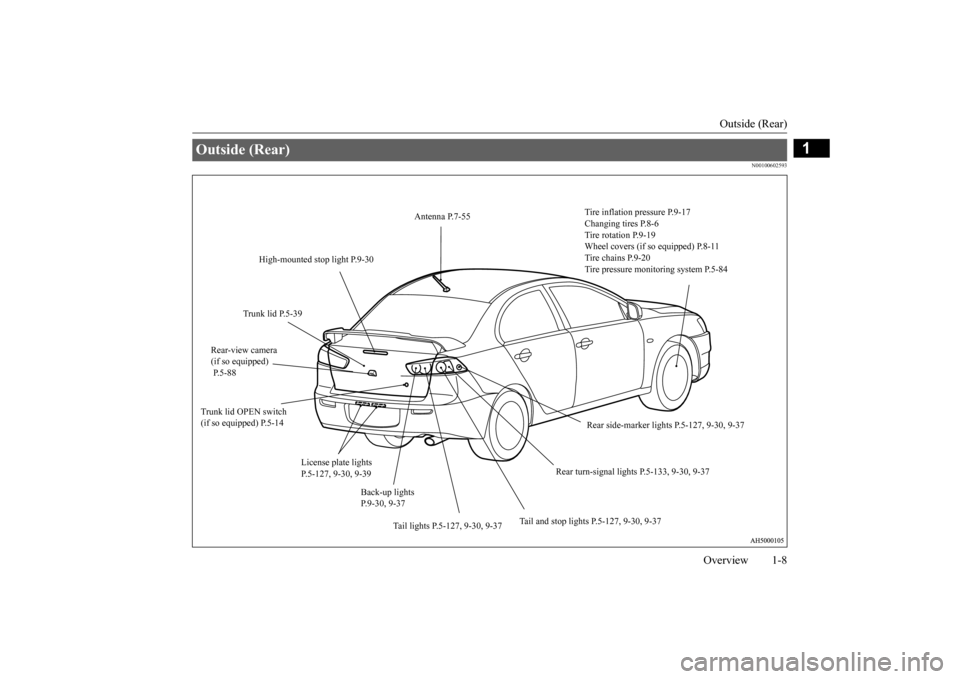
Outside (Rear)
Overview
1-8
1
N00100602
593
Outside (Rear)
Tire inflation pressure P
.9-17
Changing
tires
P.8-6
Tire rotation P
.9-19
Wheel covers (if so
equipped) P
.8-1
1
Tire chains P
.9-20
Tire pressure monitoring system P
.5-84
Antenna
P.7-55
High-m
ounted st
op light
P.9-30
Trunk
lid
P.5-39
Rear
-view
camera
(if so equipped)
P.5-88
Trunk lid OPE
N switch
(if so equipped) P
.5-14
Rear
side-marker
lights
P.5-127,
9-30,
9-37
License
plate lights
P.5-127, 9
-30, 9-39
Rear t
urn-si
gnal light
s P.5-133, 9-30, 9-37
Back-up light
s
P.9-30, 9-37
Tail and
stop
lights
P.5-127,
9-30,
9-37
Tail lights
P.5-127,
9-30,
9-37
Page 11 of 392
2-1
2
If this warning light comes on or
flashes while you’re driving...
Quick index
N00200702
191
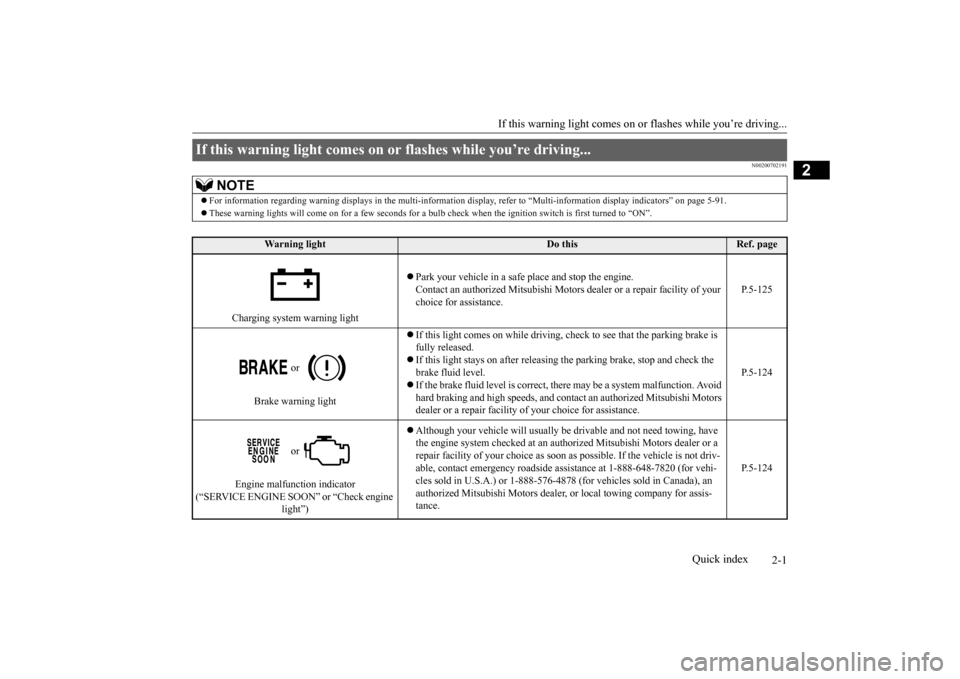
If this warning light comes on or flashes while you’r
e driving...
NOTE
For
info
rmatio
n regarding
warning
displays
in the
multi-informat
ion
display
, refer to “Multi-
information
display
ind
icators”
on page 5-9
1.
These warning
lights will
come o
n for a few second
s for a
bulb ch
eck
whe
n the ign
ition
switc
h is first turned to “ON”.
Warning light
Do this
Ref. page
Ch
arging system w
arni
ng light
Park your vehicle in a safe
place
and
stop
the
engine.
Contact an authorized Mitsubishi Motors
dealer or a repair facility of your
choice for assistance.
P.5-125
or
Brake warning light
If this light comes on while driving, check to see that the parking brake is fully released.If this light stays on after releasing the parking brake, stop and check the brake fl
uid level
.
If the
brake
fluid
level
is correct,
there
may
be
a system
malfunction.
Avoid
hard
braking
and
high
speeds,
and
contact
an
authorized
Mitsubishi
Motors
dealer or a repair facility of your choice for assistance.
P.5-124
or
Engi
ne
malfuncti
on
indicat
or
(“SER
VICE
ENGINE
SOON”
or “Check
engine
light”)
Although your vehicle will usually be drivable and not need towing, have the engine system checked at an aut
horized Mitsubishi Motors dealer or a
repair facility of your choice as soon
as possible. If the vehicle is not driv-
able, contact emer
gency roadside assistance at 1-888-648-7820 (for vehi-
cles sold in U.S.A.) or 1-888-576-487
8 (for vehicles sold in Canada), an
authorized Mitsubishi Motors dealer
, or local towing company for assis-
tance.
P.5-124
Page 12 of 392
If this warning light comes on or
flashes while you’re driving...
2-2
Quick index
2
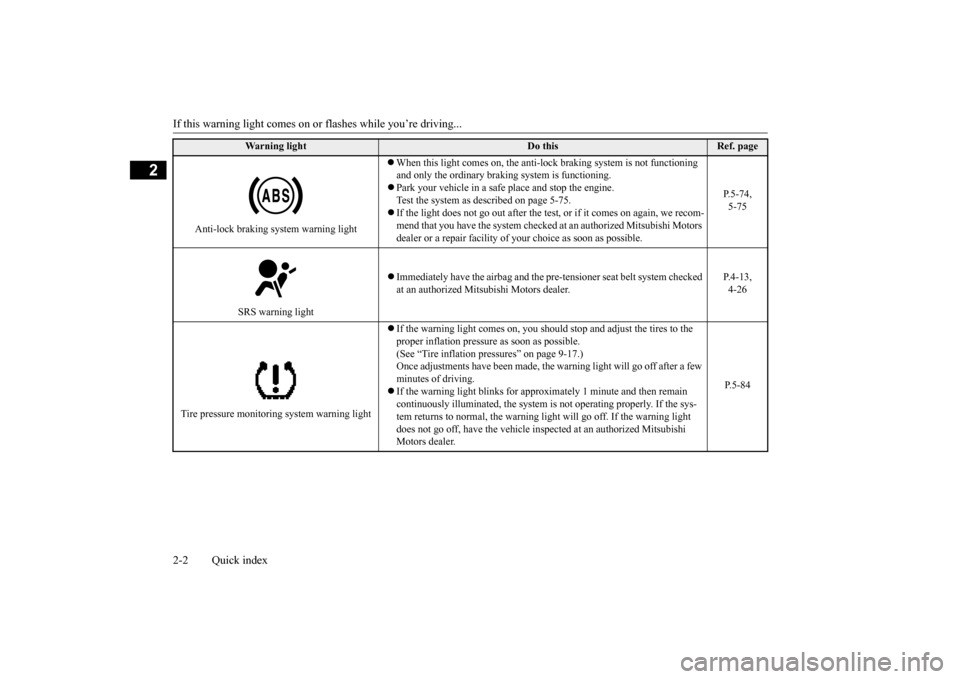
Anti-lock
braking
system
warning
light
When
this
light
comes
on,
the
anti-lock
braking
system
is not
functioning
and only the ordinary braking system is functioning.Park
your
vehicle
in a safe
place
and
stop
the
engine.
Test the system as described on page 5-75.
If the light does not go out after the test
, or if it comes on again, we recom-
mend
that
you
have
the
system
checked
at an
authorized
Mitsubishi
Motors
dealer or a repair facility of your choice as soon as possible.
P.5-74,5-75
SRS
warning
light
Immediately
have
the
airbag
and
the
pre-tensioner
seat
belt
system
checked
at an
authorized
Mitsubishi
Motors
dealer
.
P.4-13,4-26
Tire pressure monitoring system warning light
If the warning light comes on, you should
stop and adjust the tires to the
proper inflation pressure as soon as possible.(See
“Tire
inflation
pressures”
on
page
9-17.)
Once
adjustments
have
been
made,
the
warning
light
will
go
off after
a few
minutes of driving.If the warning light blinks for approximately 1 minute and then remain continuously illuminated, the system is not operating properly
. If the sys-
tem returns to normal, the warning light will go of
f. If the warning light
does not go of
f, have the vehicle inspected at an authorized Mitsubishi
Motors dealer
.
P.5-84
Warning light
Do this
Ref. page
Page 15 of 392
If this problem occurs...
Quick index
2-5
2
Problem
Do this
Ref. page
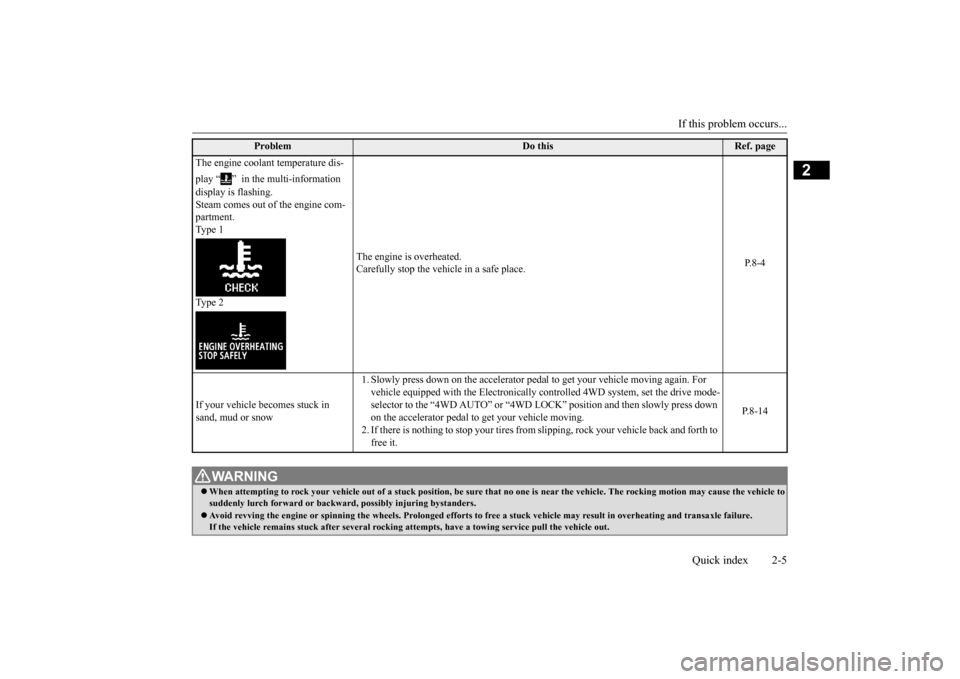
The engine coolant temperature dis-play “
” in the multi-information
display is flashing.Steam comes out of the engine com-partment. Type 1Type 2
The
engine
is overheated.
Carefully stop the vehicle in a safe place.
P.8-4
If your vehicle becomes stuck in sand, mud or snow
1.Slowly press down on the accelerator peda
l to get your vehicle moving again. For
vehicle
equipped
with
the
Electronically
controlled
4WD
system,
set
the
drive
mode-
selector
to the
“4WD
AUT
O” or “4WD
LO
CK”
position
and
then
slowly
press
down
on the accelerator pedal to get your vehicle moving.2.If there
is nothing
to stop
your
tires
from
slipping,
rock
your
vehicle
back
and
forth
to
free it.
P.8-14
W
AR
NING
When
attempting
to rock
your
vehicle
out
of a stuck
position,
be
sur
e that
no
one
is near
the
vehicle.
The
rocking
motion
may
cause
the
vehicle
to
sudde
nly lurch forw
ard
or bac
kwar
d, possi
bly injurin
g bystanders
.
Avoid
revving
the
engine
or spinning
the
wheels. Pr
olonged efforts to fr
ee a stuck ve
hicle may r
esult in overheating and transa
xle
failu
re.
If the
vehicle
remai
ns stuc
k after
severa
l rock
ing
attempts,
have
a towing
service
pull
the
vehicle
out.
Page 18 of 392
Fuel selection3-2
General information
3
N0030100
1948
Your
vehicle
is designed
to use
unleaded
gas-
oline
only
. It is
equipped
with
a fuel
filler
tube
especially
designed
to
accept
only
a
small
diameter
unlead
ed gasolin
e dispensin
g
nozzle. In
the
United
States,
fuel
suppliers
are
required
by
law
to add
deter
gents
to their
gas-
oline
to
minimize
fuel-injector
fouling
and
minimize
intake-valve
deposits.
Deter
gent
gasoline
helps
keep
your
engine
in
tune
and
your
emission-control
system
working
prop-
erly
.
Your
vehicle
is
designed
to
operate
on
unleaded
gasoline
having
a minimum
octane
number of 87 [(MON+RON)/2], or 91 RON.MON: Motor Octane NumberRON: Research Octane Number Gasoline
sold
at
some
service
stations
con-
tains
oxygenates
such
as
ethanol,
although
the
oxygenates
may
not
be
identified
by
those
names.
Oxygenates
are
required
in
some
areas
of the
country
. Such
fuel
can
be
used
in
your vehicle.A mixture
of
up
to 10
%
ethanol
(grain
alco-
hol)
and
90% unlead
ed gasolin
e may
be used
in
your
vehicle,
provided
the
octane
number
is at
least
as
high
as
that
recommended
for
unleaded gasoline. Do
not
operate
your
vehicle
on
gasoline
con-
taining
methanol
(wood
alcohol).
Using
this
type
of
alcohol
could
adversely
affect
the
vehicle
’s performance
and
damage
critical
parts
of the
vehicle’
s fuel
system.
Many
areas
of
the
country
require
the
use
of
cleaner
burning
fuel
referred
to as “Reformu-
lated Gasoline”. Reformulated
gasoline
contains
oxygenates
and
is
specially
blended
to
reduce
vehicle
emissions and improve air quality
.
Mitsubish
i Motor
s Co
rporation
strongly
sup-
ports
the
use
of
reformulated
gasoline.
Prop-
erly
blended
reformulated
gasoline
has
no
adverse
effect
on
vehicle
performance
or
the
durability of the engine and fuel system.
Fuel
selection
W
AR
NING
Gasolin
e is highl
y flammable
and
expl
o-
sive. You coul
d be bur
ned,
seriousl
y
injur
ed or
killed
when
handling
it. When-
ever
you
refu
el
you
r veh
icle,
stop
the
engin
e and
keep
flames
, sparks,
and
smoking
materials
away
from
the
vehicle.
Always
handle
fuel
in well-ventilated
out-
door
areas.
CAUTIONUsi
ng
lead
ed
gas
olin
e in your
vehicle
will
damage
the
engine,
catalytic
converter
, and
the oxyge
n sensors.
Also,
using
lead
ed gaso-
line is illeg
al, and
will
voi
d your
warranty
cove
rage of
the engi
ne, cataly
tic
conve
rter,
and
oxygen
sensors.
Gasoline
detergent
additives
Octane r
equir
ement
Oxygenated gasoline Ethanol (Gasohol)
Methanol Reformulated gasoline
Page 20 of 392
Filling the fuel tank3-4
General information
3
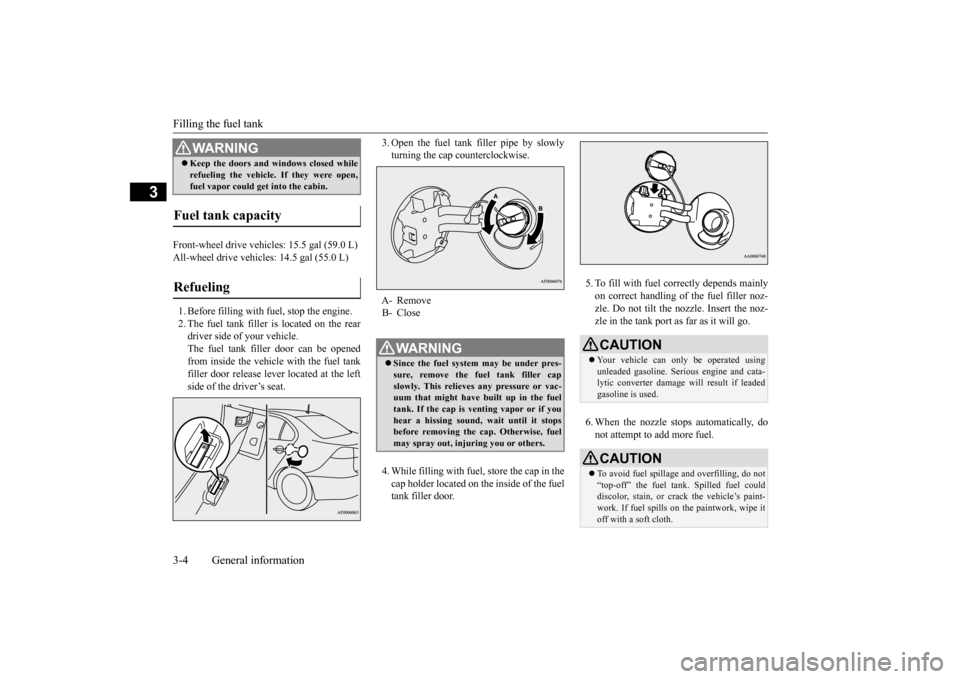
Front-wheel drive vehicles: 15.5 gal (59.0 L)All-wheel drive vehicles: 14.5 gal (55.0 L)1.Before filling with fuel, stop the engine.2.The
fuel
tank
filler
is located
on
the
rear
driver side of your vehicle. The
fuel
tank
filler
door
can
be
opened
from
inside
the
vehicle
with
the
fuel
tank
filler
door
release
lever
located
at the
left
side of the driver
’s seat.
3.Open
the
fuel
tank
filler
pipe
by
slowly
turning the cap counterclockwise.4.While
filling
with
fuel,
store
the
cap
in the
cap
holder
located
on
the
inside
of the
fuel
tank filler door
.
5.To fill
with
fuel
correctly
depends
mainly
on
correct
handling
of
the
fuel
filler
noz-
zle.
Do
not
tilt
the
nozzle.
Insert
the
noz-
zle in the tank port as far as it will go.6.When
the
nozzle
stops
automatically
, do
not attempt to add more fuel.
Keep
the
doors
and
windows
clos
ed while
refuelin
g the
veh
icle.
If the
y were ope
n,
fuel vapor
could get
into the
cabin.
Fuel tank capacity Refueling
W
AR
NING
A-Remove
B-
Close W
AR
NING
Since
the
fuel
system
may
be
under
pres-
sur
e, remove
the
fuel
tank
filler
cap
slowly
. This
relieves
any
pressur
e or
vac-
uum
that
might
have
built
up
in the
fuel
tank.
If the
cap
is venting
vapor
or if you
hear
a hissing
sound,
wait
until
it stops
befor
e removin
g the
cap.
Otherw
ise, fue
l
may
spray
out,
injuring
you
or others.
CAUTIONYour
vehicle
can
onl
y be ope
rated
using
unlead
ed gasolin
e. Serious
engi
ne and
cata-
lytic
conve
rter damag
e will
result
if lead
ed
gasoline
is used.
CAUTIONTo avoi
d fuel
spillag
e and
ove
rfilling,
do
not
“top-of
f”
the
fuel
tank.
Spilled
fuel
could
discolor
, stain,
or crack
the
vehicle’
s paint-
work.
If fuel
spills
on
the
paintw
ork,
wipe
it
off with
a soft
cloth.
Page 28 of 392
Front seats4-4
Seat and restraint systems
4
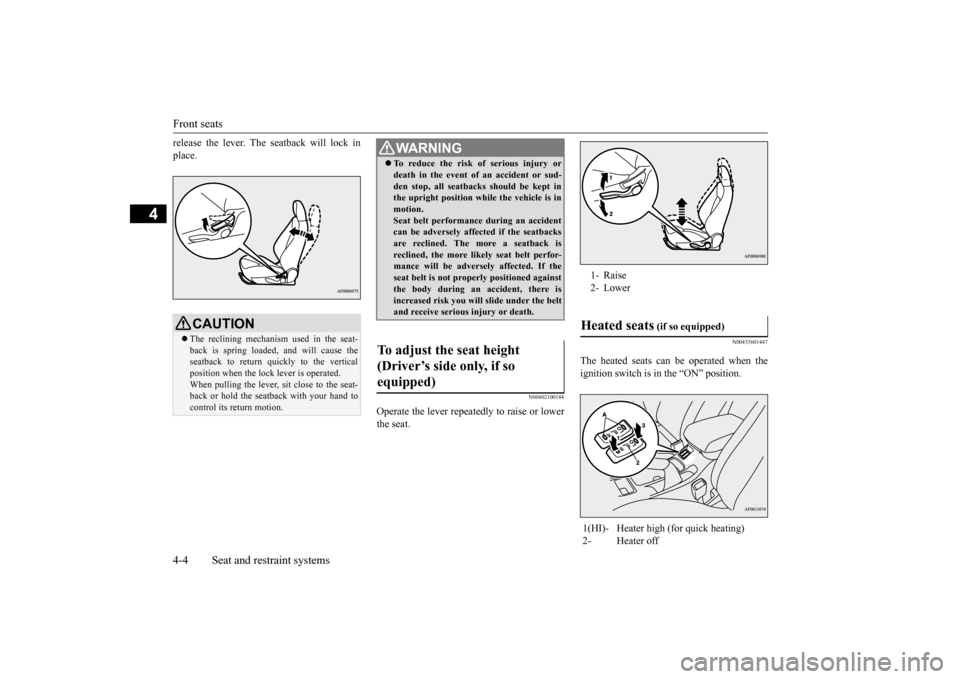
release
the
leve
r. The
seatback
will
lock
in
place.
N0040210
0184
Operate
the
lever
repeatedly
to raise
or
lower
the seat.
N0043560
1447
The
heated
seats
can
be
operated
when
the
ignition switch is in the “ON” position.
CAUTIONThe
reclining
mechanis
m used
in
the
seat-
back
is spring
loaded,
and
will
caus
e the
seatback
to
return
quickly
to
the
vertical
position
when
the
lock
lever
is operated.
When
pullin
g the
lev
er, sit close
to the seat-
back
or hold
the
seatb
ack
with your hand
to
control
its return
motion.
W
AR
NING
To reduce
the
risk
of
serious
injur
y or
death
in the even
t of an accid
ent or
sud-
den
stop,
all
seatbacks
should
be
kept
in
the
upright
position
while
the
vehicle
is in
motion. Seat
belt
performance
during
an
accident
can
be
adversely
affected
if the
seatbacks
are reclined.
The
mor
e a seatback
is
reclined,
the
mor
e likely
seat
belt
perfor
-
mance
will
be
adversely
affected.
If the
seat
belt
is not
properly
positioned
against
the
body
during
an
accident,
ther
e is
incr
eased
risk
you
will
slide
under
the
belt
and
receive serious injury or death.
To adjust the seat height (Driver
’s side only
, if so
equipped)
1-
Raise
2-
Lower
Heated seats
(if so equipped)
1(HI)-
Heater high (for quick heating)
2-
Heater
off
Page 29 of 392
Rear seats
Seat and restraint systems
4-5
4
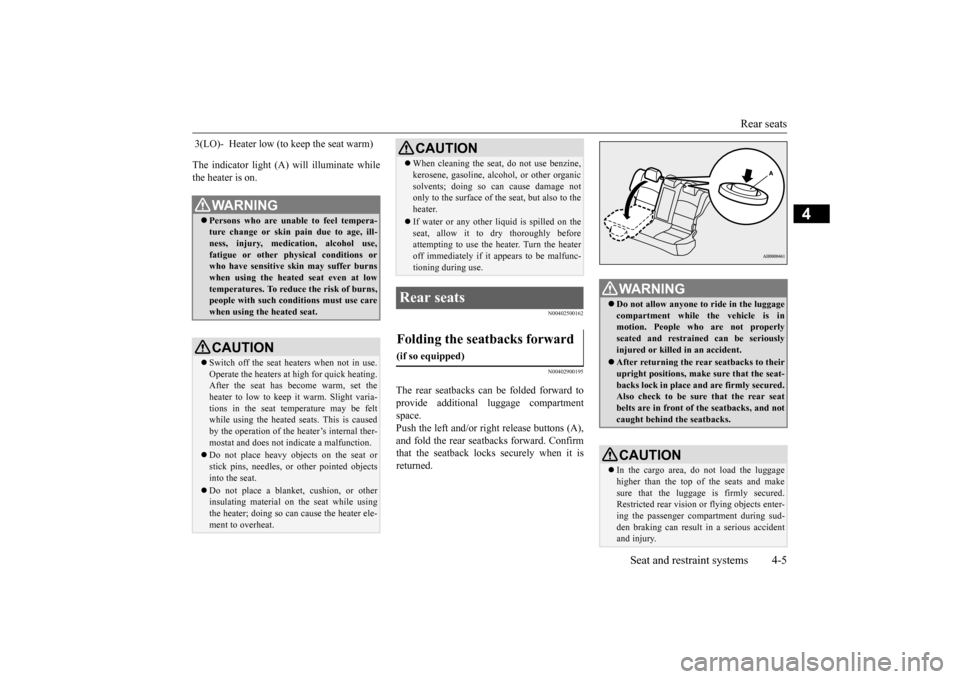
The
indicator
light
(A)
will
illuminate
while
the
heater
is on.
N00402500
162
N00402900
195
The
rear
seatbacks
can
be
folded
forward
to
provide
additional
luggage
compartment
space.Push
the
left
and/or
right
release
buttons
(A),
and
fold
the
rear
seatbacks
forward.
Confirm
that
the
seatback
locks
securely
when
it is
returned.
3(LO)-
Heater
low
(to
keep
the
seat
warm)
W
AR
NING
Pers
ons
who
are una
ble to
feel
temp
era-
ture change
or
skin
pai
n due
to age, ill-
ness,
injury
, medication,
alcohol
use,
fatigue
or
other
physical
conditions
or
who
have
sensi
tive ski
n may
suffer
bur
ns
whe
n usi
ng
the
heate
d seat
even at
low
temperatur
es. To reduce
the
risk
of bur
ns,
people
with suc
h condi
tions
must
use
care
when
using
the
heated
seat.
CAUTIONSwitch
off the seat
heaters
whe
n not
in use
.
Ope
rate
the heaters
at high
for
quick
heating.
After
the
seat
has
become
warm,
set
the
heater
to low
to keep
it warm. Slight
varia-
tions
in the seat
temp
erature
may
be felt
while
using
the heated
seats.
This is cause
d
by
the ope
ration
of the heater
’s internal
ther-
mostat
and
does
not
indicate
a malfunction.
Do not place
heavy
objects
on the seat
or
stick
pins, needles,
or other poin
ted
objects
into
the
seat.
Do
not
place
a blanket,
cushi
on,
or
other
insulating
mater
ial
on
the seat
while
using
the
heater;
doing
so can
cause
the
heater
ele-
men
t to ove
rheat.
When
cleaning
the
seat,
do
not
use
benzine,
kerosene,
gasoline,
alcohol,
or other
organic
solvents
; doing
so can
caus
e damage
not
only
to the
surface
of the
seat,
but
also
to the
heater
.
If water
or any
other liqui
d is spilled
on
the
seat,
allow
it
to dry
thoroughl
y before
attempting
to use
the
heater
. Turn
the
heater
off immediately
if it appears
to be
malfunc-
tioning d
uring use
.
Rear seats Folding the seatbacks forward
(if so equipped)
CAUTION
W
AR
NING
Do
not
allow
anyone
to ride
in the
luggage
comp
artmen
t while
the veh
icle
is in
motion
. Peop
le
who
are not
properly
seate
d and
restrained can
be seriousl
y
injur
ed or killed in an accident.
After
retu
rning the rear
seatb
acks
to their
upright
posi
tions,
make
sur
e that
the
seat-
bac
ks lock in place and
are firm
ly secu
red.
Also
check
to
be sur
e that
the
rear seat
belts
are in front of the seatb
acks,
and
not
cau
ght behind
the seatb
acks.
CAUTIONIn
the cargo
area, do
not
load the lugga
ge
highe
r than the top
of
the seats
and
mak
e
sure
that
the lugga
ge is firmly
secure
d.
Res
tricted
rear
vision
or flying
objects
enter
-
ing
the
passenger
compartment
during
sud-
den bra
king
can
result
in a serious
accid
ent
and
injury
.
Page 32 of 392
Seat
belts
4-8
Seat and restraint systems
4
N0040600
0439
Seat
belts
are
installed
in your
vehicle
to help
reduce
the
risk
of injury
to the
driver
and
pas-
senger
in
the
event
of
an
accident.
Always
use the provided seat belts. Carefully
review
the
following
information
for proper seat belt usage.
N0040620
1470
All
seats
are
equipped
with
a seat
belt
which
uses
one
combined
lap-and-shoulder
belt
with
an emer
gency locking retractor
.
Seat belts
W
AR
NING
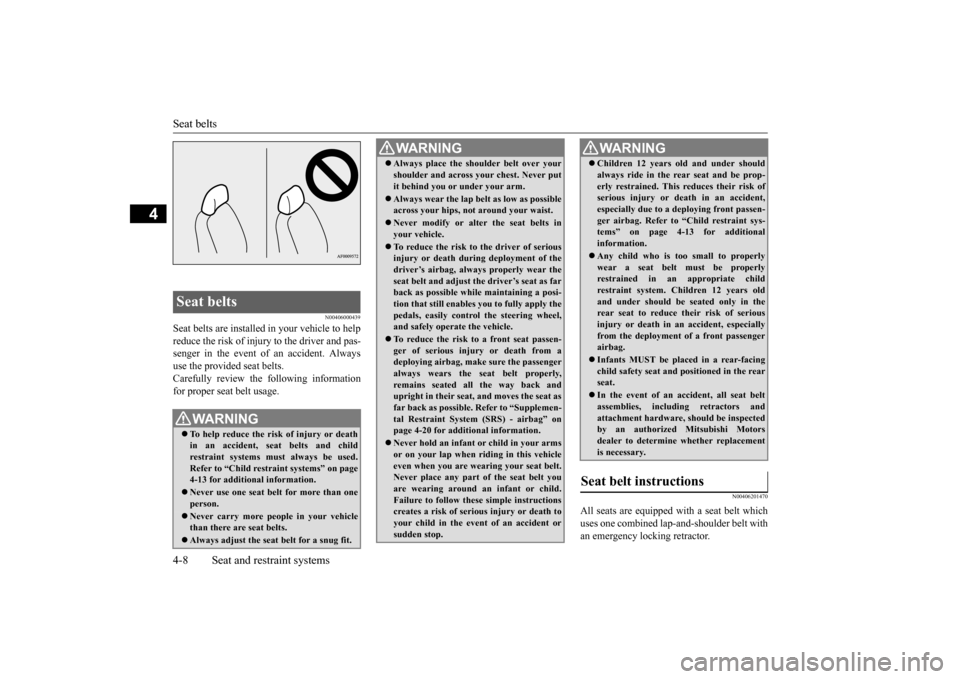
To help
reduce
the
risk
of injur
y or death
in an accid
ent,
seat
belts
and
child
restrain
t systems
must
alw
ays
be use
d.
Refer
to “Child
restraint
systems”
on
page
4-13 for
addi
tional
infor
mati
on.
Never use
one
seat belt for
mor
e than
one
person. Never
carry
mor
e people
in
your
vehicle
tha
n the
re are seat belts.
Always adjust the seat
belt for a snug
fit.
Alway
s place
the
shoul
der
belt over
your
shoulder
and
acr
oss your
chest.
Never
put
it behind
you
or under
your
arm.
Always
wear
the
lap
belt
as low
as possible
acr
oss your
hips,
not
around
your
waist.
Never
modi
fy
or
alter
the
seat
belts
in
your
vehicle.
To reduce
the risk
to the driver
of seriou
s
injury
or
death
durin
g deploymen
t of the
driver
’s airb
ag,
alw
ays
properly
wear
the
seat belt and
adjust
the
driv
er’s seat as far
bac
k as possi
ble while
mai
ntai
ning
a posi
-
tion
that
still
enables
you
to fully
appl
y the
pedals,
easily
contr
ol
the
steering
wheel,
and safely
operate
the
veh
icle.
To reduce
the
risk
to a front
seat passe
n-
ger
of serious
injury
or death
from a
deployi
ng airb
ag,
make
sur
e the
passenge
r
alw
ays
wears
the
seat
belt properly
,
remai
ns
seate
d all
the
way
bac
k and
upright
in their
seat,
and
moves
the
seat
as
far
bac
k as possi
ble. Refer to “Supplem
en-
tal
Restraint
System
(SRS)
- airbag”
on
page
4-20
for
addi
tional infor
mati
on.
Never
hold
an
infant
or child
in your
arms
or
on
your lap
whe
n rid
ing in this vehicle
even
whe
n you are wearin
g your seat belt.
Never
place
any par
t of the
seat
belt you
are wearing
around
an
infant
or
child.
Failur
e to follow
these
simple
instructions
create
s a risk
of serious
injury
or death
to
your
child
in the
event
of an
accident
or
sudden
stop.
W
AR
NING
Child
ren 12
years old and
under
shoul
d
always
rid
e in the
rear seat and
be prop-
erly
restrained. Thi
s reduces
their
risk
of
serious
injur
y or death
in an
accid
ent,
especia
lly due
to a deployi
ng
front
passe
n-
ger
airbag.
Refer
to “Child
restraint
sys-
tems”
on
page
4-13
for
addi
tional
infor
mati
on.
Any
child who
is too
small
to
properly
wear
a seat
belt must
be properly
restrained in an
appr
opriat
e child
restraint
syste
m.
Child
ren 12
yea
rs old
and
under
should
be
seated
only
in
the
rear seat
to
reduce
their
risk
of
serious
injur
y or death
in an
accid
ent,
especia
lly
from
the
deployment
of a front
passenger
airbag.Infants
MUST
be placed
in a rear-facin
g
child safe
ty seat and
positione
d in the
rear
seat.In
the
event
of
an
accident,
all
seat
belt
assemblies,
including
retractors
and
attach
men
t hardwa
re, sho
uld be inspected
by
an
authorized
Mitsubi
shi
Motor
s
dealer
to determ
ine whe
ther
replacem
ent
is necessary
.
Seat belt instructions
W
AR
NING
Page 33 of 392
Seat
belts
Seat and restraint systems
4-9
4
This
system
is designed
to provide
both
com-
fort
and
safet
y. It permit
s full
exten
sion
and
automatic
retraction
of
the
belts
during
nor
-
mal
vehicle
operation.
A
sensing
device
inside
the
belt
retractor
is designed
to lock
the
retractor
in
the
event
of
a sudden
change
in
the vehicle
’s motion.
1.Occupants
should
always
sit
back
in their
seats
with
their
backs
against
the
upright
seatback.
To reduce
the
risk
of
serious
injury
or
death
during
deployment
of
the
airbag,
adjust
the
driver
’s seat
as
far
back
as possible
while
maintaining
a pos
ition
that
still
enables
you
to
fully
apply
the
pedals,
easily
control
the
steering
wheel,
and
safely
operate
the
vehicle.
The
front
passenger
seat
should
also
be
moved
as
far
back
as
possible.
Refer
to
“Supple-
mental
Restraint
System
(SRS)
- airbag”
on
page
4-20.
Also
refer
to “To adjust
the
seat forward or backward” on page 4-3.
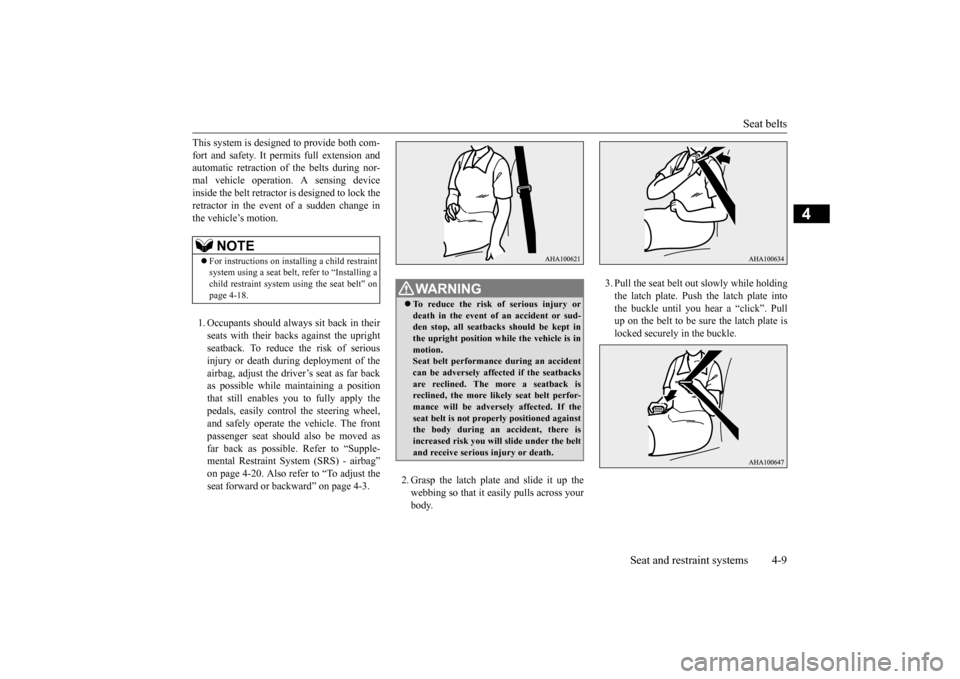
2.Grasp
the
latch
plate
and
slide
it up
the
webbing
so
that
it easily
pulls
across
your
body
.
3.Pull
the
seat
belt
out
slowly
while
holding
the
latch
plate.
Push
the
latch
plate
into
the
buckle
until
you
hear
a “click”.
Pull
up
on
the
belt
to be
sure
the
latch
plate
is
locked securely in the buckle.
NOTE
For
instructions
on
installing
a child restrain
t
system
using
a seat
belt,
refer
to “Installing
a
child
restraint
system
using
the
seat
belt”
on
page
4-18.
W
AR
NING
To reduce
the
risk
of
serious
injury
or
death
in the
event
of an
accident
or
sud-
den stop,
all
seatbacks
sho
uld be kept
in
the
upright
position
while
the
vehicle
is in
motion.Seat
belt performance
during
an accid
ent
can
be
adversely
affected
if the
seatbacks
are reclined.
The
mor
e a seatback
is
reclined,
the
mor
e likely
seat
belt
perfor
-
mance
will
be
adversely
affected.
If the
seat
belt
is not
properly
positioned
against
the
body durin
g an
accid
ent,
the
re is
increas
ed risk
you
will slide under
the
belt
and
receive s
erious
injur
y or
death.