transmission MITSUBISHI LANCER EVOLUTION 2007 Service Repair Manual
[x] Cancel search | Manufacturer: MITSUBISHI, Model Year: 2007, Model line: LANCER EVOLUTION, Model: MITSUBISHI LANCER EVOLUTION 2007Pages: 1449, PDF Size: 56.82 MB
Page 948 of 1449

REAR AXLE -General Information27B-2
GENERAL INFORMATION
The rear axle consists of rear hubs, wheel bearings,
drive shafts, and rear differential and, it has the
following features.
DThe wheel bearing is a unit bearing (double-row
angular contact ball bearing).
DThe drive shaft incorporates B.J.-T.J. type
constant velocity joints with high transmission
efficiency and low vibration and noise.DABS rotors for detecting the wheel speeds are
press-fitted to the B.J. outer wheels in vehicles
with ABS or ACD.
NOTE
1. B.J.: Birfield Joint
2. T.J.: Tripod Joint
SPECIFICATIONS
ItemVehicles without AYCVehicles with AYC
Wheel
bearingsWheel bearing typeUnit bearing (Double-row angular contact ball
bearing)
g
Bearing (outside diameter×inside diameter) mm78×40
Drive
shaft
Joint typeOutsideB.J.
shaftInsideT.J.
Shaft length*1×Shaft diameter
mm
Left483×25426×25
mmRight573×25446×25
NOTE
*1: The shaft length indicates the length between the center points of each joint.
STRUCTURAL DIAGRAM
Oil sealRear hub Differential carrier
B.J.
Drive shaftT. J .
Page 962 of 1449

REAR AXLE -On-vehicle Service27B-16
DATA LIST REFERENCE TABLE
For check, refer to GROUP 22.
ACTUATOR TEST REFERENCE TABLE
For check, refer to GROUP 22.
CHECK AT 4WD-ECU TERMINALS
For check, refer to GROUP 22.
ON-VEHICLE SERVICE
REAR AXLE TOTAL BACKLASH CHECK
1. Park the vehicle on a flat, level surface.
2. Move the transmission control lever to the neutral position.
Apply the parking brake. Raise the vehicle on a jack.
3. Turn the companion flange clockwise as far as it will go.
Make the mating mark on the dust cover of the companion
flange and on the differential carrier.
4. Turn the companion flange anti-clockwise as far as it
will go, and measure the amount of distance the mating
marks moved.
Limit: 6 mm
5. If the backlash exceeds the limit value, replace the
differential carrier assembly.
GEAR OIL LEVEL CHECK
1. Remove the filler plug.
2. Check that the gear oil level is within the specified range
from the bottom end of the filler plug hole.
3. If the gear oil level exceeds the standard value, add the
specified gear oil up to the bottom end of the filler plug
hole.
Specified gear oil:
Hypoid gear oil
MITSUBISHI Genuine Gear Oil Part No. 8149630
EX, CASTROL HYPOY LS (GL-5, SAE 90),
SHELL-LSD (GL-5, SAE 80W - 90) or equivalent
4. Fit the filler plug and tighten it to the specified torque.
Tightening torque: 49±9 N·m
Mating marks
Upper
limit
Lower
limit
Gear oil
8mm
Page 976 of 1449
REAR AXLE -Drive Shaft27B-30
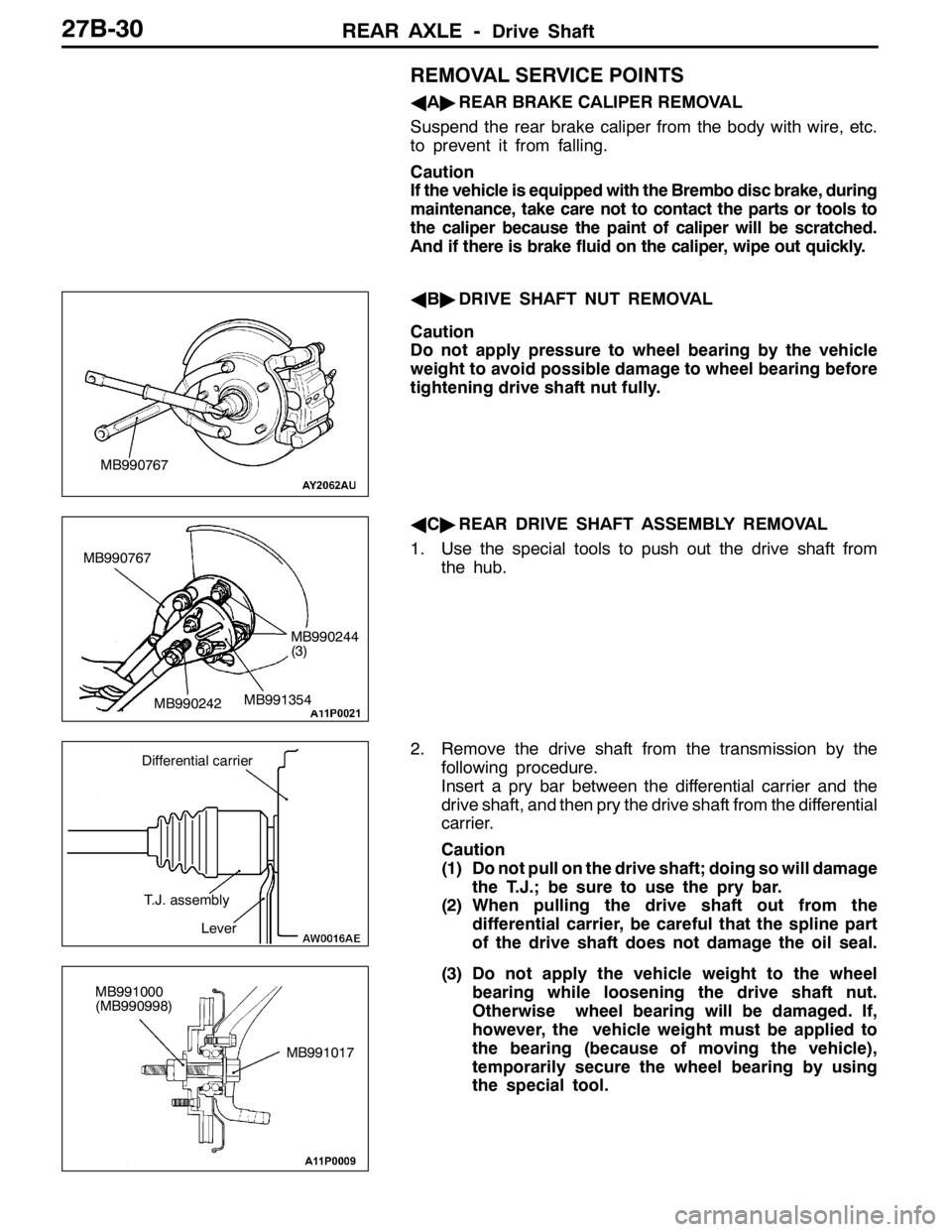
REMOVAL SERVICE POINTS
AA"REAR BRAKE CALIPER REMOVAL
Suspend the rear brake caliper from the body with wire, etc.
to prevent it from falling.
Caution
If the vehicle is equipped with the Brembo disc brake, during
maintenance, take care not to contact the parts or tools to
the caliper because the paint of caliper will be scratched.
And if there is brake fluid on the caliper, wipe out quickly.
AB"DRIVE SHAFT NUT REMOVAL
Caution
Do not apply pressure to wheel bearing by the vehicle
weight to avoid possible damage to wheel bearing before
tightening drive shaft nut fully.
AC"REAR DRIVE SHAFT ASSEMBLY REMOVAL
1. Use the special tools to push out the drive shaft from
the hub.
2. Remove the drive shaft from the transmission by the
following procedure.
Insert a pry bar between the differential carrier and the
drive shaft, and then pry the drive shaft from the differential
carrier.
Caution
(1) Do not pull on the drive shaft; doing so will damage
the T.J.; be sure to use the pry bar.
(2) When pulling the drive shaft out from the
differential carrier, be careful that the spline part
of the drive shaft does not damage the oil seal.
(3) Do not apply the vehicle weight to the wheel
bearing while loosening the drive shaft nut.
Otherwise wheel bearing will be damaged. If,
however, the vehicle weight must be applied to
the bearing (because of moving the vehicle),
temporarily secure the wheel bearing by using
the special tool.
MB990767
MB990767
MB990242MB991354
MB990244
(3)
Differential carrier
T.J. assembly
Lever
MB991017 MB991000
(MB990998)
Page 1015 of 1449

32-1
POWER PLANT
MOUNT
CONTENTS
GENERAL INFORMATION 2..................
SPECIAL TOOL 3............................
ENGINE MOUNTING 4........................TRANSMISSION MOUNTING 5................
ENGINE ROLL STOPPER, CENTERMEMBER
6 ............................................
CROSSMEMBER* 8..........................
WARNING REGARDING SERVICING OF SUPPLEMENTAL RESTRAINT SYSTEM (SRS) EQUIPPED VEHICLES
WARNING!
(1) Improper service or maintenance of any component of the SRS, or any SRS-related component, can lead to personal
injury or death to service personnel (from inadvertent firing of the air bag) or to driver and passenger (from rendering
the SRS inoperative).
(2) Service or maintenance of any SRS component or SRS-related component must be performed only at an authorized
MITSUBISHI dealer.
(3) MITSUBISHI dealer personnel must thoroughly review this manual, and especially its GROUP 52B - Supplemental
Restraint System (SRS) before beginning any service or maintenance of any component of the SRS or any SRS-related
component.
NOTE
The SRS includes the following components: SRS-ECU, SRS warning lamp, air bag module, clock spring, and interconnecting
wiring. Other SRS-related components (that may have to be removed/installed in connection with SRS service or maintenance) are
indicated in the table of contents by an asterisk (*).
Page 1016 of 1449

POWER PLANT MOUNT - General Information32-2
GENERAL INFORMATION
Inertia principal axes system is incorporated into
the engine mount system.Upper installation of roll mount reduces engine
rolling, and increase of insulator bore also reduces
idle vibration.
CONSTRUCTION DIAGRAM
Transmission mount Engine mount
Rear roll rod bracket
Front roll stopper
Front roll mount bracketRear roll mount bracket
Crossmember
Crossmember bar
CentermemberRear roll rod assembly
Page 1018 of 1449
POWER PLANT MOUNT - Engine Mounting32-4
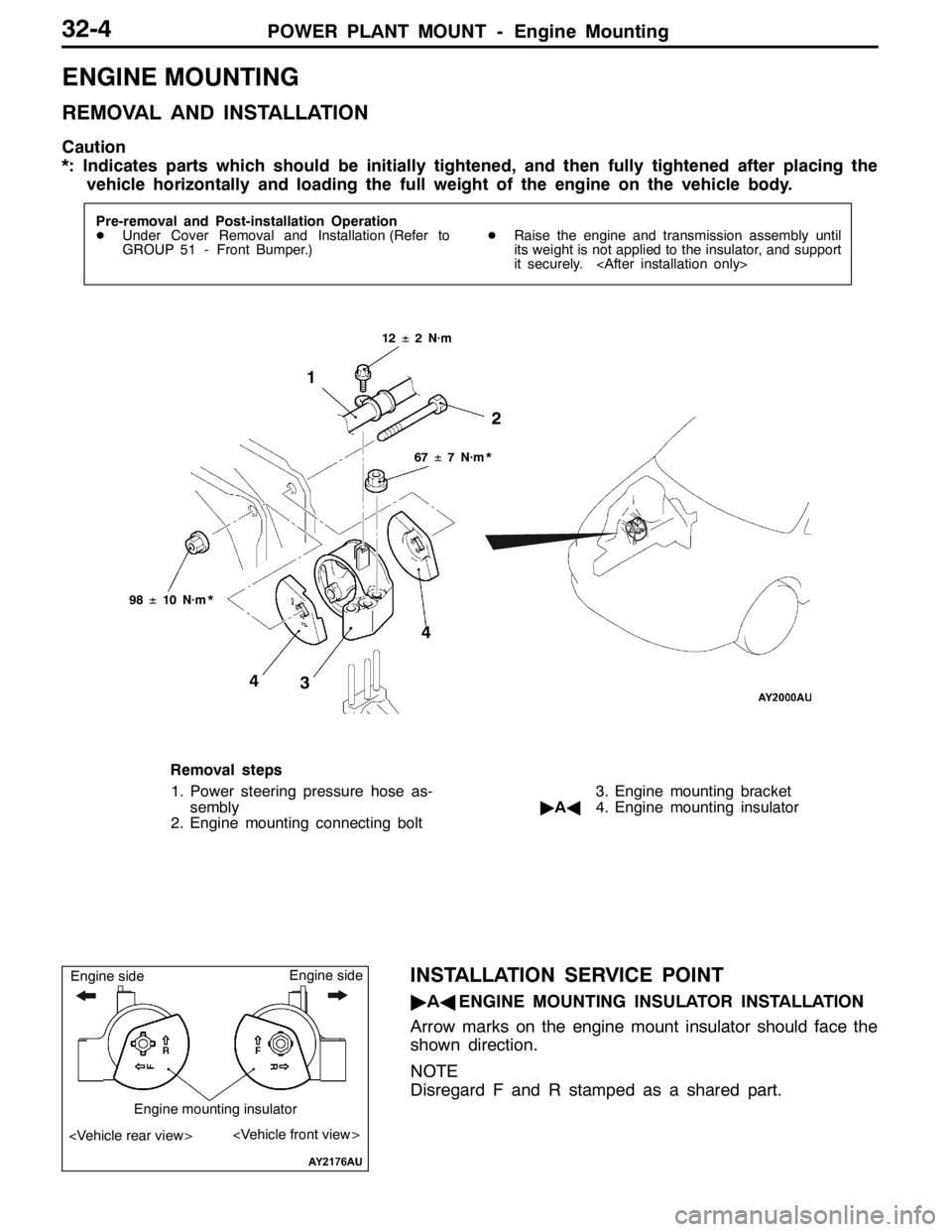
ENGINE MOUNTING
REMOVAL AND INSTALLATION
Caution
*: Indicates parts which should be initially tightened, and then fully tightened after placing the
vehicle horizontally and loading the full weight of the engine on the vehicle body.
Pre-removal and Post-installation Operation
DUnder Cover Removal and Installation (Refer to
GROUP 51 - Front Bumper.)DRaise the engine and transmission assembly until
its weight is not applied to the insulator, and support
it securely.
98±10 N·m*
67±7 N·m*
1
2
12±2 N·m
3 44
Removal steps
1. Power steering pressure hose as-
sembly
2. Engine mounting connecting bolt3. Engine mounting bracket
"AA4. Engine mounting insulator
INSTALLATION SERVICE POINT
"AAENGINE MOUNTING INSULATOR INSTALLATION
Arrow marks on the engine mount insulator should face the
shown direction.
NOTE
Disregard F and R stamped as a shared part.
Engine sideEngine side
Engine mounting insulator
Page 1019 of 1449
POWER PLANT MOUNT - Transmission Mounting32-5
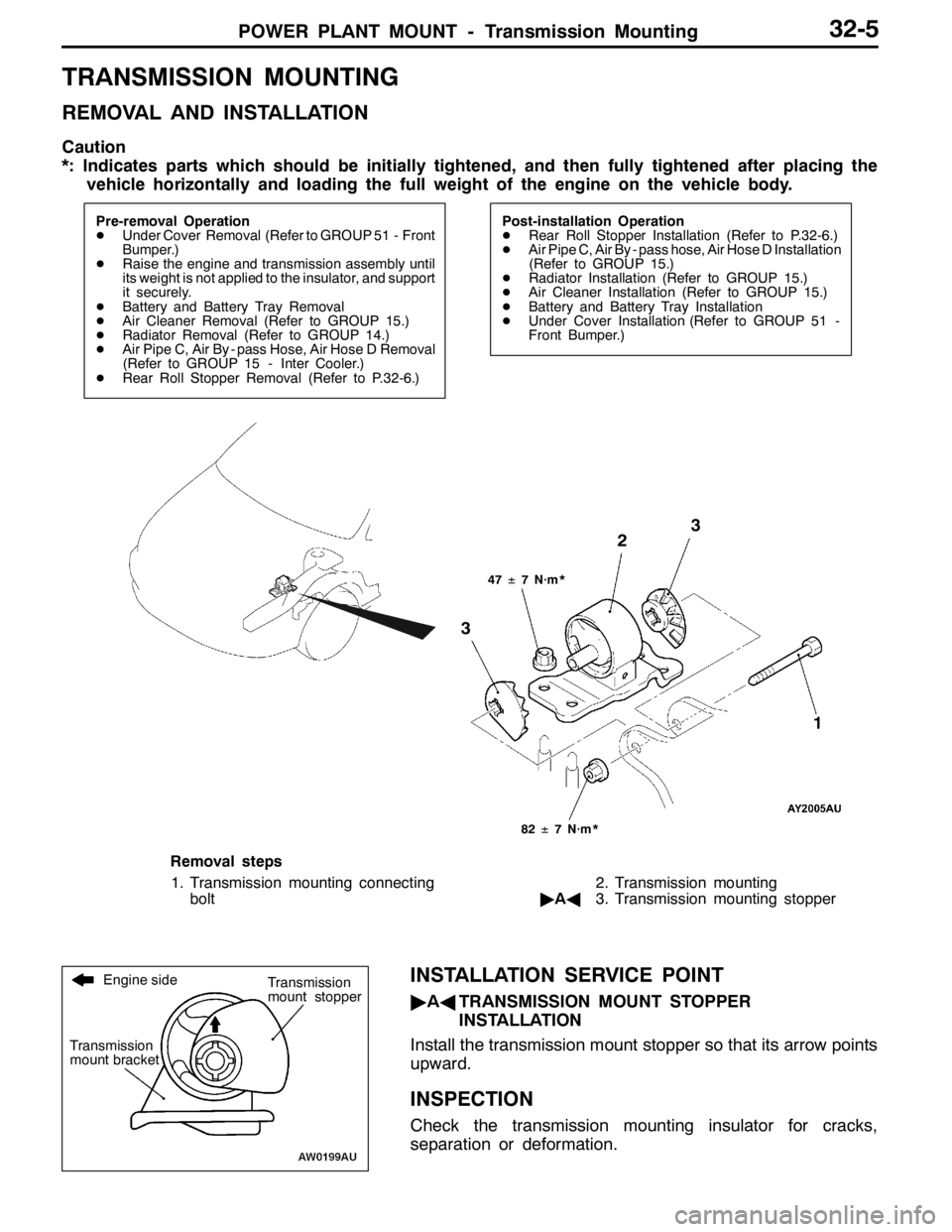
TRANSMISSION MOUNTING
REMOVAL AND INSTALLATION
Caution
*: Indicates parts which should be initially tightened, and then fully tightened after placing the
vehicle horizontally and loading the full weight of the engine on the vehicle body.
Pre-removal Operation
DUnder Cover Removal (Refer to GROUP 51 - Front
Bumper.)
DRaise the engine and transmission assembly until
its weight is not applied to the insulator, and support
it securely.
DBattery and Battery Tray Removal
DAir Cleaner Removal (Refer to GROUP 15.)
DRadiator Removal (Refer to GROUP 14.)
DAir Pipe C, Air By - pass Hose, Air Hose D Removal
(Refer to GROUP 15 - Inter Cooler.)
DRear Roll Stopper Removal (Refer to P.32-6.)Post-installation Operation
DRear Roll Stopper Installation (Refer to P.32-6.)
DAir Pipe C, Air By - pass hose, Air Hose D Installation
(Refer to GROUP 15.)
DRadiator Installation (Refer to GROUP 15.)
DAir Cleaner Installation (Refer to GROUP 15.)
DBattery and Battery Tray Installation
DUnder Cover Installation (Refer to GROUP 51 -
Front Bumper.)
47±7 N·m*
3
3
82±7 N·m*
2
1
Removal steps
1. Transmission mounting connecting
bolt2. Transmission mounting
"AA3. Transmission mounting stopper
INSTALLATION SERVICE POINT
"AATRANSMISSION MOUNT STOPPER
INSTALLATION
Install the transmission mount stopper so that its arrow points
upward.
INSPECTION
Check the transmission mounting insulator for cracks,
separation or deformation.
Engine side
Transmission
mount bracketTransmission
mount stopper
Page 1025 of 1449
POWER PLANT MOUNT - Crossmember32-11
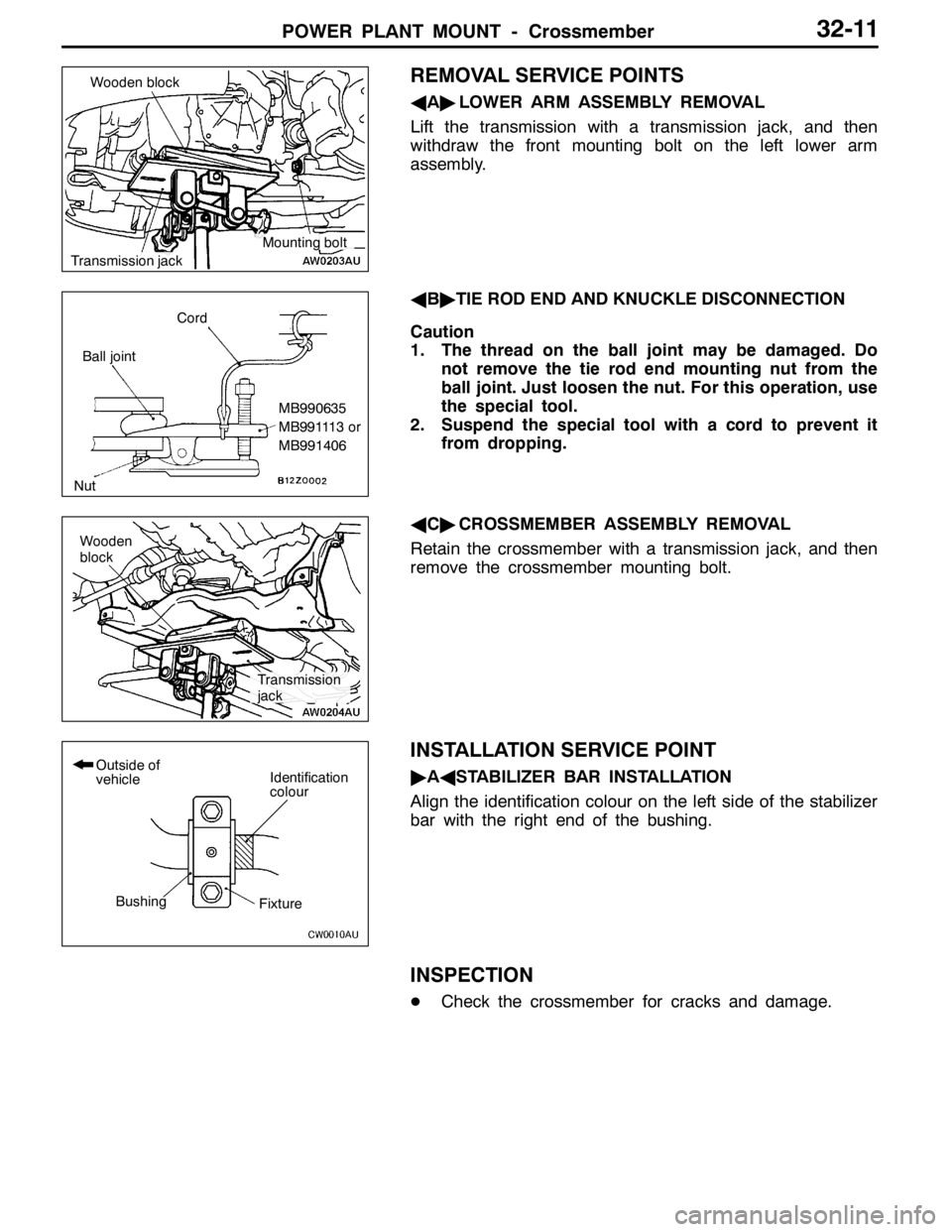
REMOVAL SERVICE POINTS
AA"LOWER ARM ASSEMBLY REMOVAL
Lift the transmission with a transmission jack, and then
withdraw the front mounting bolt on the left lower arm
assembly.
AB"TIE ROD END AND KNUCKLE DISCONNECTION
Caution
1. The thread on the ball joint may be damaged. Do
not remove the tie rod end mounting nut from the
ball joint.Just loosen the nut. For this operation, use
the special tool.
2. Suspend the special tool with a cord to prevent it
from dropping.
AC"CROSSMEMBER ASSEMBLY REMOVAL
Retain the crossmember with a transmission jack, and then
remove the crossmember mounting bolt.
INSTALLATION SERVICE POINT
"AASTABILIZER BAR INSTALLATION
Align the identification colour on the left side of the stabilizer
bar with the right end of the bushing.
INSPECTION
DCheck the crossmember for cracks and damage.
Wooden block
Transmission jack
Mounting bolt
Cord
Ball joint
MB990635
MB991113 or
MB991406
Nut
Wooden
block
Transmission
jack
Identification
colourOutside of
vehicle
BushingFixture
Page 1036 of 1449
FRONT SUSPENSION -Lower Arm Assembly33A-10
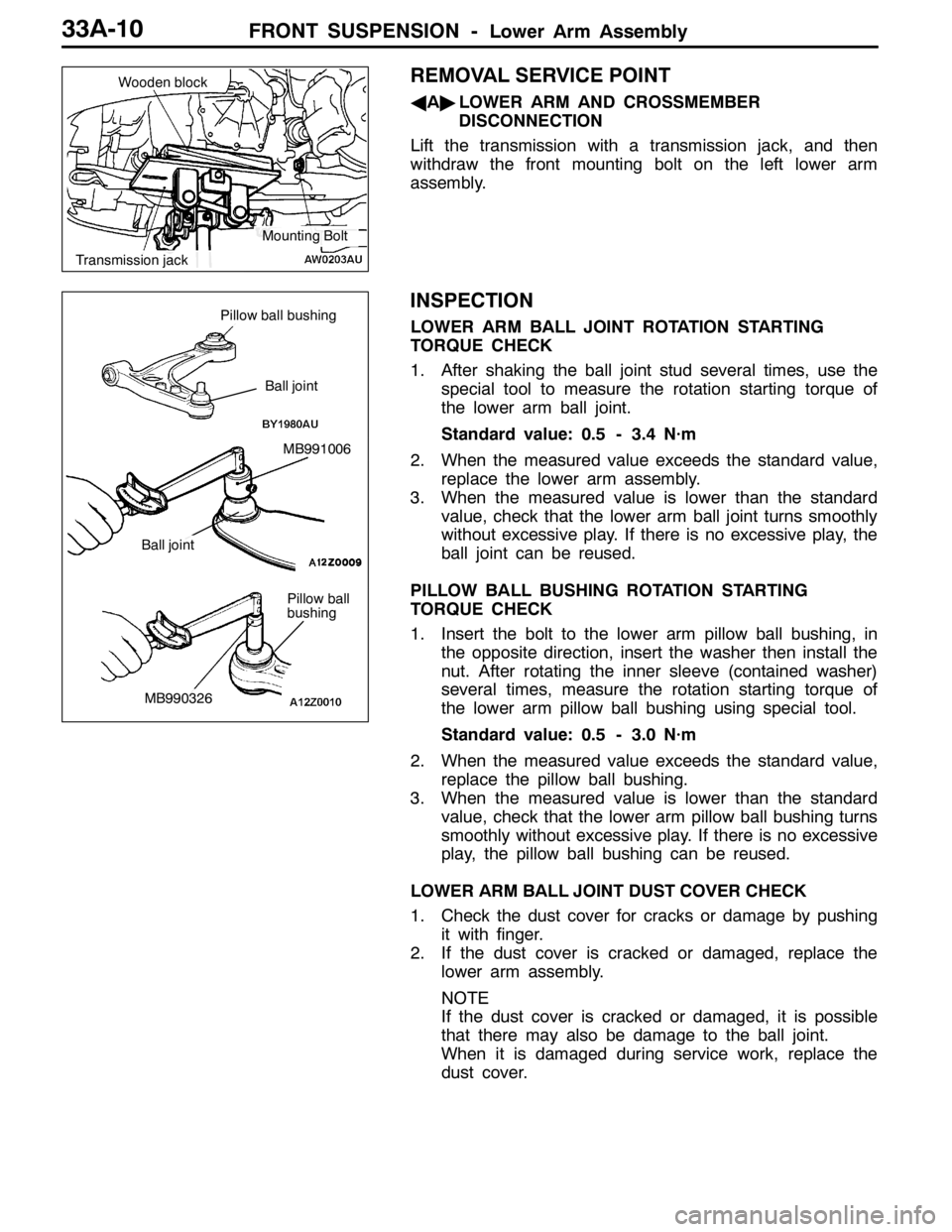
REMOVAL SERVICE POINT
AA"LOWER ARM AND CROSSMEMBER
DISCONNECTION
Lift the transmission with a transmission jack, and then
withdraw the front mounting bolt on the left lower arm
assembly.
INSPECTION
LOWER ARM BALL JOINT ROTATION STARTING
TORQUE CHECK
1. After shaking the ball joint stud several times, use the
special tool to measure the rotation starting torque of
the lower arm ball joint.
Standard value: 0.5 - 3.4 N·m
2. When the measured value exceeds the standard value,
replace the lower arm assembly.
3. When the measured value is lower than the standard
value, check that the lower arm ball joint turns smoothly
without excessive play. If there is no excessive play, the
ball joint can be reused.
PILLOW BALL BUSHING ROTATION STARTING
TORQUE CHECK
1. Insert the bolt to the lower arm pillow ball bushing, in
the opposite direction, insert the washer then install the
nut. After rotating the inner sleeve (contained washer)
several times, measure the rotation starting torque of
the lower arm pillow ball bushing using special tool.
Standard value: 0.5 - 3.0 N·m
2. When the measured value exceeds the standard value,
replace the pillow ball bushing.
3. When the measured value is lower than the standard
value, check that the lower arm pillow ball bushing turns
smoothly without excessive play. If there is no excessive
play, the pillow ball bushing can be reused.
LOWER ARM BALL JOINT DUST COVER CHECK
1. Check the dust cover for cracks or damage by pushing
it with finger.
2. If the dust cover is cracked or damaged, replace the
lower arm assembly.
NOTE
If the dust cover is cracked or damaged, it is possible
that there may also be damage to the ball joint.
When it is damaged during service work, replace the
dust cover.
Wooden block
Transmission jack
Mounting Bolt
Pillow ball
bushing
MB991006
Pillow ball bushing
Ball joint
Ball joint
MB990326
Page 1040 of 1449
FRONT SUSPENSION -Stabilizer Bar33A-14
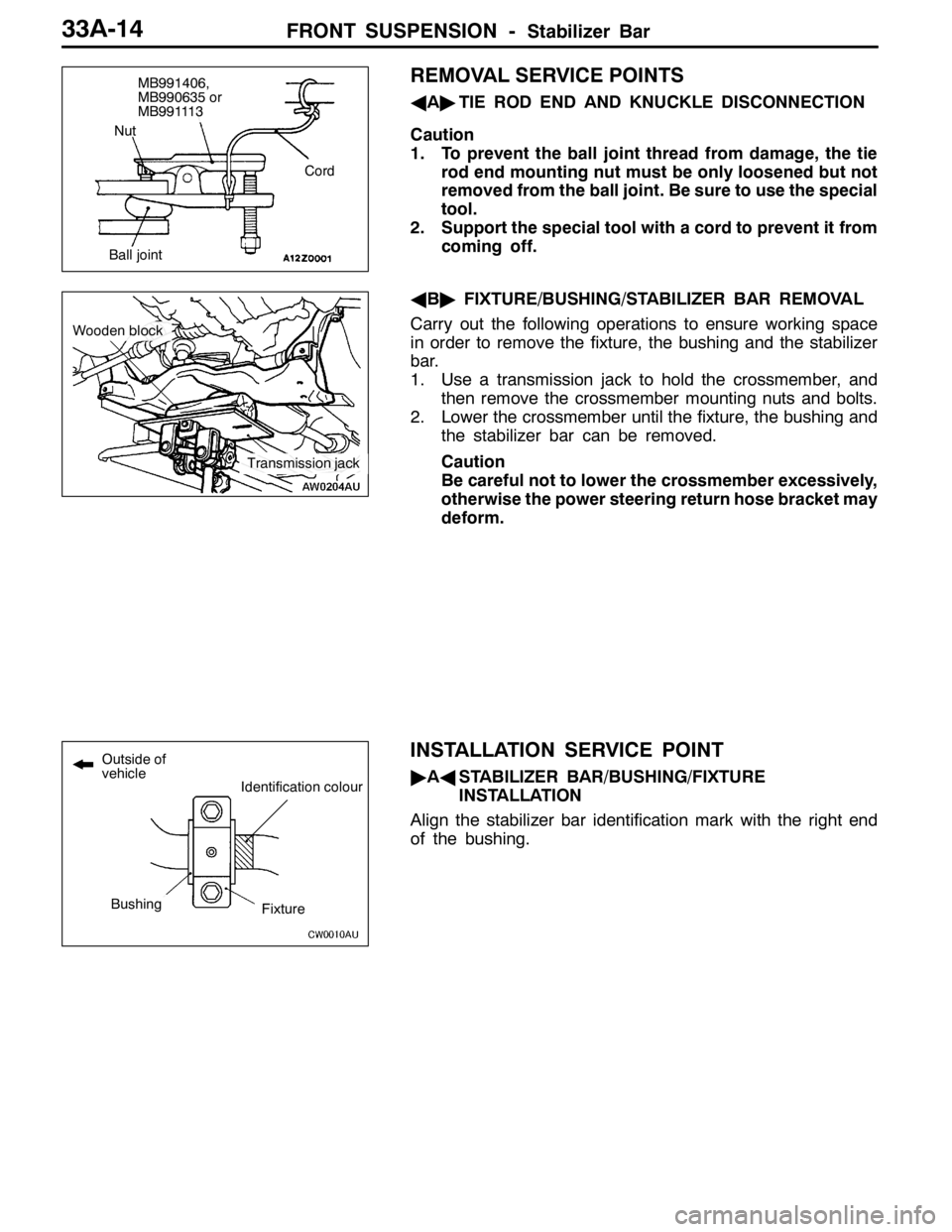
REMOVAL SERVICE POINTS
AA"TIE ROD END AND KNUCKLE DISCONNECTION
Caution
1. To prevent the ball joint thread from damage, the tie
rod end mounting nut must be only loosened but not
removed from the ball joint. Be sure to use the special
tool.
2. Support the special tool with a cord to prevent it from
coming off.
AB"FIXTURE/BUSHING/STABILIZER BAR REMOVAL
Carry out the following operations to ensure working space
in order to remove the fixture, the bushing and the stabilizer
bar.
1. Use a transmission jack to hold the crossmember, and
then remove the crossmember mounting nuts and bolts.
2. Lower the crossmember until the fixture, the bushing and
the stabilizer bar can be removed.
Caution
Be careful not to lower the crossmember excessively,
otherwise the power steering return hose bracket may
deform.
INSTALLATION SERVICE POINT
"AASTABILIZER BAR/BUSHING/FIXTURE
INSTALLATION
Align the stabilizer bar identification mark with the right end
of the bushing.
Cord
Ball jointNut
MB991406,
MB990635 or
MB991113
Transmission jack
Woodenblock
Identification colour
BushingFixture
Outside of
vehicle