weight MITSUBISHI LANCER EVOLUTION 2007 Service User Guide
[x] Cancel search | Manufacturer: MITSUBISHI, Model Year: 2007, Model line: LANCER EVOLUTION, Model: MITSUBISHI LANCER EVOLUTION 2007Pages: 1449, PDF Size: 56.82 MB
Page 939 of 1449
FRONT AXLE -Drive Shaft26-11
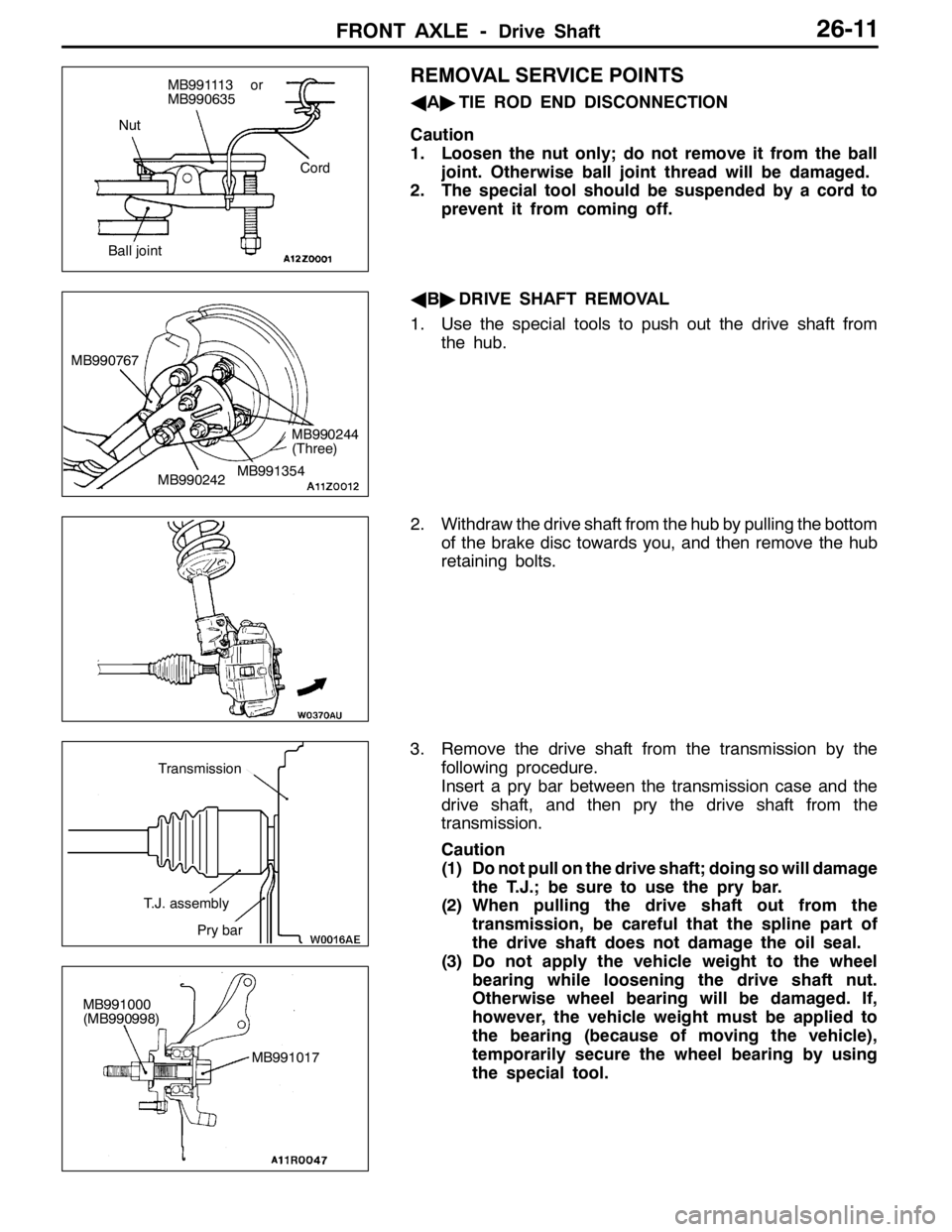
REMOVAL SERVICE POINTS
AA"TIE ROD END DISCONNECTION
Caution
1. Loosen the nut only; do not remove it from the ball
joint. Otherwise ball joint thread will be damaged.
2. The special tool should be suspended by a cord to
prevent it from coming off.
AB"DRIVE SHAFT REMOVAL
1. Use the special tools to push out the drive shaft from
the hub.
2. Withdraw the drive shaft from the hub by pulling the bottom
of the brake disc towards you, and then remove the hub
retaining bolts.
3. Remove the drive shaft from the transmission by the
following procedure.
Insert a pry bar between the transmission case and the
drive shaft, and then pry the drive shaft from the
transmission.
Caution
(1) Do not pull on the drive shaft; doing so will damage
the T.J.; be sure to use the pry bar.
(2) When pulling the drive shaft out from the
transmission, be careful that the spline part of
the drive shaft does not damage the oil seal.
(3) Do not apply the vehicle weight to the wheel
bearing while loosening the drive shaft nut.
Otherwise wheel bearing will be damaged. If,
however, the vehicle weight must be applied to
the bearing (because of moving the vehicle),
temporarily secure the wheel bearing by using
the special tool.
Nut
Cord
Ball joint
MB991113 or
MB990635
MB990242 MB990767MB991354
MB990244
(Three)
T.J. assembly
Pry bar
Transmission
MB991000
(MB990998)
MB991017
Page 972 of 1449
REAR AXLE -Rear Hub Assembly27B-26
REMOVAL SERVICE POINTS
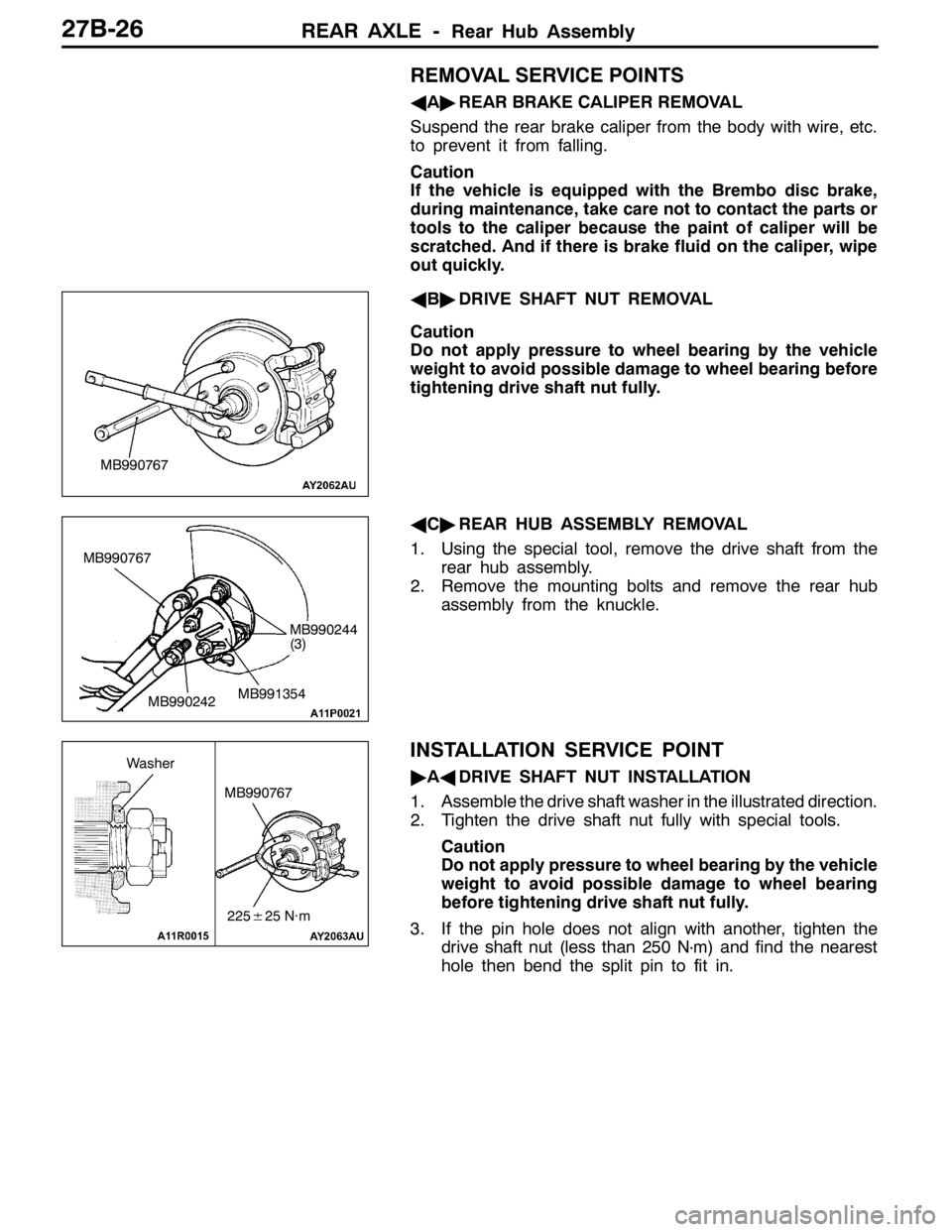
AA"REAR BRAKE CALIPER REMOVAL
Suspend the rear brake caliper from the body with wire, etc.
to prevent it from falling.
Caution
If the vehicle is equipped with the Brembo disc brake,
during maintenance, take care not to contact the parts or
tools to the caliper because the paint of caliper will be
scratched. And if there is brake fluid on the caliper, wipe
out quickly.
AB"DRIVE SHAFT NUT REMOVAL
Caution
Do not apply pressure to wheel bearing by the vehicle
weight to avoid possible damage to wheel bearing before
tightening drive shaft nut fully.
AC"REAR HUB ASSEMBLY REMOVAL
1. Using the special tool, remove the drive shaft from the
rear hub assembly.
2. Remove the mounting bolts and remove the rear hub
assembly from the knuckle.
INSTALLATION SERVICE POINT
"AADRIVE SHAFT NUT INSTALLATION
1. Assemble the drive shaft washer in the illustrated direction.
2. Tighten the drive shaft nut fully with special tools.
Caution
Do not apply pressure to wheel bearing by the vehicle
weight to avoid possible damage to wheel bearing
before tightening drive shaft nut fully.
3. If the pin hole does not align with another, tighten the
drive shaft nut (less than 250 N
·m) and find the nearest
hole then bend the split pin to fit in.
MB990767
MB990767
MB990242MB991354
MB990244
(3)
MB990767
225±25 N·m
Washer
Page 976 of 1449
REAR AXLE -Drive Shaft27B-30
REMOVAL SERVICE POINTS
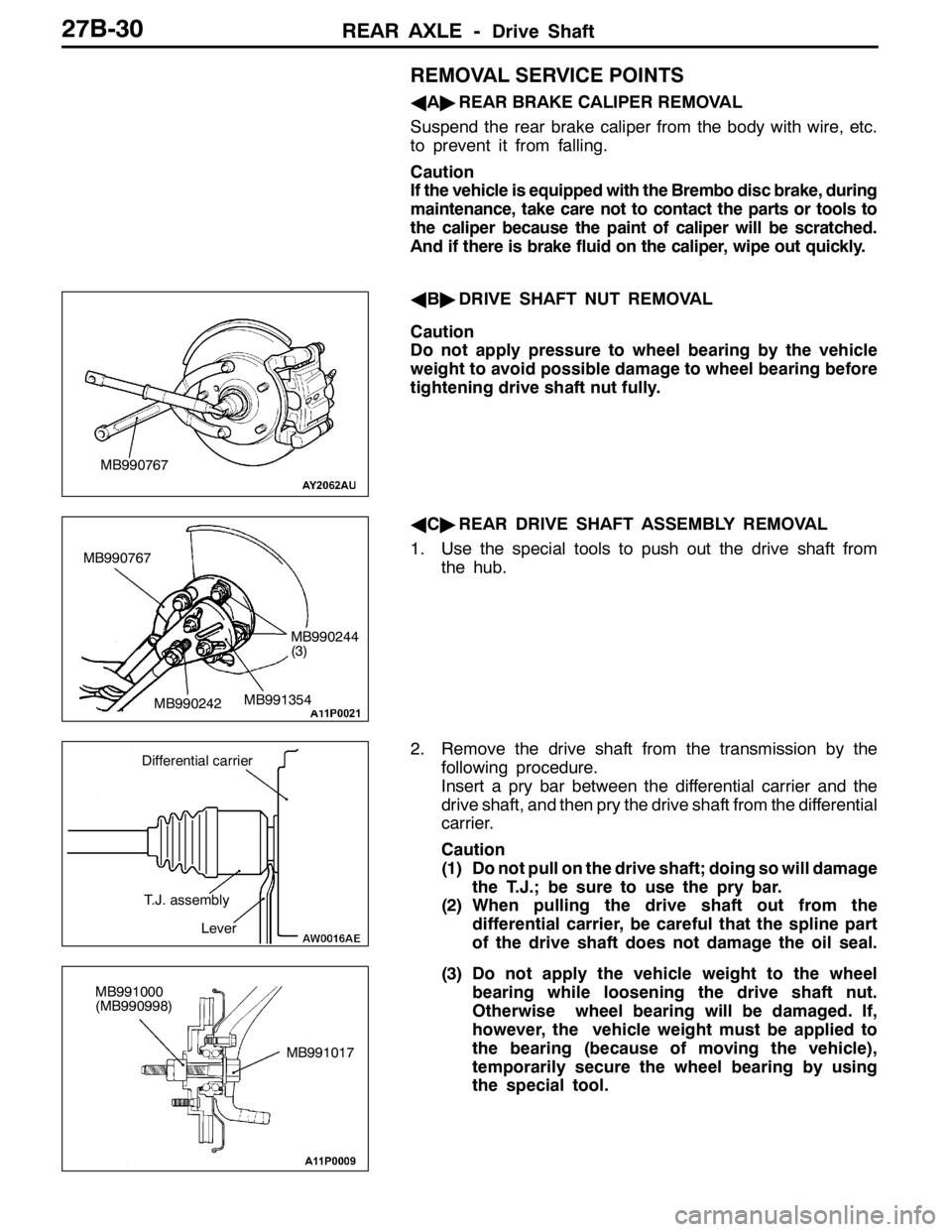
AA"REAR BRAKE CALIPER REMOVAL
Suspend the rear brake caliper from the body with wire, etc.
to prevent it from falling.
Caution
If the vehicle is equipped with the Brembo disc brake, during
maintenance, take care not to contact the parts or tools to
the caliper because the paint of caliper will be scratched.
And if there is brake fluid on the caliper, wipe out quickly.
AB"DRIVE SHAFT NUT REMOVAL
Caution
Do not apply pressure to wheel bearing by the vehicle
weight to avoid possible damage to wheel bearing before
tightening drive shaft nut fully.
AC"REAR DRIVE SHAFT ASSEMBLY REMOVAL
1. Use the special tools to push out the drive shaft from
the hub.
2. Remove the drive shaft from the transmission by the
following procedure.
Insert a pry bar between the differential carrier and the
drive shaft, and then pry the drive shaft from the differential
carrier.
Caution
(1) Do not pull on the drive shaft; doing so will damage
the T.J.; be sure to use the pry bar.
(2) When pulling the drive shaft out from the
differential carrier, be careful that the spline part
of the drive shaft does not damage the oil seal.
(3) Do not apply the vehicle weight to the wheel
bearing while loosening the drive shaft nut.
Otherwise wheel bearing will be damaged. If,
however, the vehicle weight must be applied to
the bearing (because of moving the vehicle),
temporarily secure the wheel bearing by using
the special tool.
MB990767
MB990767
MB990242MB991354
MB990244
(3)
Differential carrier
T.J. assembly
Lever
MB991017 MB991000
(MB990998)
Page 977 of 1449
REAR AXLE -Drive Shaft27B-31
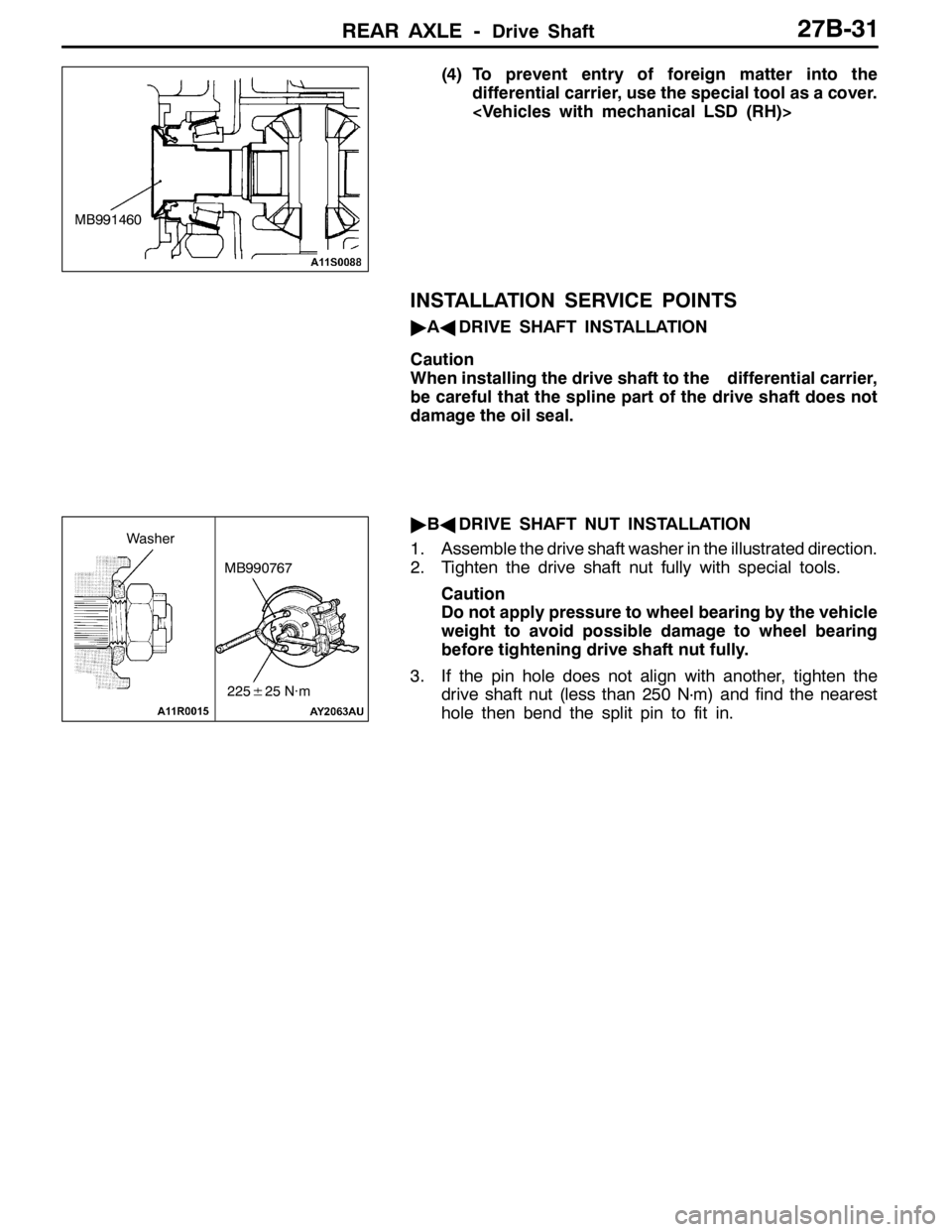
(4) To prevent entry of foreign matter into the
differential carrier, use the special tool as a cover.
INSTALLATION SERVICE POINTS
"AADRIVE SHAFT INSTALLATION
Caution
When installing the drive shaft to the differential carrier,
be careful that the spline part of the drive shaft does not
damage the oil seal.
"BADRIVE SHAFT NUT INSTALLATION
1. Assemble the drive shaft washer in the illustrated direction.
2. Tighten the drive shaft nut fully with special tools.
Caution
Do not apply pressure to wheel bearing by the vehicle
weight to avoid possible damage to wheel bearing
before tightening drive shaft nut fully.
3. If the pin hole does not align with another, tighten the
drive shaft nut (less than 250 N
·m) and find the nearest
hole then bend the split pin to fit in.
MB991460
MB990767
225±25 N·m
Washer
Page 1012 of 1449

WHEEL AND TYRE -Troubleshooting31-4
WHEEL BALANCE ACCURACY
PURPOSE
This section contains tips and procedures for
achieving accurate wheel balance. Steering wheel
vibration and /or body shake can result if any of
these procedures are not carefully observed.
1. Wheels and tires must be properly mounted
on a balancer in order to achieve correct
balance. Centering the wheel on the shaft of
the balancer is essential for proper mounting.
2. Off-the-car wheel balancers must be calibrated
periodically to ensure good balancing results.
An inaccurately calibrated balancer could cause
unnecessary replacement of tires, shocks,
suspension components, or steering
components.Check your balancer’s calibration approximately
every 100 balances. Your wheel balancer’s
instruction manual should include calibration
procedures. If the calibration procedures
specifically for your balancer are missing, use the
generic steps in this section for zero calibration,
static balance, and dynamic balance checks. The
wheel balancer calibration checks are also
described in the flowchart. (Refer to P.31-5.)
PROCEDURE
Balancing Tips
1. Confirm that the balancer’s cone and the wheel
mounting cone are undamaged and free of
dirt and rust.
2. On this vehicle the wheel’s center hole on the
hub side has a chamfered edge. Use a
back-mounting cone on your wheel balancer
to center the wheel on the balancer shaft.3. Install a wheel mounting cone. The appropriate
size cone for this vehicle is 67.0 mm.
4. Before balancing the wheel, remove any wheel
weights from both sides. Also check both sides
for any damage.
5. When installing wheel weights, hammer them
at a straight (not diagonal) angle.
Hub/shaft assembly
Spring plateClamping cup
Wheel mounting
cone
Standard passenger
car wheelWing nut
Confirming Proper Balance
1. After balancing the wheel, loosen the wing nut
and turn the wheel 180°against the balancer’s
hub. Then retighten the wing nut and check
the balance again. Repeat wheel balance if
necessary.2. Turn the wheel again 180°against the
balancer’s hub. If the wheel becomes
out-of-balance each time it is turned against
the balancer’s hub, the wheel balancer may
require calibration.
Wheel Balancer Calibration Checks
1. Mount an undamaged original-equipment alloy
rim and tire assembly (wheel) onto your
off-the-car wheel balancer. Balance the wheel.2.<
Loosen the balancer wing nut, rotate the wheel
a half turn (180°), and retighten the nut.
Recheck the balance.
Page 1013 of 1449
WHEEL AND TYRE -Troubleshooting31-5
DIf the imbalance is 5 g or less, the zero
calibration is OK. Rebalance the wheel, then
go to Step 4 to check static balance.
DIf the imbalance is more than 5 g, go to Step
3.
3. Loosen the balancer wing nut, rotate the wheel
1/4 turn (90°), and retighten the nut. Recheck
the wheel balance.
DIf the imbalance is 5 g or less, the wheel may
not be centered on the balancer, or the
balancing cones, the cup, and/or wing nut are
damaged, dirty, or inappropriate for the wheel.
You may need to refer to the balancer
manufacturer’s instructions to verify the correct
attachments. after making the necessary
corrections, recheck the wheel balance. If OK,
then go to Step 4.
DIf the imbalance is more than 5 g, the balancer
requires calibration. Contact the balancer
manufacturer for calibration by their repair
representative.
4.<
Attach a 5-g weight to the outer rim. Recheck
the balancer. The balancer should detect 5±2
g of imbalance 170°to 190°away from both the
inner and outer 5-g weights.DIf the imbalance is within specification, the static
balance calibration is correct. Go to Step 5
to check the dynamic balance.
DIf the imbalance is out of specification, the
balancer requires calibration. Contact the
balancer manufacturer for calibration by their
repair representative.
5.<
Attach a 5-g weight to the inner rim at 180°
opposite the 5-g weight that was added in step
4. Recheck the balance. The balancer should
detect 5±2g of imbalance 170°to 190°away
from both the inner and outer 5-g weights.
DIf the imbalance is within specification, the
dynamic balance calibration is correct. The
balancer calibration checks are complete.
DIf the imbalance is out of specification, the
balancer requires calibration. Contact the
balancer manufacturer for calibration by their
repair representative.
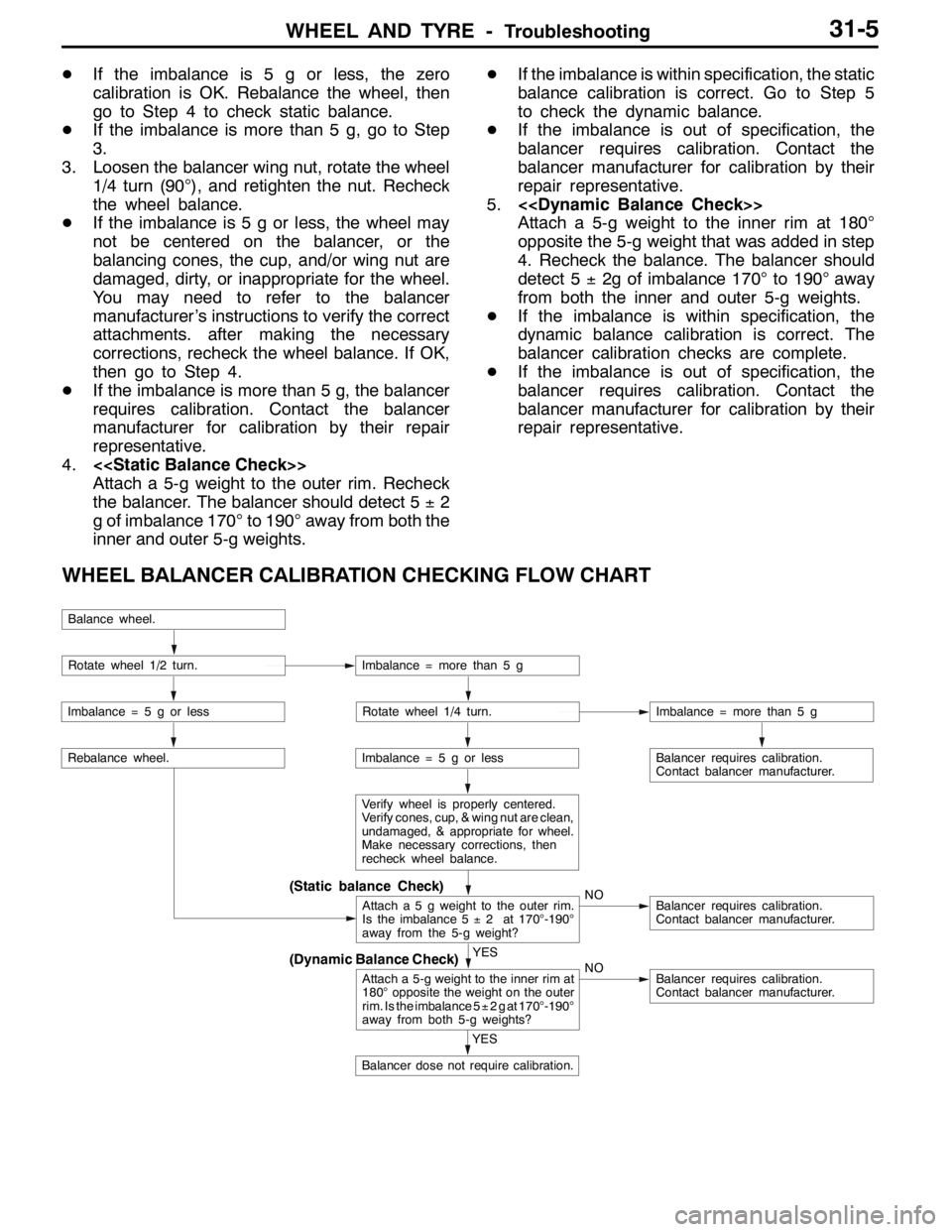
WHEEL BALANCER CALIBRATION CHECKING FLOW CHART
(Dynamic Balance Check)
(Static balance Check)
Balance wheel.
Rotate wheel 1/2 turn.Imbalance = more than 5 g
Imbalance = 5 g or lessRotate wheel 1/4 turn.Imbalance = more than 5 g
Imbalance = 5 g or less
Verify wheel is properly centered.
Verify cones, cup, & wing nut are clean,
undamaged, & appropriate for wheel.
Make necessary corrections, then
recheck wheel balance.
Attach a 5 g weight to the outer rim.
Is the imbalance 5±2 at 170°-190°
away from the 5-g weight?NOBalancer requires calibration.
Contact balancer manufacturer.
Balancer requires calibration.
Contact balancer manufacturer.
YES
Attach a 5-g weight to the inner rim at
180°opposite the weight on the outer
rim. Is the imbalance 5±2gat170°-190°
away from both 5-g weights?NOBalancer requires calibration.
Contact balancer manufacturer.
Rebalance wheel.
YES
Balancer dose not require calibration.
Page 1018 of 1449
POWER PLANT MOUNT - Engine Mounting32-4
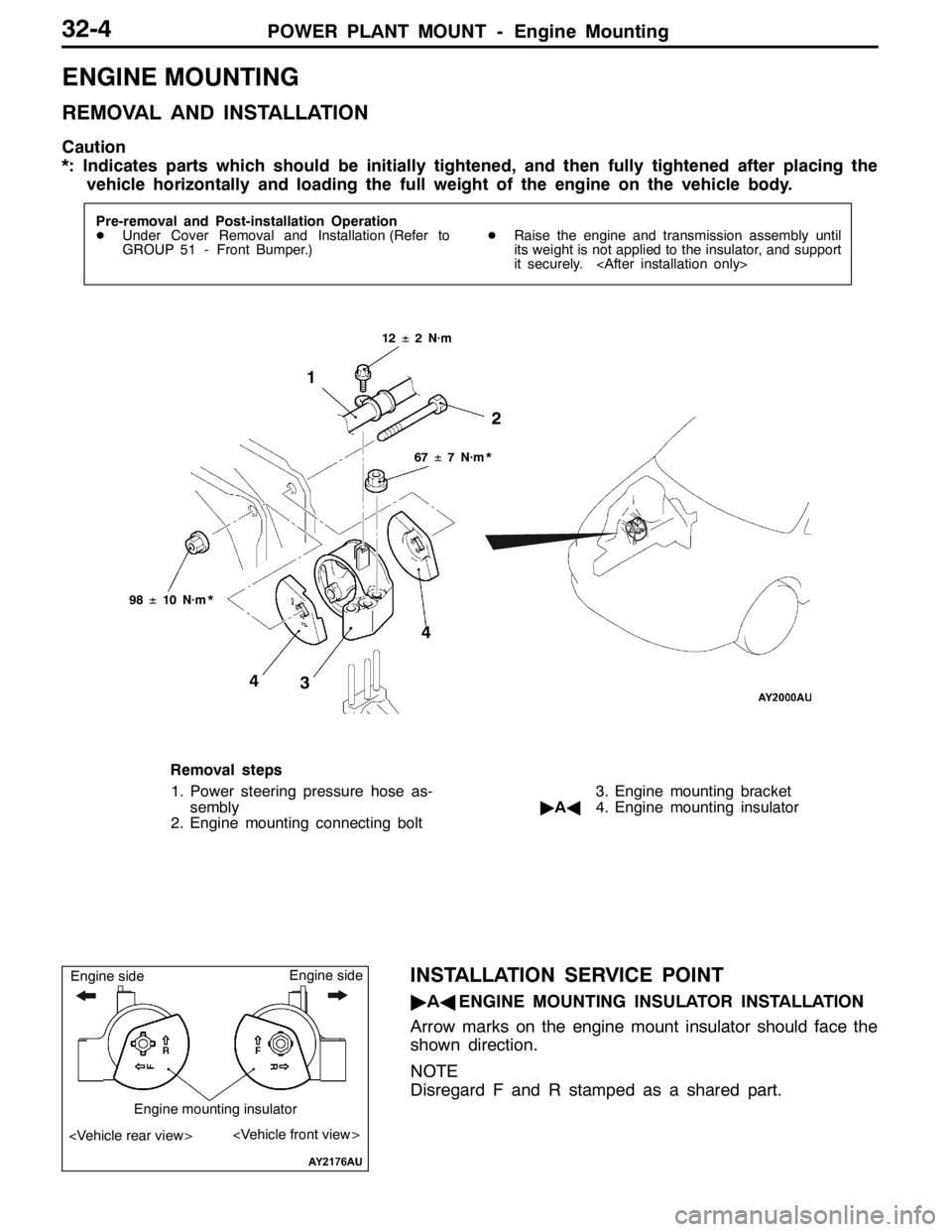
ENGINE MOUNTING
REMOVAL AND INSTALLATION
Caution
*: Indicates parts which should be initially tightened, and then fully tightened after placing the
vehicle horizontally and loading the full weight of the engine on the vehicle body.
Pre-removal and Post-installation Operation
DUnder Cover Removal and Installation (Refer to
GROUP 51 - Front Bumper.)DRaise the engine and transmission assembly until
its weight is not applied to the insulator, and support
it securely.
98±10 N·m*
67±7 N·m*
1
2
12±2 N·m
3 44
Removal steps
1. Power steering pressure hose as-
sembly
2. Engine mounting connecting bolt3. Engine mounting bracket
"AA4. Engine mounting insulator
INSTALLATION SERVICE POINT
"AAENGINE MOUNTING INSULATOR INSTALLATION
Arrow marks on the engine mount insulator should face the
shown direction.
NOTE
Disregard F and R stamped as a shared part.
Engine sideEngine side
Engine mounting insulator
Page 1019 of 1449
POWER PLANT MOUNT - Transmission Mounting32-5
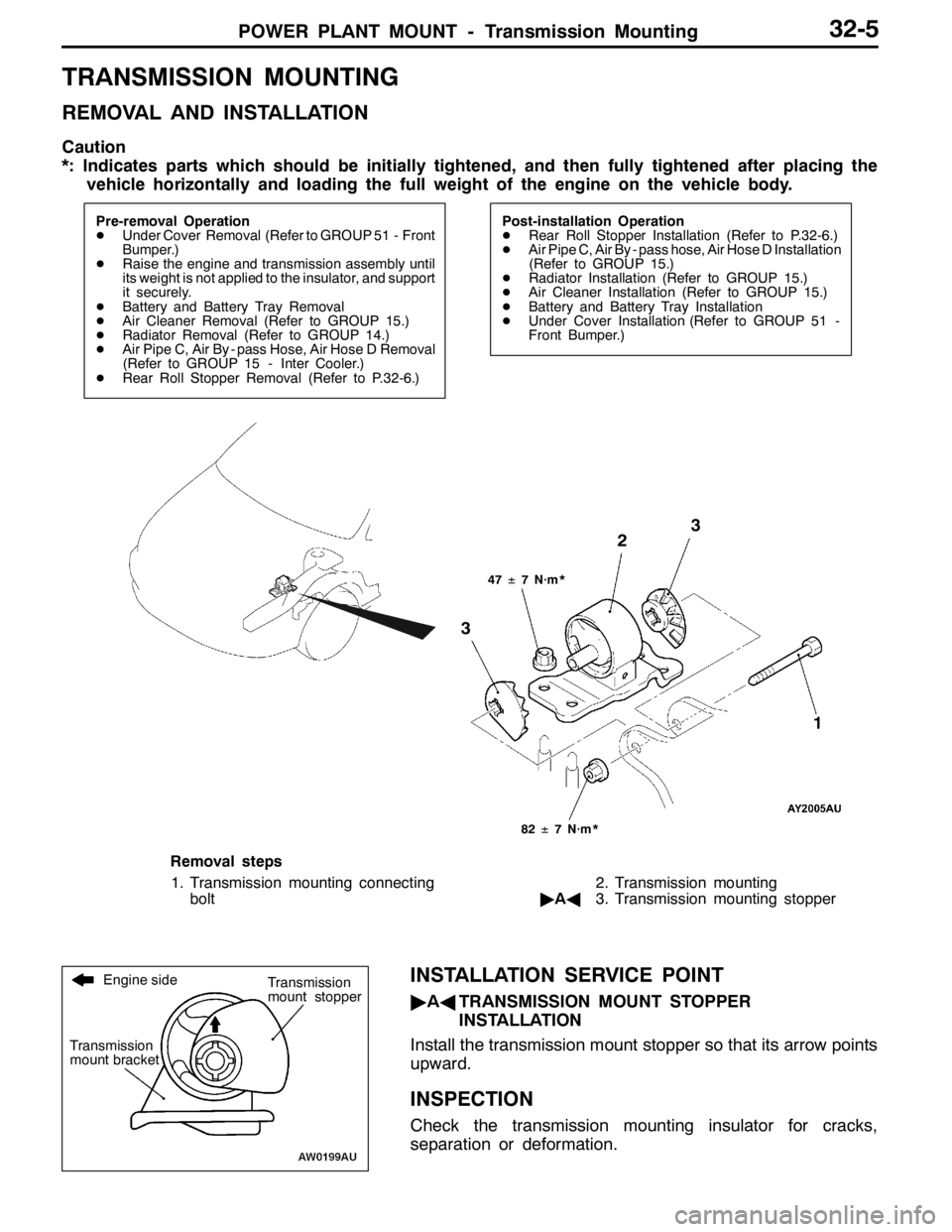
TRANSMISSION MOUNTING
REMOVAL AND INSTALLATION
Caution
*: Indicates parts which should be initially tightened, and then fully tightened after placing the
vehicle horizontally and loading the full weight of the engine on the vehicle body.
Pre-removal Operation
DUnder Cover Removal (Refer to GROUP 51 - Front
Bumper.)
DRaise the engine and transmission assembly until
its weight is not applied to the insulator, and support
it securely.
DBattery and Battery Tray Removal
DAir Cleaner Removal (Refer to GROUP 15.)
DRadiator Removal (Refer to GROUP 14.)
DAir Pipe C, Air By - pass Hose, Air Hose D Removal
(Refer to GROUP 15 - Inter Cooler.)
DRear Roll Stopper Removal (Refer to P.32-6.)Post-installation Operation
DRear Roll Stopper Installation (Refer to P.32-6.)
DAir Pipe C, Air By - pass hose, Air Hose D Installation
(Refer to GROUP 15.)
DRadiator Installation (Refer to GROUP 15.)
DAir Cleaner Installation (Refer to GROUP 15.)
DBattery and Battery Tray Installation
DUnder Cover Installation (Refer to GROUP 51 -
Front Bumper.)
47±7 N·m*
3
3
82±7 N·m*
2
1
Removal steps
1. Transmission mounting connecting
bolt2. Transmission mounting
"AA3. Transmission mounting stopper
INSTALLATION SERVICE POINT
"AATRANSMISSION MOUNT STOPPER
INSTALLATION
Install the transmission mount stopper so that its arrow points
upward.
INSPECTION
Check the transmission mounting insulator for cracks,
separation or deformation.
Engine side
Transmission
mount bracketTransmission
mount stopper
Page 1020 of 1449
POWER PLANT MOUNT - Engine Roll Stopper, Centermember32-6
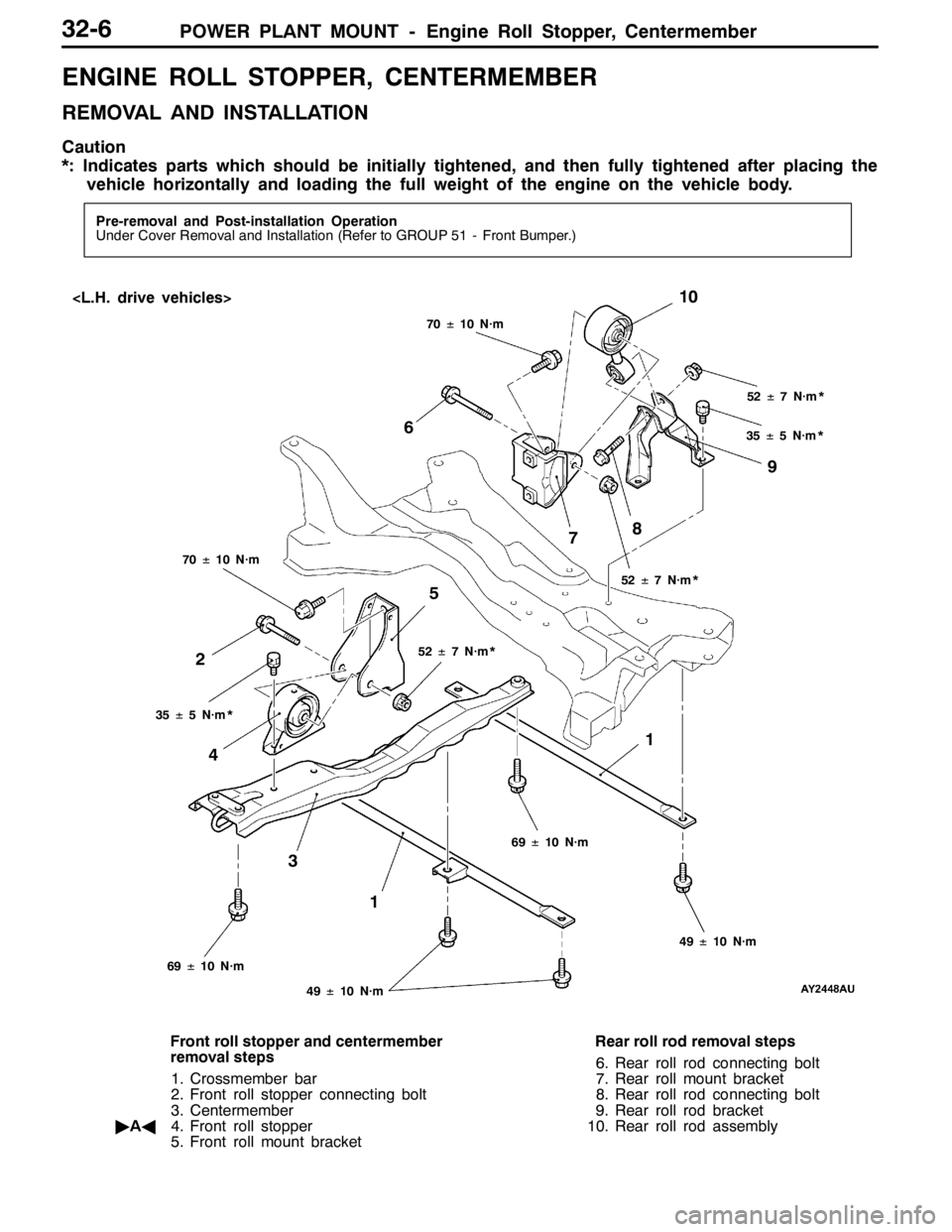
ENGINE ROLL STOPPER, CENTERMEMBER
REMOVAL AND INSTALLATION
Caution
*: Indicates parts which should be initially tightened, and then fully tightened after placing the
vehicle horizontally and loading the full weight of the engine on the vehicle body.
Pre-removal and Post-installation Operation
Under Cover Removal and Installation (Refer to GROUP 51 - Front Bumper.)
52±7 N·m*
69±10 N·m
52±7 N·m*
52±7 N·m*
70±10 N·m
1 2
3 45 6
1 78
70±10 N·m
49±10 N·m
69±10 N·m
49±10 N·m
9
35±5 N·m*
35±5 N·m*
Front roll stopper and centermember
removal steps
1. Crossmember bar
2. Front roll stopper connecting bolt
3. Centermember
"AA4. Front roll stopper
5. Front roll mount bracketRear roll rod removal steps
6. Rear roll rod connecting bolt
7. Rear roll mount bracket
8. Rear roll rod connecting bolt
9. Rear roll rod bracket
10. Rear roll rod assembly
Page 1022 of 1449

POWER PLANT MOUNT - Crossmember32-8
CROSSMEMBER
REMOVAL AND INSTALLATION
Caution
1. Before removing the steering wheel and air bag module assembly, always refer to GROUP
52B - Service Precautions, Air bag Module and Clock Spring. Also, set the front wheels so
that they are facing straight forward, and remove the ignition key. If you fail to do this, the
SRS clock spring will be damaged, causing the SRS air bag to be inoperative and serious
injury.
2. *
1: Indicates parts which should be initially tightened, and then fully tightened after placing
the vehicle horizontally and loading the full weight of the engine on the vehicle body.
3. *
2: Indicates parts which should be temporarily tightened, and then fully tightened with the
vehicle on the ground in the unladen condition.
Caution
If the vehicle is equipped the Brembo disc brake, during maintenance, take care not to contact
the parts or tools to the caliper because the paint of caliper will be scratched.
Pre-removal Operations
DUnder Cover Removal
(Refer to GROUP 51 - Front Bumper.)
DCentermember, Crossmember Bar Removal
(Refer to P.32-6.)
DFront Exhaust Pipe Removal
(Refer to GROUP 15.)
DSteering Wheel Air Bag Module Assembly Removal
(Refer to GROUP 37A.)
DPower Steering Fluid Draining
(Refer to GROUP 37A - On-vehicle Service.)Post-installation Operations
DCentermember, Crossmember Bar Installation
(Refer to P.32-6.)
DFront Exhaust Pipe Installation
(Refer to GROUP 15.)
DSteering Wheel Air Bag Module Assembly
Installation (Refer to GROUP 37A.)
DPower Steering Fluid Supplying
(Refer to GROUP 37A - On-vehicle Service.)
DPower Steering Fluid Line Bleeding
(Refer to GROUP 37A - On-vehicle Service.)
DPress the dust cover with a finger to check whether
the dust cover is cracked or damaged.
DChecking Steering Wheel Position with Wheels
Straight Ahead
DFront Wheel Alignment Check and Adjustment
(Refer to GROUP 37A - On-vehicle Service.)
DUnder Cover Installation
(Refer to GROUP 51 - Front Bumper.)