ECU MITSUBISHI LANCER EVOLUTION 2007 Service Repair Manual
[x] Cancel search | Manufacturer: MITSUBISHI, Model Year: 2007, Model line: LANCER EVOLUTION, Model: MITSUBISHI LANCER EVOLUTION 2007Pages: 1449, PDF Size: 56.82 MB
Page 957 of 1449
REAR AXLE-Troubleshooting
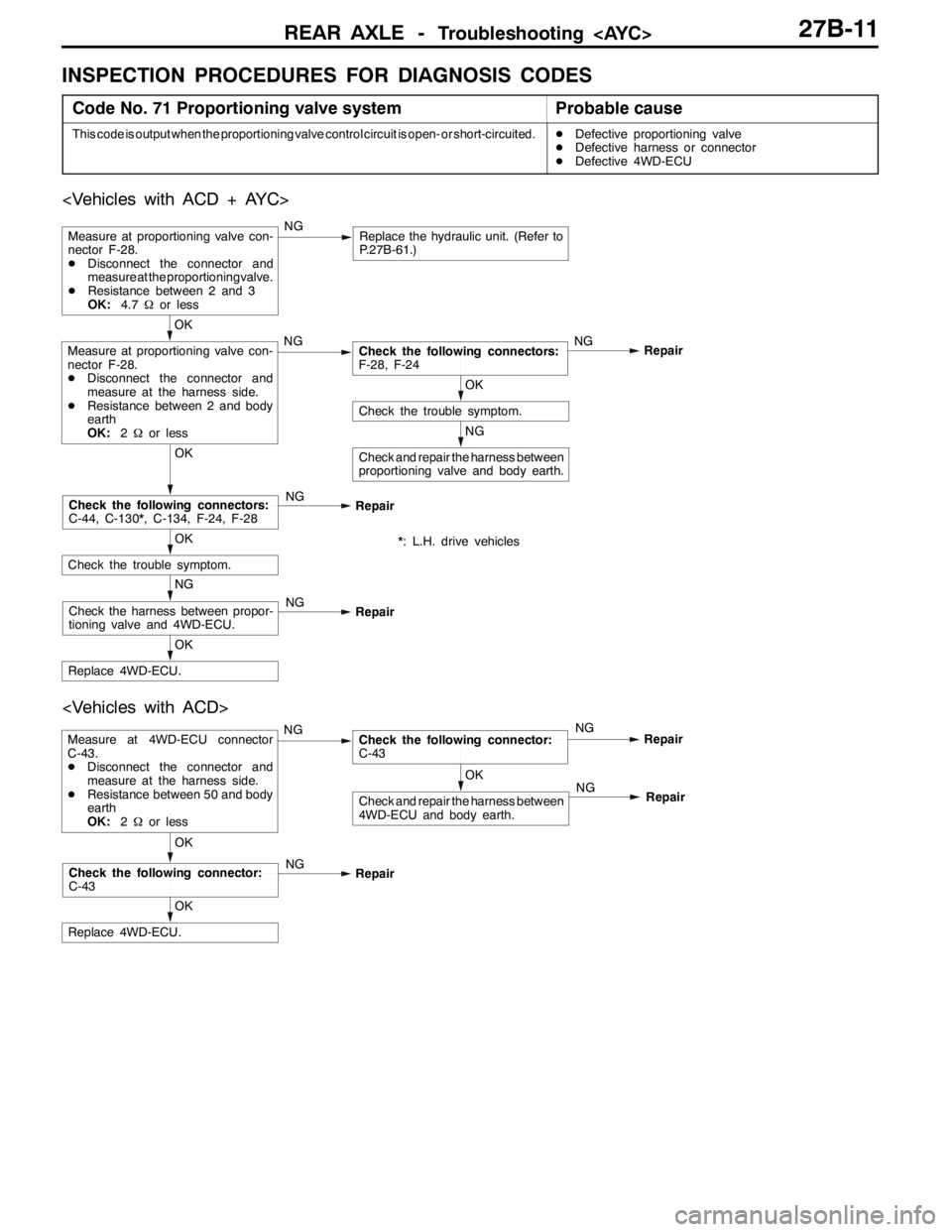
INSPECTION PROCEDURES FOR DIAGNOSIS CODES
Code No. 71 Proportioning valve systemProbable cause
This code is output when the proportioning valve control circuit is open- or short-circuited.DDefective proportioning valve
DDefective harness or connector
DDefective 4WD-ECU
NG
Check and repair the harness between
proportioning valve and body earth.
OK
Check the trouble symptom.
OK
Measure at proportioning valve con-
nector F-28.
DDisconnect the connector and
measure at the harness side.
DResistance between 2 and body
earth
OK:2Ωor lessNGCheck the following connectors:
F-28, F-24NG
Repair
Measure at proportioning valve con-
nector F-28.
DDisconnect the connector and
measure at the proportioning valve.
DResistance between 2 and 3
OK:4.7Ωor lessNGReplace the hydraulic unit. (Refer to
P.27B-61.)
OK
Replace 4WD-ECU.
NG
Check the harness between propor-
tioning valve and 4WD-ECU.NG
Repair
OK
Check the trouble symptom.
OK
Check the following connectors:
C-44, C-130*, C-134, F-24, F-28NG
Repair
*: L.H. drive vehicles
OK
Replace 4WD-ECU.
OK
Check the following connector:
C-43NG
Repair
OK
Check and repair the harness between
4WD-ECU and body earth.
Measure at 4WD-ECU connector
C-43.
DDisconnect the connector and
measure at the harness side.
DResistance between 50 and body
earth
OK:2Ωor lessNGCheck the following connector:
C-43NG
Repair
NG
Repair
Page 958 of 1449
REAR AXLE -Troubleshooting
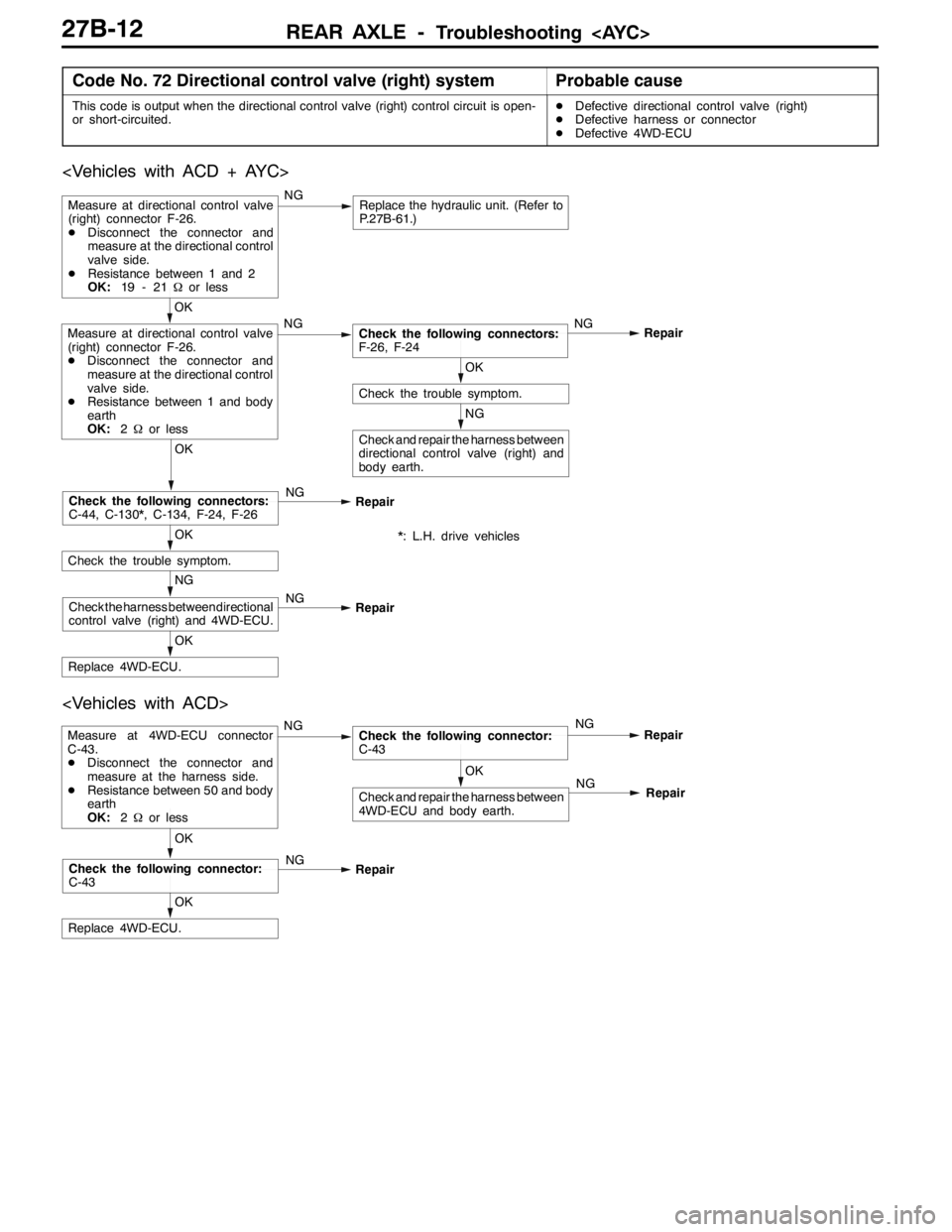
Code No. 72 Directional control valve (right) systemProbable cause
This code is output when the directional control valve (right) control circuit is open-
or short-circuited.DDefective directional control valve (right)
DDefective harness or connector
DDefective 4WD-ECU
NG
Check and repair the harness between
directional control valve (right) and
body earth.
OK
Check the trouble symptom.
OK
Replace 4WD-ECU.
NG
Check the harness between directional
control valve (right) and 4WD-ECU.NG
Repair
OK
Check the trouble symptom.
OK
Check the following connectors:
C-44, C-130*, C-134, F-24, F-26NG
Repair
OK
Measure at directional control valve
(right) connector F-26.
DDisconnect the connector and
measure at the directional control
valve side.
DResistance between 1 and body
earth
OK:2Ωor lessNGCheck the following connectors:
F-26, F-24NG
Repair
Measure at directional control valve
(right) connector F-26.
DDisconnect the connector and
measure at the directional control
valve side.
DResistance between 1 and 2
OK:19 - 21Ωor lessNGReplace the hydraulic unit. (Refer to
P.27B-61.)
*: L.H. drive vehicles
OK
Check and repair the harness between
4WD-ECU and body earth.
Measure at 4WD-ECU connector
C-43.
DDisconnect the connector and
measure at the harness side.
DResistance between 50 and body
earth
OK:2Ωor lessNGCheck the following connector:
C-43NG
Repair
OK
Replace 4WD-ECU.
OK
Check the following connector:
C-43NG
RepairNG
Repair
Page 959 of 1449
REAR AXLE -Troubleshooting
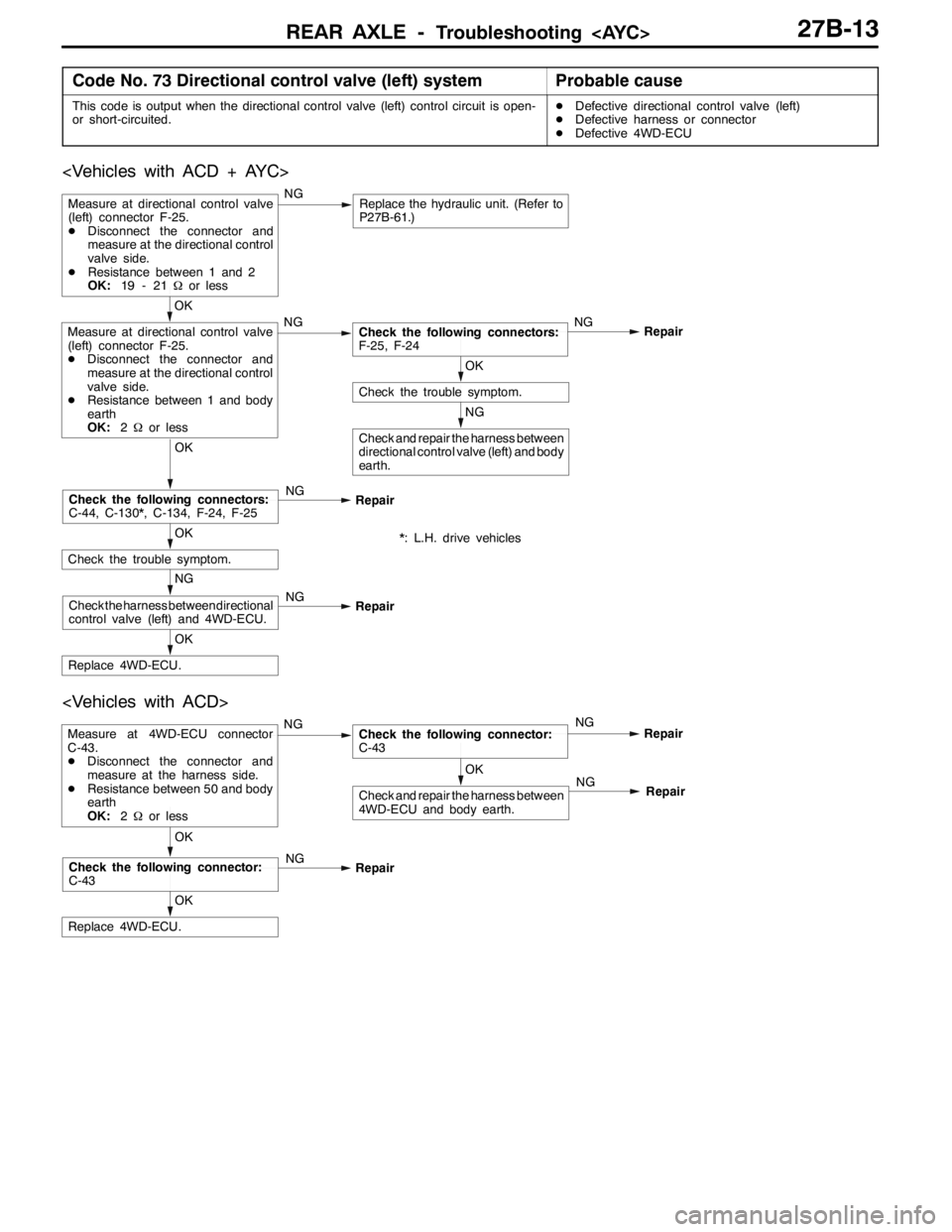
Code No. 73 Directional control valve (left) systemProbable cause
This code is output when the directional control valve (left) control circuit is open-
or short-circuited.DDefective directional control valve (left)
DDefective harness or connector
DDefective 4WD-ECU
NG
Check and repair the harness between
directional control valve (left) and body
earth.
OK
Check the trouble symptom.
OK
Replace 4WD-ECU.
NG
Check the harness between directional
control valve (left) and 4WD-ECU.NG
Repair
OK
Check the trouble symptom.
OK
Check the following connectors:
C-44, C-130*, C-134, F-24, F-25NG
Repair
OK
Measure at directional control valve
(left) connector F-25.
DDisconnect the connector and
measure at the directional control
valve side.
DResistance between 1 and body
earth
OK:2Ωor lessNGCheck the following connectors:
F-25, F-24NG
Repair
Measure at directional control valve
(left) connector F-25.
DDisconnect the connector and
measure at the directional control
valve side.
DResistance between 1 and 2
OK:19 - 21Ωor lessNGReplace the hydraulic unit. (Refer to
P27B-61.)
*: L.H. drive vehicles
OK
Check and repair the harness between
4WD-ECU and body earth.
Measure at 4WD-ECU connector
C-43.
DDisconnect the connector and
measure at the harness side.
DResistance between 50 and body
earth
OK:2Ωor lessNGCheck the following connector:
C-43NG
Repair
OK
Replace 4WD-ECU.
OK
Check the following connector:
C-43NG
RepairNG
Repair
Page 960 of 1449
REAR AXLE -Troubleshooting
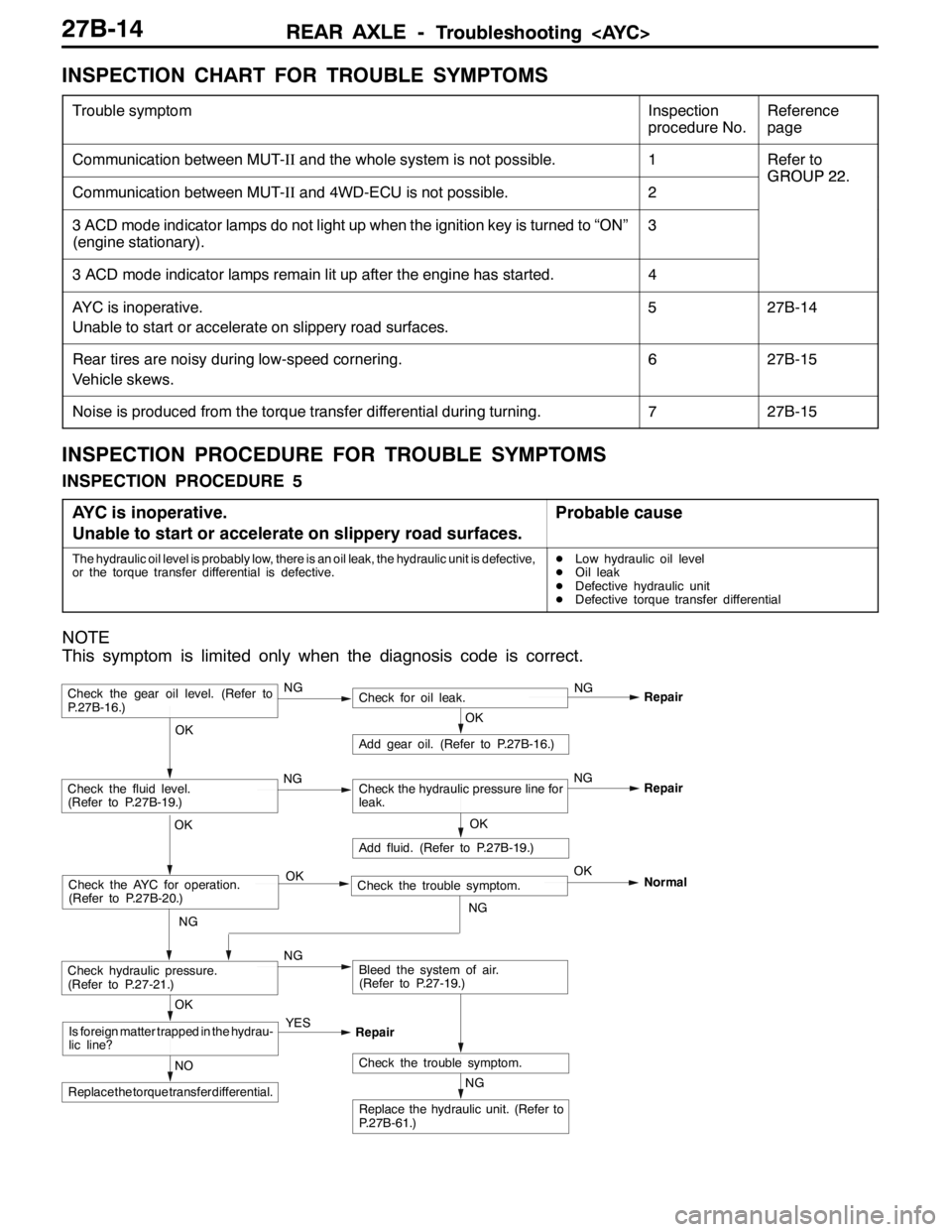
INSPECTION CHART FOR TROUBLE SYMPTOMS
Trouble symptomInspection
procedure No.Reference
page
Communication between MUT-IIand the whole system is not possible.1Refer to
GROUP22
Communication between MUT-IIand 4WD-ECU is not possible.2
GROUP22.
3 ACD mode indicator lamps do not light up when the ignition key is turned to “ON”
(engine stationary).3
3 ACD mode indicator lamps remain lit up after the engine has started.4
AYC is inoperative.
Unable to start or accelerate on slippery road surfaces.527B-14
Rear tires are noisy during low-speed cornering.
Vehicle skews.627B-15
Noise is produced from the torque transfer differential during turning.727B-15
INSPECTION PROCEDURE FOR TROUBLE SYMPTOMS
INSPECTION PROCEDURE 5
AYC is inoperative.
Unable to start or accelerate on slippery road surfaces.
Probable cause
The hydraulic oil level is probably low, there is an oil leak, the hydraulic unit is defective,
or the torque transfer differential is defective.DLow hydraulic oil level
DOil leak
DDefective hydraulic unit
DDefective torque transfer differential
NOTE
This symptom is limited only when the diagnosis code is correct.
NG
Replace the hydraulic unit. (Refer to
P.27B-61.)
NG
Add fluid. (Refer to P.27B-19.)
OKRepair
Check the trouble symptom.NO
Replace the torque transfer differential.
OK
Is foreign matter trapped in the hydrau-
lic line?YES
Repair
OK
Check the fluid level.
(Refer to P.27B-19.)Check the hydraulic pressure line for
leak.
OK
Add gear oil. (Refer to P.27B-16.)
OK
Check hydraulic pressure.
(Refer to P.27-21.)NGBleed the system of air.
(Refer to P.27-19.)
Check the gear oil level. (Refer to
P.27B-16.)NGCheck for oil leak.NG
Repair
Check the AYC for operation.
(Refer to P.27B-20.)Check the trouble symptom. OKOK
NGNormal
NGNG
Page 962 of 1449

REAR AXLE -On-vehicle Service27B-16
DATA LIST REFERENCE TABLE
For check, refer to GROUP 22.
ACTUATOR TEST REFERENCE TABLE
For check, refer to GROUP 22.
CHECK AT 4WD-ECU TERMINALS
For check, refer to GROUP 22.
ON-VEHICLE SERVICE
REAR AXLE TOTAL BACKLASH CHECK
1. Park the vehicle on a flat, level surface.
2. Move the transmission control lever to the neutral position.
Apply the parking brake. Raise the vehicle on a jack.
3. Turn the companion flange clockwise as far as it will go.
Make the mating mark on the dust cover of the companion
flange and on the differential carrier.
4. Turn the companion flange anti-clockwise as far as it
will go, and measure the amount of distance the mating
marks moved.
Limit: 6 mm
5. If the backlash exceeds the limit value, replace the
differential carrier assembly.
GEAR OIL LEVEL CHECK
1. Remove the filler plug.
2. Check that the gear oil level is within the specified range
from the bottom end of the filler plug hole.
3. If the gear oil level exceeds the standard value, add the
specified gear oil up to the bottom end of the filler plug
hole.
Specified gear oil:
Hypoid gear oil
MITSUBISHI Genuine Gear Oil Part No. 8149630
EX, CASTROL HYPOY LS (GL-5, SAE 90),
SHELL-LSD (GL-5, SAE 80W - 90) or equivalent
4. Fit the filler plug and tighten it to the specified torque.
Tightening torque: 49±9 N·m
Mating marks
Upper
limit
Lower
limit
Gear oil
8mm
Page 976 of 1449
REAR AXLE -Drive Shaft27B-30
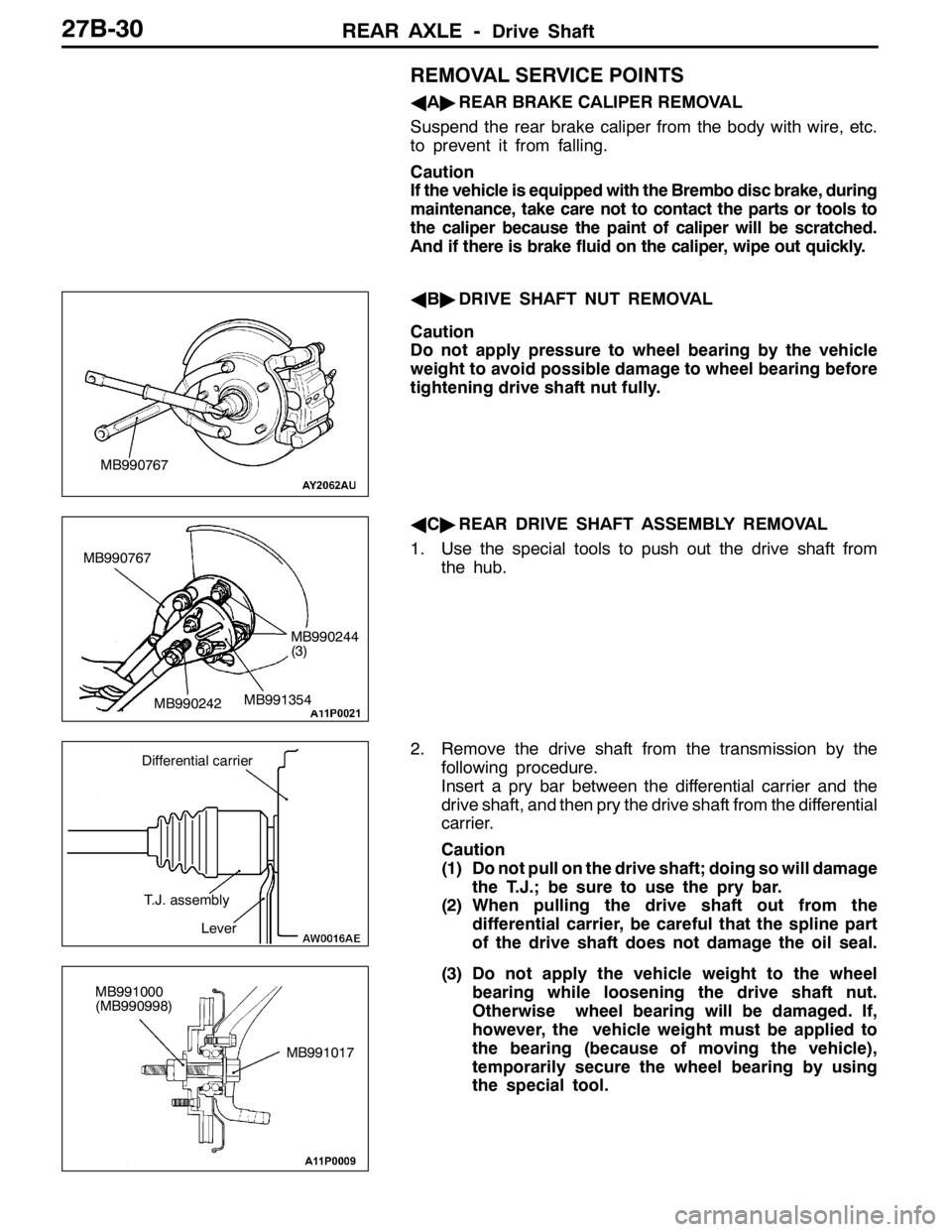
REMOVAL SERVICE POINTS
AA"REAR BRAKE CALIPER REMOVAL
Suspend the rear brake caliper from the body with wire, etc.
to prevent it from falling.
Caution
If the vehicle is equipped with the Brembo disc brake, during
maintenance, take care not to contact the parts or tools to
the caliper because the paint of caliper will be scratched.
And if there is brake fluid on the caliper, wipe out quickly.
AB"DRIVE SHAFT NUT REMOVAL
Caution
Do not apply pressure to wheel bearing by the vehicle
weight to avoid possible damage to wheel bearing before
tightening drive shaft nut fully.
AC"REAR DRIVE SHAFT ASSEMBLY REMOVAL
1. Use the special tools to push out the drive shaft from
the hub.
2. Remove the drive shaft from the transmission by the
following procedure.
Insert a pry bar between the differential carrier and the
drive shaft, and then pry the drive shaft from the differential
carrier.
Caution
(1) Do not pull on the drive shaft; doing so will damage
the T.J.; be sure to use the pry bar.
(2) When pulling the drive shaft out from the
differential carrier, be careful that the spline part
of the drive shaft does not damage the oil seal.
(3) Do not apply the vehicle weight to the wheel
bearing while loosening the drive shaft nut.
Otherwise wheel bearing will be damaged. If,
however, the vehicle weight must be applied to
the bearing (because of moving the vehicle),
temporarily secure the wheel bearing by using
the special tool.
MB990767
MB990767
MB990242MB991354
MB990244
(3)
Differential carrier
T.J. assembly
Lever
MB991017 MB991000
(MB990998)
Page 980 of 1449

REAR AXLE -Drive Shaft27B-34
"BAT.J. BOOT BAND (SMALL)/T.J. BOOT BAND
(LARGE) INSTALLATION
Set the T.J. boot bands at the specified distance in order
to adjust the amount of air inside the T.J. boot, and then
tighten the T.J. boot bands securely.
Standard value (A): 90±3mm
INSPECTION
DCheck the drive shaft for damage, bending or corrosion.
DCheck the drive shaft spline part for wear or damage.
DCheck the spider assembly for roller rotation, wear or
corrosion.
DCheck the groove inside T.J. case for wear or corrosion.
DCheck the boots for deterioration, damage or cracking.
DCheck the dust cover for damage or deterioration.
B.J. BOOT (RESIN BOOT) REPLACEMENT
Refer to GROUP26 Front Axle-Drive shaft.
A
Page 997 of 1449

REAR AXLE -Differential Carrier
REMOVAL SERVICE POINT
AA"SCREWS REMOVAL
1. Check out the alignment marks.
2. Loosen a uniform amount little by little the screws securing
differential case A to B.
3. Separate differential case B from differential case A and
remove their components.
Keep the removed spring plates, friction plates, and friction
discs organized in the order of removal and for right and
left use.
INSTALLATION SERVICE POINTS
"AADIFFERENTIAL CASE B INSTALLATION
Before starting the assembly procedure, perform the following
steps to adjust dimensional differences (clutch plate friction
force) in the axial direction of the components inside the
differential case and axial clearance of the differential side
gear.
1. Place friction discs (two each) and friction plates (three
each) one on top of another as illustrated and, using
a micrometer, measure the thickness of each of the right
and left assemblies. Select different discs and plates so
that the difference between the right and left assemblies
falls within the specified range.
Standard value: 0 – 0.05 mm
NOTE
If a new part is used, note that the friction disc comes
in two thicknesses: 1.6 mm and 1.7 mm.
2. Measure the thickness of each of the right and left spring
plates.
3. Assemble the pressure ring internal parts (pinion shaft
and pressure ring), friction plates, and friction discs and,
using a micrometer, measure the overall width.
NOTE
When taking measurements, press the assembly from
both sides so that the pinion shaft makes a positive contact
with the groove in the pressure ring.
4. Find value (A) which is the thickness measured in step
(3) added to the thickness of two spring plates.
A
Groove
Page 1015 of 1449

32-1
POWER PLANT
MOUNT
CONTENTS
GENERAL INFORMATION 2..................
SPECIAL TOOL 3............................
ENGINE MOUNTING 4........................TRANSMISSION MOUNTING 5................
ENGINE ROLL STOPPER, CENTERMEMBER
6 ............................................
CROSSMEMBER* 8..........................
WARNING REGARDING SERVICING OF SUPPLEMENTAL RESTRAINT SYSTEM (SRS) EQUIPPED VEHICLES
WARNING!
(1) Improper service or maintenance of any component of the SRS, or any SRS-related component, can lead to personal
injury or death to service personnel (from inadvertent firing of the air bag) or to driver and passenger (from rendering
the SRS inoperative).
(2) Service or maintenance of any SRS component or SRS-related component must be performed only at an authorized
MITSUBISHI dealer.
(3) MITSUBISHI dealer personnel must thoroughly review this manual, and especially its GROUP 52B - Supplemental
Restraint System (SRS) before beginning any service or maintenance of any component of the SRS or any SRS-related
component.
NOTE
The SRS includes the following components: SRS-ECU, SRS warning lamp, air bag module, clock spring, and interconnecting
wiring. Other SRS-related components (that may have to be removed/installed in connection with SRS service or maintenance) are
indicated in the table of contents by an asterisk (*).
Page 1018 of 1449
POWER PLANT MOUNT - Engine Mounting32-4
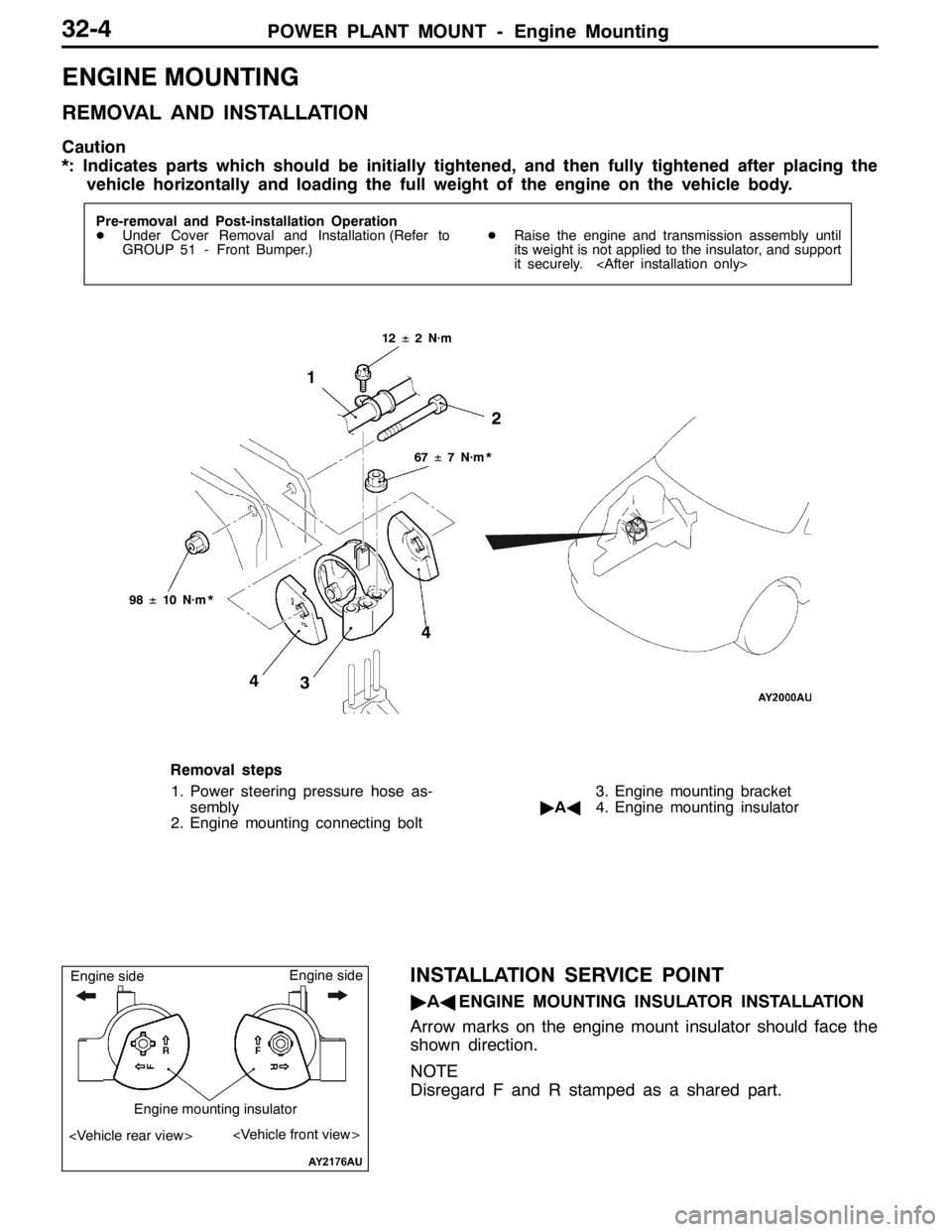
ENGINE MOUNTING
REMOVAL AND INSTALLATION
Caution
*: Indicates parts which should be initially tightened, and then fully tightened after placing the
vehicle horizontally and loading the full weight of the engine on the vehicle body.
Pre-removal and Post-installation Operation
DUnder Cover Removal and Installation (Refer to
GROUP 51 - Front Bumper.)DRaise the engine and transmission assembly until
its weight is not applied to the insulator, and support
it securely.
98±10 N·m*
67±7 N·m*
1
2
12±2 N·m
3 44
Removal steps
1. Power steering pressure hose as-
sembly
2. Engine mounting connecting bolt3. Engine mounting bracket
"AA4. Engine mounting insulator
INSTALLATION SERVICE POINT
"AAENGINE MOUNTING INSULATOR INSTALLATION
Arrow marks on the engine mount insulator should face the
shown direction.
NOTE
Disregard F and R stamped as a shared part.
Engine sideEngine side
Engine mounting insulator