ECU MITSUBISHI LANCER EVOLUTION 2007 Service Repair Manual
[x] Cancel search | Manufacturer: MITSUBISHI, Model Year: 2007, Model line: LANCER EVOLUTION, Model: MITSUBISHI LANCER EVOLUTION 2007Pages: 1449, PDF Size: 56.82 MB
Page 1101 of 1449
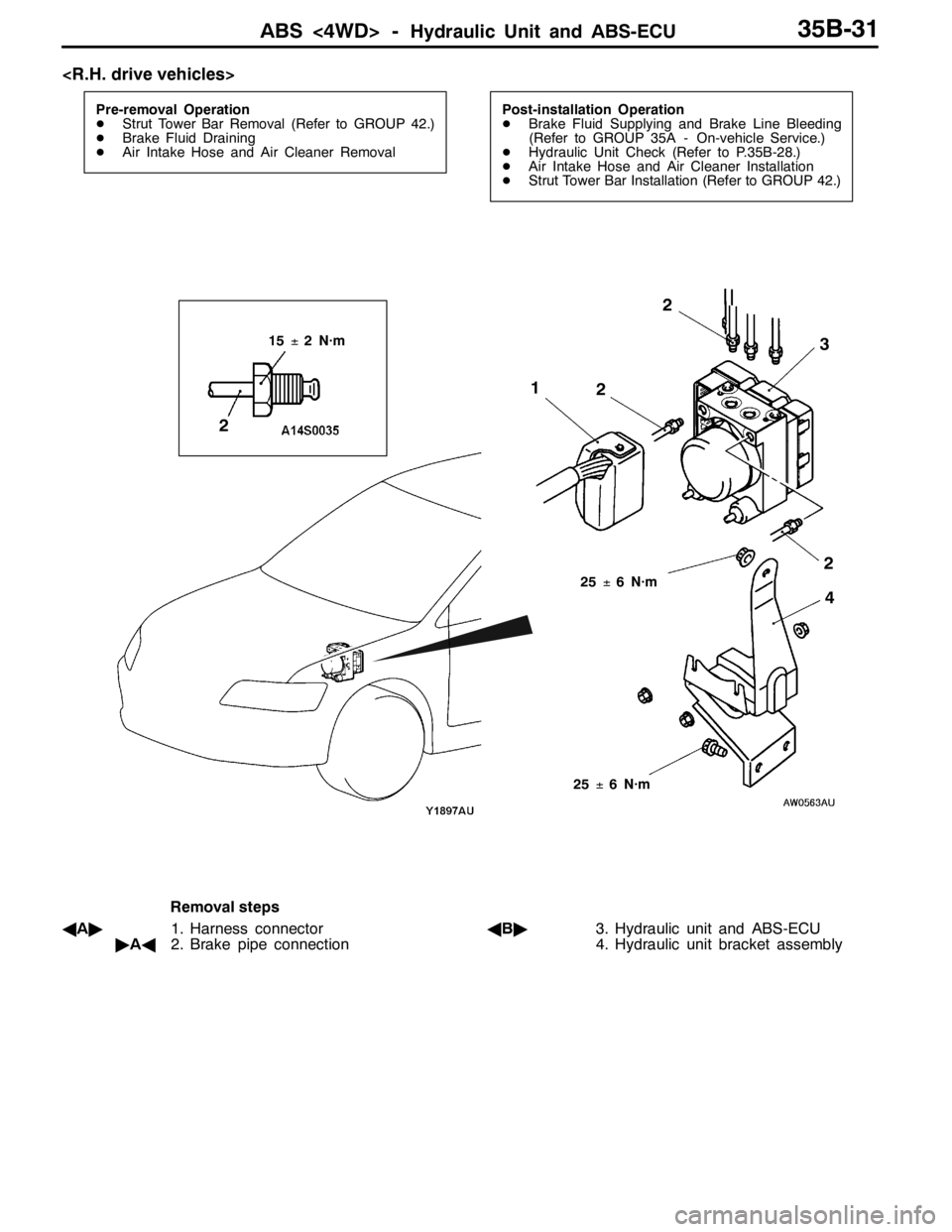
ABS <4WD> -Hydraulic Unit and ABS-ECU35B-31
Pre-removal Operation
DStrut Tower Bar Removal (Refer to GROUP 42.)
DBrake Fluid Draining
DAir Intake Hose and Air Cleaner RemovalPost-installation Operation
DBrake Fluid Supplying and Brake Line Bleeding
(Refer to GROUP 35A - On-vehicle Service.)
DHydraulic Unit Check (Refer to P.35B-28.)
DAir Intake Hose and Air Cleaner Installation
DStrut Tower Bar Installation (Refer to GROUP 42.)
213
4 2
2
2
15±2 N·m
25±6 N·m
25±6 N·m
Removal steps
AA"1. Harness connector
"AA2. Brake pipe connectionAB"3. Hydraulic unit and ABS-ECU
4. Hydraulic unit bracket assembly
Page 1102 of 1449
ABS <4WD> -Hydraulic Unit and ABS-ECU35B-32
REMOVAL SERVICE POINTS
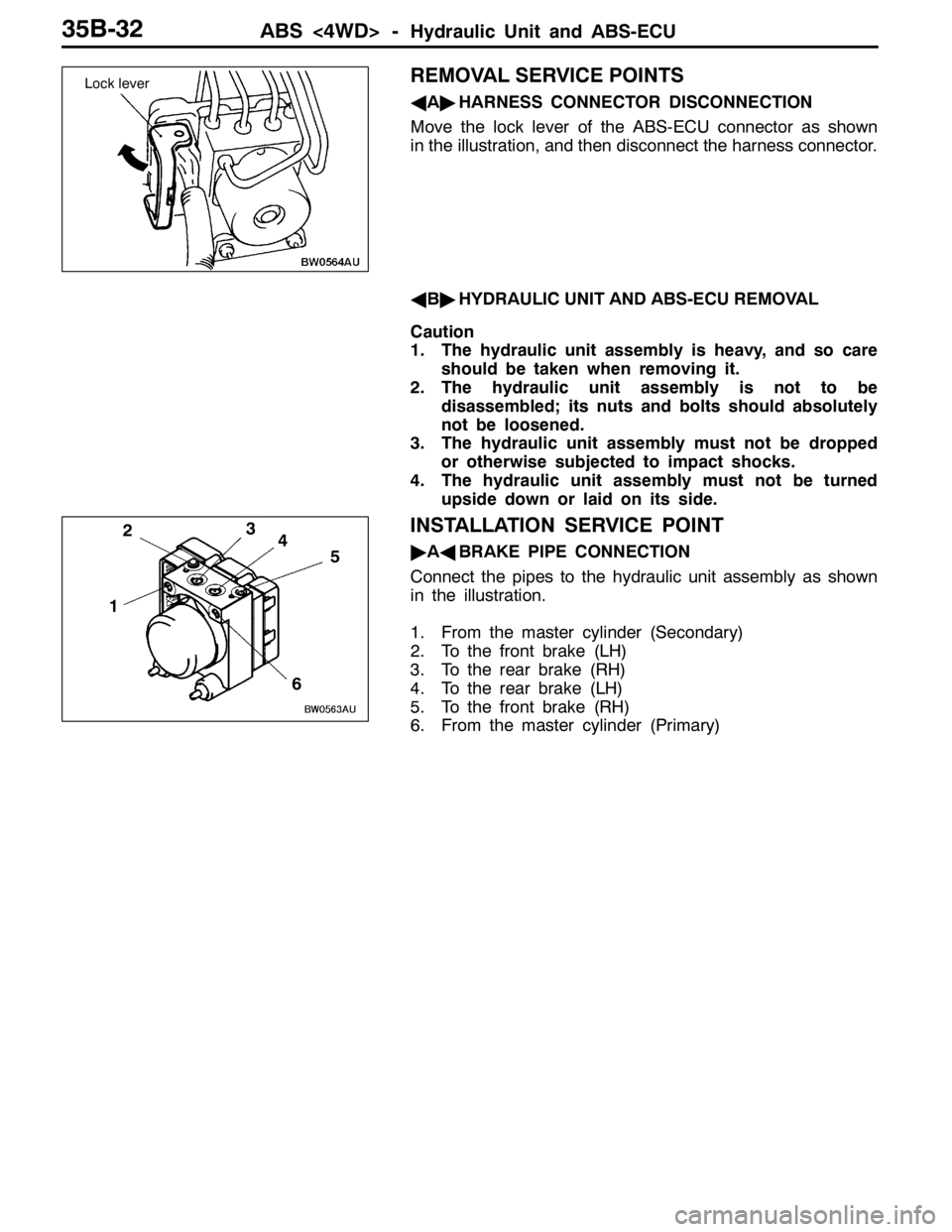
AA"HARNESS CONNECTOR DISCONNECTION
Move the lock lever of the ABS-ECU connector as shown
in the illustration, and then disconnect the harness connector.
AB"HYDRAULIC UNIT AND ABS-ECU REMOVAL
Caution
1. The hydraulic unit assembly is heavy, and so care
should be taken when removing it.
2. The hydraulic unit assembly is not to be
disassembled; its nuts and bolts should absolutely
not be loosened.
3. The hydraulic unit assembly must not be dropped
or otherwise subjected to impact shocks.
4. The hydraulic unit assembly must not be turned
upside down or laid on its side.
INSTALLATION SERVICE POINT
"AABRAKE PIPE CONNECTION
Connect the pipes to the hydraulic unit assembly as shown
in the illustration.
1. From the master cylinder (Secondary)
2. To the front brake (LH)
3. To the rear brake (RH)
4. To the rear brake (LH)
5. To the front brake (RH)
6. From the master cylinder (Primary)
Lock lever
1
234
5
6
Page 1109 of 1449
PARKING BRAKES -On-Vehicle Service36-3
ON-VEHICLE SERVICE
PARKING BRAKE LEVER STROKE CHECK
AND ADJUSTMENT
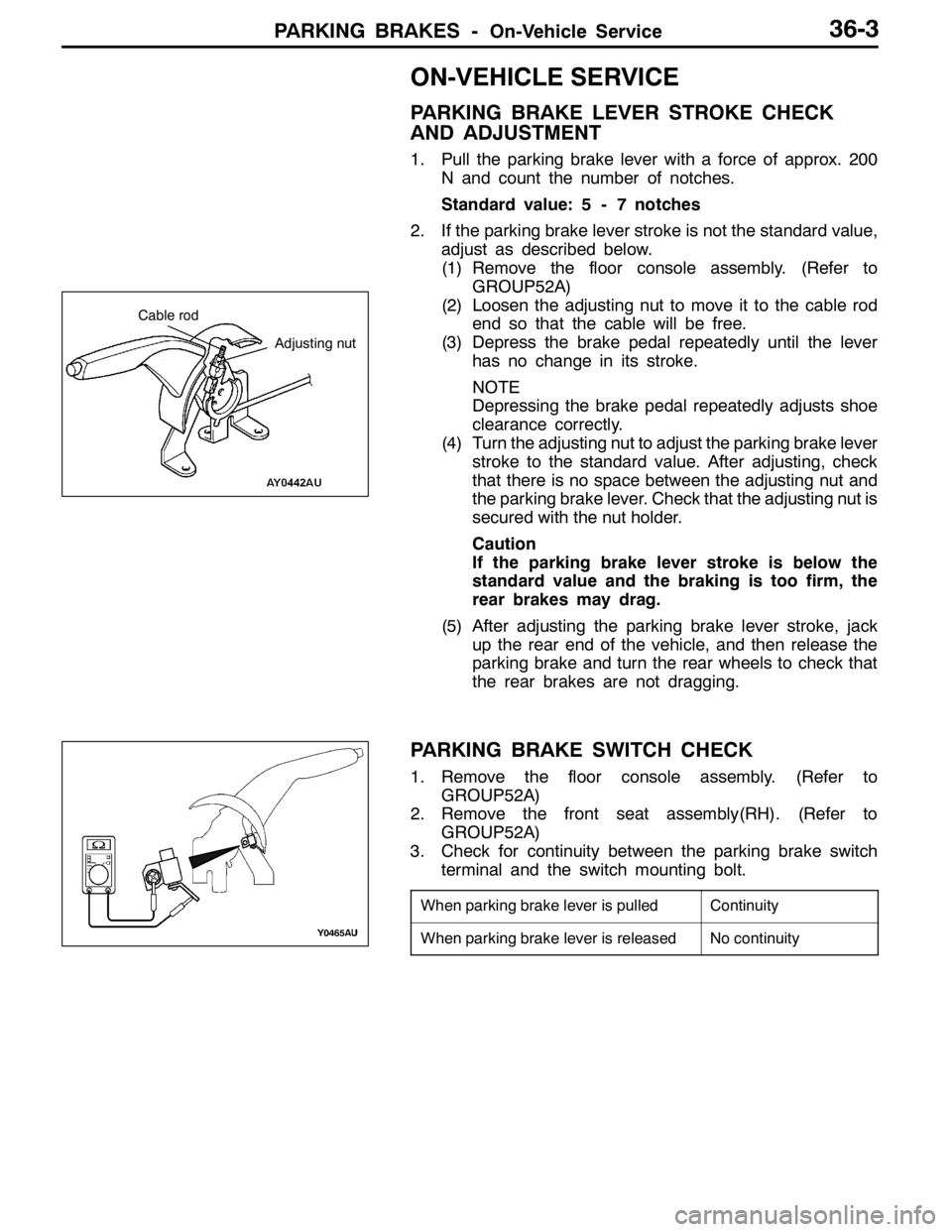
1. Pull the parking brake lever with a force of approx. 200
N and count the number of notches.
Standard value: 5 - 7 notches
2. If the parking brake lever stroke is not the standard value,
adjust as described below.
(1) Remove the floor console assembly. (Refer to
GROUP52A)
(2) Loosen the adjusting nut to move it to the cable rod
end so that the cable will be free.
(3) Depress the brake pedal repeatedly until the lever
has no change in its stroke.
NOTE
Depressing the brake pedal repeatedly adjusts shoe
clearance correctly.
(4) Turn the adjusting nut to adjust the parking brake lever
stroke to the standard value. After adjusting, check
that there is no space between the adjusting nut and
the parking brake lever. Check that the adjusting nut is
secured with the nut holder.
Caution
If the parking brake lever stroke is below the
standard value and the braking is too firm, the
rear brakes may drag.
(5) After adjusting the parking brake lever stroke, jack
up the rear end of the vehicle, and then release the
parking brake and turn the rear wheels to check that
the rear brakes are not dragging.
PARKING BRAKE SWITCH CHECK
1. Remove the floor console assembly. (Refer to
GROUP52A)
2. Remove the front seat assembly(RH). (Refer to
GROUP52A)
3. Check for continuity between the parking brake switch
terminal and the switch mounting bolt.
When parking brake lever is pulledContinuity
When parking brake lever is releasedNo continuity
Adjusting nut
Cable rod
Page 1115 of 1449

37A-1
STEERING
CONTENTS
GENERAL INFORMATION 2..................
SERVICE SPECIFICATIONS 4.................
LUBRICANTS 4..............................
SEALANT 4..................................
SPECIAL TOOLS 4...........................
ON-VEHICLE SERVICE 7.....................
Steering Wheel Free Play Check 7..............
Steering Angle Check 7........................
Tie Rod End Ball Joint Turning Torque Check 7..
Stationary Steering Effort Check 8...............
Checking Steering Wheel Return to Centre 8.....
Drive Belt Tension Check 8.....................Power Steering Fluid Level Check 9.............
Power Steering Fluid Replacement 9.............
Power Steering System Bleeding 9..............
Oil Pump Pressure Test 10.....................
Power Steering Oil Pressure Switch Check 11....
Ball Joint Dust Cover Check 11.................
STEERING WHEEL* 12.......................
STEERING SHAFT* 14.......................
POWER STEERING GEAR BOX AND
LINKAGE* 16................................
POWER STEERING OIL PUMP 29............
POWER STEERING OIL HOSES 30...........
WARNINGS REGARDING SERVICING OF SUPPLEMENTAL RESTRAINT SYSTEM (SRS) EQUIPPED VEHICLES
WARNING!
(1) Improper service or maintenance of any component of the SRS, or any SRS-related component, can lead to personal
injury or death to service personnel (from inadvertent firing of the air bag) or to the driver and passenger (from rendering
the SRS inoperative).
(2) Service or maintenance of any SRS component or SRS-related component must be performed only at an authorized
MITSUBISHI dealer.
(3) MITSUBISHI dealer personnel must thoroughly review this manual, and especially its GROUP 52B - Supplemental
Restraint System (SRS) before beginning any service or maintenance of any component of the SRS or any SRS-related
component.
NOTE
The SRS includes the following components: SRS-ECU, SRS warning lamp, air bag module, clock spring and interconnecting
wiring. Other SRS-related components (that may have to be removed/installed in connection with SRS service or maintenance) are
indicated in the table of contents by an asterisk (*).
Page 1123 of 1449

STEERING -On-vehicle Service37A-9
POWER STEERING FLUID LEVEL CHECK
1. Park the vehicle on a flat, level surface, start the engine,
and then turn the steering wheel several times to raise
the temperature of the fluid to approximately 50 - 60_C.
2. With the engine running, turn the wheel all the way to
the left and right several times.
3. Check the fluid in the oil reservoir for foaming or milkiness.
Check the difference of the fluid level when the engine
is stopped, and while it is running. If the change of the
fluid level is 5 mm or more, air bleeding should be done.
POWER STEERING FLUID REPLACEMENT
1. Raise the front wheels on a jack, and then support them
with rigid racks.
2. Disconnect the return hose connection.
3. Connect a vinyl hose to the return hose, and drain the
oil into a container.
4. Disconnect the ignition coil connectors. (Refer to
GROUP16 - Ignition System.)
5. While operating the starting motor intermittently, turn the
steering wheel all the way to the left and right several
times to drain all of the fluid.
6. Connect the return hoses securely, and then secure it
with the clip.
7. Fill the oil reservoir with specified fluid up to the lower
position of the filter, and then bleed air.
Specified fluid:
Automatic transmission fluid DEXRONII
Caution
Do not use ATF-SPIIM and ATF-SPIII.
POWER STEERING SYSTEM BLEEDING
1. Jack up the vehicle and support the front wheels with
rigid racks.
2. Disconnect the ignition coil connectors. (Refer to
GROUP16 - Ignition System.)
3. Cranking the engine with the starter several times
intermittently (during 15 to 20 seconds), turn the steering
wheel left and right fully five or six times.
Caution
(1) During the bleeding, refill the fluid so that the
level never falls below the lower position of the
filter.
(2) Be sure to bleed air only while cranking. If the
bleeding is done with the engine running, the air
will be broken up and absorbed into the fluid.
4. Connect the ignition coil connectors and idle the engine.
5. Turn the steering wheel left and right fully until no bubbles
comes out in the oil reservoir.
6. See that the fluid is not milky and that the fluid level
is up to the specified position on the level gauge.
7. See that the fluid level changes little when the steering
wheel is turned left and right.
8. Check difference in fluid levels between the engine
stopped and running.
Fluid level change: Within 5 mm
While engine
runningWhile engine
stopped
Return hose
Vinyl hose
Page 1131 of 1449

STEERING - Power Steering Gear Box and Linkage37A-17
17 6 2
3 4
15±3 N·m
57±7 N·m
5
70±10 N·m
Removal steps
1. Crossmember
(Refer to GROUP 32.)
2. Joint cover grommet
3. Return hose connection4. Return tube
5. Pressure hose connection
6. Clamp
7. Steering gear and linkage
INSPECTION
GEAR BOX PINION TOTAL ROTATION TORQUE CHECK
Caution
Secure the steering gear box and linkage in their mounting
positions only. Otherwise, deformation or damage could
result.
1. Using the special tool, turn the pinion gear at a speed
of one rotation per 4 to 6 seconds to measure total rotation
torque.
Standard values:
Total rotation torque: 0.8 – 1.8 N·m
Torque fluctuation: 0.49 N·m or less
NOTE
(1) Remove the bellows from the rack housing before
measuring.
(2) Measure the total rotation torque by turning the special
tool left and right 180_from the neutral position.
2. If the standard values are not met, adjust the pinion total
rotation torque. (Refer to P.37A-26.)
3. In case the adjustment is impossible, disassemble and
check the components, and repair if necessary.
MB991006
Page 1141 of 1449

STEERING - Power Steering Gear Box and Linkage37A-27
2. If the total rotation torque or torque fluctuation does not
meet the standard values, adjust by returning the rack
support cover within a range of 0 to 30_.
Caution
(1) Adjust around the maximum limit of the standard
values.
(2) See that no ratcheting or catching are present
when operating the rack towards the shaft
direction.
(3) Measure the total pinion torque through the whole
stroke of the rack.
3. If the adjustment is impossible in the given range, check
the components of the rack support cover, and replace
if necessary.
"LATAB WASHER/TIE ROD INSTALLATION
After installing the tie rod to the rack, fold the tab washer
end (2 locations) to the tie rod notch.
"MABELLOWS BAND INSTALLATION
1. Turn the adjusting bolt of the special tool to adjust the
opening dimension (W) to the standard value.
Standard value (W): 2.9 mm
Screw in the adjusting bolt.
Loosen the adjusting bolt.
NOTE
(1) The dimension (W) is adjusted by about 0.7 mm per
one turn.
(2) Do not turn the adjusting bolt more than one turn.
2. Use the special tool to crimp the bellows band.
Caution
(1) Hold the rack housing, and use the special tool
to crimp the bellows band securely.
(2) Crimp the bellows band until the special tool
touches the stopper.
MB991561
Stopper
Adjusting bolt W
MB991561
Page 1142 of 1449

STEERING - Power Steering Gear Box and Linkage37A-28
3. See that the crimped width (A) meets the standard value.
Standard value (A): 2.4-2.8 mm
Readjust the dimension (W) of step (1) to the value
calculated by the following equation, and repeat step
(2).
W = 5.5 mm-A [Example: If (A) is 2.9 mm, (W)
is 2.6 mm.]
Remove the bellows band, readjust the dimension
(W) of step (1) to the value calculated by the following
equation, and use a new bellows band to repeat steps
(2) to (3).
W = 5.5 mm-A [Example: If (A) is 2.3 mm, (W)
is 3.2 mm.]
"NATIE ROD END/LOCKING NUT INSTALLATION
Screw in the tie rod end until the dimension shown is achieved.
Then, temporarily tighten with the locking nut.
NOTE
The locking nut must be tightened securely only after the
power steering gear box and linkage are installed to the vehicle
and toe-in is adjusted.
"OAGEAR MOUNTING RUBBER INSTALLATION
Install the gear mounting rubber to the rack housing so that
the distance is as shown in the illustration.
TIE ROD END BALL JOINT DUST COVER
REPLACEMENT
Only when the dust cover is damaged accidentally during
service work, replace the dust cover as follows:
1. Apply grease to the inside of the dust cover.
2. Drive in the dust cover with special tool until it is fully
seated.
3. Check the dust cover for cracks or damage by pushing
it with finger.
A
Edge of bellows
assembly grooveLocking nut
184 mm
220 mm
MB990776
Page 1182 of 1449

BODY -DoorsBODY -Doors42-34
"BAOPERATION CHECK
1. Install the glass to the window regulator assembly.
Caution
(1) As fully open position which is programed in the
power window-ECU is released (initialized), the
window regulator assembly should not be
operated until it is installed to the glass.
(2) The clamping prevention function does not
operate the first time that the glass is fully closed.
2. Press the power window switch to fully-open the glass,
and then return the glass toward the fully-close position
about 30 mm each. In the fully-close position, keep on
pressing the power window switch for 0.5 second or more.
NOTE
This operation will program the power window-ECU.
INSPECTION
POWER WINDOW RELAY CONTINUITY CHECK
Battery voltageTerminal No.yg
1345
Not applied
Applied
Power window
relay
123
4
5
Page 1184 of 1449
BODY -DoorsBODY -Doors42-36
"BALOWER SASH INSTALLATION
Be sure to install the lower sash to the window rear sash
(at door) securely.
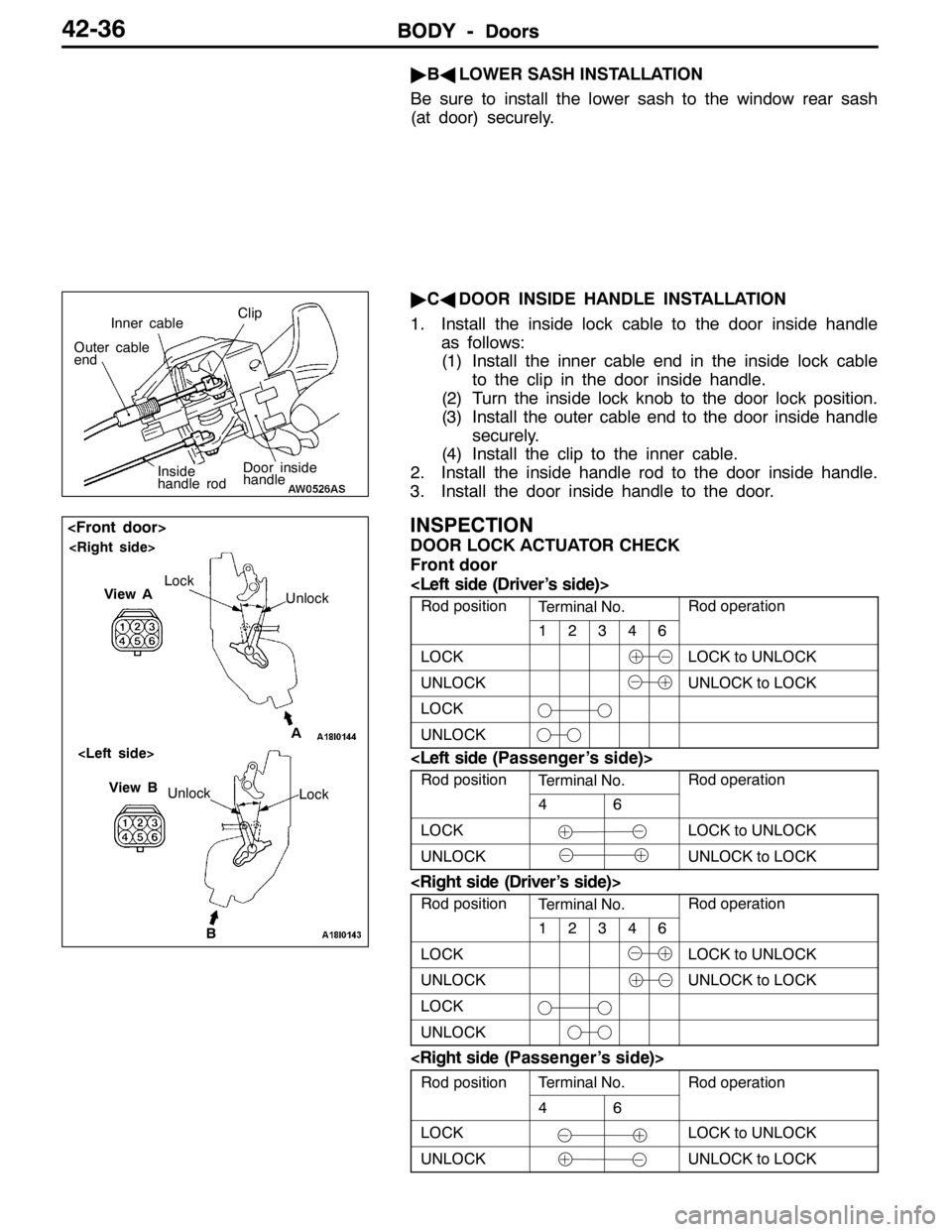
"CADOOR INSIDE HANDLE INSTALLATION
1. Install the inside lock cable to the door inside handle
as follows:
(1) Install the inner cable end in the inside lock cable
to the clip in the door inside handle.
(2) Turn the inside lock knob to the door lock position.
(3) Install the outer cable end to the door inside handle
securely.
(4) Install the clip to the inner cable.
2. Install the inside handle rod to the door inside handle.
3. Install the door inside handle to the door.
INSPECTION
DOOR LOCK ACTUATOR CHECK
Front door
Rod positionTerminal No.Rod operation
12346
LOCKLOCK to UNLOCK
UNLOCKUNLOCK to LOCK
LOCK
UNLOCK
Rod positionTerminal No.Rod operation
46
LOCKLOCK to UNLOCK
UNLOCKUNLOCK to LOCK
Rod positionTerminal No.Rod operation
12346
LOCKLOCK to UNLOCK
UNLOCKUNLOCK to LOCK
LOCK
UNLOCK
Rod positionTerminal No.Rod operationp
46
p
LOCKLOCK to UNLOCK
UNLOCKUNLOCK to LOCK
Door inside
handle
Inner cableClip
Outer cable
end
Inside
handle rod
B Unlock
View B
Lock
View A
Unlock Lock
A