radiator MITSUBISHI LANCER EVOLUTION 2007 Service Owner's Manual
[x] Cancel search | Manufacturer: MITSUBISHI, Model Year: 2007, Model line: LANCER EVOLUTION, Model: MITSUBISHI LANCER EVOLUTION 2007Pages: 1449, PDF Size: 56.82 MB
Page 611 of 1449
MPI -Troubleshooting13A-79
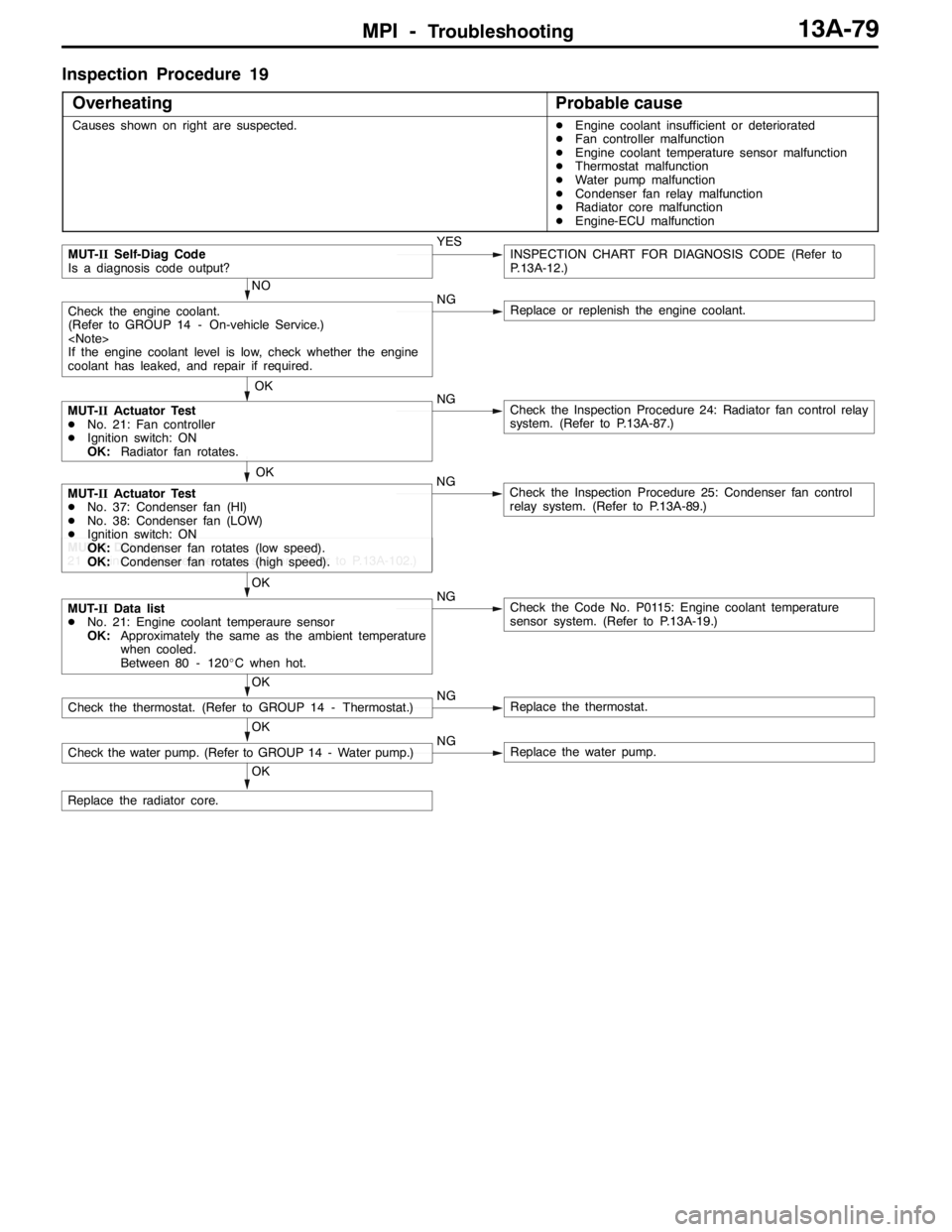
Inspection Procedure 19
Overheating
Probable cause
Causes shown on right are suspected.DEngine coolant insufficient or deteriorated
DFan controller malfunction
DEngine coolant temperature sensor malfunction
DThermostat malfunction
DWater pump malfunction
DCondenser fan relay malfunction
DRadiator core malfunction
DEngine-ECU malfunction
NO
NG
Replace or replenish the engine coolant.
OK
Replace the radiator core.
OK
Check the water pump. (Refer to GROUP 14 - Water pump.)NGReplace the water pump.
OK
Check the thermostat. (Refer to GROUP 14 - Thermostat.)NGReplace the thermostat.
OK
MUT-IIData list
DNo. 21: Engine coolant temperaure sensor
OK:Approximately the same as the ambient temperature
when cooled.
Between 80 - 120_C when hot.NGCheck the Code No. P0115: Engine coolant temperature
sensor system. (Refer to P.13A-19.)
MUT-IIData list
21 Engine coolant temperature sensor (Refer to P.13A-102.)
OK
MUT-IIActuator Test
DNo. 37: Condenser fan (HI)
DNo. 38: Condenser fan (LOW)
DIgnition switch: ON
OK:Condenser fan rotates (low speed).
OK:Condenser fan rotates (high speed).NGCheck the Inspection Procedure 25: Condenser fan control
relay system. (Refer to P.13A-89.)
MUT-IIActuator Test
DNo. 21: Fan controller
DIgnition switch: ON
OK:Radiator fan rotates.NGCheck the Inspection Procedure 24: Radiator fan control relay
system. (Refer to P.13A-87.)
OK
Check the engine coolant.
(Refer to GROUP 14 - On-vehicle Service.)
If the engine coolant level is low, check whether the engine
coolant has leaked, and repair if required.
MUT-IISelf-Diag Code
Is a diagnosis code output?YESINSPECTION CHART FOR DIAGNOSIS CODE (Refer to
P.13A-12.)
Page 612 of 1449
MPI -Troubleshooting13A-80
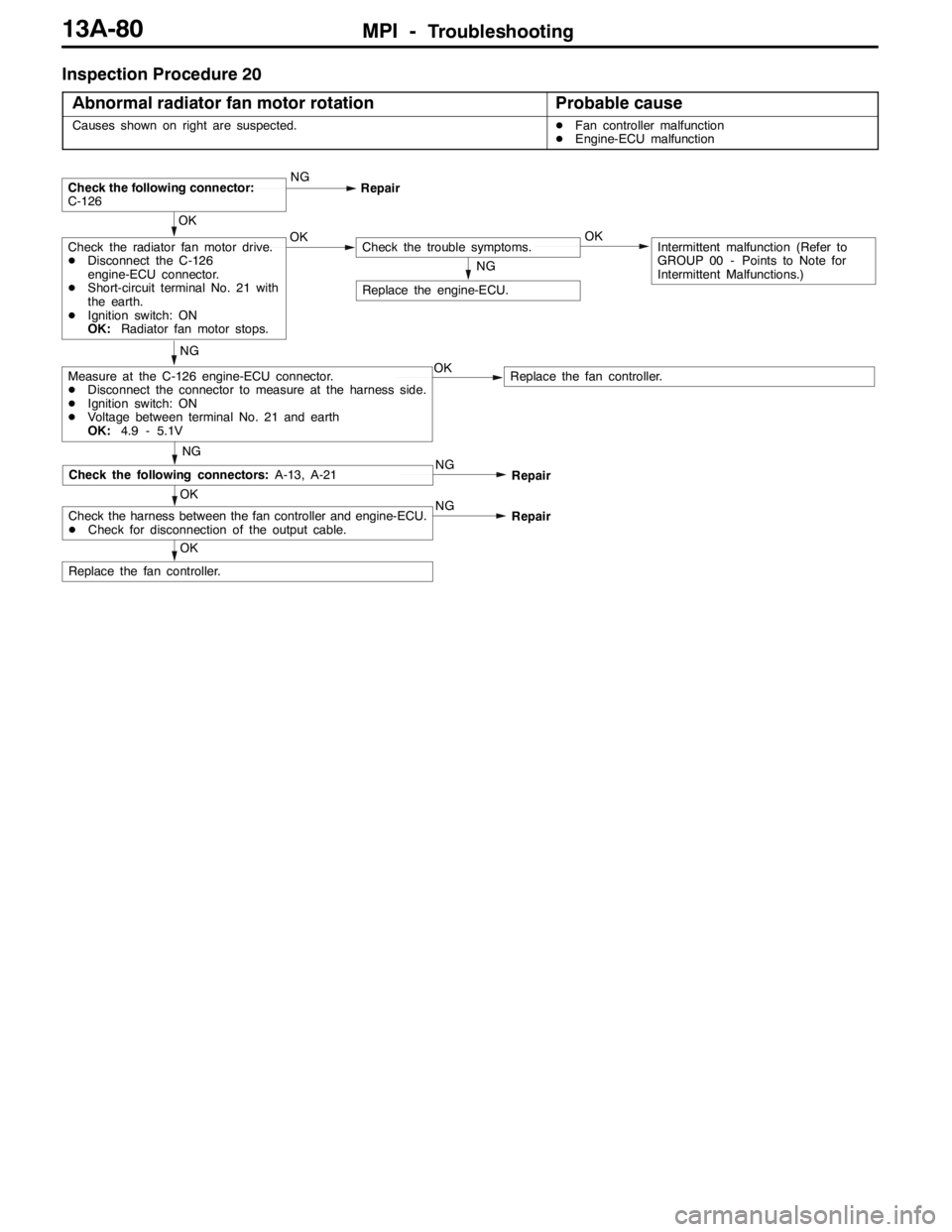
Inspection Procedure 20
Abnormal radiator fan motor rotation
Probable cause
Causes shown on right are suspected.DFan controller malfunction
DEngine-ECU malfunction
Intermittent malfunction (Refer to
GROUP 00 - Points to Note for
Intermittent Malfunctions.)OK
Replace the engine-ECU.
OK
Check the radiator fan motor drive.
DDisconnect the C-126
engine-ECU connector.
DShort-circuit terminal No. 21 with
the earth.
DIgnition switch: ON
OK:Radiator fan motor stops.NGCheck the trouble symptoms.
Check the following connector:
C-126NG
Repair
OK
NG
Measure at the C-126 engine-ECU connector.
DDisconnect the connector to measure at the harness side.
DIgnition switch: ON
DVoltage between terminal No. 21 and earth
OK:4.9 - 5.1VReplace the fan controller. NG
OK
NG
Repair
NGRepair
Replace the fan controller.
Check the following connectors:A-13, A-21
Check the harness between the fan controller and engine-ECU.
DCheck for disconnection of the output cable.OK
OK
Page 619 of 1449
MPI -Troubleshooting13A-87
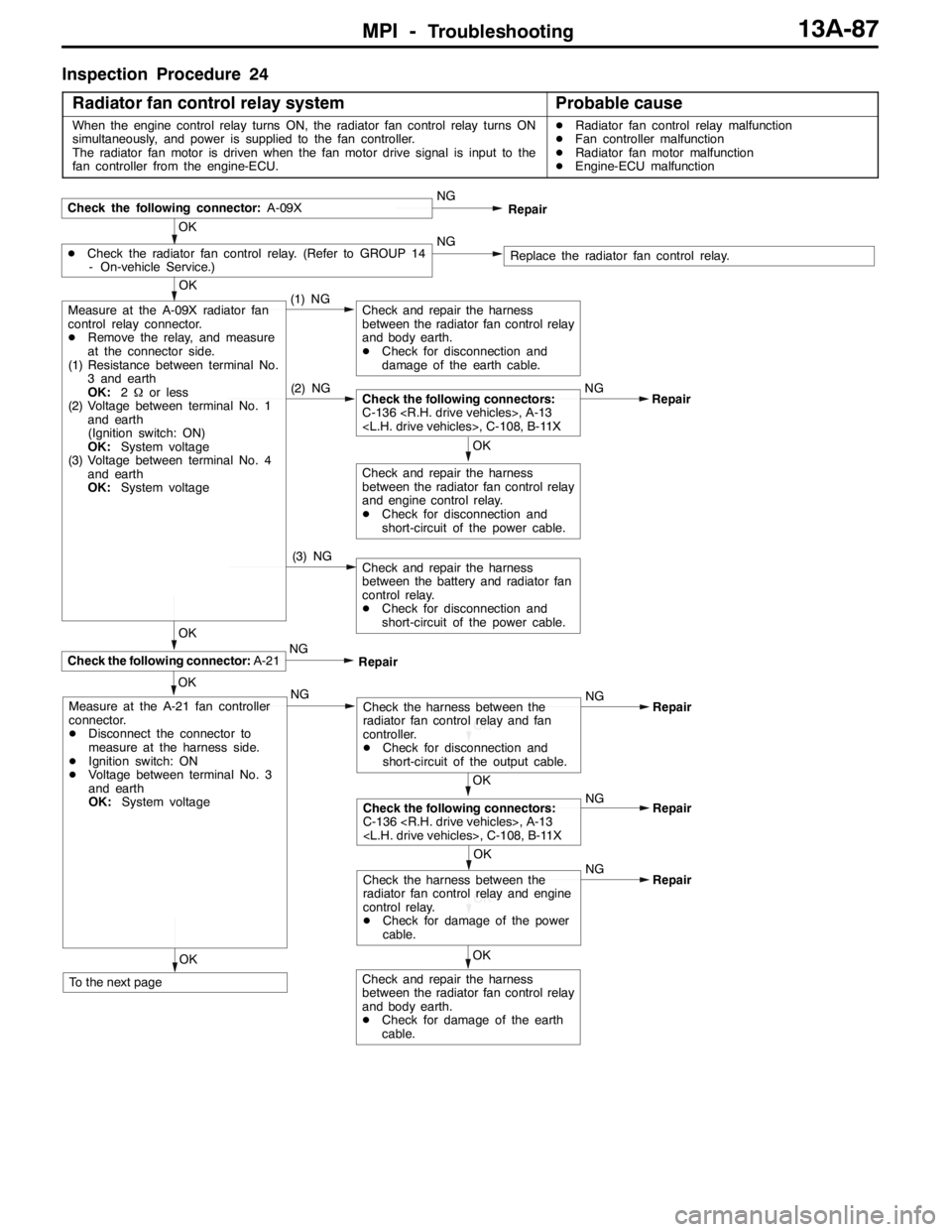
Inspection Procedure 24
Radiator fan control relay system
Probable cause
When the engine control relay turns ON, the radiator fan control relay turns ON
simultaneously, and power is supplied to the fan controller.
The radiator fan motor is driven when the fan motor drive signal is input to the
fan controller from the engine-ECU.DRadiator fan control relay malfunction
DFan controller malfunction
DRadiator fan motor malfunction
DEngine-ECU malfunction
OK
(1) NG
OK
DCheck the radiator fan control relay. (Refer to GROUP 14
- On-vehicle Service.)NGReplace the radiator fan control relay.
Check the following connector:A-09XNG
Repair
OK
OK
(2) NGCheck the following connectors:
C-136
OK
Check and repair the harness
between the radiator fan control relay
and body earth.
DCheck for disconnection and
damage of the earth cable.
Repair
OK
Check the following connector:A-21
Check and repair the harness
between the radiator fan control relay
and engine control relay.
DCheck for disconnection and
short-circuit of the power cable.
(3) NGCheck and repair the harness
between the battery and radiator fan
control relay.
DCheck for disconnection and
short-circuit of the power cable.
Measure at the A-09X radiator fan
control relay connector.
DRemove the relay, and measure
at the connector side.
(1) Resistance between terminal No.
3 and earth
OK:2Ωor less
(2) Voltage between terminal No. 1
and earth
(Ignition switch: ON)
OK:System voltage
(3) Voltage between terminal No. 4
and earth
OK:System voltage
NG
Repair
OK
Measure at the A-21 fan controller
connector.
DDisconnect the connector to
measure at the harness side.
DIgnition switch: ON
DVoltage between terminal No. 3
and earth
OK:System voltage
To the next pageNG
OK
Check the harness between the
radiator fan control relay and fan
controller.
DCheck for disconnection and
short-circuit of the output cable.NG
Repair
OK
Check the following connectors:
C-136
Repair
OK
OK
Check the harness between the
radiator fan control relay and engine
control relay.
DCheck for damage of the power
cable.NG
Repair
Check and repair the harness
between the radiator fan control relay
and body earth.
DCheck for damage of the earth
cable.
Page 620 of 1449
MPI -Troubleshooting13A-88
NGRepair
NG
Repair NG
From the previous page
OK
OK
Replace the engine-ECU.
NG
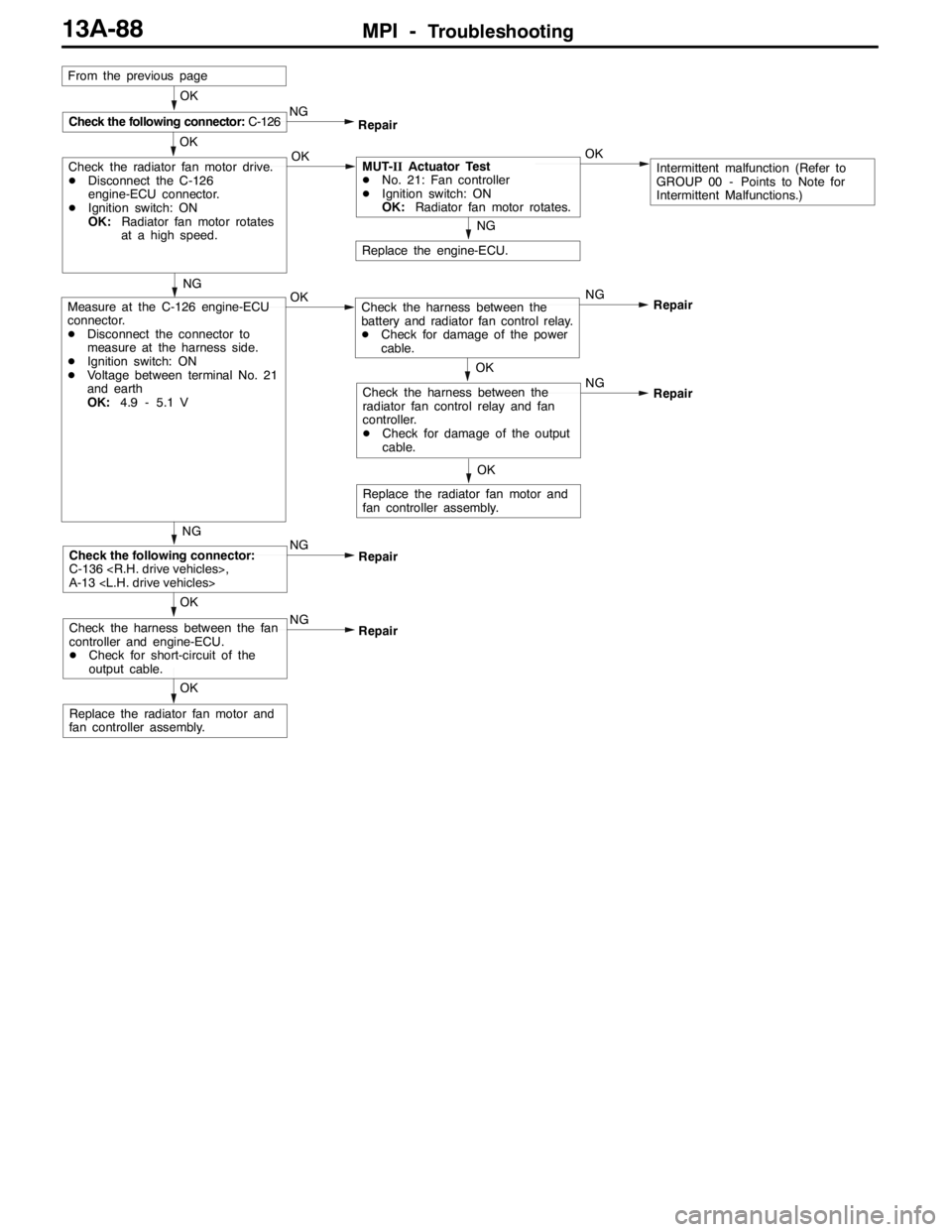
MUT-IIActuator Test
DNo. 21: Fan controller
DIgnition switch: ON
OK:Radiator fan motor rotates.
NG
Check the radiator fan motor drive.
DDisconnect the C-126
engine-ECU connector.
DIgnition switch: ON
OK:Radiator fan motor rotates
at a high speed.OK
OK
Check the harness between the
battery and radiator fan control relay.
DCheck for damage of the power
cable.RepairMeasure at the C-126 engine-ECU
connector.
DDisconnect the connector to
measure at the harness side.
DIgnition switch: ON
DVoltage between terminal No. 21
and earth
OK:4.9 - 5.1 VOK
OK
Check the harness between the
radiator fan control relay and fan
controller.
DCheck for damage of the output
cable.
Replace the radiator fan motor and
fan controller assembly.NG
NG
OK
Check the following connector:
C-136
A-13
OK
Replace the radiator fan motor and
fan controller assembly.
Check the harness between the fan
controller and engine-ECU.
DCheck for short-circuit of the
output cable.Repair NG
OK
Check the following connector:C-126
Repair
Intermittent malfunction (Refer to
GROUP 00 - Points to Note for
Intermittent Malfunctions.)
Page 640 of 1449

MPI -Troubleshooting13A-108
Item
No.Reference
page Inspection
procedure
No. Normal condition Inspection contents Drive contents Inspection
item
21Fan
controllerRadiator fan
motor is
driven.Ignition switch: “ON”Fan motor rotates
at high speed.Procedure
No. 2413A-87
36Secondary
air control
solenoid
valveSolenoid valve
turns from
OFF to ON.Ignition switch: “ON”Sound of opera-
tion can be heard
when solenoid
valve is driven.Procedure
No. 2913A-96
37Condenser
fan (HI)Condensor
fan motor is
driven.Ignition switch: “ON”Fan motor rotates
at high speed.Procedure
No. 2513A-89
38Condenser
fan (LOW)Second air
control
solenoid valveIgnition switch: “ON”Fan motor rotates
at low speed.
CHECK AT THE ENGINE-ECU TERMINALS
TERMINAL VOLTAGE CHECK CHART
1. Connect a needle-nosed wire probe (test harness:
MB991223 or paper clip) to a voltmeter probe.
2. Insert the needle-nosed wire probe into each of the
engine-ECU connector terminals from the wire side, and
measure the voltage while referring to the check chart.
NOTE
(1) Make the voltage measurement with the engine-ECU
connectors connected.
(2) You may find it convenient to pull out the engine-ECU
to make it easier to reach the connector terminals.
(3) The checks can be carried out off the order given
in the chart.
Caution
Short-circuiting the positive (+) probe between a
connector terminal and earth could damage the
vehicle wiring, the sensor, engine-ECU or all of them.
Be careful to prevent this!
3. If voltmeter shows any division from standard value, check
the corresponding sensor, actuator and related electrical
wiring, then repair or replace.
4. After repair or replacement, recheck with the voltmeter
to confirm that the repair has corrected the problem.
Needle-nosed wire probe
Page 642 of 1449

MPI -Troubleshooting13A-110
Terminal No.Normal condition Check condition (Engine condition) Check item
12Power supplyIgnition switch: “ON”System voltage
25
19Air flow sensor reset
signal
Engine: Idle operation0-1V
signal
Engine speed: 3,000 r/min6-9V
21Fan controllerRadiator fan is not operating0 - 0.3 V
Radiator fan is operating0.7 V or more
22Fuel pump relay 2Ignition switch: “ON”System voltage
Engine: Idle operation1 V or less
24A/C load signalDEngine:
Idle operation
DA/C switch: ON
(A/C compressor
runs)DOutdoor air
sensor ambient
temperature:
18_C or more
DA/C setting
temperature:
Minimum
temperature
DA/C air volume:
Maximum1 V or less
DA/C setting
temperature:
indoor
temperature
DA/C air volume:
MinimumSystem voltage
32Condenser fan motor
relay (HI)Fan inactive state
(Engine coolant temperature: 90_C or less)System voltage
Fan high-speed rotation state
(Engine coolant temperature: 105_C or more)1 V or less
33Alternator G terminalDEngine: After warm-up, idle operation
DRadiator fan: Not operating
DHeadlamp: OFF→ON
DStop lamp: OFF→ON
DRear defogger switch: OFF→ONVoltage increases by
0.2 - 3.5 V
34Condenser fan motor
relay (LOW)Fan inactive state
(Engine coolant temperature: 90_C or less)System voltage
Fan low-speed rotation state (Engine coolant
temperature: 95 - 100_C or more)1 V or less
35Intercooler water
spraylamp
Ignition switch: “ON”System voltage
spraylamp
Ignition switch: “LOCK” (OFF)1 V or less
36Engine warning lampIgnition switch: “LOCK” (OFF)→“ON”1 V or less→System
voltage (After several se-
conds have elapsed)
Page 643 of 1449

MPI -Troubleshooting13A-111
Terminal No.Normal condition Check condition (Engine condition) Check item
37Power steering fluid
pressure switchEngine: Idling after
warming upWhen steering wheel
is stationarySystem voltage
When steering wheel
is turned1 V or less
38Engine control relayIgnition switch: “LOCK” (OFF)System voltage
Ignition switch: “ON”1 V or less
39Fuel pump relay 3While engine is idling, suddenly depress the
accelerator pedal.Temporarily rises slightly
from 1 V or less.
41Alternator FR
terminalDEngine: After warm-up, idle operation
DRadiator fan: Not operating
DHead lamp: OFF→ON
DStop lamp: OFF→ON
DRear deffogger switch: OFF→ONVoltage decrease
44Intercooler water
spray switch (Auto)DIgnition switch: “ON”
DIntercooler water spray switch: ON1 V or less
DIgnition switch: “ON”
DIntercooler water spray switch: OFFSystem voltage
45A/C switchEngine: Idle operationTurn the A/C switch
OFF0.5 V or less
DA/C switch: ON
DA/C setting
temperature
When room tem-
perature is 25_C
or more: Max
Cool
When room tem-
perature is 25_C
or less: Max. HotSystem voltage
53Secondary air control
solenoid valveIgnition switch: “ON”System voltage
54Oxygen sensor
heater(Rear)
Engine: Idling after warming up1 V or less
heater(Rear)
Engine speed: 5,000r/minSystem voltage
55Intercooler water
sprayrelay
Ignition switch: “ON”System voltage
spray relay
Ignition switch: “LOCK” (OFF)1 V or less
58Tachometer signalEngine speed: 3,000r/min0.3 - 3.0 V
60Oxygen sensor
heater(front)
Engine: Idling after warming up1 V or less
heater(front)
Engine speed: 5,000r/minSystem voltage
71Ignition switch - STEngine: Cranking8 V or more
Page 689 of 1449

14-1
ENGINE COOLING
CONTENTS
GENERAL INFORMATION 2..................
SERVICE SPECIFICATIONS 2.................
LUBRICANT 2...............................
SEALANT 2..................................
SPECIAL TOOLS 3...........................
TROUBLESHOOTING 3.......................
ON-VEHICLE SERVICE 6.....................
Engine Coolant Leak Checking 6................
Radiator Cap Opening Pressure Check 6........Engine Coolant Replacement 6..................
Concentration Measurement 7...................
Radiator Fan Relay Continuity Check 8..........
Radiator Fan Controller Check 8................
Radiator Fan Motor Check 10...................
THERMOSTAT 11............................
WATER PUMP 13............................
WATER HOSE AND WATER PIPE 14..........
RADIATOR 15................................
Page 690 of 1449

ENGINE COOLING -GeneralInformation/
Service Specifications/Lubricant/Sealant14-2
GENERAL INFORMATION
The cooling system is designed to keep every part
of the engine at appropriate temperature in
whatever condition the engine may be operated.
The cooling method is of the water-cooled, pressure
forced circulation type in which the water pump
pressurizes coolant and circulates it throughout the
engine. If the coolant temperature exceeds the
prescribed temperature, the thermostat opens to
circulate the coolant through the radiator as well
so that the heat absorbed by the coolant may be
radiated into the air.The water pump is of the centrifugal type and is
driven by the drive belt from the crankshaft.
The radiator is the corrugated fin, down flow type.
The cooling fan is controlled by the radiator fan
controller and engine-ECU depend on driving
conditions.
ItemSpecification
Radiator performance kJ/h216,700
SERVICE SPECIFICATIONS
ItemsStandard valueLimit
Radiator cap opening pressure kPa93 - 12383
Range of coolant antifreeze concentration of radiator %30 - 60-
ThermostatValve opening temperature of thermostat_C80±1.5-
Full-opening temperature of thermostat_C93-
Valve lift (at 93_C) mm9.5 or more-
LUBRICANT
ItemSpecified coolantQuantity L
Engine coolantMITSUBISHI GENUINE COOLANT or equivalent6.0Enginecoolant
(including reserve tank)
MITSUBISHIGENUINECOOLANTorequivalent6.0
SEALANT
ItemSpecified sealantRemark
Cylinder block drain plug3M Nut Locking Part No. 4171 or equivalentDrying sealant
Page 691 of 1449

ENGINE COOLING -Special Tools/Troubleshooting14-3
SPECIAL TOOLS
ToolNumberNameUse
A
B
C
DMB991223
A: MB991219
B: MB991220
C: MB991221
D: MB991222Harness set
A: Test harness
B: LED harness
C: LED harness
adapter
D: ProbeDMeasurement of terminal voltage
DInspection of radiator fan controller
A: Connector pin contact pressure
inspection
B: Power circuit inspection
C: Power circuit inspection
D: Commercial tester connection
MB991658Test harnessInspection of radiator fan controller
APS
MB991791Throttle cotrollerInspection of radiator fan controller
[Use the accelerator pedal position sensor
disconnected from harness.]
TROUBLESHOOTING
INSPECTION CHART FOR TROUBLE SYMPTOMS
Trouble symptomsInspection procedure
No.Reference page
Radiator fan does not operate.114-3
Radiator fan does not change speed or stop.214-5
INSPECTION PROCEDURE FOR TROUBLE SYMPTOMS
Inspection Procedure 1
Radiator fan does not operate.
Probable cause
Failure may occur on the power supply of the radiator fan controller and the
earth circuit.
Failure may also occur on the radiator fan controller and engine-ECU.DMalfunction of fusible link
DMalfunction of radiator fan relay
DMalfunction of radiator fan controller
DMalfunction of radiator fan motor
DMalfunction of engine-ECU
DMalfunction of harness, connector