wheel MITSUBISHI LANCER EVOLUTION 2007 Service Owner's Guide
[x] Cancel search | Manufacturer: MITSUBISHI, Model Year: 2007, Model line: LANCER EVOLUTION, Model: MITSUBISHI LANCER EVOLUTION 2007Pages: 1449, PDF Size: 56.82 MB
Page 468 of 1449

ENGINE OVERHAUL -Timing Belt11B-14
REMOVAL SERVICE POINTS
AA"TIMING BELT REMOVAL
1. To ensure that the timing belt is assembled in the same
direction when reused, using chalk, etc., make an arrow
showing the rotation direction on the back surface of
the timing belt.
2. Position the exhaust camshaft sprocket’s timing mark by
approx. one tooth before the No. 1 cylinder compression
top dead centre.
Caution
When removed at the compression top dead centre,
since the exhaust camshaft is at the position pressing
down on the valve, the sprocket could rotate in reverse
due to the force of the valve spring creating a
hazardous situation.
3. Loosen the lock nut for the tensioner pulley, and remove
the timing belt.
AB"OIL PUMP SPROCKET REMOVAL
1. Remove the plug on the left side of the cylinder block.
2. Insert a Phillips driver (shaft diameter 8 mm) to stop the
counter balance shaft left from rotating.
3. Loosen the flange bolt.
4. Remove the oil pump sprocket.
AC"CRANKSHAFT BOLT REMOVAL
1. Fix the flywheel with the special tool.
2. Remove the crankshaft bolt.
AD"CRANKSHAFT SPROCKET REMOVAL
Use the special tool to remove the sprocket if it is stuck
and hard to remove.
Timing marks
Phillips driver
MD998781
MD998778
Page 473 of 1449
ENGINE OVERHAUL -Timing Belt11B-19
Caution
(1) Measure when the belt’s surface temperature is
close to room temperature.
(2) Make sure that water or oil, etc., do not get on
the mike.
(3) If strong winds contact the mike or if noise is
generated in the area while measuring, a value
that differs from the actual value may be indicated.
(4) If the measurement is carried out with the mike
contacted against the belt, a value that differs
from the actual value may be indicated.
(5) Do not measure while the engine is running.
11. Disconnect MUT-II.
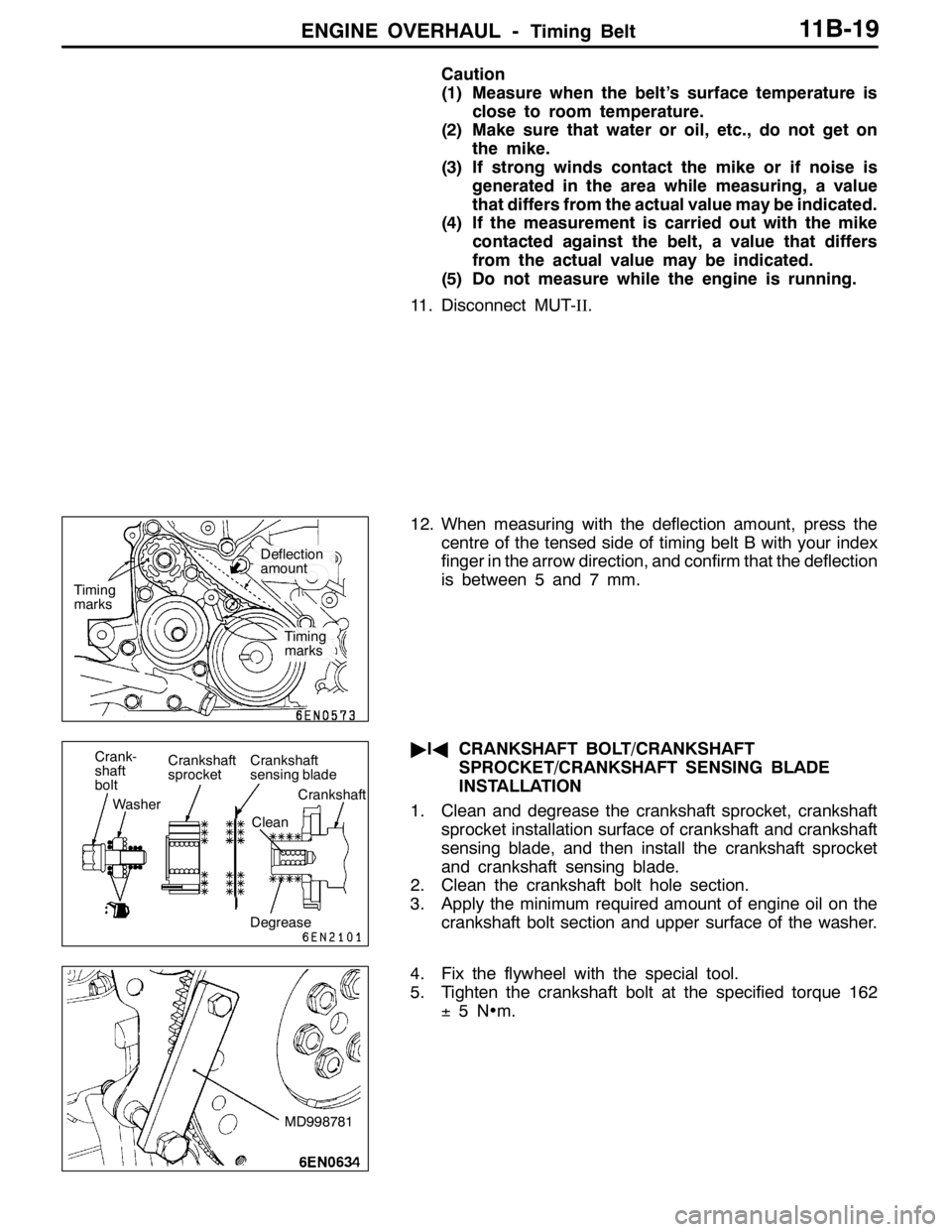
12. When measuring with the deflection amount, press the
centre of the tensed side of timing belt B with your index
finger in the arrow direction, and confirm that the deflection
is between 5 and 7 mm.
"IACRANKSHAFT BOLT/CRANKSHAFT
SPROCKET/CRANKSHAFT SENSING BLADE
INSTALLATION
1. Clean and degrease the crankshaft sprocket, crankshaft
sprocket installation surface of crankshaft and crankshaft
sensing blade, and then install the crankshaft sprocket
and crankshaft sensing blade.
2. Clean the crankshaft bolt hole section.
3. Apply the minimum required amount of engine oil on the
crankshaft bolt section and upper surface of the washer.
4. Fix the flywheel with the special tool.
5. Tighten the crankshaft bolt at the specified torque 162
±5N•m.
Timing
marks
Timing
marks
Deflection
amount
Crank-
shaft
bolt
WasherCrankshaft
sprocketCrankshaft
sensing blade
Crankshaft
Clean
Degrease
MD998781
Page 518 of 1449

ENGINE OVERHAUL -Crankshaft and Cylinder Block11B-64
CRANKSHAFT AND CYLINDER BLOCK
REMOVAL AND INSTALLATION
25±2N•m+90_- 100_
21
Apply engine oil on
all sliding sections
before installing.
4
5 6
73
8 9 1011
132±5N•m 11±1N•m
11±1N•m9±1N•m
32±2N•m
14
1312 15
Removal steps
1. Flywheel bolt
2. Flywheel
3. Rear plate
4. Bell housing cover
"EA5. Rear oil seal case
"DA6. Rear oil seal
"CA7. Bearing cap bolt
"CA8. Beam bearing cap"BA9. Crankshaft bearing lower
10. Crankshaft
"BA11. Crankshaft bearing upper
"AA12. Thrust bearing
13. Check valve
14. Oil jet
15. Cylinder block
Page 578 of 1449
MPI -Troubleshooting13A-46
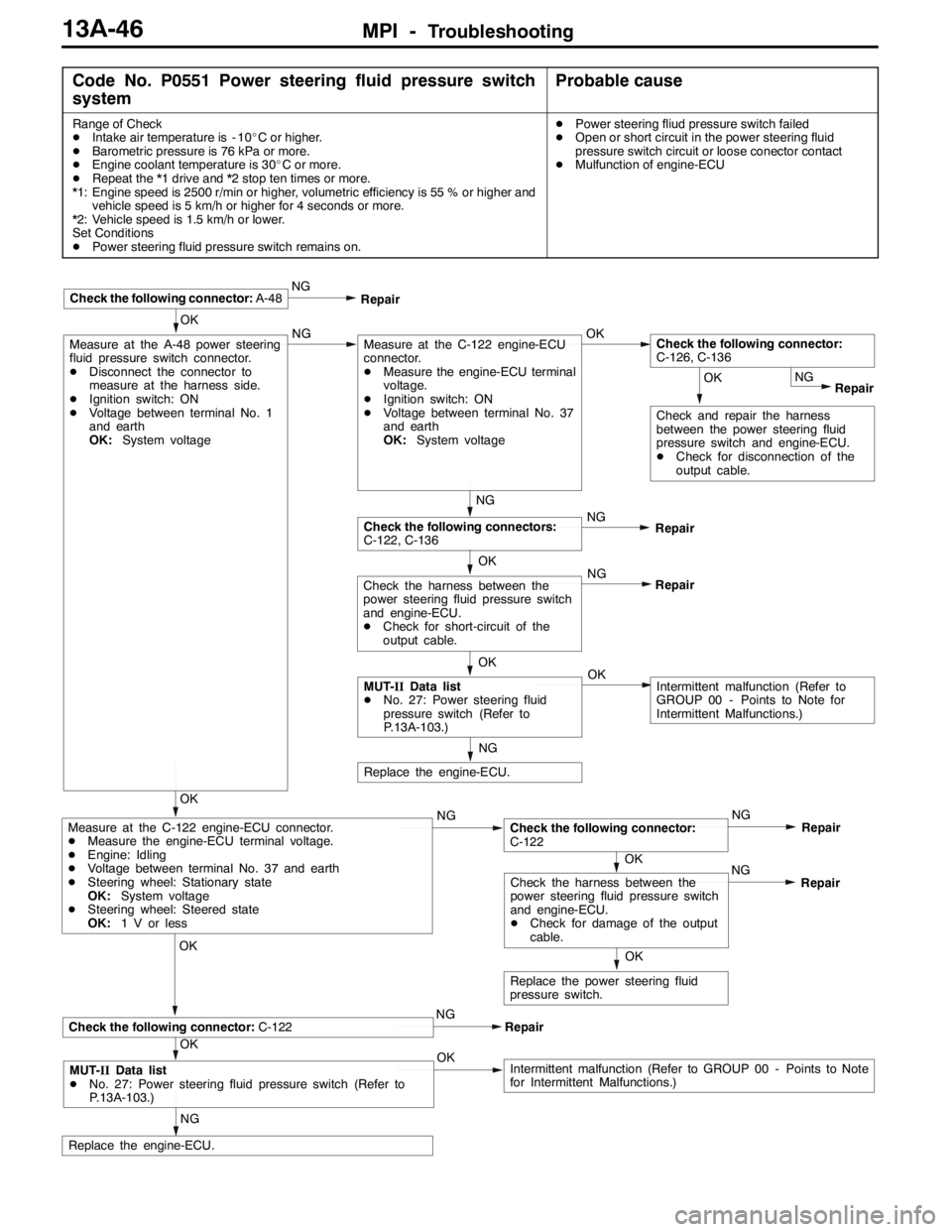
Code No. P0551 Power steering fluid pressure switch
systemProbable cause
Range of Check
DIntake air temperature is - 10_C or higher.
DBarometric pressure is 76 kPa or more.
DEngine coolant temperature is 30_C or more.
DRepeat the *1 drive and *2 stop ten times or more.
*1: Engine speed is 2500 r/min or higher, volumetric efficiency is 55 % or higher and
vehicle speed is 5 km/h or higher for 4 seconds or more.
*2: Vehicle speed is 1.5 km/h or lower.
Set Conditions
DPower steering fluid pressure switch remains on.DPower steering fliud pressure switch failed
DOpen or short circuit in the power steering fluid
pressure switch circuit or loose conector contact
DMulfunction of engine-ECU
NG
OKOK
NGCheck the following connectors:
C-122, C-136
NG
OKNG
OK
Check the harness between the
power steering fluid pressure switch
and engine-ECU.
DCheck for short-circuit of the
output cable.Repair Repair
OKIntermittent malfunction (Refer to GROUP 00 - Points to Note
for Intermittent Malfunctions.)
NG
OK
Measure at the A-48 power steering
fluid pressure switch connector.
DDisconnect the connector to
measure at the harness side.
DIgnition switch: ON
DVoltage between terminal No. 1
and earth
OK:System voltageNGMeasure at the C-122 engine-ECU
connector.
DMeasure the engine-ECU terminal
voltage.
DIgnition switch: ON
DVoltage between terminal No. 37
and earth
OK:System voltage
OK
NG
Replace the engine-ECU.
MUT-IIData list
DNo. 27: Power steering fluid pressure switch (Refer to
P.13A-103.)
OK
Check the following connector:A-48NG
Repair
NG
Repair OK
Check the following connector:
C-126, C-136
Check and repair the harness
between the power steering fluid
pressure switch and engine-ECU.
DCheck for disconnection of the
output cable.
Replace the engine-ECU.
OK
NG
MUT-IIData list
DNo. 27: Power steering fluid
pressure switch (Refer to
P.13A-103.)Intermittent malfunction (Refer to
GROUP 00 - Points to Note for
Intermittent Malfunctions.)
Measure at the C-122 engine-ECU connector.
DMeasure the engine-ECU terminal voltage.
DEngine: Idling
DVoltage between terminal No. 37 and earth
DSteering wheel: Stationary state
OK:System voltage
DSteering wheel: Steered state
OK:1 V or less
OK
Replace the power steering fluid
pressure switch.Repair
Check the following connector:
C-122NG
Repair
Check the following connector:C-122
Check the harness between the
power steering fluid pressure switch
and engine-ECU.
DCheck for damage of the output
cable.OK
Repair NG
Page 585 of 1449

MPI -Troubleshooting
Fig. 1
Vehicle
speedInitial ac-
celerator
pedal de-
pressionNormalHesitation
Sag
TimeFig. 2
Normal
Initial ac-
celerator
pedal de-
pression
IdlingStumble
Time Vehicle
speed
13A-53
PROBLEM SYMPTOMS TABLE (FOR YOUR INFORMATION)
ItemsSymptom
StartingWon’t startThe starter is used to crank the engine, but there is no combustion within the
cylinders, and the engine won’t start.
Fires up and diesThere is combustion within the cylinders, but then the engine soon stalls.
Hard startingEngine starts after cranking a while.
Idling
stability
HuntingEngine speed doesn’t remain constant; changes at idle.
stability
Rough idleUsually, a judgement can be based upon the movement of the tachometer
pointer, and the vibration transmitted to the steering wheel, shift lever, body, etc.
This is called rough idle.
Incorrect idle speedThe engine doesn’t idle at the usual correct speed.
Engine stall
(Die out)The engine stalls when the foot is taken from the accelerator pedal, regardless
of whether the vehicles is moving or not.
Engine stall
(Pass out)The engine stalls when the accelerator pedal is depressed or while it is being
used.
DrivingHesitation Sag“Hesitation” is the delay in response of the vehicle speed (engine speed) that
occurs when the accelerator is depressed in order to accelerate from the speed
at which the vehicle is now traveling, or a temporary drop in vehicle speed
(engine speed) during such acceleration.
Serious hesitation is called “sag”. (Refer to Fig. 1)
Poor accelerationPoor acceleration is inability to obtain an acceleration corresponding to the
degree of throttle opening, even though acceleration is smooth, or the inability
to reach maximum speed.
StumbleEngine speed increase is delayed when the accelerator pedal is initially
depressed for acceleration. (Refer to Fig. 2)
ShockThe feeling of a comparatively large impact or vibration when the engine is
accelerated or decelerated.
SurgeThis is repeated surging ahead during constant speed travel or during variable
speed travel.
KnockingA sharp sound like a hammer striking the cylinder walls during driving and which
adversely affects driving.
StoppingRun on
(“Dieseling”)The condition in which the engine continues to run after the ignition switch is
turned to “LOCK” (OFF) position. Also called “Dieseling”.
Page 636 of 1449

MPI -Troubleshooting13A-104
Item
No.Reference
page Inspection
procedure
No. Normal condition Inspection contents Inspection
item
25Barometric
pressure
Ignition switch: ONAltitude: 0 m101 kPaCode No.
P0105
13A-15
pressure
sensor
Altitude: 0 m95 kPa
P0105
Altitude: 0 m88 kPa
Altitude: 0 m81 kPa
27Power
steering
fluidEngine: Idle operationSteering wheel
stationaryOFFCode No.
P055113A-46
fluid
pressure
switchSteering wheel turningON
28A/C switchEngine: Idle operation
(When A/C switch isA/C switch: OFFOFFProcedure
No. 2613A-92
(WhenA/Cswitchis
ON, A/C compressor
should be operating.)A/C switch: ONON
No.26
34Air flow
sensorEngine: After
warm-upIdle operationONCode No.
P010013A-13
sensor
reset
signal
warm up
3,000 r/minOFF
P0100
37Volumetric
efficiency
DEngine coolant
temperature:
Idle operation15 - 35%--
efficiencytemperature:
85 - 95_C
DLightningand
2,500 r/min15 - 35%
DLightning and
accessories:
OFFExcessive
accellerationAccording to ac-
celeration, volu-
metric efficiency
is increased.
41Injectors*1Engine: CrankingWhen engine coolant
temperature is 0_C
(injection is carried out
for all cylinders simulta-
neously)25 - 37 ms--
When engine coolant
temperature is 20_C15 - 22 ms
When engine coolant
temperature is 80_C4.2 - 6.3 ms
Injectors*2DEngine coolant
temperature:
80–95_C
Engine: Idle operation1.5 - 2.7 ms--
80–95_C
DLamps, electric
cooling fan and
allaccessories:
2,500 r/min1.2 - 2.4 ms
allaccessories:
OFF
DTransmission:
Neutral
When engine is sud-
denly racedIncreases
Page 643 of 1449

MPI -Troubleshooting13A-111
Terminal No.Normal condition Check condition (Engine condition) Check item
37Power steering fluid
pressure switchEngine: Idling after
warming upWhen steering wheel
is stationarySystem voltage
When steering wheel
is turned1 V or less
38Engine control relayIgnition switch: “LOCK” (OFF)System voltage
Ignition switch: “ON”1 V or less
39Fuel pump relay 3While engine is idling, suddenly depress the
accelerator pedal.Temporarily rises slightly
from 1 V or less.
41Alternator FR
terminalDEngine: After warm-up, idle operation
DRadiator fan: Not operating
DHead lamp: OFF→ON
DStop lamp: OFF→ON
DRear deffogger switch: OFF→ONVoltage decrease
44Intercooler water
spray switch (Auto)DIgnition switch: “ON”
DIntercooler water spray switch: ON1 V or less
DIgnition switch: “ON”
DIntercooler water spray switch: OFFSystem voltage
45A/C switchEngine: Idle operationTurn the A/C switch
OFF0.5 V or less
DA/C switch: ON
DA/C setting
temperature
When room tem-
perature is 25_C
or more: Max
Cool
When room tem-
perature is 25_C
or less: Max. HotSystem voltage
53Secondary air control
solenoid valveIgnition switch: “ON”System voltage
54Oxygen sensor
heater(Rear)
Engine: Idling after warming up1 V or less
heater(Rear)
Engine speed: 5,000r/minSystem voltage
55Intercooler water
sprayrelay
Ignition switch: “ON”System voltage
spray relay
Ignition switch: “LOCK” (OFF)1 V or less
58Tachometer signalEngine speed: 3,000r/min0.3 - 3.0 V
60Oxygen sensor
heater(front)
Engine: Idling after warming up1 V or less
heater(front)
Engine speed: 5,000r/minSystem voltage
71Ignition switch - STEngine: Cranking8 V or more
Page 684 of 1449

FUEL SUPPLY - Fuel Tank13B-4
12
10
6 21
1
2
4
7 8
915 18
23 20
13 314
22
24 1119
5
16 175
2.5±0.5 N·m
2.5±0.5 N·m
26±4 N·m
22±4 N·m
Removal steps
1. Filler neck pipe, Filler neck vapour
pipe connection
2. Vapour pipe connection
3. Main pipe connection
4. Return pipe connection
DParking brake cable clamp (LH)
connection (Refer to GROUP 36.)
DRear wheel speed sensor (RH)
connection
(Refer to GROUP 35 - Wheel speed
sensor.)
DRear wheel speed sensor harness
connector connection
(Refer to GROUP 35 - Wheel speed
sensor.)
AA"5. Harness connector connection
AA"6. Fuel tank assembly
7. Fuel tank protector"AA8. Suction hose
"AA9. High-pressure fuel hose
10. Fuel tank pipe assembly
"AA11. High-pressure fuel hose
"BA12. Fuel tank return hose
13. Return hose
14. Fuel tank vapour hose
15. Check valve
16. Vapour hose
17. Pipe and gauge assembly
18. Plate
19. Fuel pump and gauge assembly
20. Parking
21. Fuel cut off valve assembly
22. Parking
23. Filler neck hose
24. Filler neck vapour hose
Page 727 of 1449
INTAKE AND EXHAUST -Exhaust Manifold15-21
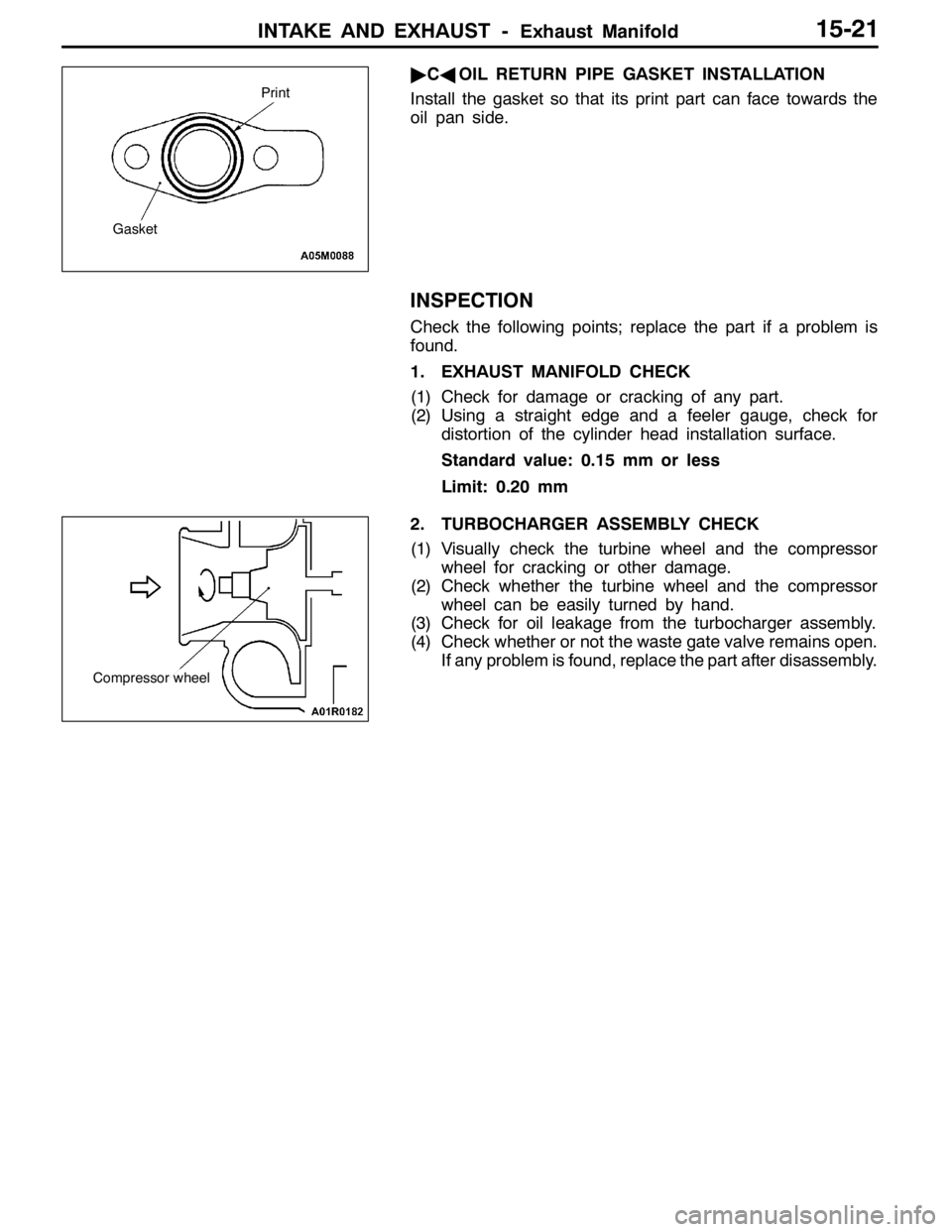
"CAOIL RETURN PIPE GASKET INSTALLATION
Install the gasket so that its print part can face towards the
oil pan side.
INSPECTION
Check the following points; replace the part if a problem is
found.
1. EXHAUST MANIFOLD CHECK
(1) Check for damage or cracking of any part.
(2) Using a straight edge and a feeler gauge, check for
distortion of the cylinder head installation surface.
Standard value: 0.15 mm or less
Limit: 0.20 mm
2. TURBOCHARGER ASSEMBLY CHECK
(1) Visually check the turbine wheel and the compressor
wheel for cracking or other damage.
(2) Check whether the turbine wheel and the compressor
wheel can be easily turned by hand.
(3) Check for oil leakage from the turbocharger assembly.
(4) Check whether or not the waste gate valve remains open.
If any problem is found, replace the part after disassembly.
Gasket
Print
Compressor wheel
Page 728 of 1449

INTAKE AND EXHAUST -Turbocharger15-22
TURBOCHARGER
DISASSEMBLY AND REASSEMBLY
5
11.3±1.5 Nm
4368
2
17
Disassembly steps
"FADInspection of turbocharger waste gate
actuator operation
1. E-ring
2. Waste gate actuator
"EA3. Coupling"DA4. Turbine housing
AA""CA5. Snap ring
AB""BA6. Turbine wheel assembly
7. Compressor cover
"AA8. O-ring