check engine MITSUBISHI LANCER EVOLUTION 2007 Service Service Manual
[x] Cancel search | Manufacturer: MITSUBISHI, Model Year: 2007, Model line: LANCER EVOLUTION, Model: MITSUBISHI LANCER EVOLUTION 2007Pages: 1449, PDF Size: 56.82 MB
Page 489 of 1449

ENGINE OVERHAUL -Rocker Arm and Camshaft11B-35
REMOVAL SERVICE POINT
AA"LASH ADJUSTER REMOVAL
Caution
When reusing the lash adjuster, always clean and inspect
it before installing. (Refer to the section on checking the
lash adjuster.)
INSTALLATION SERVICE POINTS
"AALASH ADJUSTER INSTALLATION
Caution
When reusing the lash adjuster, always clean and inspect
it before installing. (Refer to the section on checking the
lash adjuster.)
Assembly the lash adjuster onto the rocker arm while taking
care not to spill out diesel oil in it.
"BACAMSHAFT INSTALLATION
1. Apply engine oil on the camshaft journal and cam.
2. Install the camshaft onto the cylinder head.
Caution
Do not mistake the intake and exhaust camshafts.
There is a 4 mm width slit on the back end of the
exhaust side camshaft.
"CABEARING CAP INSTALLATION
1. Set the camshaft’s dowel pin to the approximate top.
2. The bearing caps No. 2 to 5 have the same shape. Check
the identification symbol before installing to prevent
mistaking the cap No., intake side and exhaust side.
Identification symbol
(Stamped on front and on No. 2 to 5 bearing caps)
I : Intake side
E : Exhaust side
Timing belt side
Slit
Exhaust side
Dowel pins
Cap No.
Identification
of IN side and
EX side
Page 497 of 1449
ENGINE OVERHAUL -Cylinder Head and Valve11B-43
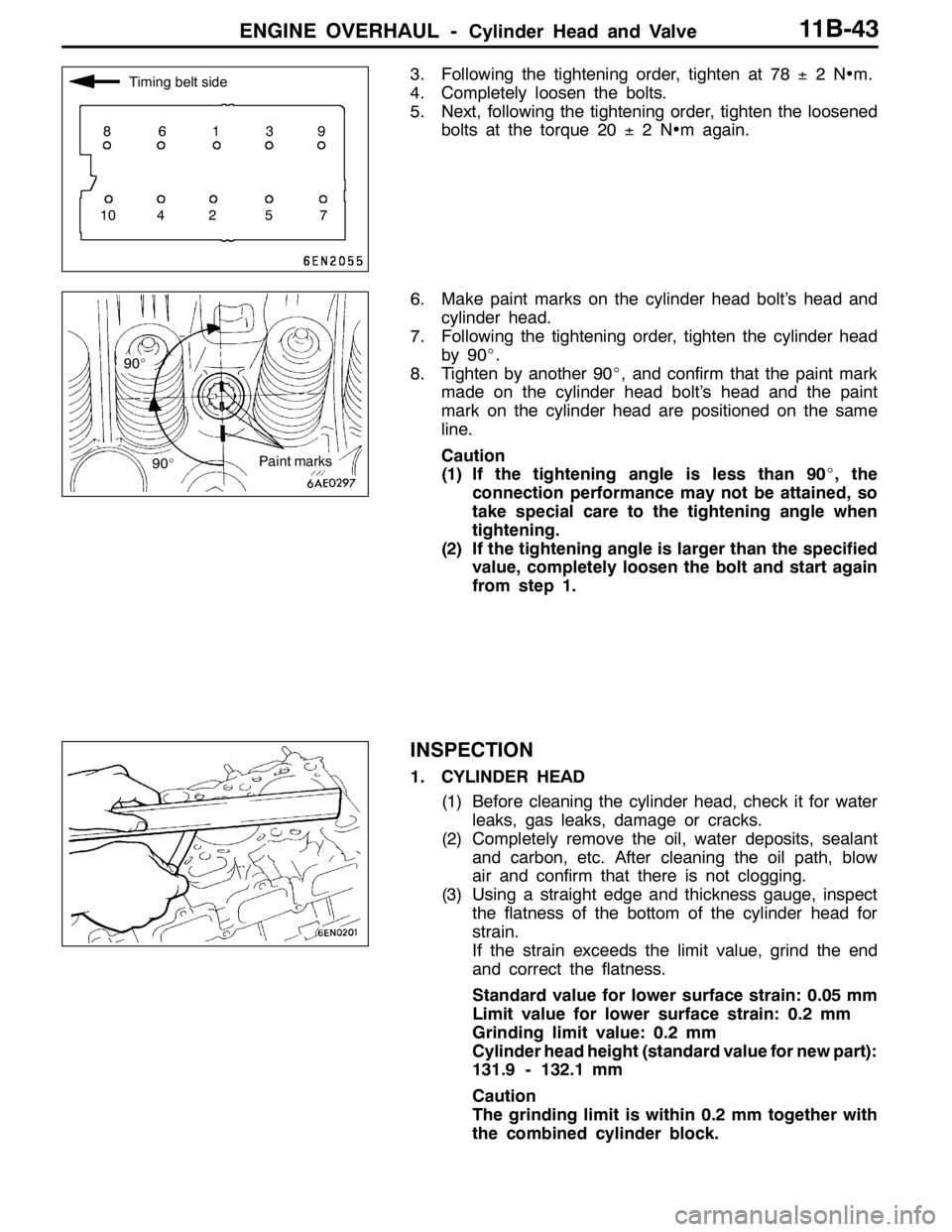
3. Following the tightening order, tighten at 78±2N•m.
4. Completely loosen the bolts.
5. Next, following the tightening order, tighten the loosened
bolts at the torque 20±2N•m again.
6. Make paint marks on the cylinder head bolt’s head and
cylinder head.
7. Following the tightening order, tighten the cylinder head
by 90_.
8. Tighten by another 90_, and confirm that the paint mark
made on the cylinder head bolt’s head and the paint
mark on the cylinder head are positioned on the same
line.
Caution
(1) If the tightening angle is less than 90_, the
connection performance may not be attained, so
take special care to the tightening angle when
tightening.
(2) If the tightening angle is larger than the specified
value, completely loosen the bolt and start again
from step 1.
INSPECTION
1. CYLINDER HEAD
(1) Before cleaning the cylinder head, check it for water
leaks, gas leaks, damage or cracks.
(2) Completely remove the oil, water deposits, sealant
and carbon, etc. After cleaning the oil path, blow
air and confirm that there is not clogging.
(3) Using a straight edge and thickness gauge, inspect
the flatness of the bottom of the cylinder head for
strain.
If the strain exceeds the limit value, grind the end
and correct the flatness.
Standard value for lower surface strain: 0.05 mm
Limit value for lower surface strain: 0.2 mm
Grinding limit value: 0.2 mm
Cylinder head height (standard value for new part):
131.9 - 132.1 mm
Caution
The grinding limit is within 0.2 mm together with
the combined cylinder block.
Timing belt side
86139
10 4 2 5 7
90_
90_
Paint marks
Page 508 of 1449

ENGINE OVERHAUL -Oil Pump and Oil Pan11B-54
"MADRAIN PLUG GASKET INSTALLATION
Replace the gasket with a new part, and install at the direction
shown in the illustration.
Caution
Incorrect installation direction will lead to oil leaks.
"NAOIL FILTER INSTALLATION
1. Clean the installation surface on the cylinder block side.
2. Apply engine oil on the O-ring for the oil filter.
3. Screw in the oil filter, and tighten approx. 3/4 of a rotation
(approx. 14±2N•m) from where the O-ring contacts
the installation surface.
INSPECTION
1. COUNTER BALANCE SHAFT
(1) Make sure that the oil hole is not clogged.
(2) Check the journal (bearing section) for seizure or
damage, and check the state of contact with the
bearings. If any faults are found, replace the counter
balance shaft, bearing or oil pump case assembly.
2. OIL COOLER BYPASS VALVE
(1) The valve must move smoothly.
(2) The L dimension must be at the standard value at
a constant temperature, constant humidity state.
Standard value: 34.5 mm
(3) The protruded dimensions must be at the standard
value after submerging into 100_C oil.
Standard value: 40 mm
Drain plug
Oil pan
Oil pan side Gasket
Bracket side
L
Valve
Page 513 of 1449
ENGINE OVERHAUL -Piston and Connecting Rod11B-59
"BAOIL RING INSTALLATION
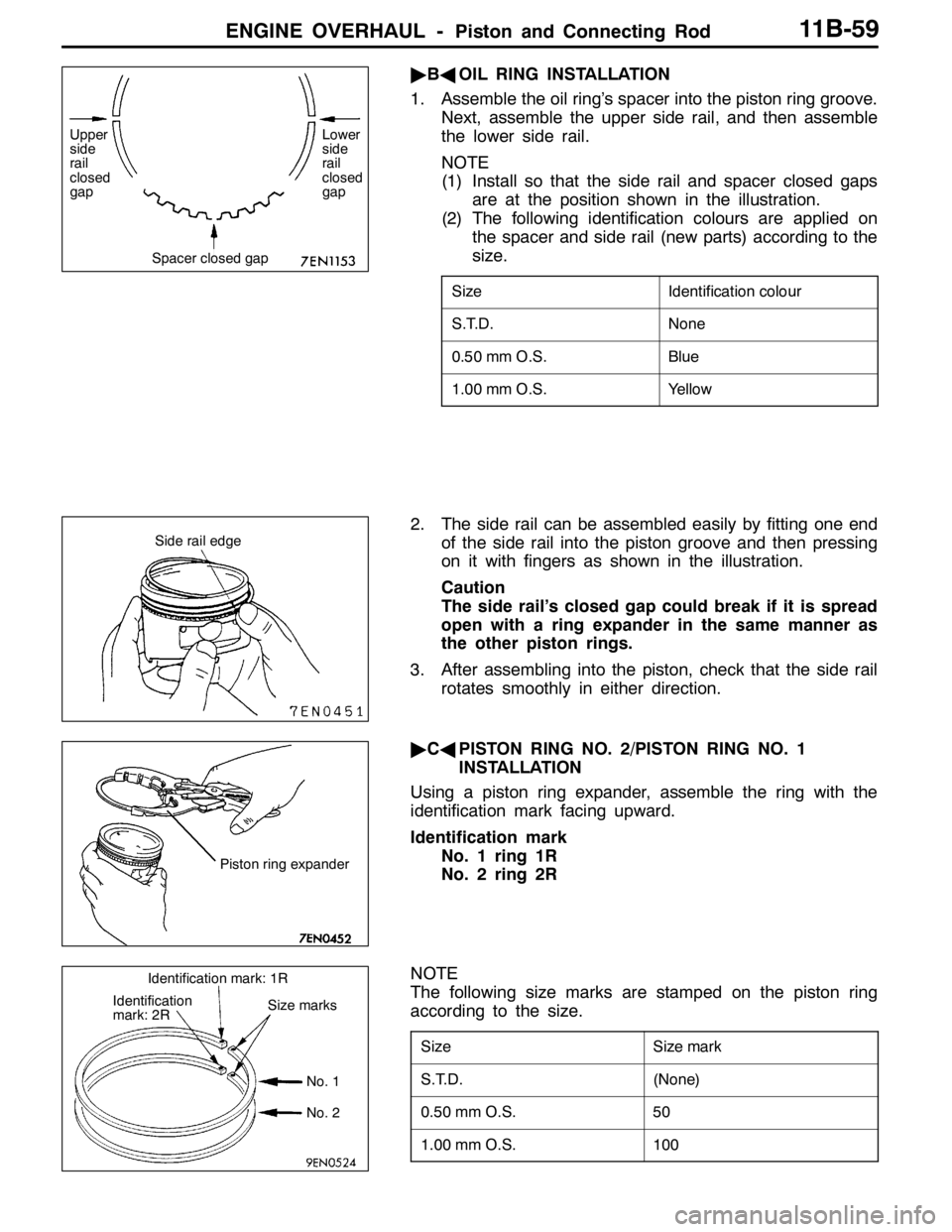
1. Assemble the oil ring’s spacer into the piston ring groove.
Next, assemble the upper side rail, and then assemble
the lower side rail.
NOTE
(1) Install so that the side rail and spacer closed gaps
are at the position shown in the illustration.
(2) The following identification colours are applied on
the spacer and side rail (new parts) according to the
size.
SizeIdentification colour
S.T.D.None
0.50 mm O.S.Blue
1.00 mm O.S.Yellow
2. The side rail can be assembled easily by fitting one end
of the side rail into the piston groove and then pressing
on it with fingers as shown in the illustration.
Caution
The side rail’s closed gap could break if it is spread
open with a ring expander in the same manner as
the other piston rings.
3. After assembling into the piston, check that the side rail
rotates smoothly in either direction.
"CAPISTON RING NO. 2/PISTON RING NO. 1
INSTALLATION
Using a piston ring expander, assemble the ring with the
identification mark facing upward.
Identification mark
No. 1 ring 1R
No. 2 ring 2R
NOTE
The following size marks are stamped on the piston ring
according to the size.
SizeSize mark
S.T.D.(None)
0.50 mm O.S.50
1.00 mm O.S.100
Spacer closed gap Upper
side
rail
closed
gapLower
side
rail
closed
gap
Side rail edge
Piston ring expander
Identification
mark: 2RSize marks
No. 1
No. 2 Identification mark: 1R
Page 516 of 1449

ENGINE OVERHAUL -Piston and Connecting Rod11B-62
9. Check that the thrust clearance at the large end of the
connecting rod is correct.
Standard value: 0.10 - 0.25 mm
Limit value: 0.4 mm
INSPECTION
1. PISTON RING
(1) Inspect the clearance between the piston ring and
ring groove. If the limit value is exceeded, replace
the piston ring or the piston ring and piston.
Standard value:
No. 1 0.03 - 0.07 mm
No. 2 0.02 - 0.06 mm
Limit value: 0.1 mm
(2) Place the piston ring and oil ring side rail into the
cylinder bore, and contact the piston front face side,
and press in. After attaining a right angle, measure
the closed gap with a thickness gauge.
NOTE
Press in the closed gap of the piston ring and oil
ring’s side rail at the position of the piston shown
in the illustration, and measure the closed gap.
Standard value:
No. 1 0.20 - 0.30 mm
No. 2 0.35 - 0.50 mm
Oil ring 0.10 - 0.40 mm
Standard value:
No. 1 0.8 mm
No. 2 0.8 mm
Oil ring 1.0 mm
Press in with piston
Piston ringClosed gap
Page 518 of 1449

ENGINE OVERHAUL -Crankshaft and Cylinder Block11B-64
CRANKSHAFT AND CYLINDER BLOCK
REMOVAL AND INSTALLATION
25±2N•m+90_- 100_
21
Apply engine oil on
all sliding sections
before installing.
4
5 6
73
8 9 1011
132±5N•m 11±1N•m
11±1N•m9±1N•m
32±2N•m
14
1312 15
Removal steps
1. Flywheel bolt
2. Flywheel
3. Rear plate
4. Bell housing cover
"EA5. Rear oil seal case
"DA6. Rear oil seal
"CA7. Bearing cap bolt
"CA8. Beam bearing cap"BA9. Crankshaft bearing lower
10. Crankshaft
"BA11. Crankshaft bearing upper
"AA12. Thrust bearing
13. Check valve
14. Oil jet
15. Cylinder block
Page 522 of 1449
ENGINE OVERHAUL -Crankshaft and Cylinder Block11B-68
INSPECTION
1. CRANKSHAFT OIL CLEARANCE (PLASTIC GAUGE
METHOD)
The oil clearance can be measured easily by using the
“plastic gauge”.
Use the following steps to use the “plastic gauge”.
(1) Wipe off all oil from the crankshaft’s outer diameter
and bearing’s inner diameter.
(2) Assemble the crankshaft.
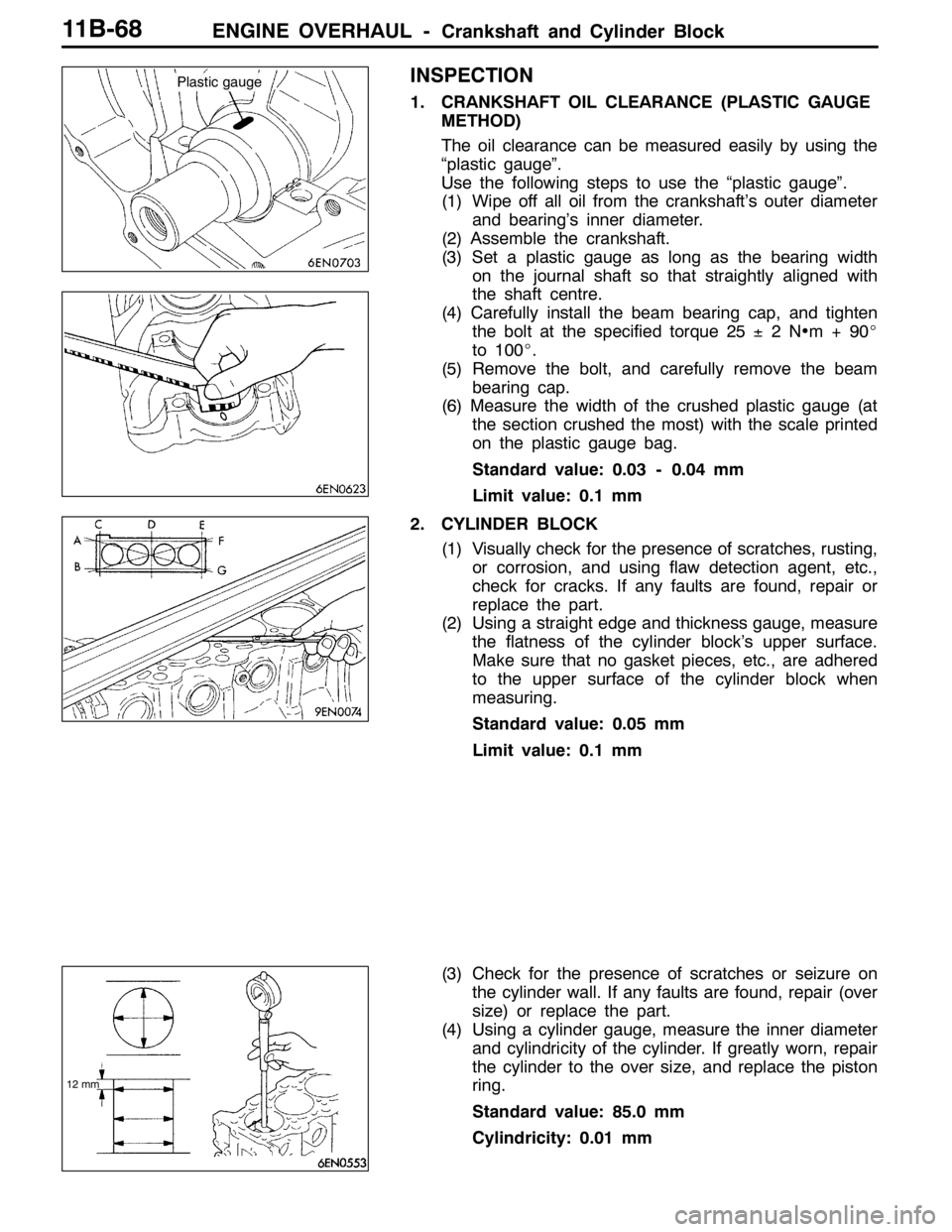
(3) Set a plastic gauge as long as the bearing width
on the journal shaft so that straightly aligned with
the shaft centre.
(4) Carefully install the beam bearing cap, and tighten
the bolt at the specified torque 25±2N•m+90_
to 100_.
(5) Remove the bolt, and carefully remove the beam
bearing cap.
(6) Measure the width of the crushed plastic gauge (at
the section crushed the most) with the scale printed
on the plastic gauge bag.
Standard value: 0.03 - 0.04 mm
Limit value: 0.1 mm
2. CYLINDER BLOCK
(1) Visually check for the presence of scratches, rusting,
or corrosion, and using flaw detection agent, etc.,
check for cracks. If any faults are found, repair or
replace the part.
(2) Using a straight edge and thickness gauge, measure
the flatness of the cylinder block’s upper surface.
Make sure that no gasket pieces, etc., are adhered
to the upper surface of the cylinder block when
measuring.
Standard value: 0.05 mm
Limit value: 0.1 mm
(3) Check for the presence of scratches or seizure on
the cylinder wall. If any faults are found, repair (over
size) or replace the part.
(4) Using a cylinder gauge, measure the inner diameter
and cylindricity of the cylinder. If greatly worn, repair
the cylinder to the over size, and replace the piston
ring.
Standard value: 85.0 mm
Cylindricity: 0.01 mm
Plastic gauge
12 mm
Page 525 of 1449

12-1
ENGINE
LUBRICATION
CONTENTS
GENERAL INFORMATION 2..................
SERVICE SPECIFICATIONS 3.................
SEALANT 3..................................
LUBRICANTS 3..............................
SPECIAL TOOL 3............................ON-VEHICLE SERVICE 4.....................
Engine Oil Check 4............................
Engine Oil Replacement 4.......................
Oil Filter Replacement 5........................
Oil Pressure Check 5..........................
ENGINE OIL COOLER 7......................
Page 528 of 1449
ENGINE LUBRICATION -On-vehicle Service12-4
ON-VEHICLE SERVICE
ENGINE OIL CHECK
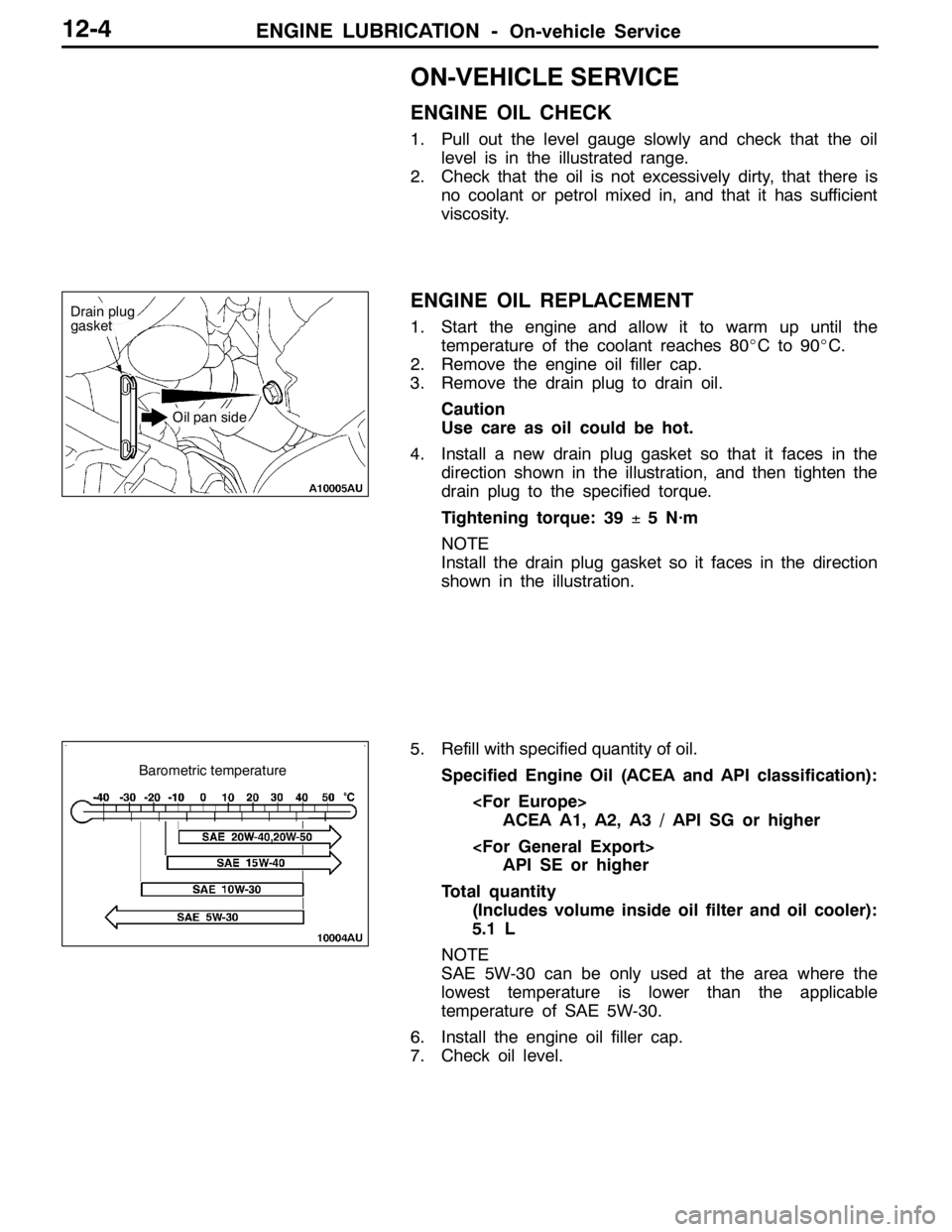
1. Pull out the level gauge slowly and check that the oil
level is in the illustrated range.
2. Check that the oil is not excessively dirty, that there is
no coolant or petrol mixed in, and that it has sufficient
viscosity.
ENGINE OIL REPLACEMENT
1. Start the engine and allow it to warm up until the
temperature of the coolant reaches 80_Cto90_C.
2. Remove the engine oil filler cap.
3. Remove the drain plug to drain oil.
Caution
Use care as oil could be hot.
4. Install a new drain plug gasket so that it faces in the
direction shown in the illustration, and then tighten the
drain plug to the specified torque.
Tightening torque: 39±5 N·m
NOTE
Install the drain plug gasket so it faces in the direction
shown in the illustration.
5. Refill with specified quantity of oil.
Specified Engine Oil (ACEA and API classification):
ACEA A1, A2, A3 / API SG or higher
API SE or higher
Total quantity
(Includes volume inside oil filter and oil cooler):
5.1 L
NOTE
SAE 5W-30 can be only used at the area where the
lowest temperature is lower than the applicable
temperature of SAE 5W-30.
6. Install the engine oil filler cap.
7. Check oil level.
Drain plug
gasket
Oil pan side
Barometric temperature
Page 529 of 1449
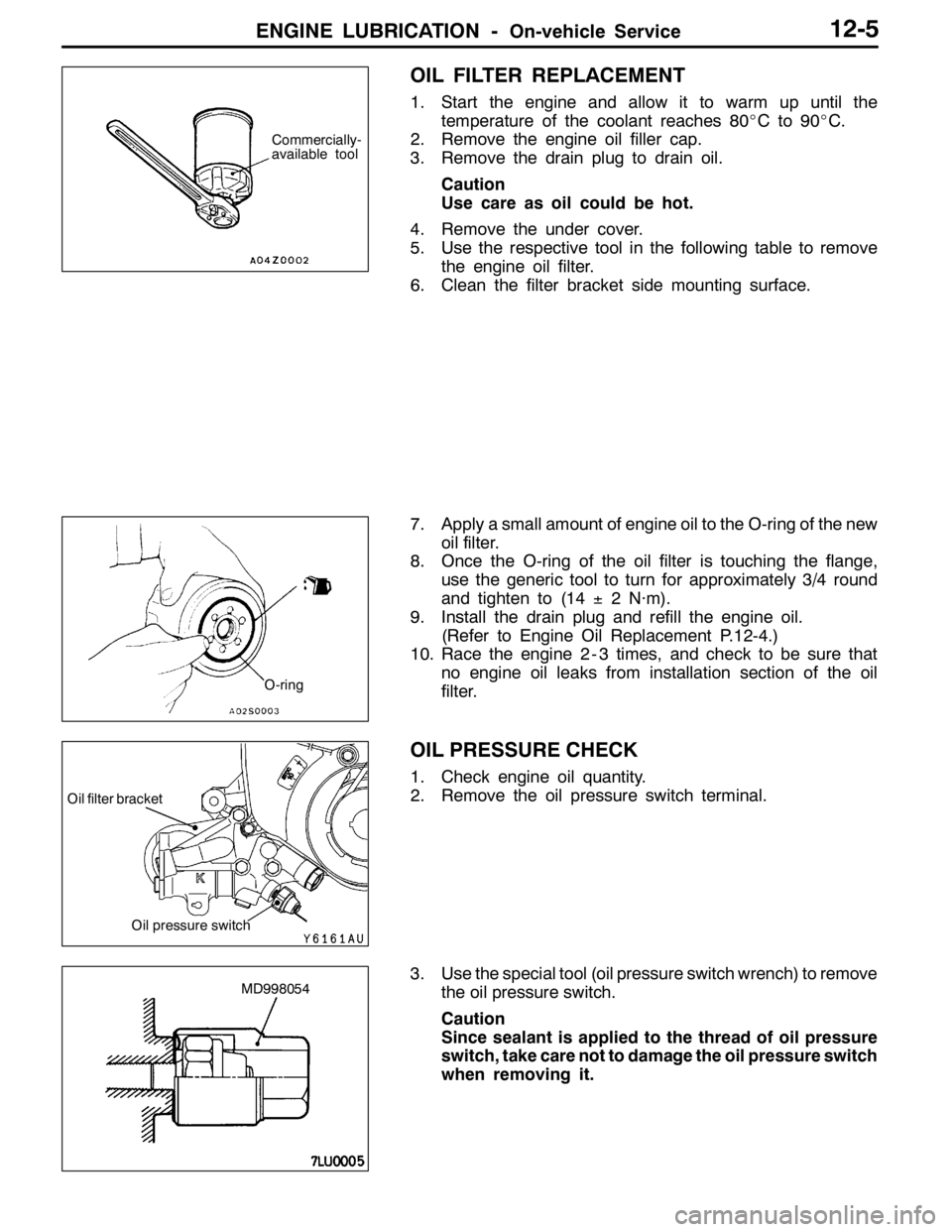
ENGINE LUBRICATION -On-vehicle Service12-5
OIL FILTER REPLACEMENT
1. Start the engine and allow it to warm up until the
temperature of the coolant reaches 80_Cto90_C.
2. Remove the engine oil filler cap.
3. Remove the drain plug to drain oil.
Caution
Use care as oil could be hot.
4. Remove the under cover.
5. Use the respective tool in the following table to remove
the engine oil filter.
6. Clean the filter bracket side mounting surface.
7. Apply a small amount of engine oil to the O-ring of the new
oil filter.
8. Once the O-ring of the oil filter is touching the flange,
use the generic tool to turn for approximately 3/4 round
and tighten to (14±2 N·m).
9. Install the drain plug and refill the engine oil.
(Refer to Engine Oil Replacement P.12-4.)
10. Race the engine 2 - 3 times, and check to be sure that
no engine oil leaks from installation section of the oil
filter.
OIL PRESSURE CHECK
1. Check engine oil quantity.
2. Remove the oil pressure switch terminal.
3. Use the special tool (oil pressure switch wrench) to remove
the oil pressure switch.
Caution
Since sealant is applied to the thread of oil pressure
switch, take care not to damage the oil pressure switch
when removing it.
Commercially-
available tool
O-ring
Oil pressure switch
Oil filter bracket
MD998054