check engine MITSUBISHI LANCER EVOLUTION 2007 Service Workshop Manual
[x] Cancel search | Manufacturer: MITSUBISHI, Model Year: 2007, Model line: LANCER EVOLUTION, Model: MITSUBISHI LANCER EVOLUTION 2007Pages: 1449, PDF Size: 56.82 MB
Page 530 of 1449

ENGINE LUBRICATION -On-vehicle Service12-6
4. Install the oil pressure gauge.
NOTE
Use a adapter of PT 1/8 thread.
5. Run the engine to warm it.
6. After the engine has been warmed up, check that oil
pressure is within the standard value.
Standard value:
At idle: 29 kPa or more
At 3,500 r/min: 294 - 686 kPa
7. Remove the oil pressure gauge.
8. Apply the specified sealant to the thread of oil pressure
switch.
Specified sealant: 3M ATD Part No. 8660 or equivalent
9. Use the special tool to tighten the oil pressure switch
to the specified torque.
Tightening torque: 10±2 N·m
Caution
Do not start the engine within one hour after the oil
pressure switch has been installed.
10. Install the oil pressure switch terminal.
MD998054
Page 534 of 1449

13A-2
MULTIPOINT FUEL
INJECTION (MPI)
CONTENTS
GENERAL INFORMATION 3...................
SERVICE SPECIFICATIONS 6.................
SEALANT 6..................................
SPECIAL TOOLS 7...........................
TROUBLESHOOTING 9.......................
ON-VEHICLE SERVICE 125..................
Fuel Pump Connector Disconnection
(How to Reduce the Fuel Pressure) 125...........
Fuel Pump Operation Check 125.................
Throttle Body (Throttle Valve Area)
Cleaning 126..................................
Throttle Position Sensor Adjustment 126...........
Basic Idle Speed Adjustment 127.................
Fuel Pressure Test 128..........................
Component Location 131........................
Engine Control Relay Continuity Check 132........
Fuel Pump Relay 1, 2 Continuity Check 132........Fuel Pump Relay 3 Continuity Check 132..........
Fuel Pump Resistor Check 132...................
Intake Air Temperature Sensor Check 132.........
Engine Coolant Temperature Sensor Check 133....
Throttle Position Sensor Check 134...............
Oxygen Sensor Check 134......................
Injector Check 136..............................
Resistor (for Injector) Check 138..................
Idle Speed Control Servo (Stepper Motor)
Check 138.....................................
Fuel Pressure Control Solenoid Valve Check 140...
Purge Control Solenoid Valve Check 140..........
EGR Control Solenoid Valve Check 140...........
INJECTOR 141..............................
THROTTLE BODY 143.......................
ENGINE CONTROL RESISTOR, RELAY 146....
ENGINE-ECU 147...........................
Page 535 of 1449

MPI -General Information13A-3
GENERAL INFORMATION
The Multipoint Fuel Injection System consists
of sensors which detect the engine conditions,
the engine-ECU which controls the system
based on signals from these sensors, and
actuators which operate under the control of
the engine-ECU. The engine-ECU carries outactivities such as fuel injection control, idle
speed control and ignition timing control. In
addition, the engine-ECU is equipped with
several diagnosis modes which simplify
troubleshooting when a problem develops.
FUEL INJECTION CONTROL
The injector drive times and injector timing are
controlled so that the optimum air/fuel mixture
is supplied to the engine to correspond to the
continually-changing engine operation condi-
tions.
A single injector is mounted at the intake port
of each cylinder. Fuel is sent under pressure
from the fuel tank by the fuel pump, with the
pressure being regulated by the fuel pressure
regulator. The fuel thus regulated is distributed
to each of the injectors.
Fuel injection is normally carried out once for
each cylinder for every two rotations of the
crankshaft. The firing order is 1-3-4-2. This iscalled sequential fuel injection. The
engine-ECU provides a richer air/fuel mixture
by carrying out “open-loop” control when the
engine is cold or operating under high load
conditions in order to maintain engine
performance. In addition, when the engine is
warm or operating under normal conditions,
the engine-ECU controls the air/fuel mixture
by using the oxygen sensor signal to carry out
“closed-loop” control in order to obtain the
theoretical air/fuel mixture ratio that provides
the maximum cleaning performance from the
three way catalyst.
IDLE AIR CONTROL
The idle speed is kept at the optimum speed
by controlling the amount of air that bypasses
the throttle valve in accordance with changes
in idling conditions and engine load during
idling. The engine-ECU drives the idle speed
control motor to keep the engine running at
the pre-set idle target speed in accordance
with the engine coolant temperature and airconditioner load. In addition, when the air
conditioner switch is turned off and on while
the engine is idling, the idle speed control motor
operates to adjust the throttle valve bypass
air amount in accordance with the engine load
conditions in order to avoid fluctuations in the
engine speed.
IGNITION TIMING CONTROL
The power transistor located in the ignition
primary circuit turns ON and OFF to control
the primary current flow to the ignition coil. This
controls the ignition timing in order to provide
the optimum ignition timing with respect to theengine operating conditions. The ignition timing
is determined by the engine-ECU from the
engine speed, intake air volume, engine coolant
temperature and barometric pressure.
SELF-DIAGNOSIS FUNCTION
DWhen an abnormality is detected in one
of the sensors or actuators related to
emission control, the engine warning lamp
(check engine lamp) illuminates as a
warning to the driver.
DWhen an abnormality is detected in one
of the sensors or actuators, a diagnosis
code corresponding to the abnormality is
output.DThe RAM data inside the engine-ECU that
is related to the sensors and actuators can
be read by means of the MUT-II. In addition,
the actuators can be force-driven under
certain circumstances.
Page 537 of 1449

MPI -General Information13A-5
MULTI-POINT FUEL INJECTION SYSTEM DIAGRAM
L1 Oxygen sensor (front)
L2 Oxygen sensor (rear)
L3 Air flow sensor
L4 Intake air temperature sensor
L5 Throttle position sensor
L6 Camshaft position sensor
L7 Crank angle sensor
L8 Barometric pressure sensor
L9 Engine coolant temperature sensor
L10 Detonation sensor
Engine-ECU
l1 Injector
l2 Idle speed control servo
l3 Fuel pressure control solenoid valve
l4 Waste gate solenoid valve
l5 EGR control solenoid valve
l6 Purge control solenoid valve
l7 Secondary air control solenoid valve
DPower supply
DIgnition switch IG
DIgnition switch ST
DVehicle speed sensor
DA/C switch
DA/C load signal
DTachometer
DPower steering fluid pressure switch
DAlternator FR terminal
DDiagnosis control terminal
DIntercooler water spray switch (automatic)
DIntercooler water spray switch (manual)DEngine control relay
DFuel pump relay 2, 3
DA/C relay
DIgnition coil
DFan controller
DCondenser fan relay (HI)
DCondenser fan relay (LOW)
DEngine warning lamp
DDiagnosis output
DAlternator G terminal
DIntercooler water spray relay
DIntercooler water spray lamp
L1 Oxygen
sensor
(front)
L4 Intake air
temperature
sensorL5 Throttle
position
sensor
L6 Camshaft
position sensorl1 Injector l2 Idle
speed
control
servo
l6 Purge
control
solenoid
valve
Three-way
catalytic converter Canister
Air
inletVacuum
tank
Fuel
pressure
reguratorFrom
fuel tank
To fuel tank
PCV valveFrom
fuel pump
Waste gate
actuatorL2 Oxygen sensor (rear) Check
valveBy-pass
valve
l5 EGR control
solenoid valve
l4 Waste gate
solenoid valve L8 Barometric
pressure
sensor
L3 Air flow
sensorl7 Secondary
air control
solenoid
valve
Secondary
air valvel3 Fuel pressure
control
solenoid valve
EGR
valve
L9 Engine coolant
temperature sensor
L7 Crank angle sensor
L10 Detonation sensor
Page 541 of 1449

MPI -Troubleshooting13A-9
TROUBLESHOOTING
DIAGNOSIS TROUBLESHOOTING FLOW
Refer to GROUP 00 - How to Use Troubleshooting/Inspection
Service Point.
NOTE
If the engine-ECU is replaced, the immobilizer-ECU and
ignition key should be replaced together with it.
DIAGNOSIS FUNCTION
ENGINE WARNING LAMP (CHECK ENGINE LAMP)
If an abnormality occurs in any of the following items related
to the MPI system, the engine warning lamp will illuminate
or flash. If the lamp remains illuminated or if the lamp
illuminates while the engine is running, check the diagnosis
code output.
However, the warning lamp will illuminate as bulb check for
5 seconds whenever the ignition switch is turned to the ON
position.
Engine warning lamp inspection items
Code No.Diagnosis item
-Engine-ECU
P0100Air flow sensor system
P0105Barometric pressure sensor system
P0110Intake air temprature sensor system
P0115Engine coolant temperature sensor system
P0120Throttle position sensor system
P0130Oxygen sensor (front) system
P0135Oxygen sensor heater (front) system
P0136Oxygen sensor (rear) system
P0141Oxygen sensor heater (rear) system
P0201No.1 injector system
P0202No.2 injector system
P0203No.3 injector system
P0204No.4 injector system
P0325Detonation sensor system
P0335Crank angle sensor system
P0340Camshaft position sensor system
P0403EGR control solenoid valve system
Engine warning lamp
(check engine lamp)
Page 542 of 1449

MPI -TroubleshootingMPI -Troubleshooting13A-10
Code No. Diagnosis item
P0443Purge control solenoid valve system
P0500Vehicle speed sensor system
P0505Idle speed control system
P0551Power steering fluid pressure switch
P1104Waste gate solenoid valve system
P1105Fuel pressure control solenoid valve system
NOTE
If the engine warning lamp illuminates because of a malfunction of the engine-ECU, communication between
MUT-IIand the engine-ECU is impossible. In this case, the diagnosis code cannot be read.
METHOD OF READING AND ERASING DIAGNOSIS
CODES
Refer to GROUP 00 - How to Use Troubleshooting/Inspection
Service Points.
INSPECTION USING MUT-IIDATA LIST AND ACTUATOR
TESTING
1. Carry out inspection by means of the data list and the
actuator test function. If there is an abnormality, check
and repair the chassis harnesses and components.
2. After repairing, re-check using the MUT-IIand check that
the abnormal input and output have returned to normal
as a result of the repairs.
3. Erase the diagnosis code memory.
4. Remove the MUT-II, and then start the engine again and
carry out a road test to confirm that the problem has
disappeared.
Page 545 of 1449
MPI -Troubleshooting13A-13
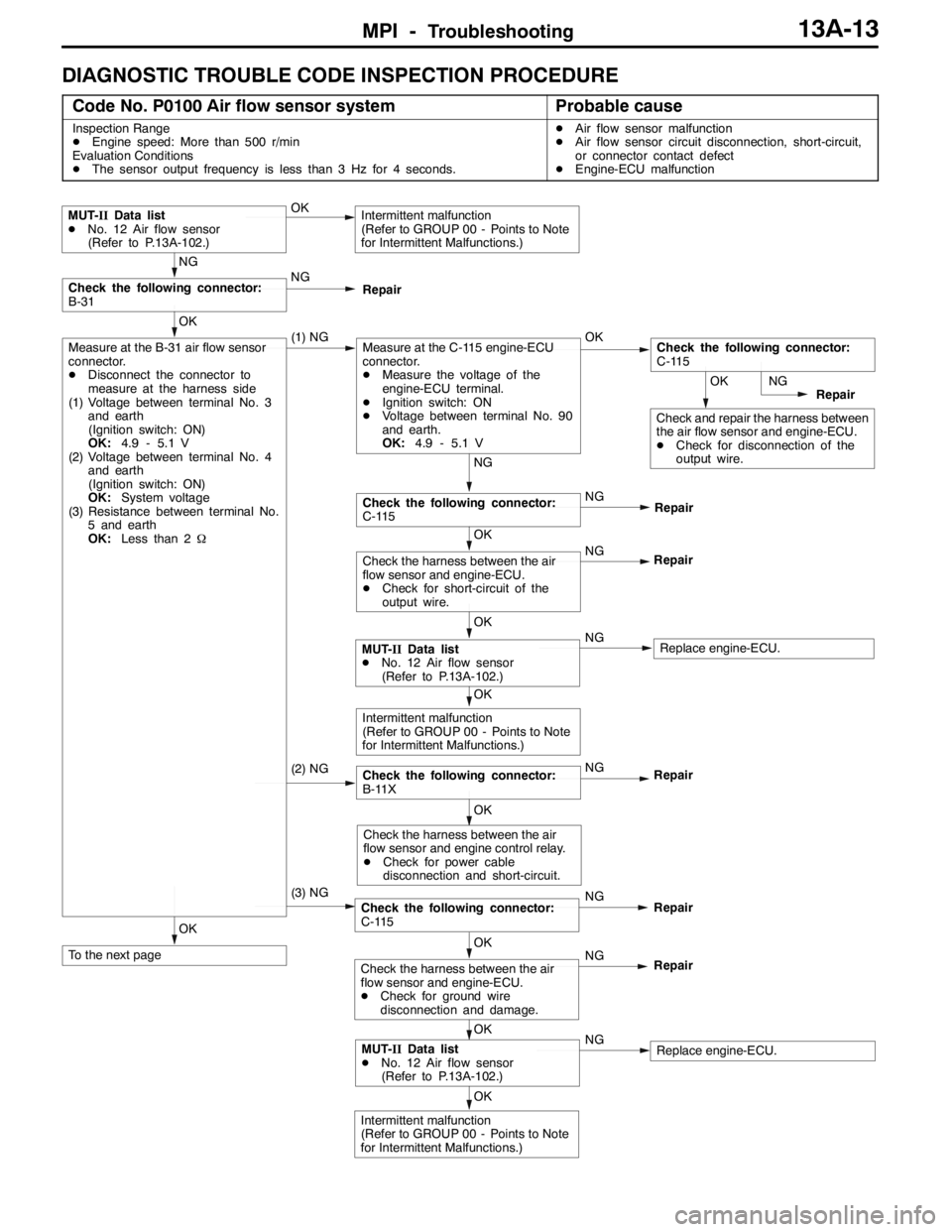
DIAGNOSTIC TROUBLE CODE INSPECTION PROCEDURE
Code No. P0100 Air flow sensor systemProbable cause
Inspection Range
DEngine speed: More than 500 r/min
Evaluation Conditions
DThe sensor output frequency is less than 3 Hz for 4 seconds.DAir flow sensor malfunction
DAir flow sensor circuit disconnection, short-circuit,
or connector contact defect
DEngine-ECU malfunction
OK
Intermittent malfunction
(Refer to GROUP 00 - Points to Note
for Intermittent Malfunctions.)
OK
MUT-IIData list
DNo. 12 Air flow sensor
(Refer to P.13A-102.)NGReplace engine-ECU.
OK
To the next pageOK
Check the harness between the air
flow sensor and engine-ECU.
DCheck for ground wire
disconnection and damage.NG
Repair
(3) NGCheck the following connector:
C-115NG
Repair
OK
Check the harness between the air
flow sensor and engine control relay.
DCheck for power cable
disconnection and short-circuit.
(2) NGCheck the following connector:
B-11XNG
OK
Intermittent malfunction
(Refer to GROUP 00 - Points to Note
for Intermittent Malfunctions.)
OK
MUT-IIData list
DNo. 12 Air flow sensor
(Refer to P.13A-102.)NGReplace engine-ECU.
OK
Check the harness between the air
flow sensor and engine-ECU.
DCheck for short-circuit of the
output wire.NG
Repair
NG
Check the following connector:
C-115NG
Repair
OK
Check and repair the harness between
the air flow sensor and engine-ECU.
DCheck for disconnection of the
output wire.NG
Repair
OK
Measure at the B-31 air flow sensor
connector.
DDisconnect the connector to
measure at the harness side
(1) Voltage between terminal No. 3
and earth
(Ignition switch: ON)
OK:4.9 - 5.1 V
(2) Voltage between terminal No. 4
and earth
(Ignition switch: ON)
OK:System voltage
(3) Resistance between terminal No.
5 and earth
OK:Less than 2Ω(1) NGMeasure at the C-115 engine-ECU
connector.
DMeasure the voltage of the
engine-ECU terminal.
DIgnition switch: ON
DVoltage between terminal No. 90
and earth.
OK:4.9 - 5.1 VOKCheck the following connector:
C-115
NG
Check the following connector:
B-31NG
Repair
MUT-IIData list
DNo. 12 Air flow sensor
(Refer to P.13A-102.)OKIntermittent malfunction
(Refer to GROUP 00 - Points to Note
for Intermittent Malfunctions.)
Repair
Page 546 of 1449
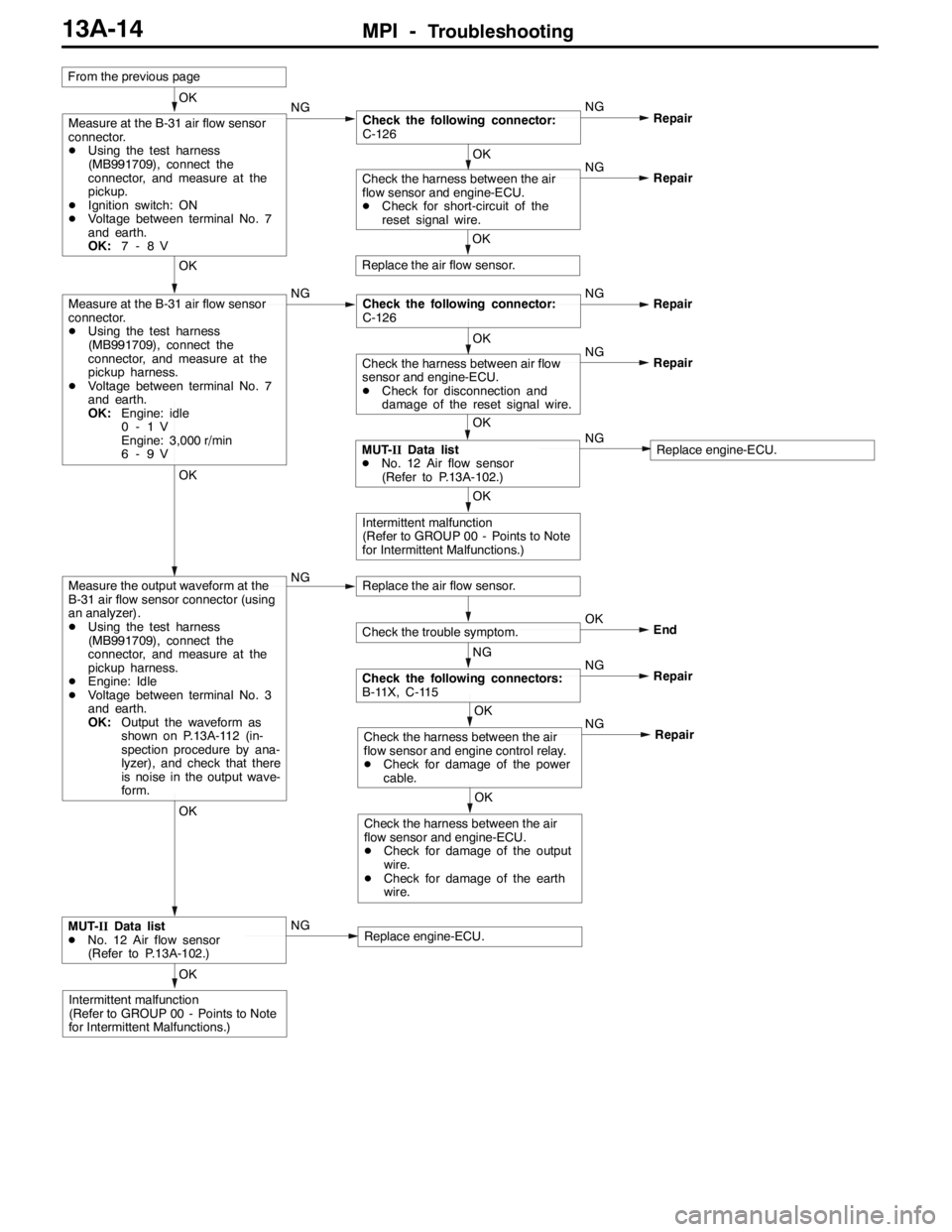
MPI -Troubleshooting13A-14
OK
Check the harness between the air
flow sensor and engine-ECU.
DCheck for damage of the output
wire.
DCheck for damage of the earth
wire.NG
OK
Check the harness between the air
flow sensor and engine control relay.
DCheck for damage of the power
cable.Repair NG
NG
Check the following connectors:
B-11X, C-115Repair OK
Check the trouble symptom.End
OK
Intermittent malfunction
(Refer to GROUP 00 - Points to Note
for Intermittent Malfunctions.)
OK
MUT-IIData list
DNo. 12 Air flow sensor
(Refer to P.13A-102.)NGReplace engine-ECU.
Replace the air flow sensor.
OK
Intermittent malfunction
(Refer to GROUP 00 - Points to Note
for Intermittent Malfunctions.)
OK
Measure the output waveform at the
B-31 air flow sensor connector (using
an analyzer).
DUsing the test harness
(MB991709), connect the
connector, and measure at the
pickup harness.
DEngine: Idle
DVoltage between terminal No. 3
and earth.
OK:Output the waveform as
shown on P.13A-112 (in-
spection procedure by ana-
lyzer), and check that there
is noise in the output wave-
form.NG
OK
MUT-IIData list
DNo. 12 Air flow sensor
(Refer to P.13A-102.)NGReplace engine-ECU.
OK
Check the harness between air flow
sensor and engine-ECU.
DCheck for disconnection and
damage of the reset signal wire.NG
Repair
OK
Measure at the B-31 air flow sensor
connector.
DUsing the test harness
(MB991709), connect the
connector, and measure at the
pickup harness.
DVoltage between terminal No. 7
and earth.
OK:Engine: idle
0-1V
Engine: 3,000 r/min
6-9VNGCheck the following connector:
C-126NGRepair
OK
Replace the air flow sensor.
OK
Check the harness between the air
flow sensor and engine-ECU.
DCheck for short-circuit of the
reset signal wire.NG
Repair
OK
Measure at the B-31 air flow sensor
connector.
DUsing the test harness
(MB991709), connect the
connector, and measure at the
pickup.
DIgnition switch: ON
DVoltage between terminal No. 7
and earth.
OK:7-8VNGCheck the following connector:
C-126NGRepair
From the previous page
Page 547 of 1449
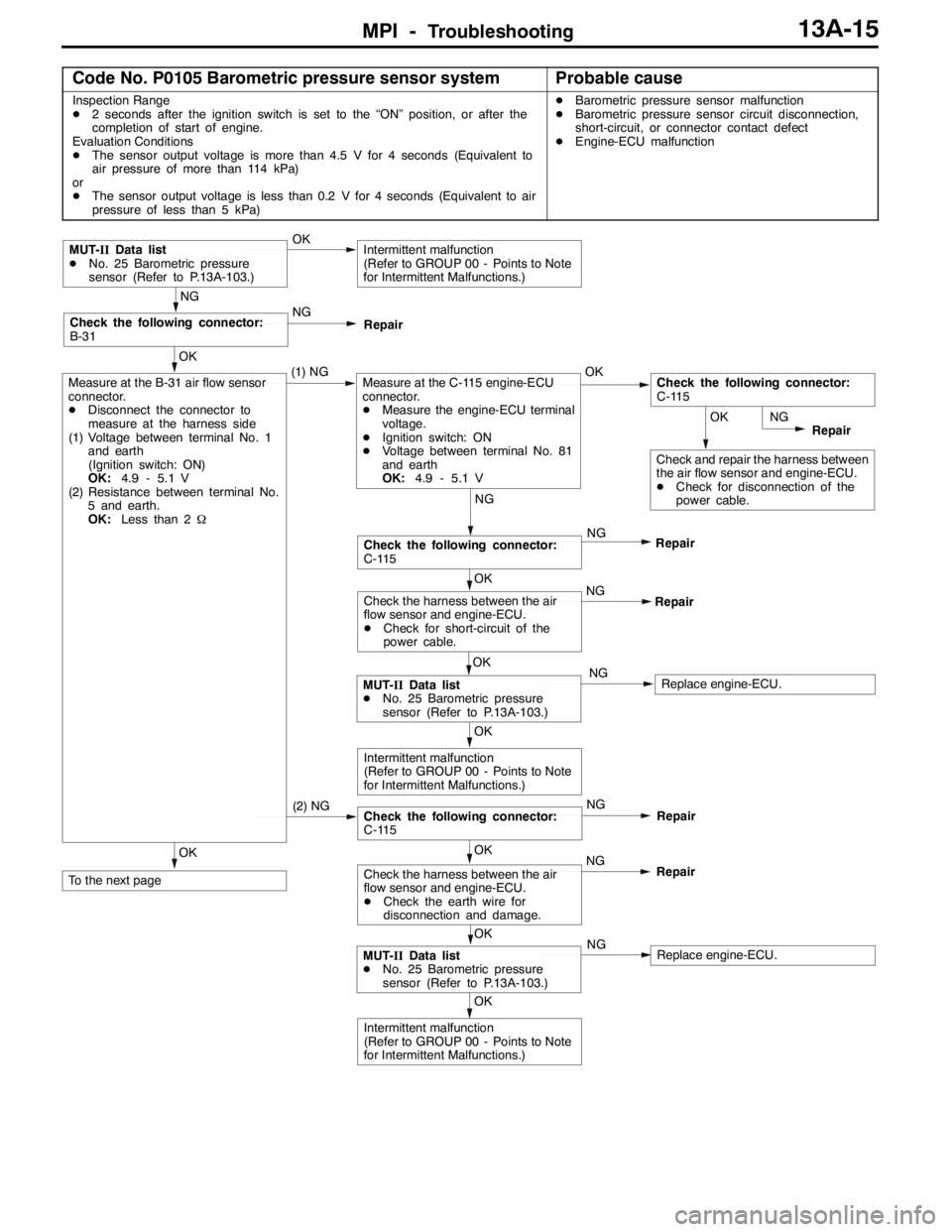
MPI -Troubleshooting13A-15
Code No. P0105 Barometric pressure sensor systemProbable cause
Inspection Range
D2 seconds after the ignition switch is set to the “ON” position, or after the
completion of start of engine.
Evaluation Conditions
DThe sensor output voltage is more than 4.5 V for 4 seconds (Equivalent to
air pressure of more than 114 kPa)
or
DThe sensor output voltage is less than 0.2 V for 4 seconds (Equivalent to air
pressure of less than 5 kPa)DBarometric pressure sensor malfunction
DBarometric pressure sensor circuit disconnection,
short-circuit, or connector contact defect
DEngine-ECU malfunction
OK
To the next page
OK
Intermittent malfunction
(Refer to GROUP 00 - Points to Note
for Intermittent Malfunctions.)
OK
MUT-IIData list
DNo. 25 Barometric pressure
sensor (Refer to P.13A-103.)NGReplace engine-ECU.
OK
Check the harness between the air
flow sensor and engine-ECU.
DCheck the earth wire for
disconnection and damage.NG
Repair
(2) NGCheck the following connector:
C-115NG
Repair
OK
Intermittent malfunction
(Refer to GROUP 00 - Points to Note
for Intermittent Malfunctions.)
OK
MUT-IIData list
DNo. 25 Barometric pressure
sensor (Refer to P.13A-103.)NGReplace engine-ECU.
OK
Check the harness between the air
flow sensor and engine-ECU.
DCheck for short-circuit of the
power cable.NG
Repair
NG
Check the following connector:
C-115NG
Repair
OK
Check and repair the harness between
the air flow sensor and engine-ECU.
DCheck for disconnection of the
power cable.NG
Repair
OK
Measure at the B-31 air flow sensor
connector.
DDisconnect the connector to
measure at the harness side
(1) Voltage between terminal No. 1
and earth
(Ignition switch: ON)
OK:4.9 - 5.1 V
(2) Resistance between terminal No.
5 and earth.
OK:Less than 2Ω(1) NGMeasure at the C-115 engine-ECU
connector.
DMeasure the engine-ECU terminal
voltage.
DIgnition switch: ON
DVoltage between terminal No. 81
and earth
OK:4.9 - 5.1 VOKCheck the following connector:
C-115
NG
Check the following connector:
B-31NG
Repair
MUT-IIData list
DNo. 25 Barometric pressure
sensor (Refer to P.13A-103.)OKIntermittent malfunction
(Refer to GROUP 00 - Points to Note
for Intermittent Malfunctions.)
Page 548 of 1449

MPI -Troubleshooting13A-16
OK
Intermittent malfunction
(Refer to GROUP 00 - Points to Note
for Intermittent Malfunctions.)
OK
MUT-IIData list
DNo. 25 Barometric pressure
sensor (Refer to P.13A-103.)NGReplace engine-ECU.
OK
Check the following connector:
C-115NG
Repair
OK
Check and repair the harness between
the air flow sensor and engine-ECU.
DCheck for disconnection and
damage of the output wire.
OK
Measure at the C-115 engine-ECU
connector.
DMeasure the engine-ECU terminal
voltage.
DIgnition switch: ON
DVoltage between terminal No. 85
and earth.
OK:High 0 m 3.8 - 4.2 V
High 600 m 3.5 - 3.9 V
High 1,200 m 3.3 - 3.7 V
High 1,800 m 3.0 - 3.4 VNGCheck the following connector:
C-115NGRepair
OK
Replace the air flow sensor.
OK
Check the harness between the air
flow sensor and engine-ECU.
DCheck for short-circuit and
damage of the output wire.NG
Repair
(3) NGCheck the following connector:
C-115NG
Repair
OK
Check and repair the harness between
the air flow sensor and engine-ECU.
DCheck for damage of the power
cable.
DCheck for damage of the earth
wire.
OK
Measure at the B-31 air flow sensor
connector.
DUsing the test harness
(MB991709), connect only
connector terminals No. 1, No. 2,
and No. 5, and measure at the
pickup harness.
DIgnition switch: ON
(1) Voltage between terminal No. 1
and earth
OK:4.9 - 5.1 V
(2) Voltage between terminal No. 5
and earth
OK:Less than 0.5 V
(3) Voltage from No. 2 to earth
OK:High 0 m 3.8 - 4.2 V
High 600 m 3.5 - 3.9 V
High 1,200 m 3.3 - 3.7 V
High 1,800 m 3.0 - 3.4 V(1), (2) NGCheck the following connectors:
C-115NGRepair
From the previous page
Code No. P0110 Intake air temperature sensor systemProbable cause
Inspection Range
DAfter setting the ignition switch to the “ON” position, or after 2 seconds from
completion of start.
Evaluation Conditions
DThe sensor output voltage is more than 4.6 V for 4 seconds (Equivalent to intake
air temperature less than - 40_C)
or
DThe sensor output voltage is less than 0.2 V for 4 seconds (Equivalent to intake
air temperature of more than 120_C)DIntake air temperature sensor malfunction
DIntake air temperature sensor circuit disconnection,
short-circuit, or connector contact defect
DEngine-ECU malfunction