check engine MITSUBISHI LANCER EVOLUTION 2007 Service Owner's Guide
[x] Cancel search | Manufacturer: MITSUBISHI, Model Year: 2007, Model line: LANCER EVOLUTION, Model: MITSUBISHI LANCER EVOLUTION 2007Pages: 1449, PDF Size: 56.82 MB
Page 447 of 1449
ENGINE -Timing Belt and Timing Belt B11A-41
2. Rotate the crankshaft counterclockwise for 1/4 round.
3. Rotate the crankshaft clockwise and mate timing marks
with each other to position No.1 cylinder at compression
TDC.
4. Loosen the temporarily tightened tensioner pulley
mounting bolt.
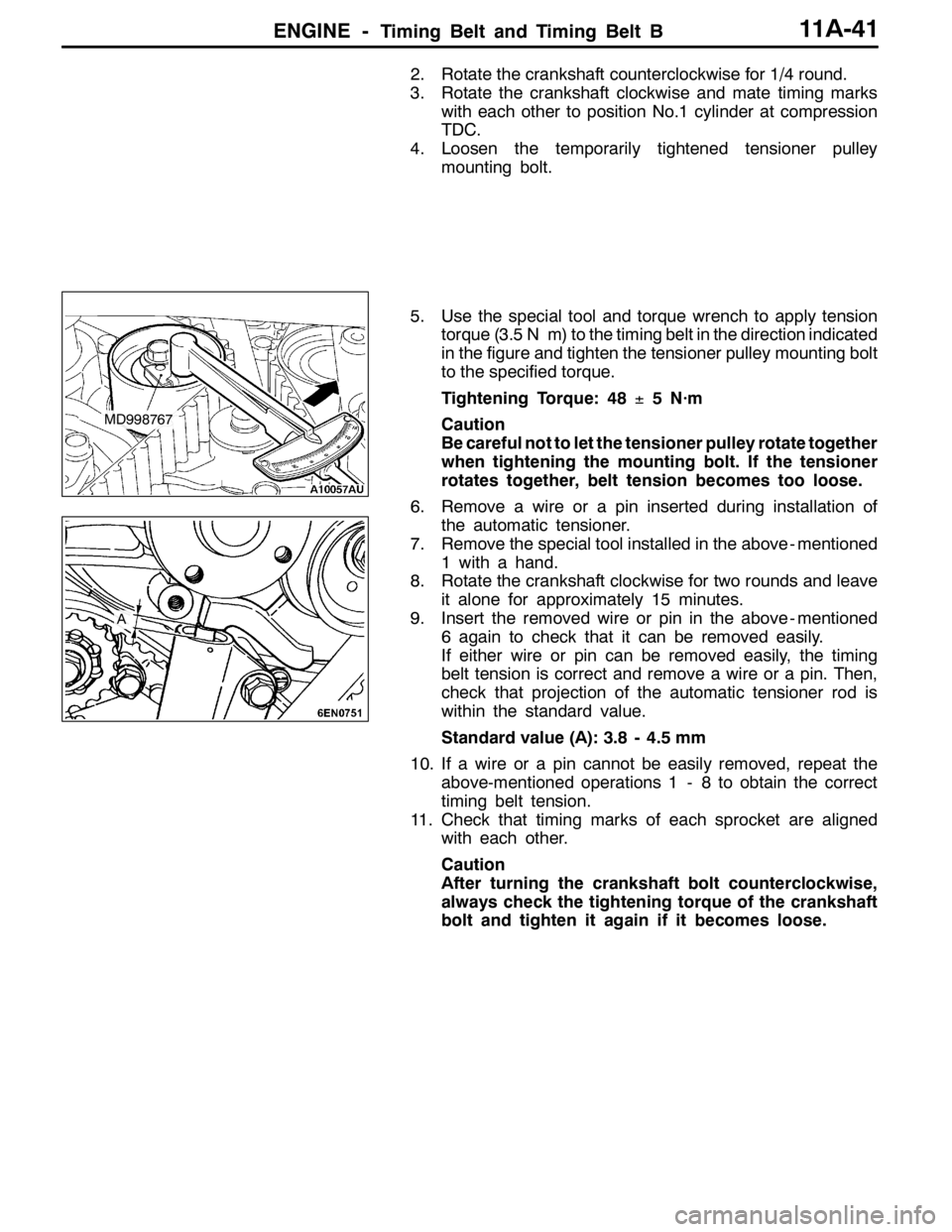
5. Use the special tool and torque wrench to apply tension
torque (3.5 Nm) to the timing belt in the direction indicated
in the figure and tighten the tensioner pulley mounting bolt
to the specified torque.
Tightening Torque: 48±5 N·m
Caution
Be careful not to let the tensioner pulley rotate together
when tightening the mounting bolt. If the tensioner
rotates together, belt tension becomes too loose.
6. Remove a wire or a pin inserted during installation of
the automatic tensioner.
7. Remove the special tool installed in the above - mentioned
1 with a hand.
8. Rotate the crankshaft clockwise for two rounds and leave
it alone for approximately 15 minutes.
9. Insert the removed wire or pin in the above - mentioned
6 again to check that it can be removed easily.
If either wire or pin can be removed easily, the timing
belt tension is correct and remove a wire or a pin. Then,
check that projection of the automatic tensioner rod is
within the standard value.
Standard value (A): 3.8 - 4.5 mm
10. If a wire or a pin cannot be easily removed, repeat the
above-mentioned operations 1 - 8 to obtain the correct
timing belt tension.
11. Check that timing marks of each sprocket are aligned
with each other.
Caution
After turning the crankshaft bolt counterclockwise,
always check the tightening torque of the crankshaft
bolt and tighten it again if it becomes loose.
MD998767
A
Page 448 of 1449
ENGINE -Timing belt and timing belt B11A-42
INSPECTION
AUTO-TENSIONER CHECK
1. Check the sealant for oil leakage and replace if necessary.
2. Check the rod end for wear or damage and replace if
necessary.
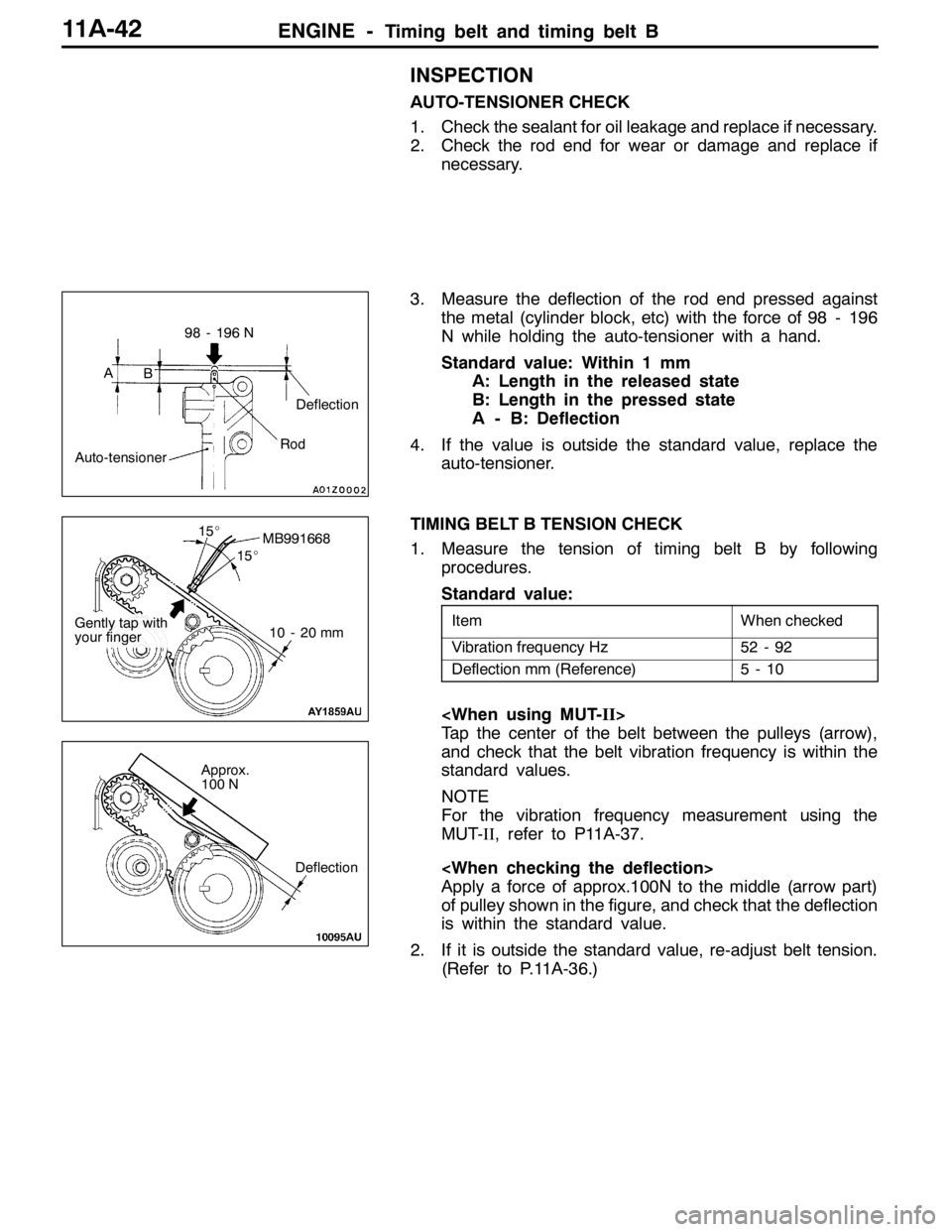
3. Measure the deflection of the rod end pressed against
the metal (cylinder block, etc) with the force of 98 - 196
N while holding the auto-tensioner with a hand.
Standard value: Within 1 mm
A: Length in the released state
B: Length in the pressed state
A - B: Deflection
4. If the value is outside the standard value, replace the
auto-tensioner.
TIMING BELT B TENSION CHECK
1. Measure the tension of timing belt B by following
procedures.
Standard value:
ItemWhen checked
Vibration frequency Hz52 - 92
Deflection mm (Reference)5-10
Tap the center of the belt between the pulleys (arrow),
and check that the belt vibration frequency is within the
standard values.
NOTE
For the vibration frequency measurement using the
MUT-II, refer to P11A-37.
Apply a force of approx.100N to the middle (arrow part)
of pulley shown in the figure, and check that the deflection
is within the standard value.
2. If it is outside the standard value, re-adjust belt tension.
(Refer to P.11A-36.)
AB
Auto-tensioner
98 - 196 N
Deflection
Rod
MB991668
10 - 20 mm
15_
15_
Gently tap with
your finger
Deflection
Approx.
100 N
Page 449 of 1449

ENGINE -Engine Assembly11A-43
ENGINE ASSEMBLY
REMOVAL AND INSTALLATION
Caution
1. If the vehicle is equipped with the Brembo disc brake, during maintenance, take care not to
contact the parts or tools to the caliper because the paint of caliper will be scratched.
2. Tightening sections indicated in the mark (*) should be finally tightened with engine weight
applied on the body after lightly tightening.
Pre-removal and Post-installation Operation
DFuel Outflow Preventive Operation (Refer to GROUP 13A - On-vehicle Service.)
DFuel Leak Check
DRemoval and Installation of Hood (Refer to GROUP 42.)
DRemoval and Installation of Strut Tower Bar (Refer to GROUP 42.)
DRemoval and Installation of Under Cover (Refer to GROUP 51 - Front Bumper.)
DRemoval and Installation of Side Cover.
DDrive Belt Tension Check (Refer to P.11A - 7.)
DAccelerator Cable Adjustment (Refer to GROUP 17 - On-vehicle Service.)
DDrainage and Refilling Engine Oil(Refer to GROUP 12 - On-vehicle Service.)
DDrainage and Refilling of Engine Coolant (Refer to GROUP 14 - On-vehicle Service.)
DAir Cleaner Removal and Installation (Refer to GROUP 15)
DRemoval and Installation of Air Pipe C, Air Pipe B and Air Hose A (Refer to GROUP 15 - Intercooler.)
DBattery and Battery Tray Removal and Installation
DRemoval and Installation of Center Cover (Refer to P.11A - 17.)
DRemoval and Installation of Accelerator Cable (Refer to GROUP 17.)
DRemoval and Installation of Radiator (Refer to GROUP 14.)
DRemoval and Installation of Crossmember Bar (Refer to GROUP 32 - Engine Roll Stopper, Centermember.)
DRemoval and Installation of Front Exhaust Pipe (Refer to GROUP 15.)
DRemoval and Installation of Air Outlet Fitting (Refer to GROUP 15 - Exhaust manifold.)
Page 453 of 1449

ENGINE -Engine Assembly11A-47
AD"ENGINE ASSEMBLY REMOVAL
After checking that all the cables, hoses, and harness
connectors have been disconnected, lift the engine with a
chain block slowly and remove the engine assembly located
at the upper engine room.
INSTALLATION SERVICE POINTS
"AAENGINE ASSEMBLY INSTALLATION
Install the engine assembly while checking that none of cables,
hoses, or harness connectors, etc. has been engaged.
"BAENGINE MOUNTING BRACKET AND STOPPER
ASSEMBLY INSTALLATION
1. Support the engine oil pan with a garage jack via a block
of wood cut adjusting the engine position and install the
engine mounting bracket and stopper assembly. Position
the engine mounting stopper so that a mark indicated
by an arrow can face the direction shown in the illustration.
2. Support engine with garage jack.
3. Remove the chain block and hold the engine assembly
with the special tool.(Tool used for removal of transmission
assembly)
"CAO-RING/FUEL HIGH PRESSURE HOSE
INSTALLATION
1. Apply small quantity of new engine oil on O-ring.
Caution
Do not let engine oil get into the delivery pipe.
2. Install the fuel high pressure pipe to the delivery pipe
rotating in both directions without damaging the O-ring
and check that it rotates smoothly.
3. In case of not rotating smoothly, remove the fuel high
pressure hose and insert it to the delivery pipe again
after checking damage of the O-ring since there is a
possibility of O-ring engagement.
4. Tighten fuel high pressure hose mounting bolt to the
specified torque.
Tightening Torque: 5.0±1.0 N·m
Engine mounting stopper
Engine side
Page 461 of 1449

ENGINE OVERHAUL -Specifications11B-7
Items Tightening torque N·m
Water outlet fitting bolt10±1
Thermostat housing bolt23±4
Water inlet pipe bolt (M6)10±1
Water inlet pipe bolt (M8)13±2
Water pump bolt14±1
Knock sensor23±2
Rocker arm, camshaft
Cam position sensor bolt8.8±1.0
Cover bolt10±2
Cam position sensing cylinder bolt22±4
Cam position sensor support bolt14±1
Bearing cap bolt20±1
Oil delivery body bolt11±1
Cylinder head, valve
Cylinder head bolt78±2→Completely loosen→20±2→90_+90_
Oil pump, oil pan
Drain plug39±5
Oil pan bolt9±3
Oil screen bolt19±3
Baffle plate bolt22±4
Oil pressure switch19±3
Oil cooler bypass valve54±5
Relief plug44±5
Oil filter bracket bolt19±3
Plug cap23±3
Flange bolt36±3
Oil pump case bolt23±3
Oil pump cover bolt17±1
Oil pump cover screw10±2
Piston, connecting rod
Connecting rod cap nut20±2+90_-94_
Crankshaft, cylinder block
Flywheel bolt132±5
Rear plate bolt11±1
Bell housing cover bolt9±1
Rear oil seal case bolt11±1
Beam bearing cap bolt25±2+90_- 100_
Check valve32±2
Throttle body
Throttle position sensor bolt2.0±0.5
Turbocharger
Waste gate actuator bolt11.3±1.5
Page 472 of 1449
ENGINE OVERHAUL -Timing Belt11B-18
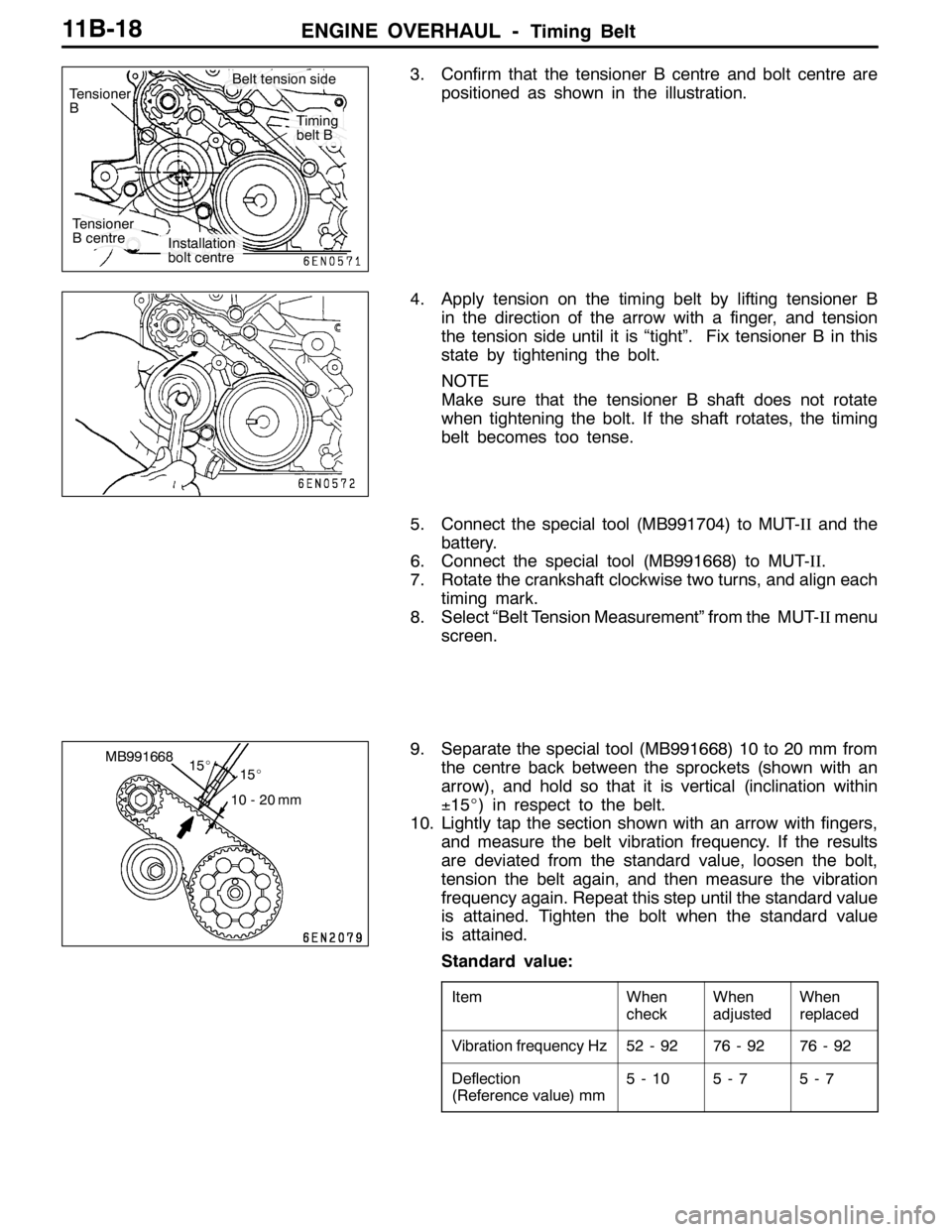
3. Confirm that the tensioner B centre and bolt centre are
positioned as shown in the illustration.
4. Apply tension on the timing belt by lifting tensioner B
in the direction of the arrow with a finger, and tension
the tension side until it is “tight”. Fix tensioner B in this
state by tightening the bolt.
NOTE
Make sure that the tensioner B shaft does not rotate
when tightening the bolt. If the shaft rotates, the timing
belt becomes too tense.
5. Connect the special tool (MB991704) to MUT-IIand the
battery.
6. Connect the special tool (MB991668) to MUT-II.
7. Rotate the crankshaft clockwise two turns, and align each
timing mark.
8. Select “Belt Tension Measurement” from the MUT-IImenu
screen.
9. Separate the special tool (MB991668) 10 to 20 mm from
the centre back between the sprockets (shown with an
arrow), and hold so that it is vertical (inclination within
±15_) in respect to the belt.
10. Lightly tap the section shown with an arrow with fingers,
and measure the belt vibration frequency. If the results
are deviated from the standard value, loosen the bolt,
tension the belt again, and then measure the vibration
frequency again. Repeat this step until the standard value
is attained. Tighten the bolt when the standard value
is attained.
Standard value:
ItemWhen
checkWhen
adjustedWhen
replaced
Vibration frequency Hz52 - 9276 - 9276 - 92
Deflection
(Reference value) mm5-105-75-7
Tensioner
B centre
Installation
bolt centre
Timing
belt B
Belt tension side
Tensioner
B
MB991668
15_ 15_
10 - 20 mm
Page 477 of 1449
ENGINE OVERHAUL -Timing Belt11B-23
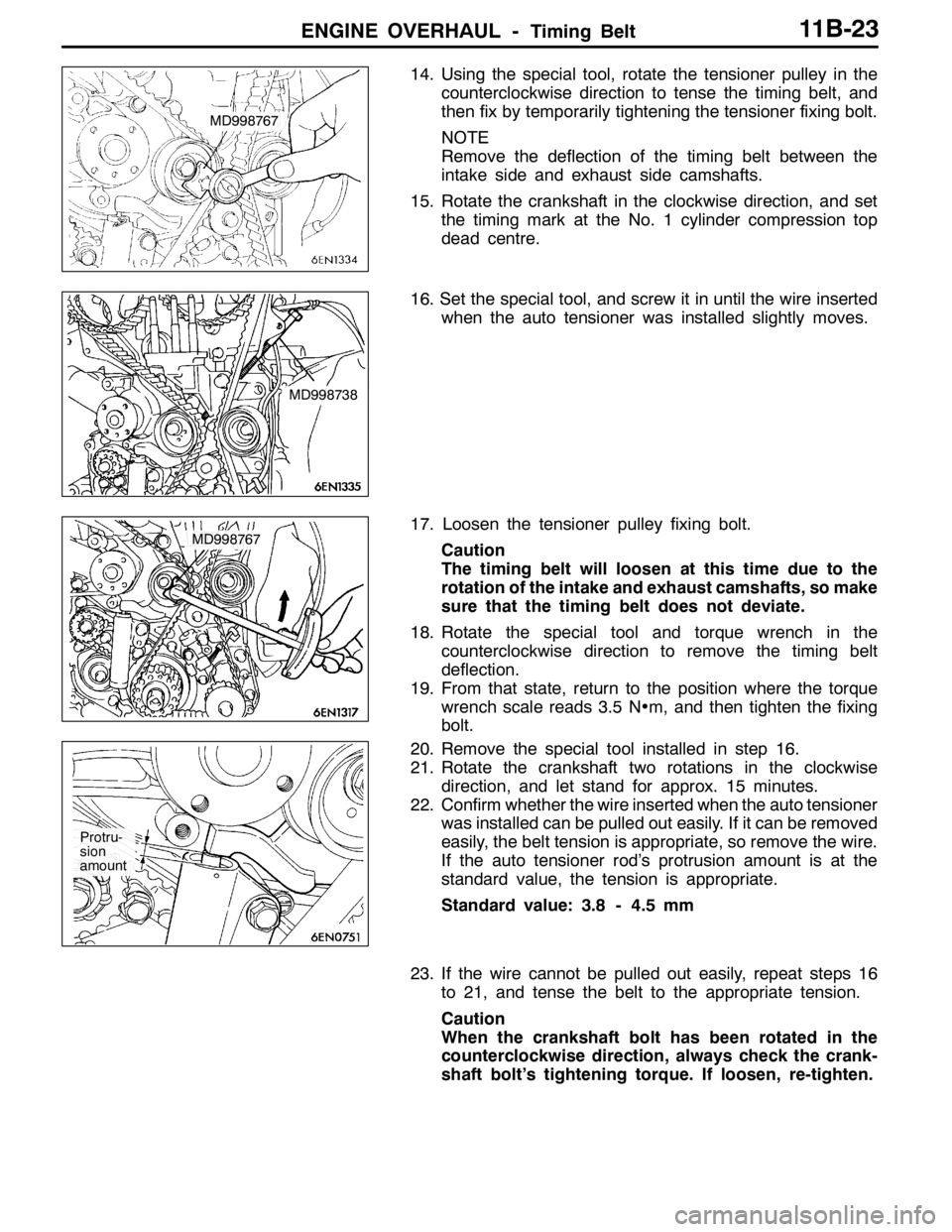
14. Using the special tool, rotate the tensioner pulley in the
counterclockwise direction to tense the timing belt, and
then fix by temporarily tightening the tensioner fixing bolt.
NOTE
Remove the deflection of the timing belt between the
intake side and exhaust side camshafts.
15. Rotate the crankshaft in the clockwise direction, and set
the timing mark at the No. 1 cylinder compression top
dead centre.
16. Set the special tool, and screw it in until the wire inserted
when the auto tensioner was installed slightly moves.
17. Loosen the tensioner pulley fixing bolt.
Caution
The timing belt will loosen at this time due to the
rotation of the intake and exhaust camshafts, so make
sure that the timing belt does not deviate.
18. Rotate the special tool and torque wrench in the
counterclockwise direction to remove the timing belt
deflection.
19. From that state, return to the position where the torque
wrench scale reads 3.5 N•m, and then tighten the fixing
bolt.
20. Remove the special tool installed in step 16.
21. Rotate the crankshaft two rotations in the clockwise
direction, and let stand for approx. 15 minutes.
22. Confirm whether the wire inserted when the auto tensioner
was installed can be pulled out easily. If it can be removed
easily, the belt tension is appropriate, so remove the wire.
If the auto tensioner rod’s protrusion amount is at the
standard value, the tension is appropriate.
Standard value: 3.8 - 4.5 mm
23. If the wire cannot be pulled out easily, repeat steps 16
to 21, and tense the belt to the appropriate tension.
Caution
When the crankshaft bolt has been rotated in the
counterclockwise direction, always check the crank-
shaft bolt’s tightening torque. If loosen, re-tighten.
MD998767
MD998738
MD998767
Protru-
sion
amount
Page 478 of 1449

ENGINE OVERHAUL -Timing Belt11B-24
INSPECTION
1. TIMING BELT
Inspect each section of the belt in detail, and if any of
the following type of damage is found, replace the belt
with a new part.
(1) Hardening of backface rubber.
The backface is glossy, marks are not made even
when a fingernail is run cross it, and there is no
elasticity.
(2) Cracking of backface rubber.
(3) Cracking of canvas.
(4) Cracking at root.
(5) Cracking on side of belt.
(6) Abnormal wear on side of belt.
NOTE
The state is normal if the cutting surface is neat as
if cut with a sharp knife.
(7) Abnormal wear of teeth.
First stages: Canvas is worn (canvas fibres are raised,
rubber is removed and whitish, and canvas seams
are unclear).
Latter stages: Canvas is worn off, and rubber is
exposed (face width is narrow).
(8) Teeth are missing.
2. AUTO TENSIONER
(1) Check for oil leaks. If any leaks are found, replace.
(2) Check whether the rod end is worn or damaged,
and replace if necessary.
(3) Measure the rod protrusion length. If not at the
standard value, replace the auto tensioner.
Standard value: 12 mm
Crack
Crack
Peeling of canvas
Cracking
on side
Cracking at root
Edges are rounded
Abnormal wear
(The core wires are frayed.)
Rubber exposed due to
worn canvas
Teeth are missing
12 mm
Page 481 of 1449

ENGINE OVERHAUL -Fuel System11B-27
INSTALLATION SERVICE POINTS
"AAINJECTOR INSTALLATION
1. Apply a small amount of new engine oil on the O-ring.
2. While rotating the injector to the left and right, insert the
O-ring into the delivery pipe while taking care not to
damage it.
Caution
Make sure that the engine oil does not enter the
delivery pipe.
3. Confirm that the injector rotates smoothly. If it does not
rotate smoothly, the O-ring may be biting in. Remove
the injector, check the O-ring for damage, and then insert
it into the delivery pipe. Check the rotation again.
"BAFUEL PRESSURE REGULATOR INSTALLATION
1. Apply a small amount of new engine oil on the O-ring.
2. While rotating the fuel pressure regulator to the left and
right, insert the O-ring into the delivery pipe while taking
care not to damage it.
Caution
Make sure that the engine oil does not enter the
delivery pipe.
3. Confirm that the fuel pressure regulator rotates smoothly.
If it does not rotate smoothly, the O-ring may be biting
in. Remove the fuel pressure regulator, check the O-ring
for damage, and then insert it into the delivery pipe. Check
the rotation again.
"CATHROTTLE BODY GASKET INSTALLATION
Assembly so that the protrusion on the throttle body gasket
is at the position shown in the illustration.
Protrusion
Page 483 of 1449

ENGINE OVERHAUL -Secondary Air System and Intake Manifold11B-29
INSTALLATION SERVICE POINTS
"AAINTAKE MANIFOLD STAY INSTALLATION
Check that the intake manifold stay is seated against the
intake manifold and cylinder block boss, and then tighten
at the specified torque 31±3N•m.
"BAMANIFOLD DIFFERENTIAL PRESSURE (MDP)
SENSOR INSTALLATION
Caution
Make sure not to apply impact against the sensor when
installing.
Do not use a sensor that has been dropped.
"CAAIR CONTROL VALVE BRACKET INSTALLATION
1. Temporarily tighten the air control valve bracket and
engine hanger with the bolt for tightening with the intake
manifold.
2. Tighten the bolt 1 shown in the illustration at the specified
torque 23±4N•m.
3. Tighten the bolt 2 shown in the illustration at the specified
torque 36±6N•m.
4. Tighten the bolt 3 shown in the illustration with the engine
hanger at the specified torque 22±4N•m.
"DAAIR PIPE ASSEMBLY INSTALLATION
1. Temporarily tighten air pipe assembly onto the air control
valve.
2. Tighten the bolts 1 and 2 shown in the illustration to
the exhaust manifold at the specified torque 49±5N•m.
3. Tighten the bolt 3 shown in the illustration to the air control
valve at the specified torque 24±3N•m.
4. Tighten the bolt 4 shown in the illustration to the cam
position sensor support at the specified toque 11±1
N•m.
5. Tighten the bolt 5 shown in the illustration to the exhaust
manifold at the specified torque 14±1N•m.
Intake manifold stay
1
23
1
5
23
4