belt MITSUBISHI LANCER EVOLUTION 2007 Service Manual PDF
[x] Cancel search | Manufacturer: MITSUBISHI, Model Year: 2007, Model line: LANCER EVOLUTION, Model: MITSUBISHI LANCER EVOLUTION 2007Pages: 1449, PDF Size: 56.82 MB
Page 519 of 1449

ENGINE OVERHAUL -Crankshaft and Cylinder Block11B-65
INSTALLATION SERVICE POINTS
"AATHRUST BEARING INSTALLATION
1. Install the thrust bearing onto the cylinder block side of
the No. 3 bearing section. The bearing can be installed
easily by applying engine oil.
2. Install the thrust bearing so that the side with the groove
faces the crankshaft weight side.
"BACRANKSHAFT BEARING INSTALLATION
1. Measure the diameter of the crankshaft journal, and
confirm the class shown below. When using a spare part,
each identification colour is painted at the position shown
in the illustration.
2. The cylinder block bearing section bore identification mark
is stamped at the position shown in the illustration.
Crankshaft journalCylinder
block
bearing
Spare
bearing
identificaClassProduct
identifica-
tion colourSpare part
identifica-
tion colourJournal
diameter
mmbearing
section
bore iden-
tification
markidentifica-
tion mark
1NoneYellow56.994 -57 0000057.00011
22
2NoneNone56.988 -56 9940156.99412
23
3NoneWhite56.982 -56 9880256.98813
24
Groove
No. 2
No. 1No. 4
No. 5No. 3
Timing belt side
Cylinder block bearing section
bore identification mark
No. 1No. 2No. 3No. 4
No. 5
Cylinder
bore size
mark
Page 520 of 1449
![MITSUBISHI LANCER EVOLUTION 2007 Service Manual PDF ENGINE OVERHAUL -Crankshaft and Cylinder Block11B-66
3. Select the bearing from the above table according to
the identification confirmed in steps 1 and 2.
[Example of selecting bearing]
(1) If the me](/img/19/57084/w960_57084-519.png "MITSUBISHI LANCER EVOLUTION 2007 Service Manual PDF ENGINE OVERHAUL -Crankshaft and Cylinder Block11B-66
3. Select the bearing from the above table according to
the identification confirmed in steps 1 and 2.
[Example of selecting bearing]
(1) If the me")
ENGINE OVERHAUL -Crankshaft and Cylinder Block11B-66
3. Select the bearing from the above table according to
the identification confirmed in steps 1 and 2.
[Example of selecting bearing]
(1) If the measured outer diameter of the crankshaft
journal is 57.000 mm, Class 1 applies, and the
identification colour is yellow.
(2) If the cylinder block bearing bore identification mark
is 0, select identification mark 0 in consideration of
step (1).
4. Install the grooved bearing on the cylinder block side.
5. Install the bearing with no oil groove onto the beam bearing
cap side.
"CABEAM BEARING CAP/BEARING CAP BOLT
INSTALLATION
1. Install the beam bearing cap with the arrow facing the
timing belt side.
2. Before installing the bearing cap bolt, confirm that the
bolt’s underhead length is less than the limit value.
Replace the bolt if it exceeds the limit value.
Limit value: 71.1 mm
3. Apply engine oil on the bolt threads and bolt surface.
4. Following the tightening order, tighten the bearing cap
bolt at 25±2N•m.
5. Make paint marks on the bolt head.
6. Using the position of the mark painted on the bolt head
as reference, make paint marks on the seat surface at
the 90_to 100_positions in the tightening direction.
7. Following the tightening order, tighten the bolt by 90_
to 100_, and confirm that the paint marks made on the
bolt and seat surface match.
Caution
(1) If the tightening angle is less than 90_, the
connection performance may not be attained, so
take special care when tightening.
(2) If the tightening angle exceeds 100_, completely
loosen the nut, and start again from step 1.Crankshaft bearing side
identification mark position
Identification
mark
Groove
Upper bearing
Lower bearing
Underhead length
Arrow
84159
732610
Paint marksPaint marks
90°- 100°
Page 526 of 1449

ENGINE LUBRICATION -General Information12-2
GENERAL INFORMATION
The lubrication method is a fully force-fed, full-flow
filtration type. The oil pump is a gear type which
is driven by the crankshaft via the timing belt.
ENGINE OILS
Health Warning
Prolonged and repeated contact with mineral oil
will result in the removal of natural fats from the
skin, leading to dryness, irritation and dermatitis.
In addition, used engine oil contains potentiallyharmful contaminants which may cause skin cancer.
Adequate means of skin protection and washing
facilities must be provided.
Recommended Precautions
The most effective precaution is to adapt working
practices which prevent, as far as practicable, the
risk of skin contact with mineral oils, for example
by using enclosed systems for handling used engine
oil and by degreasing components, where
practicable, before handling them.
Other precautions:
DAvoid prolonged and repeated contact with oils,
particularly used engine oils.
DWear protective clothing, including impervious
gloves where practicable.
DAvoid contaminating clothes, particularly
underpants, with oil.
DDo not put oily rags in pockets, the use of
overalls without pockets will avoid this.
DDo not wear heavily soiled clothing and
oil - impregnated foot - wear. Overalls must be
cleaned regularly and kept separate from
personal clothing.DWhere there is a risk of eye contact, eye
protection should be worn, for example,
chemical goggles or face shields; in addition
an eye wash facility should be provided.
DObtain First Aid treatment immediately for open
cuts and wounds.
DWash regularly with soap and water to ensure
all oil is removed, especially before meals (skin
cleansers and nail brushes will help). After
cleaning, the application of preparations
containing lanolin to replace the natural skin
oils is advised.
DDo not use petrol, kerosine, diesel fuel, gas
oil, thinners or solvents for cleaning skin.
DUse barrier creams, applying them before each
work period, to help the removal of oil from
the skin after work.
DIf skin disorders develop, obtain medical advice
without delay.
Page 591 of 1449
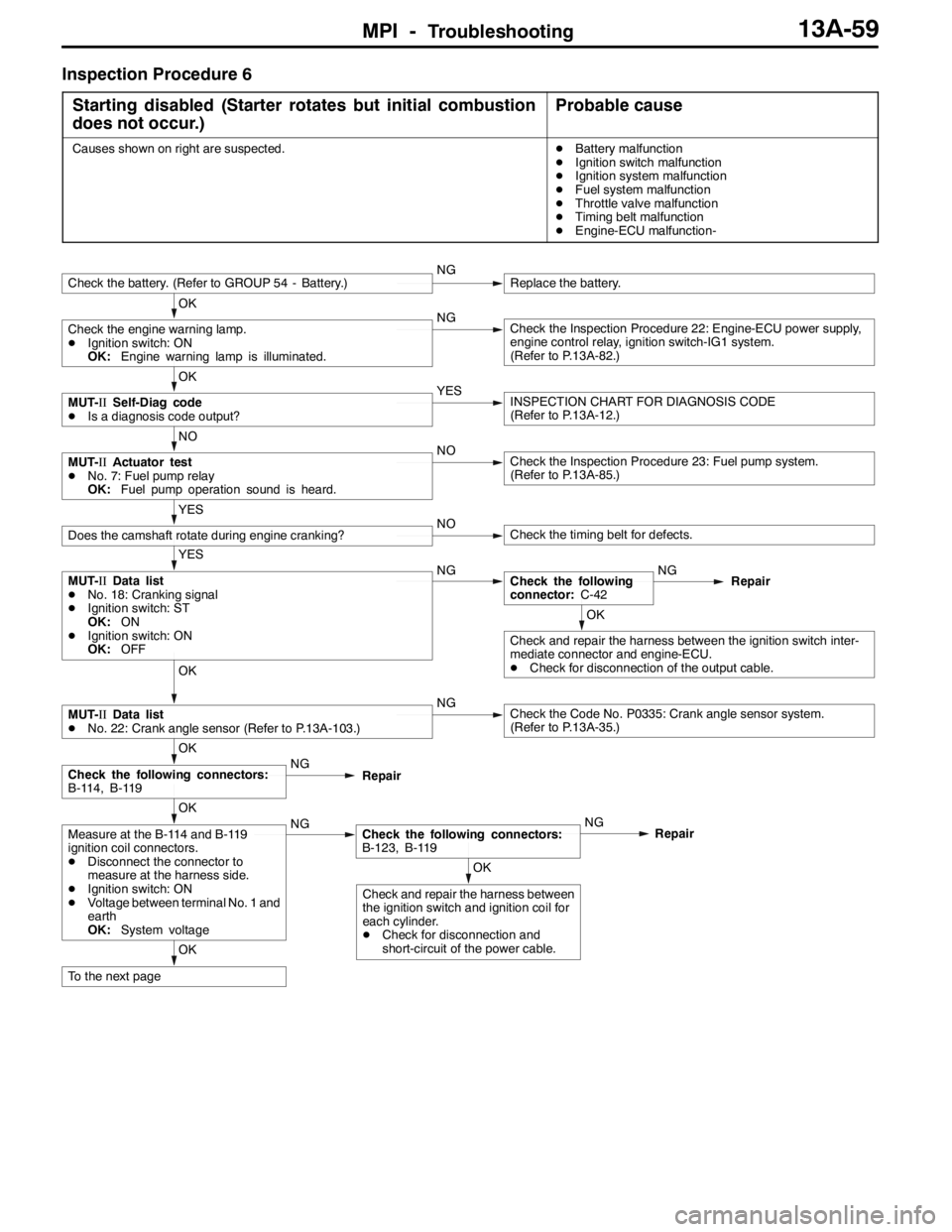
MPI -Troubleshooting13A-59
Inspection Procedure 6
Starting disabled (Starter rotates but initial combustion
does not occur.)
Probable cause
Causes shown on right are suspected.DBattery malfunction
DIgnition switch malfunction
DIgnition system malfunction
DFuel system malfunction
DThrottle valve malfunction
DTiming belt malfunction
DEngine-ECU malfunction-
OK
To the next page
OK
Check and repair the harness between
the ignition switch and ignition coil for
each cylinder.
DCheck for disconnection and
short-circuit of the power cable.
OK
Measure at the B-114 and B-119
ignition coil connectors.
DDisconnect the connector to
measure at the harness side.
DIgnition switch: ON
DVoltage between terminal No. 1 and
earth
OK:System voltageNGCheck the following connectors:
B-123, B-119NG
Repair
OK
Check the following connectors:
B-114, B-119NG
Repair
OK
MUT-IIData list
DNo. 22: Crank angle sensor (Refer to P.13A-103.)NGCheck the Code No. P0335: Crank angle sensor system.
(Refer to P.13A-35.)
OK
Check and repair the harness between the ignition switch inter-
mediate connector and engine-ECU.
DCheck for disconnection of the output cable.
YES
MUT-IIData list
DNo. 18: Cranking signal
DIgnition switch: ST
OK:ON
DIgnition switch: ON
OK:OFFNGCheck the following
connector:C-42NG
Repair
YES
Does the camshaft rotate during engine cranking?NOCheck the timing belt for defects.
NO
MUT-IIActuator test
DNo. 7: Fuel pump relay
OK:Fuel pump operation sound is heard.NOCheck the Inspection Procedure 23: Fuel pump system.
(Refer to P.13A-85.)
OK
MUT-IISelf-Diag code
DIs a diagnosis code output?YESINSPECTION CHART FOR DIAGNOSIS CODE
(Refer to P.13A-12.)
OK
Check the engine warning lamp.
DIgnition switch: ON
OK:Engine warning lamp is illuminated.NGCheck the Inspection Procedure 22: Engine-ECU power supply,
engine control relay, ignition switch-IG1 system.
(Refer to P.13A-82.)
Check the battery. (Refer to GROUP 54 - Battery.)NGReplace the battery.
Page 593 of 1449
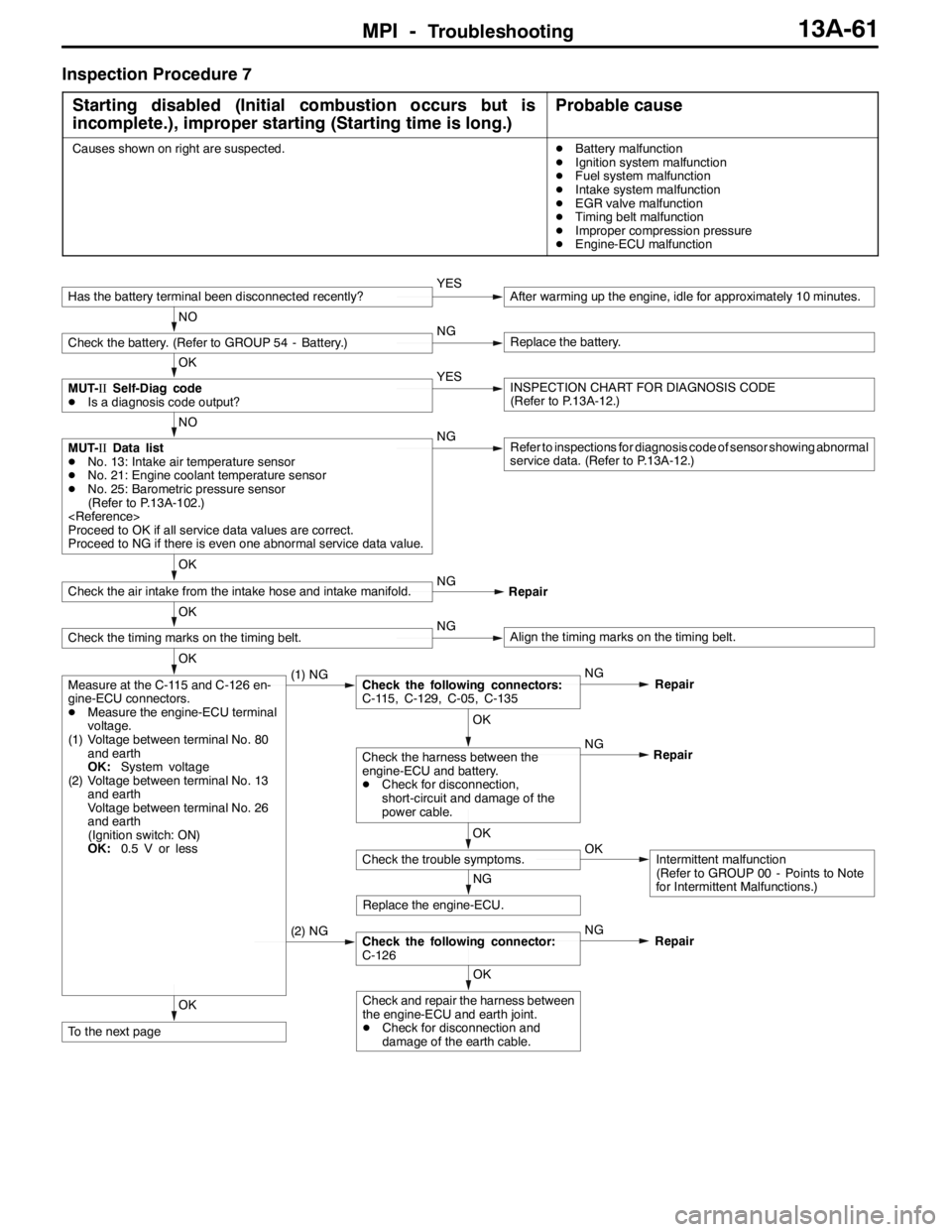
MPI -Troubleshooting13A-61
Inspection Procedure 7
Starting disabled (Initial combustion occurs but is
incomplete.), improper starting (Starting time is long.)
Probable cause
Causes shown on right are suspected.DBattery malfunction
DIgnition system malfunction
DFuel system malfunction
DIntake system malfunction
DEGR valve malfunction
DTiming belt malfunction
DImproper compression pressure
DEngine-ECU malfunction
OK
To the next page
OK
Check and repair the harness between
the engine-ECU and earth joint.
DCheck for disconnection and
damage of the earth cable.
(2) NGCheck the following connector:
C-126NG
Repair
NG
Replace the engine-ECU.
OK
Check the trouble symptoms.OKIntermittent malfunction
(Refer to GROUP 00 - Points to Note
for Intermittent Malfunctions.) NG
OK
Check the harness between the
engine-ECU and battery.
DCheck for disconnection,
short-circuit and damage of the
power cable.Repair
OK
Measure at the C-115 and C-126 en-
gine-ECU connectors.
DMeasure the engine-ECU terminal
voltage.
(1) Voltage between terminal No. 80
and earth
OK:System voltage
(2) Voltage between terminal No. 13
and earth
Voltage between terminal No. 26
and earth
(Ignition switch: ON)
OK:0.5 V or less(1) NGCheck the following connectors:
C-115, C-129, C-05, C-135NG
Repair
OK
Check the timing marks on the timing belt.NGAlign the timing marks on the timing belt.
OK
Check the air intake from the intake hose and intake manifold.NG
Repair
NO
MUT-IIData list
DNo. 13: Intake air temperature sensor
DNo. 21: Engine coolant temperature sensor
DNo. 25: Barometric pressure sensor
(Refer to P.13A-102.)
Proceed to OK if all service data values are correct.
Proceed to NG if there is even one abnormal service data value.NGRefer to inspections for diagnosis code of sensor showing abnormal
service data. (Refer to P.13A-12.)
OK
MUT-IISelf-Diag code
DIs a diagnosis code output?YESINSPECTION CHART FOR DIAGNOSIS CODE
(Refer to P.13A-12.)
NO
Check the battery. (Refer to GROUP 54 - Battery.)NGReplace the battery.
Has the battery terminal been disconnected recently?YESAfter warming up the engine, idle for approximately 10 minutes.
Page 595 of 1449
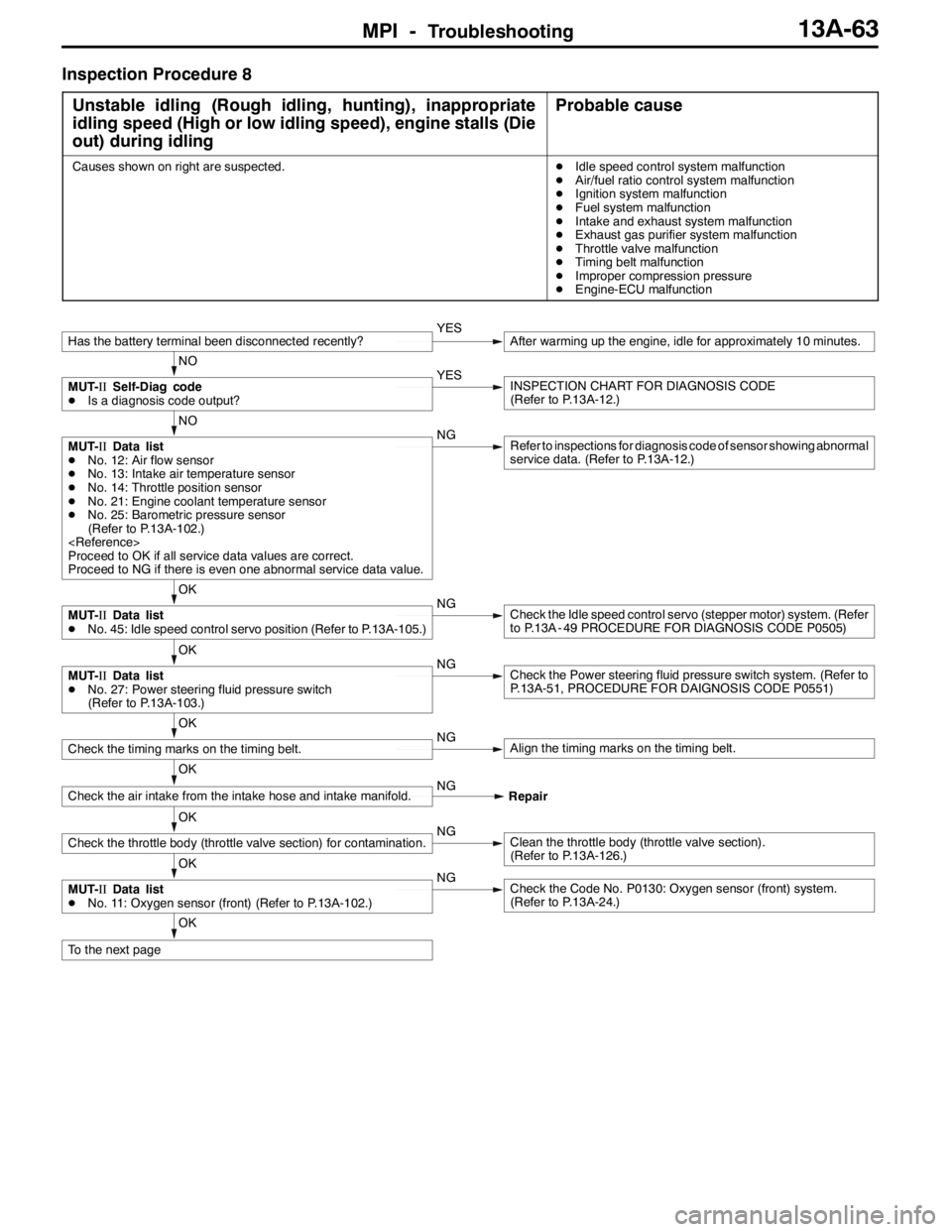
MPI -Troubleshooting13A-63
Inspection Procedure 8
Unstable idling (Rough idling, hunting), inappropriate
idling speed (High or low idling speed), engine stalls (Die
out) during idling
Probable cause
Causes shown on right are suspected.DIdle speed control system malfunction
DAir/fuel ratio control system malfunction
DIgnition system malfunction
DFuel system malfunction
DIntake and exhaust system malfunction
DExhaust gas purifier system malfunction
DThrottle valve malfunction
DTiming belt malfunction
DImproper compression pressure
DEngine-ECU malfunction
OK
To the next page
OK
MUT-IIData list
DNo. 11: Oxygen sensor (front) (Refer to P.13A-102.)NGCheck the Code No. P0130: Oxygen sensor (front) system.
(Refer to P.13A-24.)
OK
Check the throttle body (throttle valve section) for contamination.NGClean the throttle body (throttle valve section).
(Refer to P.13A-126.)
OK
Check the air intake from the intake hose and intake manifold.NG
Repair
OK
Check the timing marks on the timing belt.NGAlign the timing marks on the timing belt.
OK
MUT-IIData list
DNo. 27: Power steering fluid pressure switch
(Refer to P.13A-103.)NGCheck the Power steering fluid pressure switch system. (Refer to
P.13A-51, PROCEDURE FOR DAIGNOSIS CODE P0551)
OK
MUT-IIData list
DNo. 45: Idle speed control servo position (Refer to P.13A-105.)NGCheck the Idle speed control servo (stepper motor) system. (Refer
to P.13A - 49 PROCEDURE FOR DIAGNOSIS CODE P0505)
NO
MUT-IIData list
DNo. 12: Air flow sensor
DNo. 13: Intake air temperature sensor
DNo. 14: Throttle position sensor
DNo. 21: Engine coolant temperature sensor
DNo. 25: Barometric pressure sensor
(Refer to P.13A-102.)
Proceed to OK if all service data values are correct.
Proceed to NG if there is even one abnormal service data value.NGRefer to inspections for diagnosis code of sensor showing abnormal
service data. (Refer to P.13A-12.)
NO
MUT-IISelf-Diag code
DIs a diagnosis code output?YESINSPECTION CHART FOR DIAGNOSIS CODE
(Refer to P.13A-12.)
Has the battery terminal been disconnected recently?YESAfter warming up the engine, idle for approximately 10 minutes.
Page 600 of 1449
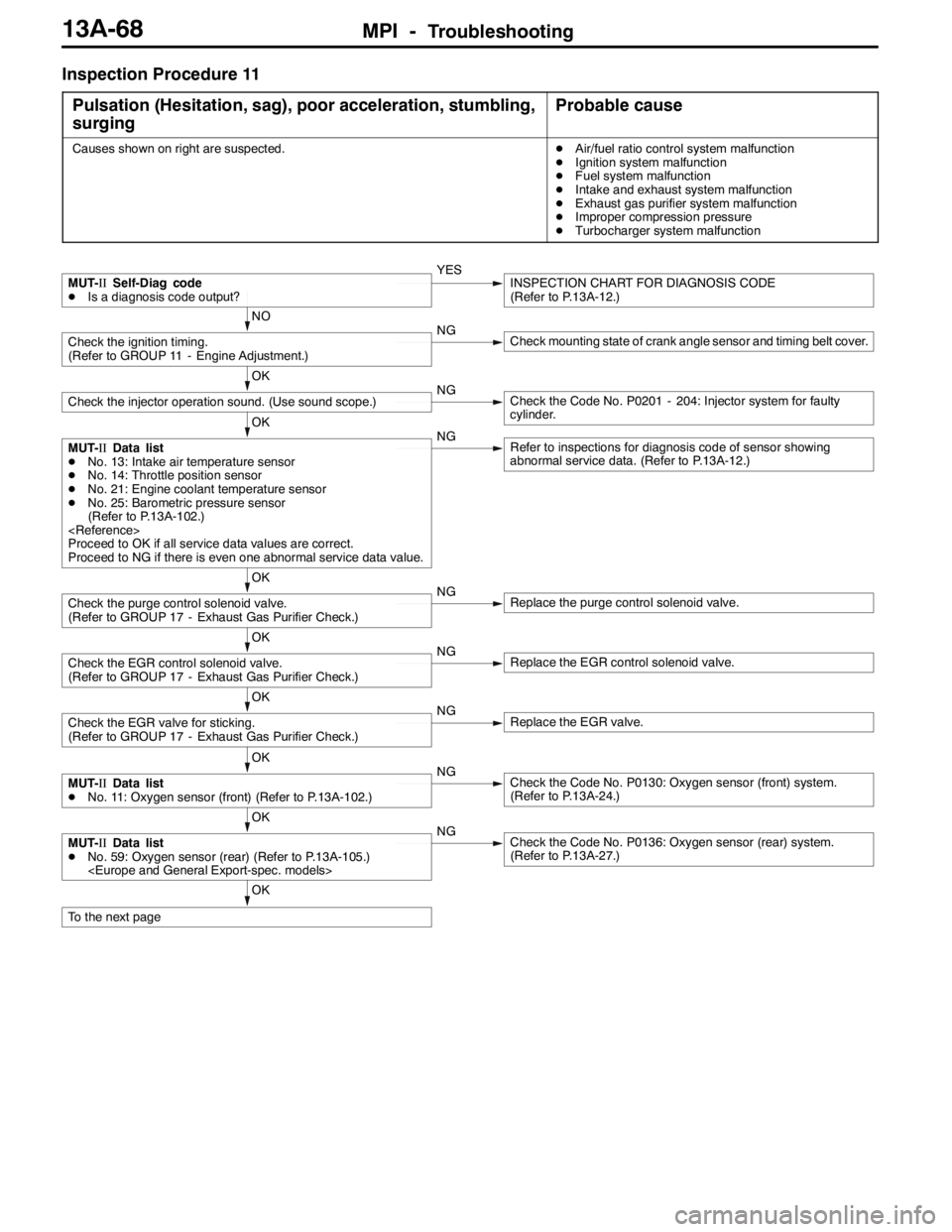
MPI -Troubleshooting13A-68
Inspection Procedure 11
Pulsation (Hesitation, sag), poor acceleration, stumbling,
surging
Probable cause
Causes shown on right are suspected.DAir/fuel ratio control system malfunction
DIgnition system malfunction
DFuel system malfunction
DIntake and exhaust system malfunction
DExhaust gas purifier system malfunction
DImproper compression pressure
DTurbocharger system malfunction
OK
To the next page
OK
MUT-IIData list
DNo. 59: Oxygen sensor (rear) (Refer to P.13A-105.)
(Refer to P.13A-27.)
OK
MUT-IIData list
DNo. 11: Oxygen sensor (front) (Refer to P.13A-102.)NGCheck the Code No. P0130: Oxygen sensor (front) system.
(Refer to P.13A-24.)
OK
Check the EGR valve for sticking.
(Refer to GROUP 17 - Exhaust Gas Purifier Check.)NGReplace the EGR valve.
OK
Check the EGR control solenoid valve.
(Refer to GROUP 17 - Exhaust Gas Purifier Check.)NGReplace the EGR control solenoid valve.
OK
Check the purge control solenoid valve.
(Refer to GROUP 17 - Exhaust Gas Purifier Check.)NGReplace the purge control solenoid valve.
OK
MUT-IIData list
DNo. 13: Intake air temperature sensor
DNo. 14: Throttle position sensor
DNo. 21: Engine coolant temperature sensor
DNo. 25: Barometric pressure sensor
(Refer to P.13A-102.)
Proceed to OK if all service data values are correct.
Proceed to NG if there is even one abnormal service data value.NGRefer to inspections for diagnosis code of sensor showing
abnormal service data. (Refer to P.13A-12.)
OK
Check the injector operation sound. (Use sound scope.)NGCheck the Code No. P0201 - 204: Injector system for faulty
cylinder.
NO
Check the ignition timing.
(Refer to GROUP 11 - Engine Adjustment.)NGCheck mounting state of crank angle sensor and timing belt cover.
MUT-IISelf-Diag code
DIs a diagnosis code output?YESINSPECTION CHART FOR DIAGNOSIS CODE
(Refer to P.13A-12.)
Page 605 of 1449
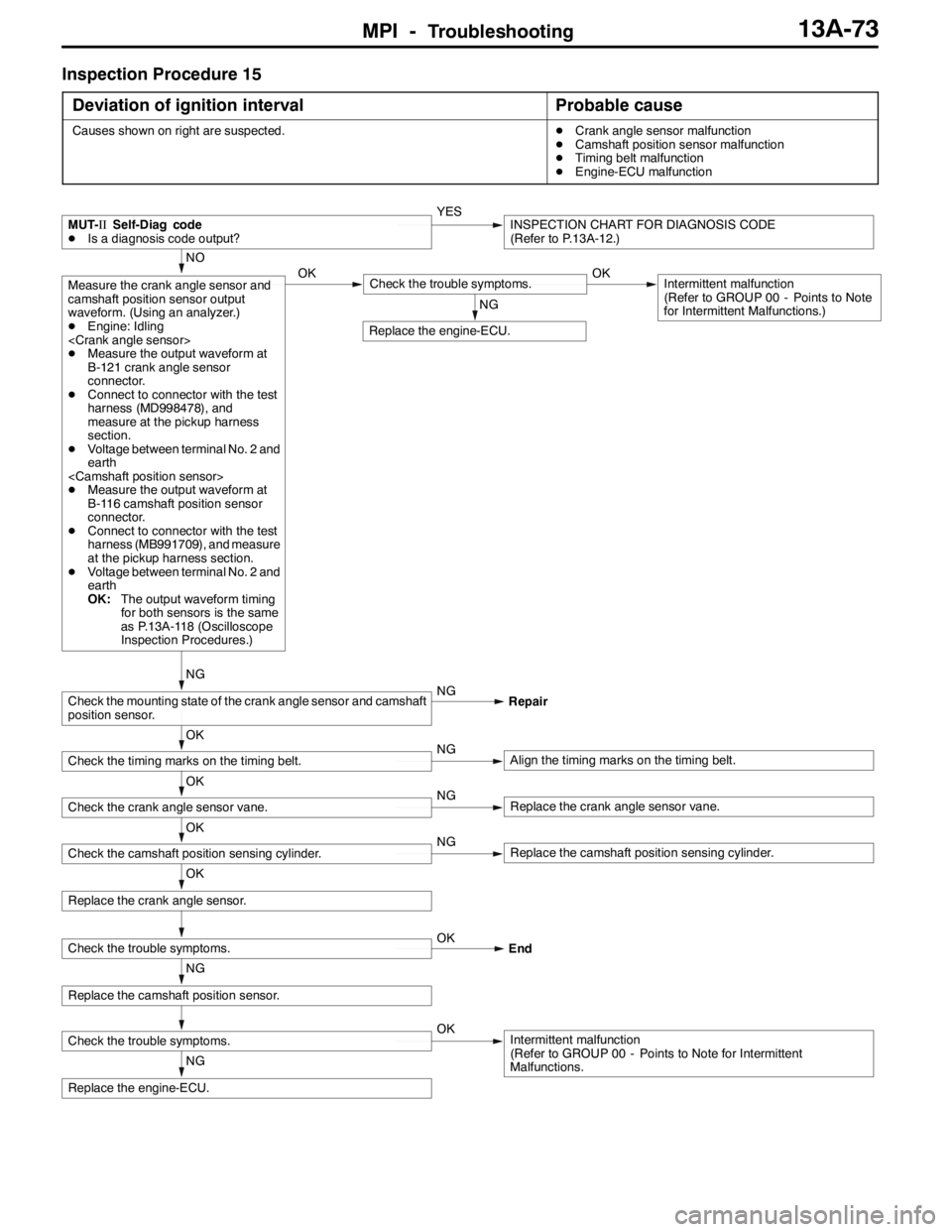
MPI -Troubleshooting13A-73
Inspection Procedure 15
Deviation of ignition interval
Probable cause
Causes shown on right are suspected.DCrank angle sensor malfunction
DCamshaft position sensor malfunction
DTiming belt malfunction
DEngine-ECU malfunction
NG
Replace the engine-ECU.
Check the trouble symptoms.OKIntermittent malfunction
(Refer to GROUP 00 - Points to Note for Intermittent
Malfunctions.
NG
Replace the camshaft position sensor.
Check the trouble symptoms.OK
End
OK
Replace the crank angle sensor.
NG
Replace the engine-ECU.
OK
Check the camshaft position sensing cylinder.NGReplace the camshaft position sensing cylinder.
OK
Check the crank angle sensor vane.NGReplace the crank angle sensor vane.
OK
Check the timing marks on the timing belt.NGAlign the timing marks on the timing belt.
NG
Check the mounting state of the crank angle sensor and camshaft
position sensor.NG
Repair
NO
Measure the crank angle sensor and
camshaft position sensor output
waveform. (Using an analyzer.)
DEngine: Idling
DMeasure the output waveform at
B-121 crank angle sensor
connector.
DConnect to connector with the test
harness (MD998478), and
measure at the pickup harness
section.
DVoltage between terminal No. 2 and
earth
DMeasure the output waveform at
B-116 camshaft position sensor
connector.
DConnect to connector with the test
harness (MB991709), and measure
at the pickup harness section.
DVoltage between terminal No. 2 and
earth
OK:The output waveform timing
for both sensors is the same
as P.13A-118 (Oscilloscope
Inspection Procedures.)OKCheck the trouble symptoms.OKIntermittent malfunction
(Refer to GROUP 00 - Points to Note
for Intermittent Malfunctions.)
MUT-IISelf-Diag code
DIs a diagnosis code output?YESINSPECTION CHART FOR DIAGNOSIS CODE
(Refer to P.13A-12.)
Page 651 of 1449

MPI -Troubleshooting13A-119
DExample 2
Cause of problem
Loose timing belt
Abnormality in sensor disk
Wave pattern characteristics
Wave pattern is displaced to the left or right.
INJECTOR
Measurement Method
1. Disconnect the injector connector, and then connect the
special tool (test harness: MB991348) in between.
(All terminals should be connected.)
2. Connect the analyzer special patterns pickup to terminal
No. 2 of the injector connector.
Alternate Method (Test harness not available)
1. Connect the analyzer special patterns pickup to
engine-ECU terminal No. 1. (When checking the No. 1
cylinder.)
2. Connect the analyzer special patterns pickup to
engine-ECU terminal No. 14. (When checking the No.
2 cylinder.)
3. Connect the analyzer special patterns pickup to
engine-ECU terminal No. 2. (When checking the No. 3
cylinder.)
4. Connect the analyzer special patterns pickup to
engine-ECU terminal No. 15. (When checking the No.
4 cylinder.)
Standard Wave Pattern
Observation conditions
FunctionSpecial patterns
Pattern heightVariable
Variable knobAdjust while viewing the wave pattern
Pattern selectorDisplay
Engine r/minIdle speed
Special
patterns
pickupAnalyzer
Page 690 of 1449

ENGINE COOLING -GeneralInformation/
Service Specifications/Lubricant/Sealant14-2
GENERAL INFORMATION
The cooling system is designed to keep every part
of the engine at appropriate temperature in
whatever condition the engine may be operated.
The cooling method is of the water-cooled, pressure
forced circulation type in which the water pump
pressurizes coolant and circulates it throughout the
engine. If the coolant temperature exceeds the
prescribed temperature, the thermostat opens to
circulate the coolant through the radiator as well
so that the heat absorbed by the coolant may be
radiated into the air.The water pump is of the centrifugal type and is
driven by the drive belt from the crankshaft.
The radiator is the corrugated fin, down flow type.
The cooling fan is controlled by the radiator fan
controller and engine-ECU depend on driving
conditions.
ItemSpecification
Radiator performance kJ/h216,700
SERVICE SPECIFICATIONS
ItemsStandard valueLimit
Radiator cap opening pressure kPa93 - 12383
Range of coolant antifreeze concentration of radiator %30 - 60-
ThermostatValve opening temperature of thermostat_C80±1.5-
Full-opening temperature of thermostat_C93-
Valve lift (at 93_C) mm9.5 or more-
LUBRICANT
ItemSpecified coolantQuantity L
Engine coolantMITSUBISHI GENUINE COOLANT or equivalent6.0Enginecoolant
(including reserve tank)
MITSUBISHIGENUINECOOLANTorequivalent6.0
SEALANT
ItemSpecified sealantRemark
Cylinder block drain plug3M Nut Locking Part No. 4171 or equivalentDrying sealant