API SN MITSUBISHI LANCER EVOLUTION 2014 10.G Owners Manual
[x] Cancel search | Manufacturer: MITSUBISHI, Model Year: 2014, Model line: LANCER EVOLUTION, Model: MITSUBISHI LANCER EVOLUTION 2014 10.GPages: 338, PDF Size: 40.99 MB
Page 116 of 338
Turbocharger operation
Features and controls 5-55
5
2. Fully engage the parking brake while depressing the brake pedal. 3. For vehicles with a manual transaxle, turn the ignition switch to the “LOCK” posi-tion to stop the engine, and then move the gearshift lever to the 1st (on a uphill) or “R” (Reverse) (on a downhill) position.For vehicles with Twin Clutch SST, place the gearshift lever in the “P” (PARK) position, and then turn the ignition switchto the “LOCK” position to stop theengine.
N00537300077
NOTE
For vehicles with Twin Clutch SST, the engine will stop and the vehicle power will turn off approximately 1 second after the ignition switch is turned to the “LOCK” position. The reason for this is that, in the time from when the ignition switch is turned to the“LOCK” position until the engine stops, the gears inside the Twin Clutch SST disengage so that the engine will start smoothly thenext time it is started. Two clutches installed in the Twin Clutch SST alternately engage and disengage toachieve smooth shifting. In addition, the gear on the side with the free clutch is engaged, therefore, quick shifting isperformed. If the engine was stopped with the gear engaged like this, it would provide resistancethe next time the engine is started. Therefore, the gear disengages in the approximately 1- second period until the engine stops. For vehicles with Twin Clutch SST, do not operate the gearshift lever or the acceleratorpedal for approximately 1 second until the engine stops.
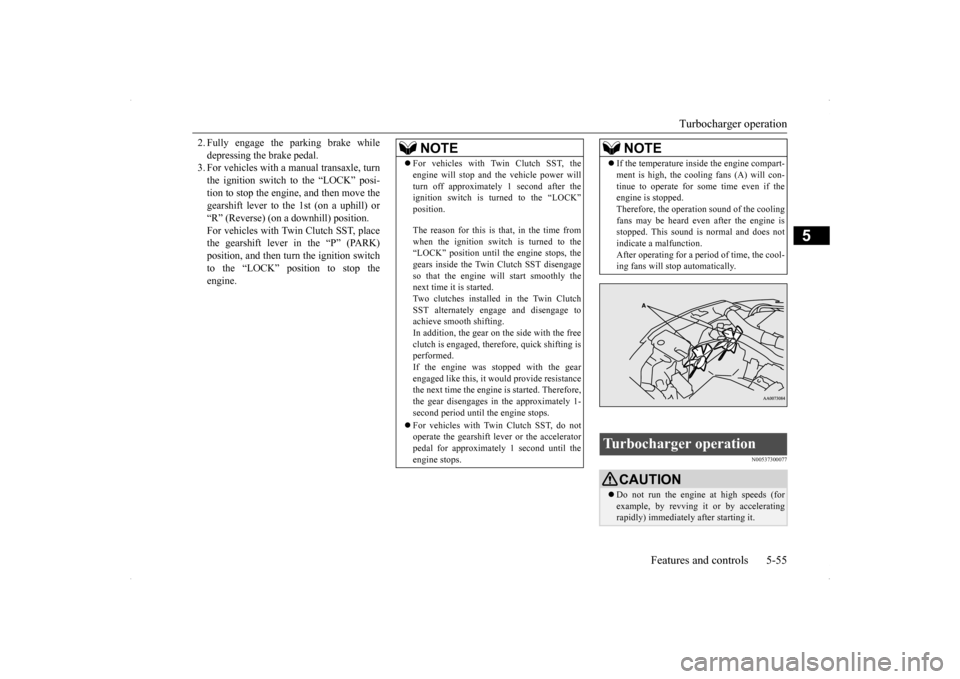
If the temperature inside the engine compart- ment is high, the cooling fans (A) will con- tinue to operate for some time even if the engine is stopped. Therefore, the operation sound of the coolingfans may be heard even after the engine is stopped. This sound is normal and does not indicate a malfunction.After operating for a period of time, the cool- ing fans will stop automatically.
Turbocharger operation
CAUTION Do not run the engine at high speeds (for example, by revving it or by accelerating rapidly) immediately after starting it.NOTE
BK0200800US.bo
ok 55 ページ 2013年2月14日 木曜日 午後2時28分
Page 117 of 338
Clutch pedal operation (if so equipped) 5-56 Features and controls
5
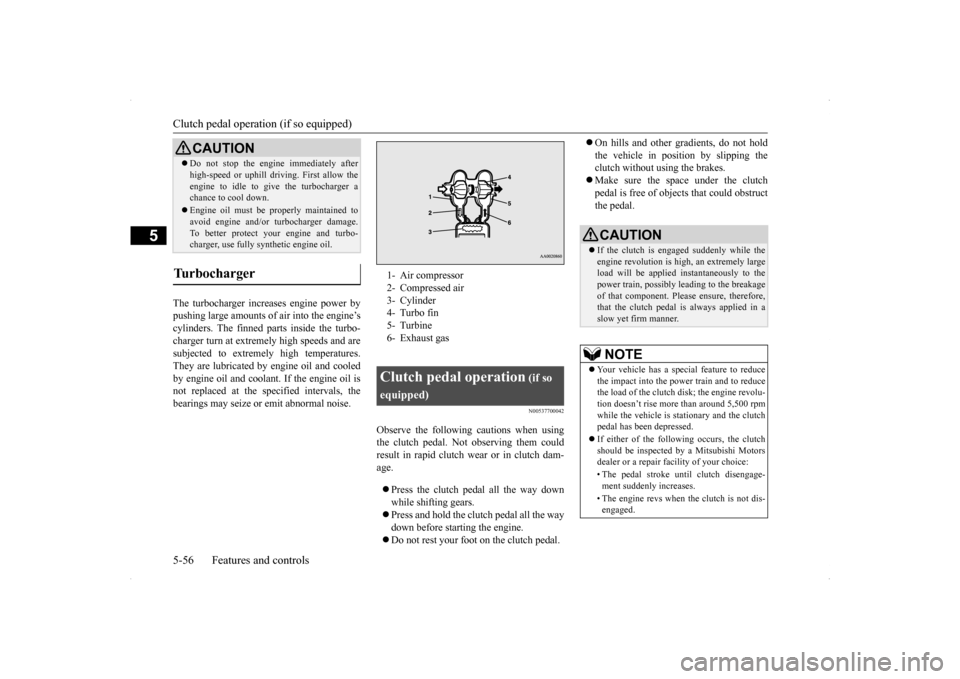
The turbocharger increases engine power by pushing large amounts of air into the engine’s cylinders. The finned parts inside the turbo-charger turn at extremely high speeds and are subjected to extremely high temperatures. They are lubricated by engine oil and cooledby engine oil and coolan
t. If the engine oil is
not replaced at the specified intervals, the bearings may seize or emit abnormal noise.
N00537700042
Observe the following cautions when usingthe clutch pedal. Not observing them couldresult in rapid clutch wear or in clutch dam- age. Press the clutch pedal all the way down while shifting gears. Press and hold the clutch pedal all the way down before starting the engine. Do not rest your foot on the clutch pedal.
On hills and other gradients, do not hold the vehicle in position by slipping the clutch without using the brakes. Make sure the space under the clutch pedal is free of objects that could obstruct the pedal.
Do not stop the engine immediately after high-speed or uphill driv
ing. First allow the
engine to idle to give the turbocharger a chance to cool down. Engine oil must be properly maintained to avoid engine and/or turbocharger damage. To better protect your engine and turbo-charger, use fully synthetic engine oil.
Turbocharger
CAUTION
1- Air compressor 2- Compressed air3- Cylinder 4- Turbo fin 5- Turbine6- Exhaust gasClutch pedal operation
(if so
equipped)
CAUTION If the clutch is engaged suddenly while the engine revolution is high, an extremely large load will be applied instantaneously to the power train, possibly leading to the breakageof that component. Please ensure, therefore, that the clutch pedal is always applied in a slow yet firm manner.NOTE
Your vehicle has a special feature to reduce the impact into the power train and to reduce the load of the clutch disk; the engine revolu-tion doesn’t rise more than around 5,500 rpm while the vehicle is stationary and the clutch pedal has been depressed. If either of the following occurs, the clutch should be inspected by a Mitsubishi Motors dealer or a repair facility of your choice: • The pedal stroke until clutch disengage- ment suddenly increases. • The engine revs when the clutch is not dis- engaged.
BK0200800US.bo
ok 56 ページ 2013年2月14日 木曜日 午後2時28分
Page 126 of 338
Twin Clutch SST (Sportronic Shif
t Transmission) (if so equipped) Features and controls 5-65
5
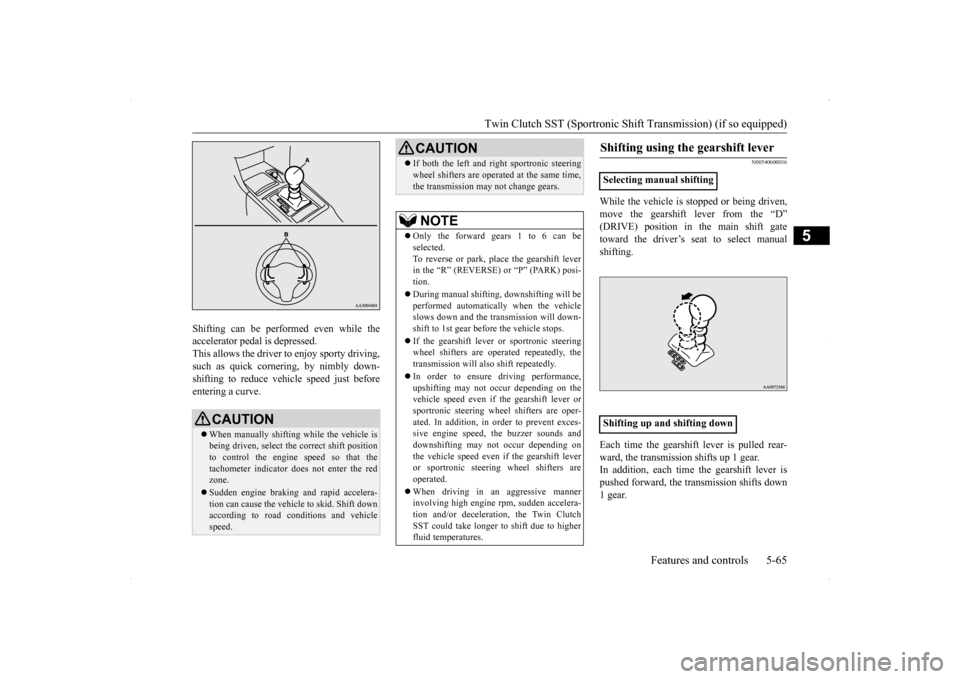
Shifting can be performed even while the accelerator pedal is depressed. This allows the driver to enjoy sporty driving,such as quick cornering, by nimbly down- shifting to reduce vehicle speed just before entering a curve.
N00540600016
While the vehicle is stopped or being driven, move the gearshift lever from the “D” (DRIVE) position in the main shift gatetoward the driver’s seat to select manual shifting. Each time the gearshift lever is pulled rear- ward, the transmission shifts up 1 gear.In addition, each time the gearshift lever is pushed forward, the transmission shifts down 1 gear.
CAUTION When manually shifting while the vehicle is being driven, select the correct shift positionto control the engine speed so that the tachometer indicator does not enter the red zone. Sudden engine braking and rapid accelera- tion can cause the vehicle to skid. Shift downaccording to road conditions and vehicle speed.
If both the left and right sportronic steering wheel shifters are operated at the same time, the transmission may not change gears.NOTE
Only the forward gears 1 to 6 can be selected. To reverse or park, place the gearshift leverin the “R” (REVERSE) or “P” (PARK) posi- tion. During manual shifting, downshifting will be performed automatically when the vehicle slows down and the transmission will down-shift to 1st gear before the vehicle stops. If the gearshift lever or sportronic steering wheel shifters are operated repeatedly, the transmission will also shift repeatedly. In order to ensure driving performance, upshifting may not occur depending on the vehicle speed even if the gearshift lever orsportronic steering wheel shifters are oper- ated. In addition, in order to prevent exces- sive engine speed, the buzzer sounds anddownshifting may not occur depending on the vehicle speed even if the gearshift lever or sportronic steering wheel shifters are operated. When driving in an aggressive manner involving high engine rpm, sudden accelera- tion and/or deceleration, the Twin ClutchSST could take longer to shift due to higher fluid temperatures.CAUTION
Shifting using the gearshift lever
Selecting manual shifting Shifting up and shifting downç
BK0200800US.bo
ok 65 ページ 2013年2月14日 木曜日 午後2時28分
Page 138 of 338
Active stability control (ASC) Features and controls 5-77
5
N00559200021
On slippery surfaces, the traction control function prevents the drive wheels from spin-ning excessive, thus helping the vehicle to start moving from a stopped condition. It also provides sufficient driving force and steeringperformance as the vehicle turns while press- ing the acceleration pedal.
N00546800010
The skid control function is designed to help the driver maintain control of the vehicle onslippery roads or during rapid steering
maneuvers. It works by controlling the engine output and the brake on each wheel.
N00559400209
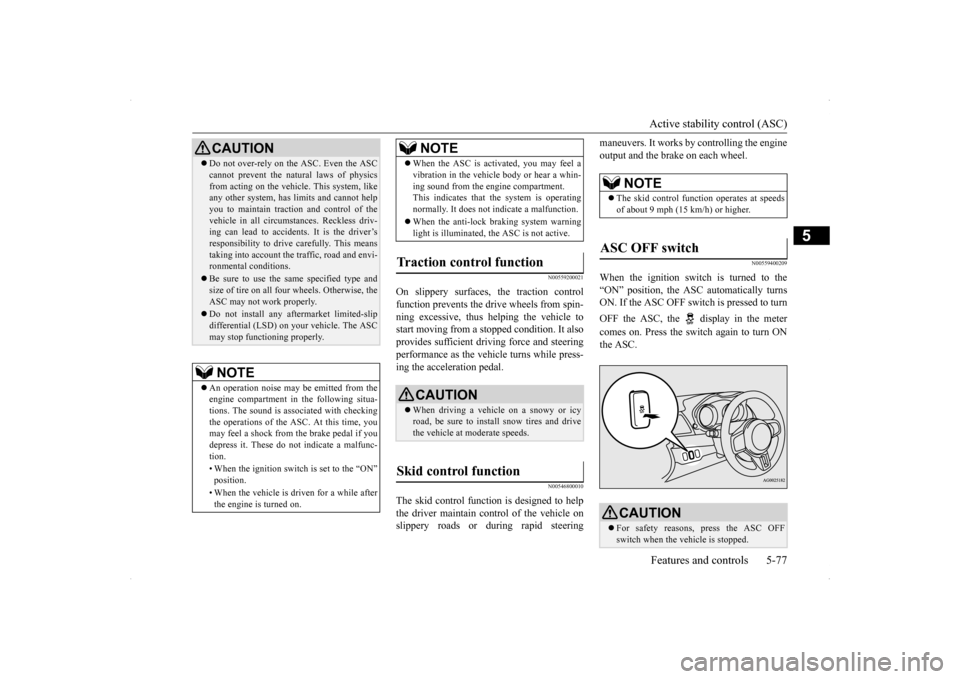
When the ignition switch is turned to the “ON” position, the ASC automatically turns ON. If the ASC OFF switch is pressed to turn OFF the ASC, the display in the meter comes on. Press the switch again to turn ON the ASC.
CAUTION Do not over-rely on the ASC. Even the ASC cannot prevent the natural laws of physics from acting on the vehicl
e. This system, like
any other system, has limits and cannot help you to maintain traction and control of thevehicle in all circumstances. Reckless driv- ing can lead to accidents. It is the driver’s responsibility to drive carefully. This meanstaking into account the traffic, road and envi- ronmental conditions. Be sure to use the same specified type and size of tire on all four wheels. Otherwise, the ASC may not work properly. Do not install any aftermarket limited-slip differential (LSD) on your vehicle. The ASCmay stop functioning properly.NOTE
An operation noise may be emitted from the engine compartment in the following situa-tions. The sound is associated with checking the operations of the ASC. At this time, you may feel a shock from the brake pedal if youdepress it. These do not indicate a malfunc- tion. • When the ignition switch is set to the “ON” position. • When the vehicle is driven for a while after the engine is turned on.
When the ASC is activated, you may feel a vibration in the vehicle body or hear a whin- ing sound from the engine compartment. This indicates that the system is operating normally. It does not indicate a malfunction. When the anti-lock braking system warning light is illuminated, the ASC is not active.
Traction control function
CAUTION When driving a vehicle on a snowy or icy road, be sure to install snow tires and drivethe vehicle at moderate speeds.
Skid control function
NOTE
NOTE
The skid control function operates at speeds of about 9 mph (15 km/h) or higher.
ASC OFF switch
CAUTION For safety reasons, press the ASC OFF switch when the vehicle is stopped.
BK0200800US.bo
ok 77 ページ 2013年2月14日 木曜日 午後2時28分
Page 149 of 338
Tire pressure monitoring system 5-88 Features and controls
5
2. If the tire pressure monitoring system warning light remains illuminated after you have been driving for about 20 min- utes after you adjust the tire inflation pres-sure, one or more of the tires may have apuncture. Inspect the tire and if it has a puncture, have it repaired by an autho- rized Mitsubishi Motors dealer as soon aspossible.
The tire pressure monitoring system may not work normally in the following circum- stances: A wireless facility or device using the same frequency is near the vehicle. Snow or ice is stuck inside the fenders and/or on the wheels. The tire inflation pressure sensor’s battery is dead. Wheels other than Mitsubishi genuine wheels are being used. Wheels that are not fi
tted with tire infla-
tion pressure sensors are being used. Wheels whose ID codes are not memo- rized by the vehicle are used. Compact spare tire is fitted on a road wheel.
A window tint that affects the radio wave signals is installed.
N00532900179
If new wheels with new tire inflation pressuresensors are installed, their ID codes must beprogrammed into the tire pressure monitoring system. Have tire and wheel replacement per- formed by an authorized Mitsubishi Motorsdealer to avoid the risk of damaging the tire inflation pressure sensors. If the wheel replacement is not done by an authorizedMitsubishi Motors dealer, it is not covered by your warranty.
Once adjustments have been made, the warn- ing light will go off after a few minutes of driving.WA R N I N G If the warning light/display illuminates while you are driving, avoid hard braking, sharp steering maneuvers and high speeds. Driving with an under-inflated tireadversely affects vehicle performance and can result in an accident.CAUTION If a tire has a puncture, replace that tire with the spare tire. Driving on a punctured tire could lead to an accident. The warning light/display may not illuminate immediately in the event of a tire blowout orrapid leak.NOTE
NOTE
To avoid the risk of damage to the tire infla- tion pressure sensors, have any punctured tire repaired by an authorized Mitsubishi Motors dealer. If the tire repair is not done by an authorized Mitsubishi Motors dealer, it isnot covered by your warranty. Do not use an aerosol puncture-repair prod- uct on any tire. Such a spray could damage the tire inflation pressure sensors. Have any puncture repaired by an authorized Mitsubi-shi Motors dealer.
NOTE
Tire inflation pressures vary with the ambi- ent temperature. If the
vehicle is subjected to
large variations in ambient temperature, thetire inflation pressures may be under-inflated (causing the warning light/display to come on) when the ambient temperature is rela-tively low. If the warning light/display comes on, adjust the tire inflation pressure.
Whenever the tires and wheels are replaced with new ones
BK0200800US.bo
ok 88 ページ 2013年2月14日 木曜日 午後2時28分
Page 262 of 338
Tools and jack
For emergencies 8-5
8
8. If the reserve tank needs coolant, you will probably also need to add coolant to the radiator. Do not loosen or remove the radiator cap until the engine has cooleddown. 9. Start the engine, and slowly add coolant, up to the bottom of the filler neck. Useplain water if you have to (and replace it with the right coolant as soon as possible).
10. Replace the radiator cap and tighten it
fully. Check the engine coolant tempera- ture display on the multi-information dis- play. You can start driving again when thebar graph for the engine coolant tempera- ture display returns to the normal zone.
11. Have your vehicle checked by your autho-
rized Mitsubishi Motors dealer or a repair facility of your choice.
N00836600311
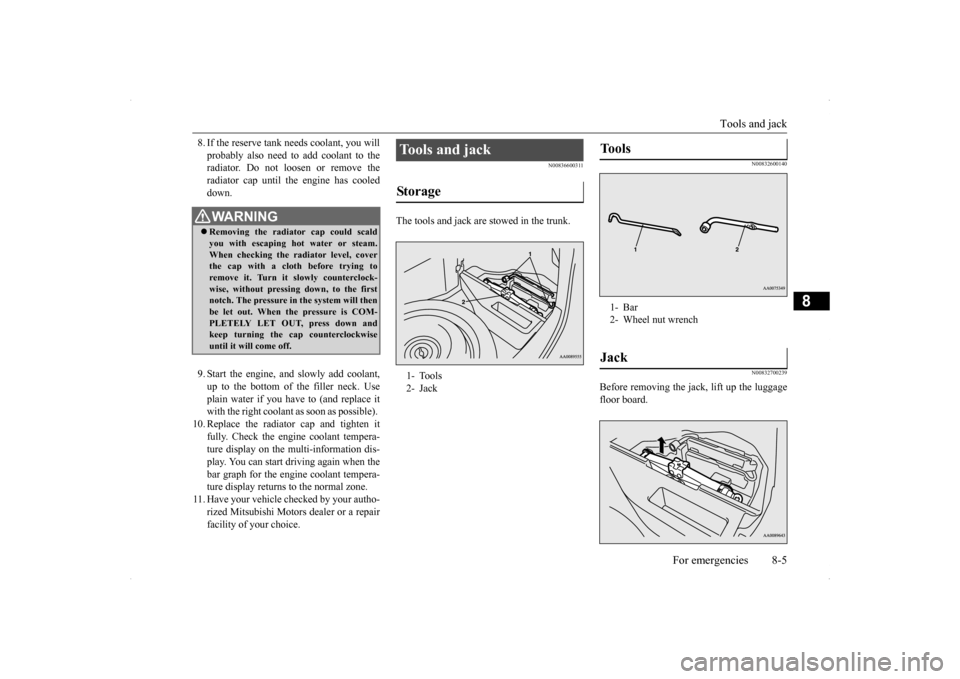
The tools and jack are stowed in the trunk.
N00832600140 N00832700239
Before removing the jack, lift up the luggage floor board.
WA R N I N G Removing the radiator cap could scald you with escaping hot water or steam.When checking the radiator level, cover the cap with a cloth before trying to remove it. Turn it slowly counterclock-wise, without pressing down, to the first notch. The pressure in the system will then be let out. When the pressure is COM-PLETELY LET OUT, press down and keep turning the cap counterclockwise until it will come off.
Tools and jack Storage 1- Tools 2- Jack
Tools 1- Bar 2- Wheel nut wrenchJack
BK0200800US.bo
ok 5 ページ 2013年2月14日 木曜日 午後2時28分
Page 270 of 338
Operation under adverse driving conditions
For emergencies 8-13
8
Drive as slow as possible when driving on bumpy or rutted roads or over potholes etc.
CAUTION Do not depress the accelerator pedal rapidly. The vehicle could start moving when it breaks free from the ice, possibly resulting in an accident.
On a bumpy or rutted road
CAUTION Driving on bumpy, rutted roads or over pot- holes can damage the tires and wheels.Wheels with low-profiles tires or under- inflated tires are especially at risk for dam- age. The vehicle’s body, bumper, muffler and other parts may be damaged if the vehicle is:• driven over a step (for example, at theentrance or exit of a parking lot);• parked too closely against a curb or parkingblock, or by the side of a road with curb- stones;• driven on a steep slope;
BK0200800US.bo
ok 13 ページ 2013年2月14日 木曜日 午後2時28分
Page 277 of 338
Engine oil and oil filter 9-6 Vehicle care and maintenance
9
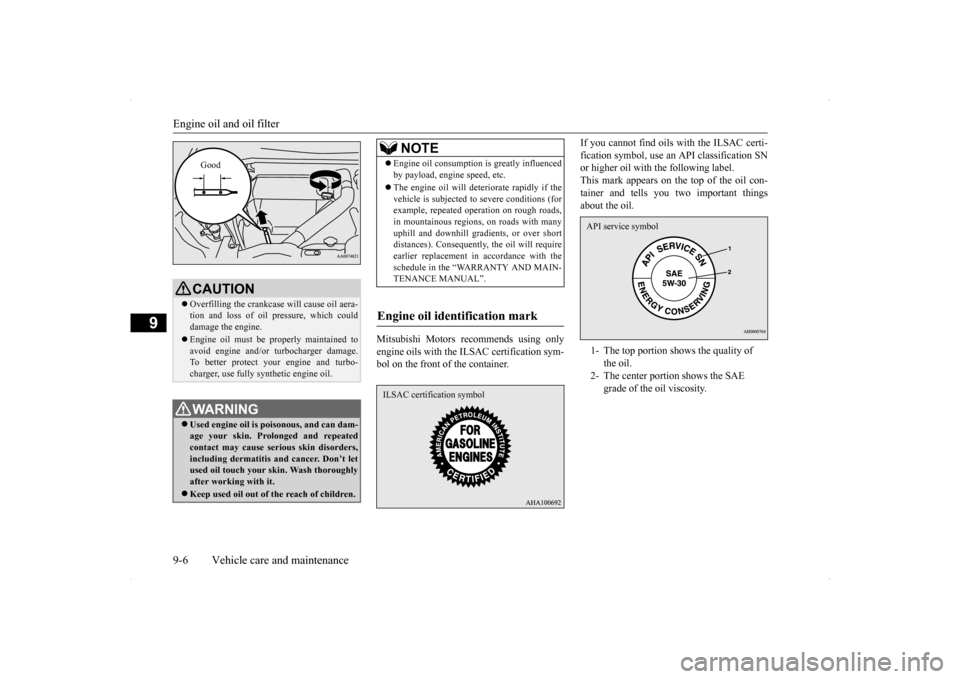
Mitsubishi Motors recommends using only engine oils with the ILSAC certification sym- bol on the front of the container.
If you cannot find oils with the ILSAC certi- fication symbol, use an API classification SN or higher oil with the following label. This mark appears on th
e top of the oil con-
tainer and tells you two important things about the oil.
CAUTION Overfilling the crankcase will cause oil aera- tion and loss of oil pressure, which could damage the engine. Engine oil must be properly maintained to avoid engine and/or turbocharger damage. To better protect your engine and turbo-charger, use fully synthetic engine oil.WA R N I N G Used engine oil is poisonous, and can dam- age your skin. Prolonged and repeatedcontact may cause serious skin disorders, including dermatitis and cancer. Don’t let used oil touch your skin. Wash thoroughlyafter working with it. Keep used oil out of the reach of children.Good
NOTE
Engine oil consumption is greatly influenced by payload, engine speed, etc. The engine oil will deteriorate rapidly if the vehicle is subjected to severe conditions (forexample, repeated operation on rough roads, in mountainous regions, on roads with many uphill and downhill gradients, or over shortdistances). Consequently, the oil will require earlier replacement in accordance with the schedule in the “WARRANTY AND MAIN-TENANCE MANUAL”.
Engine oil identification mark ILSAC certification symbol
1- The top portion shows the quality of
the oil.
2- The center portion shows the SAE
grade of the oil viscosity.
API service symbol
BK0200800US.bo
ok 6 ページ 2013年2月14日 木曜日 午後2時28分
Page 280 of 338
Manual transaxle oil (if so equipped) Vehicle care and maintenance 9-9
9
N00938200165
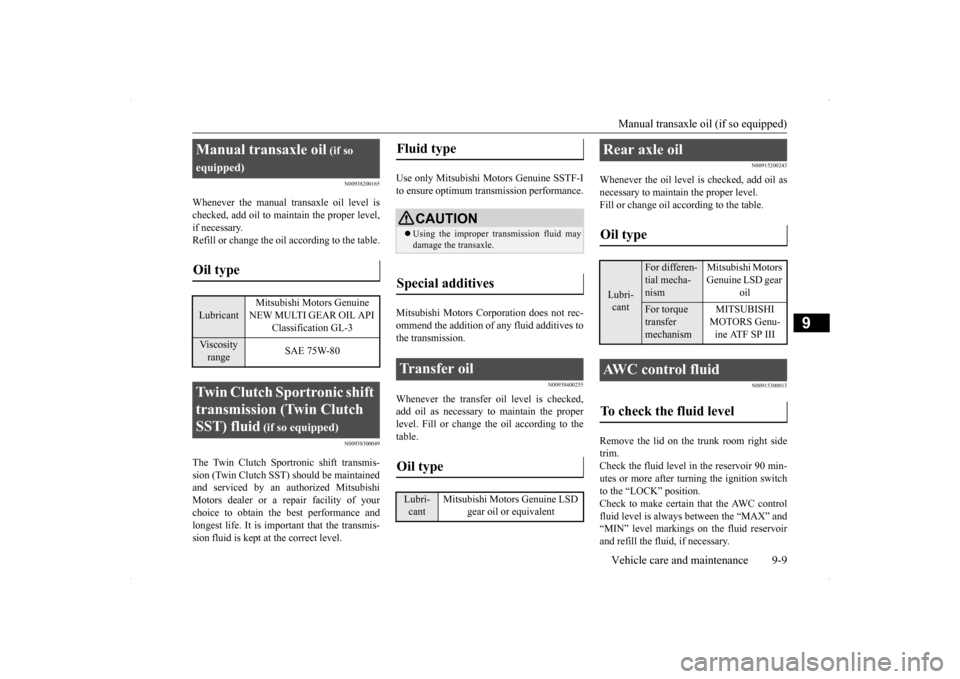
Whenever the manual transaxle oil level is checked, add oil to maintain the proper level, if necessary. Refill or change the oil according to the table.
N00938300049
The Twin Clutch Sportronic shift transmis-sion (Twin Clutch SST) should be maintained and serviced by an authorized Mitsubishi Motors dealer or a repair facility of yourchoice to obtain the best performance and longest life. It is impor
tant that the transmis-
sion fluid is kept at the correct level.
Use only Mitsubishi Motors Genuine SSTF-I to ensure optimum transmission performance. Mitsubishi Motors Corporation does not rec- ommend the addition of any fluid additives to the transmission.
N00938400255
Whenever the transfer oil level is checked,add oil as necessary to maintain the proper level. Fill or change the oil according to thetable.
N00915200243
Whenever the oil level is checked, add oil asnecessary to maintain the proper level.Fill or change oil according to the table.
N00915300013
Remove the lid on the trunk room right side trim. Check the fluid level in the reservoir 90 min-utes or more after turning the ignition switch to the “LOCK” position. Check to make certain that the AWC controlfluid level is always between the “MAX” and “MIN” level markings on the fluid reservoir and refill the fluid, if necessary.
Manual transaxle oil
(if so
equipped)Oil type
Lubricant
Mitsubishi Motors Genuine NEW MULTI GEAR OIL API
Classification GL-3
Viscosity range
SAE 75W-80
Twin Clutch Sportronic shift transmission (Twin Clutch SST) fluid
(if so equipped)
Fluid type
CAUTION Using the improper transmission fluid may damage the transaxle.
Special additives
Transfer oil Oil type Lubri- cant
Mitsubishi Motors Genuine LSD
gear oil or equivalent
Rear axle oil Oil type Lubri- cant
For differen- tial mecha- nism
Mitsubishi Motors Genuine LSD gear
oil
For torque transfer mechanism
MITSUBISHI MOTORS Genu- ine ATF SP III
AWC control fluid To check the fluid level
BK0200800US.bo
ok 9 ページ 2013年2月14日 木曜日 午後2時28分
Page 292 of 338
General maintenance
Vehicle care and maintenance 9-21
9
N00940900244
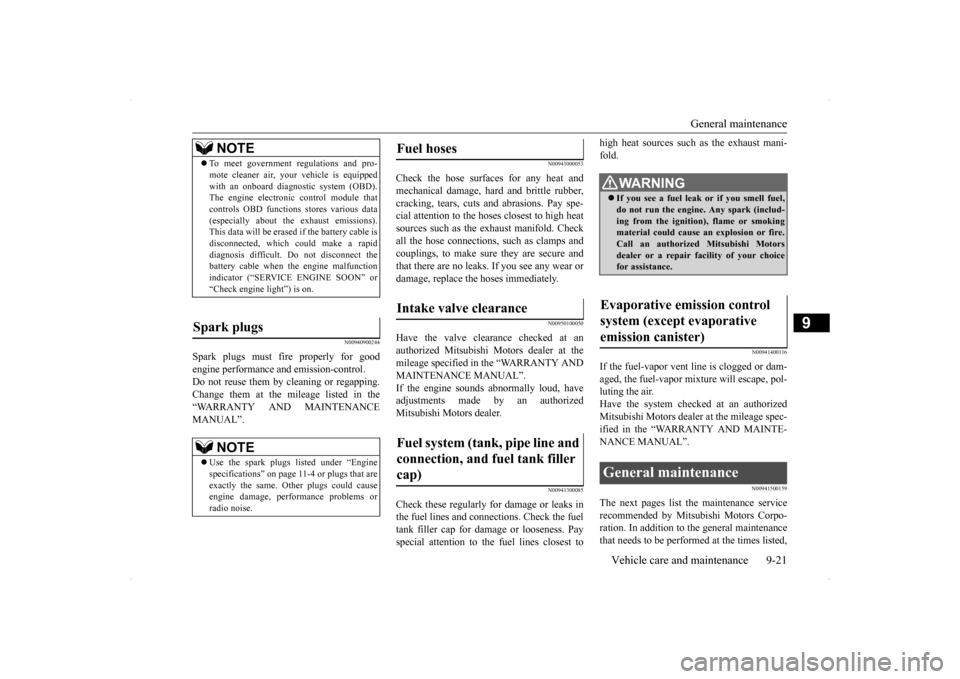
Spark plugs must fire properly for good engine performance and emission-control.Do not reuse them by cleaning or regapping. Change them at the mileage listed in the “WARRANTY AND MAINTENANCEMANUAL”.
N00941000053
Check the hose surfaces for any heat andmechanical damage, hard and brittle rubber,cracking, tears, cuts and abrasions. Pay spe- cial attention to the hoses closest to high heat sources such as the exhaust manifold. Checkall the hose connections, such as clamps and couplings, to make sure
they are secure and
that there are no leaks. If you see any wear ordamage, replace the hoses immediately.
N00950100050
Have the valve clearance checked at anauthorized Mitsubishi Motors dealer at themileage specified in the “WARRANTY AND MAINTENANCE MANUAL”. If the engine sounds abnormally loud, haveadjustments made by an authorized Mitsubishi Motors dealer.
N00941300085
Check these regularly for damage or leaks in the fuel lines and connections. Check the fuel tank filler cap for damage or looseness. Pay special attention to the fuel lines closest to
high heat sources such as the exhaust mani- fold.
N00941400116
If the fuel-vapor vent line is clogged or dam- aged, the fuel-vapor mixture will escape, pol- luting the air.Have the system checked at an authorized Mitsubishi Motors dealer at the mileage spec- ified in the “WARRANTY AND MAINTE-NANCE MANUAL”.
N00941500159
The next pages list the maintenance servicerecommended by Mitsubishi Motors Corpo- ration. In addition to the general maintenance that needs to be performed at the times listed,
NOTE
To meet government regulations and pro- mote cleaner air, your vehicle is equipped with an onboard diagnostic system (OBD). The engine electronic control module that controls OBD functions stores various data(especially about the exhaust emissions). This data will be erased if the battery cable is disconnected, which could make a rapiddiagnosis difficult. Do not disconnect the battery cable when the engine malfunction indicator (“SERVICE ENGINE SOON” or“Check engine light”) is on.
Spark plugs
NOTE
Use the spark plugs listed under “Engine specifications” on page 11-4 or plugs that are exactly the same. Other plugs could causeengine damage, performance problems or radio noise.
Fuel hoses Intake valve clearance Fuel system (tank, pipe line and connection, and fuel tank filler cap)
WA R N I N G If you see a fuel leak or if you smell fuel, do not run the engine. Any spark (includ- ing from the ignition), flame or smokingmaterial could cause an explosion or fire. Call an authorized Mitsubishi Motors dealer or a repair facility of your choicefor assistance.
Evaporative emission control system (except evaporative emission canister) General maintenance
BK0200800US.bo
ok 21 ページ 2013年2月14日 木曜日 午後2時28分