belt MITSUBISHI LANCER EVOLUTION 2015 10.G Owners Manual
[x] Cancel search | Manufacturer: MITSUBISHI, Model Year: 2015, Model line: LANCER EVOLUTION, Model: MITSUBISHI LANCER EVOLUTION 2015 10.GPages: 338, PDF Size: 43.12 MB
Page 5 of 338
Center panel 1-3 Overview
1
N00100701210
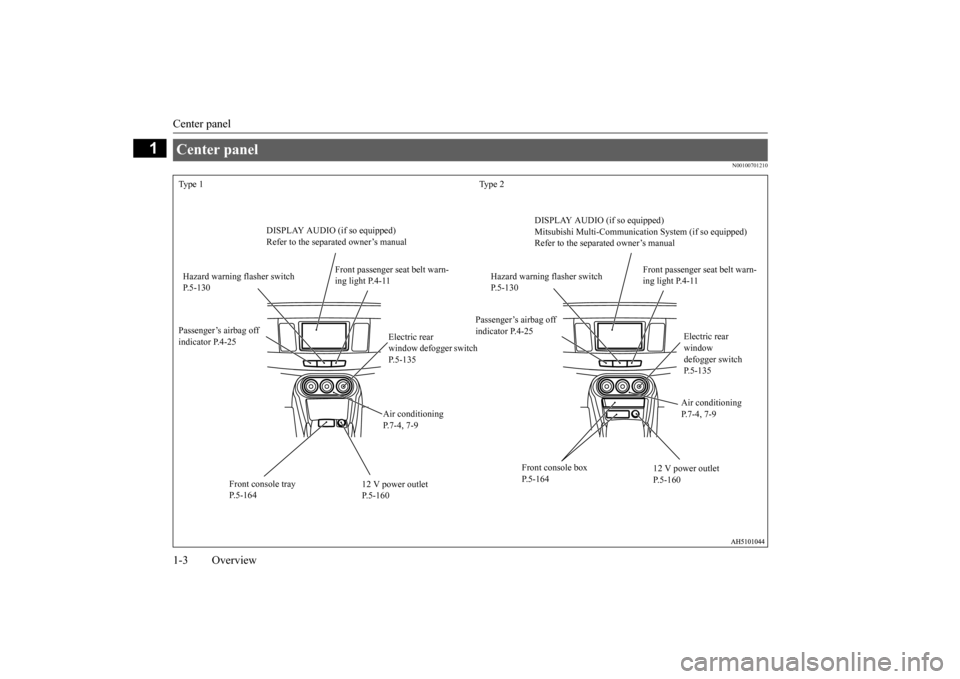
Center panel Type 1 Type 2
DISPLAY AUDIO (if so equipped) Refer to the separated owner’s manual
DISPLAY AUDIO (if so equipped) Mitsubishi Multi-Communicati
on System (if so equipped)
Refer to the separated owner’s manual
Hazard warning flasher switch P.5-130
Front passenger seat belt warn- ing light P.4-11
Hazard warning flasher switch P.5-130
Front passenger seat belt warn- ing light P.4-11
Passenger’s airbag off indicator P.4-25
Passenger’s airbag off indicator P.4-25
Electric rear window defogger switch P.5-135
Electric rear window defogger switch P.5-135
Front console box P.5-164
Air conditioning P.7-4, 7-9
Air conditioning P.7-4, 7-9
12 V power outlet P.5-160
12 V power outlet P.5-160
Front console tray P.5-164
BK0210800US.bo
ok 3 ページ 2014年4月8日 火曜日 午前11時28分
Page 6 of 338
Interior
Overview 1-4
1
N00100302330
Interior
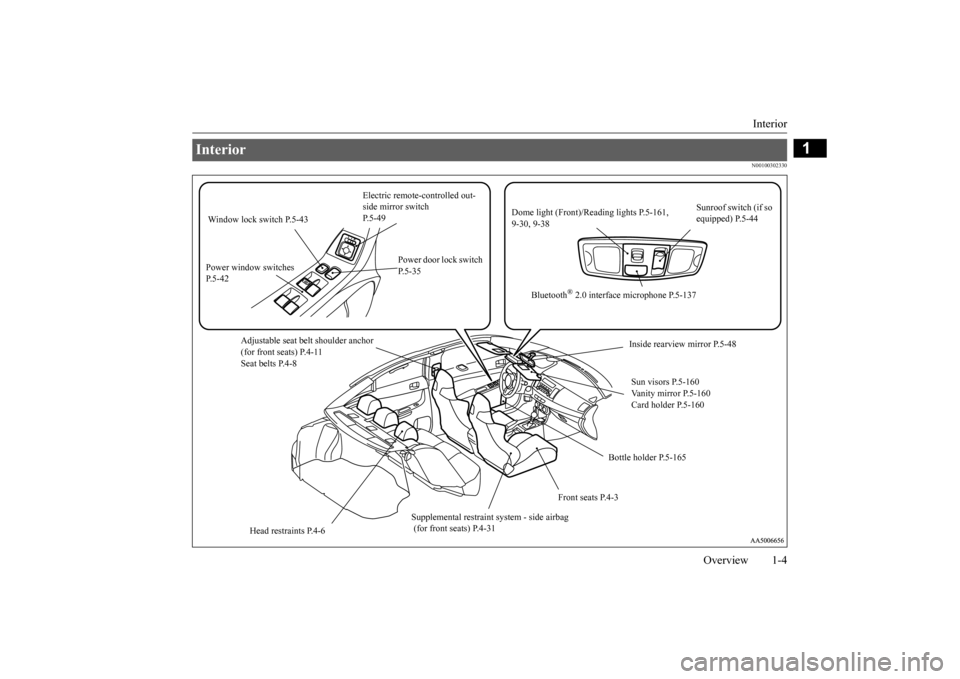
Electric remote-controlled out- side mirror switch P.5-49
Sunroof switch (if so equipped) P.5-44
Dome light (Front)/R
eading lights P.5-161,
9-30, 9-38
Window lock switch P.5-43 Power window switches P.5-42
Power door lock switch P.5-35
Bluetooth
® 2.0 interface microphone P.5-137
Adjustable seat belt shoulder anchor (for front seats) P.4-11 Seat belts P.4-8
Inside rearview mirror P.5-48 Sun visors P.5-160 Vanity mirror P.5-160Card holder P.5-160
Bottle holder P.5-165
Front seats P.4-3
Supplemental restraint
system - side airbag
(for front seats) P.4-31
Head restraints P.4-6
BK0210800US.bo
ok 4 ページ 2014年4月8日 火曜日 午前11時28分
Page 13 of 338
If this warning light comes on or
flashes while you’re driving...
2-2 Quick index
2
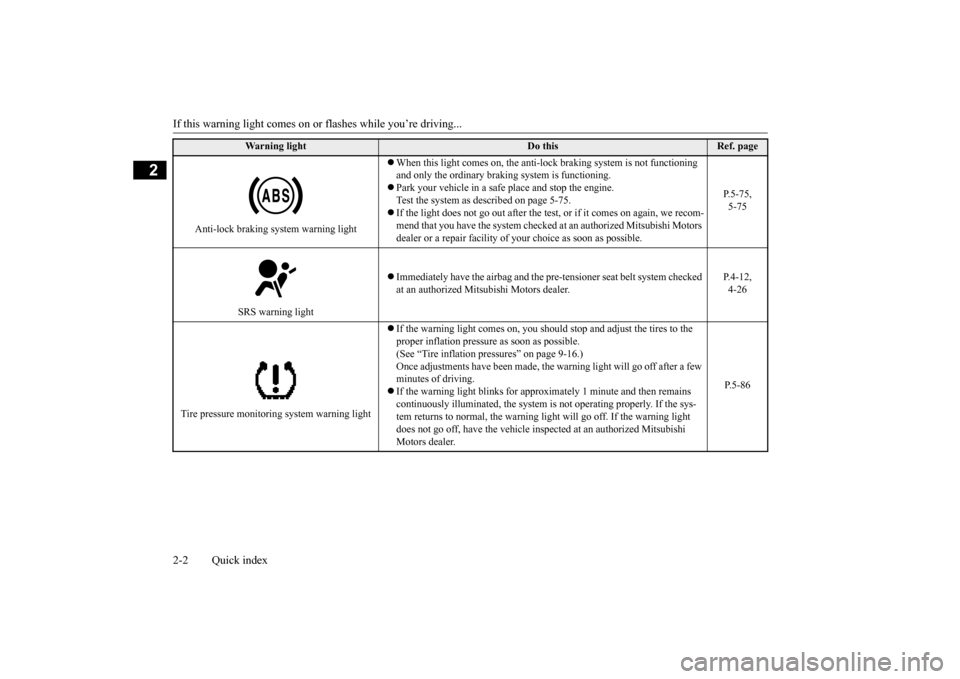
Anti-lock braking system warning light
When this light comes on, the anti-lock braking system is not functioning and only the ordinary braking system is functioning. Park your vehicle in a safe
place and stop the engine.
Test the system as described on page 5-75. If the light does not go out after the test
, or if it comes on again, we recom-
mend that you have the system checked at
an authorized Mitsubishi Motors
dealer or a repair facility of your choice as soon as possible.
P.5-75, 5-75
SRS warning light
Immediately have the airbag and the pre-tensioner seat belt system checked at an authorized Mitsubishi Motors dealer.
P.4-12, 4-26
Tire pressure monitoring system warning light
If the warning light comes on, you should
stop and adjust the tires to the
proper inflation pressure as soon as possible. (See “Tire inflation pressures” on page 9-16.)Once adjustments have been made, the
warning light will go off after a few
minutes of driving. If the warning light blinks for approximately 1 minute and then remains continuously illuminated, the system is not operating properly. If the sys- tem returns to normal, the warning light will go off. If the warning light does not go off, have the vehicle inspected at an authorized Mitsubishi Motors dealer.
P.5-86
Warning light
Do this
Ref. page
BK0210800US.bo
ok 2 ページ 2014年4月8日 火曜日 午前11時28分
Page 26 of 338
4
Seat and restraint systemsSeats ..........................................
.......................................................4-2
Seats and restraint syst
ems ..............................................................4-2
Front seats .......................
.................................................................4-3
Rear seats ........................
.................................................................4-5
Head restraints ......
.................................................
..........................4-6
Seat belts .........................
.................................................................4-8
Seat belt use during preg
nancy ......................................................4-12
Seat belt pre-tensioner and fo
rce limiter systems ..........................4-12
Child restraint system
s ...........................................
........................4-13
Maintenance and inspection of seat belts ......................................4-20Supplemental Restraint System (SRS) - airbag .............................4-20
BK0210800US.bo
ok 1 ページ 2014年4月8日 火曜日 午前11時28分
Page 27 of 338
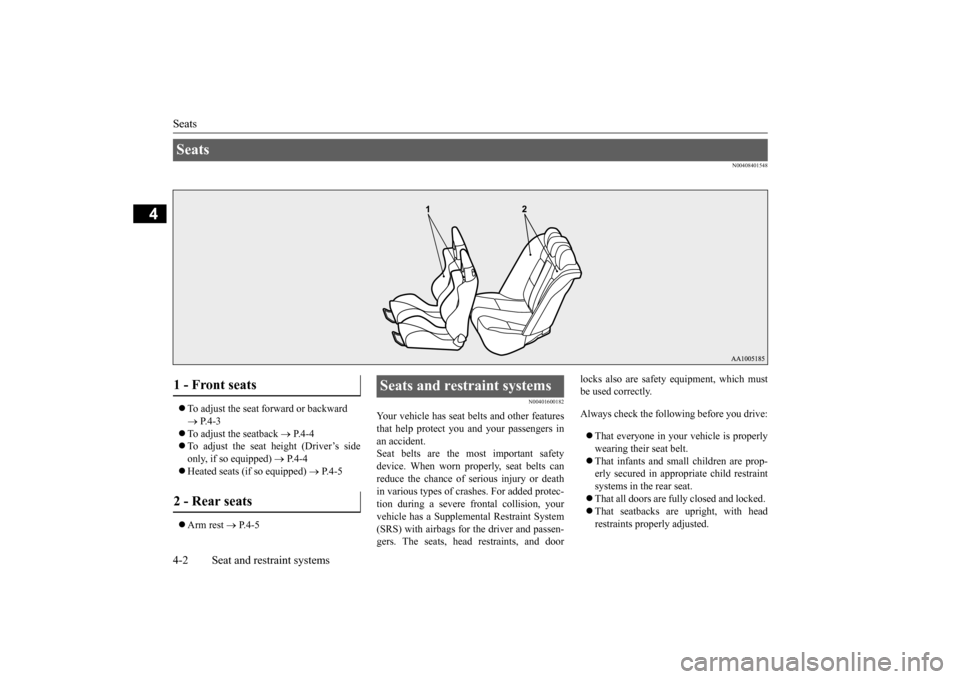
Seats 4-2 Seat and restraint systems
4
N00408401548
To adjust the seat forward or backward P.4-3
To adjust the seatback
P.4-4
To adjust the seat height (Driver’s side only, if so equipped)
P.4-4
Heated seats (if so equipped)
P.4-5
Arm rest
P.4-5
N00401600182
Your vehicle has seat belts and other features that help protect you and your passengers inan accident. Seat belts are the most important safety device. When worn properly, seat belts canreduce the chance of serious injury or death in various types of crashes. For added protec- tion during a severe frontal collision, yourvehicle has a Supplemental Restraint System(SRS) with airbags for the driver and passen- gers. The seats, head restraints, and door
locks also are safety equipment, which must be used correctly. Always check the following before you drive: That everyone in your vehicle is properly wearing their seat belt. That infants and small children are prop- erly secured in appropriate child restraint systems in the rear seat. That all doors are full
y closed and locked.
That seatbacks are upright, with head restraints properly adjusted.
Seats 1 - Front seats 2 - Rear seats
Seats and restraint systems
BK0210800US.bo
ok 2 ページ 2014年4月8日 火曜日 午前11時28分
Page 28 of 338
Front seats
Seat and restraint systems 4-3
4
Safety equipment cannot prevent injury or death in all motor vehicle accidents. You can help reduce the risk of injury or death, how- ever, by following the
instructions in this
manual.
N00401800315
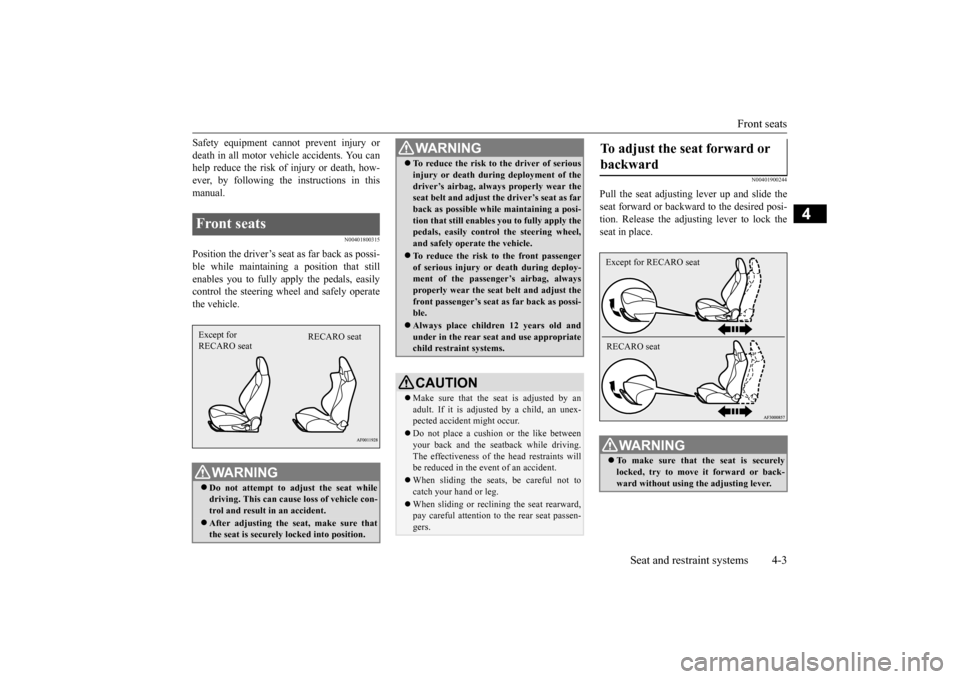
Position the driver’s seat
as far back as possi-
ble while maintaining a position that stillenables you to fully apply the pedals, easily control the steering wheel and safely operate the vehicle.
N00401900244
Pull the seat adjusting lever up and slide theseat forward or backward to the desired posi- tion. Release the adjusting lever to lock the seat in place.
Front seats
WA R N I N G Do not attempt to adjust the seat while driving. This can cause loss of vehicle con-trol and result in an accident. After adjusting the seat, make sure that the seat is securely locked into position.Except for RECARO seat
RECARO seat
To reduce the risk to the driver of serious injury or death during deployment of the driver’s airbag, always properly wear the seat belt and adjust th
e driver’s seat as far
back as possible while maintaining a posi-tion that still enables
you to fully apply the
pedals, easily control the steering wheel, and safely operate the vehicle. To reduce the risk to the front passenger of serious injury or death during deploy-ment of the passenger’s airbag, always properly wear the seat belt and adjust the front passenger’s seat as far back as possi-ble. Always place children 12 years old and under in the rear seat and use appropriate child restraint systems.CAUTION Make sure that the seat is adjusted by an adult. If it is adjusted by a child, an unex-pected accident might occur. Do not place a cushion or the like between your back and the seatback while driving. The effectiveness of the head restraints will be reduced in the event of an accident. When sliding the seats, be careful not to catch your hand or leg. When sliding or reclining the seat rearward, pay careful attention to the rear seat passen- gers.WA R N I N G
To adjust the seat forward or backward
WA R N I N G To make sure that the seat is securely locked, try to move it forward or back- ward without using the adjusting lever. Except for RECARO seat RECARO seat
BK0210800US.bo
ok 3 ページ 2014年4月8日 火曜日 午前11時28分
Page 29 of 338
Front seats 4-4 Seat and restraint systems
4
N00402001382
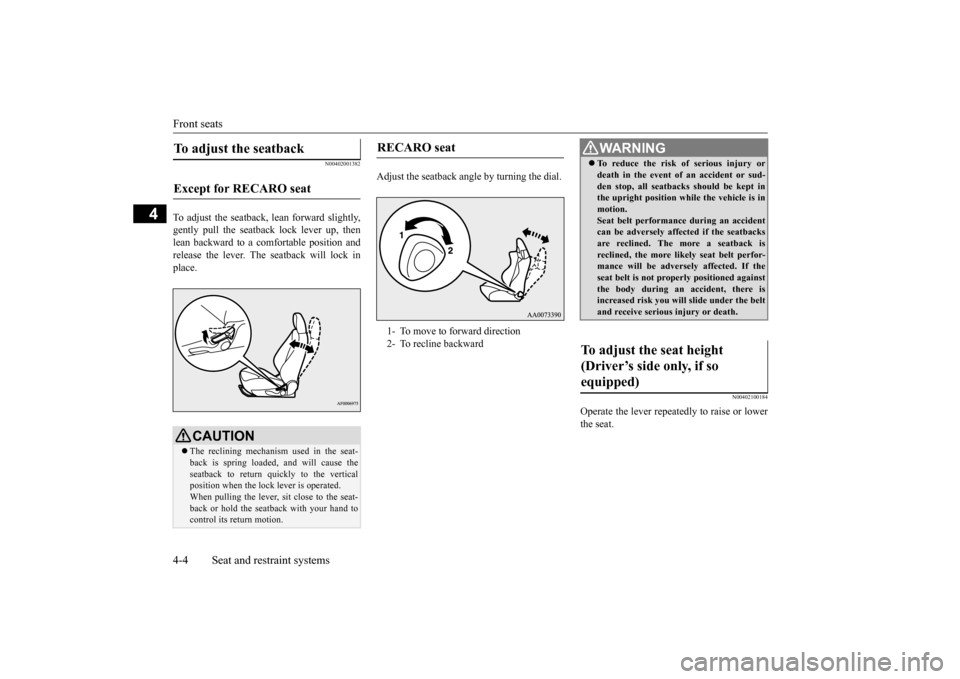
To adjust the seatback,
lean forward slightly,
gently pull the seatb
ack lock lever up, then
lean backward to a comfortable position and release the lever. The seatback will lock in place.
Adjust the seatback angle by turning the dial.
N00402100184
Operate the lever repeatedly to raise or lower the seat.
To adjust the seatback Except for RECARO seat
CAUTION The reclining mechanism used in the seat- back is spring loaded, and will cause the seatback to return quickly to the vertical position when the lock lever is operated. When pulling the lever, sit close to the seat- back or hold the seatback with your hand to control its return motion.
RECARO seat 1- To move to forward direction 2- To recline backward
WA R N I N G To reduce the risk of serious injury or death in the event of an accident or sud- den stop, all seatbacks should be kept in the upright position while the vehicle is in motion.Seat belt performance during an accident can be adversely affected if the seatbacks are reclined. The more a seatback isreclined, the more likely seat belt perfor- mance will be adversely affected. If the seat belt is not properly positioned againstthe body during an accident, there is increased risk you will slide under the belt and receive serious injury or death.
To adjust the seat height (Driver’s side only, if so equipped)
BK0210800US.bo
ok 4 ページ 2014年4月8日 火曜日 午前11時28分
Page 33 of 338
Seat belts 4-8 Seat and restraint systems
4
N00406000413
Seat belts are installed
in your vehicle to help
reduce the risk of injury to the driver and pas-
senger in the event of an accident. Always use the provided seat belts. Carefully review the following information for proper seat belt usage.
WA R N I N G In order to minimize the risk of a neck injury due to a rear impact, the driver and front passenger seatbacks must beadjusted to the upright position before vehicle operation. The driver should never adjust the seat while the vehicle is inmotion. Never place a cushion or similar device on the seatback. This can adversely affect head restraint performance by increasing the distance between your head and therestraint.
Seat belts
WA R N I N G To help reduce the risk of injury or death in an accident, seat belts and childrestraint systems must always be used. Refer to “Child restraint systems” on page 4-13 for additional information. Never use one seat belt for more than one person. Never carry more people in your vehicle than there are seat belts. Always adjust the seat
belt for a snug fit.
Always place the shoulder belt over your shoulder and across your chest. Never put it behind you or under your arm. Always wear the lap belt as low as possible across your hips, not around your waist. Never modify or alter the seat belts in your vehicle. To reduce the risk to the driver of serious injury or death during deployment of thedriver’s airbag, always properly wear the seat belt and adjust the driver’s seat as far back as possible while maintaining a posi- tion that still enables you to fully apply the pedals, easily control the steering wheel,and safely operate the vehicle.
To reduce the risk to a front seat passen- ger of serious injury or death from a deploying airbag, make sure the passenger always wears the seat belt properly, remains seated all the way back andupright in their seat, and moves the seat as far back as possible. Refer to “Supplemen- tal Restraint System (SRS) - airbag” onpage 4-20 for additional information. Never hold an infant or child in your arms or on your lap when riding in this vehicle even when you are wearing your seat belt. Never place any part of the seat belt youare wearing around an infant or child. Failure to follow these simple instructions creates a risk of serious injury or death toyour child in the event of an accident or sudden stop. Children 12 years old and under should always ride in the rear seat and be prop- erly restrained. This reduces their risk ofserious injury or death in an accident, especially due to a deploying front passen- ger airbag. Refer to “Child restraint sys-tems” on page 4-13 for additional information.WA R N I N G
BK0210800US.bo
ok 8 ページ 2014年4月8日 火曜日 午前11時28分
Page 34 of 338
Seat belts
Seat and restraint systems 4-9
4
N00406201483
All seats are equipped with a seat belt which uses one combined lap-and-shoulder belt withan emergency locking retractor. This system is designed to provide both com- fort and safety. It permits full extension and automatic retraction of the belts during nor-mal vehicle operation. A sensing device inside the belt retractor is designed to lock the retractor in the event of a sudden change inthe vehicle’s motion.
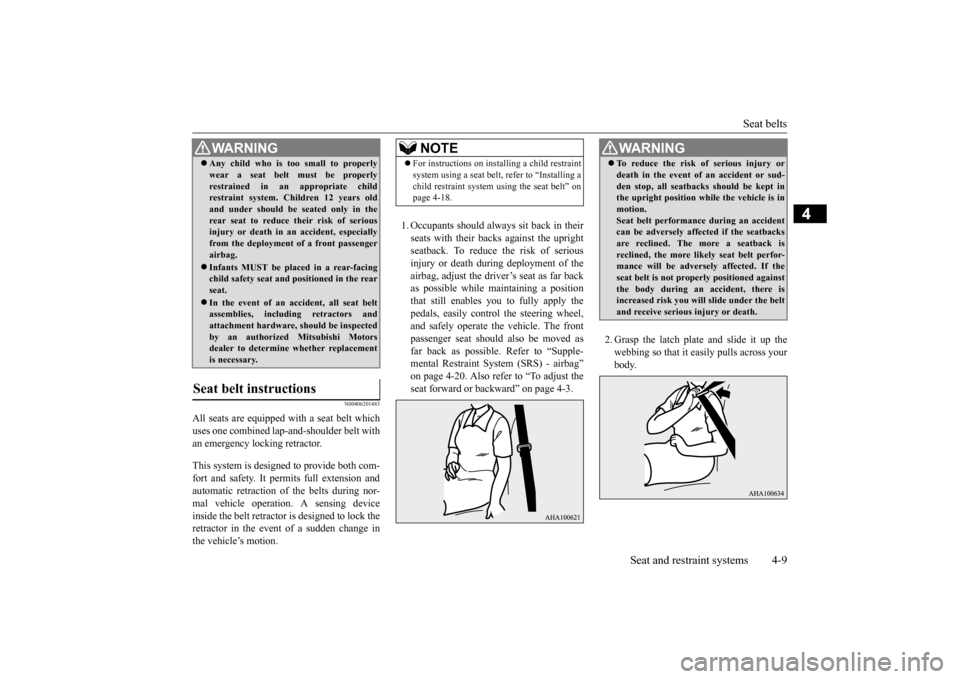
1. Occupants should always sit back in their seats with their backs against the upright seatback. To reduce the risk of seriousinjury or death during deployment of theairbag, adjust the driver’s seat as far back as possible while maintaining a position that still enables you to fully apply thepedals, easily control the steering wheel, and safely operate the vehicle. The front passenger seat should also be moved asfar back as possible. Refer to “Supple- mental Restraint System (SRS) - airbag” on page 4-20. Also refer to “To adjust theseat forward or backward” on page 4-3.
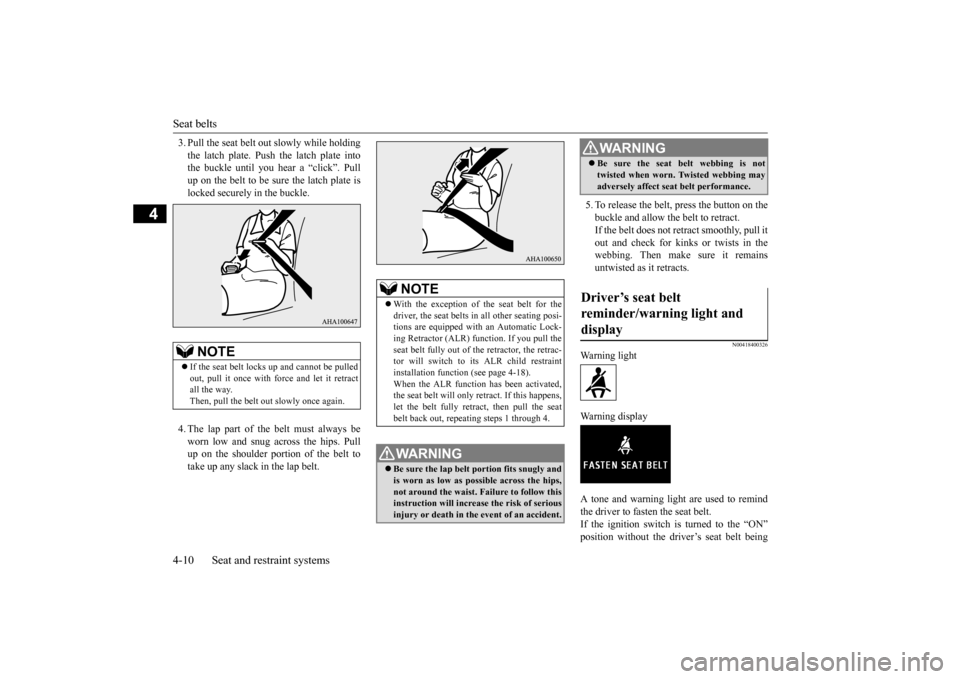
2. Grasp the latch plate and slide it up the webbing so that it easily pulls across yourbody.
Any child who is too small to properly wear a seat belt must be properly restrained in an appropriate child restraint system. Children 12 years old and under should be seated only in therear seat to reduce their risk of serious injury or death in an accident, especially from the deployment of a front passengerairbag. Infants MUST be placed in a rear-facing child safety seat and positioned in the rear seat. In the event of an accident, all seat belt assemblies, including retractors and attachment hardware, should be inspectedby an authorized Mitsubishi Motors dealer to determine whether replacement is necessary.
Seat belt instructions
WA R N I N G
NOTE
For instructions on installing a child restraint system using a seat belt, refer to “Installing a child restraint system using the seat belt” on page 4-18.
WA R N I N G To reduce the risk of serious injury or death in the event of an accident or sud- den stop, all seatbacks should be kept in the upright position while the vehicle is in motion.Seat belt performance during an accident can be adversely affected if the seatbacks are reclined. The more a seatback isreclined, the more likely seat belt perfor- mance will be adversely affected. If the seat belt is not properly positioned againstthe body during an accident, there is increased risk you will slide under the belt and receive serious injury or death.
BK0210800US.bo
ok 9 ページ 2014年4月8日 火曜日 午前11時28分
Page 35 of 338
Seat belts 4-10 Seat and restraint systems
4
3. Pull the seat belt ou
t slowly while holding
the latch plate. Push the latch plate into the buckle until you hear a “click”. Pull up on the belt to be sure the latch plate islocked securely in the buckle. 4. The lap part of the belt must always be worn low and snug across the hips. Pull up on the shoulder portion of the belt to take up any slack in the lap belt.
5. To release the belt, press the button on the buckle and allow the belt to retract. If the belt does not retract smoothly, pull itout and check for kinks or twists in the webbing. Then make sure it remains untwisted as it retracts.
N00418400326
Warning light Warning display A tone and warning light are used to remind the driver to fasten the seat belt. If the ignition switch is turned to the “ON”position without the driver’s seat belt being
NOTE
If the seat belt locks up and cannot be pulled out, pull it once with force and let it retractall the way. Then, pull the belt out slowly once again.
NOTE
With the exception of the seat belt for the driver, the seat belts in all other seating posi- tions are equipped with an Automatic Lock-ing Retractor (ALR) function. If you pull the seat belt fully out of the retractor, the retrac- tor will switch to its ALR child restraintinstallation function (see page 4-18). When the ALR function has been activated, the seat belt will only retract. If this happens,let the belt fully retract, then pull the seat belt back out, repeating steps 1 through 4.WA R N I N G Be sure the lap belt portion fits snugly and is worn as low as possible across the hips, not around the waist. Failure to follow this instruction will increase the risk of seriousinjury or death in the
event of an accident.
Be sure the seat belt webbing is not twisted when worn. Twisted webbing may adversely affect seat belt performance.
Driver’s seat belt reminder/warning light and display
WA R N I N G
BK0210800US.bo
ok 10 ページ 2014年4月8日 火曜日 午前11時28分