Start MITSUBISHI MIRAGE 2015 6.G Owners Manual
[x] Cancel search | Manufacturer: MITSUBISHI, Model Year: 2015, Model line: MIRAGE, Model: MITSUBISHI MIRAGE 2015 6.GPages: 300, PDF Size: 43.44 MB
Page 244 of 300
Operation under adverse driving conditions
For emergencies 8-19
8
When driving on a road covered with snow or ice, use s
now tires. Tire chains
cannot be used on your vehicle. There may be state or local regulations aboutusing snow tires. Al
ways check the regu-
lations in your local area before using them. Refer to “Snow tires” on page 9-17and “Tire chains” on page 9-17. Drive slowly. Do not make sudden starts or stops, sharp turns, or slam on the brakes. Allow extra distance between your vehi- cle and the vehicle in front of you, and avoid sudden braking. If a skid occurs when the accelerator pedal is depressed, take your foot off the pedal. Steer gently in the direction of the skid. Your vehicle is equipped with an anti-lock braking system (ABS). Hold the brake pedal down firmly and keep it depressed.Do not pump the brake pedal which will result in reduced braking performance. After parking on snowy or icy roads, it may be difficult to move your vehicle due to the brake being frozen. Depress the accelerator pedal little by little to movethe vehicle when safe to do so.
Drive as slow as pos
sible when driving on
bumpy, rutted roads or over potholes etc.
WA R N I N G When trying to rock
your vehicle out of a
stuck position, make sure that there are nopeople nearby. The
rocking motion can
make your vehicle suddenly lurch forward or backward, and inju
re any bystanders.
On wet roads
CAUTIONAvoid flooded roads. Water is often deeper than it looks, and you could be seriously hurtby driving into flood water. When driving in rain, on water-covered roads, or through a car
wash, water could get
into the brake discs a
nd make them fail tem-
porarily. In such cases, lightly press thebrake pedal to see if they are working prop- erly. If they are not, press the pedal lightly several times while driving to dry the brakepads or linings, then check them again. When driving in rain, a layer of water may form between the tires and the road surface (hydroplaning). This loosens your tires’ grip on the road, making it difficult to steer orbrake properly. When driving on a wet road:• Drive your vehicle at a safe speed.• Do not drive on worn tires.• Always keep the tires at the correct infla-tion pressures.
On snowy or icy roads
CAUTION Do not depress the acce
lerator pedal rapidly.
The vehicle could start moving when itbreaks free from the
ice, possibly resulting in
an accident.
On a bumpy or rutted road
CAUTION Driving on bumpy, rutted roads or over pot- holes can damage th
e tires and wheels.
Wheels with low-profiles tires or under-inflated tires are especially at risk for dam- age. The vehicle’s body, bumper, muffler and other parts may be dama
ged if the vehicle is:
• driven over a step (for example, at the entrance or exit of a parking lot);• parked too closely against a curb or parkingblock, or by the side of a road with curb- stones;• driven on a steep slope.
BK0212400US.book 19 ページ 2014年4月1日 火曜日 午後2時21分
Page 245 of 300
Fuel Pump Shut-off System 8-20 For emergencies
8
N00860600031
In the event of a collision causing frontal air- bag deployment, the fuel pump shut-off sys-tem will activate to st
op fuel supply to the
engine.Fuel Pump Shut-off System
WA R N I N G Before attempting to restart the engine after a collision, alw
ays inspect the ground
under the vehicle for leaking fuel. If a fuel leak is found or
a fuel odor is detected, do
not restart the engine. Mitsubishi Motors recommends that your vehicle be inspected by
an authorized Mit-
subishi Motors dealer
after any collision.
BK0212400US.book 20 ページ 2014年4月1日 火曜日 午後2時21分
Page 248 of 300
Catalytic converter
Vehicle care and maintenance 9-3
9
N00937400450
The catalytic converter requires you to use unleaded fuel only. Leaded gasoline will destroy the emission-c
ontrol effectiveness of
the converter. Normally, the catalyti
c converter does not
require maintenance. However, it is important to keep the engine properly tuned for the con- verter to continue to work properly.
To reduce the possibili
ty of catalytic con-
verter damage: Use UNLEADED GASOLINE ONLY of the type of recommended in the “Fuel selection”. Do not drive with an extremely low fuel level. Running out of gas could damage the catalytic converter. Do not try to start the engine by pushing or towing the vehicle. If the battery is weak or run down, use jumper cables toproperly start the engine.
Do not idle the engine with any spark plug wires disconnected or
removed, such as
when performing diagnostic tests. Do not idle the engine for a long time if it is idling roughly or otherwise obviouslymalfunctioning. To prevent the catalytic converter from being damaged from unburned gas, do notrace the engine when stopping the engine. Stop driving the vehicle if you think the performance is noticeably low, or the engine has a malfunction such as with the ignition, etc. If you are not able to stopdriving immediately, slow down and drive for only a short time.
Have your vehicle
checked at an authorized MitsubishiMotors dealer or a repair facility of your choice as soon
as possible.
In unusual situations involving major engine problems, a burning odor may indicate severe a
nd abnormal catalytic
converter overheating. If this occurs, stopin a safe place, shut
the engine off and let
the vehicle cool. Once the engine is cool, immediately take your
vehicle to a dealer
or a repair facility of
your choice for ser-
vice.
WA R N I N G Set a garage jack only at the position shown here. If the gar
age jack is set a
wrong position, it could damage yourvehicle and/or your
vehicle might fall
from the jack causing injury or death. Do not use the jack on a tilted or soft sur- face. Otherwise, the jack might slip and causepersonal injury. Always
use the jack on a
flat, hard surface. Before setting the jack, make sure there are no sand or pebblesunder the jack base.
Catalytic converter
CAUTION Damage to the catalytic
converter can result
if your vehicle is not
kept in proper operating
condition. If the engine
malfunctions or mis-
fires, or if your vehi
cle performance suffers,
have it serviced
promptly. Running your
vehicle when it is ove
rheated may result in
damage to the conve
rter and vehicle.
WA R N I N GDo not park or run your vehicle in areas where combustible materials such as dry grass or leaves can come
in contact with a
hot exhaust, since a fire could occur. Do not put undercoat paint on the cata- lytic converter.
BK0212400US.book 3 ページ 2014年4月1日 火曜日 午後2時21分
Page 250 of 300
View of the engine compartment
Vehicle care and maintenance 9-5
9
N00937600713
N00937702011
It is normal for an engi
ne to use oil. You may
need to add oil betwee
n the recommended oil
change intervals. Before starting the engine,check the engine oil level. Refill if necessary. To check the oil level, remove the dipstick, wipe it off, and gently
reinsert it all the way.
Slowly pull the dipsti
ck straight out and
check the oil level by checking the upper sur- face of the dipstick. Th
e oil level must not go
above the line on the dipstick. If the level does not reach the line which shows the minimum amo
unt of oil required,
remove the oil filler cap on the engine valve cover, and fill to within the “Good” range.
Make sure the engine hood is firmly closed before driving.If you drive without the engine hood com-pletely closed, it c
ould open up while driv-
ing.NOTE
If this does not clos
e the engine hood prop-
erly, drop it again from a slightly higher position. Do not push down strongly on the engine hood. Depending on how strongly or whereyou push down, you could create a dent in the vehicle body.CAUTION
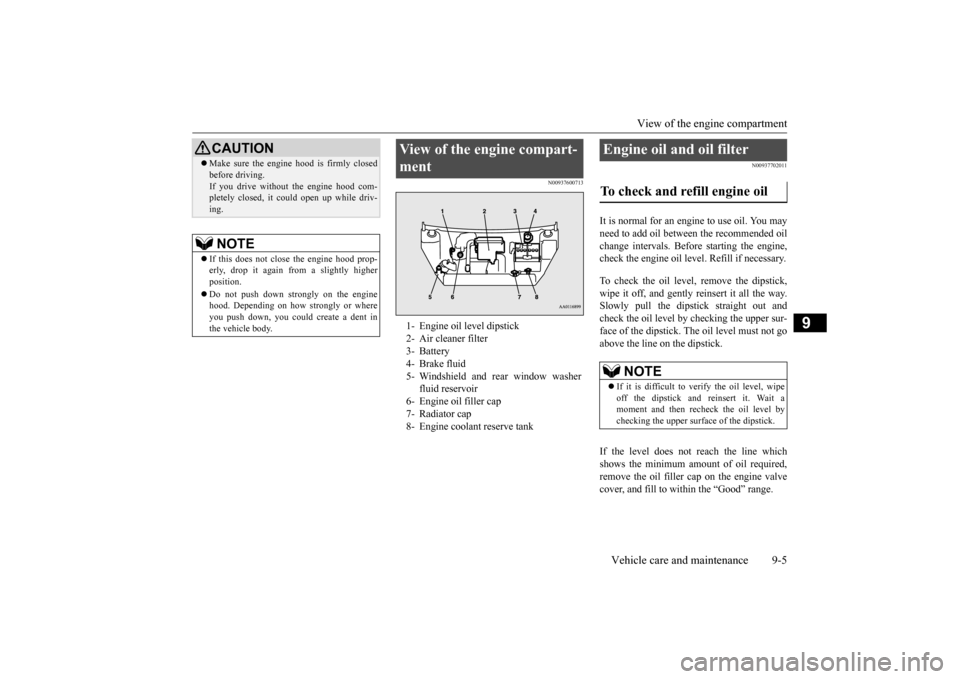
View of the engine compart- ment 1- Engine oil level dipstick 2- Air cleaner filter3- Battery 4- Brake fluid 5- Windshield and rear window washer
fluid reservoir
6- Engine oil filler cap 7- Radiator cap8- Engine coolan
t reserve tank
Engine oil and oil filter To check and refill engine oil
NOTE
If it is difficult to verify the oil level, wipe off the dipstick and
reinsert it. Wait a
moment and then recheck the oil level by checking the upper surfa
ce of the dipstick.
BK0212400US.book 5 ページ 2014年4月1日 火曜日 午後2時21分
Page 252 of 300
Engine coolant
Vehicle care and maintenance 9-7
9
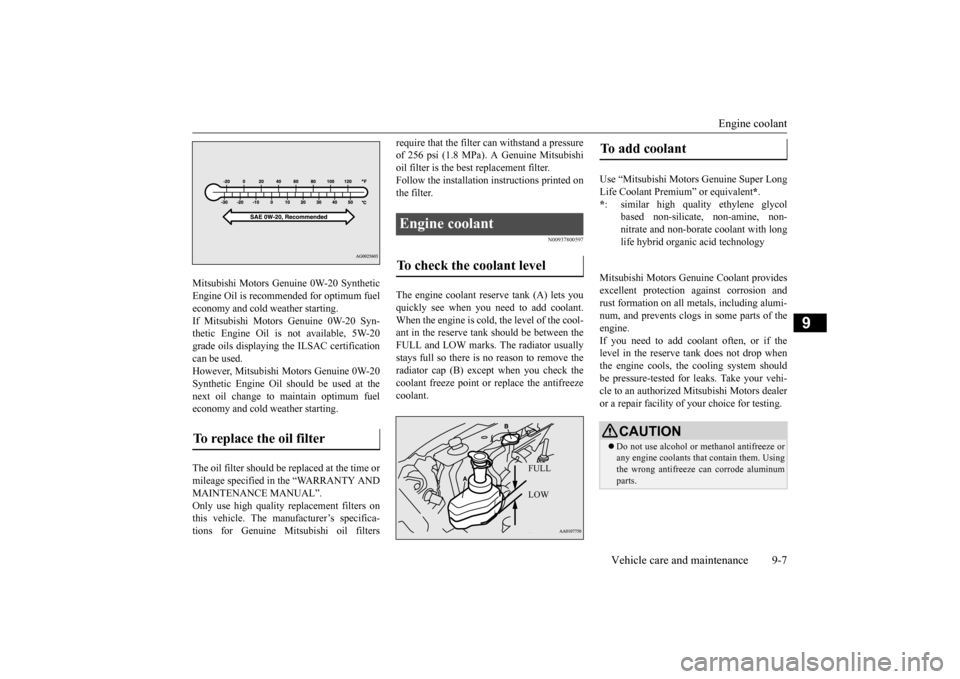
Mitsubishi Motors Genui
ne 0W-20 Synthetic
Engine Oil is recommended for optimum fueleconomy and cold weather starting. If Mitsubishi Motors Genuine 0W-20 Syn- thetic Engine Oil is not available, 5W-20grade oils displaying th
e ILSAC certification
can be used. However, Mitsubishi Motors Genuine 0W-20Synthetic Engine Oil s
hould be used at the
next oil change to maintain optimum fuel economy and cold weather starting. The oil filter should be replaced at the time or mileage specified in the “WARRANTY ANDMAINTENANCE MANUAL”. Only use high quality
replacement filters on
this vehicle. The manufacturer’s specifica-tions for Genuine Mitsubishi oil filters
require that the filter can withstand a pressure of 256 psi (1.8 MPa). A Genuine Mitsubishioil filter is the best replacement filter. Follow the installation instructions printed on the filter.
N00937800597
The engine coolant reserve tank (A) lets youquickly see when you need to add coolant. When the engine is cold
, the level of the cool-
ant in the reserve tank should be between theFULL and LOW marks. The radiator usually stays full so there is no reason to remove the radiator cap (B) except when you check thecoolant freeze point or replace the antifreeze coolant.
Mitsubishi Motors Genuine Coolant provides excellent protection
against corrosion and
rust formation on all me
tals, including alumi-
num, and prevents clogs in some parts of theengine. If you need to add coolant often, or if the level in the reserve
tank does not drop when
the engine cools, the
cooling system should
be pressure-tested for leaks. Take your vehi- cle to an authorized Mitsubishi Motors dealeror a repair facility of
your choice for testing.
To replace the oil filter
Engine coolant To check the coolant level
FULL LOW
To add coolant Use “Mitsubishi Motors
Genuine Super Long
Life Coolant Premium” or equivalent
*.
* : similar high quality
ethylene glycol
based non-silicate
, non-amine, non-
nitrate and non-borate coolant with long life hybrid organic acid technologyCAUTION Do not use alcohol or
methanol antifreeze or
any engine coolants th
at contain them. Using
the wrong antifreeze can corrode aluminum parts.
BK0212400US.book 7 ページ 2014年4月1日 火曜日 午後2時21分
Page 255 of 300
Brake fluid 9-10 Vehicle care and maintenance
9
N00938700274
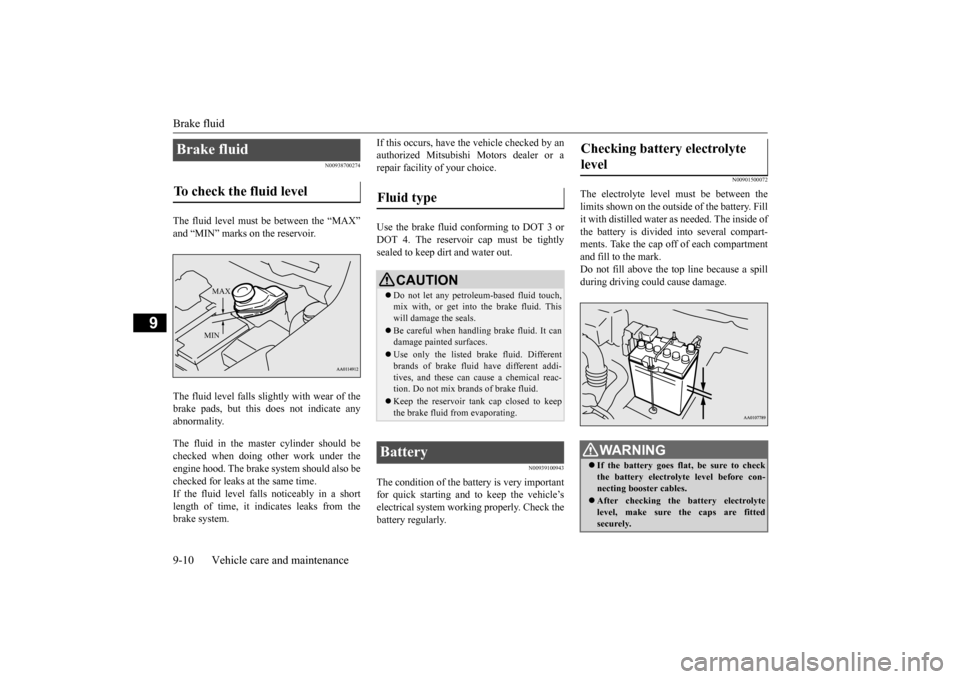
The fluid level must be between the “MAX” and “MIN” marks on the reservoir. The fluid level falls slightly with wear of the brake pads, but this
does not indicate any
abnormality. The fluid in the master cylinder should be checked when doing other work under the engine hood. The brake
system should also be
checked for leaks at the same time. If the fluid level falls noticeably in a short length of time, it indi
cates leaks from the
brake system.
If this occurs, have
the vehicle checked by an
authorized Mitsubishi Motors dealer or arepair facility of your choice. Use the brake fluid conforming to DOT 3 or DOT 4. The reservoir cap must be tightly sealed to keep dirt and water out.
N00939100943
The condition of the batte
ry is very important
for quick starting and to keep the vehicle’selectrical system working properly. Check the battery regularly.
N00901500072
The electrolyte level
must be between the
limits shown on the outside
of the battery. Fill
it with distilled water
as needed. The inside of
the battery is divided into several compart- ments. Take the cap off of each compartmentand fill to the mark. Do not fill above the t
op line because a spill
during driving could cause damage.
Brake fluid To check the fluid level
MAX MIN
Fluid type
CAUTION Do not let any petrol
eum-based fluid touch,
mix with, or get into the brake fluid. This will damage the seals. Be careful when handling brake fluid. It can damage painted surfaces. Use only the listed brake fluid. Different brands of brake fluid have different addi-tives, and these can cause a chemical reac- tion. Do not mix brands of brake fluid. Keep the reservoir ta
nk cap closed to keep
the brake fluid from evaporating.
Battery
Checking battery electrolyte level
WA R N I N G If the battery goes flat, be sure to check the battery electrolyte level before con- necting booster cables. After checking the battery electrolyte level, make sure the caps are fittedsecurely.
BK0212400US.book 10 ページ 2014年4月1日 火曜日 午後2時21分
Page 256 of 300
Battery
Vehicle care and maintenance 9-11
9
N00901600060
The battery is weaker in cold temperatures. This has to do with it
s chemical and physical
properties and is why a very cold battery,especially one with a low charge, will have a hard time starting your vehicle. It is recommended th
at you have your battery
and charging system checked by an autho- rized Mitsubishi Motors dealer or a repair facility of your choice
before the start of cold
weather. If necessary, have it charged. This will provide more reliab
le starting, and longer
battery life.
N00901701130
To disconnect the battery cable, stop theengine. Disconne
ct the negative (-) terminal
first, then the positive
(+) terminal. To recon-
nect the battery, first
connect the positive (+)
terminal and then the negative (-) terminal,before starting the vehicle. If any of the caps has a loose fit, replace the battery.
During cold weather Disconnection and connection
WA R N I N G
NOTE
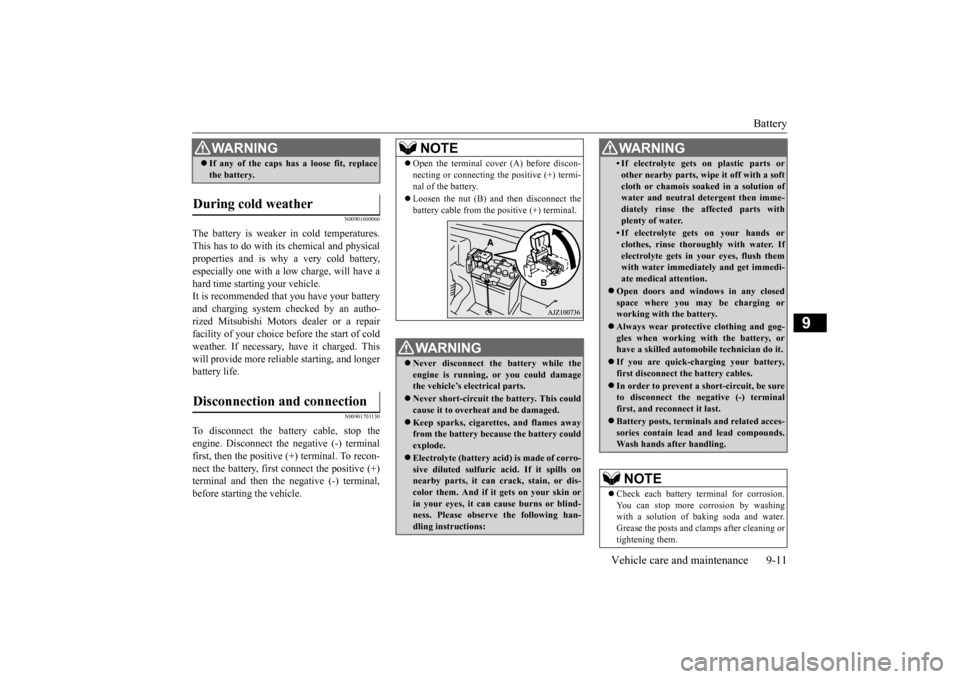
Open the terminal c
over (A) before discon-
necting or connecting
the positive (+) termi-
nal of the battery. Loosen the nut (B) and then disconnect the battery cable from the positive (+) terminal.WA R N I N G Never disconnect the battery while the engine is running, or you could damage the vehicle’s electrical parts. Never short-circuit the battery. This could cause it to overheat and be damaged. Keep sparks, cigarette
s, and flames away
from the battery because the battery couldexplode. Electrolyte (battery ac
id) is made of corro-
sive diluted sulfuric acid. If it spills on nearby parts, it can crack, stain, or dis- color them. And if it gets on your skin orin your eyes, it can cause burns or blind- ness. Please observe the following han- dling instructions:
• If electrolyte gets
on plastic parts or
other nearby parts, wi
pe it off with a soft
cloth or chamois soak
ed in a solution of
water and neutral detergent then imme- diately rinse the affected parts with plenty of water.• If electrolyte gets on your hands orclothes, rinse thoroughly with water. Ifelectrolyte gets in your eyes, flush them with water immediat
ely and get immedi-
ate medical attention.
Open doors and wind
ows in any closed
space where you may be charging orworking with the battery. Always wear protecti
ve clothing and gog-
gles when working with the battery, or have a skilled automobi
le technician do it.
If you are quick-charging your battery, first disconnect the battery cables. In order to prevent a short-circuit, be sure to disconnect the
negative (-) terminal
first, and reconnect it last. Battery posts, termin
als and related acces-
sories contain lead and lead compounds.Wash hands after handling.NOTE
Check each battery terminal for corrosion. You can stop more corrosion by washingwith a solution of baking soda and water. Grease the posts and cl
amps after cleaning or
tightening them.WA R N I N G
BK0212400US.book 11 ページ 2014年4月1日 火曜日 午後2時21分
Page 268 of 300
Fuses
Vehicle care and maintenance 9-23
9
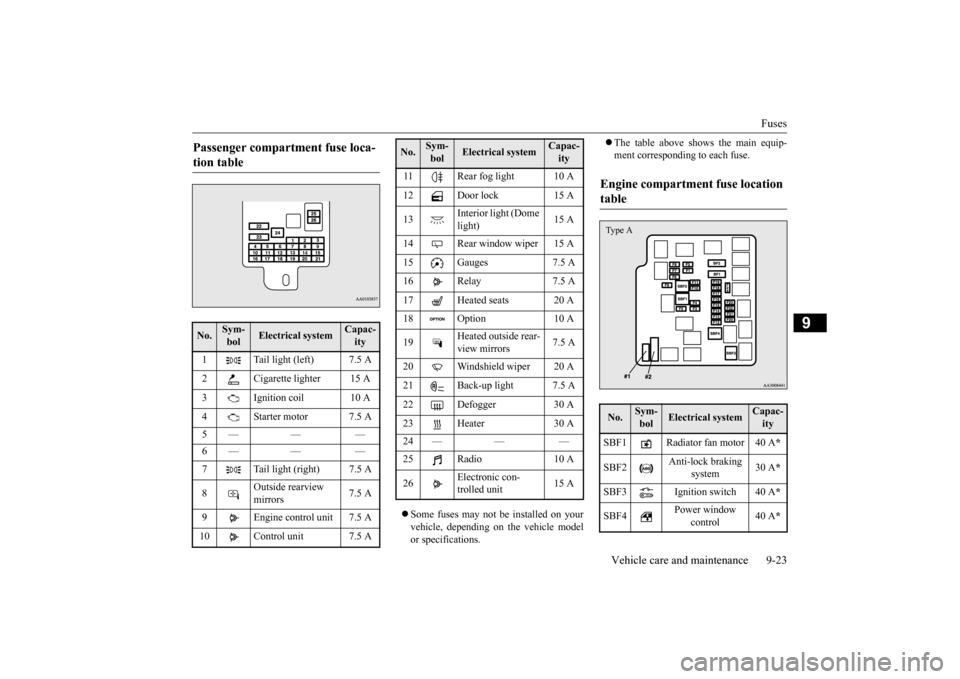
Some fuses may not be installed on your vehicle, depending on
the vehicle model
or specifications.
The table above shows the main equip- ment corresponding to each fuse.
Passenger compartment fuse loca- tion table No.
Sym- bol
Electrical system
Capac-ity
1 Tail light (left) 7.5 A 2 Cigarette lighter 15 A3 Ignition coil 10 A 4 Starter motor 7.5 A 5— — — 6— — — 7 Tail light (right) 7.5 A 8
Outside rearview mirrors
7.5 A
9 Engine control unit 7.5 A 10 Control unit 7.5 A
11 Rear fog light 10 A12 Door lock 15 A 13
Interior light (Dome light)
15 A
14 Rear window wiper 15 A 15 Gauges 7.5 A16 Relay 7.5 A 17 Heated seats 20 A 18 Option 10 A 19
Heated outside rear- view mirrors
7.5 A
20 Windshield wiper 20 A 21 Back-up light 7.5 A22 Defogger 30 A 23 Heater 30 A 24 — — — 25 Radio 10 A 26
Electronic con- trolled unit
15 A
No.
Sym- bol
Electrical system
Capac-ity
Engine compartment fuse location table No.
Sym- bol
Electrical system
Capac-ity
SBF1 Radiator fan motor 40 A
*
SBF2
Anti-lock braking
system
30 A
*
SBF3 Ignition switch 40 A
*
SBF4
Power window
control
40 A
*
Type A
BK0212400US.book 23 ページ 2014年4月1日 火曜日 午後2時21分
Page 269 of 300
Fuses 9-24 Vehicle care and maintenance
9
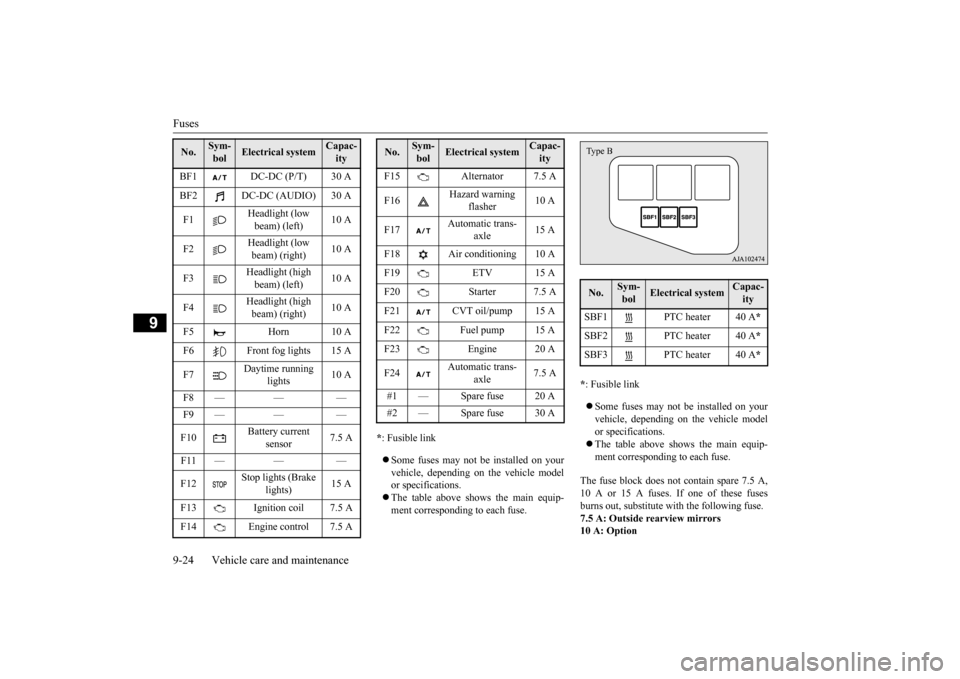
* : Fusible link Some fuses may not be installed on your vehicle, depending on
the vehicle model
or specifications. The table above show
s the main equip-
ment corresponding to each fuse.
* : Fusible link Some fuses may not be installed on your vehicle, depending on the vehicle modelor specifications. The table above shows the main equip- ment corresponding to each fuse.
The fuse block does not contain spare 7.5 A, 10 A or 15 A fuses. If one of these fuses burns out, substitute wi
th the following fuse.
7.5 A: Outside rearview mirrors10 A: Option
BF1 DC-DC (P/T) 30 A BF2 DC-DC (AUDIO) 30 A F1
Headlight (low beam) (left)
10 A
F2
Headlight (low beam) (right)
10 A
F3
Headlight (high beam) (left)
10 A
F4
Headlight (high beam) (right)
10 A
F5 Horn 10 A F6 Front fog lights 15 A F7
Daytime running
lights
10 A
F8 — — — F9 — — — F10
Battery current
sensor
7.5 A
F11 — — —F12
Stop lights (Brake
lights)
15 A
F13 Ignition coil 7.5 A F14 Engine control 7.5 ANo.
Sym- bol
Electrical system
Capac-ity
F15 Alternator 7.5 A F16
Hazard warning
flasher
10 A
F17
Automatic trans-
axle
15 A
F18 Air conditioning 10 A F19 ETV 15 AF20 Starter 7.5 A F21 CVT oil/pump 15 A F22 Fuel pump 15 A F23 Engine 20 A F24
Automatic trans-
axle
7.5 A
#1 — Spare fuse 20 A #2 — Spare fuse 30 ANo.
Sym- bol
Electrical system
Capac-ity
No.
Sym-bol
Electrical system
Capac-ity
SBF1 PTC heater 40 A
*
SBF2 PTC heater 40 A
*
SBF3 PTC heater 40 A
*
Type B
BK0212400US.book 24 ページ 2014年4月1日 火曜日 午後2時21分
Page 295 of 300

Alphabetical index 12-2
12
D
Daytime running lights
Bulb capacity
.................................
9-26
Defogger (rear window)
......................
5-80
Defrosting or defogging (windshield, door windows)
................................
7-10
, 7-16
Dimensions
........................................
11-3
Dimmer (high/lo
w beam change)
.........
5-76
Disc brake pads
..................................
9-20
Dome light
Bulb capacity
.................................
9-27
Door-ajar warning buzzer
....................
5-74
Door-ajar warning light
.......................
5-74
Doors
Lock
..............................................
5-24
Power door locks
............................
5-26
Driving during cold weather
..................
6-4
Driving, alcohol and drugs
.....................
6-2
E
Electric power steering system (EPS)
...
5-48
Electric rear win
dow defogger switch
...
5-80
Electronic immobilizer (Anti-theft starting system)
.....................................
5-3
, 5-20
Emission-control sy
stem maintenance
..9-19
Engine
Compartment
...................................
9-5
Coolant
...................................
9-7
, 11-5
High coolant temperature warning light
....
5-73 Hood
...............................................
9-4
Oil and oil filter
.......................
9-5
, 11-5
Overheating
.....................................
8-4
Serial number
.................................
11-2
Specification
...................................
11-4
Engine hood
........................................
9-4
Engine switch
.....................................
5-13
Error codes
.........................................
7-38
Exhaust system
...................................
9-21
F
Floor mat
.............................................
6-2
Fluid
Brake fluid
.....................................
11-5
Continuously variable
transmission (CVT)
fluid
......................................
9-9
, 11-5
Engine coolant
.........................
9-7
, 11-5
Manual transaxle
.............................
11-5
Washer fluid
............................
9-9
, 11-5
Fluid capacities and lubricants
..............
11-5
Free-hand advanced security transmitter (F.A.S.T.-key)
...................................
5-9
Front fog lights
Bulb capacity
..................................
9-26
Indicators
.......................................
5-71
Replacement
..................................
9-29
Switch
...........................................
5-77
Front seat adjustment
............................
4-3
Front side-marker lights
Bulb capacity
.................................
9-26
Replacement
..................................
9-28
Front turn signal light
Bulb capacity
.................................
9-26
Replacement
..................................
9-28
Fuel
Filling the fuel tank
...........................
3-3
Fuel economy
...................................
6-2
Fuel hoses
......................................
9-20
Fuel remaining warning display
.......
5-66
Fuel selection
...................................
3-2
Tank capacity
.................................
11-5
Fuel Pump Shut-off System
.................
8-20
Fuel remaining display
........................
5-66
Fuses
.................................................
9-22
Fusible links
.......................................
9-22
G
General maintenance
Maintenance
...................................
9-20
General vehicle data
............................
11-3
Genuine parts
.......................................
3-6
Glove compartment
...........................
5-108
BK0212400US.book 2 ページ 2014年4月1日 火曜日 午後2時21分