Start MITSUBISHI MIRAGE 2015 6.G Manual Online
[x] Cancel search | Manufacturer: MITSUBISHI, Model Year: 2015, Model line: MIRAGE, Model: MITSUBISHI MIRAGE 2015 6.GPages: 300, PDF Size: 43.44 MB
Page 217 of 300

To play tracks from a Bluetooth® device
(vehicles with Blue
tooth® 2.0 interface)
7-36 Comfort controls
7
N00765500089
1. Press the PWR switch to turn on the audio system. The system turns on in the last mode used.2. Press the CD button several times to switch to the BT-A (Bluetooth
®) mode.
The input mode change
s as follows every
time the CD button is
pressed: CD mode
iPod mode
Bluetooth
® mode (if so
equipped)
AUX mode
CD mode.
The BT indicator are
illuminated and then
the BT-A mode will be activated. 3. Connect your Bluetooth
® device.
Refer to “Connecting the Bluetooth
® 2.0
interface and Bluetooth
® device” on page
5-87.4. Playback starts automatically.
N00765600035
To stop the playback, press the Stop button.To restart the playback, press the Play/Pausebutton.
N00765700036
To pause the playback, press and hold thePlay/Pause button until you hear a beep.To restart the playback, press the Play/Pause button.
N00703200013
To fast-forward/revers
e the current track,
press the button or button.
To fast-forward the current track, press the
button. While the button is kept pressed,
the track will be fast-forwarded. To fast-reverse the current track, press the button. While the button is kept pressed, the track will be fast-reversed.
N00765800037
Press the button repeatedly until thedesired file number a
ppears on the display.
Press the button repeatedly until the desired file number a
ppears on the display.
4- TRACK indicator 5- Display 6- PAGE (Title scroll) button7-
(Fast-reverse/Track down) button
8-
(Fast-forward/Track up) button
9- DISP (Title display) button 10- Play/Pause button 11- Stop button 12- RPT (Repeat) button 13- RDM (Random) buttonTo l i s t e n t o t r a c
ks from a device
connected via Bluetooth
®
NOTE
Depending on the connected device, the playback may not start automatically.In this case, operate
the connected device to
start the playback.
To stop the playback (if supported by the device) To pause the playback (if sup- ported by the device) To fast-forward/reverse the track (if supported by the device)
Fast-forward Fast-reverseTo select a track (if supported by the device) Track up Track down
NOTE
Pressing the button once during the song will cause the audio system to restart play- back from the beginning of the file.
BK0212400US.book 36 ページ 2014年4月1日 火曜日 午後2時21分
Page 222 of 300
Antenna
Comfort controls 7-41
7
To clean a disc, use a soft, clean, dry cloth. Wipe directly
from the center hole
toward the outer edge. Do not wipe in a circle. Never use any chemicals such as benzine, paint thi
nner, a disc spray
cleaner, or an anti-static agent on the disc. Do not use a ball point
pen, felt pen, pen-
cil, etc. to write on the label surface of thedisc. Do not put additional la
bels or stickers on
compact discs. Also, do not use any com- pact disc on which a label or sticker has started to peel off or any compact disc thathas stickiness or ot
her contamination left
by a peeled-off label or sticker. If you use such a compact disc, the CD player maystop working properly and you may not be able to eject the compact disc.
N00751900066
You may have trouble playing back some CD-R/RW discs recorded on CD record- ers (CD-R/RW drives), either due to theirrecording characterist
ics or dirt, finger-
prints, scratches, etc.
on the disc surface.
CD-R/RW discs are less resistant to high temperatures and high humidity than ordi- nary music CDs and can therefore be damaged and rendered unplayable if leftinside your vehicle for a long time.
Depending on the combination of the writing software, the CD recorder (CD-R/RW drive), and the di
sc used to create a
CD-R/RW, the disc might not play suc- cessfully. This player cannot play the CD-R/RW discs if the sessi
on is not closed.
This player cannot play CD-R/RW discs which contain data other than CD-DA or MP3 data (Video CD, etc.). Be sure to observe
the handling instruc-
tions for the CD-R/RW disc.
N00734201508
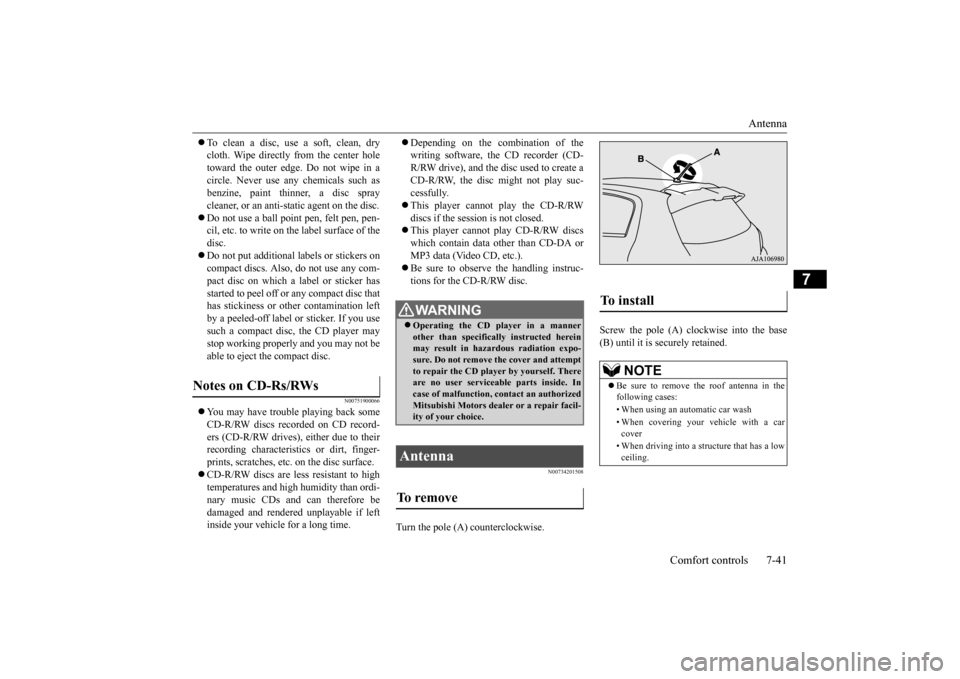
Turn the pole (A) counterclockwise.
Screw the pole (A) clockwise into the base (B) until it is securely retained.
Notes on CD-Rs/RWs
WA R N I N G Operating the CD player in a manner other than specifically instructed hereinmay result in hazardous radiation expo- sure. Do not remove the cover and attempt to repair the CD player by yourself. Thereare no user serviceable parts inside. In case of malfunction,
contact an authorized
Mitsubishi Motors dealer or a repair facil-ity of your choice.
Antenna To remove
To install
NOTE
Be sure to remove the roof antenna in the following cases: • When using an automatic car wash• When covering your ve
hicle with a car
cover • When driving into a structure that has a low ceiling.
BK0212400US.book 41 ページ 2014年4月1日 火曜日 午後2時21分
Page 226 of 300
8
For emergenciesIf the vehicle breaks down ...............................................................8-2 Jump-starting the engine ..................................................................8-2 Engine overheating ..........................................................................8-4Jack and tools ...................................................................................8-5 Tire repair kit (if so equipped) ..........................................................8-6 How to change a tire (Vehicles equipped with spare tire) ............. 8-11Towing ...........................................................................................8-17 Operation under adverse driving conditions
...........
.........
.........
.....8-18
Fuel Pump Shut-off System ...........................................................8-20
BK0212400US.book 1 ページ 2014年4月1日 火曜日 午後2時21分
Page 227 of 300
If the vehicle breaks down 8-2 For emergencies
8
N00836300233
If your vehicle breaks down on the road, move to the shoulder and turn on the hazard warning flashers. If there is no shoulder, orthe shoulder is not safe, drive in the right lane slowly with the haza
rd lights flashing until
you come to a safe stopping place. Keep theflashers flashing. If the engine stops, there will be no power assist to the steering and brakes, making these difficult to use. The brake booster will not work, so the brakes will not grip well. The brake pedal will be harder to press than usual. Since there is no power steering assist, the steering wheel will be hard to turn.
Get help from your passengers, bystanders, etc. to push the vehicle
and move it to a safe
area.
N00836400768
If the engine cannot be started because the battery is weak or de
ad, you can start it with
the battery from anothe
r vehicle using jumper
cables. 1. Take off any metal jewelry such as watch bands or bracelets th
at might create an
accidental electrical contact. 2. Position the vehi
cles close enough
together so that the jumper cables canreach, but be sure the vehicles aren’t touching each other.
3. You could be injured if the vehicles move. Set the parking brake firmly on each vehi- cle. Put an automatic transaxle or CVT in “P” (PARK) or a manual transaxle in “N”(Neutral). 4. Turn the ignition switch to the “OFF” position or put the operation mode inOFF. 5. Make sure your battery electrolyte is at the proper level. (Refer to “Battery” on page 9-10.)
If the vehicle breaks down If the engine stops/fails When the engine fails at the intersection
Jump-starting the engine
WA R N I N G To reduce the risk of igniting flammable gas that may be emitted from the battery,carefully read this section before jump- starting the vehicle. Do not try to start you
r vehicle by pushing
or towing. This can cause an accident resulting in serious
injury or death and
can damage the vehicle.NOTE
Do not use jumper cables if they have dam- age or corrosion.
CAUTION Check the other vehicle.
It must have a 12-
volt battery. If the other system isn’t 12-volt,both systems can be damaged.NOTE
Turn off all lights, heat
er, and othe
r electrical
loads. This will avoid sparks and help save both batteries.WA R N I N G If the electrolyte fluid is not visible, or looks frozen, DO NOT ATTEMPT JUMPSTARTING!! The battery might spli
t open or explode if
the temperature is below the freezingpoint or if it is not filled to the proper level.
BK0212400US.book 2 ページ 2014年4月1日 火曜日 午後2時21分
Page 228 of 300
Jump-starting the engine For emergencies 8-3
8
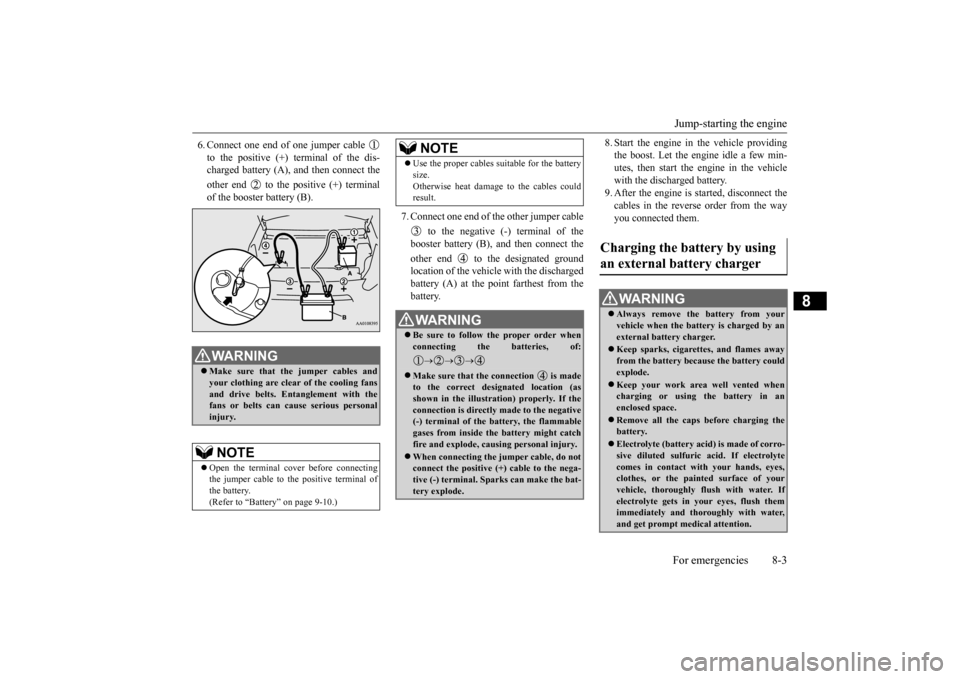
6. Connect one end of one jumper cable to the positive (+) terminal of the dis- charged battery (A),
and then connect the
other end to the positive (+) terminal of the booster battery (B).
7. Connect one end of the other jumper cable
to the negative (-) terminal of the booster battery (B), and then connect the other end to the designated ground location of the vehicle with the dischargedbattery (A) at the point farthest from the battery.
8. Start the engine in the vehicle providing the boost. Let the engine idle a few min-utes, then start the engine in the vehicle with the discharged battery. 9. After the engine is
started, disconnect the
cables in the reverse order from the way you connected them.
WA R N I N G Make sure that the jumper cables and your clothing are clear of the cooling fansand drive belts. Entanglement with the fans or belts can cause serious personal injury.NOTE
Open the terminal co
ver before connecting
the jumper cable to the positive terminal ofthe battery. (Refer to “Battery” on page 9-10.)
Use the proper cables suitable for the battery size.Otherwise heat damage
to the cables could
result.WA R N I N G Be sure to follow the proper order when connecting the batteries, of:
Make sure that the connection is made to the correct designated location (asshown in the illustration) properly. If the connection is directly made to the negative (-) terminal of the battery, the flammablegases from inside the battery might catch fire and explode, caus
ing personal injury.
When connecting the jumper cable, do not connect the positive (+) cable to the nega- tive (-) terminal. Sparks can make the bat-tery explode.NOTE
Charging the battery by using an external battery charger
WA R N I N G Always remove the battery from your vehicle when the battery is charged by an external battery charger. Keep sparks, cigarettes, and flames away from the battery because the battery couldexplode. Keep your work area well vented when charging or using
the battery in an
enclosed space. Remove all the caps
before charging the
battery. Electrolyte (battery acid) is made of corro- sive diluted sulfuric acid. If electrolyte comes in contact with your hands, eyes,clothes, or the pain
ted surface of your
vehicle, thoroughly flush with water. If electrolyte gets in your eyes, flush themimmediately and thoroughly with water, and get prompt medical attention.
BK0212400US.book 3 ページ 2014年4月1日 火曜日 午後2時21分
Page 229 of 300
Engine overheating 8-4 For emergencies
8
If you drive your vehicle with a low battery charge after the engine has been started byusing jumper cables, the engine may misfire. This can cause the an
ti-lock braking system
warning light to blink on and off. This is onlydue to the low battery voltage. It is not a problem with the brak
e system. If this hap-
pens, fully charge the battery and ensure thecharging system is operating properly.
N00836500365
If the high coolant temperature warning lightilluminates during the engine is running, the engine may be overheating. If this happens: 1. Stop the vehicle in a safe place. Turn on the hazard warning flashers.2. With the engine st
ill running, carefully
raise the engine hood to vent the engine compartment.
3. Check that the cooling fan is running. If the fan is not turning, stop the engineimmediately and contact an authorized Mitsubishi Motors dealer or a repair facil- ity of your choice for assistance. 4. If you see steam or spray coming from under the hood, turn off the engine. 5. If you do not see stea
m or spray coming
from under the hood, leave the engine onuntil the high coolant temperature warn- ing light goes off. After the high coolant temperature warning light has gone off,you can start driving again. If the high coolant temperature warning light stays on, turn off the engine.
6. When you do not see any more steam or spray, open the hood. Look for obviousleaks, such as a split radiator hose. Be careful as components will be hot. Any leak source must be repaired.7. If there is no obvious leak source, check the coolant level in the engine coolant reserve tank. If there is none, or if it is toolow, slowly add coolant. 8. If the engine coolant reserve tank needs coolant, you will probably also need to add coolant to the radiator. Do not loosen or remove the radiator cap until the enginehas cooled down. 9. Start the engine, and slowly add coolant, up to the bottom of the filler neck. Use plain water if you have to (and replace itwith the right coolant as soon as possible).
Always wear protective clothing and gog- gles when working near the battery. Keep the battery out of the reach of chil- dren.
As your vehicle has anti-lock brakes Engine overheating
WA R N I N G
WA R N I N G To avoid personal injury
, keep hands, hair,
jewelry and clothes aw
ay from the cooling
fan. The cooling fan ca
n start at any time.
WA R N I N GBefore raising the engine hood, check to see if there is steam or spray coming fromunder the hood. Steam or spray comingfrom an overheated en
gine could seriously
scald you. Do not open the hood until there is nosteam or spray.
WA R N I N G Removing the radiat
or cap could scald
you with escaping hot water or steam. When checking the radiator level, coverthe cap with a cloth before trying to remove it. Turn it slowly counterclock- wise, without pressing down, to the firstnotch. The pressure in the system will then be let out. When the pressure is COM- PLETELY LET OUT, press down andkeep turning the cap counterclockwise until it comes off.
BK0212400US.book 4 ページ 2014年4月1日 火曜日 午後2時21分
Page 230 of 300
Jack and tools
For emergencies 8-5
8
10. Replace the radiator
cap and tighten it
fully. Check the coolant temperaturewarning light. You can start driving again when the high coolant temperature warn- ing light does not come on.
11. Have the system in
spected by your autho-
rized Mitsubishi Motors dealer or a repair facility of your choice.
N00836600379
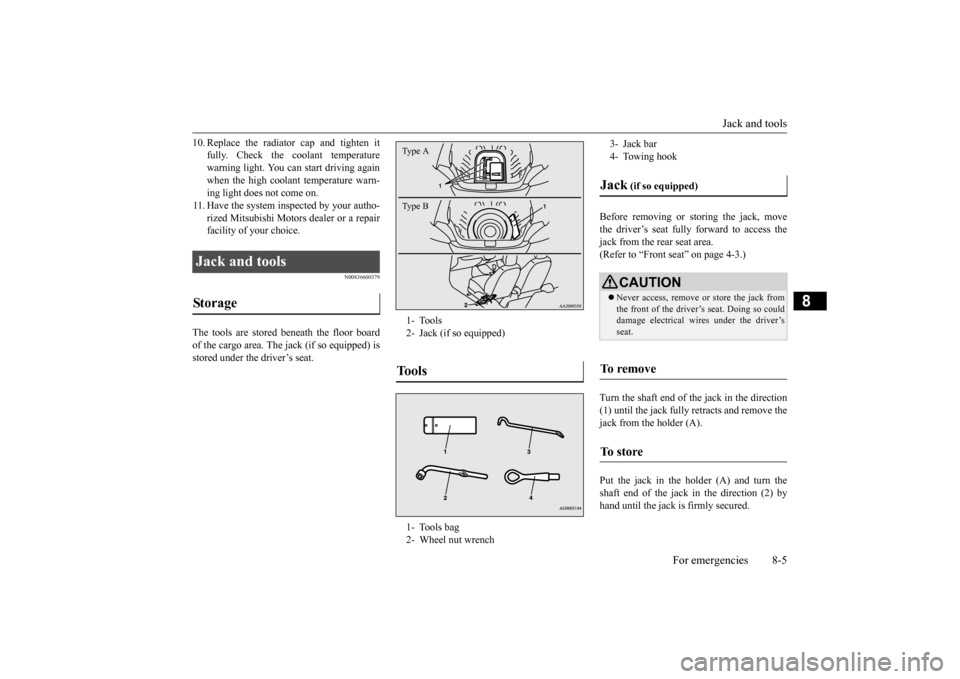
The tools are stored beneath the floor boardof the cargo area. The jack (if so equipped) is stored under the driver’s seat.
Before removing or storing the jack, move the driver’s seat fully forward to access the jack from the rear seat area. (Refer to “Front seat” on page 4-3.) Turn the shaft end of the jack in the direction (1) until the jack fully retracts and remove the jack from the holder (A). Put the jack in the holder (A) and turn the shaft end of the jack in the direction (2) byhand until the jack is firmly secured.
Jack and tools Storage
1- Tools 2- Jack (if so equipped)Tools 1- Tools bag 2- Wheel nut wrenchType A Type B
3- Jack bar 4- Towing hookJack
(if so equipped)CAUTION Never access, remove or store the jack from the front of the driver’s seat. Doing so could damage electr
ical wires under the driver’s
seat.
To remove
To s t o r e
BK0212400US.book 5 ページ 2014年4月1日 火曜日 午後2時21分
Page 235 of 300
Tire repair kit (if so equipped) 8-10 For emergencies
8
14. Check and adjust the tire pressure with
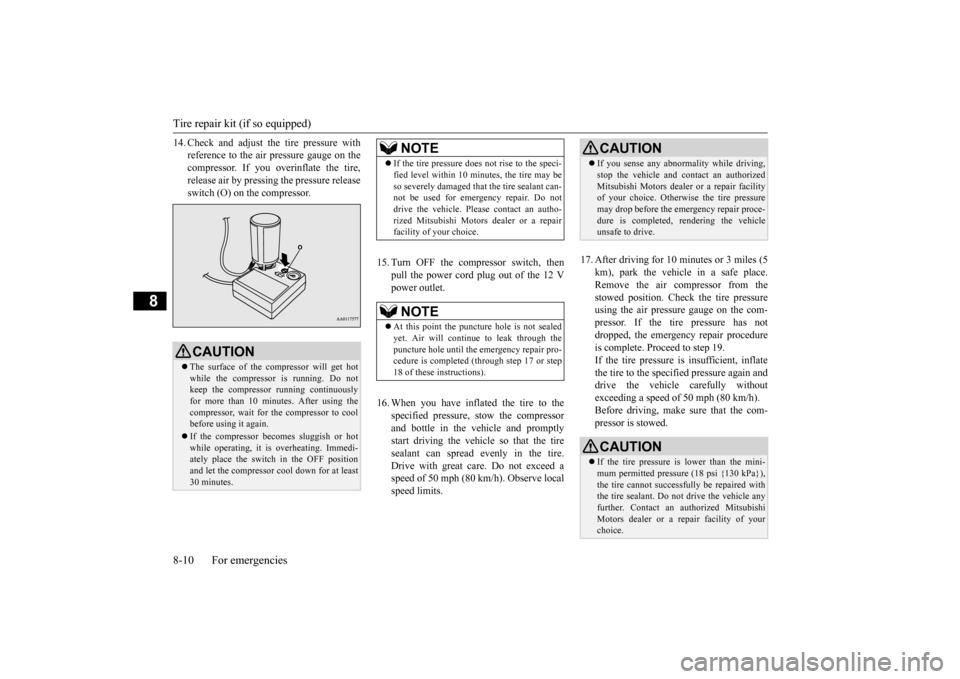
reference to the air pressure gauge on thecompressor. If you overinflate the tire, release air by pressing the pressure release switch (O) on the compressor.
15. Turn OFF the compressor switch, then
pull the power cord plug out of the 12 V power outlet.
16. When you have inflated the tire to the
specified pressure, stow the compressor and bottle in the vehicle and promptly start driving the vehicle so that the tiresealant can spread evenly in the tire. Drive with great care. Do not exceed a speed of 50 mph (80
km/h). Observe local
speed limits.
17. After driving for 10 minutes or 3 miles (5
km), park the vehicl
e in a safe place.
Remove the air compressor from the stowed position. Check the tire pressure using the air pressure gauge on the com-pressor. If the tire pressure has not dropped, the emergency repair procedure is complete. Proceed to step 19.If the tire pressure is insufficient, inflate the tire to the specified pressure again and drive the vehicle carefully withoutexceeding a speed of 50 mph (80 km/h). Before driving, make sure that the com- pressor is stowed.
CAUTION The surface of the compressor will get hot while the compressor is running. Do not keep the compressor running continuously for more than 10 minutes. After using thecompressor, wait for the compressor to cool before using it again. If the compressor becomes sluggish or hot while operating, it is
overheating. Immedi-
ately place the switch in the OFF positionand let the compressor cool down for at least 30 minutes.
NOTE
If the tire pressure does not rise to the speci- fied level within 10 minutes, the tire may beso severely damaged that
the tire sealant can-
not be used for emergency repair. Do not drive the vehicle. Plea
se contact an autho-
rized Mitsubishi Motors dealer or a repairfacility of your choice.NOTE
At this point the punctu
re hole is
not sealed
yet. Air will continue to leak through thepuncture hole until the emergency repair pro- cedure is completed (through step 17 or step 18 of these instructions).
CAUTION If you sense any abnorma
lity while driving,
stop the vehicle and c
ontact an authorized
Mitsubishi Motors dealer
or a repair facility
of your choice. Otherw
ise the tire pressure
may drop before the emergency repair proce- dure is completed,
rendering the vehicle
unsafe to drive.CAUTION If the tire pressure is lower than the mini- mum permitted pressure
(18 psi {130 kPa}),
the tire cannot successful
ly be repaired with
the tire sealant. Do not drive the vehicle any further. Contact an
authorized Mitsubishi
Motors dealer or a repair facility of yourchoice.
BK0212400US.book 10 ページ 2014年4月1日 火曜日 午後2時21分
Page 237 of 300
How to change a tire (Vehicle
s equipped with spare tire)
8-12 For emergencies
8
6. Get the jack, bar and wheel nut wrench ready. (Refer to “Jack and tools” on page 8-5.)
N00849600344
The compact spare tire is stowed beneath thefloor board of the cargo area. It is designed to save space in the cargo area. Its lighter weightmakes it easier to use if a flat tire occurs.
N00849700286
1. Lift up the floor board of the cargo area.2. To remove the spare tire, remove the installation clamp (A) by turning it coun- terclockwise.
WA R N I N G Be sure to apply choc
ks or blocks to the
correct tire when jacking up the vehicle. Ifthe vehicle moves while jacked up, thejack could slip out of
position, leading to
an accident.NOTE
The chocks shown in the illustration do not come with your vehicle. It is recommendedthat you purchase chocks
or blocks and keep
them in the vehicle for use if needed. If chocks or blocks ar
e not available, use
stones or any other obj
ects that are large
enough to hold the wheel in position.
Spare tire information Compact spare tire
WA R N I N G Tires, including spar
e tire, degrade over
time with age even when they are notbeing used. It is recommended that tiresover 6 years generally
be replaced even if
damage is not obvious.CAUTION While the compact spare tire is stowed, the inflation pressure shoul
d be checked at least
once a month to assure
that it remains at the
recommended inflation pressure. See the tire and loading informati
on placard attached to
the driver’s door sill. Refer to “Tire and load- ing information placard” on page 11-3. Driving with an improperly inflated tire can cause an accident. If
you have no choice but
to drive with an under-inflated tire, keepyour speed down and avoid sudden steering or braking, if possible. Inflate the tire to the correct pressure as s
oon as possible. Refer to
“Tire inflation pressures” on page 9-14. The compact spare tire should be used only temporarily. While the compact spare tire is being used, the tire pr
essure monitoring sys-
tem will not function pr
operly. Have the tire
replaced or repaired at an authorizedMitsubishi Motors dealer or a repair facility of your choice as soon as possible. Do not go over 50 mph (80 km/h) when driv- ing with the compact spare tire. Avoid sudden starting and braking when driving with the compact spare tire.
Do not drive through automatic car washes and over obstacles that
could possibly dam-
age the underside of your vehicle. Becausethe compact spare tire is smaller than the original tire, there is less clearance between the ground and your vehicle. Because the compact spare tire is designed only for your vehicle, do not use it on anyother vehicle. Do not put the compact spare tire on a differ- ent wheel, and do not put standard tires, snow tires, wheel covers or trim rings on the compact spare wheel.
Otherwise, you could
damage these parts or other parts on your vehicle. Do not use tire chains with your compact spare tire. Using a ch
ain could cause damage
to your vehicle and loss of the chains.
To remove spare tire
CAUTION
BK0212400US.book 12 ページ 2014年4月1日 火曜日 午後2時21分
Page 239 of 300
How to change a tire (Vehicle
s equipped with spare tire)
8-14 For emergencies
8
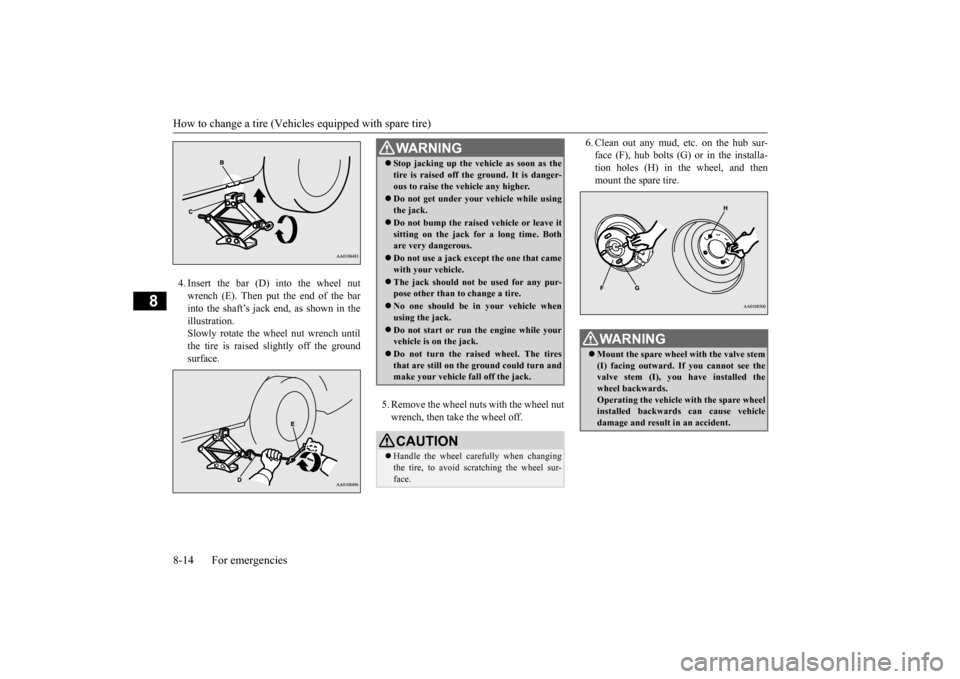
4. Insert the bar (D) into the wheel nut wrench (E). Then put the end of the barinto the shaft’s jack end, as shown in the illustration. Slowly rotate the wheel nut wrench untilthe tire is raised slightly off the ground surface.
5. Remove the wheel nuts with the wheel nut wrench, then take the wheel off.
6. Clean out any mud, etc. on the hub sur- face (F), hub bolts (G)
or in the installa-
tion holes (H) in the wheel, and then mount the spare tire.
WA R N I N G Stop jacking up the ve
hicle as soon as the
tire is raised off the ground. It is danger-ous to raise the ve
hicle any higher.
Do not get under your vehicle while using the jack. Do not bump the raised
vehicle or leave it
sitting on the jack for a long time. Bothare very dangerous. Do not use a jack except the one that came with your vehicle. The jack should not be used for any pur- pose other than to change a tire. No one should be
in your vehicle when
using the jack. Do not start or run
the engine while your
vehicle is on the jack. Do not turn the raised wheel. The tires that are still on the ground could turn and make your vehicle fall off the jack.CAUTION Handle the wheel carefully when changing the tire, to avoid scratching the wheel sur-face.
WA R N I N G Mount the spare wheel with the valve stem (I) facing outward. If
you cannot see the
valve stem (I), you
have installed the
wheel backwards. Operating the vehicle with the spare wheel installed backwards can cause vehicledamage and result
in an ac
cident.
BK0212400US.book 14 ページ 2014年4月1日 火曜日 午後2時21分