maintenance MITSUBISHI MIRAGE 2017 6.G Owner's Manual
[x] Cancel search | Manufacturer: MITSUBISHI, Model Year: 2017, Model line: MIRAGE, Model: MITSUBISHI MIRAGE 2017 6.GPages: 305, PDF Size: 8.67 MB
Page 257 of 305
Brake fluid 9-10 Vehicle care and maintenance
9
N00938700274
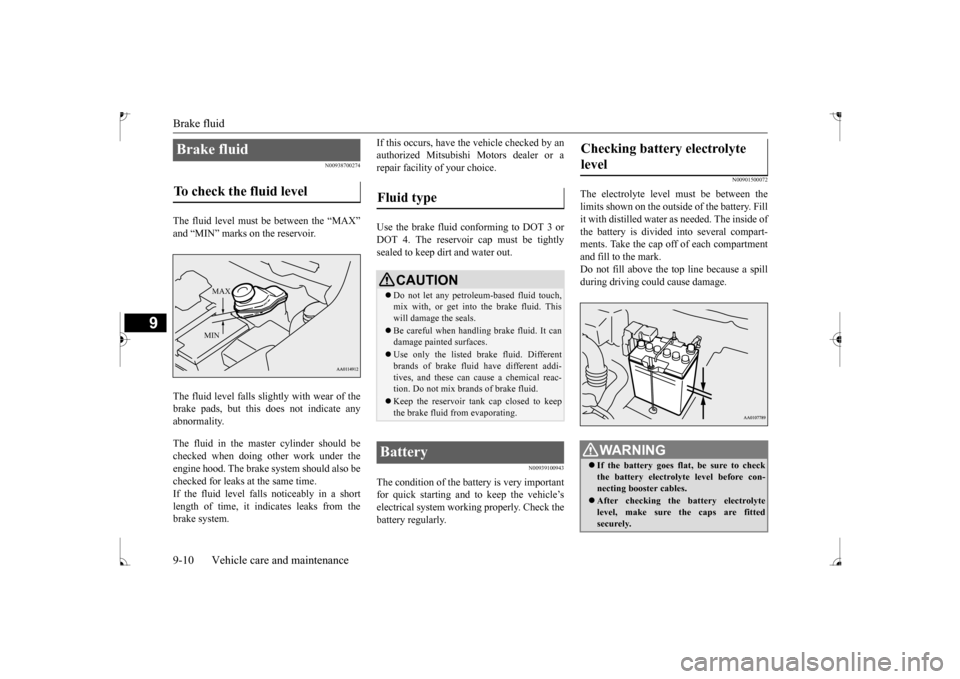
The fluid level must be between the “MAX” and “MIN” marks on the reservoir. The fluid level falls slightly with wear of the brake pads, but this
does not indicate any
abnormality. The fluid in the master cylinder should be checked when doing other work under the engine hood. The brake
system should also be
checked for leaks at the same time. If the fluid level falls noticeably in a short length of time, it indi
cates leaks from the
brake system.
If this occurs, have
the vehicle checked by an
authorized Mitsubishi Motors dealer or arepair facility of your choice. Use the brake fluid conforming to DOT 3 or DOT 4. The reservoir cap must be tightly sealed to keep dirt and water out.
N00939100943
The condition of the batte
ry is very important
for quick starting and to keep the vehicle’selectrical system working properly. Check the battery regularly.
N00901500072
The electrolyte level
must be between the
limits shown on the outside
of the battery. Fill
it with distilled water
as needed. The inside of
the battery is divided into several compart- ments. Take the cap off of each compartmentand fill to the mark. Do not fill above the t
op line because a spill
during driving could cause damage.
Brake fluid To check the fluid level
MAX MIN
Fluid type
CAUTION Do not let any petrol
eum-based fluid touch,
mix with, or get into the brake fluid. This will damage the seals. Be careful when handling brake fluid. It can damage painted surfaces. Use only the listed brake fluid. Different brands of brake fluid have different addi-tives, and these can cause a chemical reac- tion. Do not mix brands of brake fluid. Keep the reservoir ta
nk cap closed to keep
the brake fluid from evaporating.
Battery
Checking battery electrolyte level
WA R N I N G If the battery goes flat, be sure to check the battery electrolyte level before con- necting booster cables. After checking the battery electrolyte level, make sure the caps are fittedsecurely.
BK0235100US.book 10 ページ 2015年11月20日 金曜日 午後3時12分
Page 258 of 305
Battery
Vehicle care and maintenance 9-11
9
N00901600060
The battery is weaker in cold temperatures. This has to do with it
s chemical and physical
properties and is why a very cold battery,especially one with a low charge, will have a hard time starting your vehicle. It is recommended th
at you have your battery
and charging system checked by an autho- rized Mitsubishi Motors dealer or a repair facility of your choice
before the start of cold
weather. If necessary, have it charged. This will provide more reliab
le starting, and longer
battery life.
N00901701172
To disconnect the battery cable, stop theengine. Disconne
ct the negative (-) terminal
first, then the positive
(+) terminal. To recon-
nect the battery, first
connect the positive (+)
terminal and then the negative (-) terminal,before starting the vehicle. If any of the caps has a loose fit, replace the battery.
During cold weather Disconnection and connection
WA R N I N G
NOTE
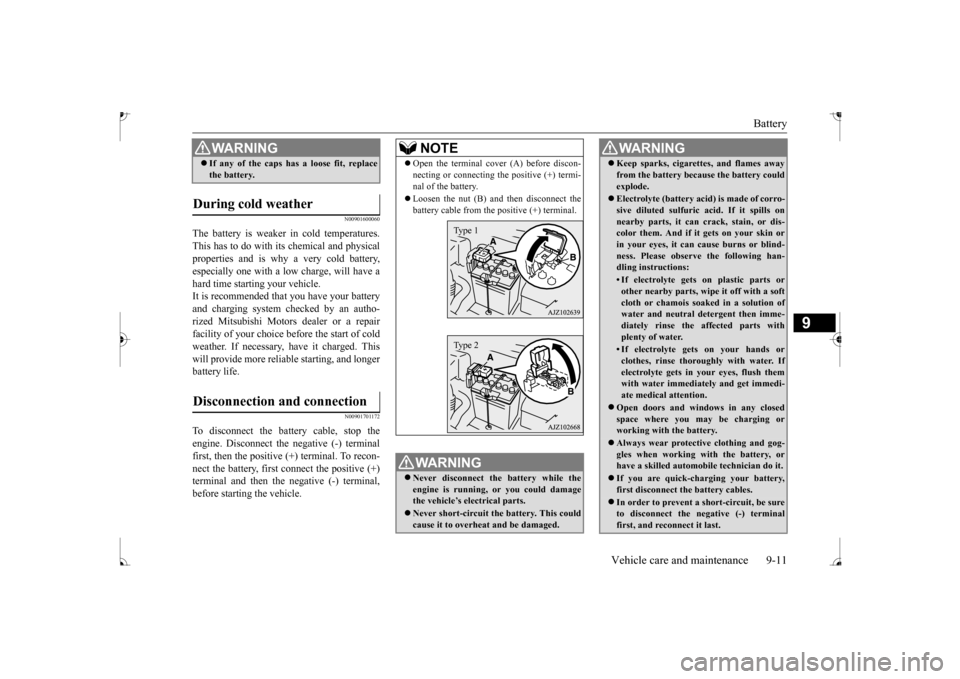
Open the terminal c
over (A) before discon-
necting or connecting
the positive (+) termi-
nal of the battery. Loosen the nut (B) and then disconnect the battery cable from the positive (+) terminal.WA R N I N G Never disconnect the battery while the engine is running, or you could damagethe vehicle’s electrical parts. Never short-circuit the battery. This could cause it to overheat and be damaged.
Type 1Type 2
Keep sparks, cigarettes, and flames away from the battery because the battery couldexplode. Electrolyte (battery acid) is made of corro- sive diluted sulfuric acid. If it spills onnearby parts, it can crack, stain, or dis- color them. And if it
gets on your skin or
in your eyes, it can cause burns or blind-ness. Please observe the following han- dling instructions:• If electrolyte gets
on plastic parts or
other nearby parts, wi
pe it off with a soft
cloth or chamois soak
ed in a solution of
water and neutral detergent then imme- diately rinse the affected parts with plenty of water.• If electrolyte gets on your hands orclothes, rinse thoroughly with water. Ifelectrolyte gets in your eyes, flush them with water immediat
ely and get immedi-
ate medical attention.
Open doors and wind
ows in any closed
space where you may be charging orworking with the battery. Always wear protecti
ve clothing and gog-
gles when working with the battery, or have a skilled automobi
le technician do it.
If you are quick-charging your battery, first disconnect the battery cables. In order to prevent a short-circuit, be sure to disconnect the
negative (-) terminal
first, and reconnect it last.WA R N I N G
BK0235100US.book 11 ページ 2015年11月20日 金曜日 午後3時12分
Page 259 of 305
Tires 9-12 Vehicle care and maintenance
9
N00939201635
It is important to fami
liarize yourself with the
following terms: Cold tire pressure: • The measured pressure after the vehicle has been parked for at least three hours, or• The measured pressure when the vehicle is driven less than 1 mile (1.6 km) after having been parked for three hours.
Maximum pressure: the maximum per- missible cold tire inflation pressure for this tire.
Recommended inflation pressure: the inflation pressure for optimum tire perfor-mance. Intended outboard sidewall: • The sidewall that
contains a whitewall,
bears white lettering or bears manufac- turer, brand, and/or model name molding that is higher or deeper than the samemolding on the other sidewall of the tire, or • The outward facing sidewall of an asym- metrical tire that has a particular side that must always face outward whenmounted on a vehicle.
Passenger car tire: a tire intended for use on passenger cars,
multipurpose passen-
ger vehicles, and trucks
that have a gross
vehicle weight rating (GVWR) of 10,000 pounds or less. Light truck (LT) tire
: a tire designated by
its manufacturer as primarily intended for use on lightweight tr
ucks or multipurpose
passenger vehicles. Tread: portion of a tire that comes into contact with the road. Tread rib: a tread se
ction running circum-
ferentially around a tire. Tread separation: pulling away of the tread from the tire carcass. Carcass: the tire structure, except tread and sidewall rubber which, when inflated,bears the load.
Battery posts, terminals and related acces- sories contain lead
and lead compounds.
Wash hands after handling.NOTE
Check each battery terminal for corrosion. You can stop more corrosion by washingwith a solution of baking soda and water. Grease the posts and cl
amps after cleaning or
tightening them. Check to see that the battery is securely installed and cannot be moved. Also checkeach terminal for tightness. If you will not be driving your vehicle for a long period of time, remove the battery and store it in a place where the battery fluid will not freeze. The battery only should be storedwith a full charge. Before cleaning the battery, tighten all the filler port caps to keep
dirt and moisture out.
WA R N I N G
Tires
WA R N I N GDriving with tires that are worn, damaged or improperly infl
ated is dangerous.
These type tire conditions will adversely affect vehicle performance. These type tire conditions can also cause atread separation or blowout which may result in an accident causing serious injury or death. Tires, including spar
e tire, degrade over
time with age even when they are notbeing used. It is recommended that tires over 6 years generally be replaced
even if damage is
not obvious.
BK0235100US.book 12 ページ 2015年11月20日 金曜日 午後3時12分
Page 260 of 305
Tires
Vehicle care and maintenance 9-13
9
Sidewall: portion of
a tire between the
tread and bead. Section width: the lin
ear distance between
the exteriors of th
e sidewalls of an
inflated tire, excludi
ng elevations due to
labeling, decoration,
or protective bands.
Bead: the part of the tire that is made of steel wires, wrapped or reinforced by plycords and that is shaped to fit the rim. Ply: a layer of rubber-coated parallel cords. Cord: the strands forming the plies in the tire. Rim: a metal support for a tire or a tire and tube assembly upon which the tire beads are seated. Rim diameter: nominal diameter of the bead seat. Groove: the space between two adjacent tread ribs.
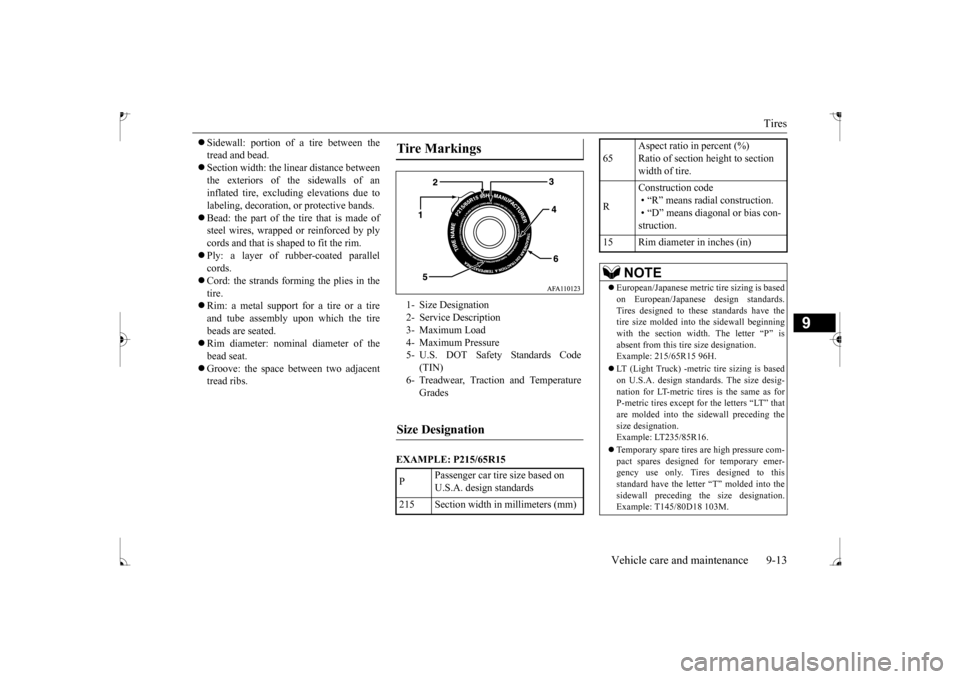
EXAMPLE: P215/65R15Tire Markings 1- Size Designation 2- Service Description 3- Maximum Load 4- Maximum Pressure5- U.S. DOT Safety Standards Code
(TIN)
6- Treadwear, Traction and Temperature
Grades
Size Designation P
Passenger car tire
size based on
U.S.A. design standards
215 Section width in millimeters (mm)
65
Aspect ratio in percent (%) Ratio of section height to section width of tire.
R
Construction code • “R” means radial construction. • “D” means diagon
al or bias con-
struction.
15 Rim diameter in inches (in)
NOTE
European/Japanese metric tire sizing is based on European/Japanese design standards.Tires designed to these standards have the tire size molded into the sidewall beginning with the section width. The letter “P” isabsent from this tire size designation. Example: 215/65R15 96H. LT (Light Truck) -metri
c tire sizing is based
on U.S.A. design standards. The size desig- nation for LT-metric tires is the same as forP-metric tires except for the letters “LT” that are molded into the sidewall preceding the size designation.Example: LT235/85R16. Temporary spare tires are high pressure com- pact spares designed
for temporary emer-
gency use only. Tires designed to this standard have the letter “T” molded into thesidewall preceding th
e size designation.
Example: T145/80D18 103M.
BK0235100US.book 13 ページ 2015年11月20日 金曜日 午後3時12分
Page 261 of 305
Tires 9-14 Vehicle care and maintenance
9
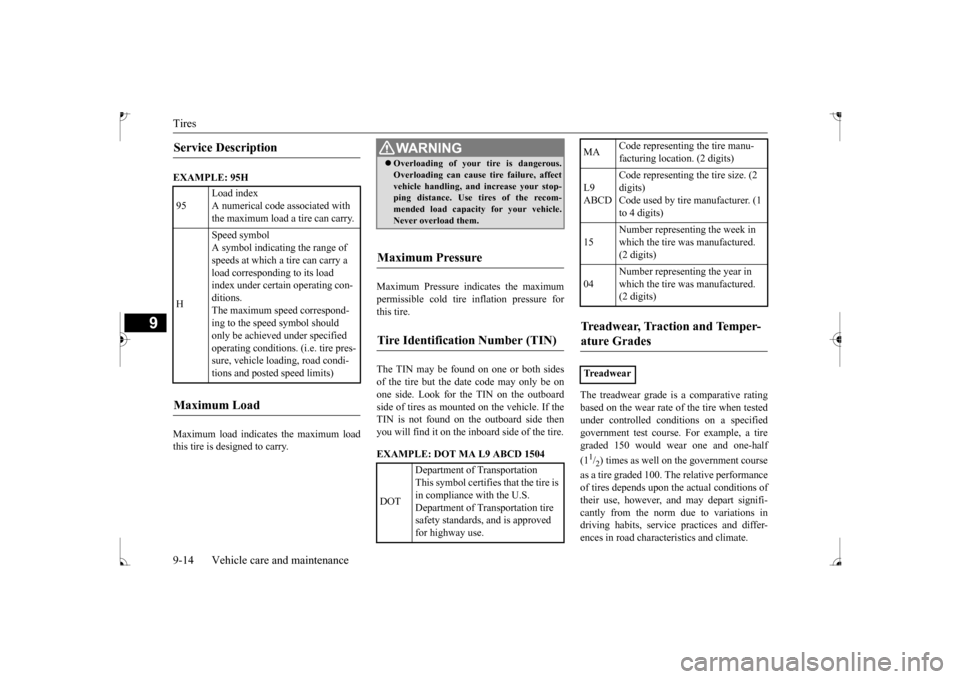
EXAMPLE: 95H Maximum load indicates the maximum load this tire is designed to carry.
Maximum Pressure indicates the maximum permissible cold tire
inflation pressure for
this tire. The TIN may be found on one or both sides of the tire but the da
te code may only be on
one side. Look for the TIN on the outboard side of tires as mounted
on the vehicle. If the
TIN is not found on the outboard side thenyou will find it on the inboard side of the tire. EXAMPLE: DOT MA L9 ABCD 1504
The treadwear grade is a comparative rating based on the wear rate of the tire when tested under controlled conditions on a specifiedgovernment test course
. For example, a tire
graded 150 would wear one and one-half (11/2) times as well on the government course
as a tire graded 100.
The relative performance
of tires depends upon the actual conditions oftheir use, however, and may depart signifi- cantly from the norm due to variations in driving habits, service practices and differ-ences in road characteristics and climate.
Service Description 95
Load index A numerical code associated with the maximum load a tire can carry.
H
Speed symbol A symbol indicating the range of speeds at which a tire can carry a load corresponding to its load index under certain operating con- ditions. The maximum speed correspond-ing to the speed symbol should only be achieved under specified operating conditions.
(i.e. tire pres-
sure, vehicle loading, road condi- tions and posted
speed limits)
Maximum Load
WA R N I N GOverloading of your tire is dangerous. Overloading can cause tire failure, affectvehicle handling, and increase your stop-ping distance. Use tires of the recom- mended load capacity for your vehicle. Never overload them.
Maximum Pressure Tire Identification Number (TIN) DOT
Department of Transportation This symbol certifies that the tire is in compliance with the U.S. Department of Tr
ansportation tire
safety standards,
and is approved
for highway use.
MA
Code representing the tire manu- facturing location. (2 digits)
L9 ABCD
Code representing th
e tire size. (2
digits) Code used by tire manufacturer. (1 to 4 digits)
15
Number representing the week in which the tire was manufactured. (2 digits)
04
Number representing the year in which the tire was manufactured. (2 digits)
Treadwear, Traction and Temper- ature Grades Tr e a d w e a r
BK0235100US.book 14 ページ 2015年11月20日 金曜日 午後3時12分
Page 262 of 305
Tires
Vehicle care and maintenance 9-15
9
The traction grades, from highest to lowest, are AA, A, B and C. Those grades representthe tire’s ability to
stop on wet pavement as
measured under controlled conditions on specified government te
st surfaces of asphalt
and concrete. A tire marked C may have poor traction performance. The temperature grades are A (the highest), B and C, representing the ti
re’s resistance to the
generation of heat and it
s ability to dissipate
heat when tested un
der controlled conditions
on a specified indoor
laboratory test wheel.
Sustained high temperature can cause the material of the tire to
degenerate and reduce
tire life, and excessive temperature can lead to sudden tire failure. The grade C corre- sponds to a level of
performance which all
passenger car tires must
meet under the Fed-
eral Motor Vehicle Safety Standard No. 109. Grades B and A represent higher levels ofperformance on the laboratory test wheel than the minimum required by law.
N00939301984
Proper tire inflation pre
ssure is essential for
the safe and satisfac
tory operation of your
vehicle. The wrong tire pressure will cause problems in three major areas: Safety Too little pressure increases flexing in the tire and can cause tire failure. Too much pressure can cause a tire to lose its abilityto cushion shock. Objects on the road and potholes could then cause tire damage that may result in tire failure. Economy The wrong tire pressure can cause uneven wear patterns in the tire tread. These abnormal wear patterns will reduce the tread life, and the tire will have to bereplaced sooner. Too little pressure also
makes it harder for
the tire to roll, and this uses up more fuel. Ride comfort and vehicle stability The superior riding ex
perience built into
your vehicle partly depends on the correcttire pressure. Too much pressure gives an uncomfortable and ja
rring ride. Too little
pressure feels as if
your vehicle is slow to
respond. Unequal tire pressure
s can make steering
your vehicle uneven
and unpredictable.
The tire pressure for your vehicle under nor- mal driving conditions is listed on the placard attached to the driver’s door sill. (Refer to “Tire and loading information plac-ard” on page 11-3.)
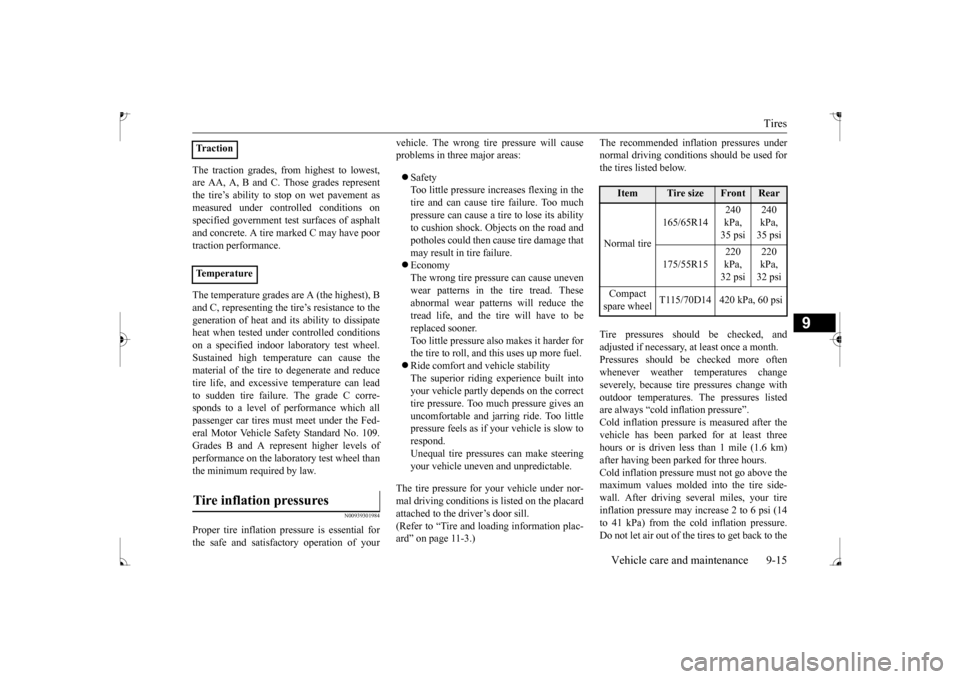
The recommended infl
ation pressures under
normal driving conditions should be used forthe tires listed below. Tire pressures should be checked, and adjusted if necessary,
at least once a month.
Pressures should be checked more often whenever weather temperatures changeseverely, becaus
e tire pressures change with
outdoor temperatures. The pressures listed are always “cold inflation pressure”.Cold inflation pressure is measured after the vehicle has been parked
for at least three
hours or is driven less than 1 mile (1.6 km)after having been parked for three hours. Cold inflation pressure
must not go above the
maximum values molded into the tire side-wall. After driving se
veral miles, your tire
inflation pressure may increase 2 to 6 psi (14 to 41 kPa) from the cold inflation pressure.Do not let air out of the tires to get back to the
Traction TemperatureTire inflation pressures
Item
Tire size
Front
Rear
Normal tire
165/65R14
240 kPa, 35 psi
240 kPa, 35 psi
175/55R15
220 kPa, 32 psi
220 kPa, 32 psi
Compact spare wheel
T115/70D14 420 kPa, 60 psi
BK0235100US.book 15 ページ 2015年11月20日 金曜日 午後3時12分
Page 263 of 305
Tires 9-16 Vehicle care and maintenance
9
specified cold pressure, or your tires will be too low.Check your tires each time you refuel. If one tire looks lower than the others, check the pressure for all of them.You should also take the following safety pre- cautions: Keep your tires inflated to the recom- mended pressures. (See the tire and load-ing information placard attached to the driver’s door sill.) Stay within the recommended load limits. Make sure that the weight of any load in your vehicle is evenly distributed. Drive at safe speeds. After filling your tires to the correct pres- sure, check them for damage and airleaks. Be sure to reinstall the caps on the valve stems.
N00939601466
N00939701193
The following maintenance steps are recom- mended: Check tire pressures regularly. Have regular maintenance done on the wheel balance and front and rear suspen-sion alignment. Rotate your tires regul
arly as described in
the “Tire rotation” section on page 9-17.
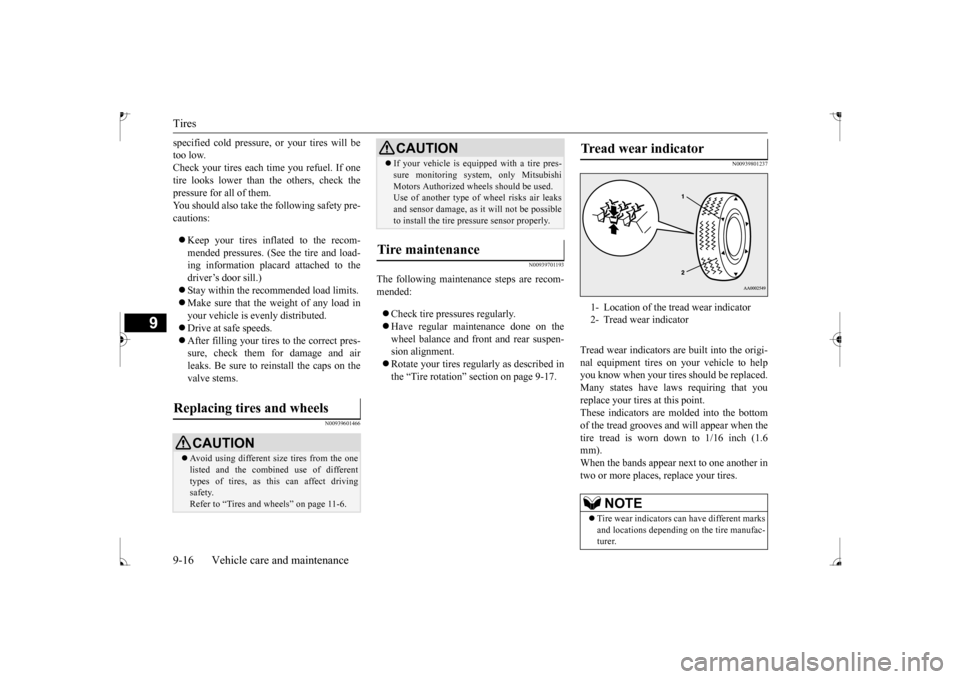
N00939801237
Tread wear indicators are built into the origi-nal equipment tires on your vehicle to helpyou know when your tires should be replaced. Many states have la
ws requiring that you
replace your tires at this point.These indicators are molded into the bottom of the tread grooves and will appear when the tire tread is worn down to 1/16 inch (1.6mm). When the bands appear next to one another in two or more places
, replace your tires.
Replacing tires and wheels
CAUTIONAvoid using different size tires from the one listed and the combined use of different types of tires, as this can affect driving safety.Refer to “Tires and wheels” on page 11-6.
If your vehicle is equipped with a tire pres- sure monitoring system, only MitsubishiMotors Authorized wheels should be used.Use of another type of wheel risks air leaks and sensor damage, as it
will not be possible
to install the tire pressure sensor properly.
Tire maintenance
CAUTION
Tread wear indicator 1- Location of the tread wear indicator 2- Tread wear indicator
NOTE
Tire wear indicators ca
n have different marks
and locations depending
on the tire manufac-
turer.
BK0235100US.book 16 ページ 2015年11月20日 金曜日 午後3時12分
Page 264 of 305
Tires
Vehicle care and maintenance 9-17
9
N00939901557
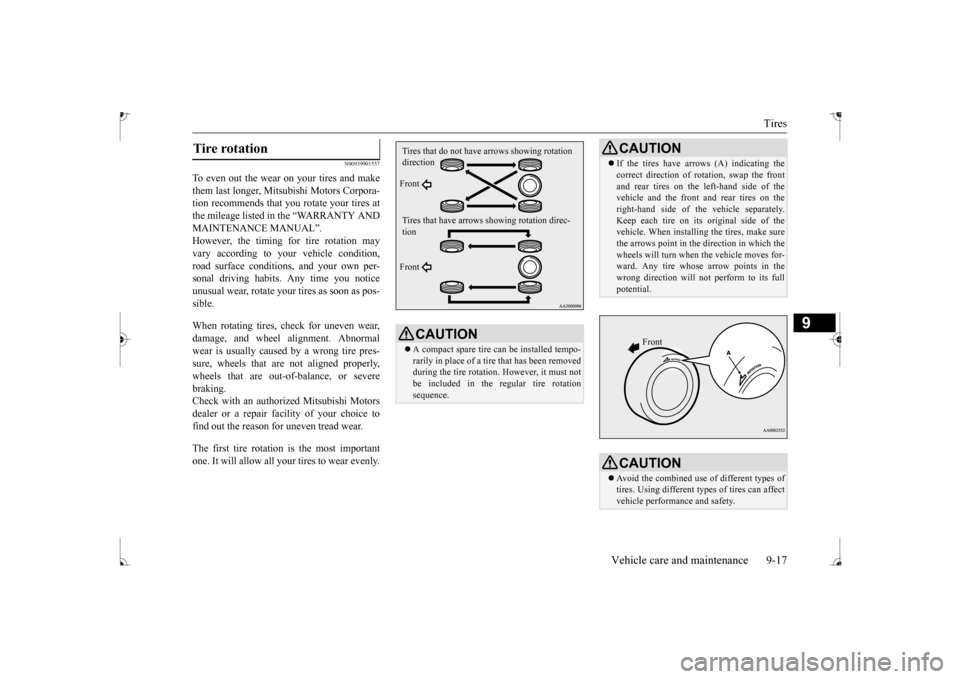
To even out the wear on your tires and make them last longer, Mitsubishi Motors Corpora- tion recommends that you rotate your tires atthe mileage listed in the “WARRANTY AND MAINTENANCE MANUAL”. However, the timing for tire rotation mayvary according to your vehicle condition, road surface conditions, and your own per- sonal driving habits. Any time you notice unusual wear, rotate your
tires as soon as pos-
sible. When rotating tires, check for uneven wear, damage, and wheel al
ignment. Abnormal
wear is usually caused by a wrong tire pres- sure, wheels that are not aligned properly,wheels that are out-of-balance, or severe braking. Check with an authorized Mitsubishi Motorsdealer or a repair fac
ility of your choice to
find out the reason for uneven tread wear. The first tire rotation is the most important one. It will allow all your tires to wear evenly.Tire rotation
CAUTION A compact spare tire can be installed tempo- rarily in place of a tire
that has been removed
during the tire rotation.
However, it must not
be included in the re
gular tire rotation
sequence.Tires that do not have arrows showing rotation direction Front Tires that have arrows
showing rotation direc-
tion Front
CAUTION If the tires have arrows (A) indicating the correct direction of ro
tation, swap the front
and rear tires on the le
ft-hand side of the
vehicle and the front
and rear tires on the
right-hand side of th
e vehicle separately.
Keep each tire on its
original side of the
vehicle. When installing the tires, make sure the arrows point in the direction in which the wheels will turn when the vehicle moves for-ward. Any tire whose arrow points in the wrong direction will not
perform to its full
potential.CAUTION Avoid the combined use of different types of tires. Using different t
ypes of tires can affect
vehicle performa
nce and safety.
Front
BK0235100US.book 17 ページ 2015年11月20日 金曜日 午後3時12分
Page 265 of 305
Clutch pedal free play (if so equipped) 9-18 Vehicle care and maintenance
9
N00940001431
In some areas of the country, snow tires are required for winter driving. If snow tires are required in your area, you must choose snowtires of the same size
and type as the original
tires provided with your vehicle. Snow tires should also be installe
d on all four wheels.
Otherwise your safety and vehicle handling can be reduced. Even where laws may permit it, snow tires should not be operated
at sustained speeds
over 75 mph (120 km/h).
N00940100116
N00940200090
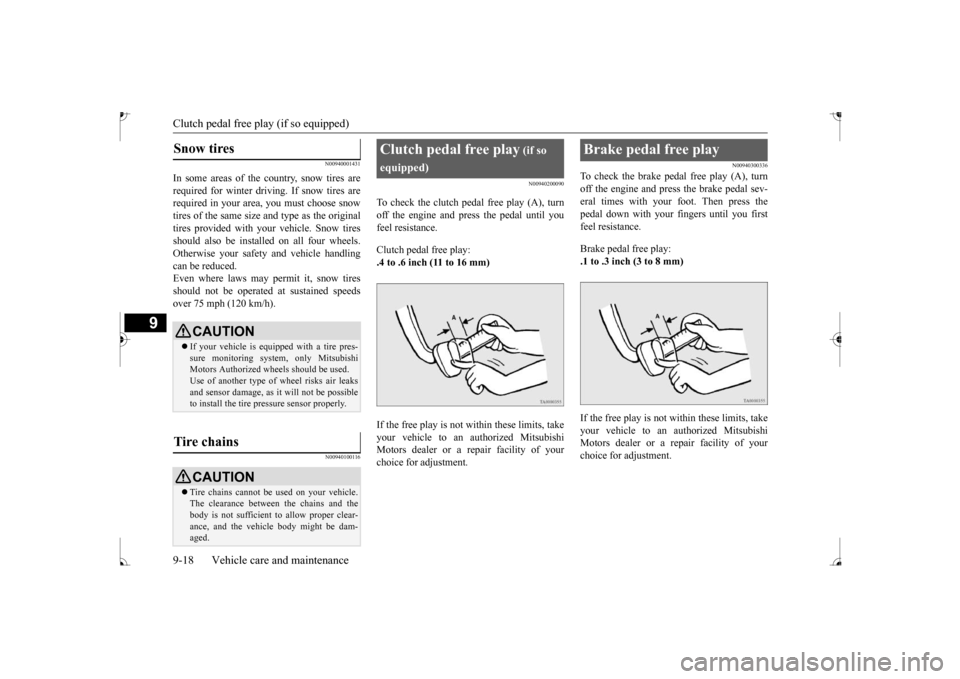
To check the clutch pedal free play (A), turn off the engine and pr
ess the pedal until you
feel resistance. Clutch pedal free play: .4 to .6 inch (11 to 16 mm) If the free play is not within these limits, take your vehicle to an
authorized Mitsubishi
Motors dealer or a repair facility of yourchoice for adjustment.
N00940300336
To check the brake pedal free play (A), turn off the engine and press the brake pedal sev- eral times with your foot. Then press thepedal down with your fingers until you first feel resistance. Brake pedal free play: .1 to .3 inch (3 to 8 mm) If the free play is not within these limits, take your vehicle to an authorized Mitsubishi Motors dealer or a repair facility of yourchoice for adjustment.
Snow tires
CAUTION If your vehicle is equippe
d with a tire pres-
sure monitoring system, only Mitsubishi Motors Authorized wheels should be used.Use of another type of
wheel risks air leaks
and sensor damage, as
it will not be possible
to install the tire pressure sensor properly.
Tire chains
CAUTION Tire chains cannot be used on your vehicle. The clearance between
the chains and the
body is not sufficient to allow proper clear- ance, and the vehicle body might be dam- aged.
Clutch pedal free play
(if so
equipped)
Brake pedal free play
BK0235100US.book 18 ページ 2015年11月20日 金曜日 午後3時12分
Page 266 of 305
Parking brake
Vehicle care and maintenance 9-19
9
N00940400252
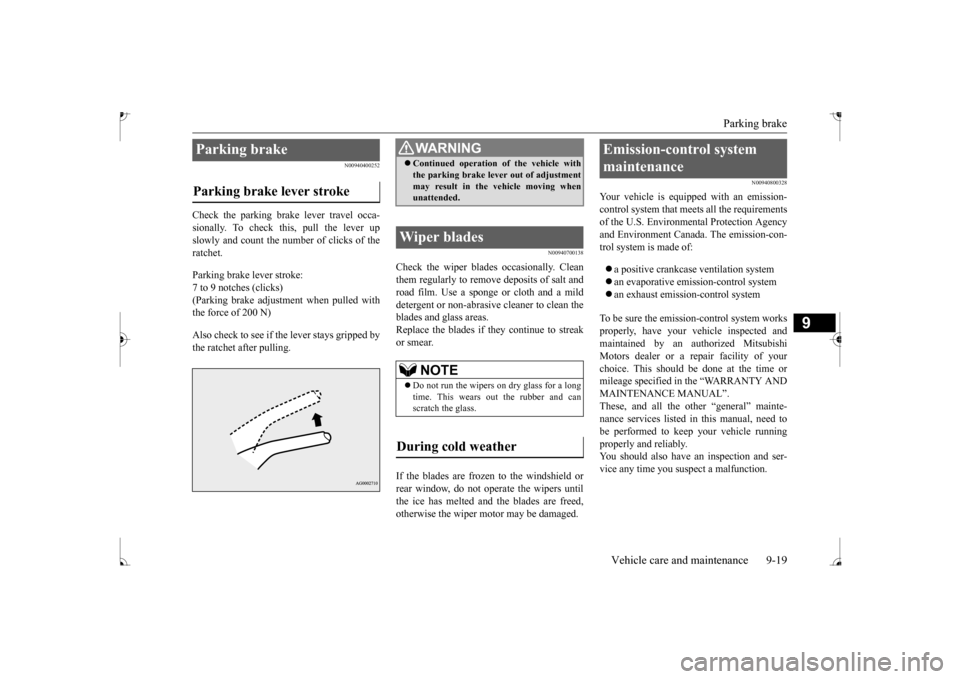
Check the parking brake lever travel occa- sionally. To check this, pull the lever up slowly and count the number of clicks of the ratchet. Parking brake lever stroke: 7 to 9 notches (clicks) (Parking brake adjustment when pulled withthe force of 200 N) Also check to see if the lever stays gripped by the ratchet after pulling.
N00940700138
Check the wiper blades
occasionally. Clean
them regularly to remove
deposits of salt and
road film. Use a sponge or cloth and a mild detergent or non-abrasive cleaner to clean theblades and glass areas. Replace the blades if th
ey continue to streak
or smear. If the blades are frozen to the windshield or rear window, do not ope
rate the wipers until
the ice has melted and the blades are freed, otherwise the wiper mo
tor may be damaged.
N00940800328
Your vehicle is equi
pped with an emission-
control system that meets all the requirements of the U.S. Environm
ental Protection Agency
and Environment Cana
da. The emission-con-
trol system is made of: a positive crankcase
ventilati
on system
an evaporative emis
sion-control system
an exhaust emission-control system
To be sure the emissi
on-control system works
properly, have your vehicle inspected andmaintained by an authorized Mitsubishi Motors dealer or a repair facility of your choice. This should be done at the time ormileage specified in the “WARRANTY AND MAINTENANCE MANUAL”. These, and all the other “general” mainte-nance services listed in this manual, need to be performed to keep
your vehicle running
properly and reliably.You should also have an inspection and ser- vice any time you suspect a malfunction.
Parking brake Parking brake lever stroke
WA R N I N G Continued operation
of the vehicle with
the parking brake leve
r out of adjustment
may result in the
vehicle moving when
unattended.
Wiper blades
NOTE
Do not run the wipers on dry glass for a long time. This wears out
the rubber and can
scratch the glass.
During cold weather
Emission-control system maintenance
BK0235100US.book 19 ページ 2015年11月20日 金曜日 午後3時12分