speci MITSUBISHI MIRAGE 2017 6.G Owners Manual
[x] Cancel search | Manufacturer: MITSUBISHI, Model Year: 2017, Model line: MIRAGE, Model: MITSUBISHI MIRAGE 2017 6.GPages: 307, PDF Size: 9.02 MB
Page 2 of 307
Table of contents
123456789101112
Overview Quick indexGeneral information Seat and restraint systems Features and controlsDriving safetyComfort controlsFor emergenciesVehicle care a
nd maintenance
Customer assistance/
Reporting Safety Defects
SpecificationsAlphabetical index
BK0236100US.book 1 ページ 2016年2月1日 月曜日 午前10時15分
Page 19 of 307
Fuel selection 3-2 General information
3
N00301000912
Your vehicle is designe
d to use unleaded gas-
oline only. It is equipped with a fuel tank filler pipe specifically
designed to accept only
a small diameter unlea
ded gasoline dispens-
ing nozzle. In the United States, fuel suppliers are required by law to add detergents to their gas-
oline to minimize fuel-injector clogging and minimize intake-valve
deposits. Detergent
gasoline helps keep your engine in tune and your emission-control system working prop- erly. Your vehicle is de
signed to operate on
unleaded gasoline having a minimum octane number of 87 [(MON+RON)/2] or 91 RON. Gasoline sold at some
service stations con-
tains oxygenates such as ethanol, although the oxygenates may not be
identified by those
names. Oxygenates
are required in some
areas of the country. Such fuel can be used in your vehicle. A mixture of up to 10 % ethanol (grain alco- hol) and 90 % unleaded
gasoline may be used
in your vehicle, provided the octane number is at least as high as that recommended for unleaded gasoline.
Do not operate your vehicle on gasoline con- taining methanol (wood alcohol). Using this type of alcohol could adversely affect thevehicle’s performance
and damage critical
parts of the vehicl
e’s fuel system.
Many areas of the country require the use of cleaner burning fuel referred to as “Reformu-lated Gasoline”.
contains oxygenates
and is specially ble
nded to reduce vehicle
emissions and improve air quality. Mitsubishi Motors Corporation strongly sup- ports the use of reformulated gasoline. Prop-erly blended reformul
ated gasoline has no
adverse effect on vehicle performance or the durability of the engine and fuel system. MMT is a manganese-
containing metallic
additive that is ble
nded into some gasolines
to increase the octane number. Mitsubishi Motors Corporation recommends using gaso-lines without MMT.
Fuel selection
WA R N I N G Gasoline is highly flammable and explo- sive. You could be burned, seriously injured or killed when handling it. When-ever you refuel your
vehicle, stop the
engine and keep fl
ames, sparks, and
smoking materials away from the vehicle.Always handle fuel in well-ventilated out- door areas.CAUTION Using leaded gasoline
in your vehicle will
damage the engine, ca
talytic converter, and
the oxygen sensors. Also, using leaded gaso- line is illegal, and
will void your warranty
coverage of the engine
, catalytic converter,
and oxygen sensors.
Gasoline detergent additives
Octane requirement Oxygenated gasoline Ethanol (Gasohol)
Methanol Reformulated gasoline MMT (methylcyclopentadienyl manganese tricarbonyl)
BK0236100US.book 2 ページ 2016年2月1日 月曜日 午前10時15分
Page 22 of 307
Modifications to and racing of your vehicle
General information 3-5
3
7. To close, turn the fuel tank filler cap slowly clockwise un
til you hear clicking
sounds, then gently push the fuel tankfiller door closed.
N00301600194
This vehicle should not be modified withnon-Mitsubishi Motors genuine parts. Mitsubishi Motors designs and manufactures high quality vehicles
with an emphasis on
safety and durability.
Modifications using
non-Mitsubishi Motors genuine parts may affect the performance, safety and/or durabil-ity of your vehicle,
and may violate applica-
ble state and/or fe
deral regulations.
DAMAGE OR PERFORMANCE PROB- LEMS RESULTING FROM MODIFICA-TIONS TO OR RACING OF YOUR
VEHICLE ARE NOT COVERED UNDER WARRANTY. Examples of modifications to your vehicle that can cause damage or performance prob- lems include the following: Failure to use Mits
ubishi Motors genuine
parts Failure to use required fuel and fluids Failure to use proper
size tires and wheels
Modification of the fu
el, intake, exhaust,
emission, suspension,
engine, drive train
or electrical wiring systems Modification of any onboard com- puter/control module, including repro- gramming, or replac
ing/adding chips to
any onboard computer/control module
Review the Warranty
and Maintenance Man-
ual for further details
regarding warranty cov-
erage.
N00301700212
CAUTION To avoid fuel spillage
and overfilling, do not
“top-off” the fuel tank. Spilled fuel coulddiscolor, stain, or cr
ack the vehicle’s paint-
work. If fuel spills on the paintwork, wipe it off with a soft cloth.WA R N I N G Make sure the fuel tank filler cap is securely closed. If the fuel tank filler cap were loose, fuel coul
d leak, resulting in a
fire.CAUTION If you need to replace the fuel tank filler cap, use only the fuel tank filler cap specified for your model vehicle.
NOTE
If the fuel tank filler cap is not tight while driving, the engine
malfunction indicator
(
Page 23 of 307
Genuine Mitsubishi Motors parts 3-6 General information
3
The installation of accessories, optional parts, etc., should only be performedwithin the limits prescribed by law, and in accordance with the guidelines and warn- ings contained within the documentsaccompanying this vehicle. Only Mitsubishi Moto
rs approved acces-
sories should be fitt
ed to your vehicle.
Improper installation of
electrical parts
could cause a fire. Refer to the “Modifica- tion/alterations to the electrical or fuel systems” section with
in this owner’s man-
ual. Using a cellular phone
or radio set inside
the vehicle without an external antenna may cause electrical system interference,which could lead to unsafe vehicle opera- tion. Tires and wheels which do not meet spec- ifications must not be used. Refer to the “Specifi
cations” section for
information regarding wheel and tiresizes.
Due to the large number of accessory and replacement parts provided by different man- ufacturers in the market, it is not always pos-sible for an authorized Mitsubishi Motors dealer to check whether the attachment or installation of a non-Mi
tsubishi Motors genu-
ine parts affects the driving safety of your Mitsubishi-vehicle.
N00301800183
Mitsubishi Motors manufactures high quality vehicles with an emphasis on safety. It isimportant to consult an
authorized Mitsubishi
Motors dealer before installation of any
accessory which may in
volve modification of
the electrical or fuel systems.
N00301400219
Mitsubishi Motors Genuine Parts aredesigned and manufactured to meet high stan- dards of performance, and are recommended for all of your maintenance needs. Also avail-able from your Mitsubishi Motors dealer are a wide variety of acce
ssories to personalize
your new vehicle. Each Mitsubishi Motorsvehicle has a selection of Mitsubishi Motors authorized accessories to choose from to tai- lor your new vehicle to your own personalpreference. Your Mitsubishi Motors dealer’s Parts Manager has information on various audio systems,
protection items,
as well as
interior and exterior ac
cessories available for
your specific model.
WA R N I N G While driving, do not use a cellular phone in a way that hinder
s safe driving. Any-
thing, including cell
ular phone usage, that
distracts you from the safe operation of your vehicle incr
eases your risk of an acci-
dent.Refer to and follow al
l state and local laws
in your area regardi
ng cellular phone
usage while driving.
Important point! Modification/alterations to the electrical or fuel systems
CAUTION Please consult an authorized Mitsubishi Motors dealer concer
ning any such acces-
sory fitment or modification. If the wires interfere
with the vehicle body or
improper installation me
thods are used (pro-
tective fuses not included, etc.), electronic devices may be adversel
y affected, resulting
in a fire, vehicle dama
ge, or other accident.
Genuine Mitsubishi Motors parts
BK0236100US.book 6 ページ 2016年2月1日 月曜日 午前10時15分
Page 24 of 307
California Perchlorate Materials Requirements
General information 3-7
3
N00300100017
Certain components of this vehicle, such as airbag modules, seat belt pretensioners, and button cell batteries, ma
y contain perchlorate
materials. Special handling may apply. For additional information, see www.d
tsc.ca.gov/hazardous-
waste/perchlorate.California Perchlorate Materials Requirements
BK0236100US.book 7 ページ 2016年2月1日 月曜日 午前10時15分
Page 39 of 307
Child restraint systems 4-14 Seat and restraint systems
4
Child restraint systems specifically designed for infants and small children are offered byseveral manufacturers
. Choose only a child
restraint system with a label certifying that it complies with Federal Motor Vehicle SafetyStandard 213 (FMVSS 213) or Motor Vehicle Restraint Systems and Booster Seats Safety Regulations (RSSR). Look for the manufac-turer’s statement of compliance on the box and child restraint system itself. The child restraint system should be appropri- ate for your child’s we
ight and height, and
should properly fit you
r vehicle’s seat.
For detailed information,
refer to the instruc-
tion manual accompanying the child restraint system. All children should be
properly restrained in
a restraint device that
offers the maximum
protection for their size and age. Be sure to check local, state, or provincial requirements for child size and age that mayvary from the recommendations listed below. Children less than 1 year old and who weigh 22 pounds (10 kg) or less MUST ride in a rear-facing child safety seat thatMUST ONLY be used in the rear seat.
Children older than 1 year of age and who weigh less than 40 pounds (18 kg) or whoare less than 40 inches (100 cm) tall must be in a forward-facing restraint used only in the rear seat. Children who weigh more than 40 pounds (18 kg) or who are more than 40 inches (100 cm) tall, regardless of age, shoulduse a suitable child seat or a booster seat in the rear seat until the vehicle’s lap-and- shoulder belt fits
them properly.
Guidelines for child restraint system selection
WA R N I N G All children must be seated in the rear seat, and properly restrained. Accident statistics
show that children of
all sizes and ages are safer when properlyrestrained in the rear seat, rather than in the front seat. Be sure to select a child restraint system that is appropriate not only for the child’s size and age but also for your vehicle.Some child restraint systems may not fit your vehicle properly.
Any child who is too large to use a child restraint system should ride in the rearseat and wear the la
p-and-shoulder belt
properly. The shoulder belt must be posi- tioned over the shou
lder and across the
chest, not across their neck, and with thelap belt positioned low on the child’s hips, not across their stomach. If necessary, a booster seat should be used to help achievea proper seat belt fi
t. Follow the booster
seat manufacturer’s instructions. Only use a booster seat that is certified as comply-ing with Federal Motor Vehicle Safety Standards or Motor Vehicle Restraint Sys- tems and Booster Seats Safety Regula-tions. Never hold an infant
or child in your arms
or on your lap when ri
ding in this vehicle,
even when you are we
aring your seat belt.
Never place any part of the seat belt youare wearing around an infant or child. Failure to follow these simple instructions creates a risk of serious injury or death toyour child in the event of an accident or sudden stop.WA R N I N G
BK0236100US.book 14 ページ 2016年2月1日 月曜日 午前10時15分
Page 46 of 307
Maintenance and inspection of seat belts
Seat and restraint systems 4-21
4
N00407000364
The seat belt webbing
may be cleaned with
mild soap or detergent solution. Do not use an organic solvent. Allow the belts to dry in theshade. Do not allow them to retract until com- pletely dry. Do not attempt to bleach or re- dye the belts. The color may rub off and thewebbing strength may be affected.
Regularly check your seat belt buckles and their release mechanisms for positive engage-ment and release of the latch plate. Check the retractors for automatic locking when in the Automatic Locking Retractor function. The entire seat belt assembly should be replaced if the webbing shows any obvious cuts, tears, increase in thickness in any sec- tion of the webbing from broken fibers, orsevere fading from sunl
ight. All of these con-
ditions indicate a we
akening of the belt,
which may adversely affect seat belt perfor- mance in an accident.
N00407701850
This vehicle is equippe
d with a Supplemental
Restraint System (SRS), which includes air- bags for the driver and passengers.
The SRS front airbags are designed to supple- ment the primary protection of the driver andfront passenger seat
belt systems by provid-
ing those occupants wi
th protection against
head and chest injuries
in certain moderate to
severe frontal collisions. The SRS front air- bags, together with sens
ors at the front of the
vehicle and sensors attached to the frontseats, form an advanced airbag system. The SRS driver’s knee airbag is designed to supplement the primar
y protection of the
driver’s seat belt system. It can reduce the forward movement of the driver’s lower legs and provide increased
overall body protection
in certain moderate to
severe frontal colli-
sions. The SRS side airbags and the curtain airbags are also designed to supplement the seat belts.The SRS side airbags provide the driver and front passenger with protection against chest injuries by deploying the bag on the sideimpacted in moderate
to severe side impact
collisions. The SRS curtain airbags provide the driver and passengers on the front seatand rear outboard seat
with protection against
head injuries by deploying the curtain airbag on the side impacted
in moderate to severe
side impact collisions
and by deploying both
curtain airbags when a rollover is detected. The curtain airbags are also designed to helpreduce the risk of comp
lete and partial ejec-
WA R N I N GAny child who is t
oo small to properly
wear a seat belt must be properlyrestrained in an appropriate childrestraint system, to reduce their risk of serious injury or de
ath in an accident.
A child should never be left unattended in, or unsupervised around, your vehicle. When you leave the ve
hicle, always take
the child out as well. Children can die from heat stroke if left or trapped inside the vehicle, especially on hot days. Keep your vehicle locked and the trunk lid closed when not in use. Keep your vehicle keys away from children. Never allow children to play in the trunk of your vehicle.
Maintenance and inspection of seat belts
WA R N I N G Do not attempt to repair or replace any part of the seat belt assemblies. This workshould be done by an authorized Mitsubishi Motors deal
er. Failure to have
an authorized Mitsub
ishi Motors dealer
perform the work could reduce the effec- tiveness of the belts and could result in a serious injury or de
ath in an
accident.
Supplemental Restraint Sys- tem (SRS) - airbag
BK0236100US.book 21 ページ 2016年2月1日 月曜日 午前10時15分
Page 48 of 307
Supplemental Restraint System (SRS) - airbag
Seat and restraint systems 4-23
4
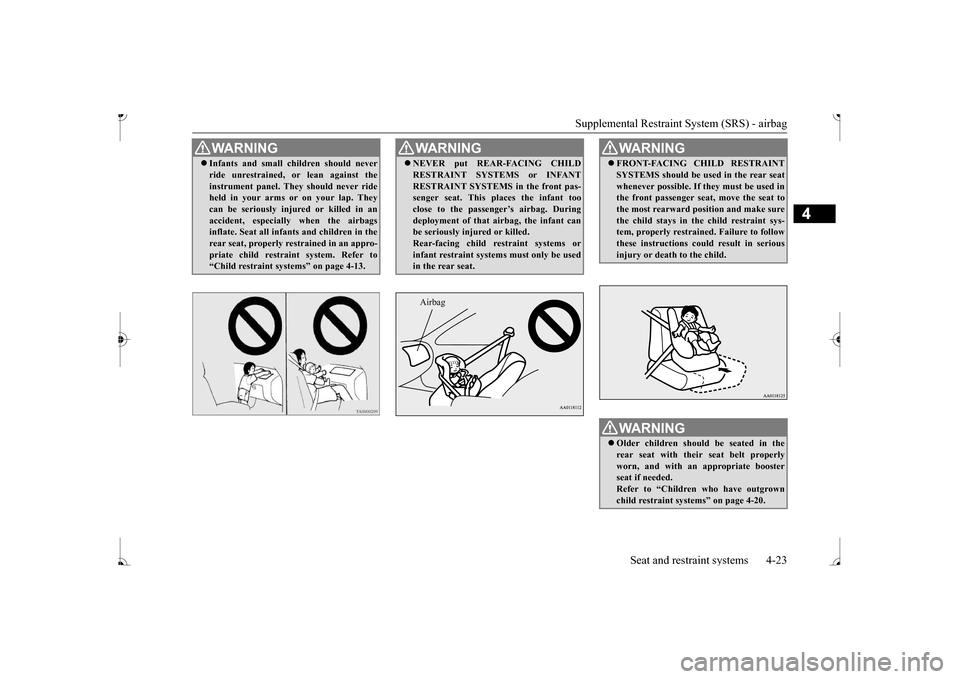
WA R N I N G Infants and small children should never ride unrestrained,
or lean against the
instrument panel. They should never rideheld in your arms or on your lap. They can be seriously inju
red or killed in an
accident, especially when the airbagsinflate. Seat all infants and children in the rear seat, properly re
strained in an appro-
priate child restraint system. Refer to“Child restraint syst
ems” on page 4-13.
WA R N I N GNEVER put REAR-FACING CHILD RESTRAINT SYSTEMS or INFANTRESTRAINT SYSTEMS in the front pas-senger seat. This places the infant too close to the passenger’s airbag. During deployment of that airbag, the infant canbe seriously inju
red or killed.
Rear-facing child restraint systems or infant restraint systems must only be usedin the rear seat.Airbag
WA R N I N G FRONT-FACING CHILD RESTRAINT SYSTEMS should be used in the rear seatwhenever possible. If they must be used inthe front passenger seat, move the seat to the most rearward position and make sure the child stays in the child restraint sys-tem, properly restrained. Failure to follow these instructions could result in serious injury or death to the child.WA R N I N G Older children should be seated in the rear seat with their seat belt properly worn, and with an
appropriate booster
seat if needed.Refer to “Children
who have outgrown
child restraint syst
ems” on page 4-20.
BK0236100US.book 23 ページ 2016年2月1日 月曜日 午前10時15分
Page 50 of 307
Supplemental Restraint System (SRS) - airbag
Seat and restraint systems 4-25
4
The main purpose of an EDR is to record, in certain crash or near
crash-like situations,
such as an airbag deployment or hitting a road obstacle, data that
will assist in under-
standing how a vehicl
e’s systems performed.
The EDR is designed to record data related to vehicle dynamics and safety systems for a short period of time,
typically 30 seconds or
less. The EDR in this vehicle is designed to record such data as: How various systems
in your vehicle were
operating; Whether or not the driver and front pas- senger safety belts we
re buckled/fastened;
How far (if at all) the driver was depress- ing the accelerator and/or brake pedal; and, How fast the vehicle was traveling.
These data can help provide a better under- standing of the circumstances in which crashes and injuries occur.
To read data recorded by an EDR, special equipment is required, and access to the vehi-cle or the EDR is needed. In addition to the vehicle manufacturer, ot
her parties, such as
law enforcement, that have the special equip-ment, can read the information if they have access to the vehicle or the EDR.
N00417900223
The driver’s seat position sensor is attachedto the seat rail and provides the airbag control unit with information on the seat’s fore-aftposition. The airbag control unit controls deployment of the driver’s front airbag in accordance with the information it receivesfrom this sensor. If there is a problem involving the driver’s seat position sensor, the SRS warning light inthe instrument panel will come on. Refer to
“SRS warning light” on page 4-27.
N00418000364
The passenger’s seat oc
cupant classification
sensor system is attach
ed to the front passen-
ger seat cushion and provides the airbag con- trol unit with information regarding theoccupant on the front passenger seat. The air- bag control unit controls deployment of the
NOTE
EDR data are recorded by your vehicle only if a non-trivial crash si
tuation occurs; no data
are recorded by the EDR under normal driv-ing conditions and no personal data (e.g., name, gender, age, a
nd crash location) are
recorded. However, ot
her parties, such as
law enforcement, could combine the EDR data with the type of
personally identifying
data routinely acquire
d during a crash inves-
tigation.
Driver’s seat position sensor
WA R N I N G If the SRS warning
light comes on, have
the vehicle inspected by an authorized Mitsubishi Motors dealer as soon as possi-ble. Please observe the following instructions to ensure that the driver’s seat position sensor can operate correctly.• Adjust the seat to the correct position,and sit well back
against the seatback.
Refer to “Front seats” on page 4-2.• Do not recline the seatback more thannecessary when driving.• Do not place metallic objects or luggageunder the front seat.
If the vehicle is involved in a severe impact, have the SRS sensor inspected byan authorized
Mitsubishi Motors dealer as
soon as possible.
Passenger’s seat occupant clas- sification sensor system
BK0236100US.book 25 ページ 2016年2月1日 月曜日 午前10時15分
Page 58 of 307

Supplemental Restraint System (SRS) - airbag
Seat and restraint systems 4-33
4
WA R N I N G In order to reduce the risk of injury from a deploying side airb
ag, do not allow any
rear seat passengers to hold onto the back of either front seat.
Special care should be
taken with children. Do not place any objects around the area where the side airbags deploy. Such objects can interfere with proper side air- bag deployment, and
cause injury during
deployment of the side airbag. Do not place stickers, labels or additional trim on the back of either front seat. They can interfere with proper side airbag deployment.
WA R N I N G Do not attach a microphone (A) or any other object around the part where thecurtain airbag deploys
, such as on the
windshield, side door
glass or front and
rear pillars and roof
side rail. When the
curtain airbag inflates, the microphone orother object may be
hurled with great
force or the curtain airbag may not inflate correctly, resulting
in death or serious
injury.WA R N I N G Do not install seat c
overs or re-cover seats
that have side airbag
s. Covers can inter-
fere with proper si
de airbag deployment
and adversely affect
side airbag perfor-
mance.
Never install a rear-facing child restraint system in the front passenger seat. Rear-facing child restraint systems MUSTONLY be used in the rear seat. Front-facing child restraint systems should also be used ON
LY in the rear seat.
If a front-facing child restraint system must be used in the front passenger seat,move the seat as far
back as possible, and
make sure that the child stays in the child restraint system, properly restrained andaway from the door. Do not allow a child to lean against or sit close to the passenger door, even if the child is seated in a child restraint system. The child’s head sh
ould also not lean
against or be close to the section of the seatback where the side airbag and cur- tain airbag are located. It is dangerous ifthe side airbag or cu
rtain airbag deploys.
Failure to follow all of these instructions could lead to serious in
jury or death to the
child. Work done on or in th
e vicinity of the side
airbag or curtain
airbag components
should be done only
by an authorized
Mitsubishi Motors dealer. There is a riskof a serious injury
or death. Improper
work methods can cause accidental side airbag or curtain ai
rbag deployment, or
render a side airb
ag or curtain airbag
inoperable. Either of these situations could result in seri
ous injury or death.
WA R N I N G
BK0236100US.book 33 ページ 2016年2月1日 月曜日 午前10時15分