engine coolant MITSUBISHI MONTERO 2000 Service Workshop Manual
[x] Cancel search | Manufacturer: MITSUBISHI, Model Year: 2000, Model line: MONTERO, Model: MITSUBISHI MONTERO 2000Pages: 1839, PDF Size: 29.19 MB
Page 415 of 1839

Page 419 of 1839

Page 474 of 1839

GDI -Troubleshooting13A-5
DATA LIST REFERENCE TABLE
The data list has been changed as the engine-ECU and the engine-A/T-ECU have been changed. The
other items are the same as for M/T.
Item
No.Inspection
itemInspection contentsNormal conditionInspec-
tion pro-
cedure
No.Refer-
ence
page
22Crank angle
sensorDEngine: Cranking
DTachometer:
ConnectedCompare the engine
speed readings on
the tachometer and
the MUT-II.AccordCode
No.
P033513A-56*
DEngine: Idling
DIdle position
switch: ONWhen engine
coolant temperature
is - 20_C1,300 - 1,500
r/min
When engine
coolant temperature
is 0_C1,300 - 1,500
r/min
When engine
coolant temperature
is 20_C1,250 - 1,450
r/min
When engine
coolant temperature
is 40_C1,100 - 1,300
r/min
When engine
coolant temperature
is 80_C (more than
four minutes later
after engine has
started)600 - 800 r/min
A1LOxygen
sensorEngine: After having
warmed up. (Air/fuel
mixture is made
leaner when deceler-When at 4,000
r/min, engine is
decelerated200 mV or lessCode
No.
P013013A-28*
leanerwhendeceler
ating, and is made
richer when racing.)Rev the engine.600 - 1000 mV
Engine: After having
warmed up (The
oxygen sensor signal
is used to check the
air/fuel mixture ratio,
and control condition
isalsocheckbythe
Engine is idling
(more than 4
minutes later after
engine has started)Voltage should
alternate between
400 mV or less
and 600 - 1,200
mV (more than 4
minutes after the
enginehasisalso checkbythe
engine-ECU
or engine-A/T-ECU
.)
2,500 r/min
enginehas
started).
24LVehicle
speed sen-
sorDrive at 40 km/hApproximately 40
km/hCode
No.
P050013A-63*
www.WorkshopManuals.co.uk
Purchased from www.WorkshopManuals.co.uk
Page 492 of 1839

13C-1
DIESEL FUEL
<4M4>
CONTENTS
GENERAL INFORMATION 2...................
SERVICE SPECIFICATIONS 3.................
SEALANT 3..................................
SPECIAL TOOLS 4...........................
TROUBLESHOOTING 5.......................
ON-VEHICLE SERVICE 42...................
Injection Timing Check and Adjustment 42.........
Idle Speed Check and Adjustment 42.............
Accelerator Pedal Position Sensor (APS)
Adjustment 42.................................
Control Relay Continuity Check 43................
Accelerator Pedal Position Sensor (APS) Check 43.Idle Switch Check 43...........................
Boost Air Temperature Sensor (Intake Air
Temperature Sensor) Check 44..................
Engine Coolant Temperature Sensor Check 44.....
Evacuation of Water from Fuel Filter 45...........
Fuel Filter Cartridge Replacement 45.............
Evacuation of Air from Fuel Line 45...............
Fuel Injection Pump Check 46...................
Intake Air Restriction Equipment Check 48.........
Injection Nozzle Check and Adjustment 49.........
INJECTION NOZZLE 50......................
INJECTION PUMP 56........................
ENGINE-ECU 59............................
www.WorkshopManuals.co.uk
Purchased from www.WorkshopManuals.co.uk
Page 493 of 1839

DIESEL FUEL <4M4> -General Information13C-2
GENERAL INFORMATION
The electronically-controlled fuel injection system consists of sensors which detect the condition of the
diesel engine, an engine-ECU which controls the system based on signals from these sensors, and actuators
which operate according to control commands from the engine-ECU.
The engine-ECU carries out operations such as fuel injection rate control, fuel injection timing control
and idle up control. In addition, the engine-ECU is equipped with several self-diagnosis functions which
make troubleshooting easier in the event that a problem develops.
FUEL INJECTION RATE CONTROL
The fuel injection completion timing is controlled by means of a solenoid-type spill valve to ensure that
the optimum amount of fuel is supplied to the engine in accordance with gradual changes in the engine
running condition.
Before fuel injection starts, the solenoid-type spill valve is on (energized), so that the valve is closed.
As the plunger turns and rises, fuel is sent out under pressure, and when the fuel flow rate reaches
the target value for fuel injection, the solenoid-type spill valve turns off. When the solenoid-type spill
valve turns off, the fuel under high pressure inside the plunger is leaked out into the pump chamber
and fuel injection is completed.
FUEL INJECTION TIMING CONTROL
The position of the injection pump timer piston is controlled so that fuel injection is carried out at the
optimum timing in accordance with the engine running condition.
The timer piston position is determined by duty control of the timing control solenoid valve which is located
in the line between the high-pressure chamber and the low-pressure chamber of the timer piston.
The fuel injection timing is advanced by increasing the control duty of the timing control solenoid valve.
IDLE SPEED CONTROL
Controlling the fuel injection rate in accordance with the engine running condition maintains the idle speed
at the optimum condition.
SELF-DIAGNOSIS FUNCTION
DWhen an abnormality is detected in any of the sensors or actuators, the engine warning lamp illuminates
to warn the driver.
DWhen an abnormality is detected in any of the sensors or actuators, a diagnosis code number
corresponding to the problem which occurred is output.
DThe RAM data relating to the sensors and actuators which is stored in the engine-ECU can be read
using the MUT-II. In addition, the actuators can be force-driven under certain conditions.
OTHER CONTROL FUNCTIONS
1. Power Supply Control
When the ignition switch is turned to ON, the relay turns on and power is supplied to components
such as the timing control solenoid valve.
2. Intake Air Throttle Control
When the engine is idling after having warmed up, the throttle valve is half opened to restrict the
amount of intake air in order to reduce vibration and noise.
3. A/C Relay Control
Turns the compressor clutch of the A/C ON and OFF
4. Fan motor relay control
The radiator fan and condenser fan operating speeds are controlled in accordance with the engine
coolant temperature and the vehicle speed.
5. Glow Control
Refer to GROUP 16.
6. EGR Control
Refer to GROUP 17.
www.WorkshopManuals.co.uk
Purchased from www.WorkshopManuals.co.uk
Page 494 of 1839

DIESEL FUEL <4M4> -Service Specifications/Sealant13C-3
SERVICE SPECIFICATIONS
ItemStandard value
Accelerator pedal position sensor reference voltage V0.985 - 1.085
Accelerator pedal position sensor resistance kW3.5 - 6.5
Boost air temperature sensor (Intake air temperatureWhen the temperature is 20_C2.3 - 2.9
sensor) resistance kWWhen the temperature is 80_C0.30 - 0.39
Engine coolant temperature sensor resistance kWWhen the temperature is 20_C2.3 - 2.6
When the temperature is 80_C0.30 - 0.34
Fuel cut solenoid valve resistanceW6.8 - 9.2
Timing control valve resistanceW10.8 - 11.2
Timer piston position sensor resistanceWConnector terminals No.1 - No.2160 - 168
Connector terminals No.1 - No.380 - 84
Connector terminals No.2 - No.380 - 84
Control sleeve position sensor resistanceWConnector terminals No.4 - No.1211.2 - 12.4
Connector terminals No.4 - No.85.6 - 6.2
Connector terminals No.8 - No.125.6 - 6.2
GE actuator (electronic governor) resistanceWConnector terminals No.6 - No.100.64 - 0.72
Fuel temperature sensor resistance kWConnector terminals No.7 - No.111.4 - 2.6
Engine speed sensor resistance kW2.15
Main/sub throttle solenoid valve resistanceW36 - 44
SEALANT
ItemSpecified sealant
Engine coolant temperature sensor3M Nut Locking Part No.4171 or equivalent
www.WorkshopManuals.co.uk
Purchased from www.WorkshopManuals.co.uk
Page 497 of 1839

DIESEL FUEL <4M4> -Troubleshooting13C-6
FAIL-SAFE, BACKUP FUNCTIONS
When abnormalities in the major sensors are detected by diagnosis functions, pre-set control logic operates
to maintain a safe driving condition for the vehicle.
Diagnosis itemControl features in malfunction
Accelerator pedal position sensorD
Accelerator pedal released (idle switch ON)
Acceleration opening degree = 0%
D
Accelerator pedal applied (idle switchOFF)
Engine controlled at low speed
Acceleration opening degree = 20% fixed
Idle switchD
Void idling speed control.
D
Void cruise control.
Engine speed sensorD
Engine controlled at low speed
D
Void cruise control.
Boost air temperature sensorMaintain the intake air temperature at 50_
C.
Vehicle speed sensorD
Void idling speed control.
D
Void cruise control.
Engine coolant temperature sensorMaintain the engine coolant temperature at 80_
C.
Control sleeve position sensorD
Engine controlled at low speed
D
Void cruise control.
Timer piston position sensorD
Injection timing stabilizing control
D
Void cruise control.
Barometric pressure sensor (ECU
built-in)Keep the barometric pressure at 101 kPa.
Fuel temperature sensorMaintain the fuel temperature at 50_
C.
Boost pressure sensorKeep the boost pressure as barometric pressure (101 kPa).
Injection correction ROMVoid correction.
GE actuatorD
Engine controlled at low speed
D
Void cruise control.
Over boostVoid cruise control.
Timing control valveD
Injection timing stabilizing control
D
Void cruise control.
www.WorkshopManuals.co.uk
Purchased from www.WorkshopManuals.co.uk
Page 498 of 1839

DIESEL FUEL <4M4> -Troubleshooting13C-7
INSPECTION CHART FOR DIAGNOSIS CODES
Code No.Diagnosis itemReference
page
11Accelerator pedal position sensor (main) system13C-8
12*Boost pressure sensor system13C-9
13Barometric pressure sensor (ECU built-in) system13C-10
14Fuel temperature sensor system13C-10
15Engine coolant temperature sensor system13C-11
16Boost air temperature sensor system13C-11
17Vehicle speed sensor system13C-12
18Engine speed sensor (backup) system13C-13
21Engine speed sensor system13C-14
23Idle switch (accelerator pedal position sensor built-in) system13C-15
25*Timer piston position sensor system13C-16
26*Control sleeve position sensor system13C-17
27Accelerator pedal position sensor (sub) system13C-18
41*Main throttle solenoid valve system13C-19
43Timing control valve system13C-20
46Injection correction ROM system13C-21
48*GE actuator (in the middle of control sleeve position sensor inoperative) system13C-21
49*Over boost (turbocharger waste gate malfunction)13C-22
54Immobilizer system13C-22
Caution
If the the above-mentioned diagnosis code number with the asterisks can be displayed along with
another code number in parentheses simultaneously, check the other code number before replacing
the engine-ECU.
12 (41, 49), 26 (48), 25 (43), 41 (12, 49), 48 (26), 49 (12, 41)
www.WorkshopManuals.co.uk
Purchased from www.WorkshopManuals.co.uk
Page 502 of 1839
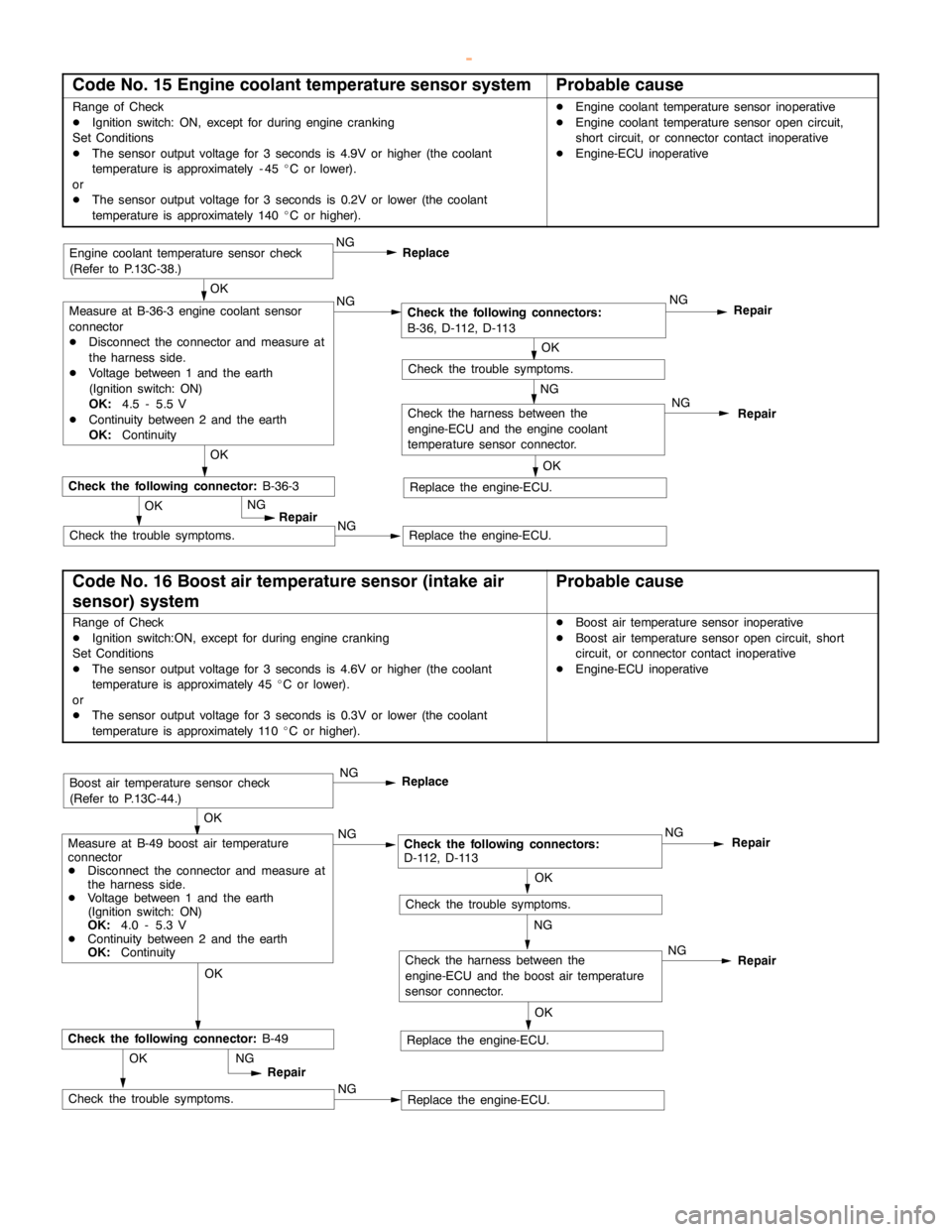
DIESEL FUEL <4M4> -Troubleshooting13C-11
Code No. 15 Engine coolant temperature sensor systemProbable cause
Range of Check
DIgnition switch: ON, except for duringenginecranking
Set Conditions
DThe sensor output voltage for 3 seconds is 4.9V or higher (the coolant
temperature is approximately - 45_C or lower).
or
DThe sensor output voltage for 3 seconds is 0.2V or lower (the coolant
temperature is approximately 140_C or higher).DEngine coolant temperature sensor inoperative
DEngine coolant temperature sensoropencircuit,
short circuit, or connector contact inoperative
DEngine-ECU inoperative
OK
NGNG
Repair
OK
OKRepair
NGEngine coolant temperature sensor check
(Refer to P.13C-38.)
Replace the engine-ECU.NG
Replace the engine-ECU.OK NG
OK
Repair
Check the following connector:
B-36-3
NGCheck the trouble symptoms.NG
Measure at B-36-3 engine coolantsensor
connector
DDisconnect the connector and measure at
the harness side.
DVoltage between 1 and the earth
(Ignition switch: ON)
OK:
4.5 - 5.5 V
DContinuity between 2 and the earth
OK:
ContinuityCheck the following connectors:
B-36, D-112, D-113
Check the harness between the
engine-ECU and the engine coolant
temperature sensor connector.
Check the trouble symptoms. Replace
Code No. 16 Boost air temperature sensor (intake air
sensor) systemProbable cause
Range of Check
DIgnition switch:ON, except for duringenginecranking
Set Conditions
DThe sensor output voltage for 3 seconds is 4.6V or higher (the coolant
temperature is approximately 45_C or lower).
or
DThe sensor output voltage for 3 seconds is 0.3V or lower (the coolant
temperature is approximately 110_C or higher).DBoost air temperature sensor inoperative
DBoost air temperature sensoropencircuit, short
circuit, or connector contact inoperative
DEngine-ECU inoperative
OK
Measure at B-49 boost air temperature
connector
DDisconnect the connector and measure at
the harness side.
DVoltage between 1 and the earth
(Ignition switch: ON)
OK:
4.0 - 5.3 V
DContinuity between 2 and the earth
OK:
ContinuityNGCheck the following connectors:
D-112, D-113NG
Repair
OK
OKRepair
NGBoost air temperature sensor check
(Refer to P.13C-44.)
Check the trouble symptoms.
Replace the engine-ECU.NG
Replace the engine-ECU.OK NG
OK
Repair
Check the following connector:
B-49Replace
NGCheck the trouble symptoms.NG
Check the harness between the
engine-ECU and the boost air temperature
sensor connector.
www.WorkshopManuals.co.uk
Purchased from www.WorkshopManuals.co.uk
Page 511 of 1839
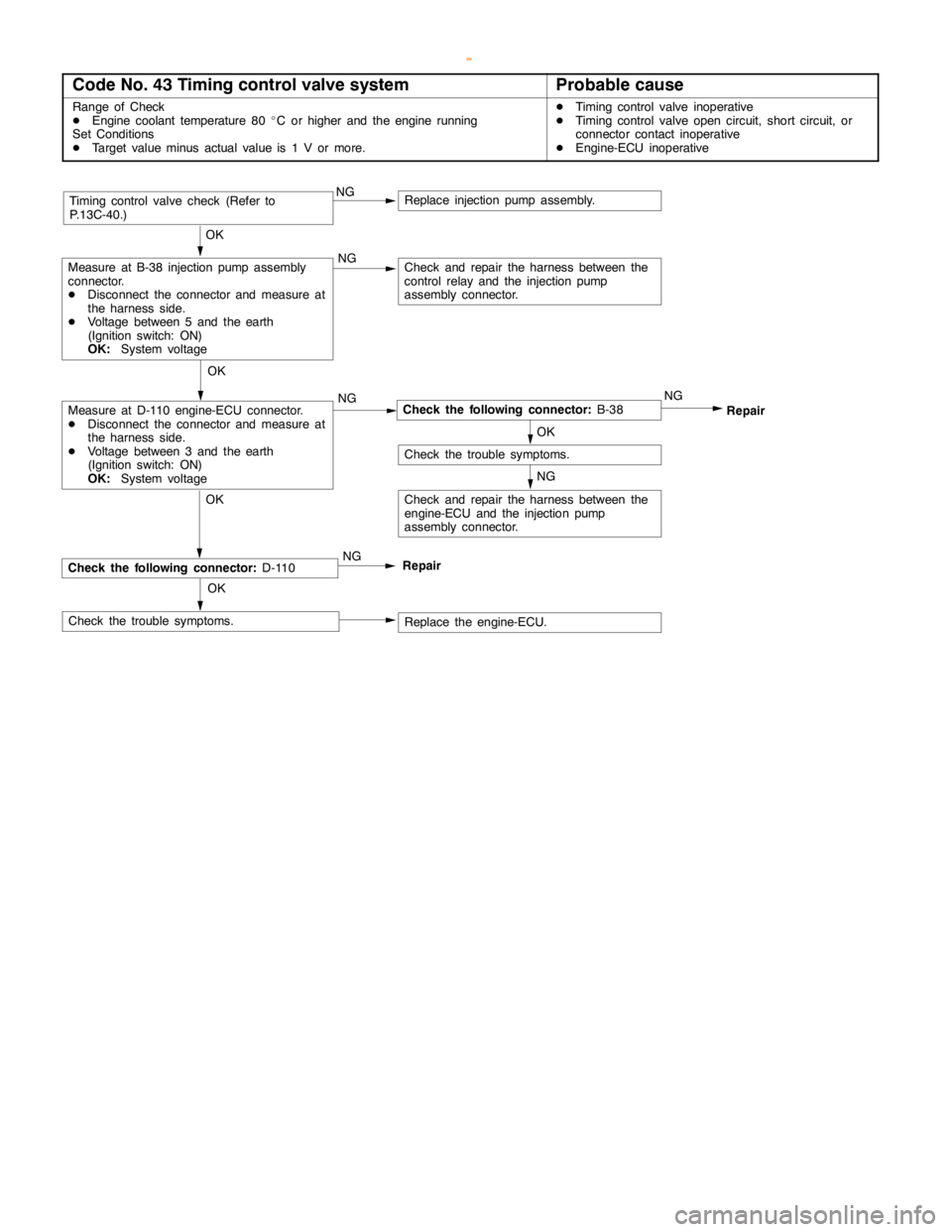
DIESEL FUEL <4M4> -Troubleshooting13C-20
Code No. 43 Timing control valve systemProbable cause
Range of Check
DEngine coolant temperature 80_C or higher and the engine running
Set Conditions
DTarget value minus actual value is 1 V or more.DTiming controlvalve inoperative
DTiming controlvalveopencircuit, short circuit, or
connector contact inoperative
DEngine-ECU inoperative
OK
OK
Check and repair the harness between the
control relay and the injectionpump
assembly connector.
Timing controlvalve check (Refer to
P.13C-40.)
Replace the engine-ECU. OK
RepairCheck the following connector:
D-110
Check the trouble symptoms.NG NG NG
Check the following connector:
B-38NG
Repair
OK
Check the trouble symptoms.
NG
NGMeasure at D-110 engine-ECU connector.
DDisconnect the connector and measure at
the harness side.
DVoltage between 3 and the earth
(Ignition switch: ON)
OK:
System voltageOK
Measure at B-38 injectionpumpassembly
connector.
DDisconnect the connector and measure at
the harness side.
DVoltage between 5 and the earth
(Ignition switch: ON)
OK:
System voltage
Replace injection pumpassembly.
Check and repair the harness between the
engine-ECU and the injection pump
assembly connector.
www.WorkshopManuals.co.uk
Purchased from www.WorkshopManuals.co.uk