lock MITSUBISHI MONTERO 2000 Service Workshop Manual
[x] Cancel search | Manufacturer: MITSUBISHI, Model Year: 2000, Model line: MONTERO, Model: MITSUBISHI MONTERO 2000Pages: 1839, PDF Size: 29.19 MB
Page 1310 of 1839

37A-1
STEERING
CONTENTS
GENERAL INFORMATION 2..................
SERVICE SPECIFICATIONS 5.................
LUBRICANTS 5..............................
SEALANT AND ADHESIVE 5.................
SPECIAL TOOLS 6..........................
ON-VEHICLE SERVICE 8.....................
Steering Wheel Free Play Check 8..............
Steering Angle Check 8........................
Tie Rod End Ball Joint Starting Torque Check 8..
Stationary Steering Effort Check 9...............
Steering Wheel Returnability Check 9............
Oil Pump Belt Tension Check <6G7,4D5> 9......Power Steering Fluid Level Check 10............
Power Steering Fluid Replacement 10...........
Power Steering System Bleeding 10.............
Oil Pump Pressure Test 11.....................
Power Steering Oil Pressure Switch Check
<6G7,4M4> 12.................................
Ball Joint Dust Cover Check 12.................
STEERING WHEEL AND SHAFT* 13.........
POWER STEERING GEAR BOX AND
LINKAGE 16................................
POWER STEERING OIL PUMP 30...........
POWER STEERING OIL HOSES 35..........
WARNINGS REGARDING SERVICING OF SUPPLEMENTAL RESTRAINT SYSTEM (SRS) EQUIPPED VEHICLES
WARNING!
(1) Improper service or maintenance of any component of the SRS, or any SRS-related component, can lead to personal
injury or death to service personnel (from inadvertent firing of the air bag) or to the driver and passenger (from rendering
the SRS inoperative).
(2) Service or maintenance of any SRS component or SRS-related component must be performed only at an authorized
MITSUBISHI dealer.
(3) MITSUBISHI dealer personnel must thoroughly review this manual, and especially its GROUP 52B - Supplemental
Restraint System (SRS) before beginning any service or maintenance of any component of the SRS or any SRS-related
component.
NOTE
The SRS includes the following components: SRS-ECU, SRS warning lamp, air bag module, clock spring and interconnecting
wiring. Other SRS-related components (that mayhave to be removed/installed in connectionwith SRS service or maintenance) are
indicated in the table of contents by an asterisk(*).
www.WorkshopManuals.co.uk
Purchased from www.WorkshopManuals.co.uk
Page 1330 of 1839
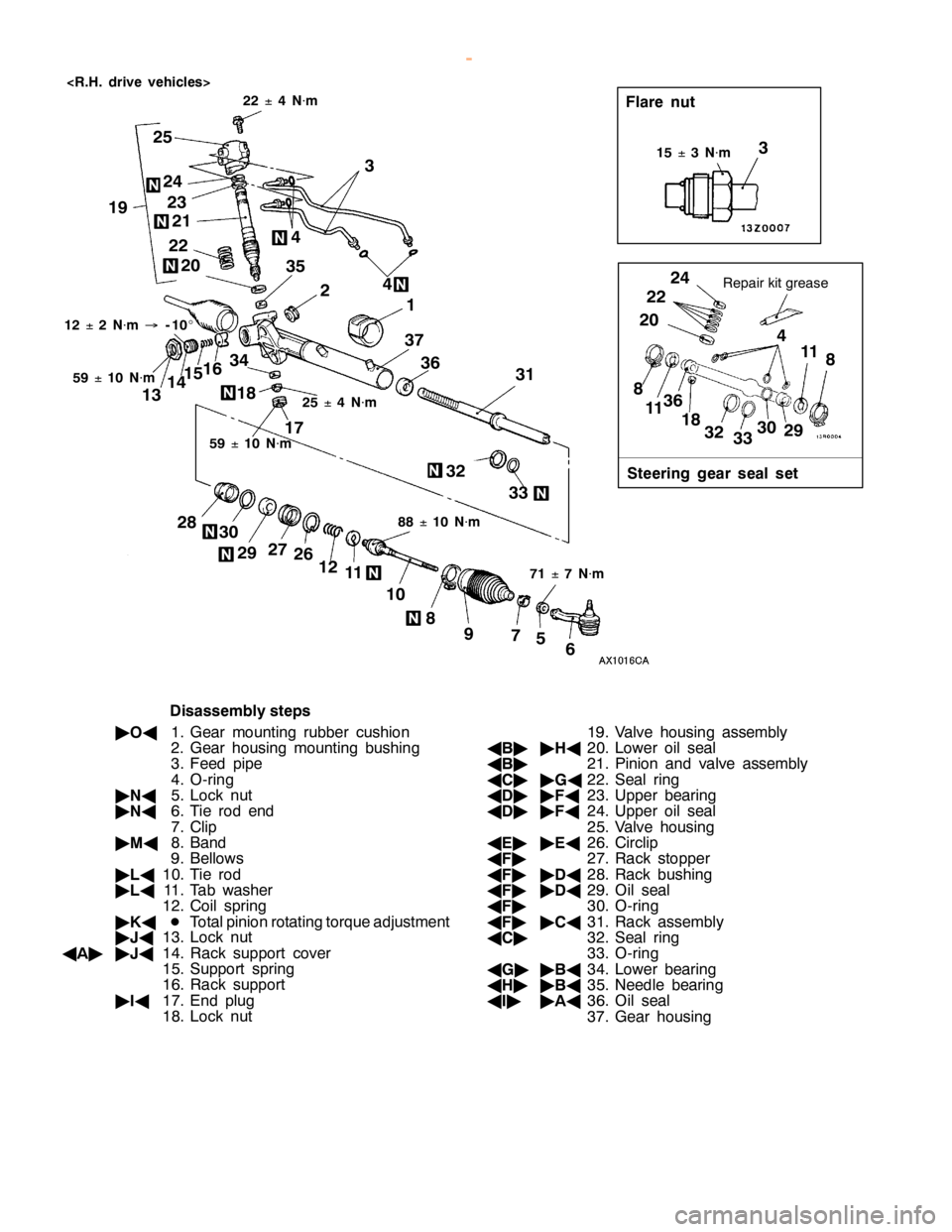
2
3 2
2 2
0
34
36
33
1
7
1
6
1 5
1 4
1 3
12 3 1
9
Ste erin g gear seal set 3
4
4 3
1 3
2 2
7 2
9 2
8 2
6
2
5 1
1 1
0 8
9
7
5
63
0 2
2 ±
4 N×
m 2
5 ±
4 N×
m
5 9 ±
10 N×
m
88 ±
10 N×
m
71 ±
7 N×
m 1
5 ±
3 N×
m
1
2
4 3
7
5 9 ±
10 N×
m 2
4
1 2 ±
2 N×
m ®
-1 0
_
<
R .H .driv e veh ic le s>
D is assem bly ste p s
" OA
1. G ear m ountin g ru bber cu sh io n
2 . G ear housin g mountin g bush in g
3 . Feed pip e
4 . O -rin g
" NA
5. Lock nut
" NA
6. Tie ro d end
7 . C lip
" MA
8. B and
9 . B ello w s
" LA
10. Tie ro d
" LA
11 . Ta b wash er
1 2. C oil sp rin g
" KA
DTo ta lp in io n ro ta tin g to rq ue adju stm ent
" JA
13. Lock nut
A A"
"
JA
14. R ack su pport co ve r
1 5. S upport sp rin g
1 6. R ack su pport
" IA
17. E nd plu g
1 8. Lock nut 1
9. Valv e housin g asse m bly
A B"
"
HA
20. Low er oil se al
A B"
21. P in io n and va lv e asse m bly
A C"
"
GA
22. S eal rin g
A D"
"
FA
23. U pper bearin g
A D"
"
FA
24. U pper oil se al
2 5. Valv e housin g
A E"
"
EA
26. C ir c lip
A F"
27. R ack sto pper
A F"
"
DA
28. R ack bush in g
A F"
"
DA
29. O il se al
A F"
30. O -rin g
A F"
"
CA
31. R ack asse m bly
A C"
32. S eal rin g
3 3. O -rin g
A G"
"
BA
34. Low er bearin g
A H"
"
BA
35. N eedle bearin g
A I"
"
AA
36. O il se al
3 7. G ear housin g
w
ww.W ork sh opM an uals .c o .u k
P urc h ased f r o m w ww.W ork sh opM an uals .c o .u k
Page 1361 of 1839
BODY -Window Glass42-9
HANDLING OF AUTO WINDOW SEALER
Keep the sealant in a cool place, not exposed to the direct
rays of the sun. Do not place any heavy article on the sealant
nor press it, otherwise it will become deformed. Avoid storing
the sealant for more than 6 months, because it will lose its
sealing effect.
BODY PINCH-WELD FLANGE SERVICING
Before servicing the body pinch-weld flange, remove old
adhesive completely. If the flange requires painting, bake
it after painting is completed.
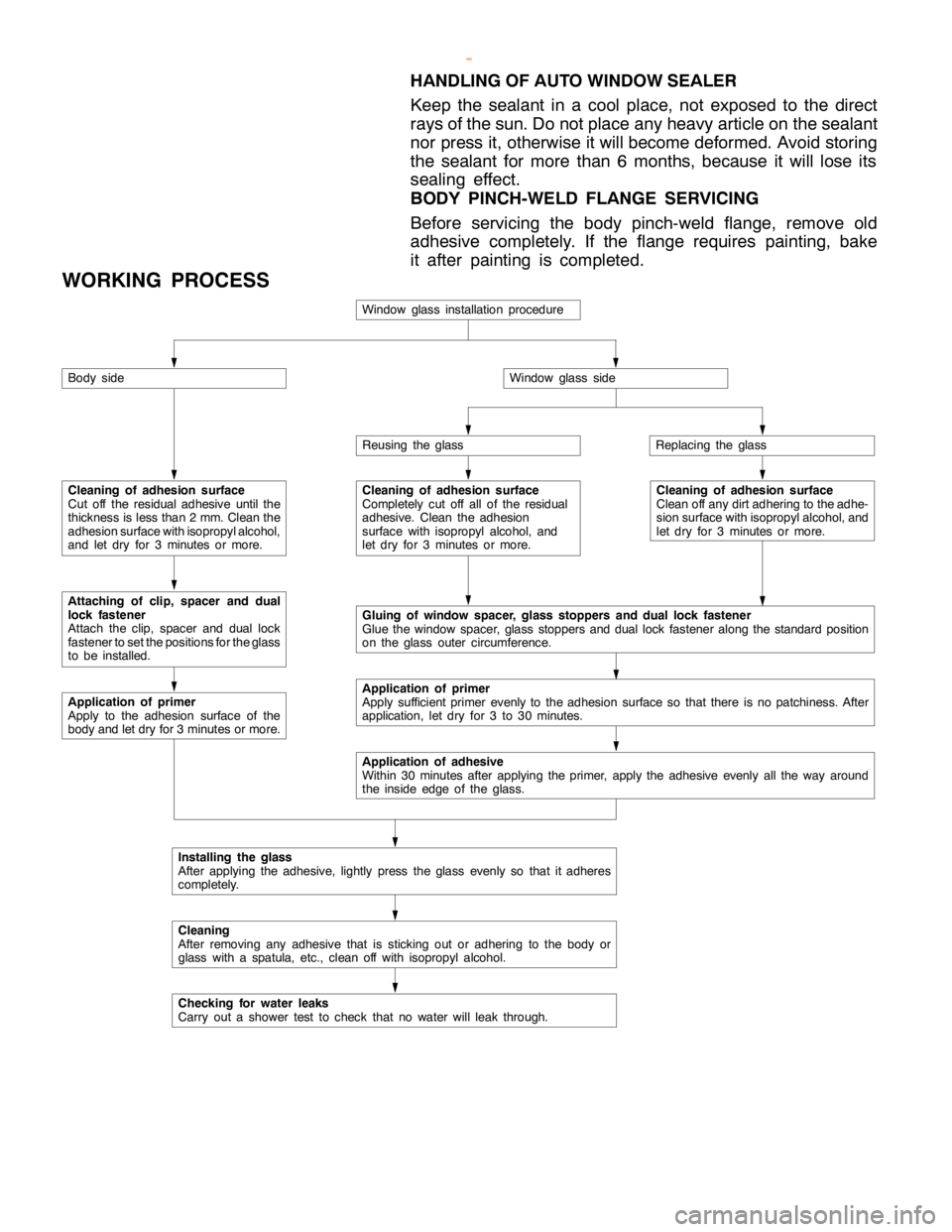
WORKING PROCESS
Window glass installation procedure
Body side
Cleaning of adhesion surface
Cut off the residual adhesive until the
thickness is less than 2 mm. Clean the
adhesion surface with isopropyl alcohol,
and let dry for 3 minutes or more.
Attaching of clip, spacer and dual
lock fastener
Attach the clip, spacer andduallock
fastener to set the positions for the glass
to be installed.
Application of primer
Apply to the adhesion surface of the
body and let dry for 3 minutes or more.
Window glass side
Reusing the glassReplacing the glass
Cleaning of adhesion surface
Completely cut off all of the residual
adhesive. Clean the adhesion
surface with isopropyl alcohol, and
let dry for 3 minutes or more.Cleaning of adhesion surface
Clean off any dirt adhering to the adhe-
sion surface with isopropyl alcohol, and
let dry for 3 minutes or more.
Gluing of window spacer, glass stoppers and dual lock fastener
Glue the window spacer, glass stoppers andduallock fasteneralong the standard position
on the glass outer circumference.
Application of primer
Apply sufficient primer evenly to the adhesion surface so that there is no patchiness. After
application, let dry for 3 to 30 minutes.
Application of adhesive
Within 30 minutes after applying the primer, apply the adhesive evenly all the way around
the inside edge of theglass.
Installing the glass
After applying the adhesive, lightly press the glass evenly so that it adheres
completely.
Cleaning
After removing any adhesive that is sticking out or adhering to the body or
glass with a spatula, etc., clean off with isopropyl alcohol.
Checking for water leaks
Carry out a shower test to check that no water will leak through.
www.WorkshopManuals.co.uk
Purchased from www.WorkshopManuals.co.uk
Page 1457 of 1839

52A-2
INTERIOR
CONTENTS
SERVICE SPECIFICATIONS 3.................
SPECIAL TOOL 3............................
INSTRUMENT PANEL
INSTRUMENT PANEL
FLOOR CONSOLE 12........................
TRIMS 13...................................
SUNVISOR HOLDER 17......................FRONT SEAT 18............................
REAR/SECOND SEAT 25....................
THIRD SEAT 35.............................
FRONT SEAT BELT 38.......................
REAR SEAT BELT
SECOND/THIRD SEAT BELT
WARNINGS REGARDING SERVICING OF SUPPLEMENTAL RESTRAINT SYSTEM (SRS) EQUIPPED VEHICLES
WARNING!
(1) Improper service or maintenance of any component of the SRS, or any SRS-related component, can lead to personal
injury or death to service personnel (from inadvertent firing of the air bag) or to the driver (from rendering the SRS
inoperative).
(2) Service or maintenance of any SRS component or SRS-related component must be performed only at an authorized
MITSUBISHI dealer.
(3) MITSUBISHI dealer personnel must thoroughly review this manual, and especially its GROUP 52B - Supplemental
Restraint System (SRS) before beginning any service or maintenance of any component of the SRS or any SRS-related
component.
NOTE
The SRS includes the following components: front impact sensors, SRS-ECU, SRS warning lamp, air bag module, clock spring and
interconnecting wiring. Other SRS-related components (that mayhave to be removed/installed in connectionwith SRS service or
maintenance) are indicated in the table of contents by an asterisk(*).
www.WorkshopManuals.co.uk
Purchased from www.WorkshopManuals.co.uk
Page 1501 of 1839

52B-1
SUPPLEMENTAL
RESTRAINT
SYSTEM (SRS)
CONTENTS
GENERAL INFORMATION 2..................
SRS SERVICE PRECAUTIONS 3..............
SPECIAL TOOLS 5..........................
TEST EQUIPMENT 6.........................
TROUBLESHOOTING 7.......................
SRS MAINTENANCE 19.....................
POST-COLLISION DIAGNOSIS 23............
INDIVIDUAL COMPONENT SERVICE 26......
WARNING/CAUTION LABELS 27.............FRONT IMPACT SENSORS 28...............
SRS AIR BAG CONTROL UNIT
(SRS-ECU) 30...............................
AIR BAG MODULES AND CLOCK
SPRING 32.................................
SIDE IMPACT SENSOR 41..................
AIR BAG MODULE DISPOSAL
PROCEDURES 43...........................
Undeployed Air Bag Module Disposal 43.........
Deployed Air Bag Module Disposal
Procedures 52.................................
CAUTION
DCarefully read and observe the information in the SERVICE PRECAUTIONS (P.52B-3.) prior to any service.
DFor information concerning troubleshooting or maintenance, always observe the procedures in the Troubleshooting
(P.52B-7.) section.
DIf any SRS components are removed or replaced in connection with any service procedures, be sure to follow the
procedures in the INDIVIDUAL COMPONENT SERVICE section (P.52B-26.) for the components involved.
DIf you have any questions about theSRS, please contact your local distributor.
www.WorkshopManuals.co.uk
Purchased from www.WorkshopManuals.co.uk
Page 1510 of 1839

SRS -Troubleshooting52B-10
Code No.21, 22, 61, 62 Driver’s side air bag module (squib)
systemProbable cause
These diagnosis codes are output if there is an abnormal resistance between the
input terminals of the driver’s side air bagmodule(squib) inside the SRS-ECU.
The trouble causes for each diagnosis code No. are as follow.
However, as for code Nos.21 and 22, if the vehicle’s condition return to normal,
SRS warning lampwill go out. (Diagnosis code will remain stored)DMalfunction of clock spring
DPartially open asclock spring is not in neutral
position
DMalfunction of harness or connector
DMalfunction of driver’s air bagmodule(squib)
DMalfunction of SRS-ECU
Table 3
Code No.Trouble Symptom
21D
Short circuit in driver’s air bag module (squib) or harness short
D
Short circuit in clock spring
D
Poor connector contact*
22D
Open circuit in driver’s air bag module (squib) or open harness
D
Open circuit in clock spring
D
Disconnected driver’s air bag module (squib) connector
D
Partially open as clock spring is not in neutral position
D
Poor connector contact
61Short circuit in driver’s air bag module (squib) harness leading to the power supply
62Short circuit in driver’s air bag module (squib) harness leading to the earth
NOTE
*: The shorting bars, which short positive (+) and negative ( - ) wires to prevent the air bags from accidental
deployment during the disconnection of the connector, are set in the squib circuit connectors. In
a defective connector, the short-bar may be still working even after the connection of the connecter.
www.WorkshopManuals.co.uk
Purchased from www.WorkshopManuals.co.uk
Page 1513 of 1839
SRS -Troubleshooting52B-13
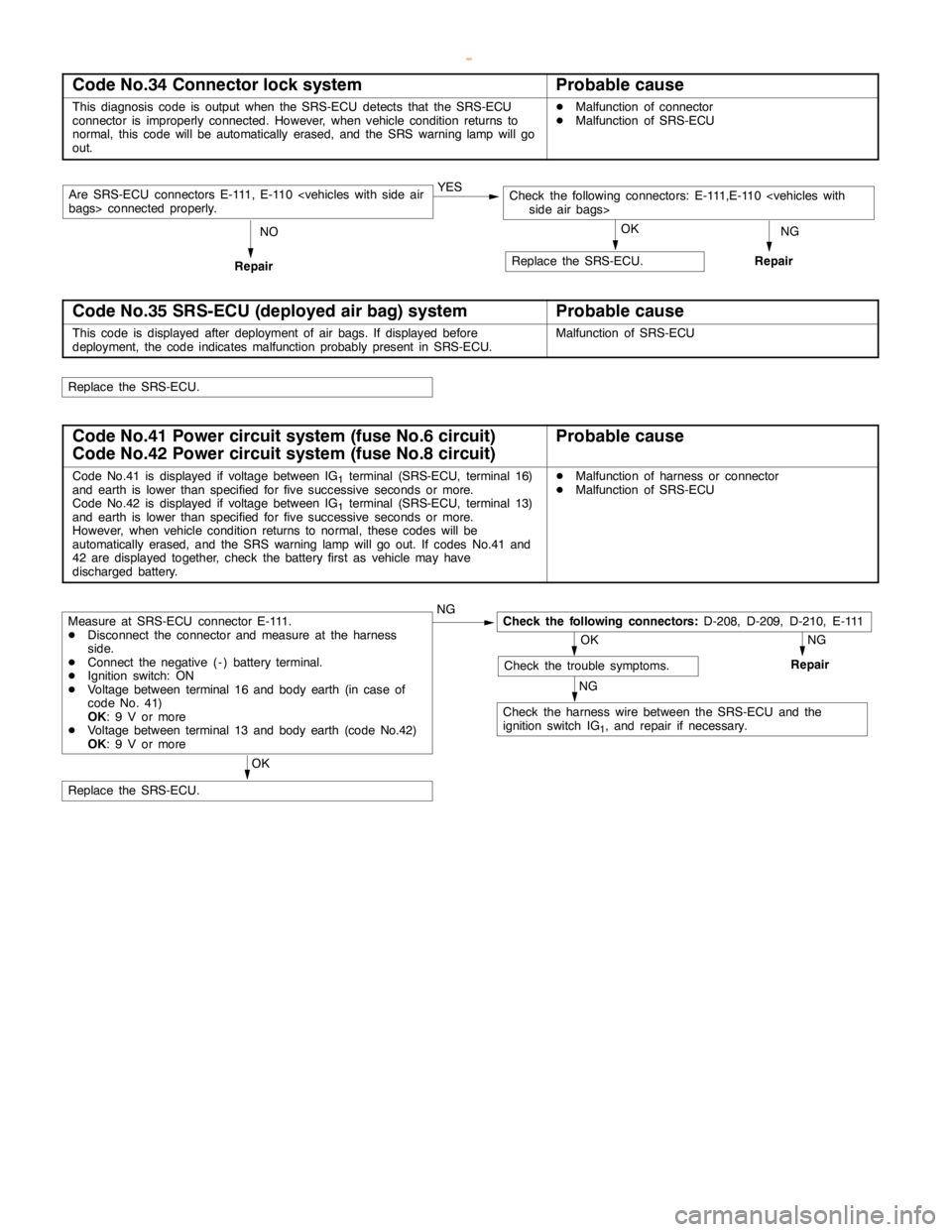
Code No.34 Connector lock systemProbable cause
This diagnosis code is output when the SRS-ECU detects that the SRS-ECU
connector is improperly connected. However, when vehicle condition returns to
normal, this code will be automatically erased, and the SRS warninglampwill go
out.DMalfunction of connector
DMalfunction of SRS-ECU
NG YES
Are SRS-ECU connectors E-111, E-110
Repair
Replace the SRS-ECU.
RepairNOOK
Code No.35 SRS-ECU (deployed air bag) systemProbable cause
This code is displayed after deployment of air bags. If displayed before
deployment, the code indicates malfunction probably present in SRS-ECU.Malfunction of SRS-ECU
Replace the SRS-ECU.
Code No.41 Power circuit system (fuse No.6 circuit)
Code No.42 Power circuit system (fuse No.8 circuit)Probable cause
Code No.41 is displayed if voltage between IG1terminal (SRS-ECU, terminal 16)
and earth is lower than specified for fivesuccessive seconds ormore.
Code No.42 is displayed if voltage between IG
1terminal (SRS-ECU, terminal 13)
and earth is lower than specified for fivesuccessive seconds ormore.
However, when vehicle condition returns to normal, these codes will be
automatically erased, and the SRS warning lampwill go out. If codes No.41 and
42 are displayed together, check the battery first as vehicle may have
discharged battery.
DMalfunction of harness or connector
DMalfunction of SRS-ECU
NGOK
NG NG
OK
Replace the SRS-ECU.
Measure at SRS-ECU connector E-111.
DDisconnect the connector and measure at the harness
side.
DConnect the negative ( - ) battery terminal.
DIgnition switch: ON
DVoltage between terminal 16 and body earth (in case of
code No. 41)
OK: 9 V or more
DVoltage between terminal 13 and body earth (code No.42)
OK: 9 V or moreCheck the following connectors:D-208, D-209, D-210, E-111
Check the trouble symptoms.Repair
Check the harness wire between the SRS-ECU and the
ignition switch IG
1, and repair if necessary.
www.WorkshopManuals.co.uk
Purchased from www.WorkshopManuals.co.uk
Page 1523 of 1839

SRS -Post-collision Diagnosis52B-23
POST-COLLISION DIAGNOSIS
Whether or not the air bags have deployed, check and service
the vehicle after collision as follows:
SRS-ECU MEMORY CHECK
1. Connect the MUT-
IIto the diagnosis connector. (Refer
to GROUP 00 – How to Use Troubleshooting/Inspection
Service Points.)
Caution
Refer to that the ignition switch is LOCK(OFF) when
connecting or disconnecting MUT-II
.
2. Read (and write down) all displayed diagnosis codes.
(Refer to P.52B-7.)
NOTE
If battery power supply has been shut down by the
collision, the MUT-
IIcannot communicate with the
SRS-ECU. Check and, repair if necessary, the instrument
panel wiring harness before the next job.
3. Use the the MUT-
IIto read the data list (how long trouble(s)
have continued and how often memory have been
erased).
Data list
NoService Data ItemApplicability
92Number indication how often the memory is cleared.Maximum time to be stored: 250
93How long problem have lasted (How long it takes
from the occurrence of the problem till the first air bag
squib igniting signal)Maximum time to be stored: 9999 minutes
(approximately 7 days)
94How long problem(s) have lasted (How long it takes
from the first air bag squib igniting signal till now.)
4. Erase the diagnosis codes and after waiting 5 seconds
or more read (and write down) all displayed diagnosis
codes. (Refer to P.52B-7.)
REPAIR PROCEDURE
DEPLOYED DRIVER’S AND FRONT PASSENGER’S AIR
BAGS
1. Replace the following parts with new ones.
DSRS-ECU (Refer to P.52B-30.)
DDriver’s air bag module (Refer to P.52B-32.)
DFront passenger’s air bag module (Refer to P.52B-32.)
2. Check the following parts and replace if malfunction is
found:
DClock spring (Refer to P.52B-32.)
DSteering wheel, steering column and intermediate
joint
(1) Check the wiring harness (built into steering
wheel) and connectors for damage, and terminals
for deformation.
(2) Check the driver’s air bag module for proper
installation to the steering wheel.
www.WorkshopManuals.co.uk
Purchased from www.WorkshopManuals.co.uk
Page 1532 of 1839

SRS -Air Bag Modules and Clock Spring52B-32
AIR BAG MODULES AND CLOCK SPRING
Caution
1. Disconnect the negative (–) battery terminal
and wait for 60 seconds or more before
starting work. Also, the disconnected
battery terminal should be insulated with
tape. (Refer to P.52B-4.)
2. Never attempt to disassemble or repair the
air bag modules and clock spring.
If faulty, just replace with new one(s).
3. Do not drop the air bag modules or clock
spring or allow contact with water, grease
or oil.
Replace if a dent, crack, deformation or rust
are present.
4. Store the air bag modules on a flat surface
with the deployment surface facing up.
Do not place anything on top of them.5. Do not store the air bag modules in a place
more than 93_
C.
6. When the driver’s and front passenger’s air
bags have been deployed, replace the
driver’s and passenger’s air bag modules
with new ones.
7. Put on gloves and safety glasses when
handling deployed air bags.
8. When discarding the undeployed air bag
module(s), be sure to deploy the air bag(s)
in advance as specified in the service
procedure.
(Refer to to P.52B-43.)
www.WorkshopManuals.co.uk
Purchased from www.WorkshopManuals.co.uk
Page 1540 of 1839

SRS -Air Bag Modules and Clock Spring52B-40
Caution
Never measure circuit resistance in the side air bag
modules (squib) even with the specified tester.
Measuring the circuit resistance with a tester causes
accidental air bag deployment due to current that
flows or static, resulting in serious personal injury.
1. Check the side air bag module deployment section
for dents and deformation.
2. Check the harness and connector for damage and
the terminals for deformation.
www.WorkshopManuals.co.uk
Purchased from www.WorkshopManuals.co.uk