lock MITSUBISHI MONTERO 2000 Service Owner's Manual
[x] Cancel search | Manufacturer: MITSUBISHI, Model Year: 2000, Model line: MONTERO, Model: MITSUBISHI MONTERO 2000Pages: 1839, PDF Size: 29.19 MB
Page 735 of 1839

INTAKE AND EXHAUST -General Information/Service Specifications/Sealant15-3
At starting and driving at low speed, the duty control
value of the variable geometry solenoid valve is
increased to apply the vacuum pressure of the
vacuum pump to the variable geometry actuator.
Applying the vacuum pressure to the variable
geometry actuator pulls the actuator rod so that
it can move towards the direction of closing the
variable nozzle of the variable geometry
turbocharger. As closing the nozzle reduces the
exhaust gas mass, the speed of exhaust gas flow
will be increased and efficiency will be improved.
Since the characteristic of boost pressure becomes
a low speed type, boost pressure will suddenly
rise from low speed.
At driving at high speed, the duty control value
of the variable geometry solenoid valve is
decreased to reduce the vacuum pressure from
the vacuum pump so that the actuator rod can
return to the deactivated status and move towards
the direction of opening the nozzle of the variable
geometry turbocharger.Opening the nozzle allows the characteristic of
boost pressure to become a high speed type so
that the appropriate boost pressure can be
maintained.
Therefore, boost pressure can be controlled by
appropriate duty control of the variable geometry
solenoid valve. The engine-ECU calculates the
correct boost pressure based on the engine speed
and fuel injection amount. Furthermore, the duty
control of the variable geometry solenoid valve is
given feedback of the signals from the variable
geometry control pressure sensor and the boost
pressure sensor so that the variable nozzle opening
angle of the variable geometry turbocharger can
be quickly adjusted to obtain the desired boost
pressure.
SERVICE SPECIFICATIONS
ItemsStandard value
Variable geometry actuator activation vacuum
(Approximately 1 mm stroke) kPaApproximately 10.5 - 12.5
Variable geometry solenoid valve coil resistance
(at 20°C)Ω29 - 35
SEALANT
ItemSpecified sealantRemarks
Thread of the intake manifold mounting
bolts3M Stud Locking No.4170 or equivalentAnaerobic sealant
www.WorkshopManuals.co.uk
Purchased from www.WorkshopManuals.co.uk
Page 821 of 1839
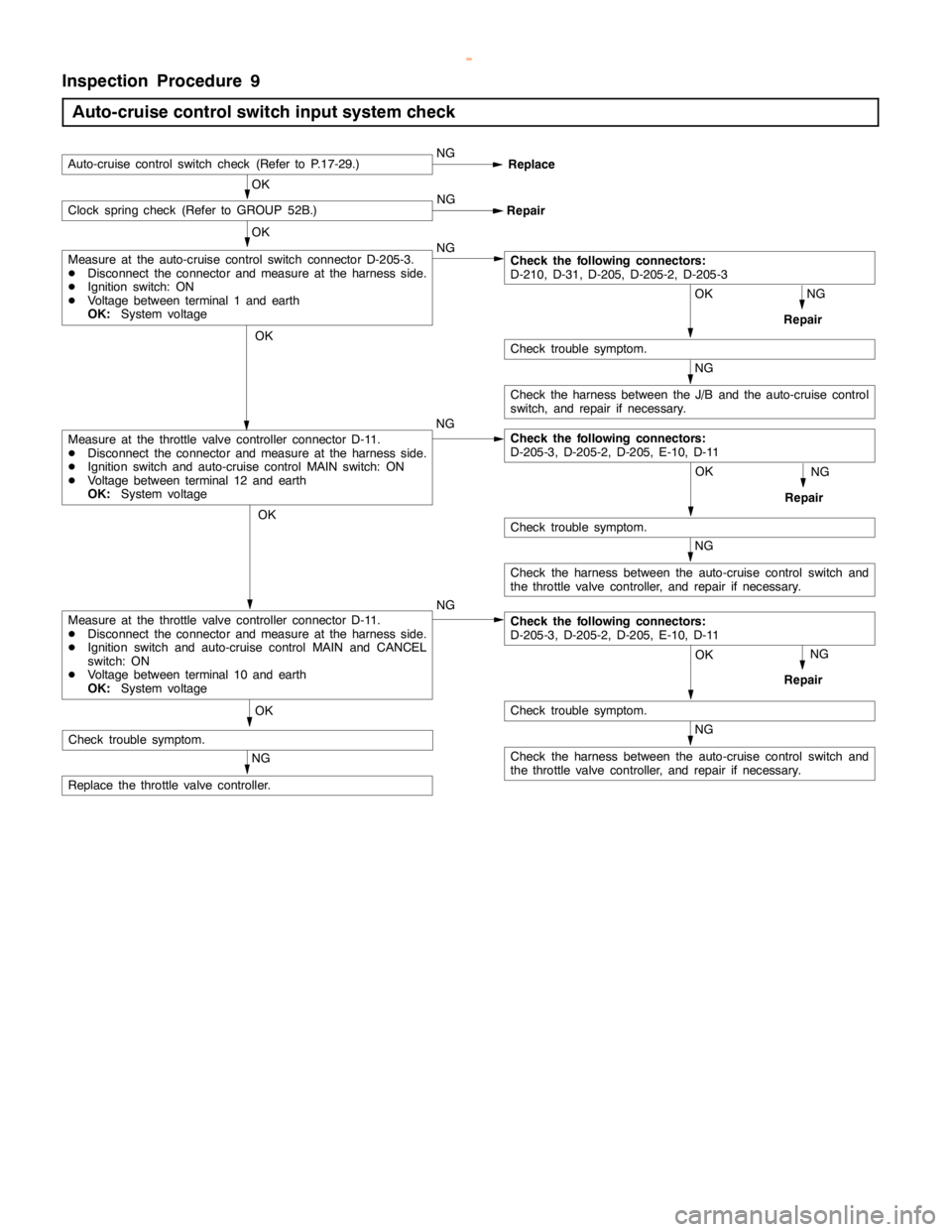
ENGINE AND EMISSION CONTROL -Auto-cruise Control System17-19
Inspection Procedure 9
Auto-cruise control switch input system check
NG
Check the harness between the auto-cruise control switch and
the throttle valve controller, and repair if necessary.
OK
NG
Repair
OK
Check trouble symptom. NG
OK
Auto-cruise control switch check (Refer to P.17-29.)NG
Replace
NG OKClock spring check (Refer to GROUP 52B.)
Repair
OK
NG
Repair
NG
OK
Check trouble symptom.
NG
Check the harness between the J/B and the auto-cruise control
switch, and repair if necessary.
Check the following connectors:
D-210, D-31, D-205, D-205-2, D-205-3
OK
Check trouble symptom.
NG
Repair
NG
Replace the throttle valve controller.NG
Measure at the throttle valve controller connector D-11.
DDisconnect the connector and measure at the harness side.
DIgnition switch and auto-cruise control MAIN switch: ON
DVoltage between terminal 12 and earth
OK:System voltage
Measure at the auto-cruise control switch connector D-205-3.
DDisconnect the connector and measure at the harness side.
DIgnition switch: ON
DVoltage between terminal 1 and earth
OK:System voltage
NG
Check the harness between the auto-cruise control switch and
the throttle valve controller, and repair if necessary.
OK
Check trouble symptom.
Check the following connectors:
D-205-3, D-205-2, D-205, E-10, D-11
Measure at the throttle valve controller connector D-11.
DDisconnect the connector and measure at the harness side.
DIgnition switch and auto-cruise control MAIN and CANCEL
switch: ON
DVoltage between terminal 10 and earth
OK:System voltageCheck the following connectors:
D-205-3, D-205-2, D-205, E-10, D-11
www.WorkshopManuals.co.uk
Purchased from www.WorkshopManuals.co.uk
Page 826 of 1839
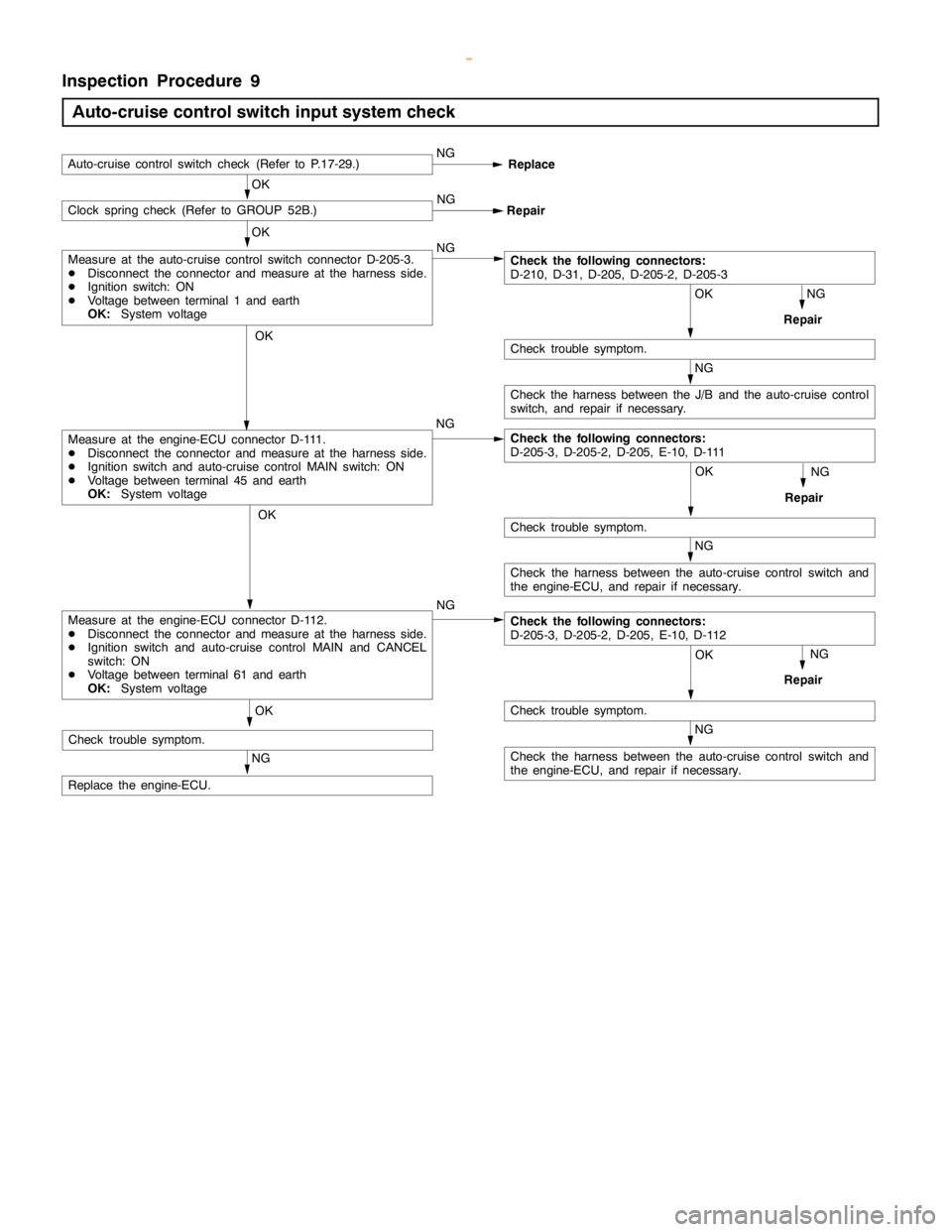
ENGINE AND EMISSION CONTROL -Auto-cruise Control System17-24
Inspection Procedure 9
Auto-cruise control switch input system check
NG
Check the harness between the auto-cruise control switch and
the engine-ECU, and repair if necessary.
OK
NG
Repair
OK
Check trouble symptom. NG
OK
Auto-cruise control switch check (Refer to P.17-29.)NG
Replace
NG OKClock spring check (Refer to GROUP 52B.)
Repair
OK
NG
Repair
NG
OK
Check trouble symptom.
NG
Check the harness between the J/B and the auto-cruise control
switch, and repair if necessary.
Check the following connectors:
D-210, D-31, D-205, D-205-2, D-205-3
OK
Check trouble symptom.
NG
Repair
NG
Replace the engine-ECU.NG
Measure at the engine-ECU connector D-111.
DDisconnect the connector and measure at the harness side.
DIgnition switch and auto-cruise control MAIN switch: ON
DVoltage between terminal 45 and earth
OK:System voltage
Measure at the auto-cruise control switch connector D-205-3.
DDisconnect the connector and measure at the harness side.
DIgnition switch: ON
DVoltage between terminal 1 and earth
OK:System voltage
NG
Check the harness between the auto-cruise control switch and
the engine-ECU, and repair if necessary.
OK
Check trouble symptom.
Check the following connectors:
D-205-3, D-205-2, D-205, E-10, D-111
Measure at the engine-ECU connector D-112.
DDisconnect the connector and measure at the harness side.
DIgnition switch and auto-cruise control MAIN and CANCEL
switch: ON
DVoltage between terminal 61 and earth
OK:System voltageCheck the following connectors:
D-205-3, D-205-2, D-205, E-10, D-112
www.WorkshopManuals.co.uk
Purchased from www.WorkshopManuals.co.uk
Page 847 of 1839

N
am e S
pecif ic a tio n E
xh aust em is sio n
c o ntr o l syste m E
xh aust g as re cir c u la tio n syste m
D EG R va lv e
D EG R so le noid va lv e No.1
D EG R so le noid va lv e No.2 E
le ctr o nic a lly -c o ntr o lle d EG R syste m
S in gle ty p e
D uty cycle so le noid va lv e
O N-O FF so le noid va lv e S
ta ndard va lu e E
G R so le noid va lv e Nos. 1 and 2re sis ta nce (a t 20_C ) W L
eve r posit io n se nso r outp utvo lt a ge V I
d le posit io n 0
.8 -1.0 F
ully open 3
.7 -4.9 E
ngin e sp eed se nso r re sis ta nce kW E
ngin e co ola ntte m pera tu re se nso r re sis ta nce A
t0_C 7
.7 -9.5 (
B uilt - in engin e co ola nt te m pera tu re gauge
u nit ) kW 2
.9 -3.6 A
t40_C 1
.3 -1.7 A
t80_C 0
.2 6 -0.3 5 S
pecif ie d se ala nt R
em ark E
ngin e co ola ntte m pera tu re gauge unit
t h re aded portio n 3
M Nut Lockin g Part N o. 4171 or equiv a le nt D
ry in g se ala nt N
um ber N
am e U
se M
D998464 T
e st harn ess
( 4 P, sq uare ) I
n sp ectio n of le ve r posit io n se nso r
Page 902 of 1839

Page 921 of 1839
Page 923 of 1839
Page 989 of 1839

AUTOMATIC TRANSMISSION -Troubleshooting
Item
No.Normal condition Inspection conditions Check item
21Ignition switchIgnition switch: ONON
Ignition switch: OFFOFF
22Transmission identi-
ficationVehicles with A/TA/T
23Stop lamp switchIgnition switch: ONBrake pedal: DepressedON
Engine: StoppedBrake pedal: ReleasedOFF
24Transfer leverTransfer shift lever position: 2HON
switch 2HTransfer shift lever position: Other than the aboveOFF
25Transfer leverTransfer shift lever position: 4HON
switch 4HTransfer shift lever position: Other than the aboveOFF
26Transfer leverTransfer shift lever position: 4HLcON
switch 4HLcTransfer shift lever position: Other than the aboveOFF
27Transfer leverTransfer shift lever position: 4LLcON
switch 4LLcTransfer shift lever position: Other than the aboveOFF
28Engine identificationPetrol vehiclesPETROL
Diesel vehiclesDIESEL
30Freewheel engageDuring 2WDON
solenoid valveDuring 4WDOFF
31Inhibitor switch NSelector lever position: NON
Selector lever position: Other than the aboveOFF
32Inhibitor switch PSelector lever position: PON
Selector lever position: Other than the aboveOFF
332WD switchDriving conditions: 2WD (2H)ON
Driving conditions: Other than the aboveOFF
342WD/4WD switchDriving conditions: 2WD (2H), 4WD (4H)ON
Driving conditions: Other than the aboveOFF
354H switchDriving conditions: 4WD (4H), 4WD (4HLc)ON
Driving conditions: Other than the aboveOFF
36Center differentialDriving conditions: 4WD (4HLc), 4WD (4LLc)ON
lock switchDriving conditions: Other than the aboveOFF
374LLc switchDriving conditions: 4WD (4LLc)ON
Driving conditions: Other than the aboveOFF
38Freewheel engageDuring 2WDOFF
switchDuring 4WDON
www.WorkshopManuals.co.uk
Purchased from www.WorkshopManuals.co.uk
Page 992 of 1839

AUTOMATIC TRANSMISSION -Troubleshooting
Ter-
minal
No.Standard value Inspection conditions Check item
40Center differential lock
lampDuring 4WD (4HLc or 4LLc)System voltage
41Solenoid valve A, BTransfer shift lever position: 2H1V
Transfer shift lever position: Other than 2HSystem voltage
42EarthAt all times0V
432WD switchTransfer shift lever position: 2H0V
Transfer shift lever position: Other than 2H10.5 V
442WD/4WD switchTransfer shift lever position: 2H or 4H0V
Transfer shift lever position: 4HLc or 4LLc10.5 V
454H switchTransfer shift lever position: 4H or 4HLc0V
Transfer shift lever position: 2H or 4LLc10.5 V
46Center differential lockTransfer shift lever position: 4HLc or 4LLc0V
switchTransfer shift lever position: 2H or 4H10.5 V
474HLc switchTransfer shift lever position: 4LLc0V
Transfer shift lever position: Other than 4LLc10.5 V
50Freewheel engage switchTransfer position: 2WD10.5 V
Transfer position: 4WD0V
www.WorkshopManuals.co.uk
Purchased from www.WorkshopManuals.co.uk
Page 993 of 1839

AUTOMATIC TRANSMISSION -
Troubleshooting
TROUBLESHOOTING
DIAGNOSIS FUNCTION
Input signal check procedure
Connect the MUT-II
or a voltage meter to the diagnosis connector, and check the inhibitor switch (reverse)
input signal.
(Refer to GROUP 00 - Guide to Troubleshooting and Inspection Procedures.)
INSPECTION CHART CLASSIFIED BY TROUBLE SYMPTOMS
Trouble SymptomInspection
procedure
No.Reference
page
When the ignition switch is at a position other than the LOCK position, the selector lever
can be moved from the P to the R position even though the brake pedal is not depressed.123-92
When the ignition switch is at a position other than the LOCK position, the selector lever
cannot be moved from the P to the R position even though the brake pedal is being
depressed.223-92
The ignition switch is at the LOCK position, but the selector lever can be moved from the
P to the R position when the brake pedal is depressed.323-93
The selector lever cannot be easily moved from the P to the R position.423-93
The selector lever cannot be moved from the R to the P position.523-93
The ignition key cannot be turned to the LOCK position when the selector lever is at the P
position.623-93
The ignition key can be turned to the LOCK position even when the selector lever is at a
position other than the P position.723-93
INSPECTION PROCEDURES FOR TROUBLE SYMPTOM
Inspection procedure 1
When the ignition switch is at a position other than the
LOCK position, the selector lever can be moved from the
P to the R position even though the brake pedal is not
depressed.
Probable cause
The cause is probably a malfunction of the selector lever assembly lock cam or
of the shift lock cable unit.DMalfunction of lock cam
DMalfunction of shift lock cable unit
Check by referring to the probable causes.
Inspection procedure 2
When the ignition switch is at a position other than the
LOCK position, the selector lever cannot be moved from
the P to the R position even though the brake pedal is
being depressed.
Probable cause
The cause is probably a malfunction of the selector lever assembly, transmission
control cable, shift lock cable unit or the ignition key cylinder lock bar.DMalfunction of selector lever assembly
DMalfunction of transmission control cable
DMalfunction of shift lock cable unit
DMalfunction of lock bar
Check by referring to the probable causes.
www.WorkshopManuals.co.uk
Purchased from www.WorkshopManuals.co.uk