change time MITSUBISHI MONTERO 2000 Service Repair Manual
[x] Cancel search | Manufacturer: MITSUBISHI, Model Year: 2000, Model line: MONTERO, Model: MITSUBISHI MONTERO 2000Pages: 1839, PDF Size: 29.19 MB
Page 275 of 1839
GDI -Troubleshooting
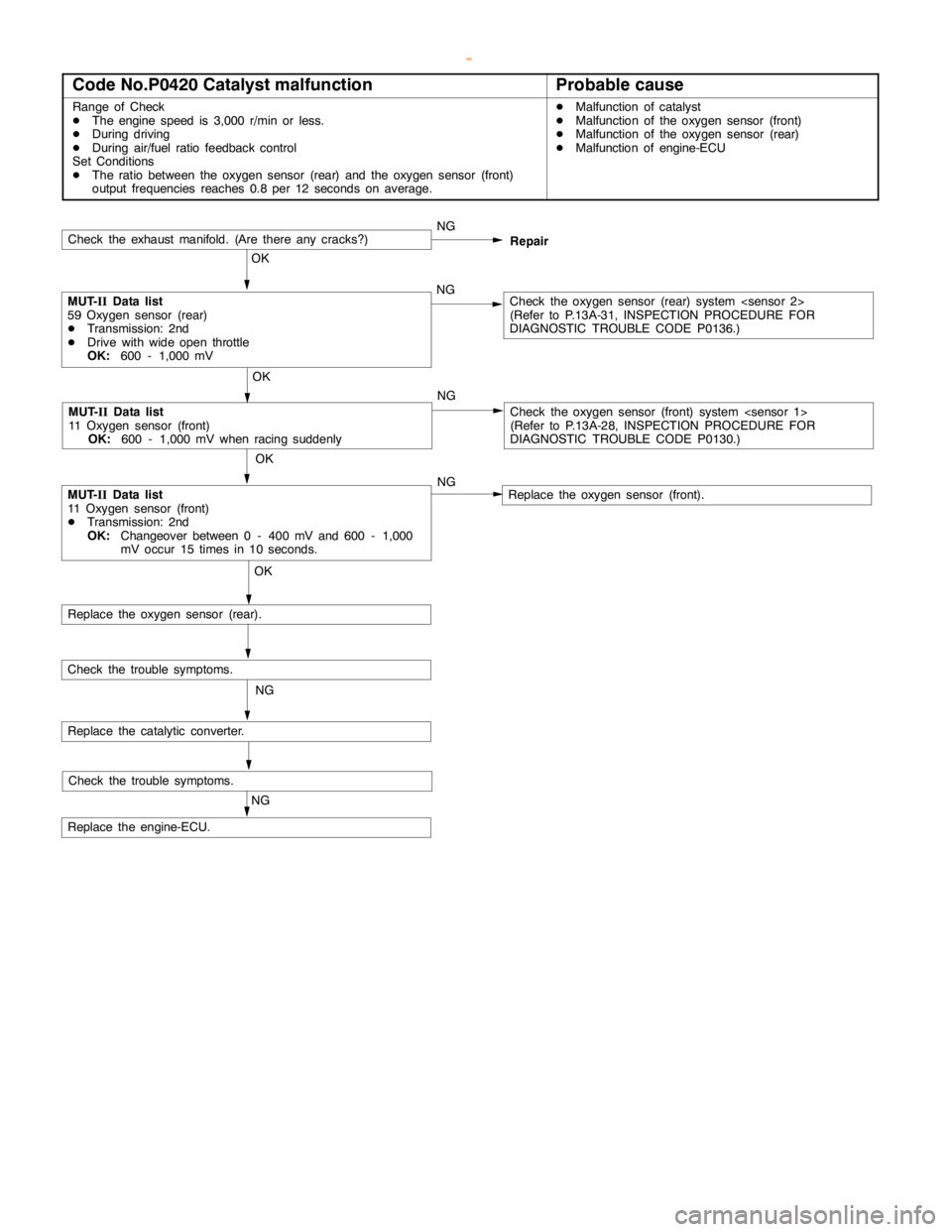
Code No.P0420 Catalyst malfunctionProbable cause
Range of Check
DThe enginespeed is 3,000 r/min or less.
DDuring driving
DDuring air/fuel ratio feedback control
Set Conditions
DThe ratio between the oxygen sensor (rear) and the oxygen sensor (front)
output frequencies reaches 0.8 per 12 seconds on average.DMalfunction of catalyst
DMalfunction of the oxygen sensor (front)
DMalfunction of the oxygen sensor (rear)
DMalfunction of engine-ECU
Check the trouble symptoms.
Check the exhaust manifold. (Are there anycracks?)NG
OK
MUT-
IIData list
59 Oxygen sensor (rear)
DTransmission: 2nd
DDrive with wideopen throttle
OK:
600 - 1,000 mVNGCheck the oxygen sensor (rear) system
(Refer to P.13A-31, INSPECTIONPROCEDURE FOR
DIAGNOSTIC TROUBLE CODE P0136.)
OK
MUT-
IIData list
11 Oxygen sensor (front)
DTransmission: 2nd
OK:
Changeover between 0 - 400 mV and 600 - 1,000
mV occur 15 times in 10 seconds.
OK
Replace the oxygen sensor (rear).
NG
Replace the catalytic converter.
Check the trouble symptoms.
NG
Replace the engine-ECU.
MUT-
IIData list
11 Oxygen sensor (front)
OK:
600 - 1,000 mV when racing suddenly
OK
NGRepair
Check the oxygen sensor (front) system
(Refer to P.13A-28, INSPECTIONPROCEDURE FOR
DIAGNOSTIC TROUBLE CODE P0130.)
Replace the oxygen sensor (front). NG
www.WorkshopManuals.co.uk
Purchased from www.WorkshopManuals.co.uk
Page 412 of 1839

Page 493 of 1839

DIESEL FUEL <4M4> -General Information13C-2
GENERAL INFORMATION
The electronically-controlled fuel injection system consists of sensors which detect the condition of the
diesel engine, an engine-ECU which controls the system based on signals from these sensors, and actuators
which operate according to control commands from the engine-ECU.
The engine-ECU carries out operations such as fuel injection rate control, fuel injection timing control
and idle up control. In addition, the engine-ECU is equipped with several self-diagnosis functions which
make troubleshooting easier in the event that a problem develops.
FUEL INJECTION RATE CONTROL
The fuel injection completion timing is controlled by means of a solenoid-type spill valve to ensure that
the optimum amount of fuel is supplied to the engine in accordance with gradual changes in the engine
running condition.
Before fuel injection starts, the solenoid-type spill valve is on (energized), so that the valve is closed.
As the plunger turns and rises, fuel is sent out under pressure, and when the fuel flow rate reaches
the target value for fuel injection, the solenoid-type spill valve turns off. When the solenoid-type spill
valve turns off, the fuel under high pressure inside the plunger is leaked out into the pump chamber
and fuel injection is completed.
FUEL INJECTION TIMING CONTROL
The position of the injection pump timer piston is controlled so that fuel injection is carried out at the
optimum timing in accordance with the engine running condition.
The timer piston position is determined by duty control of the timing control solenoid valve which is located
in the line between the high-pressure chamber and the low-pressure chamber of the timer piston.
The fuel injection timing is advanced by increasing the control duty of the timing control solenoid valve.
IDLE SPEED CONTROL
Controlling the fuel injection rate in accordance with the engine running condition maintains the idle speed
at the optimum condition.
SELF-DIAGNOSIS FUNCTION
DWhen an abnormality is detected in any of the sensors or actuators, the engine warning lamp illuminates
to warn the driver.
DWhen an abnormality is detected in any of the sensors or actuators, a diagnosis code number
corresponding to the problem which occurred is output.
DThe RAM data relating to the sensors and actuators which is stored in the engine-ECU can be read
using the MUT-II. In addition, the actuators can be force-driven under certain conditions.
OTHER CONTROL FUNCTIONS
1. Power Supply Control
When the ignition switch is turned to ON, the relay turns on and power is supplied to components
such as the timing control solenoid valve.
2. Intake Air Throttle Control
When the engine is idling after having warmed up, the throttle valve is half opened to restrict the
amount of intake air in order to reduce vibration and noise.
3. A/C Relay Control
Turns the compressor clutch of the A/C ON and OFF
4. Fan motor relay control
The radiator fan and condenser fan operating speeds are controlled in accordance with the engine
coolant temperature and the vehicle speed.
5. Glow Control
Refer to GROUP 16.
6. EGR Control
Refer to GROUP 17.
www.WorkshopManuals.co.uk
Purchased from www.WorkshopManuals.co.uk
Page 531 of 1839

DIESEL FUEL <4M4> -Troubleshooting13C-40
Terminal
No.Normal condition: Inspection conditions (engine status) Check item
36Selector switch be-
tween A/T and M/TIgnition switch: ON0-1V
37Inhibitor switchIgnition switch: ON
(Engine stops)Set the selector lever to P
or N0-1V
Set the selector lever to D,
2, L, or RSystem voltage
39Stop lamp switchDepress the brake pedalSystem voltage
40Brake switchDepress the brake pedal0-1V
46Control relayIgnition switch: ON0-1V
Ignition switch: ON®OFF (in about 8 seconds)System voltage
51Engine speed sensor
(backup)Engine: Idling1.5 - 2.5 V
55Accelerator pedal posi-
tion sensor (sub)Ignition switch: ONAccelerator pedal: Idling
position0.9 - 1.1 V
Accelerator pedal: Fully
opened position4.1 V or higher
71Ignition switch-STEngine: Cranking8 V or higher
74Control sleeve positionIgnition switch: ON (Engine stops)2.2 - 2.7 V
73sensor2.0 - 4.0 V
752.0 - 4.0 V
76Timer piston positionIgnition switch: ON (Engine stops)2.2 - 2.7 V
77sensor2.0 - 4.0 V
782.0 - 4.0 V
80Back-up power supplyIgnition switch: OFFSystem voltage
82Ignition switch-IGIgnition switch: ONSystem voltage
83Engine coolant tem-
perature sensorIgnition switch: ONEngine coolant tempera-
ture: 0_C3.4 - 4.5 V
Engine coolant tempera-
ture: 20_C2.6 - 3.6 V
Engine coolant tempera-
ture: 40_C1.8 - 2.5 V
Engine coolant tempera-
ture: 80_C0.7 - 1.1 V
84Accelerator pedal posi-
tion sensor (main)Ignition switch: ONAccelerator pedal: Idling
position0.9 - 1.1 V
Accelerator pedal: Fully
opened position4.1 V or higher
85Boost pressure sensorIgnition switch: ON (760 mmHg)1.2 - 1.6 V
86Vehicle speed sensorDIgnition switch: ON
DMove the vehicle forward slowly0V«5 V (repeat the
change)
www.WorkshopManuals.co.uk
Purchased from www.WorkshopManuals.co.uk
Page 557 of 1839

DIESEL FUEL <4M4> -General/Service Specifications/Troubleshooting13C-2
GENERAL
OUTLINE OF CHANGES
Some service procedures have been established as the following changes have been made due to the
compliance with the Emission Regulation StepIII.
DThe intake manifold cover and injection pump cover have been reshaped.
DThe throttle body assembly has been changed.
DThe EGR valve assembly has been changed.
SERVICE SPECIFICATIONS
ItemStandard value
Throttle body assembly resistanceΩat - 10 - 50_C12 - 20
at 50 - 100_C12 - 23
TROUBLESHOOTING
FAIL-SAFE, BACKUP FUNCTIONS
When abnormalities in the major sensors are detected by diagnosis functions, pre-set control logic operates
to maintain a safe driving condition for the vehicle.
Diagnosis itemControl features in malfunction
Accelerator pedal position sensorDAccelerator pedal released (idle switch ON)
Acceleration opening degree = 0 %
DAccelerator pedal applied (idle switch OFF)
Engine controlled at low speed
Acceleration opening degree = 40 %
DVoid cruise control
Idle switchDVoid idling speed control
DVoid cruise control
Engine speed sensorDEngine controlled at low speed
DVoid cruise control
Boost air temperature sensorMaintain the intake air temperature at 50_C
Vehicle speed sensorDVoid idling speed control
DVoid cruise control
DWith accelerator pedal released (when idle switch is on)
Accelerator opening angle = 0 %
DWith accelerator pedal depressed (when idle switch is off)
Accelerator opening angle = Fixed at 40 % (M/T), 28 % (A/T)
Engine coolant temperature sensorMaintain the engine coolant temperature at 80_C (engine running), 0_C
(engine stopped or just started)
Control sleeve position sensorDWith accelerator pedal released (when idle switch is on)
Engine speed = 800 r/min
DWith accelerator pedal depressed (when idle switch is off)
Engine speed = 2,000 r/min
DVoid cruise control
Timer piston position sensorDOpen control by means of engine speed
DVoid cruise control
Barometric pressure sensor (ECU built-in)Keep the barometric pressure at 101 kPa
www.WorkshopManuals.co.uk
Purchased from www.WorkshopManuals.co.uk
Page 612 of 1839

DIESEL FUEL <4D5-stepIII>-General/General Information13E-2
GENERAL
OUTLINE OF CHANGE
An electronically-controlled injection pump has been added in order to comply with Regulation STEP
III. Due to this, the following service procedures have been added.
GENERAL INFORMATION
The electronically-controlled fuel injection system consists of sensors which detect the condition of the
diesel engine, an engine-ECU which controls the system based on signals from these sensors, and actuators
which operate according to control commands from the engine-ECU.
The engine-ECU carries out operations such as fuel injection rate control, fuel injection timing control
and idle up control. In addition, the engine-ECU is equipped with several self-diagnosis functions which
make troubleshooting easier in the event that a problem develops.
FUEL INJECTION RATE CONTROL
The fuel injection completion timing is controlled by means of a solenoid-type spill valve to ensure that
the optimum amount of fuel is supplied to the engine in accordance with gradual changes in the engine
running condition.
Before fuel injection starts, the solenoid-type spill valve is on (energized), so that the valve is closed.
As the plunger turns and rises, fuel is sent out under pressure, and when the fuel flow rate reaches
the target value for fuel injection, the solenoid-type spill valve turns off. When the solenoid-type spill
valve turns off, the fuel under high pressure inside the plunger is leaked out into the pump chamber
and fuel injection is completed.
FUEL INJECTION TIMING CONTROL
The position of the injection pump timer piston is controlled so that fuel injection is carried out at the
optimum timing in accordance with the engine running condition.
The timer piston position is determined by duty control of the timing control solenoid valve which is located
in the line between the high-pressure chamber and the low-pressure chamber of the timer piston.
The fuel injection timing is advanced by increasing the control duty of the timing control solenoid valve.
IDLE SPEED CONTROL
Controlling the fuel injection rate in accordance with the engine running condition maintains the idle speed
at the optimum condition.
SELF-DIAGNOSIS FUNCTION
DWhen an abnormality is detected in any of the sensors or actuators, the engine warning lamp illuminates
to warn the driver.
DWhen an abnormality is detected in any of the sensors or actuators, a diagnosis code number
corresponding to the problem which occurred is output.
DThe RAM data relating to the sensors and actuators which is stored in the engine-ECU can be read
using the MUT-II. In addition, the actuators can be force-driven under certain conditions.
OTHER CONTROL FUNCTIONS
1. Power Supply Control
When the ignition switch is turned to ON, the relay turns on and power is supplied to components
such as the timing control solenoid valve.
2. Intake Air Throttle Control
When the engine-ECU detects an abnormality in any of the sensors or actuators, the throttle valve
is half opened to restrict the amount of intake air in order to prevent the vehicle from running away.
3. A/C Relay Control
Turns the compressor clutch of the A/C ON and OFF
4. Condenser Fan Motor Relay Control
Controls the condenser fan motor relay based on the A/C switch, engine coolant temperature and
vehicle speed input signals.
5. Glow Control
Refer to GROUP 16.
6. EGR Control
Refer to GROUP 17.
www.WorkshopManuals.co.uk
Purchased from www.WorkshopManuals.co.uk
Page 654 of 1839

DIESEL FUEL <4D5-stepIII>-Troubleshooting13E-44
ACTUATOR TEST TABLE
Item
No.Check itemDrive Con-
tentsInspection
conditionsValue to be determined
as normalCode No.
or inspec-
tion proce-
dure No.Reference
page
02Glow plug relayTurning the
relayfrom
Ignition switch:
ON
Battery charge is
energizedtotheglow
Procedure
No24
13E-39
relayfrom
OFF to ON or
fromONto
ONenergizedtotheglow
plug when the glow
plugrelayisON
No.24
fromONto
OFFplug relayisON.
03A/C compressor
relay
Turning the
relayfrom
Ignition switch:
ON
The A/C compressor
clutchmakesan
Procedure
No25
13E-39
relayrelayfrom
OFF to ON or
fromONto
ONclutchmakes an
audible sound.No.25
fromONto
OFF
11Timing control
valveTurn the
timing control
valve to ONDIgnition
switch: ON
DEngine:
Idlin
g
Makes an audible
soundCode No.
4313E-21
12Turn the
timing control
valve to OFF
Idling
DTimer piston
position
sensor:
Normal
15Glow lampTurn the glow
lamp on or offIgnition switch:
ONThe glow lamp turns
on.––
16Warning lampTurn the
warning lamp
on or offIgnition switch:
ONThe warning lamp
turns on.Procedure
No. 3, 413E-30
22Condenser fan
relayTurning the
relay from
OFF to ON or
from ON to
OFFIgnition switch:
ONThe condenser fan
rotates.Procedure
No. 1913E-36
23Throttle solenoid
valveTurn the
solenoid
valve from
OFF to ON or
from ON to
OFFDIgnition
switch: ON
DVehicle
speed:
0 km/h
DEngine
speed:
1,000 r/min
or lowerMakes an audible
soundCode No.
4113E-20
25GE actuatorTurn the GE
actuator to
ONDIgnition
switch: ON
DEngine
speed:
0 r/min orMeasure the wave
pattern between
engine-ECU connec-
tor terminals No. 1
and No. 15 using anCode No.
4813E-23
26Turn the GE
actuator to
OFF
0r/minor
lower
DControl
sleeve posi-
tion sensor:
Normal
andNo.15usingan
analyzer and check
the change in the duty
ratio.
www.WorkshopManuals.co.uk
Purchased from www.WorkshopManuals.co.uk
Page 907 of 1839

Page 1281 of 1839
ABS <4WD> -Troubleshooting35B-18
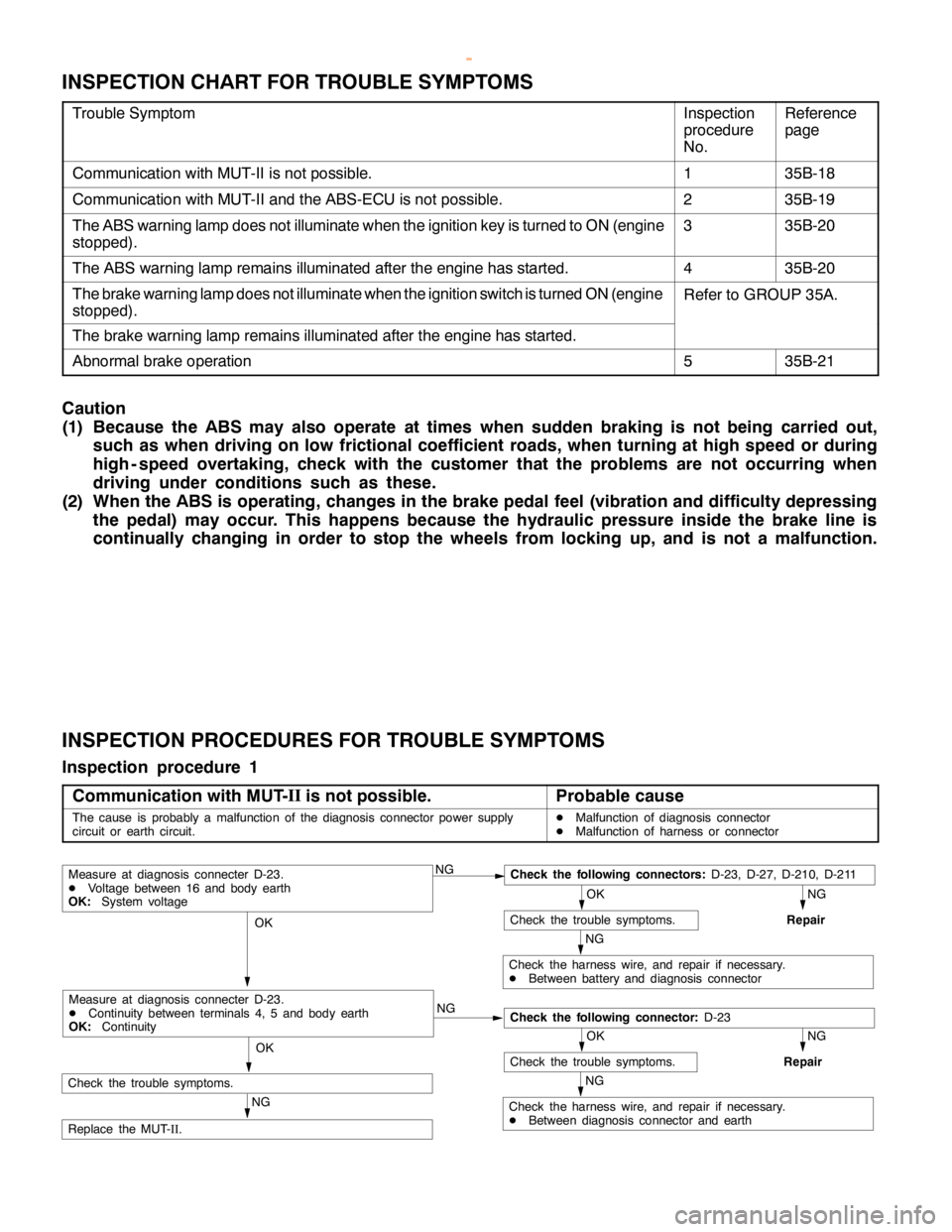
INSPECTION CHART FOR TROUBLE SYMPTOMS
Trouble SymptomInspection
procedure
No.Reference
page
Communication with MUT-II is not possible.135B-18
Communication with MUT-II and the ABS-ECU is not possible.235B-19
The ABS warning lamp does not illuminate when the ignition key is turned to ON (engine
stopped).335B-20
The ABS warning lamp remains illuminated after the engine has started.435B-20
The brake warning lamp does not illuminate when the ignition switch is turned ON (engine
stopped).Refer to GROUP 35A.
The brake warning lamp remains illuminated after the engine has started.
Abnormal brake operation535B-21
Caution
(1) Because the ABS may also operate at times when sudden braking is not being carried out,
such as when driving on low frictional coefficient roads, when turning at high speed or during
high - speed overtaking, check with the customer that the problems are not occurring when
driving under conditions such as these.
(2) When the ABS is operating, changes in the brake pedal feel (vibration and difficulty depressing
the pedal) may occur. This happens because the hydraulic pressure inside the brake line is
continually changing in order to stop the wheels from locking up, and is not a malfunction.
INSPECTION PROCEDURES FOR TROUBLE SYMPTOMS
Inspection procedure 1
Communication with MUT-II
is not possible.
Probable cause
The cause is probably a malfunction of the diagnosis connector power supply
circuit or earth circuit.DMalfunction of diagnosis connector
DMalfunction of harness or connector
NGCheck the following connectors:D-23, D-27, D-210, D-211
NG
Repair
OK
Check the trouble symptoms.
NG
Check the harness wire, and repair if necessary.
DBetween battery and diagnosis connector
OK
NG
NG
Repair
OK
Check the trouble symptoms.
NG
Check the harness wire, and repair if necessary.
DBetween diagnosis connector and earth
OK
NG
Replace the MUT-
II.
Measure at diagnosis connecter D-23.
DVoltage between 16 and body earth
OK:System voltage
Check the following connector:D-23
Measure at diagnosis connecter D-23.
DContinuity between terminals 4, 5 and body earth
OK:Continuity
Check the trouble symptoms.
www.WorkshopManuals.co.uk
Purchased from www.WorkshopManuals.co.uk
Page 1573 of 1839

54A-3
ON-VEHICLE SERVICE 46......................
Room Lamp Delay-off Time Adjustment
Procedure 46...............................
REAR COMBINATION LAMP 47...........
SPECIAL TOOLS 47...........................
TROUBLESHOOTING 47.......................
REAR COMBINATION LAMP 47................
HIGH-MOUNTED STOP LAMP 48.........
COLUMN SWITCH 48....................
SPECIAL TOOLS 48...........................
COLUMN SWITCH 48..........................
HAZARD WARNING LAMP SWITCH 50....
SPECIAL TOOLS 50...........................
HAZARD WARNING LAMP SWITCH 50.........
HORN 51................................
CIGARETTE LIGHTER 51.................
ACCESSORY SOCKET 51................
RHEOSTAT 52...........................
CLOCK OR CENTER DISPLAY 53........
TROUBLESHOOTING 53.......................
CLOCK OR CENTER DISPLAY 67..............
RADIO/TAPE PLAYER 68.................
TROUBLESHOOTING 68.......................
RADIO AND CD AUTO CHANGER 81..........
FRONT SPEAKERS 82...................
REAR SPEAKERS 82.....................
ANTENNA83 ............................DEFOGGER 86...........................
TROUBLESHOOTING
ON-VEHICLE SERVICE 86.....................
Printed Heater Check 86.....................
Defogger Relay Continuity Check 86...........
DEFOGGER SWITCH 87.......................
SMART WIRING SYSTEM (SWS)
Refer to GROUP 54B ....................
RADIATOR (RADIATOR FAN MOTOR)
Refer to GROUP 14 ......................
AUTOMATIC TRANSMISSION
Refer to GROUP 23 ......................
ANTI-LOCK BRAKE SYSTEM (ABS)
Refer to GROUP 35B ....................
DOOR HANDLE LATCH (DOOR LOCK)
Refer to GROUP 42 ......................
DOOR GLASS-REGULATOR (POWER
WINDOWS)
Refer to GROUP 42 ......................
KEYLESS ENTRY SYSTEM
Refer to GROUP 42 ......................
WINDSHIELD WIPER/WASHER
Refer to GROUP 51 ......................
REAR WIPER/WASHER
Refer to GROUP 51 ......................
SRS AIRBAG Refer to GROUP 52B......
HEATER Refer to GROUP 55.............
AIR CONDITIONER Refer to GROUP 55...
www.WorkshopManuals.co.uk
Purchased from www.WorkshopManuals.co.uk