safe driving MITSUBISHI OUTLANDER 2017 3.G User Guide
[x] Cancel search | Manufacturer: MITSUBISHI, Model Year: 2017, Model line: OUTLANDER, Model: MITSUBISHI OUTLANDER 2017 3.GPages: 521, PDF Size: 14.91 MB
Page 84 of 521
Break-in recommendations
Features and controls 5-3
5
N00508701366
Advanced automobile
manufacturing tech-
niques permit you to operate your new vehi- cle without requiring a long break-in periodof low-speed driving. However, you can add to the future perfor- mance and economy of your vehicle byobserving the following precautions during the first 300 miles (500 km). Drive your vehicle at m
oderate speeds during
the break-in period. Avoid revving the engine. Avoid rough driving such as sudden starts, sudden accelerati
on, prolonged high-
speed driving and sudden braking. These actions would have a detrimental effect onthe engine and lead to increased fuel and oil consumption; th
is could ultimately
result in the malfunction of engine com-ponents. Be particularly careful to avoid full acceleration while in low shift posi- tion (low gears). Do not overload the vehicle. Stay within the seating capacity. (Refer to “Cargo load precautions” on page 6-10.) Refrain from towing a trailer or other vehicle (Refer to “T
railer towing” on page
6-11).
N00508801716
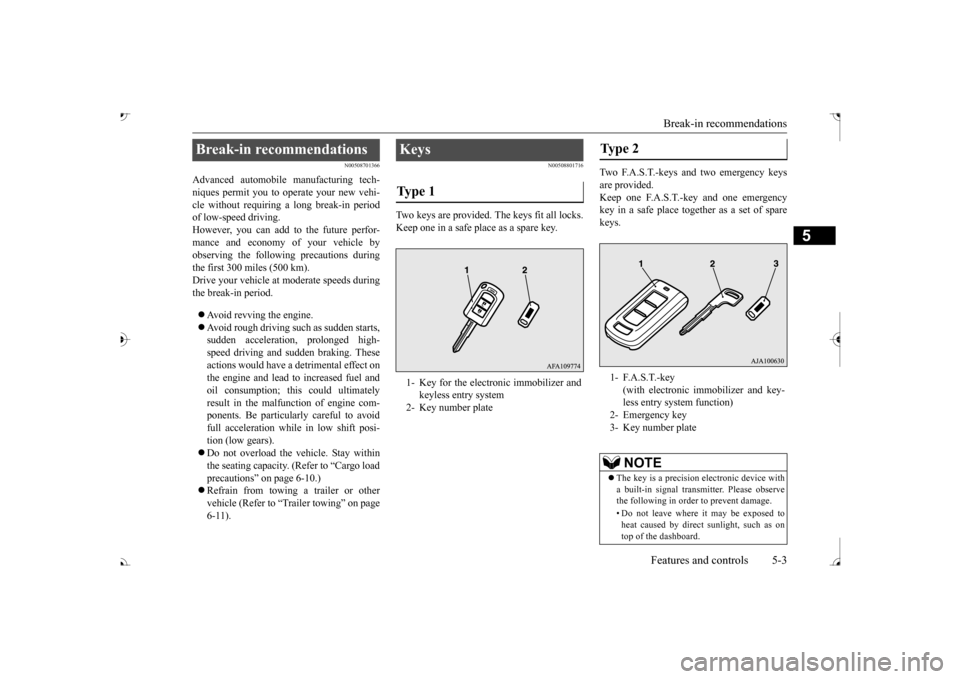
Two keys are provided. The keys fit all locks.Keep one in a safe place as a spare key.
Two F.A.S.T.-keys and two emergency keys are provided. Keep one F.A.S.T.-key and one emergency key in a safe pl
ace together as a set of spare
keys.
Break-in recommendations
Keys Ty p e 1 1- Key for the electronic immobilizer and
keyless entry system
2- Key number plate
Type 2 1- F.A.S.T.-key
(with electronic im
mobilizer and key-
less entry system function)
3- Key number plate
NOTE
The key is a precision
electronic device with
a built-in signal transm
itter. Please observe
the following in order to prevent damage. • Do not leave where it may be exposed to heat caused by direct
sunlight, such as on
top of the dashboard.
BK0239700US.book 3 ページ 2016年6月16日 木曜日 午前10時58分
Page 105 of 521
Free-hand Advanced
Security Transmitter (F.A.S
.T.-key) (if so equipped)
5
N00514301080
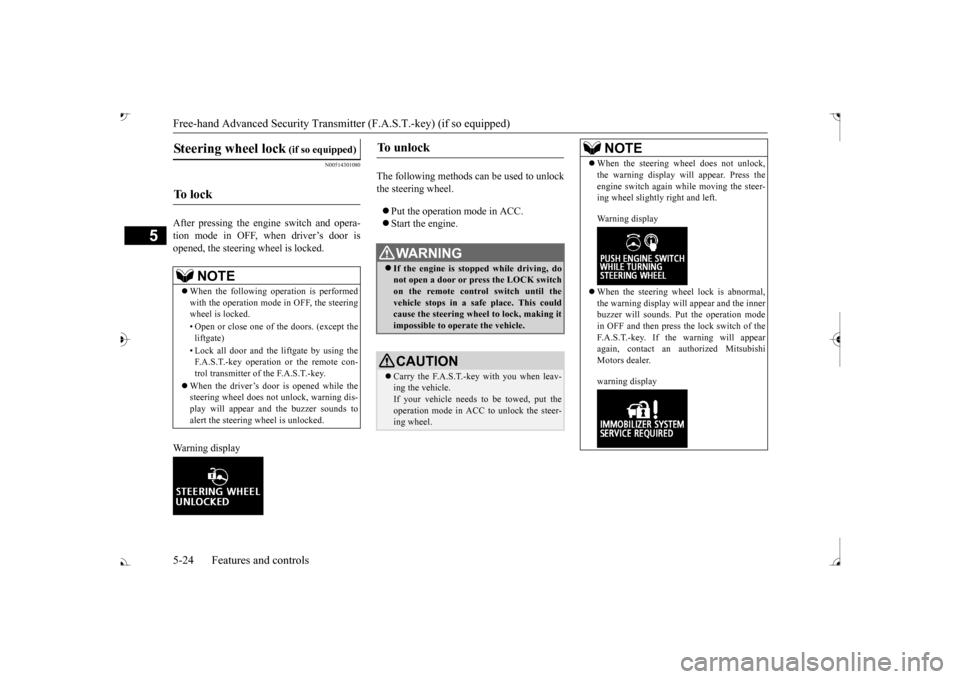
After pressing the e
ngine switch and opera-
tion mode in OFF, when driver’s door isopened, the steering wheel is locked. Warning display
The following methods ca
n be used to unlock
the steering wheel. Put the operation mode in ACC. Start the engine.
Steering wheel lock
(if so equipped)
To l o c k
NOTE
When the following ope
ration is performed
with the operation mode
in OFF, the steering
wheel is locked. • Open or close one of the doors. (except the liftgate) F.A.S.T.-key operation or the remote con- trol transmitter of the F.A.S.T.-key.
When the driver’s door is opened while the steering wheel does not
unlock, warning dis-
play will appear and the buzzer sounds toalert the steering wheel is unlocked.
To u n l o c k
WA R N I N G If the engine is stopped while driving, do not open a door or press the LOCK switch on the remote control switch until the vehicle stops in a safe
place. This could
cause the steering wheel to lock, making it impossible to operate the vehicle.CAUTION Carry the F.A.S.T.-key with you when leav- ing the vehicle.If your vehicle needs to
be towed, put the
operation mode in ACC to unlock the steer- ing wheel.
NOTE
When the steering wheel does not unlock, the warning display wi
ll appear. Press the
engine switch again wh
ile moving the steer-
ing wheel slightly right and left. Warning display When the steering wheel lock is abnormal, the warning display will
appear and the inner
buzzer will sounds. Put the operation mode in OFF and then press the lock switch of theF.A.S.T.-key. If the warning will appear again, contact an authorized Mitsubishi Motors dealer. warning display
BK0239700US.book 24 ページ 2016年6月16日 木曜日 午前10時58分
Page 132 of 521
Sunroof (if so equipped)
Features and controls 5-51
5
N00528801129
If a hand or head is trapped, for safety the door window is automati
cally lowered a little.
After the obstruction is removed, pull up the switch again to close the door window.
N00551400014
Wind buffeting can be described as the per-ception of pressure on the ears or a boomingor rumbling sound. Your vehicle may exhibit wind buffeting when driving with one or both rear door windows down or partially opened.This is a normal occurrence that can be mini- mized. If the buffeting
occurs with the rear
door windows open, open the front door win- dows as well as the rear door windows to minimize the condition.
N00511001682
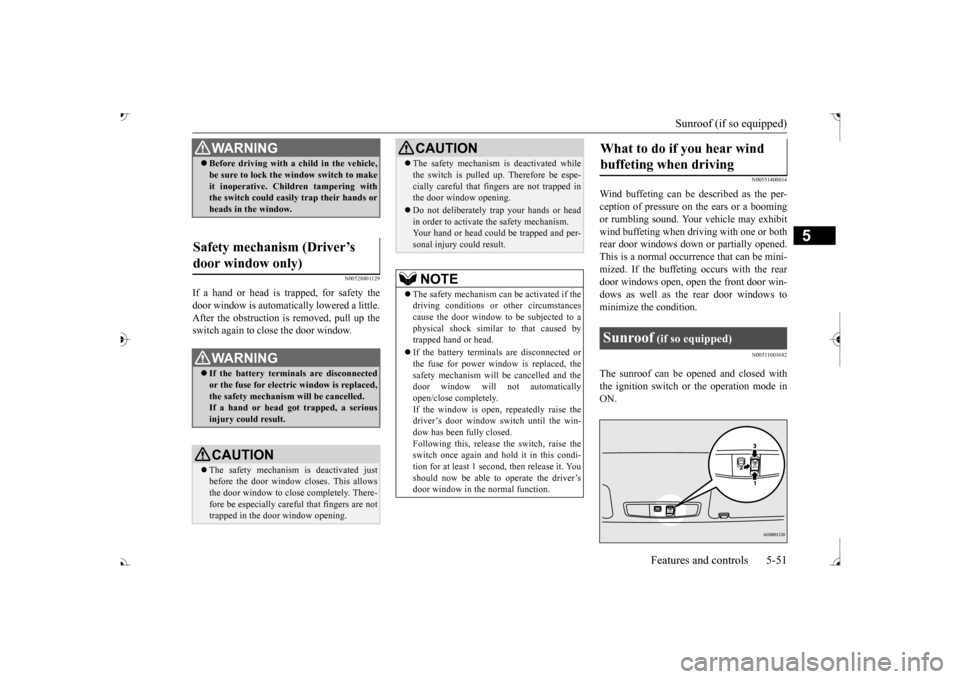
The sunroof can be ope
ned and closed with
the ignition switch or the operation mode in ON.
WA R N I N G Before driving with a child in the vehicle, be sure to lock the window switch to makeit inoperative. Children tampering withthe switch could easily trap their hands or heads in the window.
Safety mechanism (Driver’s door window only)
WA R N I N G If the battery terminals are disconnected or the fuse for electric window is replaced, the safety mechanism will be cancelled.If a hand or head got
trapped, a serious
injury could result.CAUTION The safety mechanism is deactivated just before the door window closes. This allows the door window to close completely. There-fore be especially care
ful that fingers are not
trapped in the door window opening.
The safety mechanism is deactivated while the switch is pulled up.
Therefore be espe-
cially careful that fi
ngers are not trapped in
the door window opening. Do not deliberately trap your hands or head in order to activate the safety mechanism. Your hand or head coul
d be trapped and per-
sonal injury could result.NOTE
The safety mechanism can be activated if the driving conditions or
other circumstances
cause the door window to be subjected to a physical shock similar to that caused by trapped hand or head. If the battery terminals are disconnected or the fuse for power window is replaced, thesafety mechanism will
be cancelled and the
door window will not automatically open/close completely.If the window is open,
repeatedly raise the
driver’s door window switch until the win- dow has been fully closed.Following this, release the switch, raise theswitch once again and hold it in this condi- tion for at least 1 second, then release it. You should now be able to operate the driver’sdoor window in the normal function.CAUTION
What to do if you hear wind buffeting when driving Sunroof
(if so equipped)
BK0239700US.book 51 ページ 2016年6月16日 木曜日 午前10時58分
Page 133 of 521
Sunroof (if so equipped) 5-52 Features and controls
5
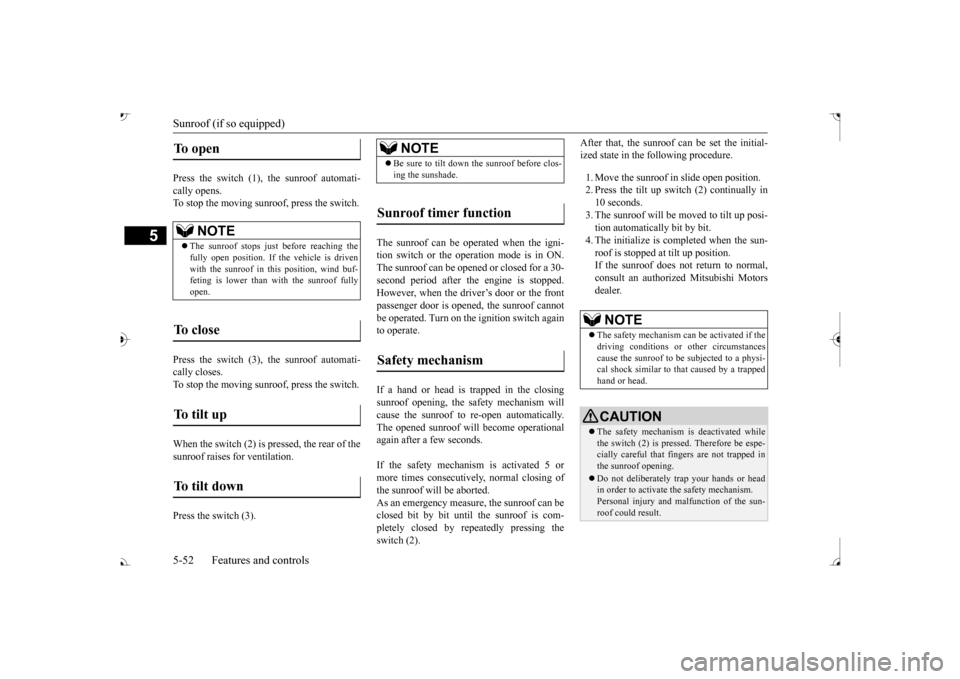
Press the switch (1), the sunroof automati- cally opens. To stop the moving sunroof, press the switch. Press the switch (3), the sunroof automati- cally closes. To stop the moving sunroof, press the switch. When the switch (2) is pressed, the rear of the sunroof raises for ventilation. Press the switch (3).
The sunroof can be operated when the igni- tion switch or the operation mode is in ON.The sunroof can be opened or closed for a 30- second period after th
e engine is stopped.
However, when the driver’s door or the frontpassenger door is opene
d, the sunroof cannot
be operated. Turn on the ignition switch again to operate. If a hand or head is trapped in the closing sunroof opening, the safety mechanism willcause the sunroof to re-open automatically. The opened sunroof will
become operational
again after a few seconds. If the safety mechanism is activated 5 or more times consecutively, normal closing ofthe sunroof will be aborted. As an emergency measure, the sunroof can be closed bit by bit until the sunroof is com-pletely closed by re
peatedly pressing the
switch (2).
After that, the sunroof can be set the initial- ized state in the following procedure. 1. Move the sunroof
in slide open position.
2. Press the tilt up switch (2) continually in 10 seconds. 3. The sunroof will be moved to tilt up posi-tion automatically bit by bit. 4. The initialize is completed when the sun- roof is stopped at tilt up position.If the sunroof does not return to normal, consult an authorized Mitsubishi Motors dealer.
To open
NOTE
The sunroof stops just before reaching the fully open position. If
the vehicle is driven
with the sunroof in this position, wind buf- feting is lower than with the sunroof fullyopen.
To close
To t i l t u p
To t i l t d o w n
NOTE
Be sure to tilt down the sunroof before clos- ing the sunshade.
Sunroof timer function
Safety mechanism
NOTE
The safety mechanism can be activated if the driving conditions or other circumstances cause the sunroof to be
subjected to a physi-
cal shock similar to th
at caused by a trapped
hand or head.CAUTION The safety mechanism is deactivated while the switch (2) is pressed. Therefore be espe- cially careful that fi
ngers are not trapped in
the sunroof opening. Do not deliberately trap your hands or head in order to activate the safety mechanism.Personal injury and malfunction of the sun- roof could result.
BK0239700US.book 52 ページ 2016年6月16日 木曜日 午前10時58分
Page 149 of 521
Automatic transaxle (if so equipped) 5-68 Features and controls
5
Also you can manually shift up and shift down the transaxle. Refer to “Sports mode” The transaxle prevents
unnecessary upshifts
even when the accelerator pedal is released and ensures smooth driving. According to the condi
tions, the transaxle
will automatically shift to a lower gear toachieve stronger engine braking. This may help reduce your need to use the service brake.
N00513801424
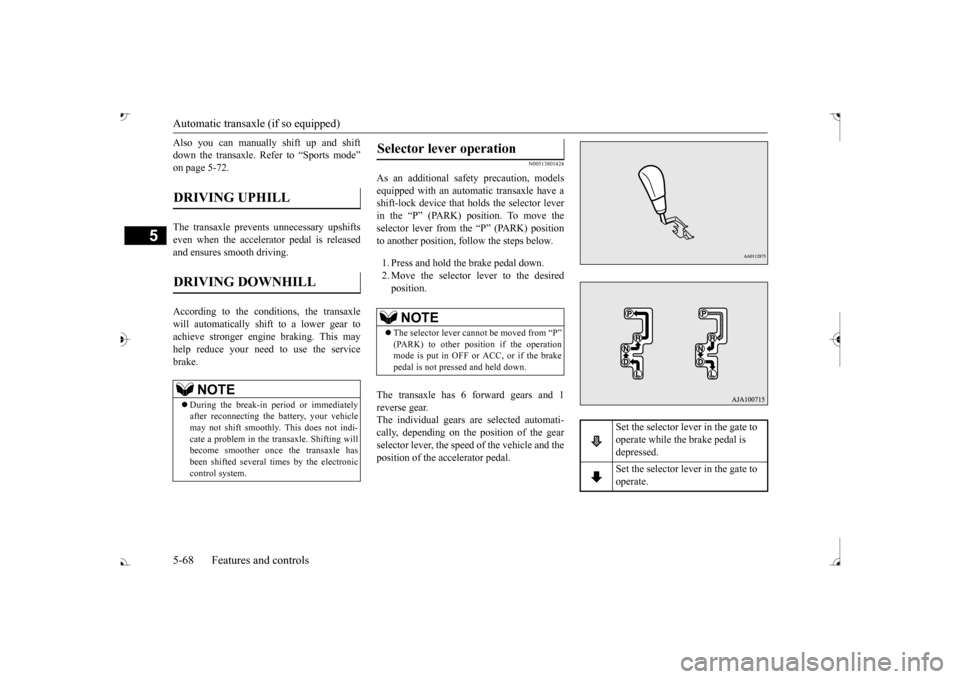
As an additional safe
ty precaution, models
equipped with an automatic transaxle have a shift-lock device that holds the selector leverin the “P” (PARK) position. To move the selector lever from the “P” (PARK) position to another position, follow the steps below. 1. Press and hold the brake pedal down. 2. Move the selector lever to the desired position.
The transaxle has 6 forward gears and 1 reverse gear.The individual gears are selected automati- cally, depending on the position of the gear selector lever, the speed of the vehicle and theposition of the accelerator pedal.
DRIVING UPHILL
DRIVING DOWNHILL
NOTE
During the break-in pe
riod or immediately
after reconnecting the
battery, your vehicle
may not shift smoothly. This does not indi-cate a problem in the transaxle. Shifting will become smoother once the transaxle has been shifted several
times by the electronic
control system.
Selector lever operation
NOTE
The selector lever cannot
be moved from “P”
mode is put in OFF or ACC, or if the brakepedal is not pressed and held down.
Set the selector lever in the gate to operate while the brake pedal is depressed. Set the selector lever in the gate to operate.
BK0239700US.book 68 ページ 2016年6月16日 木曜日 午前10時58分
Page 151 of 521
Automatic transaxle (if so equipped) 5-70 Features and controls
5
N00513901441
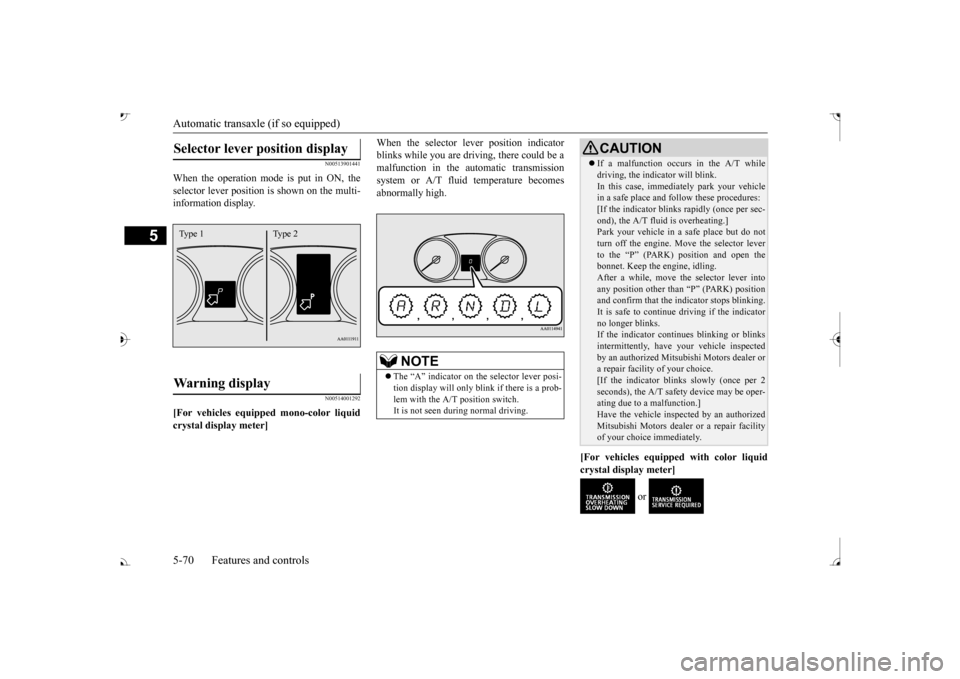
When the operation mode is put in ON, the selector lever position
is shown on the multi-
information display.
N00514001292
[For vehicles equipped mono-color liquid crystal display meter]
When the selector le
ver position indicator
blinks while you are driv
ing, there could be a
malfunction in the automatic transmission system or A/T fluid temperature becomes abnormally high.
[For vehicles equipped with color liquid crystal display meter]
or
Selector lever position display
Warning display
Type 1 Type 2
NOTE
The “A” indicator on the selector lever posi- tion display will only blink if there is a prob- lem with the A/T position switch.It is not seen during normal driving.
CAUTION If a malfunction occurs in the A/T while driving, the indicator will blink.In this case, immediat
ely park your vehicle
in a safe place and fo
llow these procedures:
[If the indicator blinks
rapidly (once per sec-
ond), the A/T fluid is overheating.]Park your vehicle in a safe place but do not turn off the engine. M
ove the selector lever
to the “P” (PARK) position and open thebonnet. Keep the engine, idling. After a while, move the selector lever into any position other than “P” (PARK) positionand confirm that the i
ndicator stops blinking.
It is safe to continue driving if the indicator no longer blinks.If the indicator conti
nues blinking or blinks
intermittently, have
your vehicle inspected
by an authorized Mitsubishi Motors dealer ora repair facility of your choice. [If the indicator blinks slowly (once per 2 seconds), the A/T safety
device may be oper-
ating due to a malfunction.] Have the vehicle inspected by an authorized Mitsubishi Motors dealer
or a repair facility
of your choice immediately.
BK0239700US.book 70 ページ 2016年6月16日 木曜日 午前10時58分
Page 152 of 521
Automatic transaxle (if so equipped)
Features and controls 5-71
5
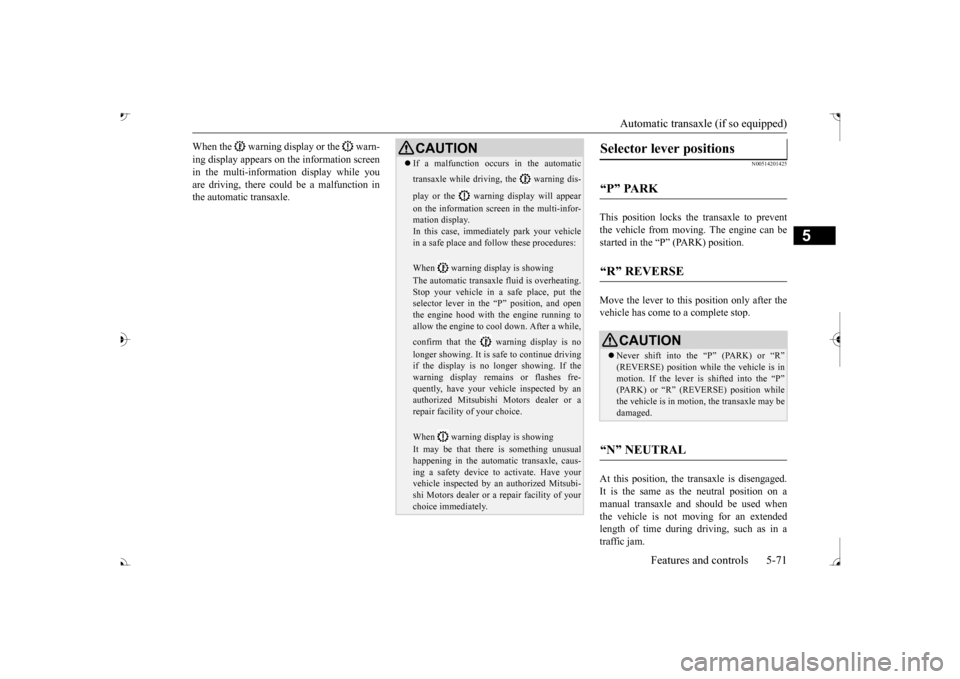
When the warning display or the warn- ing display appears on
the information screen
in the multi-information display while you are driving, there could be a malfunction in the automatic transaxle.
N00514201425
This position locks the transaxle to prevent the vehicle from moving.
The engine can be
started in the “P” (PARK) position. Move the lever to this position only after the vehicle has come to a complete stop. At this position, the
transaxle is disengaged.
It is the same as th
e neutral position on a
manual transaxle and should be used when the vehicle is not moving for an extended length of time during driving, such as in atraffic jam.
CAUTION If a malfunction occurs in the automatic transaxle while driving, the warning dis- play or the warni
ng display will appear
on the information screen in the multi-infor- mation display. In this case, immediat
ely park your vehicle
in a safe place and fo
llow these procedures:
When warning display is showing The automatic transaxle fluid is overheating. Stop your vehicle in a
safe place, put the
selector lever in the
“P” position, and open
the engine hood with the engine running to allow the engine to c
ool down. After a while,
confirm that the warning display is no longer showing. It is safe to continue driving if the display is no longer showing. If thewarning display rema
ins or flashes fre-
quently, have your vehicle inspected by an authorized Mitsubishi
Motors dealer or a
repair facility
of your choice.
When warning display is showing It may be that there is something unusual happening in the automa
tic transaxle, caus-
ing a safety device to
activate. Have your
vehicle inspected by an
authorized Mitsubi-
shi Motors dealer or a
repair facility of your
choice immediately.
Selector lever positions
“P” PARK
“R” REVERSE
CAUTION Never shift into the “P” (PARK) or “R” motion. If the lever is shifted into the “P”the vehicle is in moti
on, the transaxle may be
damaged.
“N” NEUTRAL
BK0239700US.book 71 ページ 2016年6月16日 木曜日 午前10時58分
Page 156 of 521
Continuously variable transmission (CVT) (if so equipped)
Features and controls 5-75
5
and then move the sele
ctor lever to the “P”
(PARK) position. If the transaxle does not change gears while driving, or your vehicle does not pick up enough speed when starting on an uphillslope, it may be that there is something unusual happening in the
transaxle, causing a
safety device to activa
te. Have your vehicle
checked at an authorized Mitsubishi Motors dealer or a repair facility of your choiceimmediately.
N00560201060
The CVT will automati
cally and continuously
change its gear ratio depending on road anddriving conditions. This helps achieve smooth driving and excellent fuel efficiency. If your vehicle is equipped with the spor- tronic steering wheel paddle shifter, you can manually shift up and shift down the trans-mission. Refer to “Sports mode” on page 5-80. The transmission prevents unnecessary upshifts even when the accelerator pedal is released and ensures smooth driving. According to the condi
tions, the transmission
will automatically shift to a lower gear ratioto achieve stronger engine braking. This may help reduce your need
to use the service
brake.
N00560301090
As an additional safe
ty precaution, models
equipped with a continuously variable trans- mission have a shift-lock device that holdsthe selector lever in the “P” (PARK) position. To move the selector lever from the “P”the steps below. 1. Press and hold the brake pedal down. 2. Move the selector lever to the desiredposition.
The CVT selects an optimum ratio automati- cally when the selector lever is in the “D”
nding on the speed of
the vehicle and the positi
on of the accelerator
pedal.
When the automatic transaxle makes no gear change
NOTE
When the warning display and “SLOW DOWN” or the warning display and “SERVICE REQUIRED” appear on the information screen in
the multi-information
display, there could be
a malfunction in the
automatic transaxle. Refer to “Automatic transaxle: Warning di
splay” on page 5-70.
Continuously variable transmission (CVT)
(if so
equipped)
DRIVING DOWNHILL
Selector lever operation
NOTE
The selector lever cannot
be moved from “P”
switch is set to the “OFF” or “LOCK” or“ACC” position, or if the key has been removed, or the opera
tion mode is put in
OFF or ACC, or if the brake pedal is notpressed and held down.
BK0239700US.book 75 ページ 2016年6月16日 木曜日 午前10時58分
Page 159 of 521
![MITSUBISHI OUTLANDER 2017 3.G User Guide Continuously variable transmission (CVT) (if so equipped) 5-78 Features and controls
5
N00560501089
[For vehicles equipped mono-color liquid crystal display meter]When the selector le
ver position in](/img/19/7536/w960_7536-158.png "MITSUBISHI OUTLANDER 2017 3.G User Guide Continuously variable transmission (CVT) (if so equipped) 5-78 Features and controls
5
N00560501089
[For vehicles equipped mono-color liquid crystal display meter]When the selector le
ver position in")
Continuously variable transmission (CVT) (if so equipped) 5-78 Features and controls
5
N00560501089
[For vehicles equipped mono-color liquid crystal display meter]When the selector le
ver position indicator
blinks while you are driving, there could be a malfunction in the automatic transmissionsystem or CVT fluid temperature becomes abnormally high.
[For vehicles equipped with color liquid crystal display meter]
or
When the warning display or the warn- ing display appears on the information screen in the multi-information display while you are driving, there could be a malfunction in the CVT.
NOTE
While the selector le
ver position display is
blinking, a buzzer will
sound intermittently.
Warning display
NOTE
The “A” indicator on th
e selector lever posi-
tion display will only blink if there is a prob-lem with the CVT position switch. It is not seen during normal driving.
CAUTION If a malfunction occurs in the CVT while driving, the indicator will blink.In this case, immediat
ely park your vehicle
in a safe place and follow these procedures: [If the indicator blinks
rapidly (once per sec-
ond), the CVT fluid is overheating.]Park your vehicle in
a safe place but do not
turn off the engine. M
ove the selector lever
to the
Page 160 of 521
Continuously variable transmission (CVT) (if so equipped)
Features and controls 5-79
5
N00560601107
This position locks the transmission to pre- vent the vehicle from m
oving. The engine can
be started in the “P” (PARK) position. Move the lever to this position only after the vehicle has come to a complete stop.
At this position, the transmission is disen- gaged. It is the same
as the neutral position on
a manual transaxle and should be used whenthe vehicle is not m
oving for an extended
length of time during driving, such as in a traffic jam.
This position is used fo
r most city and high-
way driving. The transmission will automati- cally and continuously ch
ange its gear ratio
depending on road and driving conditions. Use when engine braking is needed, or for high-power sport drive.
After a while, confirm that the warning display is no longer show
ing. It is safe to
continue driving if the display is no longer showing. If the warn
ing display remains or
flashes frequently,
have your vehicle
inspected by an authorized Mitsubishi Motors dealer or a repair facility of your choice. [When warning di
splay is showing]
It may be that ther
e is something unusual
happening in the CVT, causing a safety device to activate
. Have your vehicle
inspected by an authorized MitsubishiMotors dealer or a repair facility of your choice immediately.
Selector lever positions
“P” PARK
“R” REVERSE
CAUTION
CAUTION Never shift into the “P” (PARK) or “R”motion. If the lever is shifted into the “P” the vehicle is in motion, the transmission may be damaged.
“N” NEUTRAL
WA R N I N G Never move the selector lever to the “N” you could accidentally slip it into the “P” damaging the transmission. To prevent the vehicle from rolling when stopped on a slope,
the engine should be
started in the “P” (PARK) position, not in “N” (NEUTRAL) position.
To prevent rolling, always keep your foot on the brake pedal when the vehicle is in“N” (NEUTRAL) positi
on, or when shift-
ing into or out of